Top Teams
How Top Teams Can Absorb Ambiguity and
Lead Their Organizations to Success
2
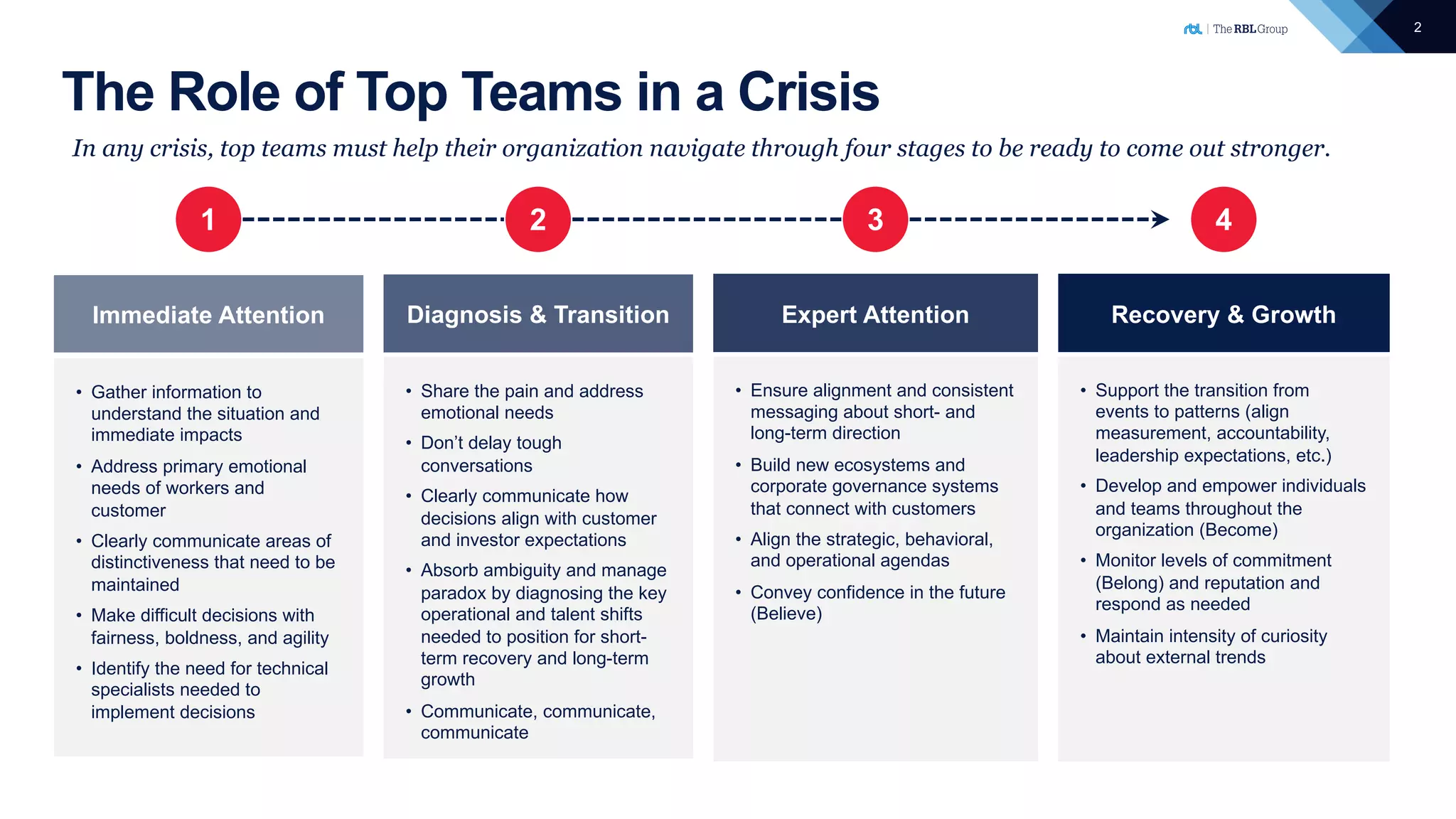
The Role of Top Teams in a Crisis
In any crisis, top teams must help their organization navigate through four stages to be ready to come out stronger.
Diagnosis & Transition
• Share the pain and address
emotional needs
• Don’t delay tough
conversations
• Clearly communicate how
decisions align with customer
and investor expectations
• Absorb ambiguity and manage
paradox by diagnosing the key
operational and talent shifts
needed to position for short-
term recovery and long-term
growth
• Communicate, communicate,
communicate
Expert Attention
• Ensure alignment and consistent
messaging about short- and
long-term direction
• Build new ecosystems and
corporate governance systems
that connect with customers
• Align the strategic, behavioral,
and operational agendas
• Convey confidence in the future
(Believe)
Recovery & Growth
• Support the transition from
events to patterns (align
measurement, accountability,
leadership expectations, etc.)
• Develop and empower individuals
and teams throughout the
organization (Become)
• Monitor levels of commitment
(Belong) and reputation and
respond as needed
• Maintain intensity of curiosity
about external trends
Immediate Attention
• Gather information to
understand the situation and
immediate impacts
• Address primary emotional
needs of workers and
customer
• Clearly communicate areas of
distinctiveness that need to be
maintained
• Make difficult decisions with
fairness, boldness, and agility
• Identify the need for technical
specialists needed to
implement decisions
1 2 3 4
3
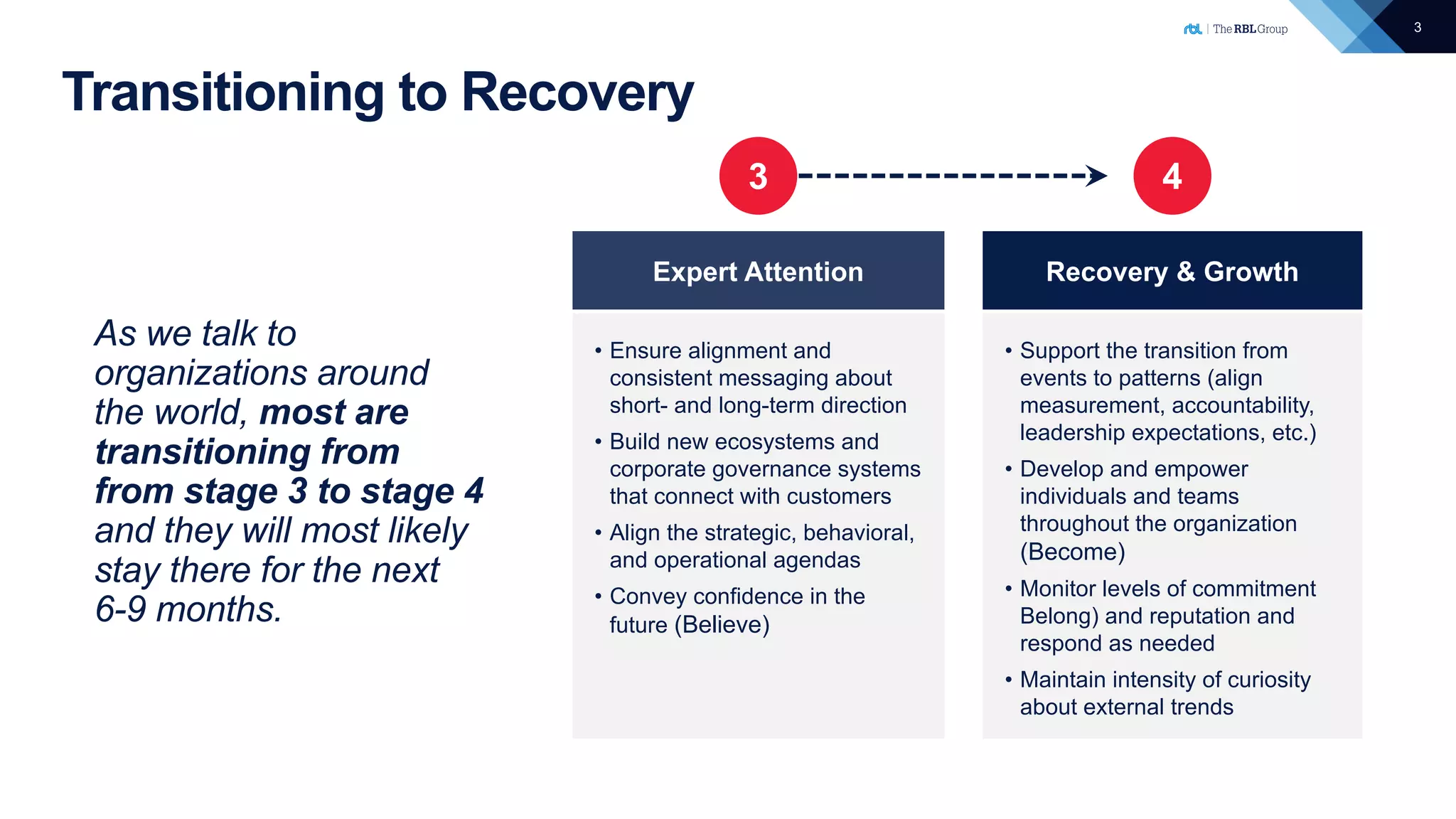
As we talk to
organizations around
the world, most are
transitioning from
from stage 3 to stage 4
and they will most likely
stay there for the next
6-9 months.
Expert Attention
• Ensure alignment and
consistent messaging about
short- and long-term direction
• Build new ecosystems and
corporate governance systems
that connect with customers
• Align the strategic, behavioral,
and operational agendas
• Convey confidence in the
future (Believe)
Recovery & Growth
• Support the transition from
events to patterns (align
measurement, accountability,
leadership expectations, etc.)
• Develop and empower
individuals and teams
throughout the organization
(Become)
• Monitor levels of commitment
Belong) and reputation and
respond as needed
• Maintain intensity of curiosity
about external trends
3 4
Transitioning to Recovery
4
CULTURE
Strategic
Agenda
Behavioral
Agenda
Operational
Agenda
To successfully transition organizations to recovery and growth,
Top Teams need to clearly define and align the strategic,
behavioral, and operational agendas.
What are our cultural
differentiators?
What behaviors do
we reward?
Structure, processes,
systems that facilitate
critical work.
Where we play and
how we win (customers,
products/services).
5
The strategic agenda clearly defines where the business will play
and how you will win in a changed (and changing) landscape.
• Scan the environment, evaluate options,
• Identify critical paradoxes and sources of
ambiguity, debate and seek alignment
• Set a clear direction / (Re)define the direction
of growth and customer value proposition
• Convey confidence in the future. Share a
compelling story with all stakeholders.
Strategic Agenda
Strategic
Agenda
CULTURE
6
Top Teams must then translate the strategic agenda into clear
expectations for employees at all levels by defining and
institutionalizing the “new” behavioral agenda…
• Define the behaviors needed by employees
and leaders for the customer value
proposition to be real to customers
• Identify and invest skill & behavior gaps that
impact customer experience (directly or
indirectly)
• Support the transition from events to patterns
by sponsoring new routines
• Monitor levels of commitment and reputation
Behavioral Agenda
Behavioral
Agenda
CULTURE
7
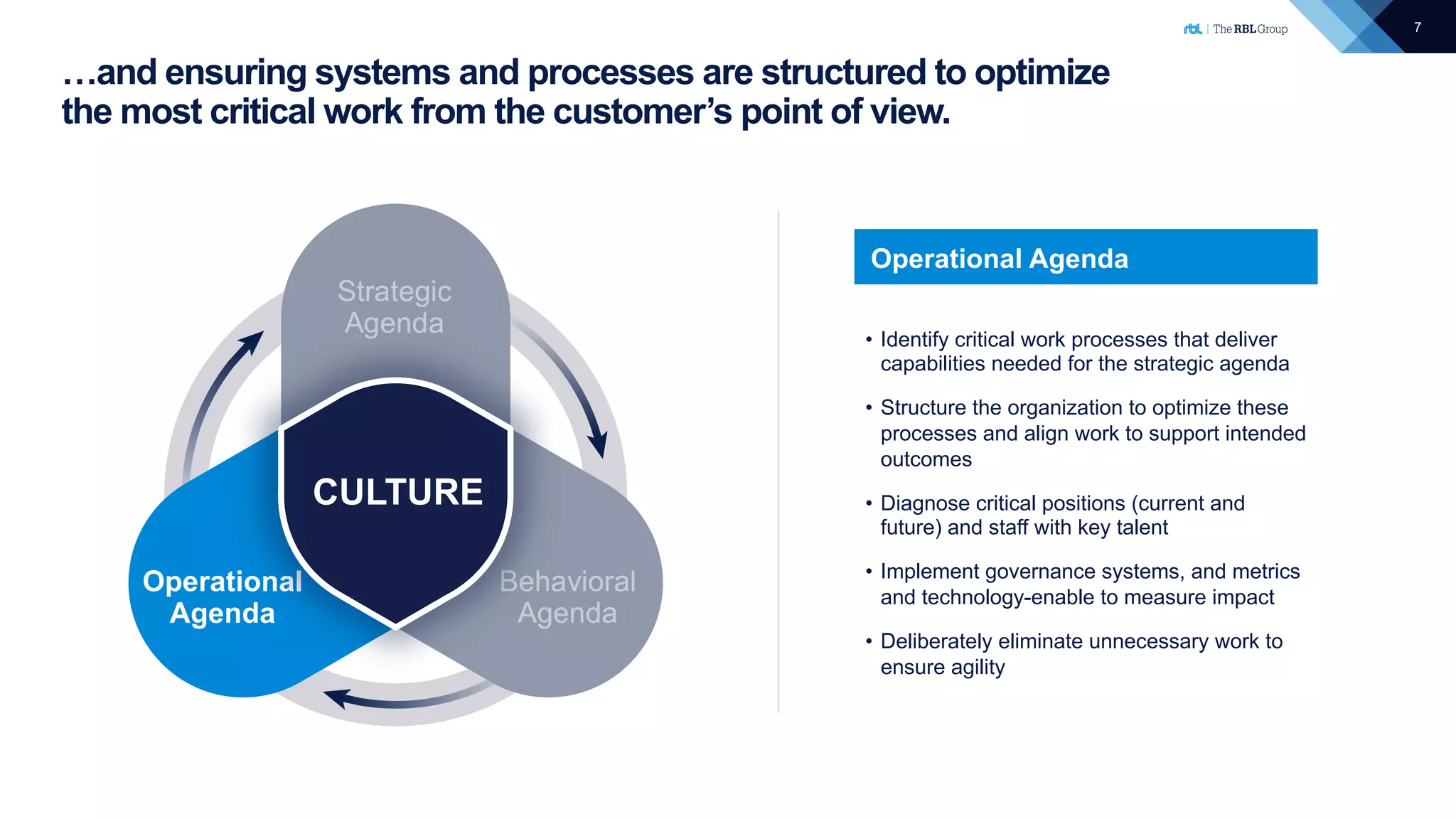
…and ensuring systems and processes are structured to optimize
the most critical work from the customer’s point of view.
• Identify critical work processes that deliver
capabilities needed for the strategic agenda
• Structure the organization to optimize these
processes and align work to support intended
outcomes
• Diagnose critical positions (current and
future) and staff with key talent
• Implement governance systems, and metrics
and technology-enable to measure impact
• Deliberately eliminate unnecessary work to
ensure agility
Operational Agenda
Operational
Agenda
CULTURE
8
Top Team Performance Impacts the Top and Bottom-Line
Cost reductions of $190M in 2
years while stock price doubled
and recognized as a top
employer.
Read more
As RBL has helped top teams improve their ability to connect the strategic, behavioral, and operational
agendas, they have seen compelling results.
Examples Include:
Reduced operating costs of
$100M/year while stock price
rose 71% and outperformed the
FTSE by a factor of 2.
Read more
Increased profit by over $1
billion dollars.
Read more
Improved sales per location by
28%.
Read more
Exceeded JV economy of scale
targets by 60% and created a
highly-engaged culture.
Read more
9
In addition to our work helping top
teams transition to growth, RBL has
deep experience working with teams
at all levels. The offerings to the right
represent just some of the team
interventions RBL has used to help
organizations deliver better results.
Other Results-Based Teams Solutions
The RBT Workshop: Ensuring Functional Team Articulation
Result-Based Teams: Basics and Fundamentals
Goal Setting and Measuring Results: Defining the ROI of Teams
Team Problem Solving: Facilitating Group Decisions
Team Roles and Responsibilities
Leading Virtual Teams
Result Based Meetings: Having Effective Team Meetings
Managing Team Performance and Continuous Improvement
Planning for Action: Selecting Team Members and Creating a Team Charter
Managing Team Conflict: Facilitating Team Interactions
Results-Based Teams =
We can help.
Contact Us Download Slides

Top Teams

  • 1.
    Top Teams How TopTeams Can Absorb Ambiguity and Lead Their Organizations to Success
  • 2.
    2 The Role ofTop Teams in a Crisis In any crisis, top teams must help their organization navigate through four stages to be ready to come out stronger. Diagnosis & Transition • Share the pain and address emotional needs • Don’t delay tough conversations • Clearly communicate how decisions align with customer and investor expectations • Absorb ambiguity and manage paradox by diagnosing the key operational and talent shifts needed to position for short- term recovery and long-term growth • Communicate, communicate, communicate Expert Attention • Ensure alignment and consistent messaging about short- and long-term direction • Build new ecosystems and corporate governance systems that connect with customers • Align the strategic, behavioral, and operational agendas • Convey confidence in the future (Believe) Recovery & Growth • Support the transition from events to patterns (align measurement, accountability, leadership expectations, etc.) • Develop and empower individuals and teams throughout the organization (Become) • Monitor levels of commitment (Belong) and reputation and respond as needed • Maintain intensity of curiosity about external trends Immediate Attention • Gather information to understand the situation and immediate impacts • Address primary emotional needs of workers and customer • Clearly communicate areas of distinctiveness that need to be maintained • Make difficult decisions with fairness, boldness, and agility • Identify the need for technical specialists needed to implement decisions 1 2 3 4
  • 3.
    3 As we talkto organizations around the world, most are transitioning from from stage 3 to stage 4 and they will most likely stay there for the next 6-9 months. Expert Attention • Ensure alignment and consistent messaging about short- and long-term direction • Build new ecosystems and corporate governance systems that connect with customers • Align the strategic, behavioral, and operational agendas • Convey confidence in the future (Believe) Recovery & Growth • Support the transition from events to patterns (align measurement, accountability, leadership expectations, etc.) • Develop and empower individuals and teams throughout the organization (Become) • Monitor levels of commitment Belong) and reputation and respond as needed • Maintain intensity of curiosity about external trends 3 4 Transitioning to Recovery
  • 4.
    4 CULTURE Strategic Agenda Behavioral Agenda Operational Agenda To successfully transitionorganizations to recovery and growth, Top Teams need to clearly define and align the strategic, behavioral, and operational agendas. What are our cultural differentiators? What behaviors do we reward? Structure, processes, systems that facilitate critical work. Where we play and how we win (customers, products/services).
  • 5.
    5 The strategic agendaclearly defines where the business will play and how you will win in a changed (and changing) landscape. • Scan the environment, evaluate options, • Identify critical paradoxes and sources of ambiguity, debate and seek alignment • Set a clear direction / (Re)define the direction of growth and customer value proposition • Convey confidence in the future. Share a compelling story with all stakeholders. Strategic Agenda Strategic Agenda CULTURE
  • 6.
    6 Top Teams mustthen translate the strategic agenda into clear expectations for employees at all levels by defining and institutionalizing the “new” behavioral agenda… • Define the behaviors needed by employees and leaders for the customer value proposition to be real to customers • Identify and invest skill & behavior gaps that impact customer experience (directly or indirectly) • Support the transition from events to patterns by sponsoring new routines • Monitor levels of commitment and reputation Behavioral Agenda Behavioral Agenda CULTURE
  • 7.
    7 …and ensuring systemsand processes are structured to optimize the most critical work from the customer’s point of view. • Identify critical work processes that deliver capabilities needed for the strategic agenda • Structure the organization to optimize these processes and align work to support intended outcomes • Diagnose critical positions (current and future) and staff with key talent • Implement governance systems, and metrics and technology-enable to measure impact • Deliberately eliminate unnecessary work to ensure agility Operational Agenda Operational Agenda CULTURE
  • 8.
    8 Top Team PerformanceImpacts the Top and Bottom-Line Cost reductions of $190M in 2 years while stock price doubled and recognized as a top employer. Read more As RBL has helped top teams improve their ability to connect the strategic, behavioral, and operational agendas, they have seen compelling results. Examples Include: Reduced operating costs of $100M/year while stock price rose 71% and outperformed the FTSE by a factor of 2. Read more Increased profit by over $1 billion dollars. Read more Improved sales per location by 28%. Read more Exceeded JV economy of scale targets by 60% and created a highly-engaged culture. Read more
  • 9.
    9 In addition toour work helping top teams transition to growth, RBL has deep experience working with teams at all levels. The offerings to the right represent just some of the team interventions RBL has used to help organizations deliver better results. Other Results-Based Teams Solutions The RBT Workshop: Ensuring Functional Team Articulation Result-Based Teams: Basics and Fundamentals Goal Setting and Measuring Results: Defining the ROI of Teams Team Problem Solving: Facilitating Group Decisions Team Roles and Responsibilities Leading Virtual Teams Result Based Meetings: Having Effective Team Meetings Managing Team Performance and Continuous Improvement Planning for Action: Selecting Team Members and Creating a Team Charter Managing Team Conflict: Facilitating Team Interactions Results-Based Teams =
  • 10.
    We can help. ContactUs Download Slides