Stanley Labovitz [email_address] 1-866-616-5552
Engagement / Alignment?? What is it & Why Should we care…….. Defined : Employee engagement is a combination of perceptions—including satisfaction, commitment, pride, loyalty, a sense of individual purpose and willingness to be an advocate for the organization — to go beyond normal expectations, displaying personal initiative, effort and persistence, that is directed toward organizational goals.”
Engagement / Alignment?? What is it & Why Should we care…….. Defined : Employee engagement is a combination of perceptions—including satisfaction,  commitment , pride,  loyalty , a sense of individual purpose and  willingness  to be an  advocate  for the organization —  to go beyond normal expectations , displaying  personal initiative , effort and persistence, that is  directed toward organizational goals .”
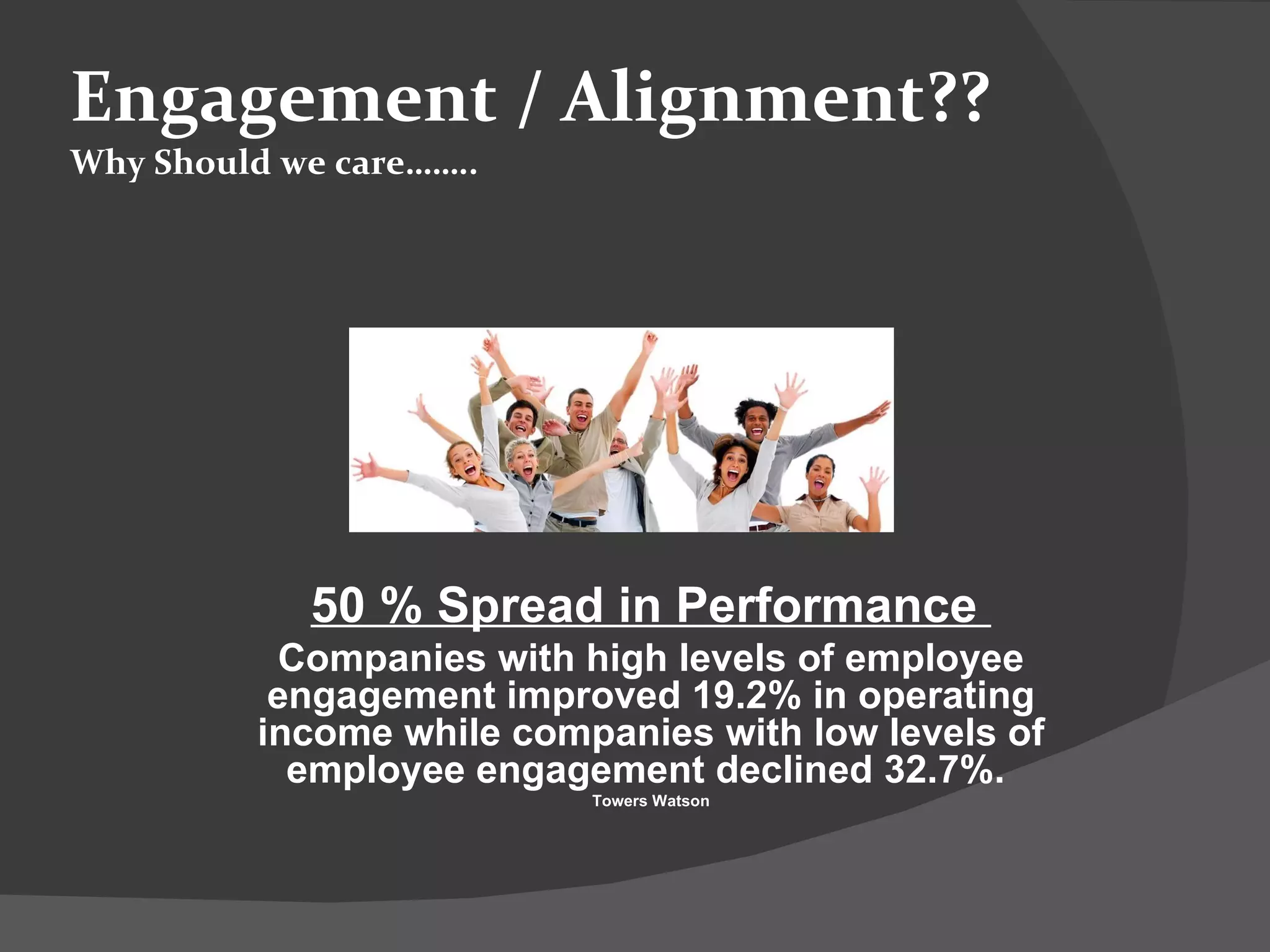
Engagement / Alignment?? Why Should we care…….. 50 % Spread in Performance  Companies with high levels of employee engagement improved 19.2% in operating income while companies with low levels of employee engagement declined 32.7%.  Towers Watson
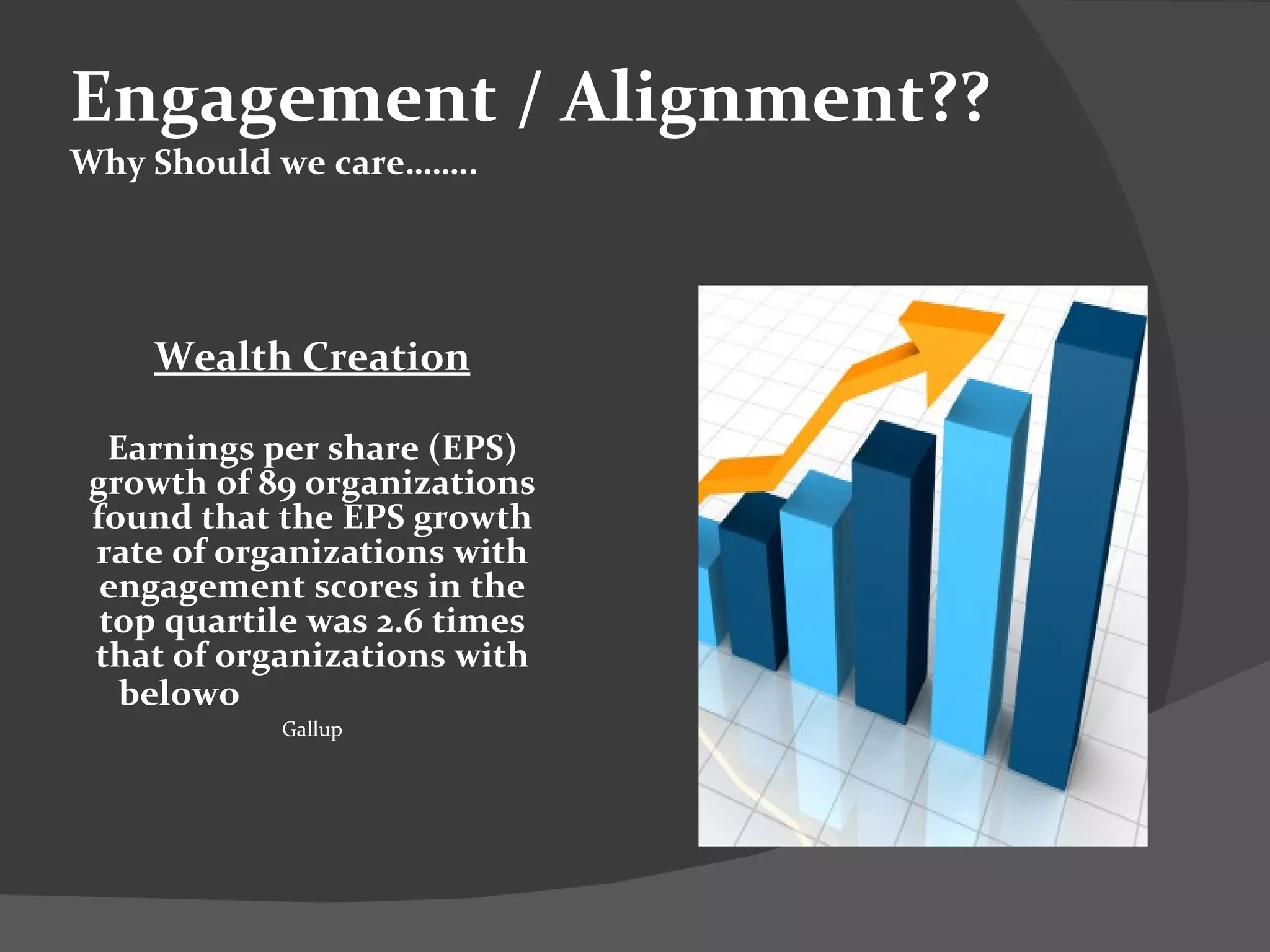
Wealth Creation Earnings per share (EPS) growth of 89 organizations found that the EPS growth rate of organizations with engagement scores in the top quartile was 2.6 times that of organizations with below average scores.   Gallup Engagement / Alignment?? Why Should we care……..
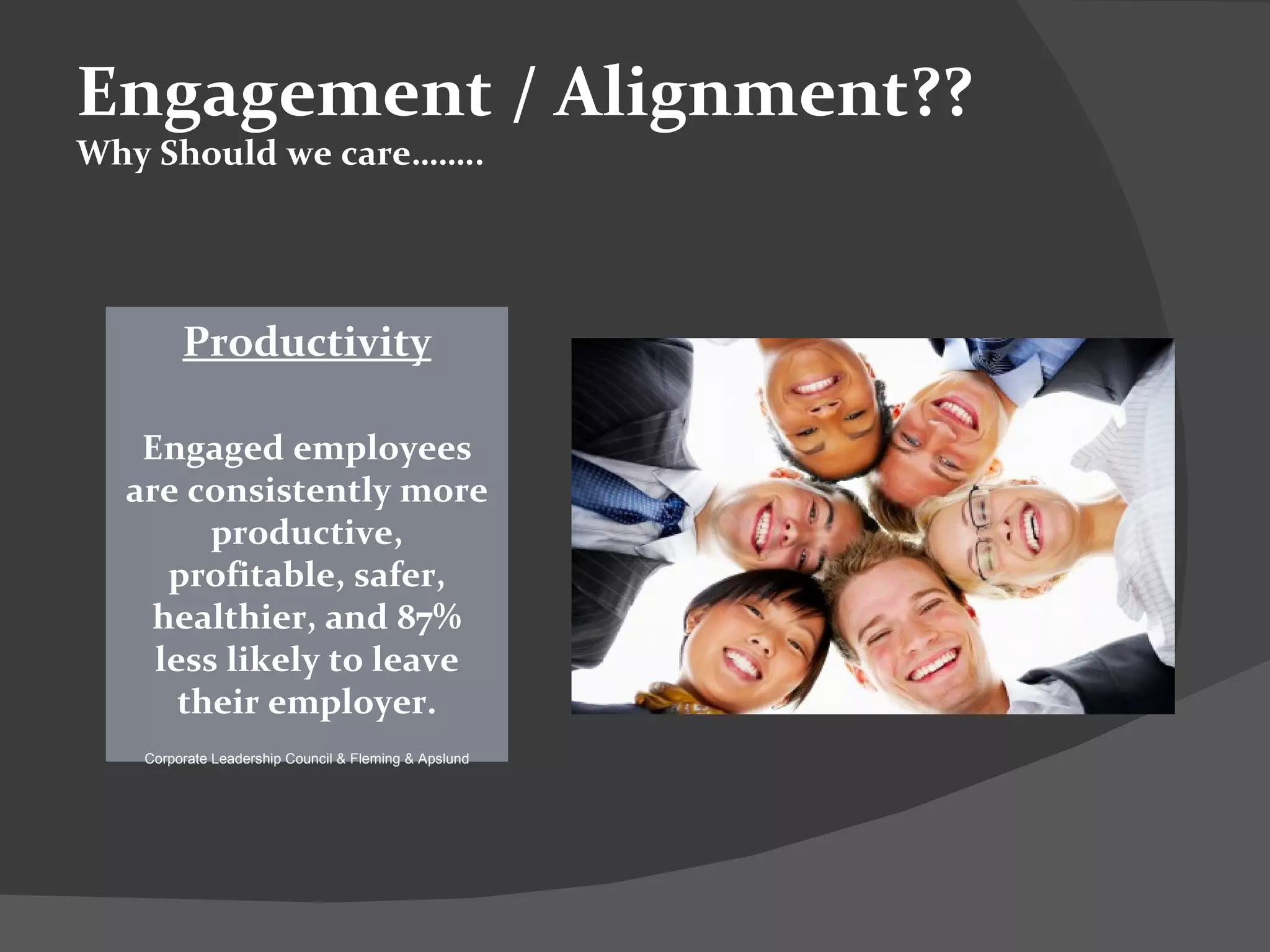
Productivity Engaged employees are consistently more productive, profitable, safer, healthier, and 87% less likely to leave their employer. Corporate Leadership Council & Fleming & Apslund Engagement / Alignment?? Why Should we care……..
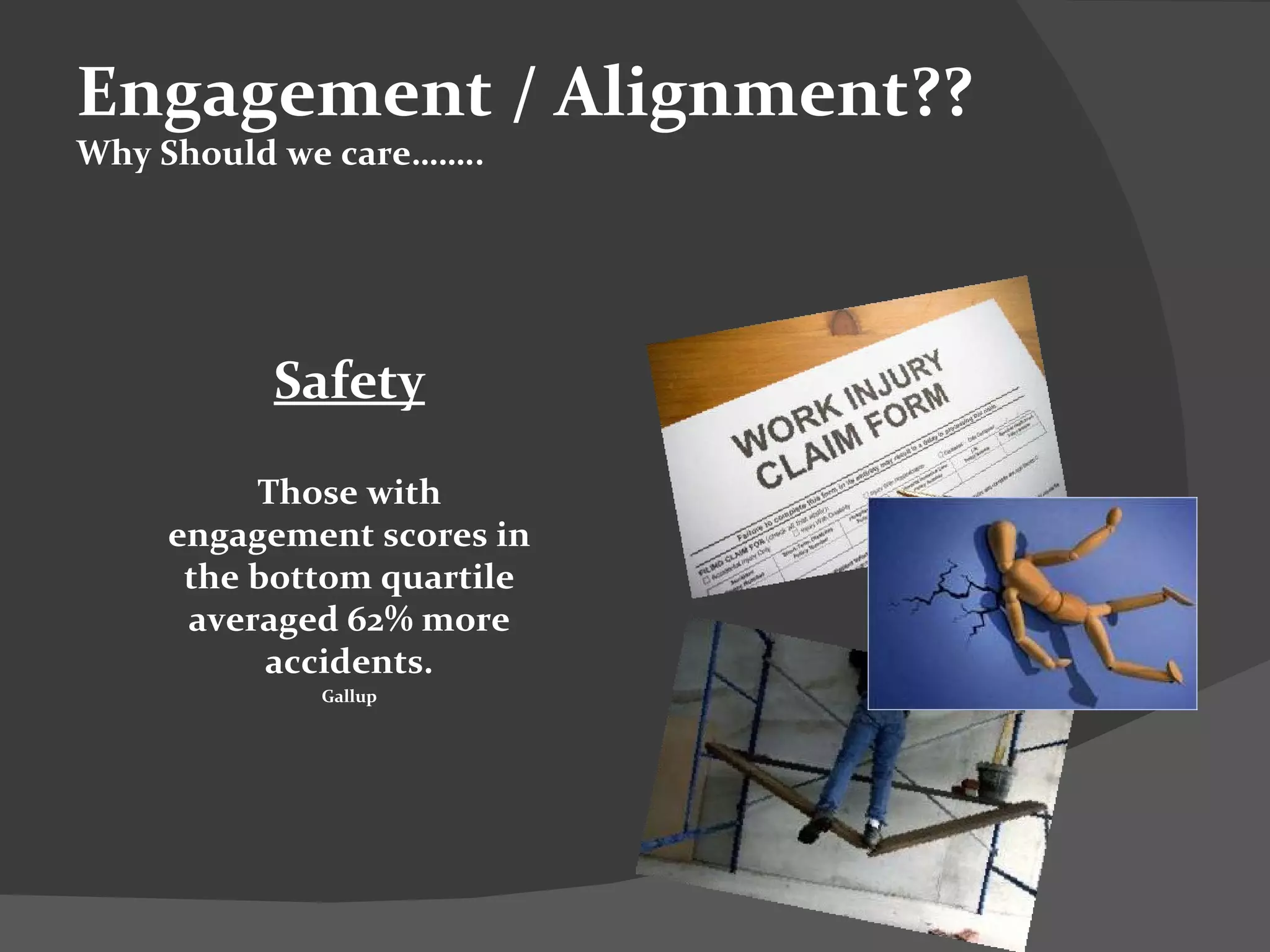
Safety Those with engagement scores in the bottom quartile averaged 62% more accidents. Gallup Engagement / Alignment?? Why Should we care……..
Engagement / Alignment?? ~ Myths to Debunk The Drivers are the Same across all Organizations Engagement Drivers are the Same as Business Drivers Employee Engagement should be ‘Maximized’ McBassi & Co
Engagement / Alignment?? ~ Myths to Debunk The Drivers are the Same across all Organizations  ~  They need to be set within the context of your “Main Thing” Engagement Drivers are the Same as Business Drivers  ~  They are very different from Business Drivers and need be integrated Employee Engagement should be ‘Maximized’  ~  Engagement bears costs and needs to be targeted & optimized to your needs McBassi & Co
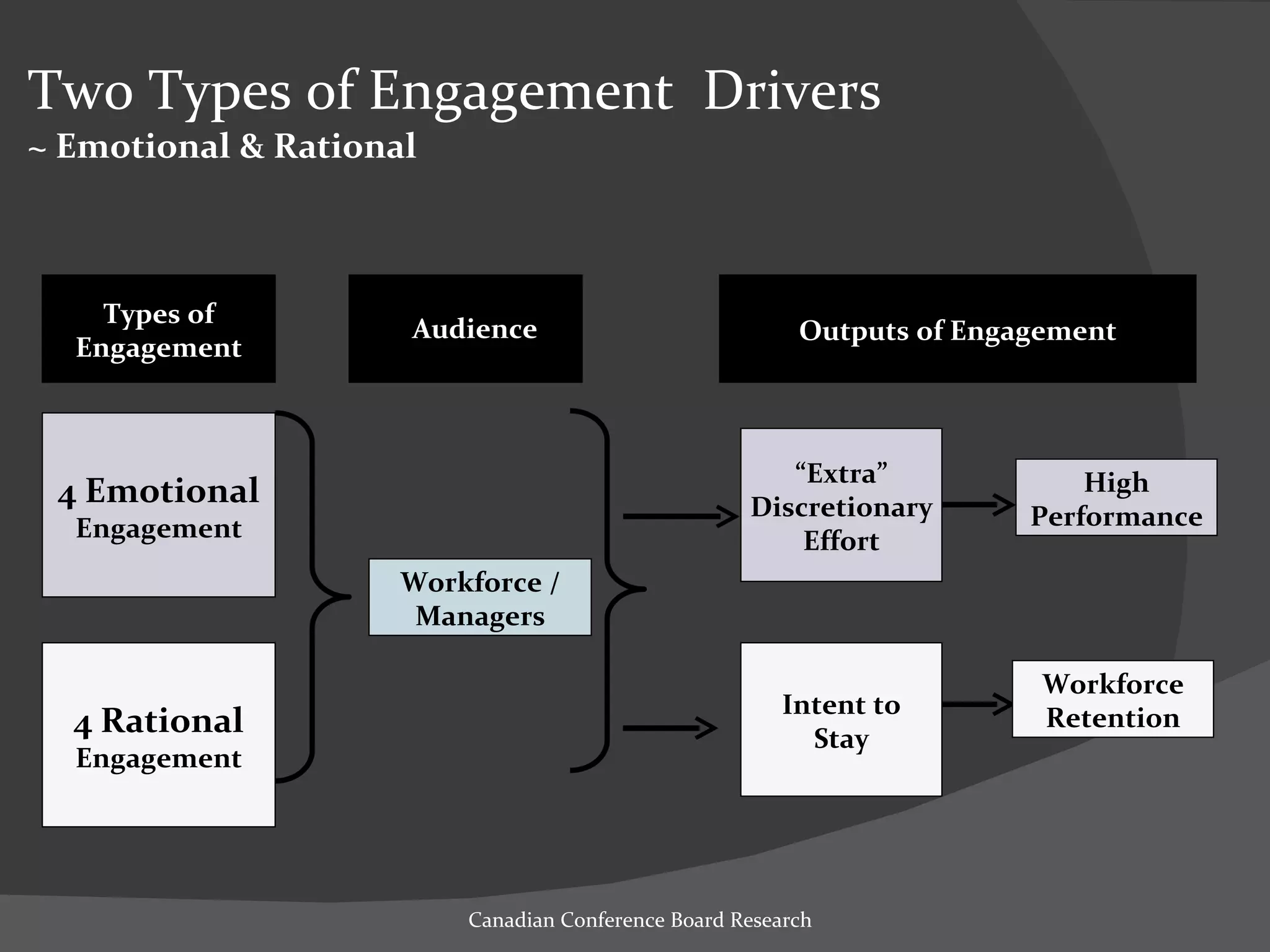
Two Types of Engagement  Drivers  ~ Emotional & Rational  Canadian Conference Board Research 4 Emotional Engagement Workforce / Managers “ Extra” Discretionary Effort 4 Rational Engagement Intent to Stay High Performance Workforce Retention Types of Engagement Outputs of Engagement Audience
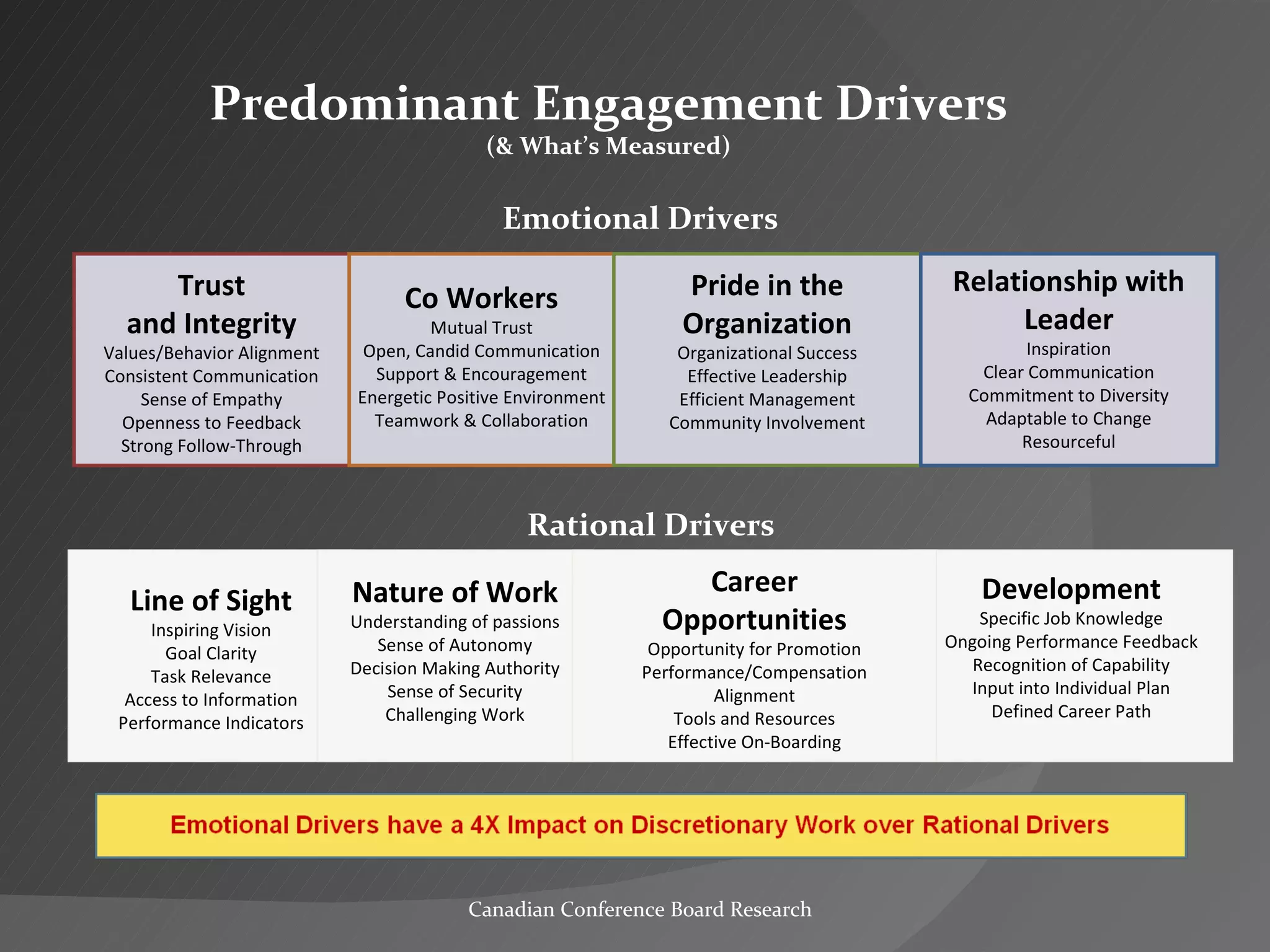
Canadian Conference Board Research Line of Sight Inspiring Vision Goal Clarity Task Relevance Access to Information Performance Indicators Nature of Work Understanding of passions Sense of Autonomy Decision Making Authority Sense of Security Challenging Work Development Specific Job Knowledge Ongoing Performance Feedback Recognition of Capability Input into Individual Plan Defined Career Path Career Opportunities Opportunity for Promotion Performance/Compensation Alignment Tools and Resources Effective On-Boarding Trust and Integrity Values/Behavior Alignment Consistent Communication Sense of Empathy Openness to Feedback Strong Follow-Through Co Workers Mutual Trust Open, Candid Communication Support & Encouragement Energetic Positive Environment Teamwork & Collaboration Pride in the Organization Organizational Success Effective Leadership Efficient Management Community Involvement Relationship with Leader Inspiration Clear Communication Commitment to Diversity Adaptable to Change Resourceful Predominant Engagement Drivers (& What’s Measured) Emotional Drivers Rational Drivers
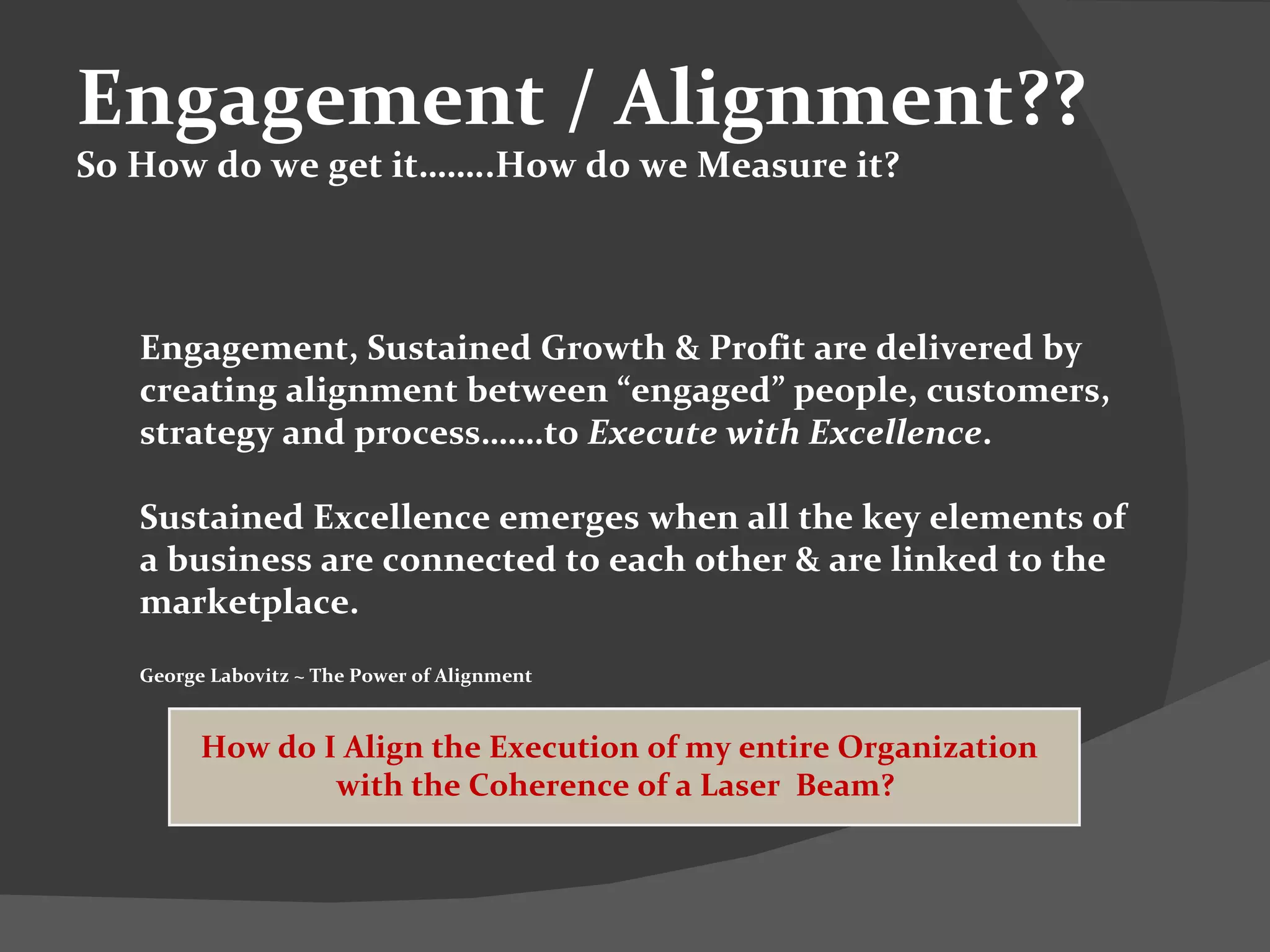
Engagement / Alignment?? So How do we get it……..How do we Measure it? Engagement, Sustained Growth & Profit are delivered by creating alignment between “engaged” people, customers, strategy and process…….to  Execute with Excellence . Sustained Excellence emerges when all the key elements of a business are connected to each other & are linked to the marketplace.  George Labovitz ~ The Power of Alignment How do I Align the Execution of my entire Organization with the Coherence of a Laser  Beam?
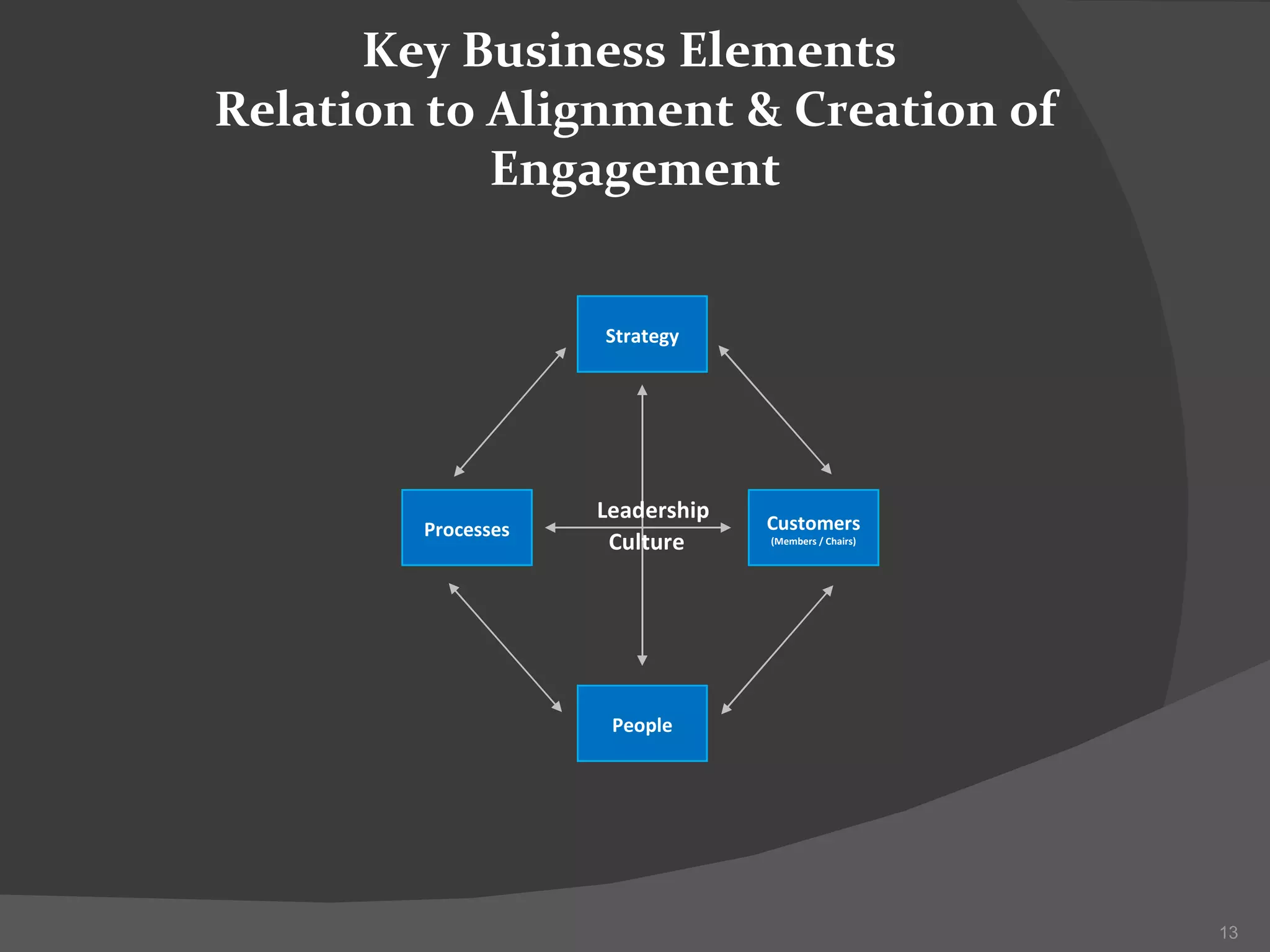
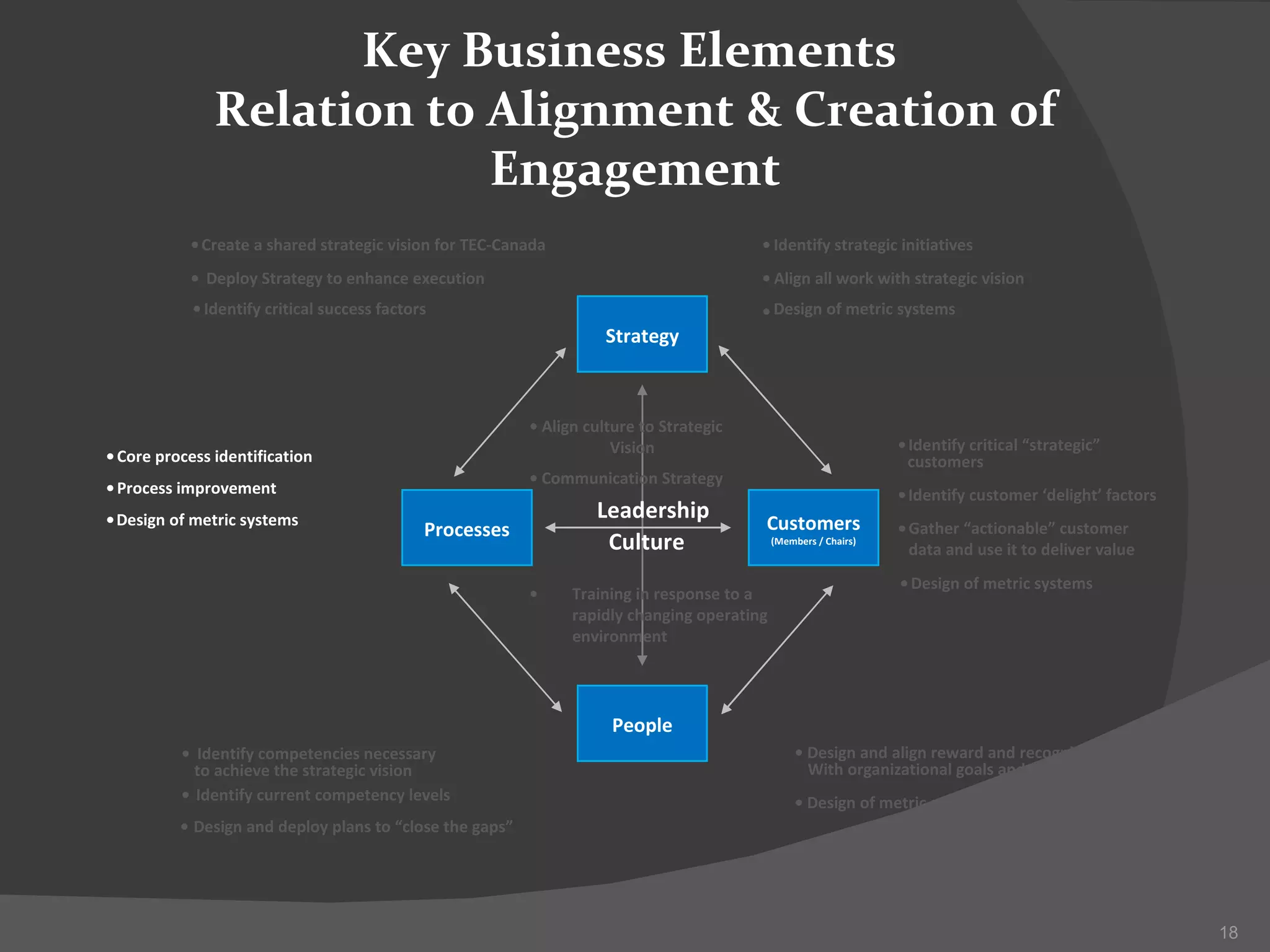
Key Business Elements  Relation to Alignment & Creation of Engagement Strategy People Processes Customers (Members / Chairs) Leadership Culture
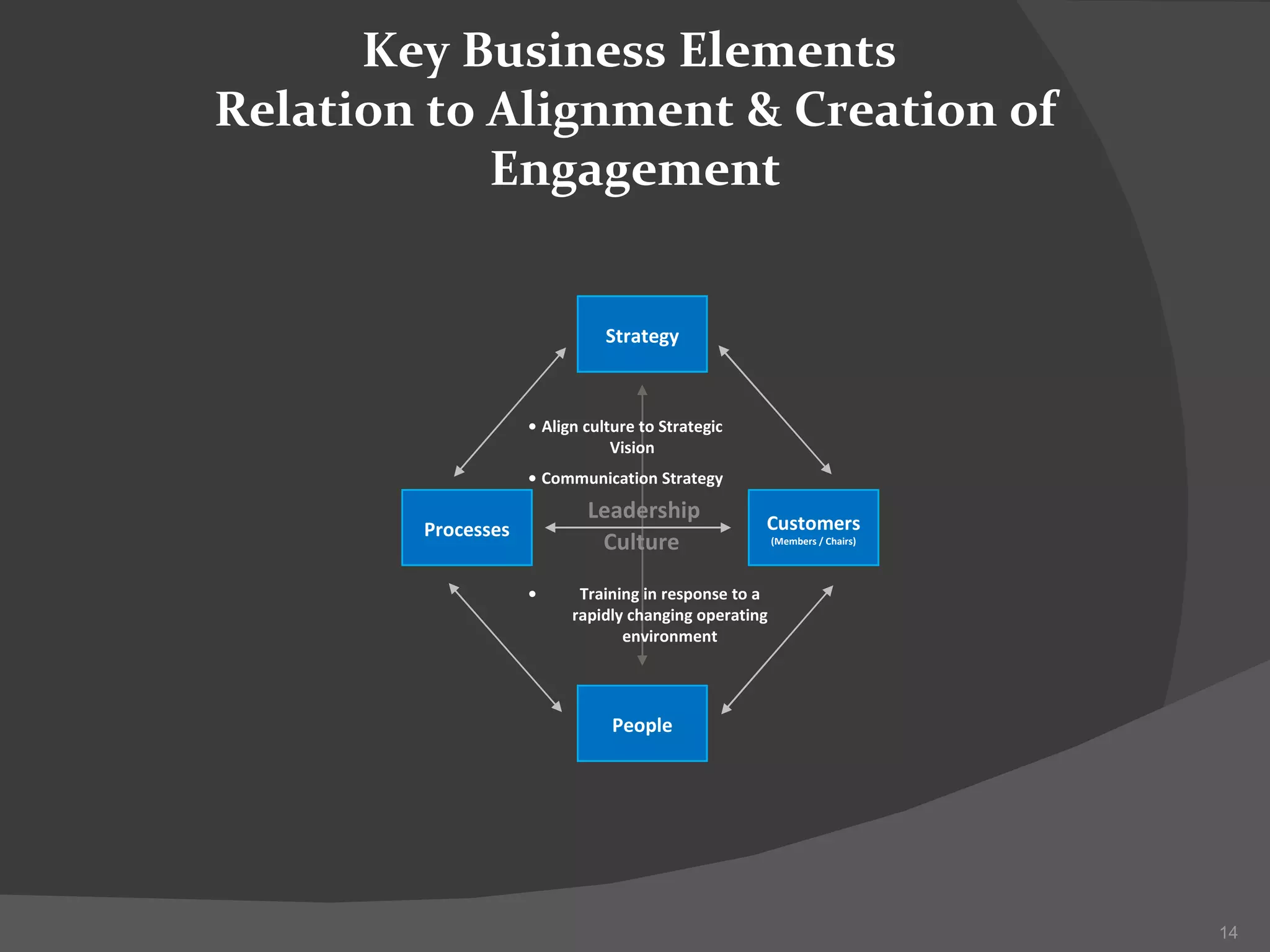
Strategy People Processes Customers (Members / Chairs) Leadership Culture Key Business Elements  Relation to Alignment & Creation of Engagement Align culture to Strategic Vision Communication Strategy • • Training in response to a rapidly changing operating environment •
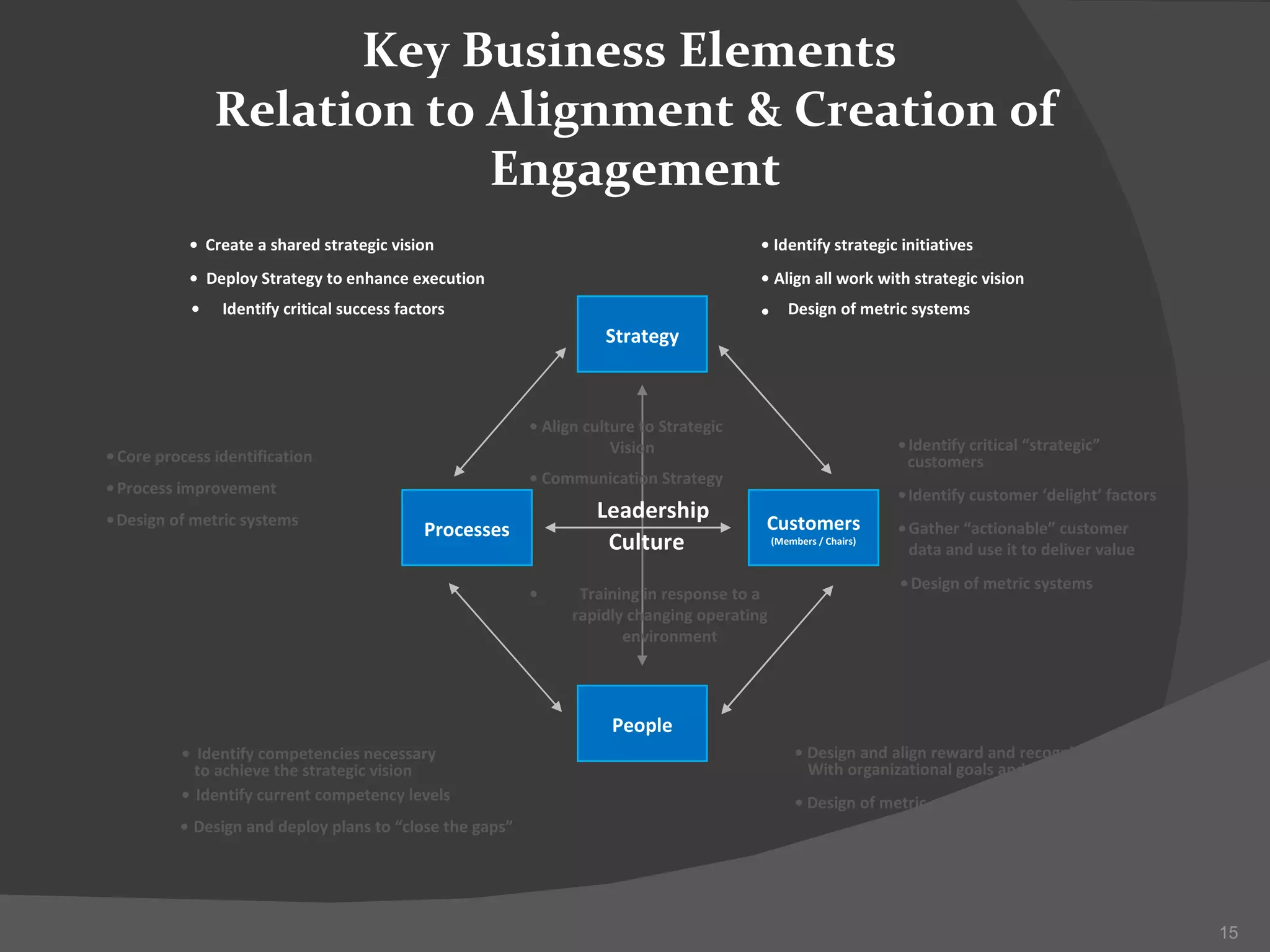
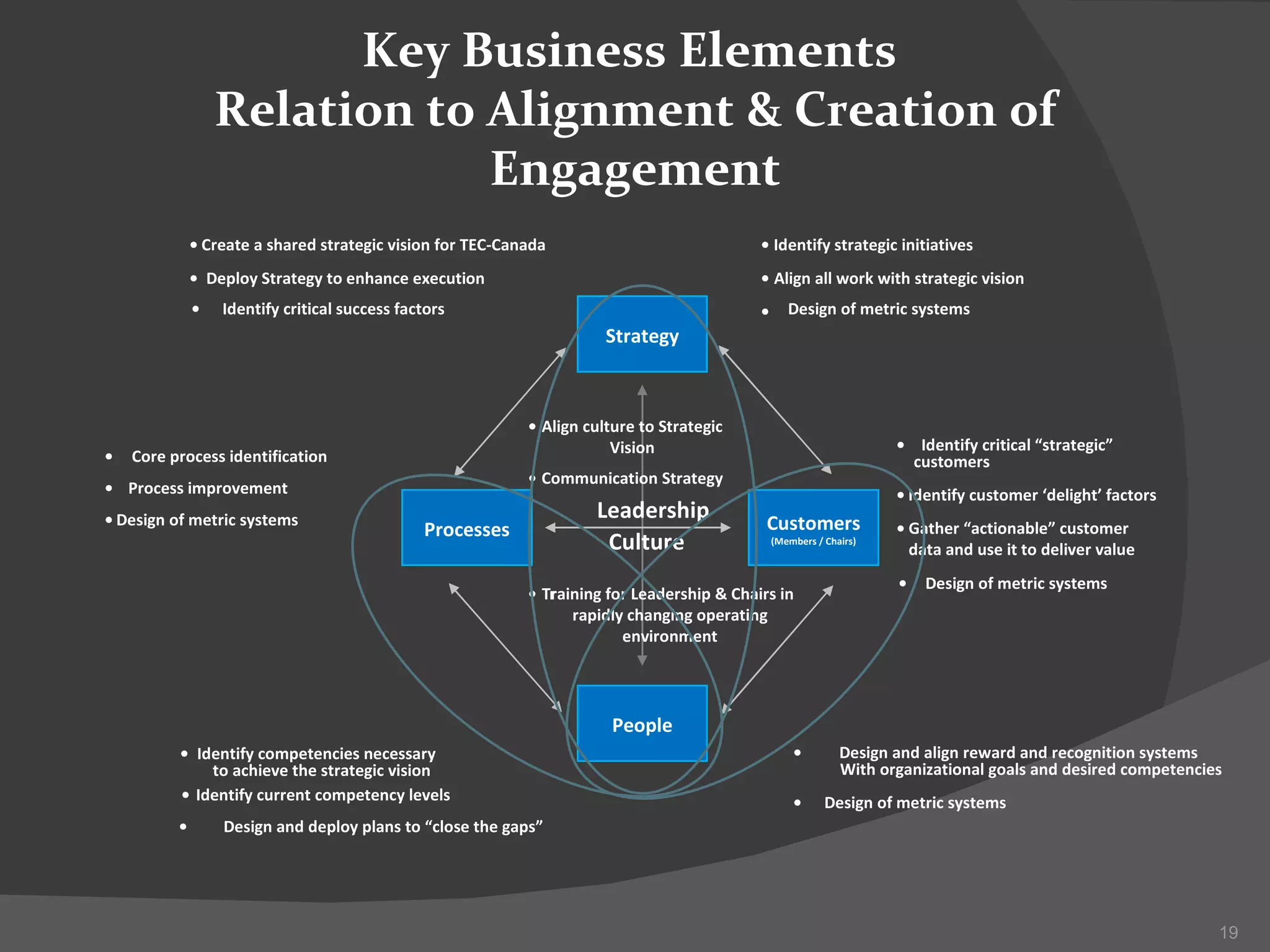
Strategy People Processes Customers (Members / Chairs) Leadership Culture Key Business Elements  Relation to Alignment & Creation of Engagement Identify strategic initiatives Align all work with strategic vision Design of metric systems • • • Create a shared strategic vision  Deploy Strategy to enhance execution Identify critical success factors • • • Identify competencies necessary to achieve the strategic vision Identify current competency levels Design and deploy plans to “close the gaps” • • • Design and align reward and recognition systems With organizational goals and desired competencies Design of metric systems • • Core process identification Process improvement Design of metric systems • • • Identify critical “strategic” customers Identify customer ‘delight’ factors Gather “actionable” customer  data and use it to deliver value Design of metric systems • • • • Align culture to Strategic Vision Communication Strategy • • Training in response to a rapidly changing operating environment •
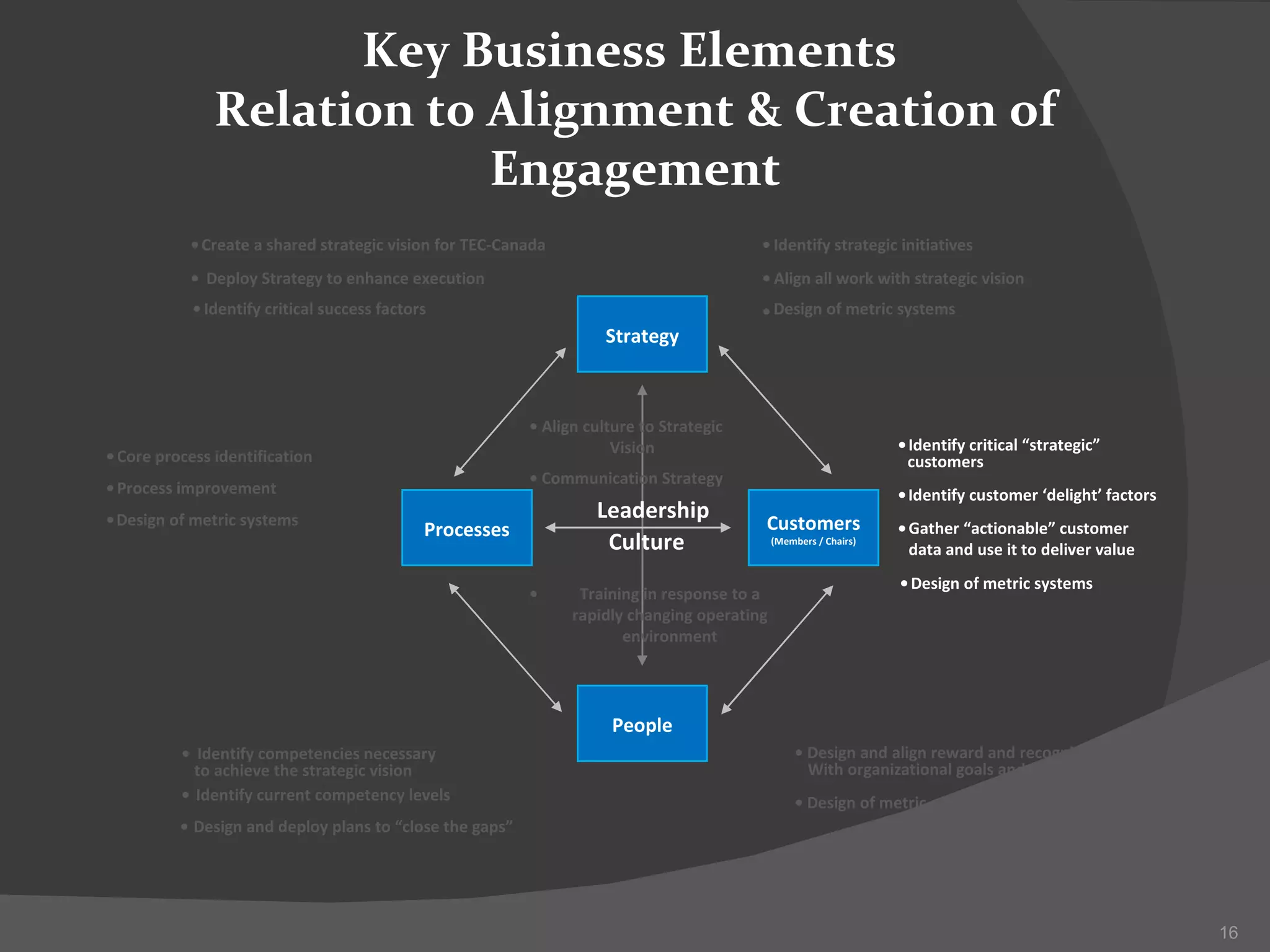
Strategy People Processes Customers (Members / Chairs) Leadership Culture Key Business Elements  Relation to Alignment & Creation of Engagement Identify strategic initiatives Align all work with strategic vision Design of metric systems • • • Create a shared strategic vision for TEC-Canada Deploy Strategy to enhance execution Identify critical success factors • • • Identify competencies necessary to achieve the strategic vision Identify current competency levels Design and deploy plans to “close the gaps” • • • Design and align reward and recognition systems With organizational goals and desired competencies Design of metric systems • • Core process identification Process improvement Design of metric systems • • • Identify critical “strategic” customers Identify customer ‘delight’ factors Gather “actionable” customer  data and use it to deliver value Design of metric systems • • • • Align culture to Strategic Vision Communication Strategy • • Training in response to a rapidly changing operating environment •
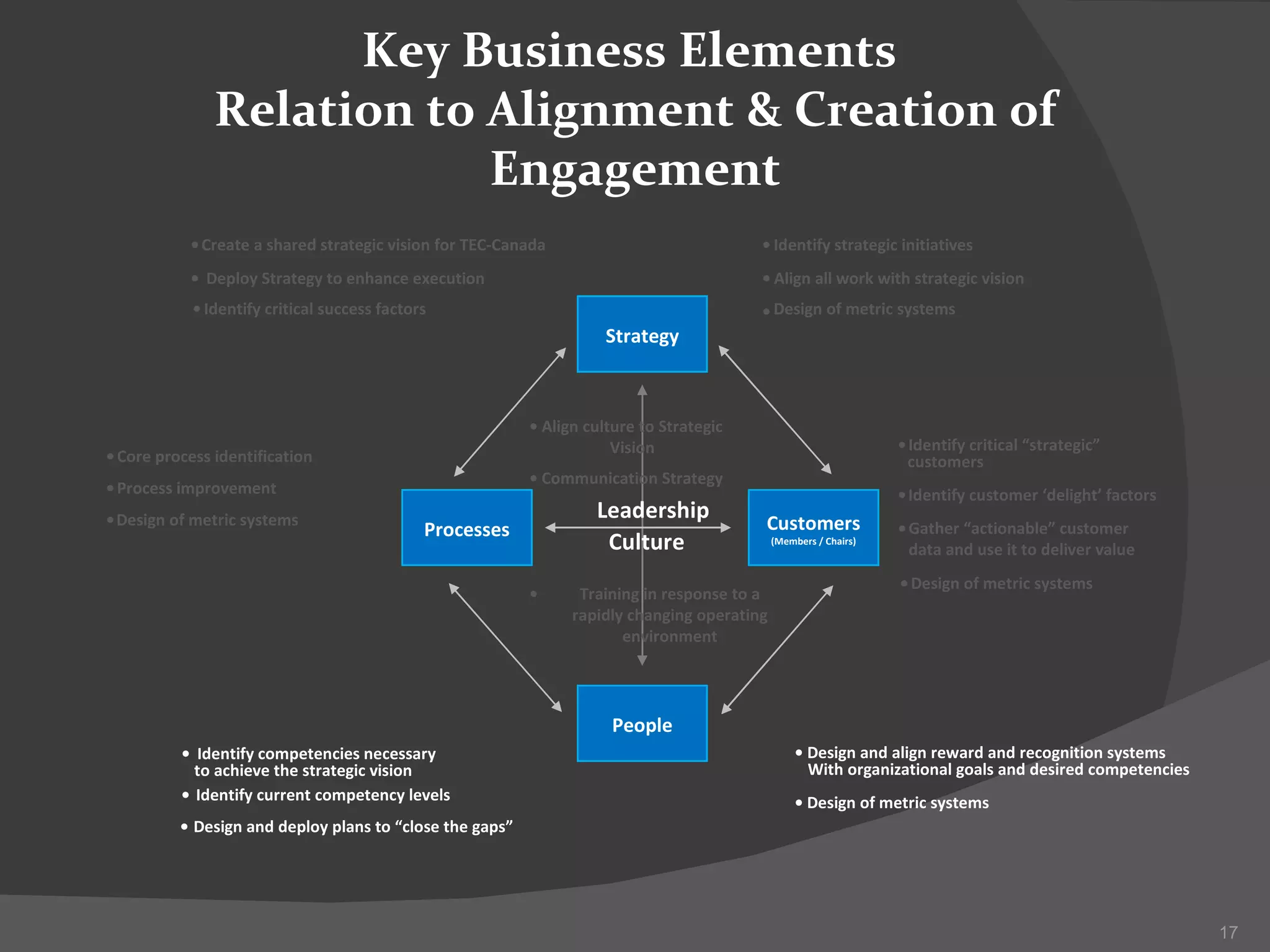
Strategy People Processes Customers (Members / Chairs) Leadership Culture Key Business Elements  Relation to Alignment & Creation of Engagement Identify strategic initiatives Align all work with strategic vision Design of metric systems • • • Create a shared strategic vision for TEC-Canada Deploy Strategy to enhance execution Identify critical success factors • • • Identify competencies necessary to achieve the strategic vision Identify current competency levels Design and deploy plans to “close the gaps” • • • Design and align reward and recognition systems With organizational goals and desired competencies Design of metric systems • • Core process identification Process improvement Design of metric systems • • • Identify critical “strategic” customers Identify customer ‘delight’ factors Gather “actionable” customer  data and use it to deliver value Design of metric systems • • • • Align culture to Strategic Vision Communication Strategy • • Training for Leadership & Chairs in  rapidly changing operating environment r •
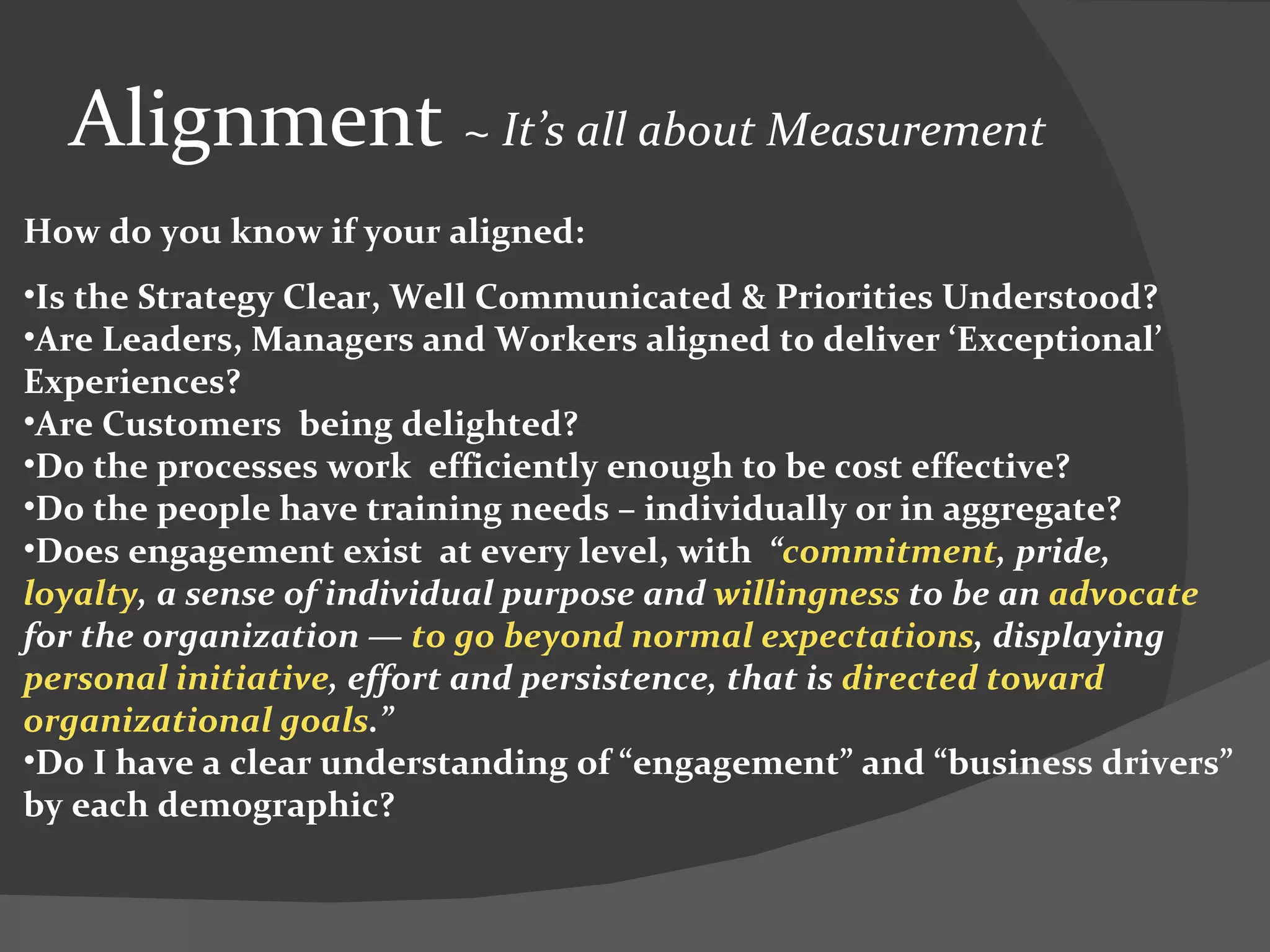
Alignment  ~  It’s all about Measurement  How do you know if your aligned: Is the Strategy Clear, Well Communicated & Priorities Understood? Are Leaders, Managers and Workers aligned to deliver ‘Exceptional’ Experiences? Are Customers  being delighted? Do the processes work  efficiently enough to be cost effective? Do the people have training needs – individually or in aggregate? Does engagement exist  at every level, with   “ commitment , pride,  loyalty , a sense of individual purpose and  willingness  to be an  advocate  for the organization —  to go beyond normal expectations , displaying  personal initiative , effort and persistence, that is  directed toward organizational goals .”  Do I have a clear understanding of “engagement” and “business drivers” by each demographic?
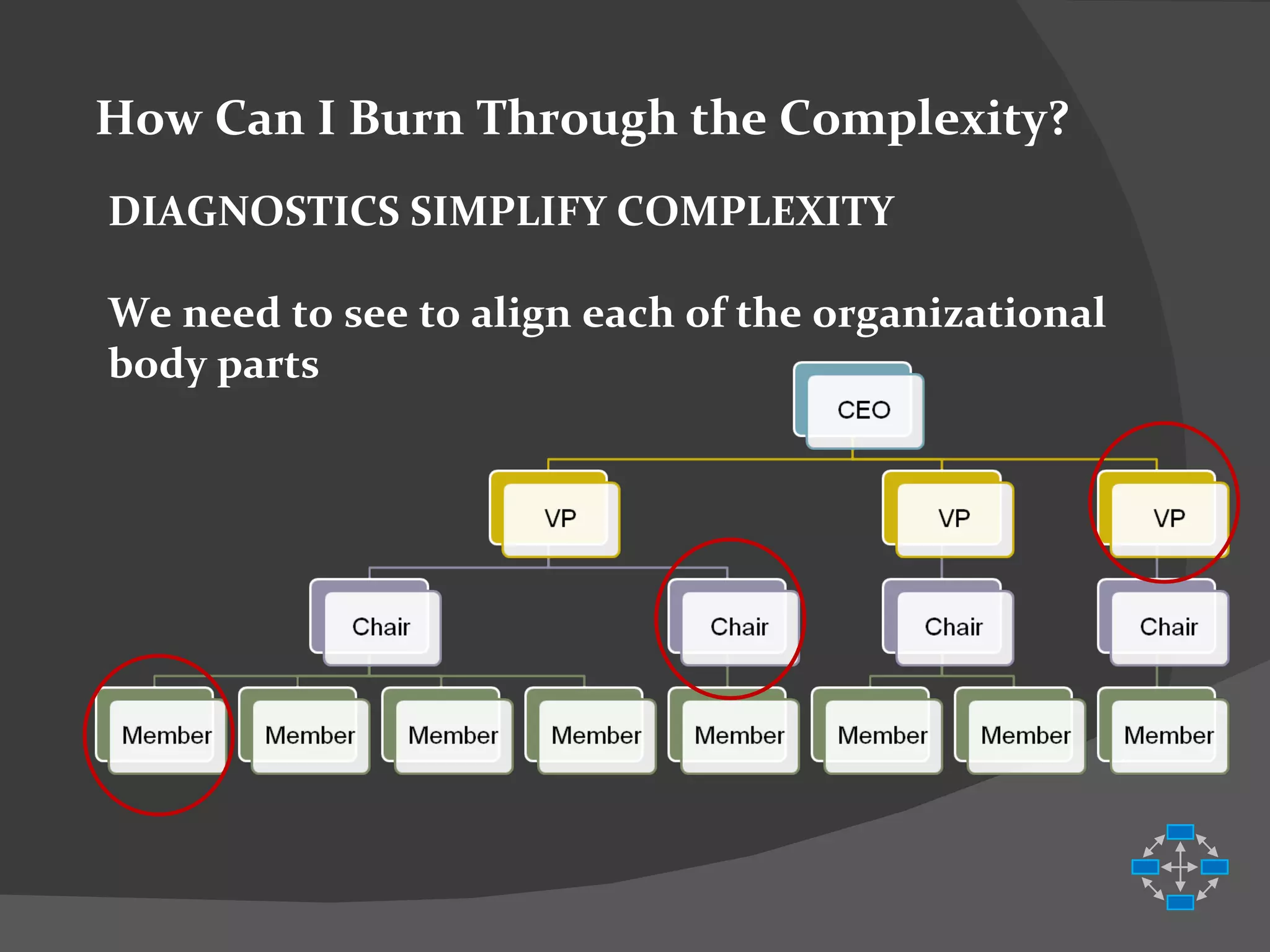
How Can I Burn Through the Complexity? DIAGNOSTICS SIMPLIFY COMPLEXITY We need to see to align each of the organizational body parts
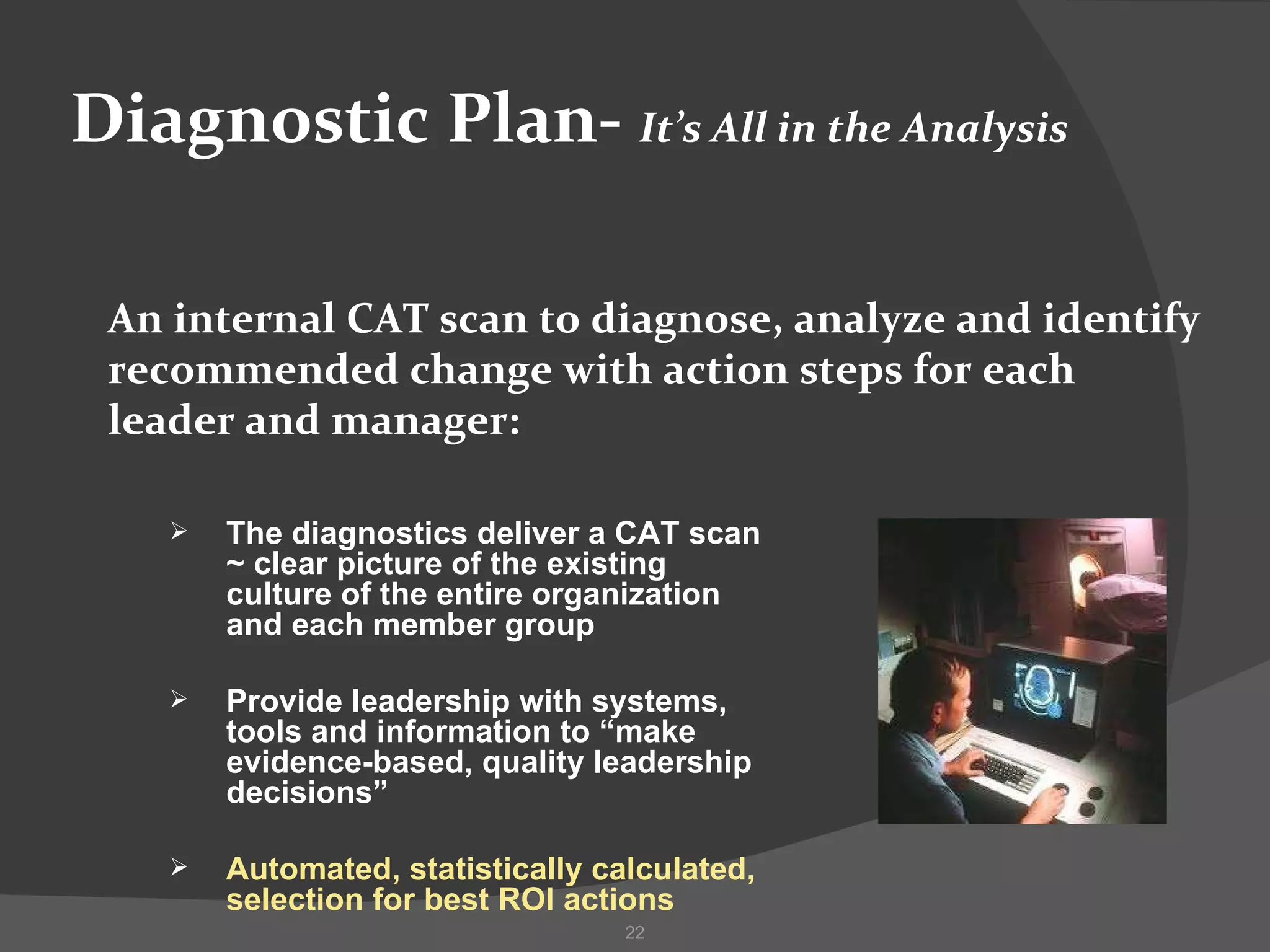
Diagnostic Plan-  It’s All in the Analysis An internal CAT scan to diagnose, analyze and identify recommended change with action steps for each leader and manager: The diagnostics deliver a CAT scan ~ clear picture of the existing culture of the entire organization and each member group  Provide leadership with systems, tools and information to “make evidence-based, quality leadership decisions” Automated, statistically calculated, selection for best ROI actions
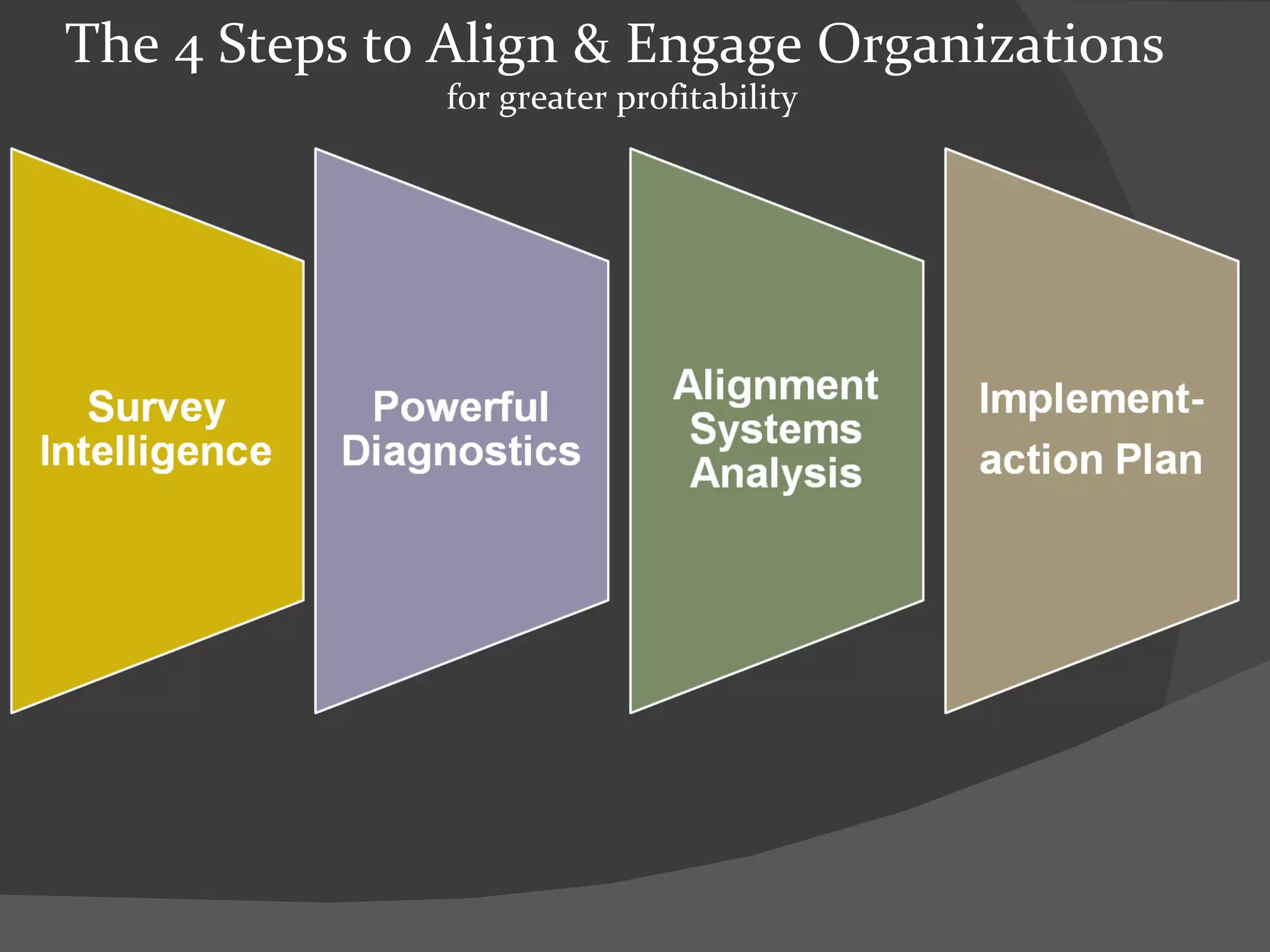
The 4 Steps to Align & Engage Organizations  for greater profitability    
Emotional Drivers   ~ to identify areas for performance improvement Operational Excellence  ~ to identify operational improvements Engagement Index  ~ Overall Rating to measure Continuous Improvement Survey Construction [Based on ‘Your’ Main Thing] Rational Drivers  ~ to identify the potential for turnover
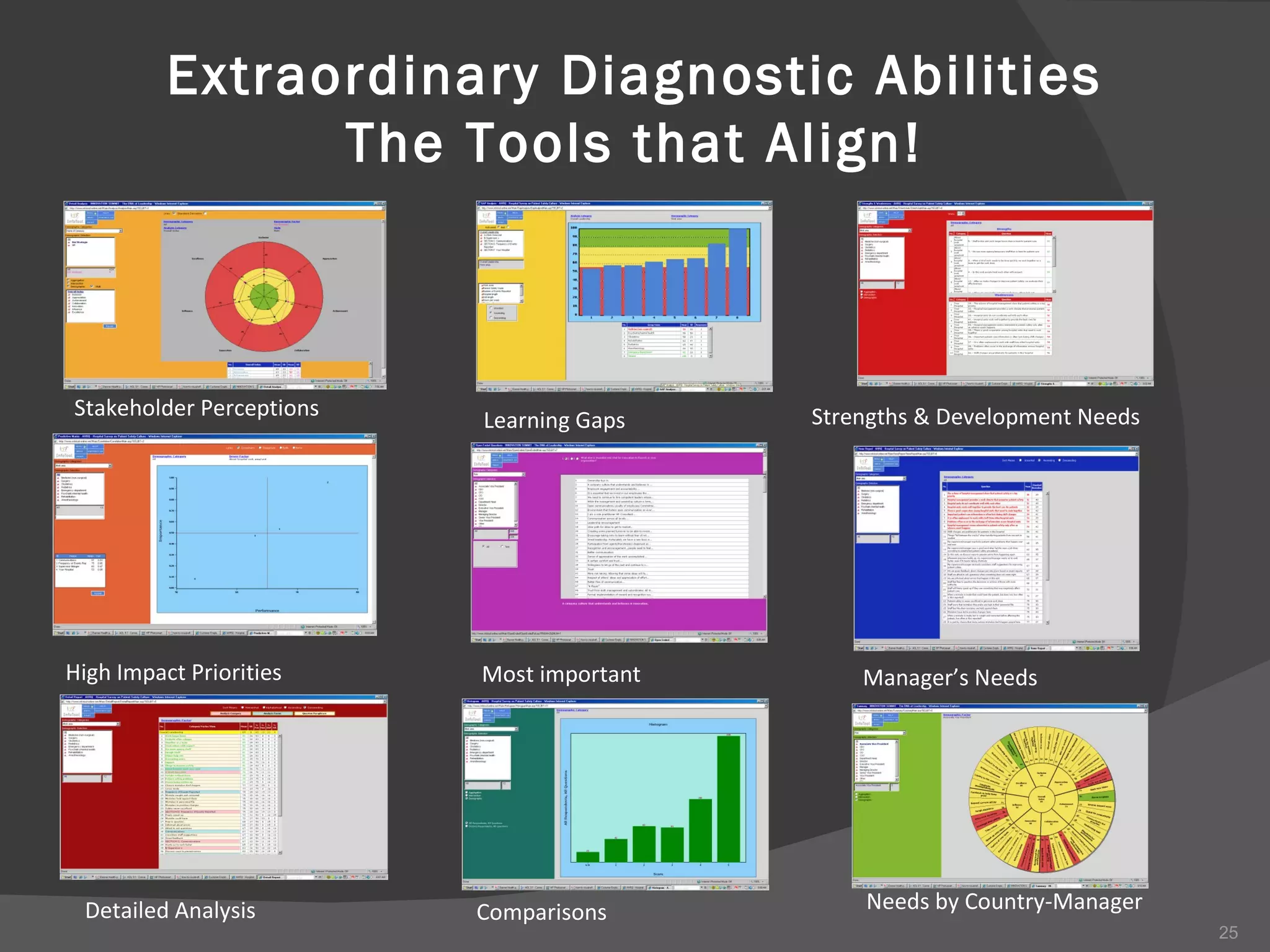
Extraordinary Diagnostic Abilities The Tools that Align! Stakeholder Perceptions Learning Gaps  Strengths & Development Needs  High Impact Priorities  Most important Needs by Country-Manager Manager’s Needs Detailed Analysis  Comparisons
Live Demo
Alignment  ~ What is it & Why is it critical How well are you aligned: Is the Strategy Clear, Well Communicated & Priorities Understood? Are Leaders, Staff & Chairs aligned to deliver ‘Exceptional’ Experiences? Who are the Customers ~ Chairs…..Members…Prospective Members? Do the processes work ~ Are they balanced between too light & too heavy? How do I identify and plan for Chair training needs – individually or in aggregate? Do I have a clear understanding of the needs – by demographics – of chairs and members? Most importantly ~ what would the Customers [Chairs & Members] say and how does it impact attraction, retention and overall profitability and sustainability of TEC-Canada?
TEC – Canada  ~ Our Value Proposition Exceptional Leaders Focus on Professional & Personal Leadership Goals Trusted Peers & Exceptional Chairs Experience, Wisdom & Mutual Accountability Exceptional Decisions Business Experts & New Learning Technologies to hone CI & Intellectual Capital Clarity of Vision through knowledge & Best Practices Regional, National & International Opportunities through Vistage’s community Exceptional Results Sharpened competitive spirit, broadened network & focus on measurable results
Stanley Labovitz “ Ultimately, if you want sustained growth & profit ~ you must create alignment between people, customers, strategy and process.” Questions & Next Steps
 

Alignment presentation

  • 1.
  • 2.
    Engagement / Alignment??What is it & Why Should we care…….. Defined : Employee engagement is a combination of perceptions—including satisfaction, commitment, pride, loyalty, a sense of individual purpose and willingness to be an advocate for the organization — to go beyond normal expectations, displaying personal initiative, effort and persistence, that is directed toward organizational goals.”
  • 3.
    Engagement / Alignment??What is it & Why Should we care…….. Defined : Employee engagement is a combination of perceptions—including satisfaction, commitment , pride, loyalty , a sense of individual purpose and willingness to be an advocate for the organization — to go beyond normal expectations , displaying personal initiative , effort and persistence, that is directed toward organizational goals .”
  • 4.
    Engagement / Alignment??Why Should we care…….. 50 % Spread in Performance Companies with high levels of employee engagement improved 19.2% in operating income while companies with low levels of employee engagement declined 32.7%. Towers Watson
  • 5.
    Wealth Creation Earningsper share (EPS) growth of 89 organizations found that the EPS growth rate of organizations with engagement scores in the top quartile was 2.6 times that of organizations with below average scores. Gallup Engagement / Alignment?? Why Should we care……..
  • 6.
    Productivity Engaged employeesare consistently more productive, profitable, safer, healthier, and 87% less likely to leave their employer. Corporate Leadership Council & Fleming & Apslund Engagement / Alignment?? Why Should we care……..
  • 7.
    Safety Those withengagement scores in the bottom quartile averaged 62% more accidents. Gallup Engagement / Alignment?? Why Should we care……..
  • 8.
    Engagement / Alignment??~ Myths to Debunk The Drivers are the Same across all Organizations Engagement Drivers are the Same as Business Drivers Employee Engagement should be ‘Maximized’ McBassi & Co
  • 9.
    Engagement / Alignment??~ Myths to Debunk The Drivers are the Same across all Organizations ~ They need to be set within the context of your “Main Thing” Engagement Drivers are the Same as Business Drivers ~ They are very different from Business Drivers and need be integrated Employee Engagement should be ‘Maximized’ ~ Engagement bears costs and needs to be targeted & optimized to your needs McBassi & Co
  • 10.
    Two Types ofEngagement Drivers ~ Emotional & Rational Canadian Conference Board Research 4 Emotional Engagement Workforce / Managers “ Extra” Discretionary Effort 4 Rational Engagement Intent to Stay High Performance Workforce Retention Types of Engagement Outputs of Engagement Audience
  • 11.
    Canadian Conference BoardResearch Line of Sight Inspiring Vision Goal Clarity Task Relevance Access to Information Performance Indicators Nature of Work Understanding of passions Sense of Autonomy Decision Making Authority Sense of Security Challenging Work Development Specific Job Knowledge Ongoing Performance Feedback Recognition of Capability Input into Individual Plan Defined Career Path Career Opportunities Opportunity for Promotion Performance/Compensation Alignment Tools and Resources Effective On-Boarding Trust and Integrity Values/Behavior Alignment Consistent Communication Sense of Empathy Openness to Feedback Strong Follow-Through Co Workers Mutual Trust Open, Candid Communication Support & Encouragement Energetic Positive Environment Teamwork & Collaboration Pride in the Organization Organizational Success Effective Leadership Efficient Management Community Involvement Relationship with Leader Inspiration Clear Communication Commitment to Diversity Adaptable to Change Resourceful Predominant Engagement Drivers (& What’s Measured) Emotional Drivers Rational Drivers
  • 12.
    Engagement / Alignment??So How do we get it……..How do we Measure it? Engagement, Sustained Growth & Profit are delivered by creating alignment between “engaged” people, customers, strategy and process…….to Execute with Excellence . Sustained Excellence emerges when all the key elements of a business are connected to each other & are linked to the marketplace. George Labovitz ~ The Power of Alignment How do I Align the Execution of my entire Organization with the Coherence of a Laser Beam?
  • 13.
    Key Business Elements Relation to Alignment & Creation of Engagement Strategy People Processes Customers (Members / Chairs) Leadership Culture
  • 14.
    Strategy People ProcessesCustomers (Members / Chairs) Leadership Culture Key Business Elements Relation to Alignment & Creation of Engagement Align culture to Strategic Vision Communication Strategy • • Training in response to a rapidly changing operating environment •
  • 15.
    Strategy People ProcessesCustomers (Members / Chairs) Leadership Culture Key Business Elements Relation to Alignment & Creation of Engagement Identify strategic initiatives Align all work with strategic vision Design of metric systems • • • Create a shared strategic vision Deploy Strategy to enhance execution Identify critical success factors • • • Identify competencies necessary to achieve the strategic vision Identify current competency levels Design and deploy plans to “close the gaps” • • • Design and align reward and recognition systems With organizational goals and desired competencies Design of metric systems • • Core process identification Process improvement Design of metric systems • • • Identify critical “strategic” customers Identify customer ‘delight’ factors Gather “actionable” customer data and use it to deliver value Design of metric systems • • • • Align culture to Strategic Vision Communication Strategy • • Training in response to a rapidly changing operating environment •
  • 16.
    Strategy People ProcessesCustomers (Members / Chairs) Leadership Culture Key Business Elements Relation to Alignment & Creation of Engagement Identify strategic initiatives Align all work with strategic vision Design of metric systems • • • Create a shared strategic vision for TEC-Canada Deploy Strategy to enhance execution Identify critical success factors • • • Identify competencies necessary to achieve the strategic vision Identify current competency levels Design and deploy plans to “close the gaps” • • • Design and align reward and recognition systems With organizational goals and desired competencies Design of metric systems • • Core process identification Process improvement Design of metric systems • • • Identify critical “strategic” customers Identify customer ‘delight’ factors Gather “actionable” customer data and use it to deliver value Design of metric systems • • • • Align culture to Strategic Vision Communication Strategy • • Training in response to a rapidly changing operating environment •
  • 17.
    Strategy People ProcessesCustomers (Members / Chairs) Leadership Culture Key Business Elements Relation to Alignment & Creation of Engagement Identify strategic initiatives Align all work with strategic vision Design of metric systems • • • Create a shared strategic vision for TEC-Canada Deploy Strategy to enhance execution Identify critical success factors • • • Identify competencies necessary to achieve the strategic vision Identify current competency levels Design and deploy plans to “close the gaps” • • • Design and align reward and recognition systems With organizational goals and desired competencies Design of metric systems • • Core process identification Process improvement Design of metric systems • • • Identify critical “strategic” customers Identify customer ‘delight’ factors Gather “actionable” customer data and use it to deliver value Design of metric systems • • • • Align culture to Strategic Vision Communication Strategy • • Training in response to a rapidly changing operating environment •
  • 18.
    Strategy People ProcessesCustomers (Members / Chairs) Leadership Culture Key Business Elements Relation to Alignment & Creation of Engagement Identify strategic initiatives Align all work with strategic vision Design of metric systems • • • Create a shared strategic vision for TEC-Canada Deploy Strategy to enhance execution Identify critical success factors • • • Identify competencies necessary to achieve the strategic vision Identify current competency levels Design and deploy plans to “close the gaps” • • • Design and align reward and recognition systems With organizational goals and desired competencies Design of metric systems • • Core process identification Process improvement Design of metric systems • • • Identify critical “strategic” customers Identify customer ‘delight’ factors Gather “actionable” customer data and use it to deliver value Design of metric systems • • • • Align culture to Strategic Vision Communication Strategy • • Training in response to a rapidly changing operating environment •
  • 19.
    Strategy People ProcessesCustomers (Members / Chairs) Leadership Culture Key Business Elements Relation to Alignment & Creation of Engagement Identify strategic initiatives Align all work with strategic vision Design of metric systems • • • Create a shared strategic vision for TEC-Canada Deploy Strategy to enhance execution Identify critical success factors • • • Identify competencies necessary to achieve the strategic vision Identify current competency levels Design and deploy plans to “close the gaps” • • • Design and align reward and recognition systems With organizational goals and desired competencies Design of metric systems • • Core process identification Process improvement Design of metric systems • • • Identify critical “strategic” customers Identify customer ‘delight’ factors Gather “actionable” customer data and use it to deliver value Design of metric systems • • • • Align culture to Strategic Vision Communication Strategy • • Training for Leadership & Chairs in rapidly changing operating environment r •
  • 20.
    Alignment ~ It’s all about Measurement How do you know if your aligned: Is the Strategy Clear, Well Communicated & Priorities Understood? Are Leaders, Managers and Workers aligned to deliver ‘Exceptional’ Experiences? Are Customers being delighted? Do the processes work efficiently enough to be cost effective? Do the people have training needs – individually or in aggregate? Does engagement exist at every level, with “ commitment , pride, loyalty , a sense of individual purpose and willingness to be an advocate for the organization — to go beyond normal expectations , displaying personal initiative , effort and persistence, that is directed toward organizational goals .” Do I have a clear understanding of “engagement” and “business drivers” by each demographic?
  • 21.
    How Can IBurn Through the Complexity? DIAGNOSTICS SIMPLIFY COMPLEXITY We need to see to align each of the organizational body parts
  • 22.
    Diagnostic Plan- It’s All in the Analysis An internal CAT scan to diagnose, analyze and identify recommended change with action steps for each leader and manager: The diagnostics deliver a CAT scan ~ clear picture of the existing culture of the entire organization and each member group Provide leadership with systems, tools and information to “make evidence-based, quality leadership decisions” Automated, statistically calculated, selection for best ROI actions
  • 23.
    The 4 Stepsto Align & Engage Organizations for greater profitability    
  • 24.
    Emotional Drivers ~ to identify areas for performance improvement Operational Excellence ~ to identify operational improvements Engagement Index ~ Overall Rating to measure Continuous Improvement Survey Construction [Based on ‘Your’ Main Thing] Rational Drivers ~ to identify the potential for turnover
  • 25.
    Extraordinary Diagnostic AbilitiesThe Tools that Align! Stakeholder Perceptions Learning Gaps Strengths & Development Needs High Impact Priorities Most important Needs by Country-Manager Manager’s Needs Detailed Analysis Comparisons
  • 26.
  • 27.
    Alignment ~What is it & Why is it critical How well are you aligned: Is the Strategy Clear, Well Communicated & Priorities Understood? Are Leaders, Staff & Chairs aligned to deliver ‘Exceptional’ Experiences? Who are the Customers ~ Chairs…..Members…Prospective Members? Do the processes work ~ Are they balanced between too light & too heavy? How do I identify and plan for Chair training needs – individually or in aggregate? Do I have a clear understanding of the needs – by demographics – of chairs and members? Most importantly ~ what would the Customers [Chairs & Members] say and how does it impact attraction, retention and overall profitability and sustainability of TEC-Canada?
  • 28.
    TEC – Canada ~ Our Value Proposition Exceptional Leaders Focus on Professional & Personal Leadership Goals Trusted Peers & Exceptional Chairs Experience, Wisdom & Mutual Accountability Exceptional Decisions Business Experts & New Learning Technologies to hone CI & Intellectual Capital Clarity of Vision through knowledge & Best Practices Regional, National & International Opportunities through Vistage’s community Exceptional Results Sharpened competitive spirit, broadened network & focus on measurable results
  • 29.
    Stanley Labovitz “Ultimately, if you want sustained growth & profit ~ you must create alignment between people, customers, strategy and process.” Questions & Next Steps
  • 30.