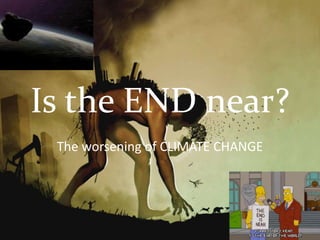
Is the END near?
The worsening of CLIMATE CHANGE
What is CLIMATE CHANGE?
• Climate change occurs when long-term weather
patterns are altered — for example, through
human activity. Global warming is one measure of
climate change, and is a rise in the average global
temperature.
BUT IS IT
HAPPENING? REALLY
HAPPENING?
EVIDENCES OF CLIMATE
CHANGE
• RISING OF SEA LEVEL
• GLOBAL TEMPERATURE RISE
• WARMING OCEAN
• SHRINKING ICE SHEETS
• DECLINING ARCTIC SEA ICE
• GLACIAL RETREAT
• EXTREME EVENTS
• OCEAN ACIDIFICATION
• DECEREASED SNOW COVER
VITAL
SIGNS OF
THE
PLANET
Carbon Dioxide
• Carbon dioxide (CO2) is an important heat-
trapping (greenhouse) gas, which is
released through human activities such as
deforestation and burning fossil fuels, as
well as natural processes such as respiration
and volcanic eruptions.
Current CO2 Level:
405.92 ppm
LEVEL OF CO2
GLOBAL TEMPERATURE
• This graph illustrates the change in global
surface temperature relative to 1951-1980
average temperatures. The 10 warmest years
in the 136-year record all have occurred
since 2000, with the exception of 1998. The
year 2016 ranks as the warmest on record.
Latest Annual Averrage:
0.99 °C
TEMPERATURE THROUGHOUT
THE YEARS
ARCTIC SEA ICE MINIMUM
• Arctic sea ice reaches its minimum each
September. September Arctic sea ice is now
declining at a rate of 13.3 percent per
decade, relative to the 1981 to 2010 average.
This graph shows the average monthly
Arctic sea ice extent in September since
1979, derived from satellite observations.
Down by 13.3% per decade
Rate of Change:
ARCTIC SEA ICE MINIMUM
LAND ICE
• Data from NASA's GRACE satellites show
that the land ice sheets in both Antarctica
and Greenland are losing mass. The
continent of Antarctica has been losing
about 118 gigatonnes of ice per year since
2002, while the Greenland ice sheet has
been losing an estimated 281 gigatonnes per
year.
LAND ICE
SEA LEVEL
• Sea level rise is caused primarily by two
factors related to global warming: the added
water from melting land ice and the
expansion of sea water as it warms. The first
chart tracks the change in sea level since
1993 as observed by satellites.
Sea Level Latest Measurement:
82.7mm
SEA LEVEL
Climate Change: What Happens
after 2100?
Would it be too cold
Will our world end?
Is earth still habitable?
Will this world would be
flaming hot?
Do you think nothing would
change?
Do you think nothing would
change?
Would the ocean be still full of
fish?
Can we still call Earth as Earth?
Do we even care?Do humans still exist?
References
• http://www.davidsuzuki.org/issues/climate-change/science/climate-
change-basics/climate-change-101-1/
• https://climate.nasa.gov/evidence/
• https://climate.nasa.gov/vital-signs/sea-level/
• https://climate.nasa.gov/vital-signs/land-ice/
• https://climate.nasa.gov/vital-signs/arctic-sea-ice/
• https://climate.nasa.gov/vital-signs/global-temperature/
• https://climate.nasa.gov/vital-signs/carbon-dioxide/

Is the end near

  • 1.
    Is the ENDnear? The worsening of CLIMATE CHANGE
  • 2.
    What is CLIMATECHANGE? • Climate change occurs when long-term weather patterns are altered — for example, through human activity. Global warming is one measure of climate change, and is a rise in the average global temperature. BUT IS IT HAPPENING? REALLY HAPPENING?
  • 3.
    EVIDENCES OF CLIMATE CHANGE •RISING OF SEA LEVEL • GLOBAL TEMPERATURE RISE • WARMING OCEAN • SHRINKING ICE SHEETS • DECLINING ARCTIC SEA ICE • GLACIAL RETREAT • EXTREME EVENTS • OCEAN ACIDIFICATION • DECEREASED SNOW COVER
  • 4.
  • 5.
    Carbon Dioxide • Carbondioxide (CO2) is an important heat- trapping (greenhouse) gas, which is released through human activities such as deforestation and burning fossil fuels, as well as natural processes such as respiration and volcanic eruptions. Current CO2 Level: 405.92 ppm
  • 6.
  • 7.
    GLOBAL TEMPERATURE • Thisgraph illustrates the change in global surface temperature relative to 1951-1980 average temperatures. The 10 warmest years in the 136-year record all have occurred since 2000, with the exception of 1998. The year 2016 ranks as the warmest on record. Latest Annual Averrage: 0.99 °C
  • 8.
  • 9.
    ARCTIC SEA ICEMINIMUM • Arctic sea ice reaches its minimum each September. September Arctic sea ice is now declining at a rate of 13.3 percent per decade, relative to the 1981 to 2010 average. This graph shows the average monthly Arctic sea ice extent in September since 1979, derived from satellite observations. Down by 13.3% per decade Rate of Change:
  • 10.
  • 11.
    LAND ICE • Datafrom NASA's GRACE satellites show that the land ice sheets in both Antarctica and Greenland are losing mass. The continent of Antarctica has been losing about 118 gigatonnes of ice per year since 2002, while the Greenland ice sheet has been losing an estimated 281 gigatonnes per year.
  • 12.
  • 13.
    SEA LEVEL • Sealevel rise is caused primarily by two factors related to global warming: the added water from melting land ice and the expansion of sea water as it warms. The first chart tracks the change in sea level since 1993 as observed by satellites. Sea Level Latest Measurement: 82.7mm
  • 14.
  • 15.
    Climate Change: WhatHappens after 2100? Would it be too cold Will our world end? Is earth still habitable? Will this world would be flaming hot? Do you think nothing would change? Do you think nothing would change? Would the ocean be still full of fish? Can we still call Earth as Earth? Do we even care?Do humans still exist?
  • 17.
    References • http://www.davidsuzuki.org/issues/climate-change/science/climate- change-basics/climate-change-101-1/ • https://climate.nasa.gov/evidence/ •https://climate.nasa.gov/vital-signs/sea-level/ • https://climate.nasa.gov/vital-signs/land-ice/ • https://climate.nasa.gov/vital-signs/arctic-sea-ice/ • https://climate.nasa.gov/vital-signs/global-temperature/ • https://climate.nasa.gov/vital-signs/carbon-dioxide/