C
Dangerous Degrees
o
WRONGWAYWRONGWAYwrongwayWRONGWAYWRONGWAYWRONG
W
RONG
W
AY
W
RONG
W
AY
W
RONG
W
AY
W
RONG
W
AY
W
RONG
W
AY
W
RONG
W
AY
W
RON
WRONGWAYWRONGWAYWRONGWAYWRONGWAYWRONGWAYWRONGWAY
WRONGWAYWRONGWAYwrongwayWRONGWAYWRONGWAYWRONG
WRONGWAYWRONGWAY
wrong
wayWRONGWAYWRONGWAYWRONGWA
WRONGWAYWRONGWAY
wrong
wayWRONGWAYWRONGWAYWRONGWA
WRONGWAYWRONGWAYWRONG
Take a breath. The air entering your lungs isn’t
what it was even a decade ago. Year on year,
the concentration of carbon dioxide (CO2) and
several other gases has been rising. Since 1900,
humanity has pumped nearly one-and-a-half million
million tonnes of CO2 and other heat-trapping
greenhouse gases into the atmosphere.1
Today, CO2
emissions from fossil fuels are around 50 per cent
higher than they were 20 years ago, and have been
rising each year.2
This kind of change to the chemical mixture in
the air doesn’t come without consequences.
Acting like a blanket, the build-up of greenhouse
gases is the main reason why the average global
temperature has risen by nearly 1°C in the last
century. In fact, the extra heat now trapped in the
atmosphere is equivalent, in energy terms, to the
detonation of almost 500 million Hiroshima-sized
atomic bombs every year for the last century.3
Science has been studying the climate system
(i.e. the air, oceans, and land) for well over 150 years.
From the first studies confirming the heat-trapping
properties of CO2 in the 1850s, to the multiple
lines of evidence pieced together by thousands
of scientists today—we are witnessing a global
warming unprecedented in human history.
The most up-to-date research sounds a clear
warning: unchecked, the rise in greenhouse gas
(or carbon pollution) emissions could see the
average global temperature rise by more than
6°C above the pre-industrial average by the end
of the century.4
Even with all of the pledges to
cut emissions made so far by the nations of the
world, the temperature is set to rise at least 4°C
by the 2060s.5
What does this really mean? After all, the mercury
can rise or fall sharply in a few hours. So what
does a few degrees over a few decades matter?
And, if climate change is as risky as scientists say
it is, what is to be done?
This booklet explains why a rise of only a few
degrees in the average global temperature risks
our prosperity, security, and health. It explains why
it is so important to reverse the rise in emissions
within the decade. And why it is still within our
means to do so.
IF WE DON’T CHANGE DIRECTION NOW, WE’LL END UP WHERE
WE’RE HEADING.
02
NG
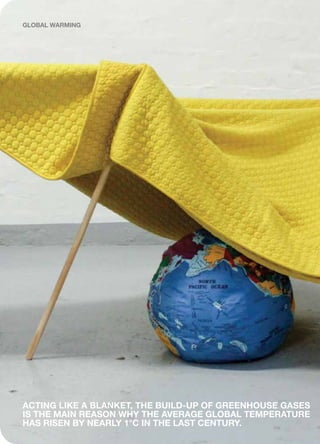
ACTING LIKE a blanket, the build-up of greenhouse gases
is the main reason why the average global temperature
has risen by nearly 1°C in the last century.
GLOBAL WARMING
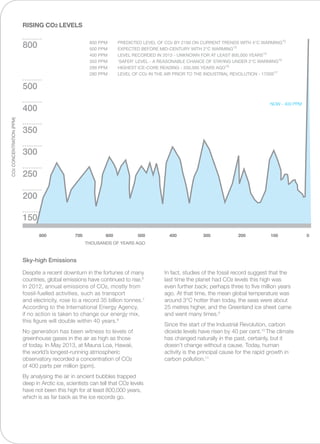
Despite a recent downturn in the fortunes of many
countries, global emissions have continued to rise.6
In 2012, annual emissions of CO2, mostly from
fossil-fuelled activities, such as transport
and electricity, rose to a record 35 billion tonnes.7
According to the International Energy Agency,
if no action is taken to change our energy mix,
this figure will double within 40 years.8
No generation has been witness to levels of
greenhouse gases in the air as high as those
of today. In May 2013, at Mauna Loa, Hawaii,
the world’s longest-running atmospheric
observatory recorded a concentration of CO2
of 400 parts per million (ppm).
By analysing the air in ancient bubbles trapped
deep in Arctic ice, scientists can tell that CO2 levels
have not been this high for at least 800,000 years,
which is as far back as the ice records go.
In fact, studies of the fossil record suggest that the
last time the planet had CO2 levels this high was
even further back; perhaps three to five million years
ago. At that time, the mean global temperature was
around 3°C hotter than today, the seas were about
25 metres higher, and the Greenland ice sheet came
and went many times.9
Since the start of the Industrial Revolution, carbon
dioxide levels have risen by 40 per cent.10
The climate
has changed naturally in the past, certainly, but it
doesn’t change without a cause. Today, human
activity is the principal cause for the rapid growth in
carbon pollution.11
Sky-high Emissions
NOW - 400 PPM
RISING CO2 LEVELS
800 700 600 500 400 300 200 100 0
thousands of years ago
Co2concentration(PPM)
200
150
250
300
350
400
500
800 800 ppm 	 Predicted level of CO2 by 2100 on current trends with 4°C warming12
500 ppm 	Expected before mid-century with 2°C warming13
400 ppm 	Level recorded in 2013 - unknown for at least 800,000 years14
350 ppm 	 ‘Safer’ level - a reasonable chance of staying under 2°C warming15
299 ppm 	Highest ice-core reading - 330,000 years ago16
280 ppm 	Level of CO2 in the air prior to the Industrial Revolution - 1700s17
06
These striking events follow the warmest decade since
records began. Australia’s average daily maximum
temperatures have warmed by about 0.8°C since
1910.25
The frequency of days above 40°C is rising,
the frequency of heatwaves is increasing, and record
hot days now outnumber extremely cold days by
more than two to one.26
Southern Australia—where
most of us live and most of our food is produced—has
seen a significant decline in average annual rainfall.
At the same time, in the north, the risk of torrential
downpours and flooding rises with every degree.27
Ready or not, we are living with the early symptoms
of climate change. The financial, environmental and
human costs are already being felt.
The Canary in the Coalmine
The average global temperature is now around 0.8°C
higher than it was at the start of the 20th century.
And it’s getting warmer faster: the 20 warmest years
on record have all occurred since 1981, and the 10
warmest since 2000.18
Global temperatures hit a new
record high in 2010.19
Glaciers worldwide are losing ice, and the Arctic sea
ice is thinning and shrinking.20
According to the US
National Snow and Ice Data Center, the waters around
the North Pole could be ice free in summer by 2030.21
Sea ice is the canary in the coalmine: an indicator
of worldwide warming with disturbing, far-reaching
consequences.
Over the planet as a whole, areas dry today are
projected to become even drier and wet areas
wetter.22
In southeastern Australia, high fire-danger
conditions increased rapidly through the 1990s
and early 2000s.23
Despite the flooding in 2010 and
2011, most of the continent saw drier-than-average
conditions in 2011, and the summer of 2012–13 was
the hottest on record.24
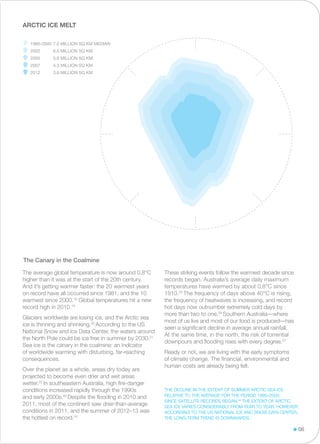
arctic ice melt
1980-2000	7.0 million sq km median	
2002 	 6.0 million sq km 	
2005	 5.6 million sq km 	
2007	 4.3 million sq km 	
2012	 3.6 million sq km
The decline in the extent of summer Arctic sea ice
relative to the average for the period 1980–2000;
since satellite records began.28
The extent of Arctic
sea ice varies considerably from year to year. However,
according to the US National Ice and Snow Data Center,
the long-term trend is downwards.’
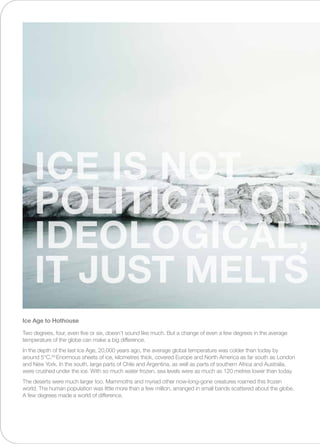
Two degrees, four, even five or six, doesn’t sound like much. But a change of even a few degrees in the average
temperature of the globe can make a big difference.
In the depth of the last Ice Age, 20,000 years ago, the average global temperature was colder than today by
around 5°C.29
Enormous sheets of ice, kilometres thick, covered Europe and North America as far south as London
and New York. In the south, large parts of Chile and Argentina, as well as parts of southern Africa and Australia,
were crushed under the ice. With so much water frozen, sea levels were as much as 120 metres lower than today.
The deserts were much larger too. Mammoths and myriad other now-long-gone creatures roamed this frozen
world. The human population was little more than a few million, arranged in small bands scattered about the globe.
A few degrees made a world of difference.
Ice Age to Hothouse
ICE IS NOT
POLITICAL OR
IDEOLOGICAL,
IT JUST MELTS
The warming that thawed the ice and brought humanity out of the cold, fundamentally changed the face of
the planet. The climate does not change without being forced to: from the depths of the Ice Age to 12,500
years ago, subtle changes in the Earth’s orbit together with a naturally occurring rise in carbon dioxide levels
raised the mean global temperature by about 5°C.30
These few degrees were enough to completely alter the
environment, cause widespread coastal inundation, trigger innumerable extinctions, and see people begin
to switch from hunting and gathering to farming.
And if a few degrees change in the average temperature was enough to so drastically and irreversibly change
the prehistoric world, imagine what a few more might do. Back then, the warming took thousands of years,
the world has already warmed by almost 1°C on average in a century. The projected rise of between
4°C and 6°C will take mere decades.31
Today, there are more than 7 billion human beings, and our numbers grow by about a million every week.
By 2050, there could be as many as 9 billion people. We have nowhere else to go. Each degree risks making
life for billions of people more dangerous; undoing decades of social and economic progress.
A Shock to the System
08
A rapidly changing climate drives not just
warmer but wilder weather. Past weather
patterns are no longer a good guide to future
risk. As new data has come to hand, and the
scientific models found to match observed
changes, projections of future climate risk
have tended to become more dire, not less.
On present trends, we will pump enough
carbon pollution into the air to push the world’s
temperature up by about 4–6°C above the
pre-industrial average by 2100. And if the
promises already made are not kept, we could
hit the 4°C-mark decades earlier.32
Cooking the Planet
CHANGE
Four degrees of warming is highly likely to
produce a planet marked with more frequent
and more severe drought, chronic catastrophic
fires, heavier downpours and more frequent
floods, and more intense tropical cyclones.
This will require extraordinary adaptation efforts.34
The risks associated with environmental changes
are often non-linear. Rather, they can blow out,
with dramatic step changes. For example, a really
big storm surge today might occur, on average,
once a century. But research suggests that with
only a 10cm sea-level rise, such extreme events are
likely to occur several times a year. A 50cm sea-level
rise could see such dangerous surges occurring
hundreds of times a year in some locations.35
Similarly, bushfire risk in southeastern Australia is
projected to increase by 5 per cent with a 1.5°C rise
in global temperatures above pre-industrial levels,
but by 20 per cent with a 3.4°C increase.36
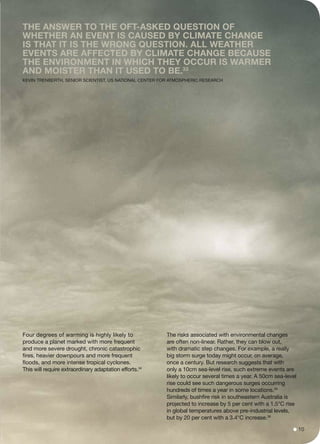
The answer to the oft-asked question of
whether an event is caused by climate change
is that it is the wrong question. All weather
events are affected by climate change because
the environment in which they occur is warmer
and moister than it used to be.33
Kevin Trenberth, senior scientist, US National Center for Atmospheric Research
10
The future, by definition, is unknowable. While the
science can tell us, in broad terms, the shape of
things to come under different warming scenarios,
we can’t yet know exactly how the impacts will unfold
or how they’ll interact. We don’t know how fast we
need to adapt nor, given how climate change could
erode our prosperity, whether we will have the shared
wealth to cope with the worst scenarios.
We should not be lulled into a false sense of security,
thinking that the globe will warm slowly, gently or
steadily. Instead, natural climate variability is mixing
with climate change; a cocktail that is likely to
produce a more volatile environment.
These more hostile conditions can cause a
breakdown in natural services such as those that
deliver soil fertility and drinking water leading to
chronic food and water shortages, environmental
and economic deterioration, more ill health,
large-scale movements of people, all of which
place immense stress on people, commerce,
and the institutions of government, further straining
international relations, and causing a much higher
security risk.
Scientists have long voiced concern that global
warming might reach one or more tipping points:
thresholds beyond which even a little more warming
radically alters key elements of the climate system,
causing conditions to deteriorate permanently.37
Examples include a massive dieback of the Amazon
rainforest, interruptions to the Indian Monsoon,
and the loss of summer sea ice in the Arctic.
Some changes may accelerate the warming.
It is feared, for instance, that a thawing of the
Arctic permafrost could release massive volumes
of methane, itself a potent greenhouse gas.
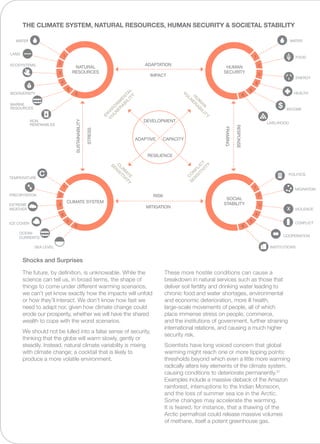
Shocks and Surprises
RISK
SUSTAINABILITY
RESPONSE
ADAPTATION
NATURAL
RESOURCES
CLIMATE SYSTEM
SOCIAL
STABILITY
HUMAN
SECURITY
LIVELIHOOD
EN
VIR
O
N
M
EN
TAL
VU
LN
ER
ABILITY
H
U
M
AN
VU
LN
ER
ABILITY
C
LIM
ATE
SEN
SITIVITY
C
O
N
FLIC
T
SEN
SITIVITYMITIGATION
STRESS
FRAMING
IMPACT
CAPACITYADAPTIVE
RESILIENCE
DEVELOPMENT
THE CLIMATE SYSTEM, NATURAL RESOURCES, HUMAN SECURITY & SOCIETAL STABILITY
1
1
2
2
3
3
4
4
5
5
6
6
WATER WATER
POLITICS
MIGRATION
VIOLENCE
CONFLICT
COOPERATION
INSTITUTIONS
FOOD
ENERGY
HEALTH
INCOME
LAND
ECOSYSTEMS
TEMPERATURE
PRECIPITATION
EXTREME
WEATHER
ICE COVER
SEA LEVEL
OCEAN
CURRENTS
BIODIVERSITY
MARINE
RESOURCES
NON
RENEWABLES
$
C
1
1
3
3
4
4
6
6
2
2
5
5
AGRICULTURE INFRASTRUCTURE HEALTH ECOSYSTEMS REGIONAL SECURITY ATMOSPHERIC
CO2 (PPM)
12
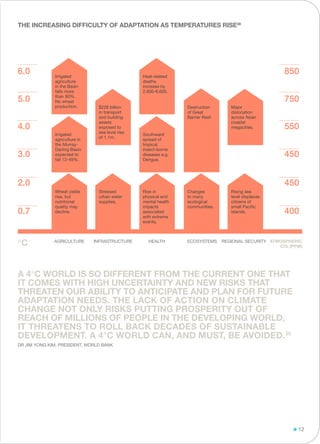
A 4°C world is so different from the current one that
it comes with high uncertainty and new risks that
threaten our ability to anticipate and plan for future
adaptation needs. The lack of action on climate
change not only risks putting prosperity out of
reach of millions of people in the developing world,
it threatens to roll back decades of sustainable
development. A 4°C world can, and must, be avoided.39
Dr Jim Yong Kim, President, World Bank
°C
0.7 400
2.0 450
4503.0
5504.0
750
850
5.0
6.0
Wheat yields
rise, but
nutritional
quality may
decline.
Stressed
urban water
supplies.
Rising sea
level displaces
citizens of
small Pacific
islands.
Irrigated
agriculture in
the Murray-
Darling Basin
expected to
fall 12-49%.
$226 billion
in transport
and building
assets
exposed to
sea level rise
of 1.1m.
Major
dislocation
across Asian
coastal
megacities.
Irrigated
agriculture
in the Basin
falls more
than 90%.
No wheat
production.
Rise in
physical and
mental health
impacts
associated
with extreme
events.
Southward
spread of
tropical
insect-borne
diseases e.g.
Dengue.
Heat-related
deaths
increase by
2,600-8,600.
Changes
to many
ecological
communities.
Destruction
of Great
Barrier Reef.
THE INCREASING DIFFICULTY OF ADAPTATION AS TEMPERATURES RISE38
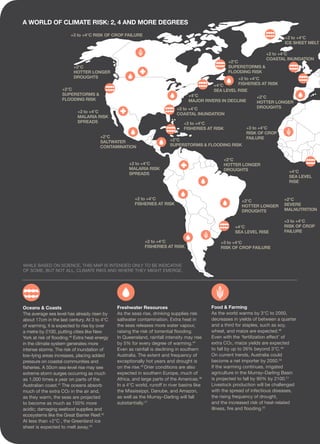
A world of CLIMATE RISK: 2, 4 and more degrees
Freshwater Resources
As the seas rise, drinking supplies risk
saltwater contamination. Extra heat in
the seas releases more water vapour,
raising the risk of torrential flooding.
In Queensland, rainfall intensity may rise
by 5% for every degree of warming.44
Even as rainfall is declining in southern
Australia. The extent and frequency of
exceptionally hot years and drought is
on the rise.45
Drier conditions are also
expected in southern Europe, much of
Africa, and large parts of the Americas.46
In a 4°C world, runoff in river basins like
the Mississippi, Danube, and Amazon,
as well as the Murray–Darling will fall
substantially.47
Food & Farming
As the world warms by 3°C to 2050,
decreases in yields of between a quarter
and a third for staples, such as soy,
wheat, and maize are expected.48
Even with the ‘fertilization effect’ of
extra CO2, maize yields are expected
to fall by up to 26% beyond 3°C.49
On current trends, Australia could
become a net importer by 2050.50
If the warming continues, irrigated
agriculture in the Murray–Darling Basin
is projected to fall by 90% by 2100.51
Livestock production will be challenged
with the spread of infectious diseases,
the rising frequency of drought,
and the increased risk of heat-related
illness, fire and flooding.52
Oceans & Coasts
The average sea level has already risen by
about 17cm in the last century. At 3 to 4°C
of warming, it is expected to rise by over
a metre by 2100, putting cities like New
York at risk of flooding.40
Extra heat energy
in the climate system generates more
intense storms. The risk of inundation of
low-lying areas increases, placing added
pressure on coastal communities and
fisheries. A 50cm sea-level rise may see
extreme storm surges occurring as much
as 1,000 times a year on parts of the
Australian coast.41
The oceans absorb
much of the extra CO2 in the air and,
as they warm, the seas are projected
to become as much as 150% more
acidic; damaging seafood supplies and
ecosystems like the Great Barrier Reef.42
At less than +2°C , the Greenland ice
sheet is expected to melt away.43
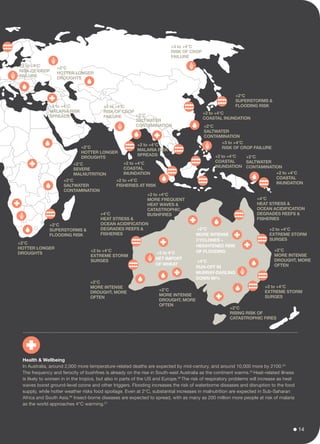
WHILE BASED ON SCIENCE, THIS map IS INTENDED only TO BE indicative
OF SOME, BUT NOT ALL, CLIMATE RIKS AND WHERE THEY MIGHT EMERGE.
+2 to +4°C
MALARIA RISK
SPREADS
+2 to +4°C
MALARIA RISK
SPREADS
+2 to +4°C
FISHERIES AT RISK
+2 to +4°C
FISHERIES AT RISK
+2 to +4°C
FISHERIES AT RISK
+2 to +4°C
FISHERIES AT RISK
+2 to +4°C
COASTAL INUNDATION
+2 to +4°C
COASTAL INUNDATION
+2°C
SALTWATER
CONTAMINATION
+4°C
MAJOR RIVERS IN DECLINE
+4°C
SEA LEVEL RISE
+4°C
SEA LEVEL RISE
+4°C
SEA LEVEL
RISE
+2°C
SEVERE
MALNUTRITION
+2°C
SUPERSTORMS &
FLOODING RISK
+2°C
SUPERSTORMS &
FLOODING RISK
+2 to +4°C
ICE SHEET MELT
+2°C
SUPERSTORMS & FLOODING RISK
+2°C
HOTTER LONGER
DROUGHTS
+2°C
HOTTER LONGER
DROUGHTS
+2°C
HOTTER LONGER
DROUGHTS
+2°C
HOTTER LONGER
DROUGHTS
+3 to +4°C RISK OF CROP FAILURE
+3 to +4°C
RISK OF CROP FAILURE
+3 to +4°C
RISK OF CROP
FAILURE
+3 to +4°C
RISK OF CROP
FAILURE
Health & Wellbeing
In Australia, around 2,000 more temperature-related deaths are expected by mid-century, and around 10,000 more by 2100.53
The frequency and ferocity of bushfires is already on the rise in South-east Australia as the continent warms.54
Heat-related illness
is likely to worsen in in the tropics, but also in parts of the US and Europe.55
The risk of respiratory problems will increase as heat
waves boost ground-level ozone and other triggers. Flooding increases the risk of waterborne diseases and disruption to the food
supply, while hotter weather risks food spoilage. Even at 2°C, substantial increases in malnutrition are expected in Sub-Saharan
Africa and South Asia.56
Insect-borne diseases are expected to spread, with as many as 200 million more people at risk of malaria
as the world approaches 4°C warming.57
14
+2 to +4°C
EXTREME STORM
SURGES
+2 to +4°C
MORE FREQUENT
HEAT WAVES &
CATASTROPHIC
BUSHFIRES
+2°C
MORE INTENSE
CYCLONES +
HEIGHTENED RISK
OF FLOODING
+4°C
RUN-OFF IN
MURRAY-DARLING
DOWN 90%
+2 to 4°C
NET IMPORT
OF WHEAT
+4°C
HEAT STRESS &
OCEAN ACIDIFICATION
DEGRADES REEFS &
FISHERIES
+4°C
HEAT STRESS &
OCEAN ACIDIFICATION
DEGRADES REEFS &
FISHERIES
+2 to +4°C
EXTREME STORM
SURGES
+2 to +4°C
EXTREME STORM
SURGES
+2 to +4°C
MALARIA RISK
SPREADS
+2 to +4°C
MALARIA RISK
SPREADS
+2 to +4°C
FISHERIES AT RISK
+2 to +4°C
COASTAL
INUNDATION +2 to +4°C
COASTAL
INUNDATION
+2 to +4°C
COASTAL
INUNDATION
+2 to +4°C
COASTAL INUNDATION
+2°C
SEVERE
MALNUTRITION
+2°C
SUPERSTORMS &
FLOODING RISK
+2°C
SUPERSTORMS &
FLOODING RISK
+2°C
HOTTER LONGER
DROUGHTS
+2°C
SALTWATER
CONTAMINATION
+2°C
SALTWATER
CONTAMINATION
+2°C
SALTWATER
CONTAMINATION
+2°C
SALTWATER
CONTAMINATION
+2°C
HOTTER LONGER
DROUGHTS
+2°C
HOTTER LONGER
DROUGHTS
+3 to +4°C
RISK OF CROP
FAILURE
+3 to +4°C
RISK OF CROP
FAILURE
+3 to +4°C
RISK OF CROP FAILURE
+3 to +4°C
RISK OF CROP
FAILURE
+2°C
MORE INTENSE
DROUGHT, MORE
OFTEN
+2°C
MORE INTENSE
DROUGHT, MORE
OFTEN
+2°C
MORE INTENSE
DROUGHT, MORE
OFTEN
+2°C
RISING RISK OF
CATASTROPHIC FIRES
A storm, heat wave or drought doesn’t occur in
a vacuum. No country, community or company
experiences disasters in isolation. We live in an
interdependent world; one facing dwindling stocks
of critical resources, such as freshwater, seafood,
soil, and arable land. Strife in one corner of the
world easily spills over into others. Disasters tie up
emergency services, armed forces, and medical
teams. They damage supplies of power, water,
fuel and food. They destroy farms and damage
tourism, and may slash export earnings by millions,
even billions of dollars.
The recent uprisings in the Arab world, for example,
were catalysed in part by rising food prices.59
When the world food crisis of 2007–08 hit there
were already nearly a billion people undernourished;
the crisis saw hundreds of millions more people
plunged into hunger and food stress. The crisis
compromised trade, triggered riots in major cities,
and saw old grievances explode into violence.
The causes of the crisis were many (including more
expensive oil and fertilisers) but drought in
grain-producing countries like Australia served to
amplify price shocks.60
There is still a lot that is not known about how impacts
on one sector or region might cascade into others.
In a world heading towards more and more intense
extremes, the direct and indirect or knock-on
effects are beginning to worry agencies whose job
it is to promote economic development. According to
the Asian Development Bank, climate change is
one of the greatest emerging threats to food security
in the region.61
A Less Safe, Less Secure World
Climate change will exacerbate existing hardships and
stresses in our neighbourhood, possibly risking the
reaching of critical tipping points... As the world
becomes more networked, the impacts of climate
change in one country or region will affect the
prosperity and security of others around the world.58
Australian Strategic Policy Institute
The Internal Displacement Monitoring Centre reports
that, between 2009 and 2011, more than 40 million
people in the Asia-Pacific region were displaced by
climate-related and extreme weather events.63
The poor in particular will struggle to cope with more
and more extreme events and gradual or even abrupt
environmental deterioration—all compounded by
pre-existing problems, such as civil strife, war, and
endemic poverty.
The drivers of population displacement and migration
are complex. Climate change adds a new layer
of complexity and a new driver. Predictions of the
likely number of future ‘environmental refugees’
vary widely—from tens of millions to up to a billion
by 2050—and will depend on a host of factors,
including how quickly and forcefully the world acts
to rein in emissions.64
Take our fragile, crowded, hungry, interconnected
world and turn up the thermostat by a few
degrees. What will happen? How will communities,
governments, companies, and the natural
environment cope? A growing stack of American
and European reports has identified climate change
as an emerging risk to peace and security.65
Recent work by the American Security Project
reveals that the defence departments and intelligence
services of more than 100 countries now view global
warming as, not simply an environmental issue,
but a real risk to national security.66
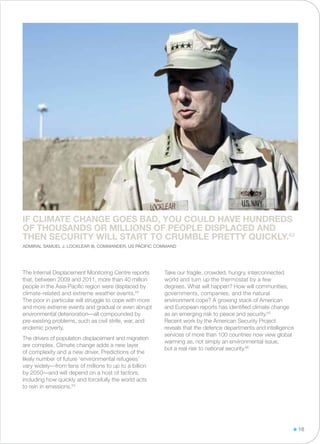
If climate change goes bad, you could have hundreds
of thousands or millions of people displaced and
then security will start to crumble pretty quickly.62
Admiral Samuel J. Locklear III, Commander, US Pacific Command
16
As the temperature rises and the climate shifts,
the risks to human health from more hostile weather
climb and multiply, as if the direct effects of heat
waves, torrential downpours, floods, storm surges,
and bushfires weren’t already bad enough.
Matching food output and quality to 21st century
demand will be a hard enough challenge as it
is, but climate change will almost certainly make
agriculture overall a lot harder as the century wears
on. Moreover, food safety can be compromised by
extremely hot weather, and the nutritional quality
of crops can be degraded as key environmental
factors shift. Loading up the air with extra CO2, for
example, is known to depress protein yield in wheat
and elevate toxins such as cyanide in other staples.68
Much extra CO2 is actually dissolved in the seas,
raising the acidity of the waters. A warming of 4°C
equates to a rise in the acidity of the oceans of
about 150 per cent, with profound consequences
for seafood production.69
As weather patterns change and the temperature rises,
so too the spread of existing infections will change
and new diseases arise. Mosquito-borne diseases,
such as Dengue Fever, are likely to spread further
afield; affecting millions more people. Today’s climate
confines Dengue to North Queensland, but with
northern Australia becoming both hotter and wetter,
millions more Australians are likely to be exposed to
the infection in coming decades.70
The frequency of extremely hot days in Australia has
already doubled since 1960, with heat waves rising
in frequency.71
According to Australia’s Bureau of
Meteorology and CSIRO, with no action on climate
change, the end of the century will see the number
of days in a year over 35°C rise 2.5 times in Adelaide,
treble in Melbourne in Hobart, quadruple in Sydney,
be six times higher in Canberra, and 20 times in
Brisbane.72
In Perth, for more than two months
out of a given year, the mercury will soar over 35°C,
as it will for 10 months in Darwin.73
The Human Costs of Climate Change
Climate change is the biggest global health threat of
the 21st century... the impacts will be felt all around
the world, and not just in some distant future but in
our lifetimes and those of our children.67
The Lancet, 2009
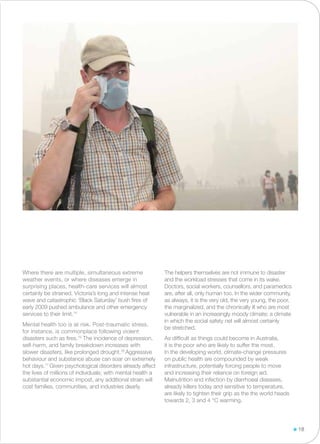
Where there are multiple, simultaneous extreme
weather events, or where diseases emerge in
surprising places, health-care services will almost
certainly be strained. Victoria’s long and intense heat
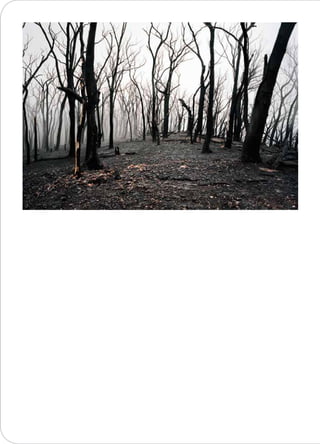
wave and catastrophic ‘Black Saturday’ bush fires of
early 2009 pushed ambulance and other emergency
services to their limit.74
Mental health too is at risk. Post-traumatic stress,
for instance, is commonplace following violent
disasters such as fires.75
The incidence of depression,
self-harm, and family breakdown increases with
slower disasters, like prolonged drought.76
Aggressive
behaviour and substance abuse can soar on extremely
hot days.77
Given psychological disorders already affect
the lives of millions of individuals; with mental health a
substantial economic impost, any additional strain will
cost families, communities, and industries dearly.
The helpers themselves are not immune to disaster
and the workload stresses that come in its wake.
Doctors, social workers, counsellors, and paramedics
are, after all, only human too. In the wider community,
as always, it is the very old, the very young, the poor,
the marginalized, and the chronically ill who are most
vulnerable in an increasingly moody climate; a climate
in which the social safety net will almost certainly
be stretched.
As difficult as things could become in Australia,
it is the poor who are likely to suffer the most.
In the developing world, climate-change pressures
on public health are compounded by weak
infrastructure, potentially forcing people to move
and increasing their reliance on foreign aid.
Malnutrition and infection by diarrhoeal diseases,
already killers today and sensitive to temperature,
are likely to tighten their grip as the the world heads
towards 2, 3 and 4 °C warming.
18
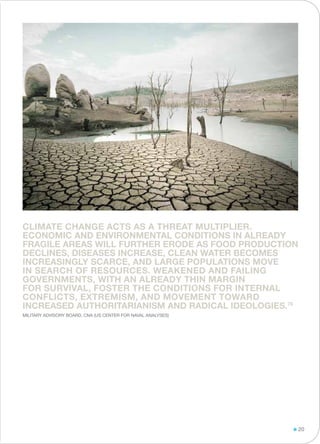
Climate change acts as a threat multiplier.
Economic and environmental conditions in already
fragile areas will further erode as food production
declines, diseases increase, clean water becomes
increasingly scarce, and large populations move
in search of resources. Weakened and failing
governments, with an already thin margin
for survival, foster the conditions for internal
conflicts, extremism, and movement toward
increased authoritarianism and radical ideologies.78
Military Advisory Board, CNA (US CENTER FOR NAVAL ANALYSES)
20
There are some reasons to be optimistic: the last
decade has seen a global boom in clean energy
and other low-pollution investment. In 2011, nearly
half of all global investment in power generation
was directed towards clean energy.80
More than 80 countries representing around
80 per cent of global emissions have now
committed to reduce or limit their carbon pollution.
All major economies, including the US and China,
are implementing policies to reduce emissions,
drive clean energy investment, and improve energy
efficiency. Several developing nations, China,
Brazil, South Africa, Mexico, and India, amongst
them, are following suit.
At recent UN conferences, 190 countries agreed to
hold global warming to below 2°C.81
While the ink
is on paper, it remains to be seen if words translate
into the level of action matching the scale and
urgency of the task.
However, 2°C is a global guardrail to steer clear of;
it is not a benchmark of safety to aim for. Keeping under
2°C reduces but doesn’t rid us of the risk of dangerous
climate change. It does help to focus the attention of
governments and to steer international effort away
from the worst scenarios, but it is far from a safe goal.
Beyond 2°C the world enters dangerous territory.
The science suggests we are headed for tipping points
in the earth system beyond which adaption becomes
very difficult and costly. The limit of 1.5–2°C is the
global community’s best guess of a global warming
guardrail; above this the risk of abrupt, irreversible,
and dangerous climate change rises.
There is a big and growing gap between the emissions
pathway we need to be on to avoid a rise over 2°C
and the one we’re on. To give the world a reasonable
chance of staying well below the 2°C line, emissions
must peak before 2020 and fall steadily thereafter.82
The State of Global Action
Given the… damage after only 0.8°C of warming so far,
a target of 2°C seems almost cavalier.79
Realclimate.org
22
Many nations, including Australia, as well as numerous
local communities and leading firms, have made good
steps in the right direction. Often, action is taken
because clean energy and energy efficiency simply
make good economic and/or business sense.
Dozens of countries have already put a price on
pollution, signalling the market to invest and innovate
in the right direction.
Closing the gap towards effective action is still doable
- technically and economically. Modelling of emissions
trajectories suggests that, despite rising emissions
to date, it is still possible to meet even a 1.5°C by
2100 target and avoid altogether the risks of a world
2°C hotter.83
In fact, to 2020, the path to 1.5°C
or 2°C is much the same.84
The technology and
know-how already exist to re-tool the economy and
meet the world’s energy, food, and other needs in a
much cleaner way.
* from 1990 levels
** temperature rise is relative to pre-industrial
levels and ranges from the most likely (50% chance
of occurring) to the worst case (10% chance of
occurring).
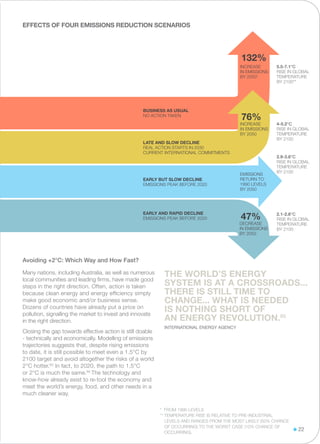
Avoiding +2°C: Which Way and How Fast?
Business as usual
NO ACTION TAKEN
5.5-7.1°C
RISE IN GLOBAL
TEMPERATURE
BY 2100**
4-5.2°C
RISE IN GLOBAL
TEMPERATURE
BY 2100
2.9-3.8°C
RISE IN GLOBAL
TEMPERATURE
BY 2100
2.1-2.8°C
RISE IN GLOBAL
TEMPERATURE
BY 2100
increase
in emissions
by 2050*
132%
76%
47%
increase
in emissions
by 2050
DEcrease
in emissions
BY 2050
emissions
RETURN TO
1990 LEVELS
BY 2050
Late and slow decline
REAL action starts in 2030
Current International Commitments
early but slow decline
Emissions peak before 2020
early and rapid decline
emissions peak before 2020
EFFECTS OF four emissions reduction SCENARIOS
The world’s energy
system is at a crossroads...
there Is still time to
change... What is needed
is nothing short of
an energy revolution.85
International Energy Agency
STEERING CLEAR
OF 4°C
6 2
4
12.0107
Capture and Store Carbon
It would be imprudent to bet on a wholesale
transformation of the energy supply in the short
time available to avoid dangerous warming.
Modelling of future warming shows that even if
humanity were to stop pumping out greenhouse
gases today, the global temperature would still
rise by at least another degree or so. Atmospheric
levels of CO2 and other pollutants are already
too high. Carbon must be drawn down out of
the atmosphere. Moreover, the heavy base of
fossil-fuelled power already installed is difficult to
unbuild and replace, and has decades yet to run.
To cut the risk of long-term warming beyond
2°C we must, in effect, produce a nett drop in
emissions, i.e. negative emissions. This means
scaling up reforestation efforts. It also means
biomass power stations equipped with carbon
capture and storage (CCS) facilities.
Reduce all Pollutants
There are no two ways about it: without cuts
in carbon dioxide emissions, the world cannot
avoid runaway warming. It is very important,
however, that deep reductions are made in all
greenhouse gases: methane, nitrous oxide,
and others. Focusing on some pollutants at the
expense of others will only make the task harder.
Cutting other pollutants, such as ozone, sulphur
oxide and soot, will not only help to keep global
warming in check, but also save lives and
health-care costs. An effective mitigation strategy
means spreading the effort.
24
Invest in a Broad Mix of Cleaner Alternatives
In recent years, the renewable energy sector has
shown very strong growth, despite a downturn
in global economic activity overall. Policies that
catalyse a plethora of clean energy sources
will spread risk and cut the chances of any one
approach failing to live up to expectations.
Because of its capacity to both produce energy
more cleanly and to absorb carbon, bioenergy
is likely to feature strongly in future sustainable
energy mixtures. Australia also has abundant and
mostly untapped renewable energy resources
in solar, wind, geothermal, and wave energy.
Governments should also try to optimise the social,
environmental, and economic benefits that come
with the development of renewables.
Develop a Diverse Policy Portfolio
There is no silver bullet that will stop climate
change. No single policy measure or program
can work alone. Instead, a diversity of initiatives
is needed. This means scaling up existing efforts,
and filling in any gaps, to re-tool and re-design
the global economy, including: carbon pricing,
energy efficiency incentives, research and
development, commercialising clean energy,
reduced deforestation, and cleaner transport.
Make Sure all Major Emitters do their Share
At the UN negotiations in Durban, South Africa,
2011, nations agreed to finish, by 2015, a new
legal framework covering all major emitters;
those countries with the highest contribution to
the problem. The decision to adopt a new, single,
binding agreement in 2015 is important for both
political and practical reasons: by bringing in
China, India and other major sources of pollution,
it removes a key barrier to a US commitment to
pollution reductions. As the negotiations unfold,
it is still an open question whether Australia will,
in its role as a middle power, deploy its diplomacy
to strengthen global ambition, or weaken it.
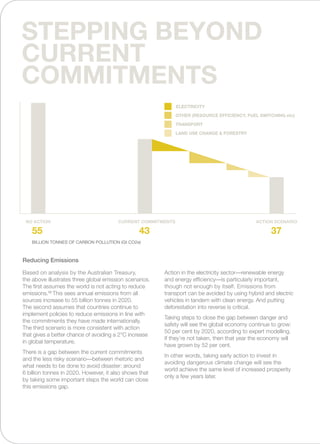
Based on analysis by the Australian Treasury,
the above illustrates three global emission scenarios.
The first assumes the world is not acting to reduce
emissions.86
This sees annual emissions from all
sources increase to 55 billion tonnes in 2020.
The second assumes that countries continue to
implement policies to reduce emissions in line with
the commitments they have made internationally.
The third scenario is more consistent with action
that gives a better chance of avoiding a 2°C increase
in global temperature.
There is a gap between the current commitments
and the less risky scenario—between rhetoric and
what needs to be done to avoid disaster: around
6 billion tonnes in 2020. However, it also shows that
by taking some important steps the world can close
this emissions gap.
Action in the electricity sector—renewable energy
and energy efficiency—is particularly important,
though not enough by itself. Emissions from
transport can be avoided by using hybrid and electric
vehicles in tandem with clean energy. And putting
deforestation into reverse is critical.
Taking steps to close the gap between danger and
safety will see the global economy continue to grow:
50 per cent by 2020, according to expert modelling.
If they’re not taken, then that year the economy will
have grown by 52 per cent.
In other words, taking early action to invest in
avoiding dangerous climate change will see the
world achieve the same level of increased prosperity
only a few years later.
Reducing Emissions
STEPPING BEYOND
CURRENT
COMMITMENTS
55 43 37
BILLION TONNES OF CARBON POLLUTION (Gt CO2e)
NO ACTION ACTION SCENARIOCURRENT COMMITMENTS
other (resource efficiency, fuel switching etc)
land use change  forestry
transport
electricity
The International Energy Agency warns that current
investments in buildings, transportation systems,
factories and other infrastructure are locking in high
energy-use patterns and associated emissions for
decades, limiting future options for abating emissions
and stranding assets.87
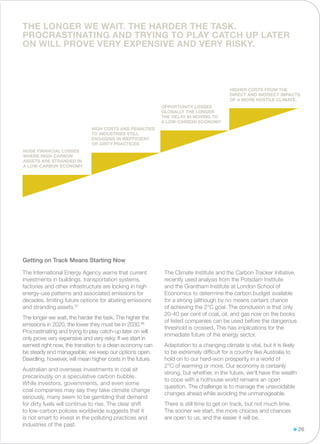
The longer we wait, the harder the task. The higher the
emissions in 2020, the lower they must be in 2030.88
Procrastinating and trying to play catch-up later on will
only prove very expensive and very risky. If we start in
earnest right now, the transition to a clean economy can
be steady and manageable; we keep our options open.
Dawdling, however, will mean higher costs in the future.
Australian and overseas investments in coal sit
precariously on a speculative carbon bubble.
While investors, governments, and even some
coal companies may say they take climate change
seriously, many seem to be gambling that demand
for dirty fuels will continue to rise. The clear shift
to low-carbon policies worldwide suggests that it
is not smart to invest in the polluting practices and
industries of the past.
The Climate Institute and the Carbon Tracker Initiative,
recently used analysis from the Potsdam Institute
and the Grantham Institute at London School of
Economics to determine the carbon budget available
for a strong (although by no means certain) chance
of achieving the 2°C goal. The conclusion is that only
20-40 per cent of coal, oil, and gas now on the books
of listed companies can be used before the dangerous
threshold is crossed. This has implications for the
immediate future of the energy sector.
Adaptation to a changing climate is vital, but it is likely
to be extremely difficult for a country like Australia to
hold on to our hard-won prosperity in a world of
2°C of warming or more. Our economy is certainly
strong, but whether, in the future, we’ll have the wealth
to cope with a hothouse world remains an open
question. The challenge is to manage the unavoidable
changes ahead while avoiding the unmanageable.
There is still time to get on track, but not much time.
The sooner we start, the more choices and chances
are open to us, and the easier it will be.
Getting on Track Means Starting Now
26
HUGE FINANCIAL LOSSES
WHERE HIGH-CARBON
ASSETS ARE STRANDED IN
A LOW-CARBON ECONOMY
HIGH COSTS AND PENALTIES
TO INDUSTRIES STILL
ENGAGING IN INEFFICIENT
OR DIRTY PRACTICES
OPPORTUNITY LOSSES
GLOBALLY THE LONGER
THE DELAY IN MOVING TO
A LOW-CARBON ECONOMY
HIGHER COSTS from the
direct and indirect impacts
of a more hostile climate.
THE LONGER WE WAIT. THE HARDER THE TASK.
PROCRASTINATING and trying to play catch up later
on will prove very expensive and very risky.
Notes
1 Carbon Dioxide Information Analysis Center, ‘Fossil-Fuel CO2
Emissions by Region’, http://cdiac.ornl.gov/trends/emis/
tre_regn.html
2 C. Le Quéré et al. ‘The Global Carbon Budget 1959–2011’
Earth System Science Data Discussions, 5, 1107–1157,
2 December 2012, doi:10.5194/ essdd-5-1107-2012,
http://bit.ly/UY8GTQ
3 M. Sandiford ‘Our effect on the earth is real: how we’re
geo-engineering the planet’, The Conversation, June 16,
2011, http://theconversation.com/our-effect-on-the-earth-is-
real-how-were-geo-engineering-the-planet-1544
4 S. Solomon et al. (eds.), Climate Change 2007: The Physical
Science Basis. Contribution of Working Group I to the Fourth
Assessment Report of the Intergovernmental Panel on
Climate Change, Cambridge University Press, Cambridge,
United Kingdom and New York, NY, USA, 2007.
5 Potsdam Institute for Climate Impact Research and
Climate Analytics, 4°: Turn Down the Heat, The World Bank,
Washington, DC, November 2012.
6 Le Quéré et al, Op Cit.
7 Le Quéré et al, Op Cit.
8 IEA, ‘Tracking Clean Energy Progress’, International
Energy Agency, 2012, http://www.iea.org/publications/
freepublications/publication/Tracking_Clean_Energy_
Progress.pdf
9 R. Monroe, ‘What Does 400 ppm Look Like?’ The Keeling
Curve, Scripps Institution of Oceanography, April 25, 2013,
http://keelingcurve.ucsd.edu/what-does-400-ppm-look-like/
10 CSIRO, ‘The Science of Climate Change, http://www.csiro.
au/en/Outcomes/Climate/Understanding/the-science-of-
climate-change/Greenhouse-gases-and-climate-change.aspx
11 CSIRO, Op Cit.
12 Potsdam Institute for Climate Impact Research and Climate
Analytics, Op Cit.
13 Potsdam Institute for Climate Impact Research and Climate
Analytics, Op Cit.
14 http://keelingcurve.ucsd.edu/special-note-on-may-9-2013-
reading/
15 Scipps institution of Oceanography, ‘Special note on the May
9, 2013 reading’, The Keeling Curve, May 10, 2013, http://
keelingcurve.ucsd.edu/special-note-on-may-9-2013-reading/
16 Scipps Institution of Oceanography, http://keelingcurve.ucsd.
edu (specific curve re 800,000 years http://bluemoon.ucsd.
edu/co2_400/co2_800k.png)
17 Scipps Institution of Oceanography, http://keelingcurve.ucsd.
edu (specific curve re 300 years http://bluemoon.ucsd.edu/
co2_400/co2_800k_zoom.png)
18 CSIRO and Bureau of Meteorology, State of the Climate
– 2012, April 26, 2012, http://www.csiro.au/Outcomes/
Climate/Understanding/State-of-the-Climate-2012.aspx
19 CSIRO and BOM, Op Cit.
20 National Snow and Ice Data Center, ‘Arctic sea ice reaches
lowest extent for the year and the satellite’ September
19, 2012, recordhttp://nsidc.org/news/press/2012_
seaiceminimum.html
21 National Snow and Ice Data Center, ‘Arctic Sea Ice Shatters
All Previous Record Lows’, October 1, 2007, http://
nsidc.org/news/press/2007_seaiceminimum/20071001_
pressrelease.html
22 P. J. Durack, et al. ‘Ocean Salinities Reveal Strong Global
Water Cycle Intensification During 1950 to 2000’, Science,
2012; 336 (6080): 455 DOI: 10.1126/science.1212222
23 C. Lucas et al., Bushfire Weather in Southeast Australia:
Recent Trends and Projected Climate Change Impacts,
Bushfire CRC, Australian Bureau of Meteorology, and CSIRO
Marine and Atmospheric Research, Consultancy Report
prepared for The Climate Institute, September 2007. http://
www.climateinstitute.org.au/articles/publications/briefing-
bushfire-weather-in-south-east-australia.html
24 Bureau of Meteorology, ‘Special Climate Statement 43 –
extreme heat in January 2013’,
Updated 1 February 2013,
http://www.bom.gov.au/climate/current/statements/scs43e.pdf
25 CSIRO and Bureau of Meteorology, Op Cit.
26 N. Plummer et al. ‘What’s causing Australia’s heat wave?’
The Conversation, http://theconversation.com/whats-
causing-australias-heat-wave-11628
27 State of Queensland, Increasing Queensland’s resilience
to inland flooding in a changing climate: Final Report of
the Inland Flooding Study, 2010, www.ehp.qld.gov.au/
climatechange/pdf/inland-flood-study.pdf
28 National Oceanic and Atmospheric Administration, ‘Arctic
Change’, http://www.arctic.noaa.gov/detect/ice-seaice.html
29 T. Schneider von Deimling et al. ‘How cold was the
Last Glacial Maximum?’, Geophys. Res. Lett., 33, L14709,
doi:10.1029/2006GL026484, 2006.
30 Schneider von Deimling et al, Op Cit.
31 Solomon et al., Op Cit.
32 Potsdam Institute for Climate Impact Research and
Climate Analytics, Op Cit.
33 K. E. Trenberth, ‘Framing the way to relate climate extremes
to climate change’, Climatic Change, 115(2), 283–290,
November 2012.
34 Potsdam Institute for Climate Impact Research and
Climate Analytics, Op Cit.
35 Department of Climate Change, Climate Change Risk to
Australia’s Coasts, Commonwealth of Australia, 2009,
http://www.climatechange.gov.au/sites/climatechange/files/
documents/03_2013/cc-risks-full-report.pdf
36 Lucas et al., Op Cit.
37 T. M. Lenton, et al., ‘Tipping Elements in the Earth’s
Climate System’, PNAS 105 (6): 1786–1793. 2008,
doi:10.1073/pnas.0705414105
38 R. Garnaut, The Garnaut Climate Change Review, May
2011, http://www.garnautreview.org.au/chp6.htm; S. M.
Howden, et al., ‘Australian agriculture in a climate of change’.
In: Managing climate change: papers from the Greenhouse
2009 conference, pp 101–111. CSIRO Publishing, 2010.;
Department of Climate Change and Energy Efficiency, Op Cit.
39 Potsdam Institute for Climate Impact Research and Climate
Analytics, Op Cit., p ix
40 Potsdam Institute for Climate Impact Research and Climate
Analytics, Op Cit.,
41 Department of Climate Change, Op Cit.
42 Potsdam Institute for Climate Impact Research and Climate
Analytics, Op Cit.
43 A. Robinson et al., ‘Multistability and critical thresholds of the
Greenland ice sheet’, Nature Climate Change, 2, 429–432,
March 2012 [doi:10.1038/NCLIMATE1449]
44 State of Queensland, Increasing Queensland’s resilience
to inland flooding in a changing climate: Final Report of
the Inland Flooding Study, 2010, www.ehp.qld.gov.au/
climatechange/pdf/inland-flood-study.pdf
45 Plummer et al., Op. Cit.
46 Potsdam Institute for Climate Impact Research and Climate
Analytics, Op Cit.
47 Potsdam Institute for Climate Impact Research and Climate
Analytics, Op Cit.
48 Potsdam Institute for Climate Impact Research and Climate
Analytics, Op Cit.
49 Potsdam Institute for Climate Impact Research and Climate
Analytics, Op Cit.
50 S. M. Howden, et al., Australian agriculture in a climate of change.
In: Managing climate change: papers from the Greenhouse
2009 conference. pp 101–111. CSIRO Publishing, 2010.
51 R. Garnaut, The Garnaut Climate Change Review, May
2011, http://www.garnautreview.org.au/chp6.htm
52 S. M. Howden et al. ‘Climate change and Australian livestock
systems: impacts, research and policy issues’, Australian
Journal of Experimental Agriculture, 48(7) 780–788, June 20,
2008, http://dx.doi.org/10.1071/EA08033
53 L. Hughes and T. McMichael, The Critical Decade:
Climate Change and Health, Climate Commission,
November 2011, http://climatecommission.gov.au/wp-
content/uploads/111129_FINAL-FOR-WEB.pdf
54 Lucas et al., Op Cit.
55 Potsdam Institute for Climate Impact Research and Climate
Analytics, Op Cit.
56 Potsdam Institute for Climate Impact Research and Climate
Analytics, Op Cit.
57 Potsdam Institute for Climate Impact Research and Climate
Analytics, Op Cit.
58 A. Press et al., Heavy Weather: Climate and the Australian
Defence Force, Australian Strategic Policy Institute, Special
Report, Issue 49, March 2013, p 1, http://www.aspi.org.au/
publications/publication_details.aspx?ContentID=354
59 C. E. Werrell and F. Fermia, The Arab Spring and Climate
Change, The Center for American Progress, Stimson,
and The Center for Climate and Security, February 2013,
http://climateandsecurity.files.wordpress.com/2012/04/
climatechangearabspring-ccs-cap-stimson.pdf
60 Werrell and Fermia, Op Cit.
61 Asian development Bank, Food Security and Climate
Change in the Pacific: Rethinking the Options, ADB,
September 2011, http://www.adb.org/publications/food-
security-and-climate-change-pacific-rethinking-options
62 B. Bender, ‘Chief of US Pacific forces calls climate change
biggest worry’, Boston Globe, March 9, 2013, http://www.
bostonglobe.com/news/nation/2013/03/09/admiral-samuel-
locklear-commander-pacific-forces-warns-that-climate-
change-top-threat/BHdPVCLrWEMxRe9IXJZcHL/story.html
63 IDMC, Displacement due to natural hazard-induced
disasters: Global estimates for 2009 and 2010, June 2011,
http://www.internal-displacement.org/8025708F004CFA06/
(httpPublications)/D558B66C3B055DE0C12578A7002C0FE
1?OpenDocument
64 Potsdam Institute for Climate Impact Research and Climate
Analytics, Op Cit.
65 See, for example: The Center for Climate and Security,
http://climateandsecurity.org/resources/
66 American Security Project, The Global Security Defense Index
on Climate Change: Preliminary Results, March 2013,
http://americansecurityproject.org/featured-items/2013/
the-global-security-defense-index-on-climate-change-
preliminary-results/
67 A. Costello et al. ‘Managing the health effects of climate
change’, Lancet, 373(1), 693–733, 2009.
68 Potsdam Institute for Climate Impact Research and Climate
Analytics, Op Cit.
69 Potsdam Institute for Climate Impact Research and Climate
Analytics, Op Cit.
70 Plummer et al., Op Cit.
71 Hughes and McMichael, Op Cit.
72 Hughes and McMichael, Op Cit.
73 Hughes and McMichael, Op Cit.
74 Department of Human Services, Heatwave in Victoria:
an Assessment of Health Impacts, Government of Victoria,
January 2009.
75 The Climate Institute, A Climate of Suffering, 2011,
http://www.climateinstitute.org.au/a-climate-of-suffering.html
76 The Climate Institute, Op Cit.
77 The Climate Institute, Op Cit.
78 G. R. Sullivan et al., National Security and the Threat
of Climate Change, Military Advisory Board, The CNA
Corporation, 2007, http://www.cna.org/sites/default/files/
National%20Security%20and%20the%20Threat%20of%20
Climate%20Change%20-%20Print.pdf
79 Realclimate.org, ‘Two degrees’, July 8, 2009, http://www.
realclimate.org/index.php/archives/2009/07/two-degrees/
80 United Nations Environment Programme and Bloomberg
New Energy Finance, Global Trends in Renewable Energy
Investment 2011, 2011, http://fs-unep-centre.org/sites/
default/files/media/sefi2011finallowres.pdf
81 UNFCC, The Cancun Agreements, An assessment by
the Executive Secretary of the United Nations Framework
Convention on Climate Change, 2011, http://cancun.unfccc.
int/cancun-agreements/significance-of-the-key-agreements-
reached-at-cancun/
82 United Nations Environment Programme, The Emissions Gap
Report 2012, A UNEP Synthesis Report, UNEP,
http://www.unep.org/pdf/2012gapreport.pdf
83 W. Hare et al., Closing the 2020 emissions gap: Issues,
options and strategies, Climate Analytics and Ecofys, August
3, 2012, http://www.ecofys.com/en/publication/closing-the-
2020-emissions-gap-issues-options-and-strategies/
84 Hare et al., Op Ciot.
85 International Energy Agency, World Energy Outlook 2008,
86 Australian Treasury, Strong Growth, Low Pollution:
Modelling a Carbon Price, http://archive.treasury.gov.au/
carbonpricemodelling/content/report/09chapter5.asp
87 IEA, Op Cit.
88 Hare et al., Op Cit.
89 P. Hawken, Commencement Address, University ofg
Portland, 2009, http://www.up.edu/commencement/default.
aspx?cid=9456
28
The Climate Institute
Level 15/179 Elizabeth Street
Sydney NSW 2000, Australia
+61 2 8239 6299
info@climateinstitute.org.au
www.climateinstituate.org.au
Printed on Carbon Neutral, FSC Certified 100% Recycled Paper
Key imagery in this booklet has been photographed by Michael Hall,
Creative Fellow at The Climate Institute
Platform + Design GLIDER
This project was possible thanks to
support from the Dara Fund No. 2
(a sub fund of the Australian Communities
Foundation) and The Poola Charitable
Foundation (Tom Kantor Fund).
We would also like to acknowledge the
support of Michael and Silvia Kantor and
the Nelson Meers Foundation towards
our Creative Fellowship.
Now more than ever, we need your help
to build public awareness and support for climate and
carbon action. Support our Carbon Crunch Appeal and
help ensure Australia’s zero-carbon future.
www.climateinstitute.org.au/support
The
Climate
Institute
if you look at the
science about
what is happening
on earth and
aren’t pessimistic,
you don’t
understand data.
But if you meet
the people who
are working to
restore this earth
and the lives of
the poor, and you
aren’t optimistic,
you haven’t
got a pulse.
Paul Hawken, Author, Journalist, and Entrepreneur
89
www.climateinstitute.org.auwww.climateinstitute.org.au

TCI_DangerousDegrees_print

  • 1.
  • 2.
  • 3.
    Take a breath.The air entering your lungs isn’t what it was even a decade ago. Year on year, the concentration of carbon dioxide (CO2) and several other gases has been rising. Since 1900, humanity has pumped nearly one-and-a-half million million tonnes of CO2 and other heat-trapping greenhouse gases into the atmosphere.1 Today, CO2 emissions from fossil fuels are around 50 per cent higher than they were 20 years ago, and have been rising each year.2 This kind of change to the chemical mixture in the air doesn’t come without consequences. Acting like a blanket, the build-up of greenhouse gases is the main reason why the average global temperature has risen by nearly 1°C in the last century. In fact, the extra heat now trapped in the atmosphere is equivalent, in energy terms, to the detonation of almost 500 million Hiroshima-sized atomic bombs every year for the last century.3 Science has been studying the climate system (i.e. the air, oceans, and land) for well over 150 years. From the first studies confirming the heat-trapping properties of CO2 in the 1850s, to the multiple lines of evidence pieced together by thousands of scientists today—we are witnessing a global warming unprecedented in human history. The most up-to-date research sounds a clear warning: unchecked, the rise in greenhouse gas (or carbon pollution) emissions could see the average global temperature rise by more than 6°C above the pre-industrial average by the end of the century.4 Even with all of the pledges to cut emissions made so far by the nations of the world, the temperature is set to rise at least 4°C by the 2060s.5 What does this really mean? After all, the mercury can rise or fall sharply in a few hours. So what does a few degrees over a few decades matter? And, if climate change is as risky as scientists say it is, what is to be done? This booklet explains why a rise of only a few degrees in the average global temperature risks our prosperity, security, and health. It explains why it is so important to reverse the rise in emissions within the decade. And why it is still within our means to do so. IF WE DON’T CHANGE DIRECTION NOW, WE’LL END UP WHERE WE’RE HEADING. 02 NG
  • 4.
    ACTING LIKE ablanket, the build-up of greenhouse gases is the main reason why the average global temperature has risen by nearly 1°C in the last century. GLOBAL WARMING
  • 6.
    Despite a recentdownturn in the fortunes of many countries, global emissions have continued to rise.6 In 2012, annual emissions of CO2, mostly from fossil-fuelled activities, such as transport and electricity, rose to a record 35 billion tonnes.7 According to the International Energy Agency, if no action is taken to change our energy mix, this figure will double within 40 years.8 No generation has been witness to levels of greenhouse gases in the air as high as those of today. In May 2013, at Mauna Loa, Hawaii, the world’s longest-running atmospheric observatory recorded a concentration of CO2 of 400 parts per million (ppm). By analysing the air in ancient bubbles trapped deep in Arctic ice, scientists can tell that CO2 levels have not been this high for at least 800,000 years, which is as far back as the ice records go. In fact, studies of the fossil record suggest that the last time the planet had CO2 levels this high was even further back; perhaps three to five million years ago. At that time, the mean global temperature was around 3°C hotter than today, the seas were about 25 metres higher, and the Greenland ice sheet came and went many times.9 Since the start of the Industrial Revolution, carbon dioxide levels have risen by 40 per cent.10 The climate has changed naturally in the past, certainly, but it doesn’t change without a cause. Today, human activity is the principal cause for the rapid growth in carbon pollution.11 Sky-high Emissions NOW - 400 PPM RISING CO2 LEVELS 800 700 600 500 400 300 200 100 0 thousands of years ago Co2concentration(PPM) 200 150 250 300 350 400 500 800 800 ppm Predicted level of CO2 by 2100 on current trends with 4°C warming12 500 ppm Expected before mid-century with 2°C warming13 400 ppm Level recorded in 2013 - unknown for at least 800,000 years14 350 ppm ‘Safer’ level - a reasonable chance of staying under 2°C warming15 299 ppm Highest ice-core reading - 330,000 years ago16 280 ppm Level of CO2 in the air prior to the Industrial Revolution - 1700s17
  • 7.
    06 These striking eventsfollow the warmest decade since records began. Australia’s average daily maximum temperatures have warmed by about 0.8°C since 1910.25 The frequency of days above 40°C is rising, the frequency of heatwaves is increasing, and record hot days now outnumber extremely cold days by more than two to one.26 Southern Australia—where most of us live and most of our food is produced—has seen a significant decline in average annual rainfall. At the same time, in the north, the risk of torrential downpours and flooding rises with every degree.27 Ready or not, we are living with the early symptoms of climate change. The financial, environmental and human costs are already being felt. The Canary in the Coalmine The average global temperature is now around 0.8°C higher than it was at the start of the 20th century. And it’s getting warmer faster: the 20 warmest years on record have all occurred since 1981, and the 10 warmest since 2000.18 Global temperatures hit a new record high in 2010.19 Glaciers worldwide are losing ice, and the Arctic sea ice is thinning and shrinking.20 According to the US National Snow and Ice Data Center, the waters around the North Pole could be ice free in summer by 2030.21 Sea ice is the canary in the coalmine: an indicator of worldwide warming with disturbing, far-reaching consequences. Over the planet as a whole, areas dry today are projected to become even drier and wet areas wetter.22 In southeastern Australia, high fire-danger conditions increased rapidly through the 1990s and early 2000s.23 Despite the flooding in 2010 and 2011, most of the continent saw drier-than-average conditions in 2011, and the summer of 2012–13 was the hottest on record.24 arctic ice melt 1980-2000 7.0 million sq km median 2002 6.0 million sq km 2005 5.6 million sq km 2007 4.3 million sq km 2012 3.6 million sq km The decline in the extent of summer Arctic sea ice relative to the average for the period 1980–2000; since satellite records began.28 The extent of Arctic sea ice varies considerably from year to year. However, according to the US National Ice and Snow Data Center, the long-term trend is downwards.’
  • 8.
    Two degrees, four,even five or six, doesn’t sound like much. But a change of even a few degrees in the average temperature of the globe can make a big difference. In the depth of the last Ice Age, 20,000 years ago, the average global temperature was colder than today by around 5°C.29 Enormous sheets of ice, kilometres thick, covered Europe and North America as far south as London and New York. In the south, large parts of Chile and Argentina, as well as parts of southern Africa and Australia, were crushed under the ice. With so much water frozen, sea levels were as much as 120 metres lower than today. The deserts were much larger too. Mammoths and myriad other now-long-gone creatures roamed this frozen world. The human population was little more than a few million, arranged in small bands scattered about the globe. A few degrees made a world of difference. Ice Age to Hothouse ICE IS NOT POLITICAL OR IDEOLOGICAL, IT JUST MELTS
  • 9.
    The warming thatthawed the ice and brought humanity out of the cold, fundamentally changed the face of the planet. The climate does not change without being forced to: from the depths of the Ice Age to 12,500 years ago, subtle changes in the Earth’s orbit together with a naturally occurring rise in carbon dioxide levels raised the mean global temperature by about 5°C.30 These few degrees were enough to completely alter the environment, cause widespread coastal inundation, trigger innumerable extinctions, and see people begin to switch from hunting and gathering to farming. And if a few degrees change in the average temperature was enough to so drastically and irreversibly change the prehistoric world, imagine what a few more might do. Back then, the warming took thousands of years, the world has already warmed by almost 1°C on average in a century. The projected rise of between 4°C and 6°C will take mere decades.31 Today, there are more than 7 billion human beings, and our numbers grow by about a million every week. By 2050, there could be as many as 9 billion people. We have nowhere else to go. Each degree risks making life for billions of people more dangerous; undoing decades of social and economic progress. A Shock to the System 08
  • 10.
    A rapidly changingclimate drives not just warmer but wilder weather. Past weather patterns are no longer a good guide to future risk. As new data has come to hand, and the scientific models found to match observed changes, projections of future climate risk have tended to become more dire, not less. On present trends, we will pump enough carbon pollution into the air to push the world’s temperature up by about 4–6°C above the pre-industrial average by 2100. And if the promises already made are not kept, we could hit the 4°C-mark decades earlier.32 Cooking the Planet CHANGE
  • 11.
    Four degrees ofwarming is highly likely to produce a planet marked with more frequent and more severe drought, chronic catastrophic fires, heavier downpours and more frequent floods, and more intense tropical cyclones. This will require extraordinary adaptation efforts.34 The risks associated with environmental changes are often non-linear. Rather, they can blow out, with dramatic step changes. For example, a really big storm surge today might occur, on average, once a century. But research suggests that with only a 10cm sea-level rise, such extreme events are likely to occur several times a year. A 50cm sea-level rise could see such dangerous surges occurring hundreds of times a year in some locations.35 Similarly, bushfire risk in southeastern Australia is projected to increase by 5 per cent with a 1.5°C rise in global temperatures above pre-industrial levels, but by 20 per cent with a 3.4°C increase.36 The answer to the oft-asked question of whether an event is caused by climate change is that it is the wrong question. All weather events are affected by climate change because the environment in which they occur is warmer and moister than it used to be.33 Kevin Trenberth, senior scientist, US National Center for Atmospheric Research 10
  • 12.
    The future, bydefinition, is unknowable. While the science can tell us, in broad terms, the shape of things to come under different warming scenarios, we can’t yet know exactly how the impacts will unfold or how they’ll interact. We don’t know how fast we need to adapt nor, given how climate change could erode our prosperity, whether we will have the shared wealth to cope with the worst scenarios. We should not be lulled into a false sense of security, thinking that the globe will warm slowly, gently or steadily. Instead, natural climate variability is mixing with climate change; a cocktail that is likely to produce a more volatile environment. These more hostile conditions can cause a breakdown in natural services such as those that deliver soil fertility and drinking water leading to chronic food and water shortages, environmental and economic deterioration, more ill health, large-scale movements of people, all of which place immense stress on people, commerce, and the institutions of government, further straining international relations, and causing a much higher security risk. Scientists have long voiced concern that global warming might reach one or more tipping points: thresholds beyond which even a little more warming radically alters key elements of the climate system, causing conditions to deteriorate permanently.37 Examples include a massive dieback of the Amazon rainforest, interruptions to the Indian Monsoon, and the loss of summer sea ice in the Arctic. Some changes may accelerate the warming. It is feared, for instance, that a thawing of the Arctic permafrost could release massive volumes of methane, itself a potent greenhouse gas. Shocks and Surprises RISK SUSTAINABILITY RESPONSE ADAPTATION NATURAL RESOURCES CLIMATE SYSTEM SOCIAL STABILITY HUMAN SECURITY LIVELIHOOD EN VIR O N M EN TAL VU LN ER ABILITY H U M AN VU LN ER ABILITY C LIM ATE SEN SITIVITY C O N FLIC T SEN SITIVITYMITIGATION STRESS FRAMING IMPACT CAPACITYADAPTIVE RESILIENCE DEVELOPMENT THE CLIMATE SYSTEM, NATURAL RESOURCES, HUMAN SECURITY & SOCIETAL STABILITY 1 1 2 2 3 3 4 4 5 5 6 6 WATER WATER POLITICS MIGRATION VIOLENCE CONFLICT COOPERATION INSTITUTIONS FOOD ENERGY HEALTH INCOME LAND ECOSYSTEMS TEMPERATURE PRECIPITATION EXTREME WEATHER ICE COVER SEA LEVEL OCEAN CURRENTS BIODIVERSITY MARINE RESOURCES NON RENEWABLES $ C 1 1 3 3 4 4 6 6 2 2 5 5
  • 13.
    AGRICULTURE INFRASTRUCTURE HEALTHECOSYSTEMS REGIONAL SECURITY ATMOSPHERIC CO2 (PPM) 12 A 4°C world is so different from the current one that it comes with high uncertainty and new risks that threaten our ability to anticipate and plan for future adaptation needs. The lack of action on climate change not only risks putting prosperity out of reach of millions of people in the developing world, it threatens to roll back decades of sustainable development. A 4°C world can, and must, be avoided.39 Dr Jim Yong Kim, President, World Bank °C 0.7 400 2.0 450 4503.0 5504.0 750 850 5.0 6.0 Wheat yields rise, but nutritional quality may decline. Stressed urban water supplies. Rising sea level displaces citizens of small Pacific islands. Irrigated agriculture in the Murray- Darling Basin expected to fall 12-49%. $226 billion in transport and building assets exposed to sea level rise of 1.1m. Major dislocation across Asian coastal megacities. Irrigated agriculture in the Basin falls more than 90%. No wheat production. Rise in physical and mental health impacts associated with extreme events. Southward spread of tropical insect-borne diseases e.g. Dengue. Heat-related deaths increase by 2,600-8,600. Changes to many ecological communities. Destruction of Great Barrier Reef. THE INCREASING DIFFICULTY OF ADAPTATION AS TEMPERATURES RISE38
  • 14.
    A world ofCLIMATE RISK: 2, 4 and more degrees Freshwater Resources As the seas rise, drinking supplies risk saltwater contamination. Extra heat in the seas releases more water vapour, raising the risk of torrential flooding. In Queensland, rainfall intensity may rise by 5% for every degree of warming.44 Even as rainfall is declining in southern Australia. The extent and frequency of exceptionally hot years and drought is on the rise.45 Drier conditions are also expected in southern Europe, much of Africa, and large parts of the Americas.46 In a 4°C world, runoff in river basins like the Mississippi, Danube, and Amazon, as well as the Murray–Darling will fall substantially.47 Food & Farming As the world warms by 3°C to 2050, decreases in yields of between a quarter and a third for staples, such as soy, wheat, and maize are expected.48 Even with the ‘fertilization effect’ of extra CO2, maize yields are expected to fall by up to 26% beyond 3°C.49 On current trends, Australia could become a net importer by 2050.50 If the warming continues, irrigated agriculture in the Murray–Darling Basin is projected to fall by 90% by 2100.51 Livestock production will be challenged with the spread of infectious diseases, the rising frequency of drought, and the increased risk of heat-related illness, fire and flooding.52 Oceans & Coasts The average sea level has already risen by about 17cm in the last century. At 3 to 4°C of warming, it is expected to rise by over a metre by 2100, putting cities like New York at risk of flooding.40 Extra heat energy in the climate system generates more intense storms. The risk of inundation of low-lying areas increases, placing added pressure on coastal communities and fisheries. A 50cm sea-level rise may see extreme storm surges occurring as much as 1,000 times a year on parts of the Australian coast.41 The oceans absorb much of the extra CO2 in the air and, as they warm, the seas are projected to become as much as 150% more acidic; damaging seafood supplies and ecosystems like the Great Barrier Reef.42 At less than +2°C , the Greenland ice sheet is expected to melt away.43 WHILE BASED ON SCIENCE, THIS map IS INTENDED only TO BE indicative OF SOME, BUT NOT ALL, CLIMATE RIKS AND WHERE THEY MIGHT EMERGE. +2 to +4°C MALARIA RISK SPREADS +2 to +4°C MALARIA RISK SPREADS +2 to +4°C FISHERIES AT RISK +2 to +4°C FISHERIES AT RISK +2 to +4°C FISHERIES AT RISK +2 to +4°C FISHERIES AT RISK +2 to +4°C COASTAL INUNDATION +2 to +4°C COASTAL INUNDATION +2°C SALTWATER CONTAMINATION +4°C MAJOR RIVERS IN DECLINE +4°C SEA LEVEL RISE +4°C SEA LEVEL RISE +4°C SEA LEVEL RISE +2°C SEVERE MALNUTRITION +2°C SUPERSTORMS & FLOODING RISK +2°C SUPERSTORMS & FLOODING RISK +2 to +4°C ICE SHEET MELT +2°C SUPERSTORMS & FLOODING RISK +2°C HOTTER LONGER DROUGHTS +2°C HOTTER LONGER DROUGHTS +2°C HOTTER LONGER DROUGHTS +2°C HOTTER LONGER DROUGHTS +3 to +4°C RISK OF CROP FAILURE +3 to +4°C RISK OF CROP FAILURE +3 to +4°C RISK OF CROP FAILURE +3 to +4°C RISK OF CROP FAILURE
  • 15.
    Health & Wellbeing InAustralia, around 2,000 more temperature-related deaths are expected by mid-century, and around 10,000 more by 2100.53 The frequency and ferocity of bushfires is already on the rise in South-east Australia as the continent warms.54 Heat-related illness is likely to worsen in in the tropics, but also in parts of the US and Europe.55 The risk of respiratory problems will increase as heat waves boost ground-level ozone and other triggers. Flooding increases the risk of waterborne diseases and disruption to the food supply, while hotter weather risks food spoilage. Even at 2°C, substantial increases in malnutrition are expected in Sub-Saharan Africa and South Asia.56 Insect-borne diseases are expected to spread, with as many as 200 million more people at risk of malaria as the world approaches 4°C warming.57 14 +2 to +4°C EXTREME STORM SURGES +2 to +4°C MORE FREQUENT HEAT WAVES & CATASTROPHIC BUSHFIRES +2°C MORE INTENSE CYCLONES + HEIGHTENED RISK OF FLOODING +4°C RUN-OFF IN MURRAY-DARLING DOWN 90% +2 to 4°C NET IMPORT OF WHEAT +4°C HEAT STRESS & OCEAN ACIDIFICATION DEGRADES REEFS & FISHERIES +4°C HEAT STRESS & OCEAN ACIDIFICATION DEGRADES REEFS & FISHERIES +2 to +4°C EXTREME STORM SURGES +2 to +4°C EXTREME STORM SURGES +2 to +4°C MALARIA RISK SPREADS +2 to +4°C MALARIA RISK SPREADS +2 to +4°C FISHERIES AT RISK +2 to +4°C COASTAL INUNDATION +2 to +4°C COASTAL INUNDATION +2 to +4°C COASTAL INUNDATION +2 to +4°C COASTAL INUNDATION +2°C SEVERE MALNUTRITION +2°C SUPERSTORMS & FLOODING RISK +2°C SUPERSTORMS & FLOODING RISK +2°C HOTTER LONGER DROUGHTS +2°C SALTWATER CONTAMINATION +2°C SALTWATER CONTAMINATION +2°C SALTWATER CONTAMINATION +2°C SALTWATER CONTAMINATION +2°C HOTTER LONGER DROUGHTS +2°C HOTTER LONGER DROUGHTS +3 to +4°C RISK OF CROP FAILURE +3 to +4°C RISK OF CROP FAILURE +3 to +4°C RISK OF CROP FAILURE +3 to +4°C RISK OF CROP FAILURE +2°C MORE INTENSE DROUGHT, MORE OFTEN +2°C MORE INTENSE DROUGHT, MORE OFTEN +2°C MORE INTENSE DROUGHT, MORE OFTEN +2°C RISING RISK OF CATASTROPHIC FIRES
  • 16.
    A storm, heatwave or drought doesn’t occur in a vacuum. No country, community or company experiences disasters in isolation. We live in an interdependent world; one facing dwindling stocks of critical resources, such as freshwater, seafood, soil, and arable land. Strife in one corner of the world easily spills over into others. Disasters tie up emergency services, armed forces, and medical teams. They damage supplies of power, water, fuel and food. They destroy farms and damage tourism, and may slash export earnings by millions, even billions of dollars. The recent uprisings in the Arab world, for example, were catalysed in part by rising food prices.59 When the world food crisis of 2007–08 hit there were already nearly a billion people undernourished; the crisis saw hundreds of millions more people plunged into hunger and food stress. The crisis compromised trade, triggered riots in major cities, and saw old grievances explode into violence. The causes of the crisis were many (including more expensive oil and fertilisers) but drought in grain-producing countries like Australia served to amplify price shocks.60 There is still a lot that is not known about how impacts on one sector or region might cascade into others. In a world heading towards more and more intense extremes, the direct and indirect or knock-on effects are beginning to worry agencies whose job it is to promote economic development. According to the Asian Development Bank, climate change is one of the greatest emerging threats to food security in the region.61 A Less Safe, Less Secure World Climate change will exacerbate existing hardships and stresses in our neighbourhood, possibly risking the reaching of critical tipping points... As the world becomes more networked, the impacts of climate change in one country or region will affect the prosperity and security of others around the world.58 Australian Strategic Policy Institute
  • 17.
    The Internal DisplacementMonitoring Centre reports that, between 2009 and 2011, more than 40 million people in the Asia-Pacific region were displaced by climate-related and extreme weather events.63 The poor in particular will struggle to cope with more and more extreme events and gradual or even abrupt environmental deterioration—all compounded by pre-existing problems, such as civil strife, war, and endemic poverty. The drivers of population displacement and migration are complex. Climate change adds a new layer of complexity and a new driver. Predictions of the likely number of future ‘environmental refugees’ vary widely—from tens of millions to up to a billion by 2050—and will depend on a host of factors, including how quickly and forcefully the world acts to rein in emissions.64 Take our fragile, crowded, hungry, interconnected world and turn up the thermostat by a few degrees. What will happen? How will communities, governments, companies, and the natural environment cope? A growing stack of American and European reports has identified climate change as an emerging risk to peace and security.65 Recent work by the American Security Project reveals that the defence departments and intelligence services of more than 100 countries now view global warming as, not simply an environmental issue, but a real risk to national security.66 If climate change goes bad, you could have hundreds of thousands or millions of people displaced and then security will start to crumble pretty quickly.62 Admiral Samuel J. Locklear III, Commander, US Pacific Command 16
  • 18.
    As the temperaturerises and the climate shifts, the risks to human health from more hostile weather climb and multiply, as if the direct effects of heat waves, torrential downpours, floods, storm surges, and bushfires weren’t already bad enough. Matching food output and quality to 21st century demand will be a hard enough challenge as it is, but climate change will almost certainly make agriculture overall a lot harder as the century wears on. Moreover, food safety can be compromised by extremely hot weather, and the nutritional quality of crops can be degraded as key environmental factors shift. Loading up the air with extra CO2, for example, is known to depress protein yield in wheat and elevate toxins such as cyanide in other staples.68 Much extra CO2 is actually dissolved in the seas, raising the acidity of the waters. A warming of 4°C equates to a rise in the acidity of the oceans of about 150 per cent, with profound consequences for seafood production.69 As weather patterns change and the temperature rises, so too the spread of existing infections will change and new diseases arise. Mosquito-borne diseases, such as Dengue Fever, are likely to spread further afield; affecting millions more people. Today’s climate confines Dengue to North Queensland, but with northern Australia becoming both hotter and wetter, millions more Australians are likely to be exposed to the infection in coming decades.70 The frequency of extremely hot days in Australia has already doubled since 1960, with heat waves rising in frequency.71 According to Australia’s Bureau of Meteorology and CSIRO, with no action on climate change, the end of the century will see the number of days in a year over 35°C rise 2.5 times in Adelaide, treble in Melbourne in Hobart, quadruple in Sydney, be six times higher in Canberra, and 20 times in Brisbane.72 In Perth, for more than two months out of a given year, the mercury will soar over 35°C, as it will for 10 months in Darwin.73 The Human Costs of Climate Change Climate change is the biggest global health threat of the 21st century... the impacts will be felt all around the world, and not just in some distant future but in our lifetimes and those of our children.67 The Lancet, 2009
  • 19.
    Where there aremultiple, simultaneous extreme weather events, or where diseases emerge in surprising places, health-care services will almost certainly be strained. Victoria’s long and intense heat wave and catastrophic ‘Black Saturday’ bush fires of early 2009 pushed ambulance and other emergency services to their limit.74 Mental health too is at risk. Post-traumatic stress, for instance, is commonplace following violent disasters such as fires.75 The incidence of depression, self-harm, and family breakdown increases with slower disasters, like prolonged drought.76 Aggressive behaviour and substance abuse can soar on extremely hot days.77 Given psychological disorders already affect the lives of millions of individuals; with mental health a substantial economic impost, any additional strain will cost families, communities, and industries dearly. The helpers themselves are not immune to disaster and the workload stresses that come in its wake. Doctors, social workers, counsellors, and paramedics are, after all, only human too. In the wider community, as always, it is the very old, the very young, the poor, the marginalized, and the chronically ill who are most vulnerable in an increasingly moody climate; a climate in which the social safety net will almost certainly be stretched. As difficult as things could become in Australia, it is the poor who are likely to suffer the most. In the developing world, climate-change pressures on public health are compounded by weak infrastructure, potentially forcing people to move and increasing their reliance on foreign aid. Malnutrition and infection by diarrhoeal diseases, already killers today and sensitive to temperature, are likely to tighten their grip as the the world heads towards 2, 3 and 4 °C warming. 18
  • 21.
    Climate change actsas a threat multiplier. Economic and environmental conditions in already fragile areas will further erode as food production declines, diseases increase, clean water becomes increasingly scarce, and large populations move in search of resources. Weakened and failing governments, with an already thin margin for survival, foster the conditions for internal conflicts, extremism, and movement toward increased authoritarianism and radical ideologies.78 Military Advisory Board, CNA (US CENTER FOR NAVAL ANALYSES) 20
  • 22.
    There are somereasons to be optimistic: the last decade has seen a global boom in clean energy and other low-pollution investment. In 2011, nearly half of all global investment in power generation was directed towards clean energy.80 More than 80 countries representing around 80 per cent of global emissions have now committed to reduce or limit their carbon pollution. All major economies, including the US and China, are implementing policies to reduce emissions, drive clean energy investment, and improve energy efficiency. Several developing nations, China, Brazil, South Africa, Mexico, and India, amongst them, are following suit. At recent UN conferences, 190 countries agreed to hold global warming to below 2°C.81 While the ink is on paper, it remains to be seen if words translate into the level of action matching the scale and urgency of the task. However, 2°C is a global guardrail to steer clear of; it is not a benchmark of safety to aim for. Keeping under 2°C reduces but doesn’t rid us of the risk of dangerous climate change. It does help to focus the attention of governments and to steer international effort away from the worst scenarios, but it is far from a safe goal. Beyond 2°C the world enters dangerous territory. The science suggests we are headed for tipping points in the earth system beyond which adaption becomes very difficult and costly. The limit of 1.5–2°C is the global community’s best guess of a global warming guardrail; above this the risk of abrupt, irreversible, and dangerous climate change rises. There is a big and growing gap between the emissions pathway we need to be on to avoid a rise over 2°C and the one we’re on. To give the world a reasonable chance of staying well below the 2°C line, emissions must peak before 2020 and fall steadily thereafter.82 The State of Global Action Given the… damage after only 0.8°C of warming so far, a target of 2°C seems almost cavalier.79 Realclimate.org
  • 23.
    22 Many nations, includingAustralia, as well as numerous local communities and leading firms, have made good steps in the right direction. Often, action is taken because clean energy and energy efficiency simply make good economic and/or business sense. Dozens of countries have already put a price on pollution, signalling the market to invest and innovate in the right direction. Closing the gap towards effective action is still doable - technically and economically. Modelling of emissions trajectories suggests that, despite rising emissions to date, it is still possible to meet even a 1.5°C by 2100 target and avoid altogether the risks of a world 2°C hotter.83 In fact, to 2020, the path to 1.5°C or 2°C is much the same.84 The technology and know-how already exist to re-tool the economy and meet the world’s energy, food, and other needs in a much cleaner way. * from 1990 levels ** temperature rise is relative to pre-industrial levels and ranges from the most likely (50% chance of occurring) to the worst case (10% chance of occurring). Avoiding +2°C: Which Way and How Fast? Business as usual NO ACTION TAKEN 5.5-7.1°C RISE IN GLOBAL TEMPERATURE BY 2100** 4-5.2°C RISE IN GLOBAL TEMPERATURE BY 2100 2.9-3.8°C RISE IN GLOBAL TEMPERATURE BY 2100 2.1-2.8°C RISE IN GLOBAL TEMPERATURE BY 2100 increase in emissions by 2050* 132% 76% 47% increase in emissions by 2050 DEcrease in emissions BY 2050 emissions RETURN TO 1990 LEVELS BY 2050 Late and slow decline REAL action starts in 2030 Current International Commitments early but slow decline Emissions peak before 2020 early and rapid decline emissions peak before 2020 EFFECTS OF four emissions reduction SCENARIOS The world’s energy system is at a crossroads... there Is still time to change... What is needed is nothing short of an energy revolution.85 International Energy Agency
  • 24.
    STEERING CLEAR OF 4°C 62 4 12.0107 Capture and Store Carbon It would be imprudent to bet on a wholesale transformation of the energy supply in the short time available to avoid dangerous warming. Modelling of future warming shows that even if humanity were to stop pumping out greenhouse gases today, the global temperature would still rise by at least another degree or so. Atmospheric levels of CO2 and other pollutants are already too high. Carbon must be drawn down out of the atmosphere. Moreover, the heavy base of fossil-fuelled power already installed is difficult to unbuild and replace, and has decades yet to run. To cut the risk of long-term warming beyond 2°C we must, in effect, produce a nett drop in emissions, i.e. negative emissions. This means scaling up reforestation efforts. It also means biomass power stations equipped with carbon capture and storage (CCS) facilities. Reduce all Pollutants There are no two ways about it: without cuts in carbon dioxide emissions, the world cannot avoid runaway warming. It is very important, however, that deep reductions are made in all greenhouse gases: methane, nitrous oxide, and others. Focusing on some pollutants at the expense of others will only make the task harder. Cutting other pollutants, such as ozone, sulphur oxide and soot, will not only help to keep global warming in check, but also save lives and health-care costs. An effective mitigation strategy means spreading the effort.
  • 25.
    24 Invest in aBroad Mix of Cleaner Alternatives In recent years, the renewable energy sector has shown very strong growth, despite a downturn in global economic activity overall. Policies that catalyse a plethora of clean energy sources will spread risk and cut the chances of any one approach failing to live up to expectations. Because of its capacity to both produce energy more cleanly and to absorb carbon, bioenergy is likely to feature strongly in future sustainable energy mixtures. Australia also has abundant and mostly untapped renewable energy resources in solar, wind, geothermal, and wave energy. Governments should also try to optimise the social, environmental, and economic benefits that come with the development of renewables. Develop a Diverse Policy Portfolio There is no silver bullet that will stop climate change. No single policy measure or program can work alone. Instead, a diversity of initiatives is needed. This means scaling up existing efforts, and filling in any gaps, to re-tool and re-design the global economy, including: carbon pricing, energy efficiency incentives, research and development, commercialising clean energy, reduced deforestation, and cleaner transport. Make Sure all Major Emitters do their Share At the UN negotiations in Durban, South Africa, 2011, nations agreed to finish, by 2015, a new legal framework covering all major emitters; those countries with the highest contribution to the problem. The decision to adopt a new, single, binding agreement in 2015 is important for both political and practical reasons: by bringing in China, India and other major sources of pollution, it removes a key barrier to a US commitment to pollution reductions. As the negotiations unfold, it is still an open question whether Australia will, in its role as a middle power, deploy its diplomacy to strengthen global ambition, or weaken it.
  • 26.
    Based on analysisby the Australian Treasury, the above illustrates three global emission scenarios. The first assumes the world is not acting to reduce emissions.86 This sees annual emissions from all sources increase to 55 billion tonnes in 2020. The second assumes that countries continue to implement policies to reduce emissions in line with the commitments they have made internationally. The third scenario is more consistent with action that gives a better chance of avoiding a 2°C increase in global temperature. There is a gap between the current commitments and the less risky scenario—between rhetoric and what needs to be done to avoid disaster: around 6 billion tonnes in 2020. However, it also shows that by taking some important steps the world can close this emissions gap. Action in the electricity sector—renewable energy and energy efficiency—is particularly important, though not enough by itself. Emissions from transport can be avoided by using hybrid and electric vehicles in tandem with clean energy. And putting deforestation into reverse is critical. Taking steps to close the gap between danger and safety will see the global economy continue to grow: 50 per cent by 2020, according to expert modelling. If they’re not taken, then that year the economy will have grown by 52 per cent. In other words, taking early action to invest in avoiding dangerous climate change will see the world achieve the same level of increased prosperity only a few years later. Reducing Emissions STEPPING BEYOND CURRENT COMMITMENTS 55 43 37 BILLION TONNES OF CARBON POLLUTION (Gt CO2e) NO ACTION ACTION SCENARIOCURRENT COMMITMENTS other (resource efficiency, fuel switching etc) land use change forestry transport electricity
  • 27.
    The International EnergyAgency warns that current investments in buildings, transportation systems, factories and other infrastructure are locking in high energy-use patterns and associated emissions for decades, limiting future options for abating emissions and stranding assets.87 The longer we wait, the harder the task. The higher the emissions in 2020, the lower they must be in 2030.88 Procrastinating and trying to play catch-up later on will only prove very expensive and very risky. If we start in earnest right now, the transition to a clean economy can be steady and manageable; we keep our options open. Dawdling, however, will mean higher costs in the future. Australian and overseas investments in coal sit precariously on a speculative carbon bubble. While investors, governments, and even some coal companies may say they take climate change seriously, many seem to be gambling that demand for dirty fuels will continue to rise. The clear shift to low-carbon policies worldwide suggests that it is not smart to invest in the polluting practices and industries of the past. The Climate Institute and the Carbon Tracker Initiative, recently used analysis from the Potsdam Institute and the Grantham Institute at London School of Economics to determine the carbon budget available for a strong (although by no means certain) chance of achieving the 2°C goal. The conclusion is that only 20-40 per cent of coal, oil, and gas now on the books of listed companies can be used before the dangerous threshold is crossed. This has implications for the immediate future of the energy sector. Adaptation to a changing climate is vital, but it is likely to be extremely difficult for a country like Australia to hold on to our hard-won prosperity in a world of 2°C of warming or more. Our economy is certainly strong, but whether, in the future, we’ll have the wealth to cope with a hothouse world remains an open question. The challenge is to manage the unavoidable changes ahead while avoiding the unmanageable. There is still time to get on track, but not much time. The sooner we start, the more choices and chances are open to us, and the easier it will be. Getting on Track Means Starting Now 26 HUGE FINANCIAL LOSSES WHERE HIGH-CARBON ASSETS ARE STRANDED IN A LOW-CARBON ECONOMY HIGH COSTS AND PENALTIES TO INDUSTRIES STILL ENGAGING IN INEFFICIENT OR DIRTY PRACTICES OPPORTUNITY LOSSES GLOBALLY THE LONGER THE DELAY IN MOVING TO A LOW-CARBON ECONOMY HIGHER COSTS from the direct and indirect impacts of a more hostile climate. THE LONGER WE WAIT. THE HARDER THE TASK. PROCRASTINATING and trying to play catch up later on will prove very expensive and very risky.
  • 28.
    Notes 1 Carbon DioxideInformation Analysis Center, ‘Fossil-Fuel CO2 Emissions by Region’, http://cdiac.ornl.gov/trends/emis/ tre_regn.html 2 C. Le Quéré et al. ‘The Global Carbon Budget 1959–2011’ Earth System Science Data Discussions, 5, 1107–1157, 2 December 2012, doi:10.5194/ essdd-5-1107-2012, http://bit.ly/UY8GTQ 3 M. Sandiford ‘Our effect on the earth is real: how we’re geo-engineering the planet’, The Conversation, June 16, 2011, http://theconversation.com/our-effect-on-the-earth-is- real-how-were-geo-engineering-the-planet-1544 4 S. Solomon et al. (eds.), Climate Change 2007: The Physical Science Basis. Contribution of Working Group I to the Fourth Assessment Report of the Intergovernmental Panel on Climate Change, Cambridge University Press, Cambridge, United Kingdom and New York, NY, USA, 2007. 5 Potsdam Institute for Climate Impact Research and Climate Analytics, 4°: Turn Down the Heat, The World Bank, Washington, DC, November 2012. 6 Le Quéré et al, Op Cit. 7 Le Quéré et al, Op Cit. 8 IEA, ‘Tracking Clean Energy Progress’, International Energy Agency, 2012, http://www.iea.org/publications/ freepublications/publication/Tracking_Clean_Energy_ Progress.pdf 9 R. Monroe, ‘What Does 400 ppm Look Like?’ The Keeling Curve, Scripps Institution of Oceanography, April 25, 2013, http://keelingcurve.ucsd.edu/what-does-400-ppm-look-like/ 10 CSIRO, ‘The Science of Climate Change, http://www.csiro. au/en/Outcomes/Climate/Understanding/the-science-of- climate-change/Greenhouse-gases-and-climate-change.aspx 11 CSIRO, Op Cit. 12 Potsdam Institute for Climate Impact Research and Climate Analytics, Op Cit. 13 Potsdam Institute for Climate Impact Research and Climate Analytics, Op Cit. 14 http://keelingcurve.ucsd.edu/special-note-on-may-9-2013- reading/ 15 Scipps institution of Oceanography, ‘Special note on the May 9, 2013 reading’, The Keeling Curve, May 10, 2013, http:// keelingcurve.ucsd.edu/special-note-on-may-9-2013-reading/ 16 Scipps Institution of Oceanography, http://keelingcurve.ucsd. edu (specific curve re 800,000 years http://bluemoon.ucsd. edu/co2_400/co2_800k.png) 17 Scipps Institution of Oceanography, http://keelingcurve.ucsd. edu (specific curve re 300 years http://bluemoon.ucsd.edu/ co2_400/co2_800k_zoom.png) 18 CSIRO and Bureau of Meteorology, State of the Climate – 2012, April 26, 2012, http://www.csiro.au/Outcomes/ Climate/Understanding/State-of-the-Climate-2012.aspx 19 CSIRO and BOM, Op Cit. 20 National Snow and Ice Data Center, ‘Arctic sea ice reaches lowest extent for the year and the satellite’ September 19, 2012, recordhttp://nsidc.org/news/press/2012_ seaiceminimum.html 21 National Snow and Ice Data Center, ‘Arctic Sea Ice Shatters All Previous Record Lows’, October 1, 2007, http:// nsidc.org/news/press/2007_seaiceminimum/20071001_ pressrelease.html 22 P. J. Durack, et al. ‘Ocean Salinities Reveal Strong Global Water Cycle Intensification During 1950 to 2000’, Science, 2012; 336 (6080): 455 DOI: 10.1126/science.1212222 23 C. Lucas et al., Bushfire Weather in Southeast Australia: Recent Trends and Projected Climate Change Impacts, Bushfire CRC, Australian Bureau of Meteorology, and CSIRO Marine and Atmospheric Research, Consultancy Report prepared for The Climate Institute, September 2007. http:// www.climateinstitute.org.au/articles/publications/briefing- bushfire-weather-in-south-east-australia.html 24 Bureau of Meteorology, ‘Special Climate Statement 43 – extreme heat in January 2013’,
Updated 1 February 2013, http://www.bom.gov.au/climate/current/statements/scs43e.pdf 25 CSIRO and Bureau of Meteorology, Op Cit. 26 N. Plummer et al. ‘What’s causing Australia’s heat wave?’ The Conversation, http://theconversation.com/whats- causing-australias-heat-wave-11628 27 State of Queensland, Increasing Queensland’s resilience to inland flooding in a changing climate: Final Report of the Inland Flooding Study, 2010, www.ehp.qld.gov.au/ climatechange/pdf/inland-flood-study.pdf 28 National Oceanic and Atmospheric Administration, ‘Arctic Change’, http://www.arctic.noaa.gov/detect/ice-seaice.html 29 T. Schneider von Deimling et al. ‘How cold was the Last Glacial Maximum?’, Geophys. Res. Lett., 33, L14709, doi:10.1029/2006GL026484, 2006. 30 Schneider von Deimling et al, Op Cit. 31 Solomon et al., Op Cit. 32 Potsdam Institute for Climate Impact Research and Climate Analytics, Op Cit. 33 K. E. Trenberth, ‘Framing the way to relate climate extremes to climate change’, Climatic Change, 115(2), 283–290, November 2012. 34 Potsdam Institute for Climate Impact Research and Climate Analytics, Op Cit. 35 Department of Climate Change, Climate Change Risk to Australia’s Coasts, Commonwealth of Australia, 2009, http://www.climatechange.gov.au/sites/climatechange/files/ documents/03_2013/cc-risks-full-report.pdf 36 Lucas et al., Op Cit. 37 T. M. Lenton, et al., ‘Tipping Elements in the Earth’s Climate System’, PNAS 105 (6): 1786–1793. 2008, doi:10.1073/pnas.0705414105 38 R. Garnaut, The Garnaut Climate Change Review, May 2011, http://www.garnautreview.org.au/chp6.htm; S. M. Howden, et al., ‘Australian agriculture in a climate of change’. In: Managing climate change: papers from the Greenhouse 2009 conference, pp 101–111. CSIRO Publishing, 2010.; Department of Climate Change and Energy Efficiency, Op Cit. 39 Potsdam Institute for Climate Impact Research and Climate Analytics, Op Cit., p ix 40 Potsdam Institute for Climate Impact Research and Climate Analytics, Op Cit., 41 Department of Climate Change, Op Cit. 42 Potsdam Institute for Climate Impact Research and Climate Analytics, Op Cit. 43 A. Robinson et al., ‘Multistability and critical thresholds of the Greenland ice sheet’, Nature Climate Change, 2, 429–432, March 2012 [doi:10.1038/NCLIMATE1449]
  • 29.
    44 State ofQueensland, Increasing Queensland’s resilience to inland flooding in a changing climate: Final Report of the Inland Flooding Study, 2010, www.ehp.qld.gov.au/ climatechange/pdf/inland-flood-study.pdf 45 Plummer et al., Op. Cit. 46 Potsdam Institute for Climate Impact Research and Climate Analytics, Op Cit. 47 Potsdam Institute for Climate Impact Research and Climate Analytics, Op Cit. 48 Potsdam Institute for Climate Impact Research and Climate Analytics, Op Cit. 49 Potsdam Institute for Climate Impact Research and Climate Analytics, Op Cit. 50 S. M. Howden, et al., Australian agriculture in a climate of change. In: Managing climate change: papers from the Greenhouse 2009 conference. pp 101–111. CSIRO Publishing, 2010. 51 R. Garnaut, The Garnaut Climate Change Review, May 2011, http://www.garnautreview.org.au/chp6.htm 52 S. M. Howden et al. ‘Climate change and Australian livestock systems: impacts, research and policy issues’, Australian Journal of Experimental Agriculture, 48(7) 780–788, June 20, 2008, http://dx.doi.org/10.1071/EA08033 53 L. Hughes and T. McMichael, The Critical Decade: Climate Change and Health, Climate Commission, November 2011, http://climatecommission.gov.au/wp- content/uploads/111129_FINAL-FOR-WEB.pdf 54 Lucas et al., Op Cit. 55 Potsdam Institute for Climate Impact Research and Climate Analytics, Op Cit. 56 Potsdam Institute for Climate Impact Research and Climate Analytics, Op Cit. 57 Potsdam Institute for Climate Impact Research and Climate Analytics, Op Cit. 58 A. Press et al., Heavy Weather: Climate and the Australian Defence Force, Australian Strategic Policy Institute, Special Report, Issue 49, March 2013, p 1, http://www.aspi.org.au/ publications/publication_details.aspx?ContentID=354 59 C. E. Werrell and F. Fermia, The Arab Spring and Climate Change, The Center for American Progress, Stimson, and The Center for Climate and Security, February 2013, http://climateandsecurity.files.wordpress.com/2012/04/ climatechangearabspring-ccs-cap-stimson.pdf 60 Werrell and Fermia, Op Cit. 61 Asian development Bank, Food Security and Climate Change in the Pacific: Rethinking the Options, ADB, September 2011, http://www.adb.org/publications/food- security-and-climate-change-pacific-rethinking-options 62 B. Bender, ‘Chief of US Pacific forces calls climate change biggest worry’, Boston Globe, March 9, 2013, http://www. bostonglobe.com/news/nation/2013/03/09/admiral-samuel- locklear-commander-pacific-forces-warns-that-climate- change-top-threat/BHdPVCLrWEMxRe9IXJZcHL/story.html 63 IDMC, Displacement due to natural hazard-induced disasters: Global estimates for 2009 and 2010, June 2011, http://www.internal-displacement.org/8025708F004CFA06/ (httpPublications)/D558B66C3B055DE0C12578A7002C0FE 1?OpenDocument 64 Potsdam Institute for Climate Impact Research and Climate Analytics, Op Cit. 65 See, for example: The Center for Climate and Security, http://climateandsecurity.org/resources/ 66 American Security Project, The Global Security Defense Index on Climate Change: Preliminary Results, March 2013, http://americansecurityproject.org/featured-items/2013/ the-global-security-defense-index-on-climate-change- preliminary-results/ 67 A. Costello et al. ‘Managing the health effects of climate change’, Lancet, 373(1), 693–733, 2009. 68 Potsdam Institute for Climate Impact Research and Climate Analytics, Op Cit. 69 Potsdam Institute for Climate Impact Research and Climate Analytics, Op Cit. 70 Plummer et al., Op Cit. 71 Hughes and McMichael, Op Cit. 72 Hughes and McMichael, Op Cit. 73 Hughes and McMichael, Op Cit. 74 Department of Human Services, Heatwave in Victoria: an Assessment of Health Impacts, Government of Victoria, January 2009. 75 The Climate Institute, A Climate of Suffering, 2011, http://www.climateinstitute.org.au/a-climate-of-suffering.html 76 The Climate Institute, Op Cit. 77 The Climate Institute, Op Cit. 78 G. R. Sullivan et al., National Security and the Threat of Climate Change, Military Advisory Board, The CNA Corporation, 2007, http://www.cna.org/sites/default/files/ National%20Security%20and%20the%20Threat%20of%20 Climate%20Change%20-%20Print.pdf 79 Realclimate.org, ‘Two degrees’, July 8, 2009, http://www. realclimate.org/index.php/archives/2009/07/two-degrees/ 80 United Nations Environment Programme and Bloomberg New Energy Finance, Global Trends in Renewable Energy Investment 2011, 2011, http://fs-unep-centre.org/sites/ default/files/media/sefi2011finallowres.pdf 81 UNFCC, The Cancun Agreements, An assessment by the Executive Secretary of the United Nations Framework Convention on Climate Change, 2011, http://cancun.unfccc. int/cancun-agreements/significance-of-the-key-agreements- reached-at-cancun/ 82 United Nations Environment Programme, The Emissions Gap Report 2012, A UNEP Synthesis Report, UNEP, http://www.unep.org/pdf/2012gapreport.pdf 83 W. Hare et al., Closing the 2020 emissions gap: Issues, options and strategies, Climate Analytics and Ecofys, August 3, 2012, http://www.ecofys.com/en/publication/closing-the- 2020-emissions-gap-issues-options-and-strategies/ 84 Hare et al., Op Ciot. 85 International Energy Agency, World Energy Outlook 2008, 86 Australian Treasury, Strong Growth, Low Pollution: Modelling a Carbon Price, http://archive.treasury.gov.au/ carbonpricemodelling/content/report/09chapter5.asp 87 IEA, Op Cit. 88 Hare et al., Op Cit. 89 P. Hawken, Commencement Address, University ofg Portland, 2009, http://www.up.edu/commencement/default. aspx?cid=9456 28
  • 30.
    The Climate Institute Level15/179 Elizabeth Street Sydney NSW 2000, Australia +61 2 8239 6299 info@climateinstitute.org.au www.climateinstituate.org.au Printed on Carbon Neutral, FSC Certified 100% Recycled Paper Key imagery in this booklet has been photographed by Michael Hall, Creative Fellow at The Climate Institute Platform + Design GLIDER This project was possible thanks to support from the Dara Fund No. 2 (a sub fund of the Australian Communities Foundation) and The Poola Charitable Foundation (Tom Kantor Fund). We would also like to acknowledge the support of Michael and Silvia Kantor and the Nelson Meers Foundation towards our Creative Fellowship. Now more than ever, we need your help to build public awareness and support for climate and carbon action. Support our Carbon Crunch Appeal and help ensure Australia’s zero-carbon future. www.climateinstitute.org.au/support The Climate Institute
  • 31.
    if you lookat the science about what is happening on earth and aren’t pessimistic, you don’t understand data. But if you meet the people who are working to restore this earth and the lives of the poor, and you aren’t optimistic, you haven’t got a pulse. Paul Hawken, Author, Journalist, and Entrepreneur 89
  • 32.