DeLapa | Consulting
Climate Change -
The Earth Is Warming
How and What We Know
DeLapa | Consulting
The Logic
1. Concentrations of greenhouse gases (CO2, methane, others) are
increasing in the atmosphere.
2. Greenhouse gases trap heat (i.e., Greenhouse Effect).
3. Scientific evidence (data) of atmospheric and oceanic warming is
overwhelming. Over the past 30 years the data has only gotten
stronger.
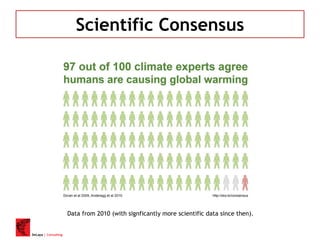
4. 97%+ of climate scientists agree that human activities, principally
the burning of hydrocarbons, are causing the earth to warm and
the climate to change quickly and dramatically.
5. Every reputable scientific association accepts this as fact as well.
DeLapa | Consulting
Atmospheric CO2 Over the Past
400,000 Years
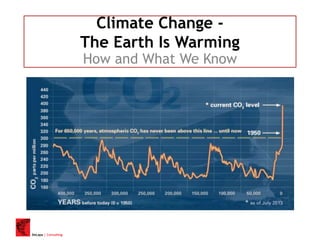
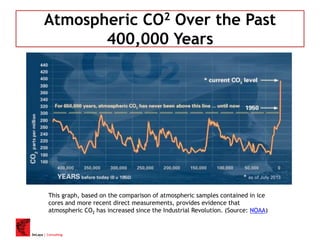
This graph, based on the comparison of atmospheric samples contained in ice
cores and more recent direct measurements, provides evidence that
atmospheric CO2 has increased since the Industrial Revolution. (Source: NOAA)
DeLapa | Consulting
Atmospheric CO2
Over the Past 60 Years
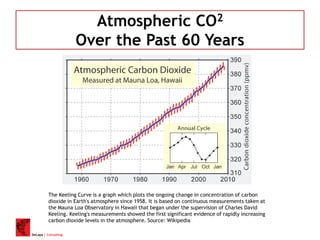
The Keeling Curve is a graph which plots the ongoing change in concentration of carbon
dioxide in Earth's atmosphere since 1958. It is based on continuous measurements taken at
the Mauna Loa Observatory in Hawaii that began under the supervision of Charles David
Keeling. Keeling's measurements showed the first significant evidence of rapidly increasing
carbon dioxide levels in the atmosphere. Source: Wikipedia
DeLapa | Consulting
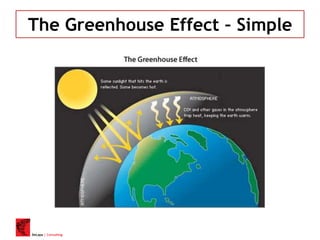
The Greenhouse Effect – Simple
DeLapa | Consulting
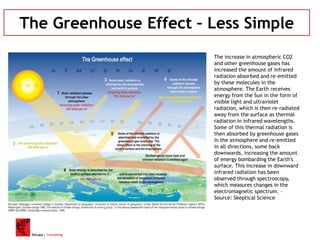
The Greenhouse Effect – Less Simple
The increase in atmospheric CO2
and other greenhouse gases has
increased the amount of infrared
radiation absorbed and re-emitted
by these molecules in the
atmosphere. The Earth receives
energy from the Sun in the form of
visible light and ultraviolet
radiation, which is then re-radiated
away from the surface as thermal
radiation in infrared wavelengths.
Some of this thermal radiation is
then absorbed by greenhouse gases
in the atmosphere and re-emitted
in all directions, some back
downwards, increasing the amount
of energy bombarding the Earth's
surface. This increase in downward
infrared radiation has been
observed through spectroscopy,
which measures changes in the
electromagnetic spectrum. –
Source: Skeptical Science
DeLapa | Consulting
Rising Global Temperatures
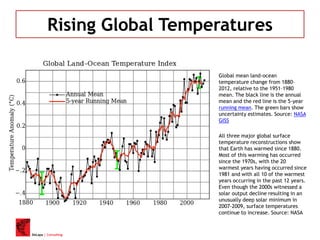
Global mean land-ocean
temperature change from 1880–
2012, relative to the 1951–1980
mean. The black line is the annual
mean and the red line is the 5-year
running mean. The green bars show
uncertainty estimates. Source: NASA
GISS
All three major global surface
temperature reconstructions show
that Earth has warmed since 1880.
Most of this warming has occurred
since the 1970s, with the 20
warmest years having occurred since
1981 and with all 10 of the warmest
years occurring in the past 12 years.
Even though the 2000s witnessed a
solar output decline resulting in an
unusually deep solar minimum in
2007-2009, surface temperatures
continue to increase. Source: NASA
DeLapa | Consulting
Warming Oceans
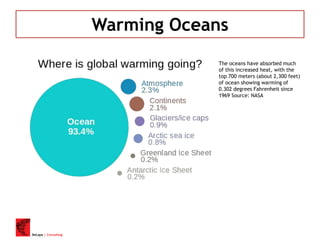
The oceans have absorbed much
of this increased heat, with the
top 700 meters (about 2,300 feet)
of ocean showing warming of
0.302 degrees Fahrenheit since
1969 Source: NASA
DeLapa | Consulting
Shrinking Ice Sheets - Global
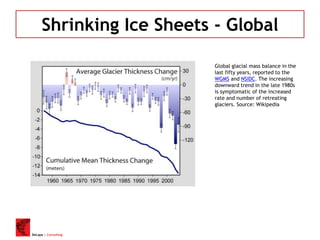
Global glacial mass balance in the
last fifty years, reported to the
WGMS and NSIDC. The increasing
downward trend in the late 1980s
is symptomatic of the increased
rate and number of retreating
glaciers. Source: Wikipedia
DeLapa | Consulting
Shrinking Ice Sheets - Greenland
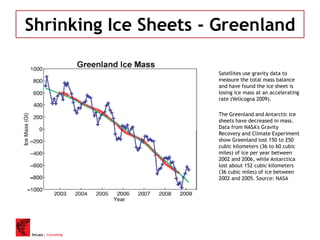
Satellites use gravity data to
measure the total mass balance
and have found the ice sheet is
losing ice mass at an accelerating
rate (Velicogna 2009).
The Greenland and Antarctic ice
sheets have decreased in mass.
Data from NASA's Gravity
Recovery and Climate Experiment
show Greenland lost 150 to 250
cubic kilometers (36 to 60 cubic
miles) of ice per year between
2002 and 2006, while Antarctica
lost about 152 cubic kilometers
(36 cubic miles) of ice between
2002 and 2005. Source: NASA
DeLapa | Consulting
Declining Arctic Sea Ice
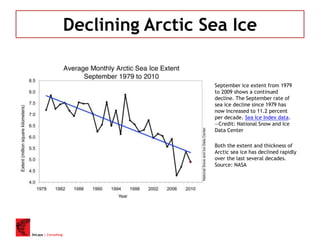
September ice extent from 1979
to 2009 shows a continued
decline. The September rate of
sea ice decline since 1979 has
now increased to 11.2 percent
per decade. Sea Ice Index data.
—Credit: National Snow and Ice
Data Center
Both the extent and thickness of
Arctic sea ice has declined rapidly
over the last several decades.
Source: NASA
DeLapa | Consulting
Glacial Retreat
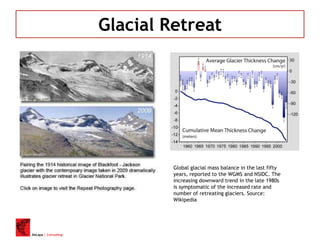
Global glacial mass balance in the last fifty
years, reported to the WGMS and NSIDC. The
increasing downward trend in the late 1980s
is symptomatic of the increased rate and
number of retreating glaciers. Source:
Wikipedia
DeLapa | Consulting
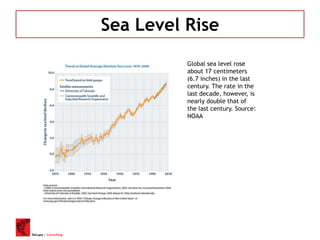
Sea Level Rise
Global sea level rose
about 17 centimeters
(6.7 inches) in the last
century. The rate in the
last decade, however, is
nearly double that of
the last century. Source:
NOAA
DeLapa | Consulting
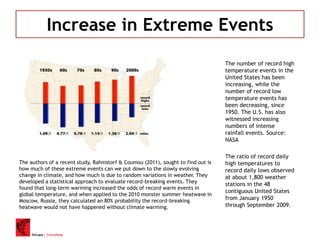
Increase in Extreme Events
The number of record high
temperature events in the
United States has been
increasing, while the
number of record low
temperature events has
been decreasing, since
1950. The U.S. has also
witnessed increasing
numbers of intense
rainfall events. Source:
NASA
The ratio of record daily
high temperatures to
record daily lows observed
at about 1,800 weather
stations in the 48
contiguous United States
from January 1950
through September 2009.
The authors of a recent study, Rahmstorf & Coumou (2011), sought to find out is
how much of these extreme events can we put down to the slowly evolving
change in climate, and how much is due to random variations in weather. They
developed a statistical approach to evaluate record-breaking events. They
found that long-term warming increased the odds of record warm events in
global temperature, and when applied to the 2010 monster summer heatwave in
Moscow, Russia, they calculated an 80% probability the record-breaking
heatwave would not have happened without climate warming.
DeLapa | Consulting
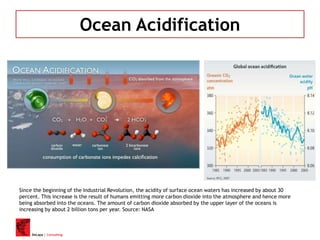
Ocean Acidification
Since the beginning of the Industrial Revolution, the acidity of surface ocean waters has increased by about 30
percent. This increase is the result of humans emitting more carbon dioxide into the atmosphere and hence more
being absorbed into the oceans. The amount of carbon dioxide absorbed by the upper layer of the oceans is
increasing by about 2 billion tons per year. Source: NASA
DeLapa | Consulting
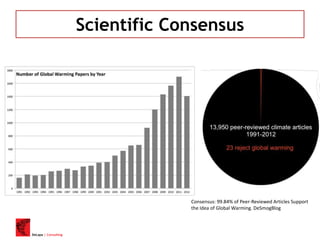
Scientific Consensus
Consensus: 99.84% of Peer-Reviewed Articles Support
the Idea of Global Warming. DeSmogBlog
DeLapa | Consulting
Scientific Consensus
Data from 2010 (with signficantly more scientific data since then).
DeLapa | Consulting
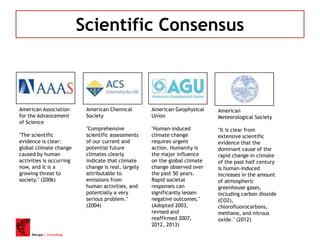
Scientific Consensus
American Association
for the Advancement
of Science
"The scientific
evidence is clear:
global climate change
caused by human
activities is occurring
now, and it is a
growing threat to
society." (2006)
American Chemical
Society
"Comprehensive
scientific assessments
of our current and
potential future
climates clearly
indicate that climate
change is real, largely
attributable to
emissions from
human activities, and
potentially a very
serious problem."
(2004)
American Geophysical
Union
"Human‐induced
climate change
requires urgent
action. Humanity is
the major influence
on the global climate
change observed over
the past 50 years.
Rapid societal
responses can
significantly lessen
negative outcomes."
(Adopted 2003,
revised and
reaffirmed 2007,
2012, 2013)
American
Meteorological Society
"It is clear from
extensive scientific
evidence that the
dominant cause of the
rapid change in climate
of the past half century
is human-induced
increases in the amount
of atmospheric
greenhouse gases,
including carbon dioxide
(CO2),
chlorofluorocarbons,
methane, and nitrous
oxide." (2012)

Climate Change - How We Know What We Know

  • 1.
    DeLapa | Consulting ClimateChange - The Earth Is Warming How and What We Know
  • 2.
    DeLapa | Consulting TheLogic 1. Concentrations of greenhouse gases (CO2, methane, others) are increasing in the atmosphere. 2. Greenhouse gases trap heat (i.e., Greenhouse Effect). 3. Scientific evidence (data) of atmospheric and oceanic warming is overwhelming. Over the past 30 years the data has only gotten stronger. 4. 97%+ of climate scientists agree that human activities, principally the burning of hydrocarbons, are causing the earth to warm and the climate to change quickly and dramatically. 5. Every reputable scientific association accepts this as fact as well.
  • 3.
    DeLapa | Consulting AtmosphericCO2 Over the Past 400,000 Years This graph, based on the comparison of atmospheric samples contained in ice cores and more recent direct measurements, provides evidence that atmospheric CO2 has increased since the Industrial Revolution. (Source: NOAA)
  • 4.
    DeLapa | Consulting AtmosphericCO2 Over the Past 60 Years The Keeling Curve is a graph which plots the ongoing change in concentration of carbon dioxide in Earth's atmosphere since 1958. It is based on continuous measurements taken at the Mauna Loa Observatory in Hawaii that began under the supervision of Charles David Keeling. Keeling's measurements showed the first significant evidence of rapidly increasing carbon dioxide levels in the atmosphere. Source: Wikipedia
  • 5.
    DeLapa | Consulting TheGreenhouse Effect – Simple
  • 6.
    DeLapa | Consulting TheGreenhouse Effect – Less Simple The increase in atmospheric CO2 and other greenhouse gases has increased the amount of infrared radiation absorbed and re-emitted by these molecules in the atmosphere. The Earth receives energy from the Sun in the form of visible light and ultraviolet radiation, which is then re-radiated away from the surface as thermal radiation in infrared wavelengths. Some of this thermal radiation is then absorbed by greenhouse gases in the atmosphere and re-emitted in all directions, some back downwards, increasing the amount of energy bombarding the Earth's surface. This increase in downward infrared radiation has been observed through spectroscopy, which measures changes in the electromagnetic spectrum. – Source: Skeptical Science
  • 7.
    DeLapa | Consulting RisingGlobal Temperatures Global mean land-ocean temperature change from 1880– 2012, relative to the 1951–1980 mean. The black line is the annual mean and the red line is the 5-year running mean. The green bars show uncertainty estimates. Source: NASA GISS All three major global surface temperature reconstructions show that Earth has warmed since 1880. Most of this warming has occurred since the 1970s, with the 20 warmest years having occurred since 1981 and with all 10 of the warmest years occurring in the past 12 years. Even though the 2000s witnessed a solar output decline resulting in an unusually deep solar minimum in 2007-2009, surface temperatures continue to increase. Source: NASA
  • 8.
    DeLapa | Consulting WarmingOceans The oceans have absorbed much of this increased heat, with the top 700 meters (about 2,300 feet) of ocean showing warming of 0.302 degrees Fahrenheit since 1969 Source: NASA
  • 9.
    DeLapa | Consulting ShrinkingIce Sheets - Global Global glacial mass balance in the last fifty years, reported to the WGMS and NSIDC. The increasing downward trend in the late 1980s is symptomatic of the increased rate and number of retreating glaciers. Source: Wikipedia
  • 10.
    DeLapa | Consulting ShrinkingIce Sheets - Greenland Satellites use gravity data to measure the total mass balance and have found the ice sheet is losing ice mass at an accelerating rate (Velicogna 2009). The Greenland and Antarctic ice sheets have decreased in mass. Data from NASA's Gravity Recovery and Climate Experiment show Greenland lost 150 to 250 cubic kilometers (36 to 60 cubic miles) of ice per year between 2002 and 2006, while Antarctica lost about 152 cubic kilometers (36 cubic miles) of ice between 2002 and 2005. Source: NASA
  • 11.
    DeLapa | Consulting DecliningArctic Sea Ice September ice extent from 1979 to 2009 shows a continued decline. The September rate of sea ice decline since 1979 has now increased to 11.2 percent per decade. Sea Ice Index data. —Credit: National Snow and Ice Data Center Both the extent and thickness of Arctic sea ice has declined rapidly over the last several decades. Source: NASA
  • 12.
    DeLapa | Consulting GlacialRetreat Global glacial mass balance in the last fifty years, reported to the WGMS and NSIDC. The increasing downward trend in the late 1980s is symptomatic of the increased rate and number of retreating glaciers. Source: Wikipedia
  • 13.
    DeLapa | Consulting SeaLevel Rise Global sea level rose about 17 centimeters (6.7 inches) in the last century. The rate in the last decade, however, is nearly double that of the last century. Source: NOAA
  • 14.
    DeLapa | Consulting Increasein Extreme Events The number of record high temperature events in the United States has been increasing, while the number of record low temperature events has been decreasing, since 1950. The U.S. has also witnessed increasing numbers of intense rainfall events. Source: NASA The ratio of record daily high temperatures to record daily lows observed at about 1,800 weather stations in the 48 contiguous United States from January 1950 through September 2009. The authors of a recent study, Rahmstorf & Coumou (2011), sought to find out is how much of these extreme events can we put down to the slowly evolving change in climate, and how much is due to random variations in weather. They developed a statistical approach to evaluate record-breaking events. They found that long-term warming increased the odds of record warm events in global temperature, and when applied to the 2010 monster summer heatwave in Moscow, Russia, they calculated an 80% probability the record-breaking heatwave would not have happened without climate warming.
  • 15.
    DeLapa | Consulting OceanAcidification Since the beginning of the Industrial Revolution, the acidity of surface ocean waters has increased by about 30 percent. This increase is the result of humans emitting more carbon dioxide into the atmosphere and hence more being absorbed into the oceans. The amount of carbon dioxide absorbed by the upper layer of the oceans is increasing by about 2 billion tons per year. Source: NASA
  • 16.
    DeLapa | Consulting ScientificConsensus Consensus: 99.84% of Peer-Reviewed Articles Support the Idea of Global Warming. DeSmogBlog
  • 17.
    DeLapa | Consulting ScientificConsensus Data from 2010 (with signficantly more scientific data since then).
  • 18.
    DeLapa | Consulting ScientificConsensus American Association for the Advancement of Science "The scientific evidence is clear: global climate change caused by human activities is occurring now, and it is a growing threat to society." (2006) American Chemical Society "Comprehensive scientific assessments of our current and potential future climates clearly indicate that climate change is real, largely attributable to emissions from human activities, and potentially a very serious problem." (2004) American Geophysical Union "Human‐induced climate change requires urgent action. Humanity is the major influence on the global climate change observed over the past 50 years. Rapid societal responses can significantly lessen negative outcomes." (Adopted 2003, revised and reaffirmed 2007, 2012, 2013) American Meteorological Society "It is clear from extensive scientific evidence that the dominant cause of the rapid change in climate of the past half century is human-induced increases in the amount of atmospheric greenhouse gases, including carbon dioxide (CO2), chlorofluorocarbons, methane, and nitrous oxide." (2012)

Editor's Notes

  • #2 This graph, based on the comparison of atmospheric samples contained in ice cores and more recent direct measurements, provides evidence that atmospheric CO2 has increased since the Industrial Revolution. (Source: NOAA)