Debt financing for Venture backed Startups
Samir Kaji
Senior Managing Director
First Republic Bank
2Kauffman Fellows | Venture Debt
Table Of Contents
Overview
Types Of Debt Financing
Venture Debt Overview
Recurring Revenue Lines
A/R lines
Q&A
Sources
3Kauffman Fellows | Venture Debt
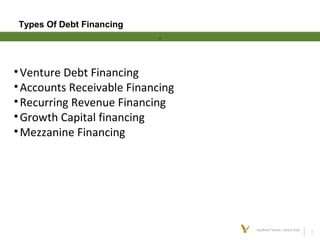
Types Of Debt Financing
d
•Venture Debt Financing
•Accounts Receivable Financing
•Recurring Revenue Financing
•Growth Capital financing
•Mezzanine Financing
4Kauffman Fellows | Venture Debt
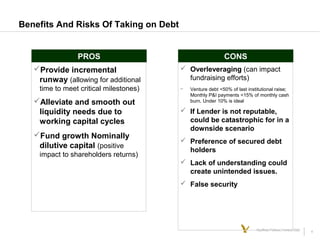
Benefits And Risks Of Taking on Debt
Provide incremental
runway (allowing for additional
time to meet critical milestones)
Alleviate and smooth out
liquidity needs due to
working capital cycles
Fund growth Nominally
dilutive capital (positive
impact to shareholders returns)
PROS
 Overleveraging (can impact
fundraising efforts)
− Venture debt <50% of last institutional raise;
Monthly P&I payments <15% of monthly cash
burn. Under 10% is ideal
 If Lender is not reputable,
could be catastrophic for in a
downside scenario
 Preference of secured debt
holders
 Lack of understanding could
create unintended issues.
 False security
CONS
5Kauffman Fellows | Venture Debt
Venture Debt Overview
What is Venture Debt?
Simply debt financing for Venture Capital backed companies for the purpose of
extending cash runway and accelrating growth in a way that’s minimally dilutive for
shareholders
A non-formula based term financing with durations of 3-5 years
Lenders provide with a belief that next round financing risk is nominal.
When is it appropriate for a company to explore Venture Debt?
The company is backed by a strong syndicate of Venture partners that has the ability to
further support the Company financially with or without the introduction of a new lead
For early stage companies, the management team should be able to clearly define the
milestones prior to the next equity fundraising, and should have a high degree of
confidence of reasonably hitting them.
The Company has a management team and board that preferably has worked with secured
creditors in the past (not necessary of course!)
6Kauffman Fellows | Venture Debt
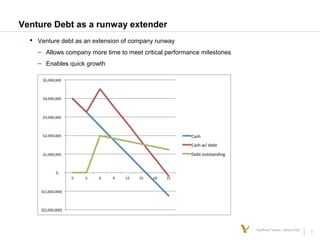
Venture Debt as a runway extender
 Venture debt as an extension of company runway
– Allows company more time to meet critical performance milestones
– Enables quick growth
7Kauffman Fellows | Venture Debt
Terms of Debt to be considered
Key Terms To Be Aware Of
All-in IRR: should include all fees, backend payments, etc. IRR’s range 6% - 15%+
depending on risk profile of transaction and other economics of the deal (warrants)
MAC Clauses: a subjective default that allows lender to “call” a loan if lender deems, in their
sole discretion, that a material deterioration in the business has occurred
Warrants:
Collateral: blanket lien on all assets is standard; IP may be included if risk level is higher
Financial Covenants: Income statement, milestone, or balance sheet.
Real runway provided by the debt?
Borrowing Base Is there a formula that governs borrowing?
Draw requirement far in advance of cash-out? If so, how amortization will there be prior to
projected cash out?
8Kauffman Fellows | Venture Debt
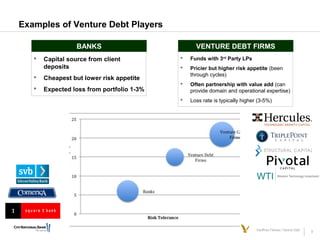
Examples of Venture Debt Players
 Capital source from client
deposits
 Cheapest but lower risk appetite
 Expected loss from portfolio 1-3%
BANKS
 Funds with 3rd
Party LPs
 Pricier but higher risk appetite (been
through cycles)
 Often partnership with value add (can
provide domain and operational expertise)
 Loss rate is typically higher (3-5%)
VENTURE DEBT FIRMS
9Kauffman Fellows | Venture Debt
Banks VS Venture Debt Firms Terms
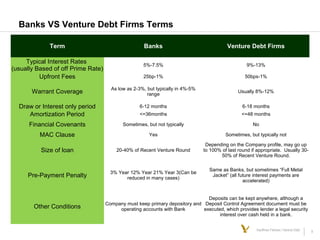
Term Banks Venture Debt Firms
Typical Interest Rates
(usually Based of off Prime Rate)
5%-7.5% 9%-13%
Upfront Fees 25bp-1% 50bps-1%
Warrant Coverage
As low as 2-3%, but typically in 4%-5%
range
Usually 8%-12%
Draw or Interest only period 6-12 months 6-18 months
Amortization Period <=36months <=48 months
Financial Covenants Sometimes, but not typically No
MAC Clause Yes Sometimes, but typically not
Size of loan 20-40% of Recent Venture Round
Depending on the Company profile, may go up
to 100% of last round if appropriate. Usually 30-
50% of Recent Venture Round.
Pre-Payment Penalty
3% Year 12% Year 21% Year 3(Can be
reduced in many cases)
Same as Banks, but sometimes “Full Metal
Jacket” (all future interest payments are
accelerated)
Other Conditions
Company must keep primary depository and
operating accounts with Bank
Deposits can be kept anywhere, although a
Deposit Control Agreement document must be
executed, which provides lender a legal security
interest over cash held in a bank.
10Kauffman Fellows | Venture Debt
Example of Venture Debt
XYZ company raises a $10MM Series A round, led by Founders Fund, done at
a $30MM Pre-Money Valuation. 8M fully diluted shares authorized after round
($5/share)
Projected Burn is $500K/month (20 months of cash runway).
Company is offered $5MM Venture Debt term loan, with following terms:
–12 Month Interest only Drawdown period, following by a 36 month amortization period.
–Interest rate of 9% with back-end payment of 5%.
–No MAC
–No Financial Covenants
–Warrant Coverage of 10% on Series A shares.
• 10% * $5MM = $500,000/$5 PPS = Lender has the right to purchase 100,000 shares at $5 at any time over
next 8-10 years. 100,000/8MM shares = 1.25% dilution.
Best case scenario is debt provides additional 6-8 months of cash runway,
more milestones hit, and thus allowing for better valuation at B round.
11Kauffman Fellows | Venture Debt
Formula based Working Capital Lines (Also commonly called asset
based lines)
 Revolving Facilities
 Typically 1-2 years in length, with ability to renew
 Lender offers a borrowing base against something tangible
– AR
– PO
– Inventory
– Recurring Revenue

12Kauffman Fellows | Venture Debt
Formula based Working Capital Lines -Accounts Receivable Lines
 Financing provided against a Company’s Accounts Receivable base, or in some cases
against specific invoices (not PO financing).
 Used to smooth out working capital cycles
– Good for businesses that have large AR balances. Traditional software license models,
hardware models, etc.
 Usually cheapest form of financing
 Formula based (lender will look at quality of account debtors, concentrations). Borrowing
advance rate of 70-80% of qualified eligible accounts receivables.
 Almost always come with performance and/or liquidity covenants (the exception being
specific invoice by invoice financing offered by some lenders).
 Provided by Banks, not Venture Debt firms
13Kauffman Fellows | Venture Debt
Formula Based Lines - Recurring Revenue lines
Recurring Revenue lines
Financing provided against a company’s recurring revenue stream
Used to smooth out working capital and help financing CAC’s
– Good for businesses that have recurring revenue models such as SaaS and
subscription based companies.
Similar pricing to Accounts Receivable lines.
Formula based on revenue
– 2-7x of MRR
– Adjusted for Churn (usually gross, but lenders becoming increasingly ok with net)
Almost always come with performance and/or liquidity covenants (the exception being
specific invoice by invoice financing offered by some lenders).
– Performance to plan covenant on revenues or bookings
– Liquidity covenants (Adjusted Quick Ratio, Liquidity ratio). More common with larger
deals.
– Most often provided by Bank’s, but specialty fund lenders like SaaS Capital and Golub
Capital also provide.
14Kauffman Fellows | Venture Debt
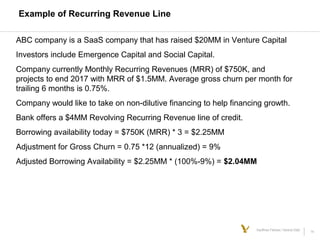
Example of Recurring Revenue Line
ABC company is a SaaS company that has raised $20MM in Venture Capital
Investors include Emergence Capital and Social Capital.
Company currently Monthly Recurring Revenues (MRR) of $750K, and
projects to end 2017 with MRR of $1.5MM. Average gross churn per month for
trailing 6 months is 0.75%.
Company would like to take on non-dilutive financing to help financing growth.
Bank offers a $4MM Revolving Recurring Revenue line of credit.
Borrowing availability today = $750K (MRR) * 3 = $2.25MM
Adjustment for Gross Churn = 0.75 *12 (annualized) = 9%
Adjusted Borrowing Availability = $2.25MM * (100%-9%) = $2.04MM
15Kauffman Fellows | Venture Debt
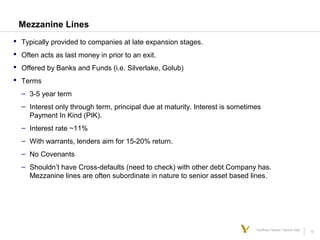
Mezzanine Lines
 Typically provided to companies at late expansion stages.
 Often acts as last money in prior to an exit.
 Offered by Banks and Funds (i.e. Silverlake, Golub)
 Terms
– 3-5 year term
– Interest only through term, principal due at maturity. Interest is sometimes
Payment In Kind (PIK).
– Interest rate ~11%
– With warrants, lenders aim for 15-20% return.
– No Covenants
– Shouldn’t have Cross-defaults (need to check) with other debt Company has.
Mezzanine lines are often subordinate in nature to senior asset based lines.

Venture Debt financing for startups

  • 1.
    Debt financing forVenture backed Startups Samir Kaji Senior Managing Director First Republic Bank
  • 2.
    2Kauffman Fellows |Venture Debt Table Of Contents Overview Types Of Debt Financing Venture Debt Overview Recurring Revenue Lines A/R lines Q&A Sources
  • 3.
    3Kauffman Fellows |Venture Debt Types Of Debt Financing d •Venture Debt Financing •Accounts Receivable Financing •Recurring Revenue Financing •Growth Capital financing •Mezzanine Financing
  • 4.
    4Kauffman Fellows |Venture Debt Benefits And Risks Of Taking on Debt Provide incremental runway (allowing for additional time to meet critical milestones) Alleviate and smooth out liquidity needs due to working capital cycles Fund growth Nominally dilutive capital (positive impact to shareholders returns) PROS  Overleveraging (can impact fundraising efforts) − Venture debt <50% of last institutional raise; Monthly P&I payments <15% of monthly cash burn. Under 10% is ideal  If Lender is not reputable, could be catastrophic for in a downside scenario  Preference of secured debt holders  Lack of understanding could create unintended issues.  False security CONS
  • 5.
    5Kauffman Fellows |Venture Debt Venture Debt Overview What is Venture Debt? Simply debt financing for Venture Capital backed companies for the purpose of extending cash runway and accelrating growth in a way that’s minimally dilutive for shareholders A non-formula based term financing with durations of 3-5 years Lenders provide with a belief that next round financing risk is nominal. When is it appropriate for a company to explore Venture Debt? The company is backed by a strong syndicate of Venture partners that has the ability to further support the Company financially with or without the introduction of a new lead For early stage companies, the management team should be able to clearly define the milestones prior to the next equity fundraising, and should have a high degree of confidence of reasonably hitting them. The Company has a management team and board that preferably has worked with secured creditors in the past (not necessary of course!)
  • 6.
    6Kauffman Fellows |Venture Debt Venture Debt as a runway extender  Venture debt as an extension of company runway – Allows company more time to meet critical performance milestones – Enables quick growth
  • 7.
    7Kauffman Fellows |Venture Debt Terms of Debt to be considered Key Terms To Be Aware Of All-in IRR: should include all fees, backend payments, etc. IRR’s range 6% - 15%+ depending on risk profile of transaction and other economics of the deal (warrants) MAC Clauses: a subjective default that allows lender to “call” a loan if lender deems, in their sole discretion, that a material deterioration in the business has occurred Warrants: Collateral: blanket lien on all assets is standard; IP may be included if risk level is higher Financial Covenants: Income statement, milestone, or balance sheet. Real runway provided by the debt? Borrowing Base Is there a formula that governs borrowing? Draw requirement far in advance of cash-out? If so, how amortization will there be prior to projected cash out?
  • 8.
    8Kauffman Fellows |Venture Debt Examples of Venture Debt Players  Capital source from client deposits  Cheapest but lower risk appetite  Expected loss from portfolio 1-3% BANKS  Funds with 3rd Party LPs  Pricier but higher risk appetite (been through cycles)  Often partnership with value add (can provide domain and operational expertise)  Loss rate is typically higher (3-5%) VENTURE DEBT FIRMS
  • 9.
    9Kauffman Fellows |Venture Debt Banks VS Venture Debt Firms Terms Term Banks Venture Debt Firms Typical Interest Rates (usually Based of off Prime Rate) 5%-7.5% 9%-13% Upfront Fees 25bp-1% 50bps-1% Warrant Coverage As low as 2-3%, but typically in 4%-5% range Usually 8%-12% Draw or Interest only period 6-12 months 6-18 months Amortization Period <=36months <=48 months Financial Covenants Sometimes, but not typically No MAC Clause Yes Sometimes, but typically not Size of loan 20-40% of Recent Venture Round Depending on the Company profile, may go up to 100% of last round if appropriate. Usually 30- 50% of Recent Venture Round. Pre-Payment Penalty 3% Year 12% Year 21% Year 3(Can be reduced in many cases) Same as Banks, but sometimes “Full Metal Jacket” (all future interest payments are accelerated) Other Conditions Company must keep primary depository and operating accounts with Bank Deposits can be kept anywhere, although a Deposit Control Agreement document must be executed, which provides lender a legal security interest over cash held in a bank.
  • 10.
    10Kauffman Fellows |Venture Debt Example of Venture Debt XYZ company raises a $10MM Series A round, led by Founders Fund, done at a $30MM Pre-Money Valuation. 8M fully diluted shares authorized after round ($5/share) Projected Burn is $500K/month (20 months of cash runway). Company is offered $5MM Venture Debt term loan, with following terms: –12 Month Interest only Drawdown period, following by a 36 month amortization period. –Interest rate of 9% with back-end payment of 5%. –No MAC –No Financial Covenants –Warrant Coverage of 10% on Series A shares. • 10% * $5MM = $500,000/$5 PPS = Lender has the right to purchase 100,000 shares at $5 at any time over next 8-10 years. 100,000/8MM shares = 1.25% dilution. Best case scenario is debt provides additional 6-8 months of cash runway, more milestones hit, and thus allowing for better valuation at B round.
  • 11.
    11Kauffman Fellows |Venture Debt Formula based Working Capital Lines (Also commonly called asset based lines)  Revolving Facilities  Typically 1-2 years in length, with ability to renew  Lender offers a borrowing base against something tangible – AR – PO – Inventory – Recurring Revenue 
  • 12.
    12Kauffman Fellows |Venture Debt Formula based Working Capital Lines -Accounts Receivable Lines  Financing provided against a Company’s Accounts Receivable base, or in some cases against specific invoices (not PO financing).  Used to smooth out working capital cycles – Good for businesses that have large AR balances. Traditional software license models, hardware models, etc.  Usually cheapest form of financing  Formula based (lender will look at quality of account debtors, concentrations). Borrowing advance rate of 70-80% of qualified eligible accounts receivables.  Almost always come with performance and/or liquidity covenants (the exception being specific invoice by invoice financing offered by some lenders).  Provided by Banks, not Venture Debt firms
  • 13.
    13Kauffman Fellows |Venture Debt Formula Based Lines - Recurring Revenue lines Recurring Revenue lines Financing provided against a company’s recurring revenue stream Used to smooth out working capital and help financing CAC’s – Good for businesses that have recurring revenue models such as SaaS and subscription based companies. Similar pricing to Accounts Receivable lines. Formula based on revenue – 2-7x of MRR – Adjusted for Churn (usually gross, but lenders becoming increasingly ok with net) Almost always come with performance and/or liquidity covenants (the exception being specific invoice by invoice financing offered by some lenders). – Performance to plan covenant on revenues or bookings – Liquidity covenants (Adjusted Quick Ratio, Liquidity ratio). More common with larger deals. – Most often provided by Bank’s, but specialty fund lenders like SaaS Capital and Golub Capital also provide.
  • 14.
    14Kauffman Fellows |Venture Debt Example of Recurring Revenue Line ABC company is a SaaS company that has raised $20MM in Venture Capital Investors include Emergence Capital and Social Capital. Company currently Monthly Recurring Revenues (MRR) of $750K, and projects to end 2017 with MRR of $1.5MM. Average gross churn per month for trailing 6 months is 0.75%. Company would like to take on non-dilutive financing to help financing growth. Bank offers a $4MM Revolving Recurring Revenue line of credit. Borrowing availability today = $750K (MRR) * 3 = $2.25MM Adjustment for Gross Churn = 0.75 *12 (annualized) = 9% Adjusted Borrowing Availability = $2.25MM * (100%-9%) = $2.04MM
  • 15.
    15Kauffman Fellows |Venture Debt Mezzanine Lines  Typically provided to companies at late expansion stages.  Often acts as last money in prior to an exit.  Offered by Banks and Funds (i.e. Silverlake, Golub)  Terms – 3-5 year term – Interest only through term, principal due at maturity. Interest is sometimes Payment In Kind (PIK). – Interest rate ~11% – With warrants, lenders aim for 15-20% return. – No Covenants – Shouldn’t have Cross-defaults (need to check) with other debt Company has. Mezzanine lines are often subordinate in nature to senior asset based lines.