Is OER mainstreamed and sustainable?

                Peter Reed: Lecturer & eLearning Coordinator, MMU
                                           ALT-C, Manchester, 2012


@Reedyreedles
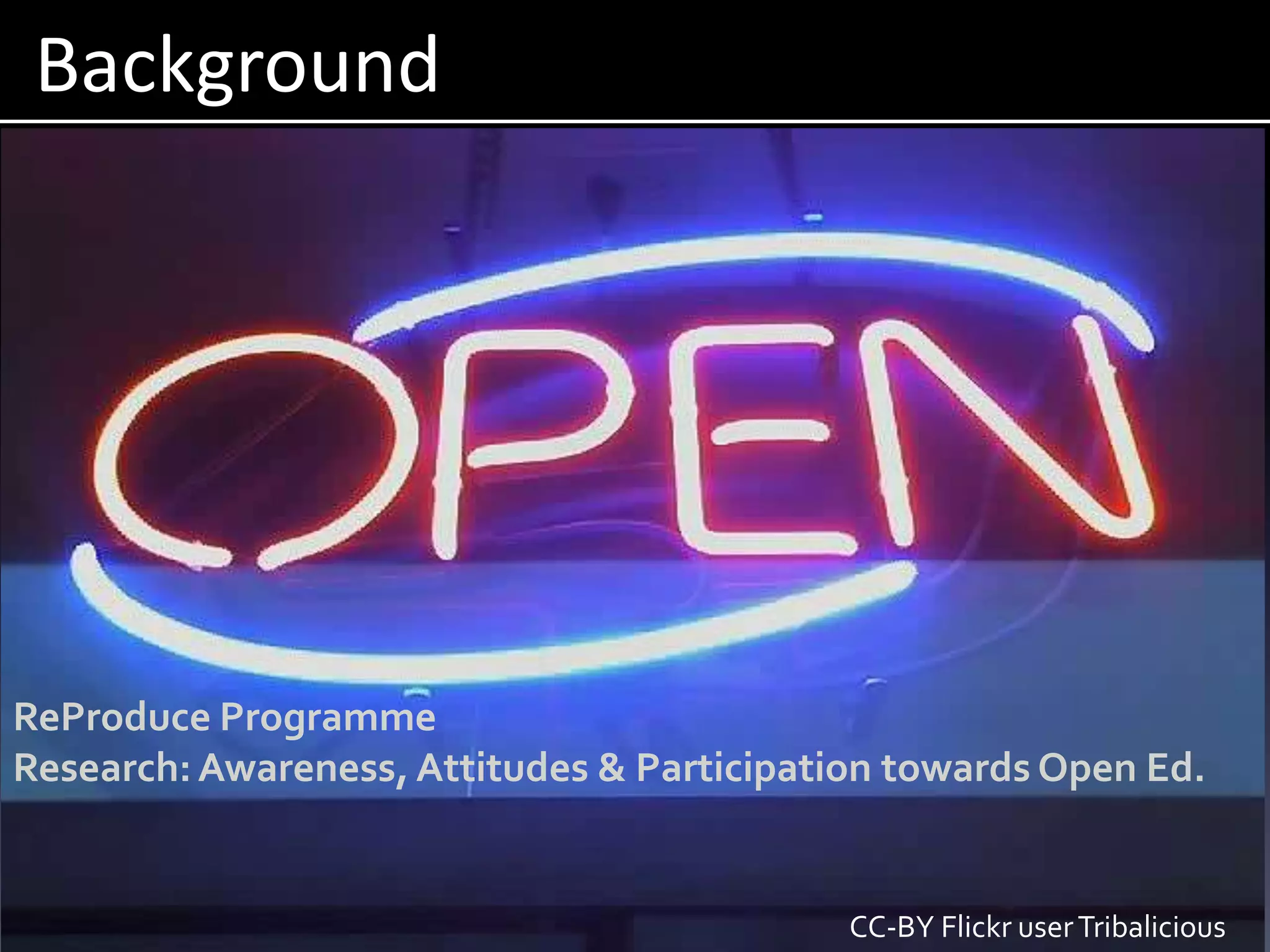
Background


ReProduce Programme
Research: Awareness, Attitudes & Participation towards Open Ed.


     @Reedyreedles                          CC-BY Flickr user Tribalicious
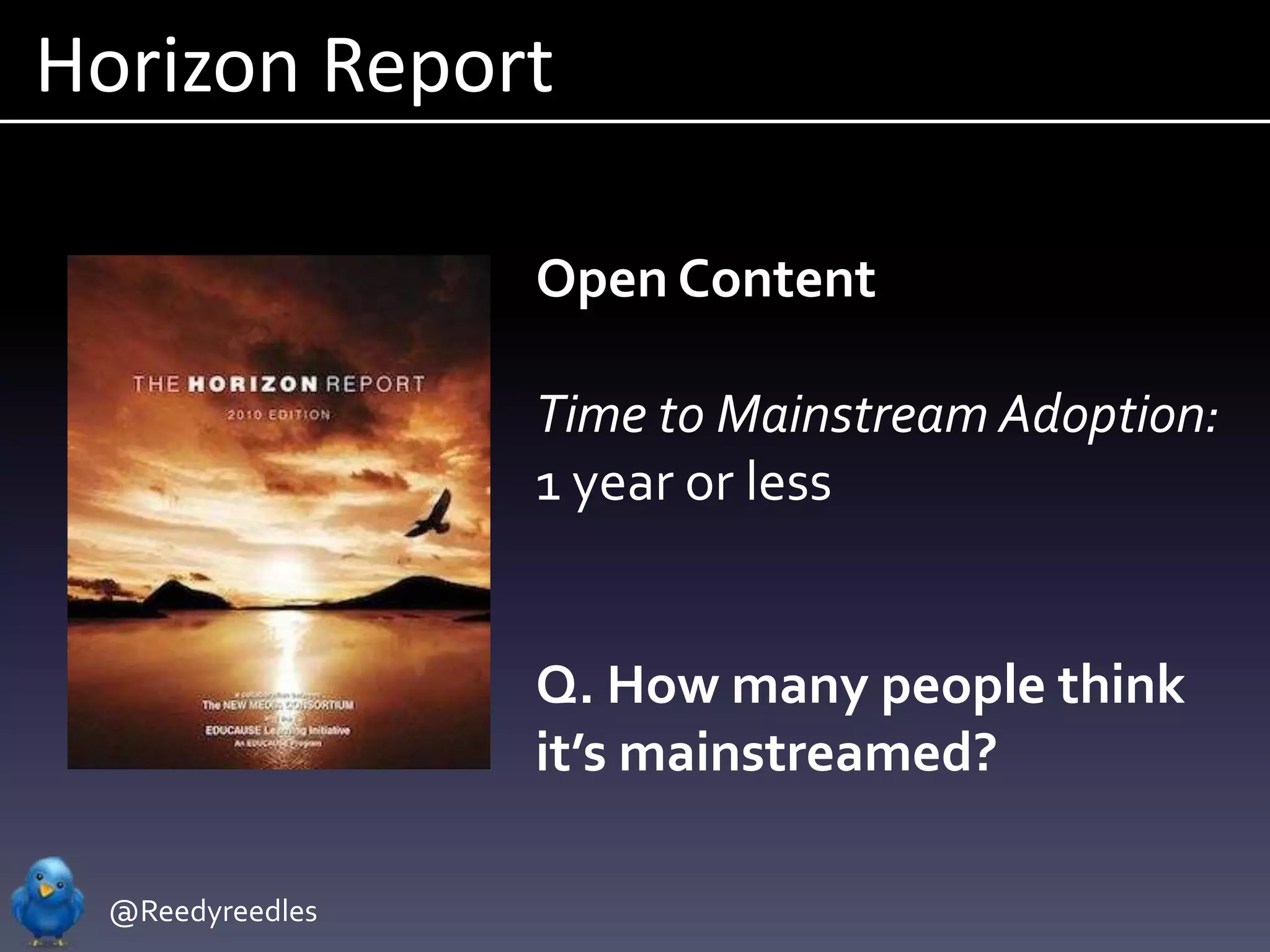
Horizon Report

                 Open Content

                 Time to Mainstream Adoption:
                 1 year or less


                 Q. How many people think
                 it’s mainstreamed?

 @Reedyreedles
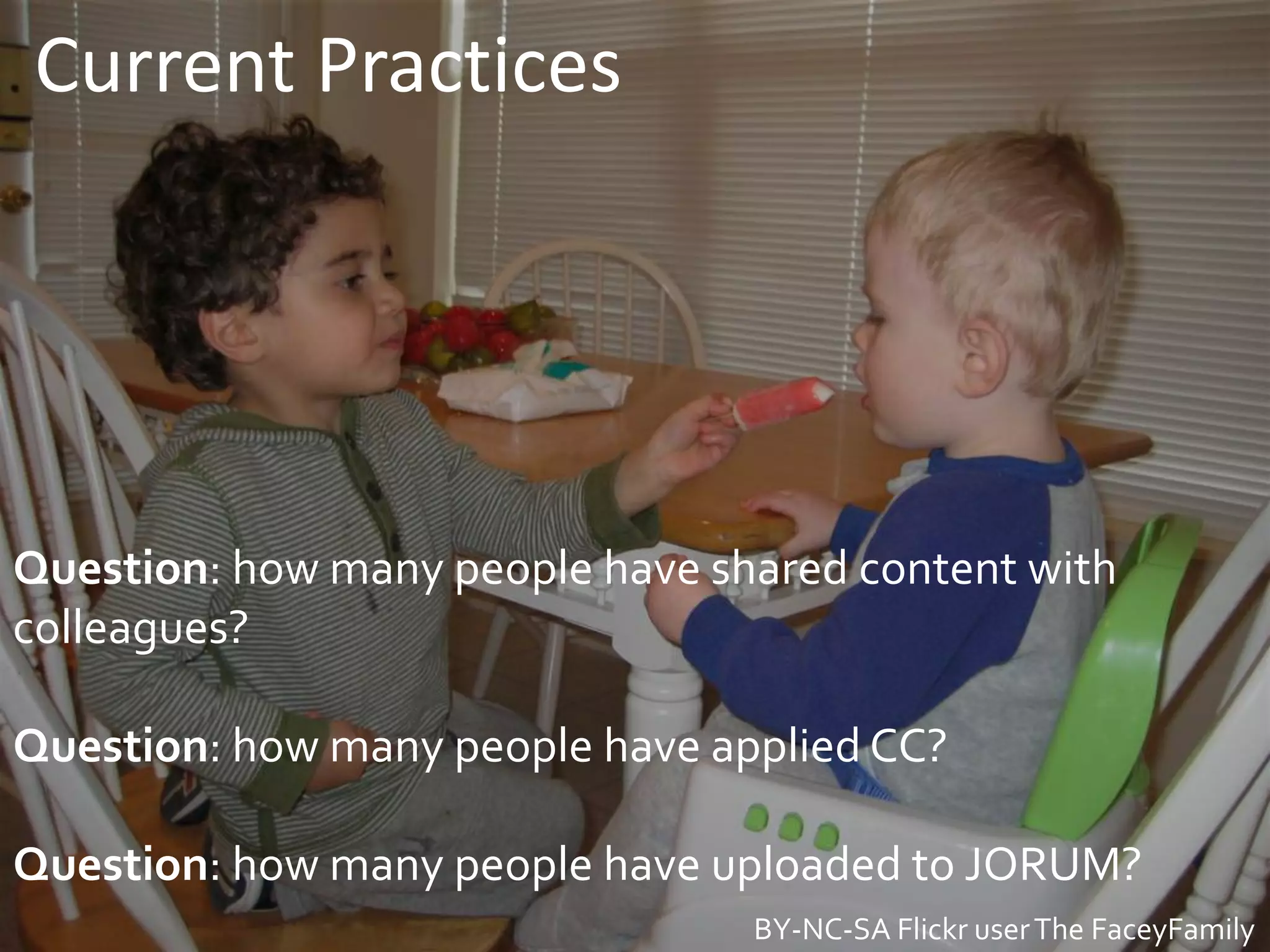
Current Practices


Question: how many people have shared content with
colleagues?

Question: how many people have applied CC?

Question: how many people have uploaded to JORUM?
    @Reedyreedles
                                 BY-NC-SA Flickr user The FaceyFamily
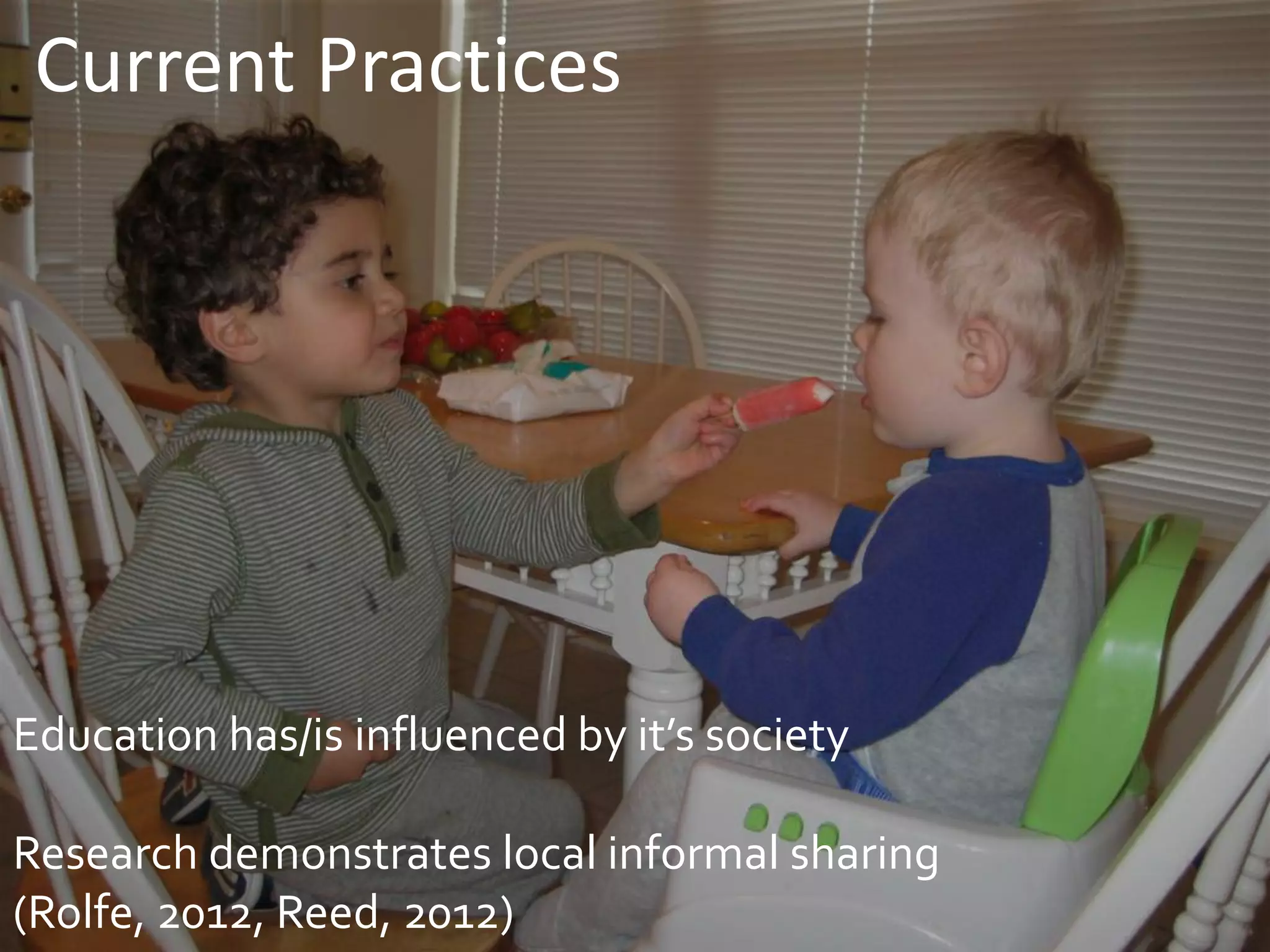
Current Practices


Education has/is influenced by it’s society

Research demonstrates local informal sharing
(Rolfe, 2012, Reed, 2012)
     @Reedyreedles
Mainstream

  Without doubt, this needs to change if the
  movement is to scale and have a significant
impact, and for me, one of the major challenges
     to the Open Content Movement is in
   embedding 'open practice' as 'standard
  practice' amongst academic staff, if it is to
      continue beyond funding activity.


 @Reedyreedles
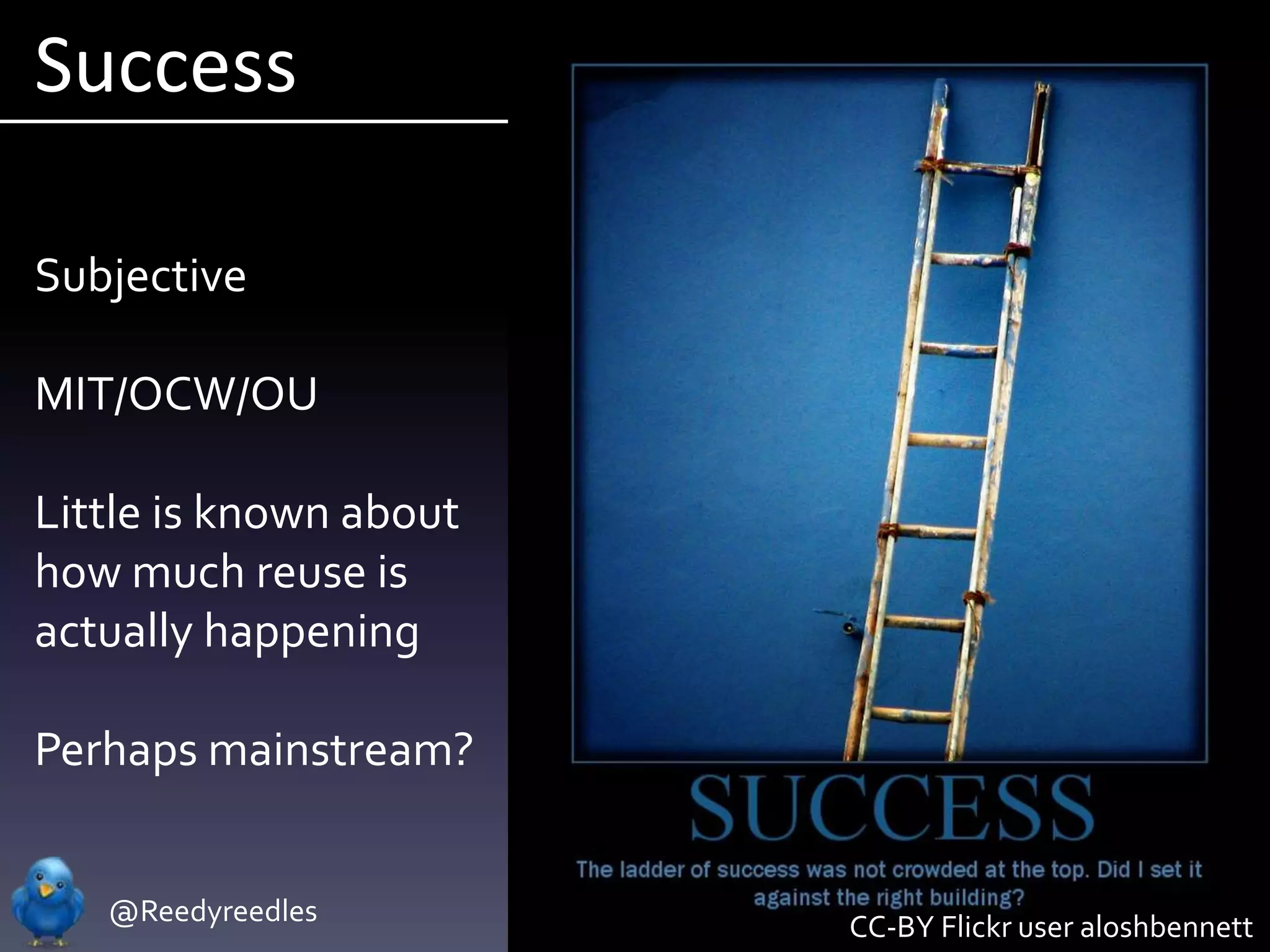
Success

Subjective

MIT/OCW/OU

Little is known about
how much reuse is
actually happening

Perhaps mainstream?


   @Reedyreedles        CC-BY Flickr user aloshbennett
Mainstream


 “Mainstream is, generally, the common
   current thought of the majority”
                              (Wikipedia)


 @Reedyreedles
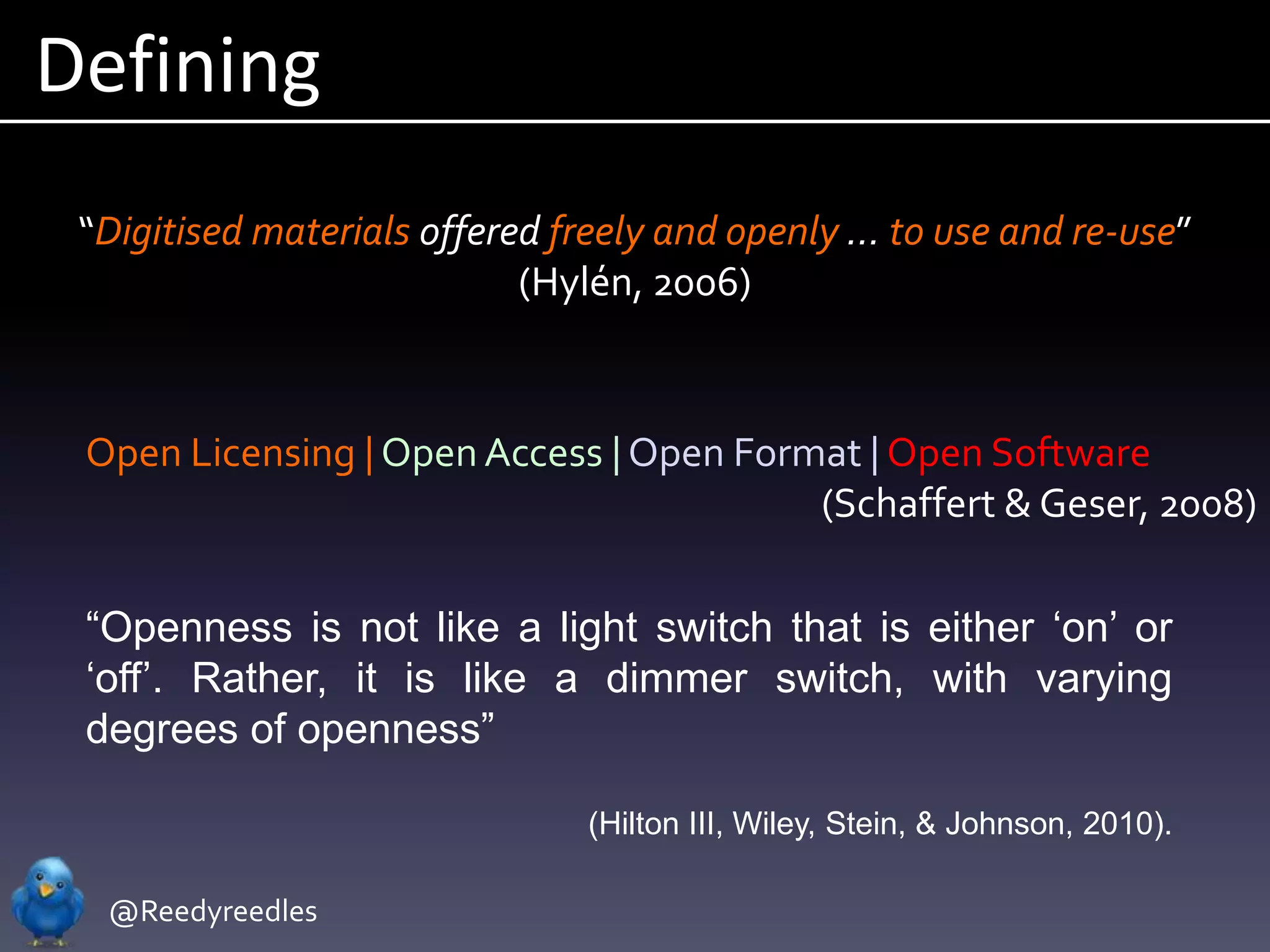
Defining
 “Digitised materials offered freely and openly … to use and re-use”
                            (Hylén, 2006)


 Open Licensing | Open Access | Open Format | Open Software
                                         (Schaffert & Geser, 2008)

 “Openness is not like a light switch that is either „on‟ or
 „off‟. Rather, it is like a dimmer switch, with varying
 degrees of openness”

                               (Hilton III, Wiley, Stein, & Johnson, 2010).

  @Reedyreedles
Sustainability

Question:

 Would you share your everyday teaching materials
                  within JORUM
                       OR
  Do you invest more time/effort before sharing?

If yes, will the masses engage?


  @Reedyreedles
Sustainability
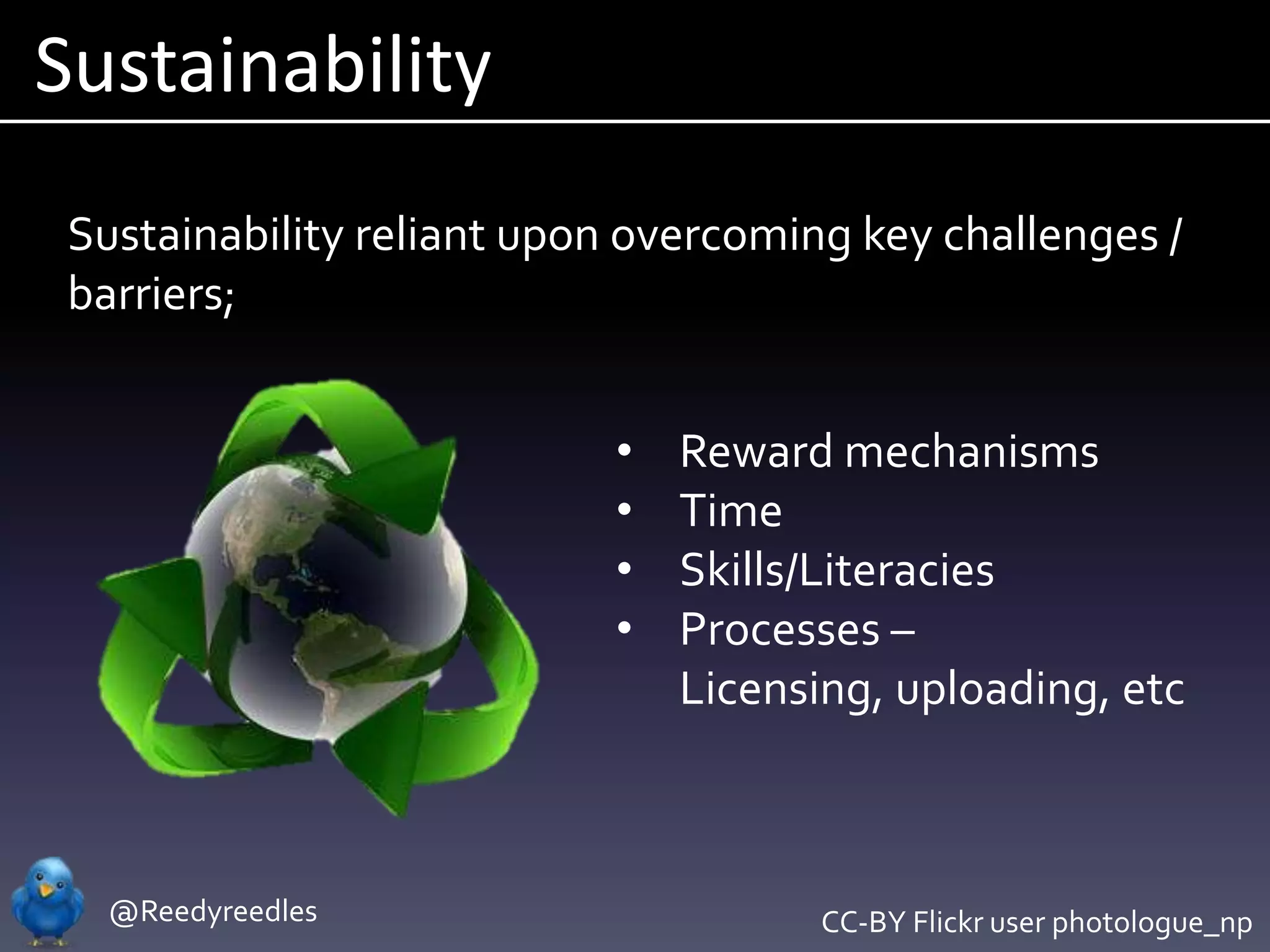
 Sustainability reliant upon overcoming key challenges /
 barriers;


                            •   Reward mechanisms
                            •   Time
                            •   Skills/Literacies
                            •   Processes –
                                Licensing, uploading, etc


   @Reedyreedles                       CC-BY Flickr user photologue_np
Sustainability


Until HEIs strategically focus on OER for OER-sake,
      which will come at a cost, it can't reach
   mainstream, after all, would the breadth of
 institutions currently engaging with OER be the
  same if JISC/HEA funding wasn't so plentiful?


  @Reedyreedles
Sustainability


         Any Questions?


  @Reedyreedles

Is OER Mainstreamed and Sustainable?

  • 1.
    Is OER mainstreamedand sustainable? Peter Reed: Lecturer & eLearning Coordinator, MMU ALT-C, Manchester, 2012 @Reedyreedles
  • 2.
    Background ReProduce Programme Research: Awareness,Attitudes & Participation towards Open Ed. @Reedyreedles CC-BY Flickr user Tribalicious
  • 3.
    Horizon Report Open Content Time to Mainstream Adoption: 1 year or less Q. How many people think it’s mainstreamed? @Reedyreedles
  • 4.
    Current Practices Question: howmany people have shared content with colleagues? Question: how many people have applied CC? Question: how many people have uploaded to JORUM? @Reedyreedles BY-NC-SA Flickr user The FaceyFamily
  • 5.
    Current Practices Education has/isinfluenced by it’s society Research demonstrates local informal sharing (Rolfe, 2012, Reed, 2012) @Reedyreedles
  • 6.
    Mainstream Withoutdoubt, this needs to change if the movement is to scale and have a significant impact, and for me, one of the major challenges to the Open Content Movement is in embedding 'open practice' as 'standard practice' amongst academic staff, if it is to continue beyond funding activity. @Reedyreedles
  • 7.
    Success Subjective MIT/OCW/OU Little is knownabout how much reuse is actually happening Perhaps mainstream? @Reedyreedles CC-BY Flickr user aloshbennett
  • 8.
    Mainstream “Mainstream is,generally, the common current thought of the majority” (Wikipedia) @Reedyreedles
  • 9.
    Defining “Digitised materialsoffered freely and openly … to use and re-use” (Hylén, 2006) Open Licensing | Open Access | Open Format | Open Software (Schaffert & Geser, 2008) “Openness is not like a light switch that is either „on‟ or „off‟. Rather, it is like a dimmer switch, with varying degrees of openness” (Hilton III, Wiley, Stein, & Johnson, 2010). @Reedyreedles
  • 10.
    Sustainability Question: Would youshare your everyday teaching materials within JORUM OR Do you invest more time/effort before sharing? If yes, will the masses engage? @Reedyreedles
  • 11.
    Sustainability Sustainability reliantupon overcoming key challenges / barriers; • Reward mechanisms • Time • Skills/Literacies • Processes – Licensing, uploading, etc @Reedyreedles CC-BY Flickr user photologue_np
  • 12.
    Sustainability Until HEIs strategicallyfocus on OER for OER-sake, which will come at a cost, it can't reach mainstream, after all, would the breadth of institutions currently engaging with OER be the same if JISC/HEA funding wasn't so plentiful? @Reedyreedles
  • 13.
    Sustainability Any Questions? @Reedyreedles

Editor's Notes

  • #3 I should state from the outset, that I am a big advocate of openness; I have managed a JISC-funded project on OER and researched aspects of the 'movement'; particularly interested in people’s attitudes and ‘participation’ towards the OER movement. 
  • #4 I began to question whether the OER movement had indeed mainstreamed after flicking through the most recent Horizon report. For those not aware, this annual publication  'predicts' the latest technologies and their 'time to mainstream adoption'). I recall Open Content featuring in the 2010 report (that's 2 years ago) as a movement to reach mainstream adoption within a year or less i.e. last year. With my sceptic hat on, I questioned the Twitterverse if OER had indeed become mainstream. A resulting discussion/debate is what led me to writing this. Question – how many think it’s mainstreamed?
  • #5 Question: how many people have shared content with colleagues? Question: how many people have applied CC? Question: how many people have uploaded to JORUM?
  • #6 There will always be societal influences in education - sharing locally amongst academic colleagues, has, is, and probably always will take place. Viv Rolfe (from DMU) and myself are both interested in the current awareness and attitudes towards OER; both my article (submitted to Research in Learning Technology) and Viv's 2012 article (in the same journal) demonstrate that teaching staff are sharing content on an informal scale with colleagues within department/faculty, but they are not applying (creative commons) licences or sharing via repositories. Without doubt, this needs to change if the movement is to scale and have a significant impact, and for me, one of the major challenges to the Open Content Movement is in embedding 'open practice' as 'standard practice' amongst academic staff, if it is to continue beyond funding activity.
  • #8 …is subjective - one might see the movement's influence on an individual teacher/lecturer as being significant, whilst others may want more 'bang for their buck'. I'm of the latter, and whilst the big players such as MIT OCW and the OU OpenLearndemonstrate significant access/download/sign-up figures, the OpenLearn Research Report (McAndrew. et. al, 2006-2008) - all be it a few years old now - highlighted that we don't know how much 'reuse' is actually happening. Instead I see the success of such movements when they become Mainstream.
  • #9 Aha, another word of subjectivity - Mainstream!"Mainstream is, generally, the common current thought of the majority" (Wikipedia article on 'mainstream') Whilst many HEIs in the UK have some OER activity, to me, OER becoming mainstream means that not only are a select group of people within institutions engaging (and probably as a result of funding), but the majority of staff engaging from the majority of institutions.And by engaging, I don't mean letting my friend use my powerpoint slides, I mean formally licensing and sharing via a repository
  • #10 “Digitised materials offered freely and openly … to use and re-use” (Hylén, 2006)Schaffert & Geser (2008) suggest if something is to be open, it must subscribe to 4 elements: Open Licensing, Openly Access, Open Software and Open Format. This is quite a strict viewpoint, whereas Hilton et. al. (2010) suggest;"Openness is not like a light switch that is either ‘on’ or ‘off’. Rather, it is like a dimmer switch, with varying degrees of openness” (Hilton et. al, 2010)Either way, both Viv's and my own research highlights that the current informal sharing isn't really 'open' (in the strict sense of the word), or even if we consider varying degrees of openness, it demonstrates such a dim view the light switch may as well be off.
  • #11  For as long as it requires extra workload and/or time, the chances of mass sharing of resources will be slim, especially in a era where wanting 'more for less' is prevalent. Sharing content is often more time consuming - not just the process of uploading a file to a repository, but inevitably (and rightly or wrongly) the stakes related to QA increase. Staff might be willing to use their own materials in class, but the thought of sharing those materials 'as is', can be daunting. Question: would you share your everyday teaching materials within JORUM?
  • #12 So whilst there are resources, workflows and development tools available, I just don't see mass engagement when funding ceases. Many authors suggest barriers that must be overcome, such as reward mechanisms and licensing - I agree that until HEIs strategically focus on OER for OER-sake, which will come at a cost, it can't reach mainstream, after all, would the breadth of institutions currently engaging with OER be the same if JISC/HEA funding wasn't so plentiful? With these questions out in the air, I must once again repeat my 'allegiance' to the 'Movement' (no this isn't a Star Wars film), but in doing so, I must also critically reflect on my academic activities, and in an era of openness, share my questions. I am not so dogmatic to believe I am 100% correct on these points, and accept that my views could be a 'glass-half-empty' stance, but I only hope they spark a debate.
  • #13 So whilst there are resources, workflows and development tools available, I just don't see mass engagement when funding ceases. Many authors suggest barriers that must be overcome, such as reward mechanisms and licensing - I agree that until HEIs strategically focus on OER for OER-sake, which will come at a cost, it can't reach mainstream, after all, would the breadth of institutions currently engaging with OER be the same if JISC/HEA funding wasn't so plentiful? With these questions out in the air, I must once again repeat my 'allegiance' to the 'Movement' (no this isn't a Star Wars film), but in doing so, I must also critically reflect on my academic activities, and in an era of openness, share my questions. I am not so dogmatic to believe I am 100% correct on these points, and accept that my views could be a 'glass-half-empty' stance, but I only hope they spark a debate.
  • #14 So whilst there are resources, workflows and development tools available, I just don't see mass engagement when funding ceases. Many authors suggest barriers that must be overcome, such as reward mechanisms and licensing - I agree that until HEIs strategically focus on OER for OER-sake, which will come at a cost, it can't reach mainstream, after all, would the breadth of institutions currently engaging with OER be the same if JISC/HEA funding wasn't so plentiful? With these questions out in the air, I must once again repeat my 'allegiance' to the 'Movement' (no this isn't a Star Wars film), but in doing so, I must also critically reflect on my academic activities, and in an era of openness, share my questions. I am not so dogmatic to believe I am 100% correct on these points, and accept that my views could be a 'glass-half-empty' stance, but I only hope they spark a debate.