Open Educational Resources:Opportunities
and Obstacles of OER in Higher Education
by Sean Mayfield
2025
Licensed Under CC BY-NC-SA 4.0
3.
WHAT ARE OPENEDUCATIONAL
RESOURCES?
• Open educational resources (OER) provide academic content that is free
to access and use.
• OER include textbooks, images, videos, audio, lectures, and entire
courses.
• OER are typically released for use with open licenses, via platforms like
OER Commons and Creative Commons.
• OER are adaptable to the needs of the user, allowing revisions, remixing,
reuse, redistribution and allow the user to retain their own copy of the
resource.
• OER provide many opportunities for students, faculty, and institutions,
but there are some potential obstacles involved in their use.
4.
OPEN EDUCATIONAL RESOURCES:
OPPORTUNITIES
•OER content is free.
• OER provides flexibility for course creators.
• OER promotes social justice.
• OER development encourages collaboration.
• OER supports student success.
5.
OPEN EDUCATIONAL RESOURCES:
OPPORTUNITIES
•Since OER content is free to use, it greatly reduces the cost
of course materials for students and can reduce institutional
expenses.
• OER offers real financial savings to students by lowering (or
sometimes eliminating) the costs of textbooks and other required
media. (Abramovich and McBride)
• OER also saves colleges money by permitting reuse and alteration
of course materials without licensing charges. (Ibid)
6.
OPEN EDUCATIONAL RESOURCES:
OPPORTUNITIES
•OER is flexible, meaning it is adaptable to the needs of
course creators and the student populations they serve.
• Because OER content is adaptable to the needs of course
creators, institutions, and the students they serve, it
enables course content and outcomes to more effectively
align with institutional and accreditation objectives.
(Abdous)
7.
OPEN EDUCATIONAL RESOURCES:
OPPORTUNITIES
•The free and open nature of OER content enables
curriculum development and delivery that better serves
inclusive learning objectives and the larger goals of social
justice. (Ivory and Pashia), (Colvard, et al.)
8.
OPEN EDUCATIONAL RESOURCES:
OPPORTUNITIES
•OER makes the process of interdisciplinary and
intradisciplinary curricular collaboration easier.
• The open and malleable features of OER enable faculty in multiple
fields to more easily work together and build instructional content
in collaboration with information technology professionals and
administrators within their institutions and beyond.
(Pawlyshyn, et al.)
9.
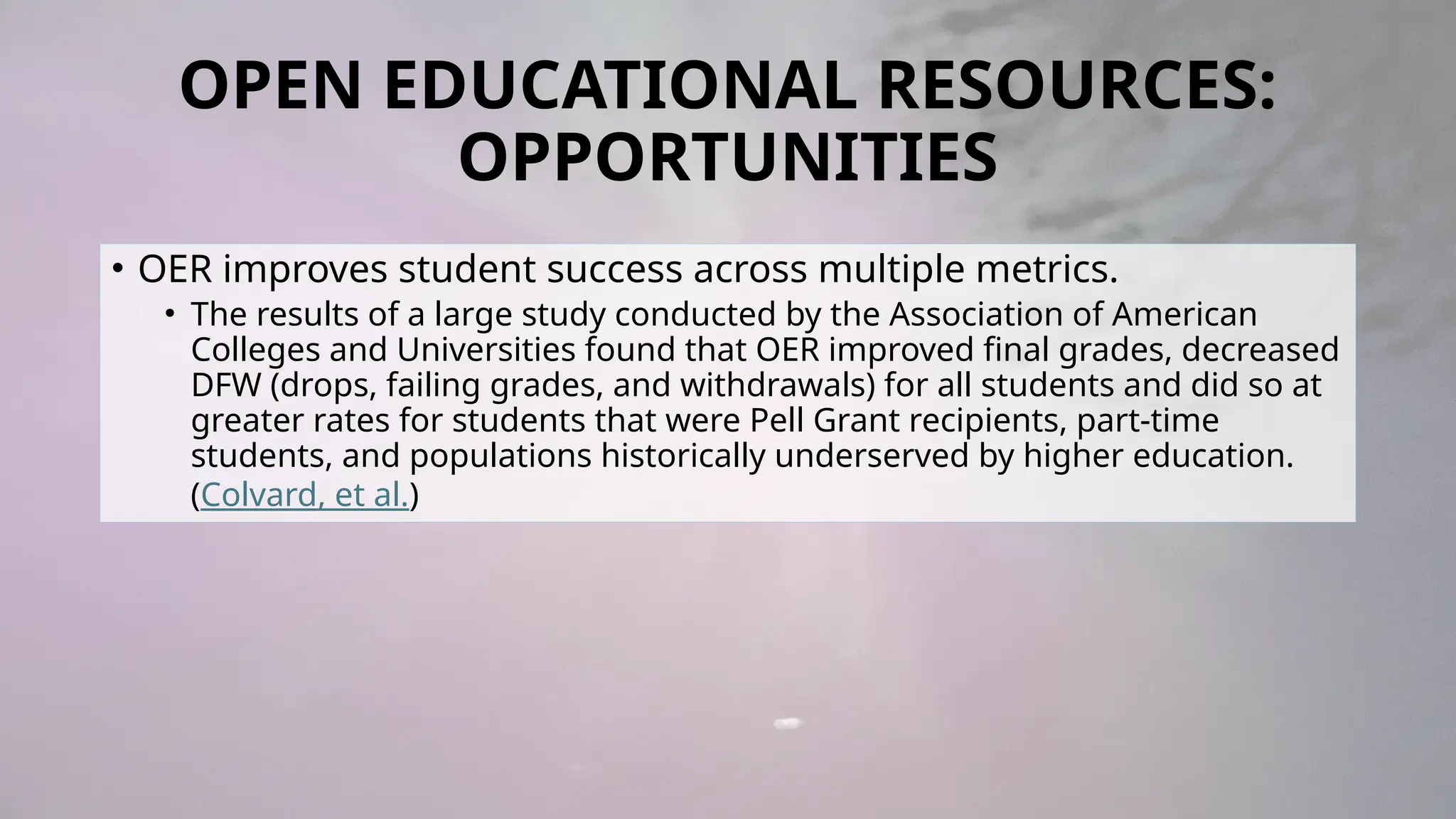
OPEN EDUCATIONAL RESOURCES:
OPPORTUNITIES
•OER improves student success across multiple metrics.
• The results of a large study conducted by the Association of American
Colleges and Universities found that OER improved final grades, decreased
DFW (drops, failing grades, and withdrawals) for all students and did so at
greater rates for students that were Pell Grant recipients, part-time
students, and populations historically underserved by higher education.
(Colvard, et al.)
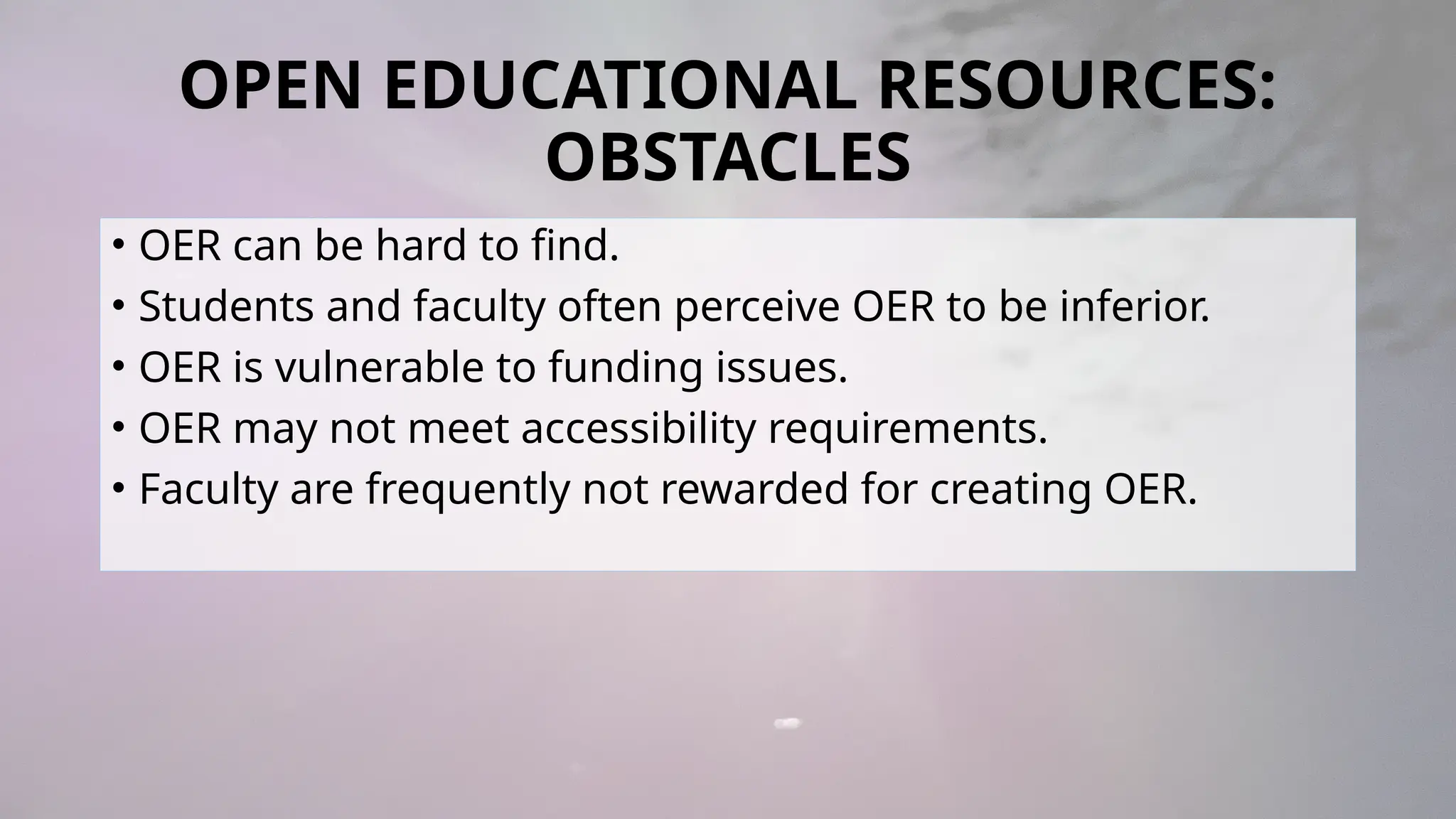
10.
OPEN EDUCATIONAL RESOURCES:
OBSTACLES
•OER can be hard to find.
• Students and faculty often perceive OER to be inferior.
• OER is vulnerable to funding issues.
• OER may not meet accessibility requirements.
• Faculty are frequently not rewarded for creating OER.
11.
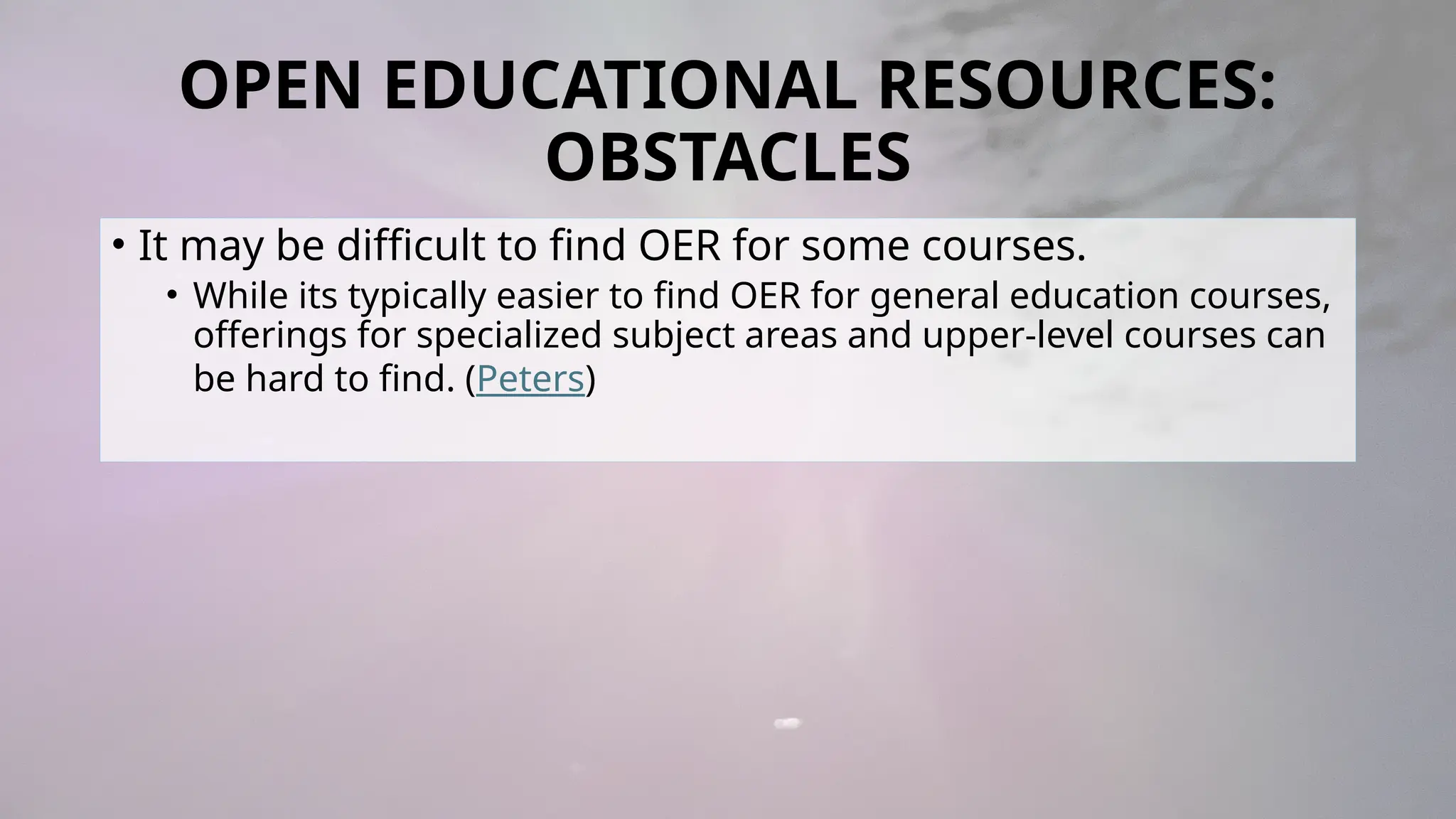
OPEN EDUCATIONAL RESOURCES:
OBSTACLES
•It may be difficult to find OER for some courses.
• While its typically easier to find OER for general education courses,
offerings for specialized subject areas and upper-level courses can
be hard to find. (Peters)
12.
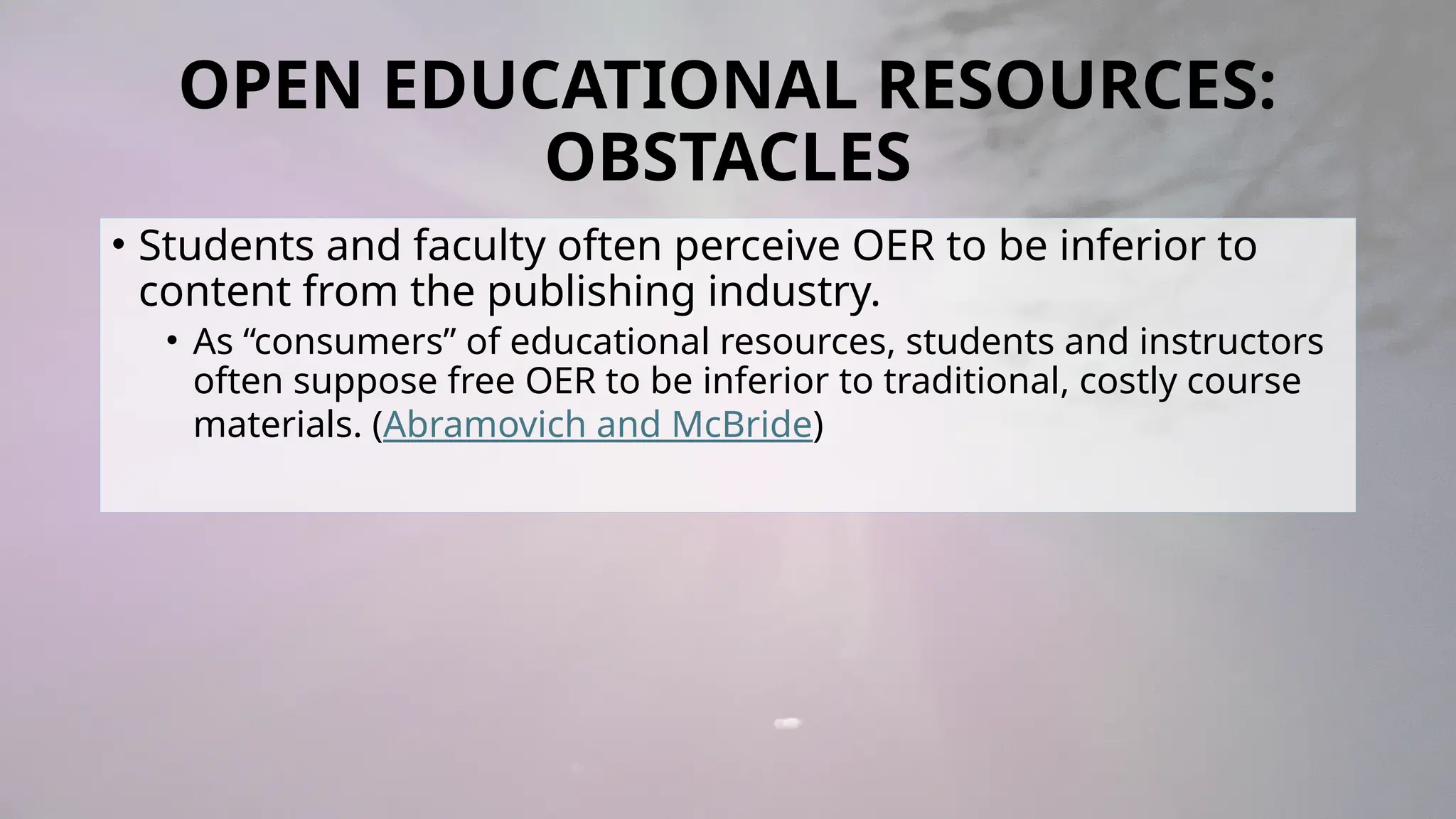
OPEN EDUCATIONAL RESOURCES:
OBSTACLES
•Students and faculty often perceive OER to be inferior to
content from the publishing industry.
• As “consumers” of educational resources, students and instructors
often suppose free OER to be inferior to traditional, costly course
materials. (Abramovich and McBride)
13.
OPEN EDUCATIONAL RESOURCES:
OBSTACLES
•Cuts in funding for education and changing priorities in the
private sector could negatively impact development, access,
and support for OER.
• The decrease in public spending for education places a greater
reliance on private capital and philanthropic funding, which leave
OER exposed if current levels of support from the private sector
diminish significantly. (Hewlett Foundation)
14.
OPEN EDUCATIONAL RESOURCES:
OBSTACLES
•Some OER may not meet current accessibility standards or
be updated in the future to meet new standards.
• Lack of resources and support for OER creators can lead to barriers
that prevent widespread adoption, including content not being
accessible to all learners. (Schultz and Azadbakht)
15.
OPEN EDUCATIONAL RESOURCES:
OBSTACLES
•OER creators are frequently not compensated or supported for their
efforts.
• OER creation is typically not rewarded in the current tenure system. (
Crissinger)
• Concurrently, the number of tenured and tenure-track faculty is decreasing,
while incentives and support for non-tenured faculty to devote time toward
the creation of OER are even less than what is available to tenured and
tenure-track faculty. (Ibid)
16.
OPEN EDUCATIONAL RESOURCES:
CONCLUSION
•There are real opportunities and some obstacles involved in
OER, but, the benefits outweigh the challenges.
• The financial savings for students are a big reason why – and
especially in the current era of inflation, stagnant wages, and
general economic uncertainty.
• Another reason is the data showing OER improves student success
and especially for Pell Grant recipients, part-time students, and
populations historically underserved by higher education.
• And both of these reasons connect with how OER better serves
inclusive learning objectives and the larger goals of social justice.
• Though some of the obstacles related to OER can be
problematic, they do not supersede the opportunities.
17.
Works Cited
Abdous, M’hammed.“Educational Resources: Trends, Benefits, and Challenges in U.S. Higher Education.” Center for Faculty Development, Old
Dominion University.
https://www.odu.edu/facultydevelopment/article/unlocking-the-potential-of-open-educational-resources-trends-benefits.
Abramovich, Samuel and Mark McBride. “Open education resources and perceptions of financial value.” The Internet and Higher Education,
Volume 39, 2018, Pages 33-38, ISSN 1096-7516. https://doi.org/10.1016/j.iheduc.2018.06.002.
Colvard, Nicholas, et al. “The Impact of Open Educational Resources on Various Student Success Metrics.” International Journal of Teaching and
Learning in Higher Education, Volume 30, Number 2, 2018, Pages 262-276, ISSN 1812-9129. Institute of Education Science.
https://files.eric.ed.gov/fulltext/EJ1184998.pdf.
Crissinger, Sarah. “A Critical Take on OER Practices: Interrogating Commercialization, Colonialism, and Content.” In The Library with the Lead Pipe,
An open access, open peer reviewed journal. October 21, 2015.
https://www.inthelibrarywiththeleadpipe.org/2015/a-critical-take-on-oer-practices-interrogating-commercialization-colonialism-and-conte
nt/
.
Ivory, CJ and Angela Pashia. Using Open Educational Resources to Promote Social Justice, Association of College and Research Libraries, Chicago, IL,
2022. https://www.ala.org/sites/default/files/acrl/content/publications/booksanddigitalresources/digital/9780838936771_OA.pdf.
Pawlyshyn, Nancy, et al. "Adopting OER: A Case Study of Cross-Institutional Collaboration and Innovation." EDUCAUSE Review (Online), 2013.
ProQuest. https://www.proquest.com/openview/024ff25a29c019254b947c28499b98a6/1?pq-origsite=gscholar&cbl=7213897.
Peters, Victoria. "What are the Challenges of Using OER?" Research Help at DePauw Libraries, DePauw University Libraries, 22 Nov. 2022,
https://libanswers.depauw.edu/faq/380181.
Schultz, Teresa, & Elena Azadbakht. "Open but Not for All: A Survey of Open Educational Resource Librarians on Accessibility." College & Research
Libraries [Online], 82.5 (2021): 755. https://crl.acrl.org/index.php/crl/article/view/25018/32895.
“White Paper: Open Educational Resources, Breaking the Lockbox on Education.” The William and Flora Hewlett Foundation. November 2013.
https://hewlett.org/wp-content/uploads/2016/08/OER%20White%20Paper%20Nov%2022%202013%20Final_0.pdf.
![Works Cited
Abdous, M’hammed. “Educational Resources: Trends, Benefits, and Challenges in U.S. Higher Education.” Center for Faculty Development, Old
Dominion University.
https://www.odu.edu/facultydevelopment/article/unlocking-the-potential-of-open-educational-resources-trends-benefits.
Abramovich, Samuel and Mark McBride. “Open education resources and perceptions of financial value.” The Internet and Higher Education,
Volume 39, 2018, Pages 33-38, ISSN 1096-7516. https://doi.org/10.1016/j.iheduc.2018.06.002.
Colvard, Nicholas, et al. “The Impact of Open Educational Resources on Various Student Success Metrics.” International Journal of Teaching and
Learning in Higher Education, Volume 30, Number 2, 2018, Pages 262-276, ISSN 1812-9129. Institute of Education Science.
https://files.eric.ed.gov/fulltext/EJ1184998.pdf.
Crissinger, Sarah. “A Critical Take on OER Practices: Interrogating Commercialization, Colonialism, and Content.” In The Library with the Lead Pipe,
An open access, open peer reviewed journal. October 21, 2015.
https://www.inthelibrarywiththeleadpipe.org/2015/a-critical-take-on-oer-practices-interrogating-commercialization-colonialism-and-conte
nt/
.
Ivory, CJ and Angela Pashia. Using Open Educational Resources to Promote Social Justice, Association of College and Research Libraries, Chicago, IL,
2022. https://www.ala.org/sites/default/files/acrl/content/publications/booksanddigitalresources/digital/9780838936771_OA.pdf.
Pawlyshyn, Nancy, et al. "Adopting OER: A Case Study of Cross-Institutional Collaboration and Innovation." EDUCAUSE Review (Online), 2013.
ProQuest. https://www.proquest.com/openview/024ff25a29c019254b947c28499b98a6/1?pq-origsite=gscholar&cbl=7213897.
Peters, Victoria. "What are the Challenges of Using OER?" Research Help at DePauw Libraries, DePauw University Libraries, 22 Nov. 2022,
https://libanswers.depauw.edu/faq/380181.
Schultz, Teresa, & Elena Azadbakht. "Open but Not for All: A Survey of Open Educational Resource Librarians on Accessibility." College & Research
Libraries [Online], 82.5 (2021): 755. https://crl.acrl.org/index.php/crl/article/view/25018/32895.
“White Paper: Open Educational Resources, Breaking the Lockbox on Education.” The William and Flora Hewlett Foundation. November 2013.
https://hewlett.org/wp-content/uploads/2016/08/OER%20White%20Paper%20Nov%2022%202013%20Final_0.pdf.](https://image.slidesharecdn.com/oertraining-assignment9-1-ppt-250718170923-e19b08f6/75/OER-TRAINING-ASSIGNMENT-9-1-PPT-pptx-17-2048.jpg)


