Inspiring Climate Action
Dr Phil Driver
• Author of:
– “Validating Strategies – Linking Projects and Results to Uses and Benefits”
– “From Woe to Flow” – Validating and Implementing Strategies”
• Founder of OpenStrategies Ltd
• Lecturer in strategy in NZ, Australia, the UK and Germany
• Background in business, science, technology and the public sector
Today’s presentation
1. NZ’s climate change strategic environment
2. PRUB-Logic for inspiring climate action
3. Inspiring an example adaptation/mitigation
project
4. Summary
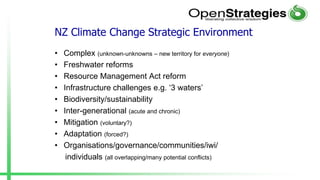
NZ Climate Change Strategic Environment
• Complex (unknown-unknowns – new territory for everyone)
• Freshwater reforms
• Resource Management Act reform
• Infrastructure challenges e.g. ‘3 waters’
• Biodiversity/sustainability
• Inter-generational (acute and chronic)
• Mitigation (voluntary?)
• Adaptation (forced?)
• Organisations/governance/communities/iwi/
individuals (all overlapping/many potential conflicts)
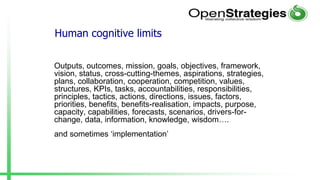
Outputs, outcomes, mission, goals, objectives, framework,
vision, status, cross-cutting-themes, aspirations, strategies,
plans, collaboration, cooperation, competition, values,
structures, KPIs, tasks, accountabilities, responsibilities,
principles, tactics, actions, directions, issues, factors,
priorities, benefits, benefits-realisation, impacts, purpose,
capacity, capabilities, forecasts, scenarios, drivers-for-
change, data, information, knowledge, wisdom….
and sometimes ‘implementation’
Human cognitive limits
Our key principle
The smallest amount of strategic information…
that has the highest value…
to the most people
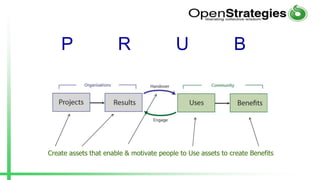
Create assets that enable & motivate people to Use assets to create Benefits
P R U B
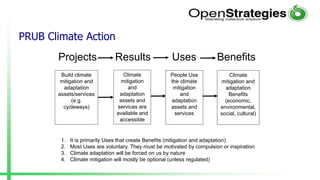
PRUB Climate Action
Projects Results Uses Benefits
Build climate
mitigation and
adaptation
assets/services
(e.g.
cycleways)
Climate
mitigation
and
adaptation
assets and
services are
available and
accessible
People Use
the climate
mitigation
and
adaptation
assets and
services
Climate
mitigation and
adaptation
Benefits
(economic,
environmental,
social, cultural)
1. It is primarily Uses that create Benefits (mitigation and adaptation)
2. Most Uses are voluntary. They must be motivated by compulsion or inspiration
3. Climate adaptation will be forced on us by nature
4. Climate mitigation will mostly be optional (unless regulated)
Only Uses create Benefits
(an inconvenient truth)
Climate action?
• We mostly know what needs doing to mitigate and adapt
to climate change
• Why aren’t we doing it?
• We’re not sufficiently motivated (compelled or inspired)
• Project managers generally cannot ‘compel’
actions/Uses
• So we need to ‘inspire’ Uses
Compelling and inspiring climate action
1. Adaptation
Will require convincing, pragmatic business cases that motivate
stakeholders
2. Mitigation
Will require inspirational Results and communications that
motivate stakeholders
Mitigation/adaptation - tell a better project story
Can projects be modified,
or even just re-defined,
so as to increasingly inspire action
from all stakeholders?
Mitigation/adaptation planting project
• Plant trees and shrubs in catchments and alongside waterways
to reduce flooding caused by climate change and to capture
carbon
• Is that practical and useful (yes!)
• Is that inspiring? (hmmmm….)
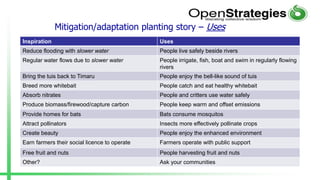
Mitigation/adaptation planting story – Uses
Inspiration Uses
Reduce flooding with slower water People live safely beside rivers
Regular water flows due to slower water People irrigate, fish, boat and swim in regularly flowing
rivers
Bring the tuis back to Timaru People enjoy the bell-like sound of tuis
Breed more whitebait People catch and eat healthy whitebait
Absorb nitrates People and critters use water safely
Produce biomass/firewood/capture carbon People keep warm and offset emissions
Provide homes for bats Bats consume mosquitos
Attract pollinators Insects more effectively pollinate crops
Create beauty People enjoy the enhanced environment
Earn farmers their social licence to operate Farmers operate with public support
Free fruit and nuts People harvesting fruit and nuts
Other? Ask your communities
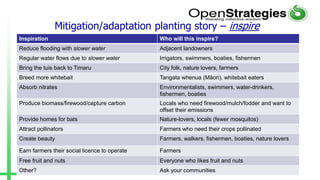
Mitigation/adaptation planting story – inspire
Inspiration Who will this inspire?
Reduce flooding with slower water Adjacent landowners
Regular water flows due to slower water Irrigators, swimmers, boaties, fishermen
Bring the tuis back to Timaru City folk, nature lovers, farmers
Breed more whitebait Tangata whenua (Māori), whitebait eaters
Absorb nitrates Environmentalists, swimmers, water-drinkers,
fishermen, boaties
Produce biomass/firewood/capture carbon Locals who need firewood/mulch/fodder and want to
offset their emissions
Provide homes for bats Nature-lovers, locals (fewer mosquitos)
Attract pollinators Farmers who need their crops pollinated
Create beauty Farmers, walkers, fishermen, boaties, nature lovers
Earn farmers their social licence to operate Farmers
Free fruit and nuts Everyone who likes fruit and nuts
Other? Ask your communities
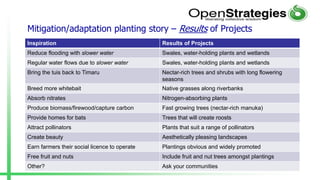
Mitigation/adaptation planting story – Results of Projects
Inspiration Results of Projects
Reduce flooding with slower water Swales, water-holding plants and wetlands
Regular water flows due to slower water Swales, water-holding plants and wetlands
Bring the tuis back to Timaru Nectar-rich trees and shrubs with long flowering
seasons
Breed more whitebait Native grasses along riverbanks
Absorb nitrates Nitrogen-absorbing plants
Produce biomass/firewood/capture carbon Fast growing trees (nectar-rich manuka)
Provide homes for bats Trees that will create roosts
Attract pollinators Plants that suit a range of pollinators
Create beauty Aesthetically pleasing landscapes
Earn farmers their social licence to operate Plantings obvious and widely promoted
Free fruit and nuts Include fruit and nut trees amongst plantings
Other? Ask your communities
Did that cost more?
There were few additional costs in
making the story more inspiring
for many different stakeholders
Summary for project managers
Create inspiring stories (7+)
for every Project
For more information
Dr Phil Driver,
Visiting lecturer, Cologne University of Applied Sciences
CEO, OpenStrategies Ltd
Author: Validating Strategies – Linking Projects and Results to Uses and Benefits
http://www.gowerpublishing.com/isbn/9781472427816
Author: “From Woe to Flow – Validating and Implementing Strategies (2020)
www.openstrategies.com
phildriver@openstrategies.com
+64 (0)21 0236 5861
Extra slides that may help with questions
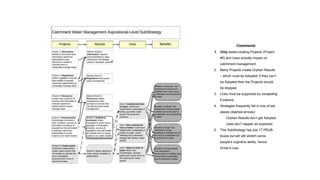
Comments
1. Only asset-creating Projects (Project
#5) and Uses actually impact on
catchment management.
2. Many Projects create Orphan Results
– which must be Adopted. If they can’t
be Adopted then the Projects should
be stopped.
3. Links must be supported by compelling
Evidence.
4. Strategies frequently fail in one of two
places (dashed arrows):
Orphan Results don’t get Adopted
Uses don’t happen as expected
5. This SubStrategy has just 17 PRUB-
boxes but will still stretch some
people’s cognitive ability, hence
Driver’s Law
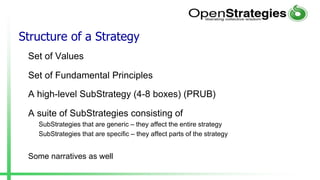
Structure of a Strategy
Set of Values
Set of Fundamental Principles
A high-level SubStrategy (4-8 boxes) (PRUB)
A suite of SubStrategies consisting of
SubStrategies that are generic – they affect the entire strategy
SubStrategies that are specific – they affect parts of the strategy
Some narratives as well

Phil Driver: Inspiring Climate Action

  • 1.
    Inspiring Climate Action DrPhil Driver • Author of: – “Validating Strategies – Linking Projects and Results to Uses and Benefits” – “From Woe to Flow” – Validating and Implementing Strategies” • Founder of OpenStrategies Ltd • Lecturer in strategy in NZ, Australia, the UK and Germany • Background in business, science, technology and the public sector
  • 2.
    Today’s presentation 1. NZ’sclimate change strategic environment 2. PRUB-Logic for inspiring climate action 3. Inspiring an example adaptation/mitigation project 4. Summary
  • 3.
    NZ Climate ChangeStrategic Environment • Complex (unknown-unknowns – new territory for everyone) • Freshwater reforms • Resource Management Act reform • Infrastructure challenges e.g. ‘3 waters’ • Biodiversity/sustainability • Inter-generational (acute and chronic) • Mitigation (voluntary?) • Adaptation (forced?) • Organisations/governance/communities/iwi/ individuals (all overlapping/many potential conflicts)
  • 4.
    Outputs, outcomes, mission,goals, objectives, framework, vision, status, cross-cutting-themes, aspirations, strategies, plans, collaboration, cooperation, competition, values, structures, KPIs, tasks, accountabilities, responsibilities, principles, tactics, actions, directions, issues, factors, priorities, benefits, benefits-realisation, impacts, purpose, capacity, capabilities, forecasts, scenarios, drivers-for- change, data, information, knowledge, wisdom…. and sometimes ‘implementation’ Human cognitive limits
  • 5.
    Our key principle Thesmallest amount of strategic information… that has the highest value… to the most people
  • 6.
    Create assets thatenable & motivate people to Use assets to create Benefits P R U B
  • 7.
    PRUB Climate Action ProjectsResults Uses Benefits Build climate mitigation and adaptation assets/services (e.g. cycleways) Climate mitigation and adaptation assets and services are available and accessible People Use the climate mitigation and adaptation assets and services Climate mitigation and adaptation Benefits (economic, environmental, social, cultural) 1. It is primarily Uses that create Benefits (mitigation and adaptation) 2. Most Uses are voluntary. They must be motivated by compulsion or inspiration 3. Climate adaptation will be forced on us by nature 4. Climate mitigation will mostly be optional (unless regulated)
  • 8.
    Only Uses createBenefits (an inconvenient truth)
  • 9.
    Climate action? • Wemostly know what needs doing to mitigate and adapt to climate change • Why aren’t we doing it? • We’re not sufficiently motivated (compelled or inspired) • Project managers generally cannot ‘compel’ actions/Uses • So we need to ‘inspire’ Uses
  • 10.
    Compelling and inspiringclimate action 1. Adaptation Will require convincing, pragmatic business cases that motivate stakeholders 2. Mitigation Will require inspirational Results and communications that motivate stakeholders
  • 11.
    Mitigation/adaptation - tella better project story Can projects be modified, or even just re-defined, so as to increasingly inspire action from all stakeholders?
  • 12.
    Mitigation/adaptation planting project •Plant trees and shrubs in catchments and alongside waterways to reduce flooding caused by climate change and to capture carbon • Is that practical and useful (yes!) • Is that inspiring? (hmmmm….)
  • 13.
    Mitigation/adaptation planting story– Uses Inspiration Uses Reduce flooding with slower water People live safely beside rivers Regular water flows due to slower water People irrigate, fish, boat and swim in regularly flowing rivers Bring the tuis back to Timaru People enjoy the bell-like sound of tuis Breed more whitebait People catch and eat healthy whitebait Absorb nitrates People and critters use water safely Produce biomass/firewood/capture carbon People keep warm and offset emissions Provide homes for bats Bats consume mosquitos Attract pollinators Insects more effectively pollinate crops Create beauty People enjoy the enhanced environment Earn farmers their social licence to operate Farmers operate with public support Free fruit and nuts People harvesting fruit and nuts Other? Ask your communities
  • 14.
    Mitigation/adaptation planting story– inspire Inspiration Who will this inspire? Reduce flooding with slower water Adjacent landowners Regular water flows due to slower water Irrigators, swimmers, boaties, fishermen Bring the tuis back to Timaru City folk, nature lovers, farmers Breed more whitebait Tangata whenua (Māori), whitebait eaters Absorb nitrates Environmentalists, swimmers, water-drinkers, fishermen, boaties Produce biomass/firewood/capture carbon Locals who need firewood/mulch/fodder and want to offset their emissions Provide homes for bats Nature-lovers, locals (fewer mosquitos) Attract pollinators Farmers who need their crops pollinated Create beauty Farmers, walkers, fishermen, boaties, nature lovers Earn farmers their social licence to operate Farmers Free fruit and nuts Everyone who likes fruit and nuts Other? Ask your communities
  • 15.
    Mitigation/adaptation planting story– Results of Projects Inspiration Results of Projects Reduce flooding with slower water Swales, water-holding plants and wetlands Regular water flows due to slower water Swales, water-holding plants and wetlands Bring the tuis back to Timaru Nectar-rich trees and shrubs with long flowering seasons Breed more whitebait Native grasses along riverbanks Absorb nitrates Nitrogen-absorbing plants Produce biomass/firewood/capture carbon Fast growing trees (nectar-rich manuka) Provide homes for bats Trees that will create roosts Attract pollinators Plants that suit a range of pollinators Create beauty Aesthetically pleasing landscapes Earn farmers their social licence to operate Plantings obvious and widely promoted Free fruit and nuts Include fruit and nut trees amongst plantings Other? Ask your communities
  • 16.
    Did that costmore? There were few additional costs in making the story more inspiring for many different stakeholders
  • 17.
    Summary for projectmanagers Create inspiring stories (7+) for every Project
  • 18.
    For more information DrPhil Driver, Visiting lecturer, Cologne University of Applied Sciences CEO, OpenStrategies Ltd Author: Validating Strategies – Linking Projects and Results to Uses and Benefits http://www.gowerpublishing.com/isbn/9781472427816 Author: “From Woe to Flow – Validating and Implementing Strategies (2020) www.openstrategies.com phildriver@openstrategies.com +64 (0)21 0236 5861
  • 19.
    Extra slides thatmay help with questions
  • 20.
    Comments 1. Only asset-creatingProjects (Project #5) and Uses actually impact on catchment management. 2. Many Projects create Orphan Results – which must be Adopted. If they can’t be Adopted then the Projects should be stopped. 3. Links must be supported by compelling Evidence. 4. Strategies frequently fail in one of two places (dashed arrows): Orphan Results don’t get Adopted Uses don’t happen as expected 5. This SubStrategy has just 17 PRUB- boxes but will still stretch some people’s cognitive ability, hence Driver’s Law
  • 21.
    Structure of aStrategy Set of Values Set of Fundamental Principles A high-level SubStrategy (4-8 boxes) (PRUB) A suite of SubStrategies consisting of SubStrategies that are generic – they affect the entire strategy SubStrategies that are specific – they affect parts of the strategy Some narratives as well