Wikieducator.org
       OER Online Community
    An Online Community Ethnography
   Contributing to the Edupunks, DIY U,
     and the Free Culture Movement

The whole presentation can be seen at: http://z.umn.edu/wikieducator
Why Wikieducator?
Personal Reasons / Bias
•   Social Reproduction – Family, Conditions, Opportunity
•   North / South – Digital Divide
•   Means of Production / Progress
•   What We Learned From The Past
•   Desire From Marginalized Voices To Be Heard

- (Part of my biases were included in the first letter of
  invitation to participants) – Response rate was lower
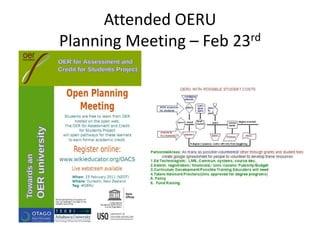
Attended OERU
Planning Meeting – Feb 23rd
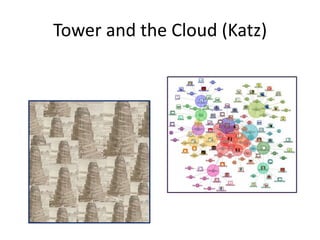
Tower and the Cloud (Katz)
Leapfrogging Futures!
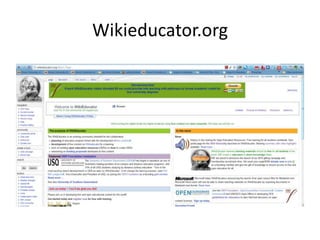
Wikieducator.org
Wikieducator.org
• Founded by Wayne Mackintosh
• Opened – in August 2006
• Slogan – “To turn the digital divide into digital
  dividends using free content and open
  networks”

 For CI 5323 – Online Learning Communities Course,
 we had to pick an online community and interact with
 it weekly.
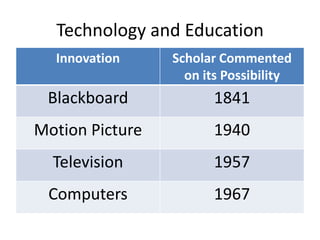
Technology and Education
  Innovation     Scholar Commented
                   on its Possibility
 Blackboard            1841
Motion Picture         1940
  Television           1957
 Computers             1967
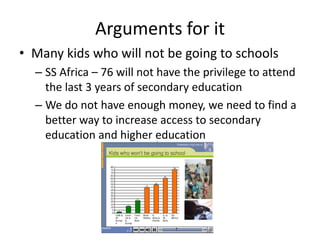
Arguments for it
• Many kids who will not be going to schools
  – SS Africa – 76 will not have the privilege to attend
    the last 3 years of secondary education
  – We do not have enough money, we need to find a
    better way to increase access to secondary
    education and higher education
Technology and Social Links
• Importance of the Guttenberg Press on
  spreading knowledge between the elite
• But need for social connections (at an
  individual level)
• Find a mechanism that enshrines education as
  a common global good.
• “Wiki technology combined with the right
  license meets these two requirements”
WikiEducator Mission

• 2015 – A free curriculum for all sectors
   – “Working collaboratively with educators
     around the world we aim to develop free
     content resources in support of all national
     curricula”
   – Not replacing closed content. There are
     motivated producers in both the open and
     close curriculum projects
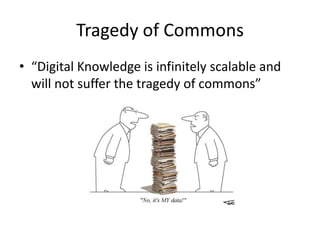
Tragedy of Commons
• “Digital Knowledge is infinitely scalable and
  will not suffer the tragedy of commons”
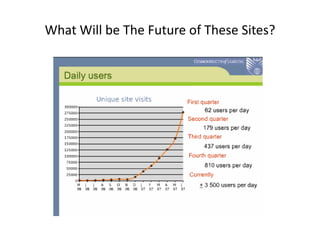
What Will be The Future of These Sites?
Some Initiatives
• VUSSC - Virtual University for Small States of the Commonwealth
   – Network of 30 countries - OER

• UNESCO/COL Computer Navigator's Certificate
   – Free computer and Software training for developing countries

• FLOSS4Edu
   – Address the absence of Free content in African Schools

• Learning4Content and Scalability
   – Scale up the development of OER
   – Native American proverb - "Tell me and I'll forget, show me and I may
     not remember, involve me, and I'll understand"
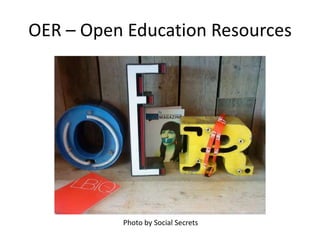
OER – Open Education Resources


          Photo by Social Secrets
What are OER?
• “open educational resources are digitised materials
  offered freely and openly for educators, students and
  self-learners to use and reuse for teaching, learning
  and research”
• Term was first coined at a UNESCO meeting – 2002
• OECD - the concept of “open educational resources”
  is both broad and vague. (As noticed through this
  research)
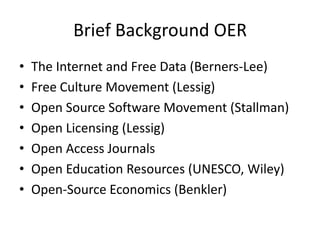
Brief Background OER
•   The Internet and Free Data (Berners-Lee)
•   Free Culture Movement (Lessig)
•   Open Source Software Movement (Stallman)
•   Open Licensing (Lessig)
•   Open Access Journals
•   Open Education Resources (UNESCO, Wiley)
•   Open-Source Economics (Benkler)
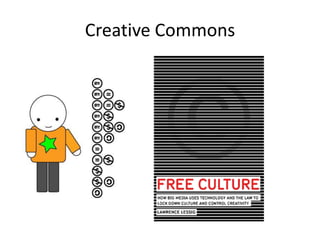
Creative Commons
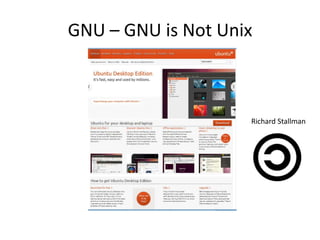
GNU – GNU is Not Unix


                    Richard Stallman
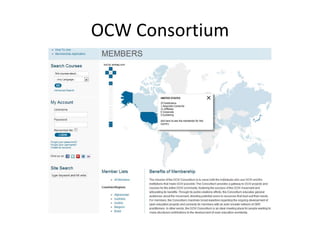
OCW Consortium
Freedoms

• Freedom 0 – Freedom to use

• Freedom 1 – Freedom to adapt to your needs

• Freedom 2 – Freedom to help your neighbor (copies)

• Freedom 3 – Freedom to help your community
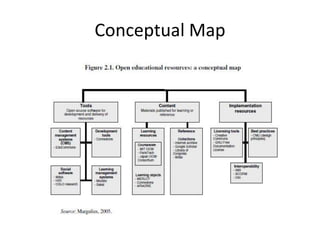
Conceptual Map
Research Project
• Mini Ethnography – Hoping to expand it into a
  9 month to a year project.
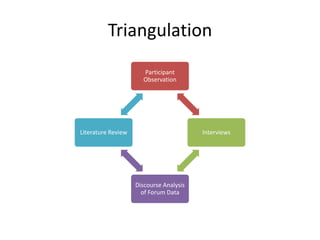
Triangulation
                      Participant
                      Observation


Literature Review                        Interviews


                    Discourse Analysis
                      of Forum Data
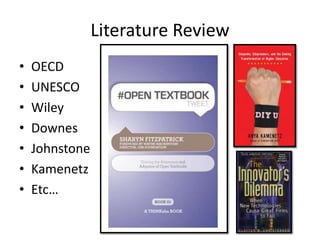
Literature Review
•   OECD
•   UNESCO
•   Wiley
•   Downes
•   Johnstone
•   Kamenetz
•   Etc…
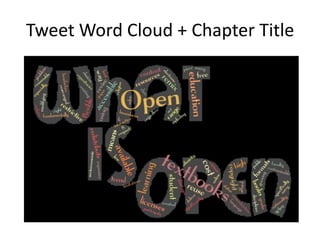
Tweet Word Cloud + Chapter Title
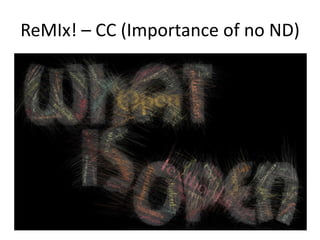
ReMIx! – CC (Importance of no ND)
Participant Observation
• Became a member of Wikieducator.org
• Became a member of SCOPE – BC Campus
• Attended the February 23, 2011 OERU Planning
  Meeting
• Began developing my own OER
• Became a member of the OCW Online
  Communities
• Became a member of the OERU Google Group
• Became a member of the WSIS – OER and OERU
  Groups
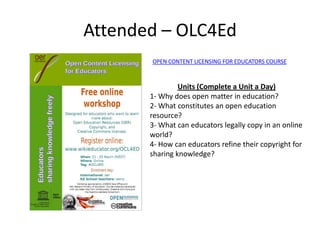
Attended – OLC4Ed
       OPEN CONTENT LICENSING FOR EDUCATORS COURSE


                Units (Complete a Unit a Day)
       1- Why does open matter in education?
       2- What constitutes an open education
       resource?
       3- What can educators legally copy in an online
       world?
       4- How can educators refine their copyright for
       sharing knowledge?
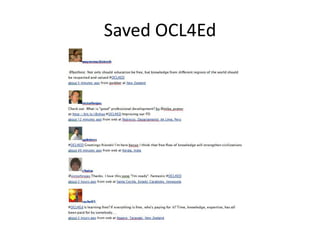
Saved OCL4Ed
Responses OCL4Ed (Day 3)
• With the case study itself, I wondered if there could be multiple
  case studies made available for future iterations (through
  hyperlinks?). I accessed the link to the P2P - copyright for educators
  the page provided and it was helpful for finding other examples, but
  I felt that more case studies could be made available and help one
  to further your understand of Creative Commons.

•    One possibility could be to include a case study that mentions the
    implications of a YouTube video. In the school I used to work at
    teachers primarily used YouTube videos and Netflix when including
    audio visuals in their classrooms. Perhaps an additional case study
    could address this murkier subject, instead of analyzing a formal
    source such as a BBC video, YouTube.com or another video sharing
    website could be explored. This argument is particularly linked to
    question four.
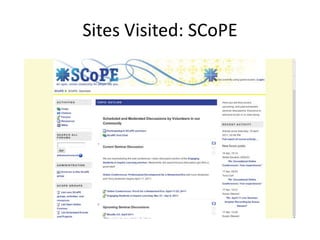
Sites Visited: SCoPE
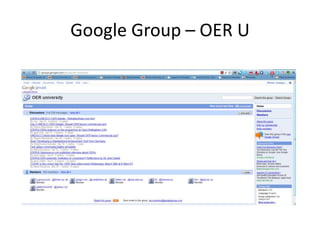
Google Group – OER U
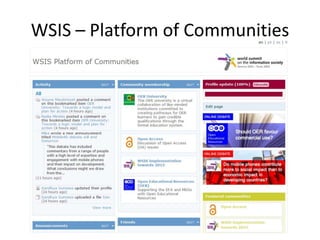
WSIS – Platform of Communities
Interviews
• Took the open list of participants to the OERU
  Planning Meeting
• Made an Microsoft Access Database
  – Included Name, Job Description, Email, Blog,
    Institutional Website
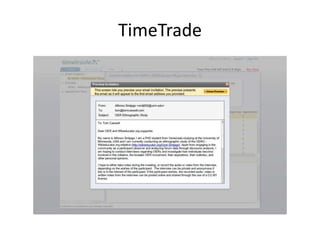
• Tried to send personalized emails from Access
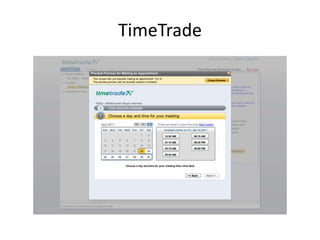
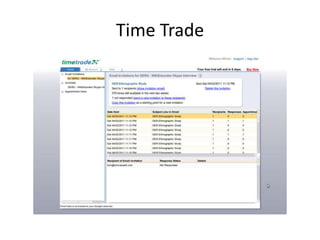
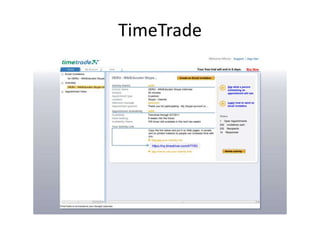
• Decided to try TimeTrade
  – (24/7 Availability)
Time Trade
TimeTrade
TimeTrade
TimeTrade
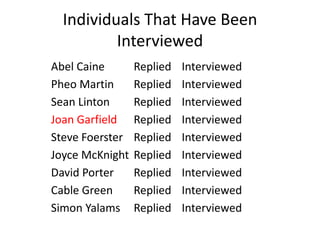
Individuals That Have Been
          Interviewed
Abel Caine       Replied   Interviewed
Pheo Martin      Replied   Interviewed
Sean Linton      Replied   Interviewed
Joan Garfield    Replied   Interviewed
Steve Foerster   Replied   Interviewed
Joyce McKnight   Replied   Interviewed
David Porter     Replied   Interviewed
Cable Green      Replied   Interviewed
Simon Yalams     Replied   Interviewed
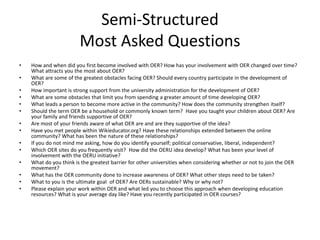
Semi-Structured
                        Most Asked Questions
•   How and when did you first become involved with OER? How has your involvement with OER changed over time?
    What attracts you the most about OER?
•   What are some of the greatest obstacles facing OER? Should every country participate in the development of
    OER?
•   How important is strong support from the university administration for the development of OER?
•   What are some obstacles that limit you from spending a greater amount of time developing OER?
•   What leads a person to become more active in the community? How does the community strengthen itself?
•   Should the term OER be a household or commonly known term? Have you taught your children about OER? Are
    your family and friends supportive of OER?
•   Are most of your friends aware of what OER are and are they supportive of the idea?
•   Have you met people within Wikieducator.org? Have these relationships extended between the online
    community? What has been the nature of these relationships?
•   If you do not mind me asking, how do you identify yourself; political conservative, liberal, independent?
•   Which OER sites do you frequently visit? How did the OERU idea develop? What has been your level of
    involvement with the OERU initiative?
•   What do you think is the greatest barrier for other universities when considering whether or not to join the OER
    movement?
•   What has the OER community done to increase awareness of OER? What other steps need to be taken?
•   What to you is the ultimate goal of OER? Are OERs sustainable? Why or why not?
•   Please explain your work within OER and what led you to choose this approach when developing education
    resources? What is your average day like? Have you recently participated in OER courses?
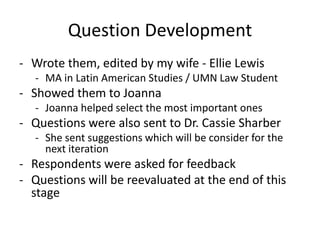
Question Development
- Wrote them, edited by my wife - Ellie Lewis
  - MA in Latin American Studies / UMN Law Student
- Showed them to Joanna
  - Joanna helped select the most important ones
- Questions were also sent to Dr. Cassie Sharber
  - She sent suggestions which will be consider for the
    next iteration
- Respondents were asked for feedback
- Questions will be reevaluated at the end of this
  stage
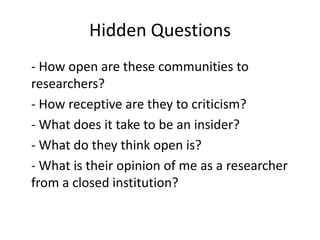
Hidden Questions
- How open are these communities to
researchers?
- How receptive are they to criticism?
- What does it take to be an insider?
- What do they think open is?
- What is their opinion of me as a researcher
from a closed institution?
Transcribing!
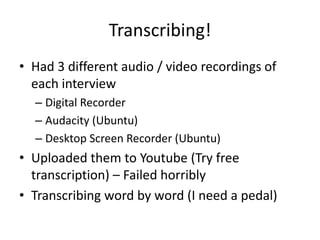
• Had 3 different audio / video recordings of
  each interview
  – Digital Recorder
  – Audacity (Ubuntu)
  – Desktop Screen Recorder (Ubuntu)
• Uploaded them to Youtube (Try free
  transcription) – Failed horribly
• Transcribing word by word (I need a pedal)
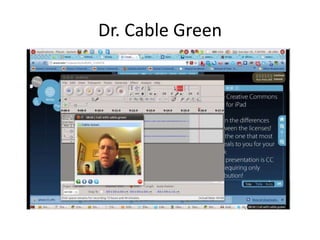
Dr. Cable Green
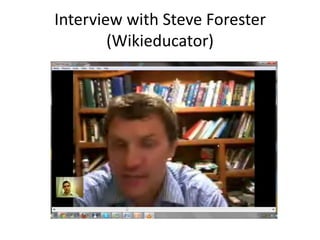
Interview with Steve Forester
        (Wikieducator)
Steve Forester
• “I think a lot of people who would like to develop
  open educational resources are constrained by
  other responsibilities that's why one of the
  initiatives that Wayne Mackintosh put together is
  to encourage universities to devote the equivalent
  of a full-time person to the development of open
  educational resources because with that sort of
  institutional commitment, it would really help
  individuals who are affiliated with those
  institutions and are interested in participating, as it
  would allow them to have the time that they need
  to do so.”
Interview with Abel Caine (UNESCO)
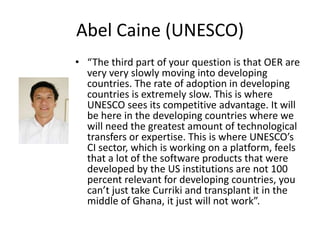
Abel Caine (UNESCO)
• “The third part of your question is that OER are
  very very slowly moving into developing
  countries. The rate of adoption in developing
  countries is extremely slow. This is where
  UNESCO sees its competitive advantage. It will
  be here in the developing countries where we
  will need the greatest amount of technological
  transfers or expertise. This is where UNESCO’s
  CI sector, which is working on a platform, feels
  that a lot of the software products that were
  developed by the US institutions are not 100
  percent relevant for developing countries, you
  can’t just take Curriki and transplant it in the
  middle of Ghana, it just will not work”.
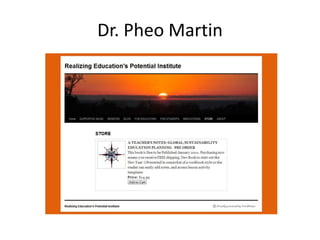
Dr. Pheo Martin
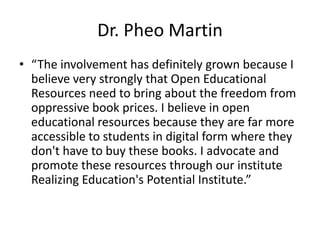
Dr. Pheo Martin
• “The involvement has definitely grown because I
  believe very strongly that Open Educational
  Resources need to bring about the freedom from
  oppressive book prices. I believe in open
  educational resources because they are far more
  accessible to students in digital form where they
  don't have to buy these books. I advocate and
  promote these resources through our institute
  Realizing Education's Potential Institute.”
Dr. Pheo Martin
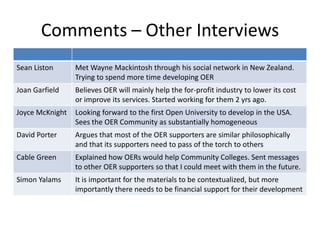
Comments – Other Interviews
Sean Liston      Met Wayne Mackintosh through his social network in New Zealand.
                 Trying to spend more time developing OER
Joan Garfield    Believes OER will mainly help the for-profit industry to lower its cost
                 or improve its services. Started working for them 2 yrs ago.
Joyce McKnight   Looking forward to the first Open University to develop in the USA.
                 Sees the OER Community as substantially homogeneous
David Porter     Argues that most of the OER supporters are similar philosophically
                 and that its supporters need to pass of the torch to others
Cable Green      Explained how OERs would help Community Colleges. Sent messages
                 to other OER supporters so that I could meet with them in the future.
Simon Yalams     It is important for the materials to be contextualized, but more
                 importantly there needs to be financial support for their development
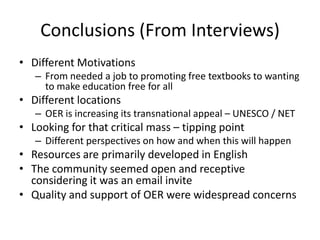
Conclusions (From Interviews)
• Different Motivations
   – From needed a job to promoting free textbooks to wanting
     to make education free for all
• Different locations
   – OER is increasing its transnational appeal – UNESCO / NET
• Looking for that critical mass – tipping point
   – Different perspectives on how and when this will happen
• Resources are primarily developed in English
• The community seemed open and receptive
  considering it was an email invite
• Quality and support of OER were widespread concerns
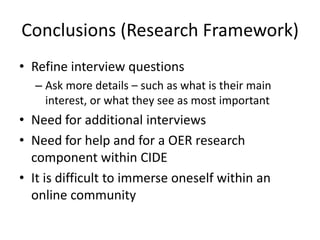
Conclusions (Research Framework)
• Refine interview questions
  – Ask more details – such as what is their main
    interest, or what they see as most important
• Need for additional interviews
• Need for help and for a OER research
  component within CIDE
• It is difficult to immerse oneself within an
  online community

2011 - Analyzing Wikieducators - Short Ethnography

  • 1.
    Wikieducator.org OER Online Community An Online Community Ethnography Contributing to the Edupunks, DIY U, and the Free Culture Movement The whole presentation can be seen at: http://z.umn.edu/wikieducator
  • 2.
  • 3.
    Personal Reasons /Bias • Social Reproduction – Family, Conditions, Opportunity • North / South – Digital Divide • Means of Production / Progress • What We Learned From The Past • Desire From Marginalized Voices To Be Heard - (Part of my biases were included in the first letter of invitation to participants) – Response rate was lower
  • 4.
  • 5.
    Tower and theCloud (Katz)
  • 6.
  • 7.
  • 8.
    Wikieducator.org • Founded byWayne Mackintosh • Opened – in August 2006 • Slogan – “To turn the digital divide into digital dividends using free content and open networks” For CI 5323 – Online Learning Communities Course, we had to pick an online community and interact with it weekly.
  • 9.
    Technology and Education Innovation Scholar Commented on its Possibility Blackboard 1841 Motion Picture 1940 Television 1957 Computers 1967
  • 10.
    Arguments for it •Many kids who will not be going to schools – SS Africa – 76 will not have the privilege to attend the last 3 years of secondary education – We do not have enough money, we need to find a better way to increase access to secondary education and higher education
  • 11.
    Technology and SocialLinks • Importance of the Guttenberg Press on spreading knowledge between the elite • But need for social connections (at an individual level) • Find a mechanism that enshrines education as a common global good. • “Wiki technology combined with the right license meets these two requirements”
  • 12.
    WikiEducator Mission • 2015– A free curriculum for all sectors – “Working collaboratively with educators around the world we aim to develop free content resources in support of all national curricula” – Not replacing closed content. There are motivated producers in both the open and close curriculum projects
  • 13.
    Tragedy of Commons •“Digital Knowledge is infinitely scalable and will not suffer the tragedy of commons”
  • 14.
    What Will beThe Future of These Sites?
  • 15.
    Some Initiatives • VUSSC- Virtual University for Small States of the Commonwealth – Network of 30 countries - OER • UNESCO/COL Computer Navigator's Certificate – Free computer and Software training for developing countries • FLOSS4Edu – Address the absence of Free content in African Schools • Learning4Content and Scalability – Scale up the development of OER – Native American proverb - "Tell me and I'll forget, show me and I may not remember, involve me, and I'll understand"
  • 16.
    OER – OpenEducation Resources Photo by Social Secrets
  • 17.
    What are OER? •“open educational resources are digitised materials offered freely and openly for educators, students and self-learners to use and reuse for teaching, learning and research” • Term was first coined at a UNESCO meeting – 2002 • OECD - the concept of “open educational resources” is both broad and vague. (As noticed through this research)
  • 18.
    Brief Background OER • The Internet and Free Data (Berners-Lee) • Free Culture Movement (Lessig) • Open Source Software Movement (Stallman) • Open Licensing (Lessig) • Open Access Journals • Open Education Resources (UNESCO, Wiley) • Open-Source Economics (Benkler)
  • 19.
  • 20.
    GNU – GNUis Not Unix Richard Stallman
  • 21.
  • 22.
    Freedoms • Freedom 0– Freedom to use • Freedom 1 – Freedom to adapt to your needs • Freedom 2 – Freedom to help your neighbor (copies) • Freedom 3 – Freedom to help your community
  • 23.
  • 24.
    Research Project • MiniEthnography – Hoping to expand it into a 9 month to a year project.
  • 25.
    Triangulation Participant Observation Literature Review Interviews Discourse Analysis of Forum Data
  • 26.
    Literature Review • OECD • UNESCO • Wiley • Downes • Johnstone • Kamenetz • Etc…
  • 27.
    Tweet Word Cloud+ Chapter Title
  • 28.
    ReMIx! – CC(Importance of no ND)
  • 29.
    Participant Observation • Becamea member of Wikieducator.org • Became a member of SCOPE – BC Campus • Attended the February 23, 2011 OERU Planning Meeting • Began developing my own OER • Became a member of the OCW Online Communities • Became a member of the OERU Google Group • Became a member of the WSIS – OER and OERU Groups
  • 30.
    Attended – OLC4Ed OPEN CONTENT LICENSING FOR EDUCATORS COURSE Units (Complete a Unit a Day) 1- Why does open matter in education? 2- What constitutes an open education resource? 3- What can educators legally copy in an online world? 4- How can educators refine their copyright for sharing knowledge?
  • 31.
  • 32.
    Responses OCL4Ed (Day3) • With the case study itself, I wondered if there could be multiple case studies made available for future iterations (through hyperlinks?). I accessed the link to the P2P - copyright for educators the page provided and it was helpful for finding other examples, but I felt that more case studies could be made available and help one to further your understand of Creative Commons. • One possibility could be to include a case study that mentions the implications of a YouTube video. In the school I used to work at teachers primarily used YouTube videos and Netflix when including audio visuals in their classrooms. Perhaps an additional case study could address this murkier subject, instead of analyzing a formal source such as a BBC video, YouTube.com or another video sharing website could be explored. This argument is particularly linked to question four.
  • 33.
  • 34.
  • 35.
    WSIS – Platformof Communities
  • 36.
    Interviews • Took theopen list of participants to the OERU Planning Meeting • Made an Microsoft Access Database – Included Name, Job Description, Email, Blog, Institutional Website • Tried to send personalized emails from Access • Decided to try TimeTrade – (24/7 Availability)
  • 37.
  • 38.
  • 39.
  • 40.
  • 41.
    Individuals That HaveBeen Interviewed Abel Caine Replied Interviewed Pheo Martin Replied Interviewed Sean Linton Replied Interviewed Joan Garfield Replied Interviewed Steve Foerster Replied Interviewed Joyce McKnight Replied Interviewed David Porter Replied Interviewed Cable Green Replied Interviewed Simon Yalams Replied Interviewed
  • 42.
    Semi-Structured Most Asked Questions • How and when did you first become involved with OER? How has your involvement with OER changed over time? What attracts you the most about OER? • What are some of the greatest obstacles facing OER? Should every country participate in the development of OER? • How important is strong support from the university administration for the development of OER? • What are some obstacles that limit you from spending a greater amount of time developing OER? • What leads a person to become more active in the community? How does the community strengthen itself? • Should the term OER be a household or commonly known term? Have you taught your children about OER? Are your family and friends supportive of OER? • Are most of your friends aware of what OER are and are they supportive of the idea? • Have you met people within Wikieducator.org? Have these relationships extended between the online community? What has been the nature of these relationships? • If you do not mind me asking, how do you identify yourself; political conservative, liberal, independent? • Which OER sites do you frequently visit? How did the OERU idea develop? What has been your level of involvement with the OERU initiative? • What do you think is the greatest barrier for other universities when considering whether or not to join the OER movement? • What has the OER community done to increase awareness of OER? What other steps need to be taken? • What to you is the ultimate goal of OER? Are OERs sustainable? Why or why not? • Please explain your work within OER and what led you to choose this approach when developing education resources? What is your average day like? Have you recently participated in OER courses?
  • 43.
    Question Development - Wrotethem, edited by my wife - Ellie Lewis - MA in Latin American Studies / UMN Law Student - Showed them to Joanna - Joanna helped select the most important ones - Questions were also sent to Dr. Cassie Sharber - She sent suggestions which will be consider for the next iteration - Respondents were asked for feedback - Questions will be reevaluated at the end of this stage
  • 44.
    Hidden Questions - Howopen are these communities to researchers? - How receptive are they to criticism? - What does it take to be an insider? - What do they think open is? - What is their opinion of me as a researcher from a closed institution?
  • 45.
    Transcribing! • Had 3different audio / video recordings of each interview – Digital Recorder – Audacity (Ubuntu) – Desktop Screen Recorder (Ubuntu) • Uploaded them to Youtube (Try free transcription) – Failed horribly • Transcribing word by word (I need a pedal)
  • 46.
  • 47.
    Interview with SteveForester (Wikieducator)
  • 48.
    Steve Forester • “Ithink a lot of people who would like to develop open educational resources are constrained by other responsibilities that's why one of the initiatives that Wayne Mackintosh put together is to encourage universities to devote the equivalent of a full-time person to the development of open educational resources because with that sort of institutional commitment, it would really help individuals who are affiliated with those institutions and are interested in participating, as it would allow them to have the time that they need to do so.”
  • 49.
    Interview with AbelCaine (UNESCO)
  • 50.
    Abel Caine (UNESCO) •“The third part of your question is that OER are very very slowly moving into developing countries. The rate of adoption in developing countries is extremely slow. This is where UNESCO sees its competitive advantage. It will be here in the developing countries where we will need the greatest amount of technological transfers or expertise. This is where UNESCO’s CI sector, which is working on a platform, feels that a lot of the software products that were developed by the US institutions are not 100 percent relevant for developing countries, you can’t just take Curriki and transplant it in the middle of Ghana, it just will not work”.
  • 51.
  • 52.
    Dr. Pheo Martin •“The involvement has definitely grown because I believe very strongly that Open Educational Resources need to bring about the freedom from oppressive book prices. I believe in open educational resources because they are far more accessible to students in digital form where they don't have to buy these books. I advocate and promote these resources through our institute Realizing Education's Potential Institute.”
  • 53.
  • 54.
    Comments – OtherInterviews Sean Liston Met Wayne Mackintosh through his social network in New Zealand. Trying to spend more time developing OER Joan Garfield Believes OER will mainly help the for-profit industry to lower its cost or improve its services. Started working for them 2 yrs ago. Joyce McKnight Looking forward to the first Open University to develop in the USA. Sees the OER Community as substantially homogeneous David Porter Argues that most of the OER supporters are similar philosophically and that its supporters need to pass of the torch to others Cable Green Explained how OERs would help Community Colleges. Sent messages to other OER supporters so that I could meet with them in the future. Simon Yalams It is important for the materials to be contextualized, but more importantly there needs to be financial support for their development
  • 55.
    Conclusions (From Interviews) •Different Motivations – From needed a job to promoting free textbooks to wanting to make education free for all • Different locations – OER is increasing its transnational appeal – UNESCO / NET • Looking for that critical mass – tipping point – Different perspectives on how and when this will happen • Resources are primarily developed in English • The community seemed open and receptive considering it was an email invite • Quality and support of OER were widespread concerns
  • 56.
    Conclusions (Research Framework) •Refine interview questions – Ask more details – such as what is their main interest, or what they see as most important • Need for additional interviews • Need for help and for a OER research component within CIDE • It is difficult to immerse oneself within an online community

Editor's Notes

  • #3 http://www.flickr.com/photos/greut/502095764/sizes/o/
  • #7 http://www.petsfoto.com/poison-dart-frogs/http://commons.wikimedia.org/wiki/File:Red_eyed_tree_frog_edit2.jpghttp://commons.wikimedia.org/wiki/File:Frog_on_bough.jpghttp://animals.nationalgeographic.com/staticfiles/NGS/Shared/StaticFiles/animals/images/1024/amazon-horned-frog.jpghttp://en.wikipedia.org/wiki/File:Leapfrog_in_harlem.jpg
  • #13 Not replacing closed contentThere are motivated producers in both the open and close curriculum projectsQuality is equally important for closed and free content
  • #15 http://wikieducator.org/WikiEducator:Multimedia/Our_project
  • #17 http://okrasroka.wordpress.com/
  • #22 http://www.ocwconsortium.org/members
  • #25 http://www.topnews.in/scientists-identify-microbes-can-increase-plant-growth-2115905
  • #31 http://wikieducator.org/Open_content_licensing_for_educators/Workshop_schedule