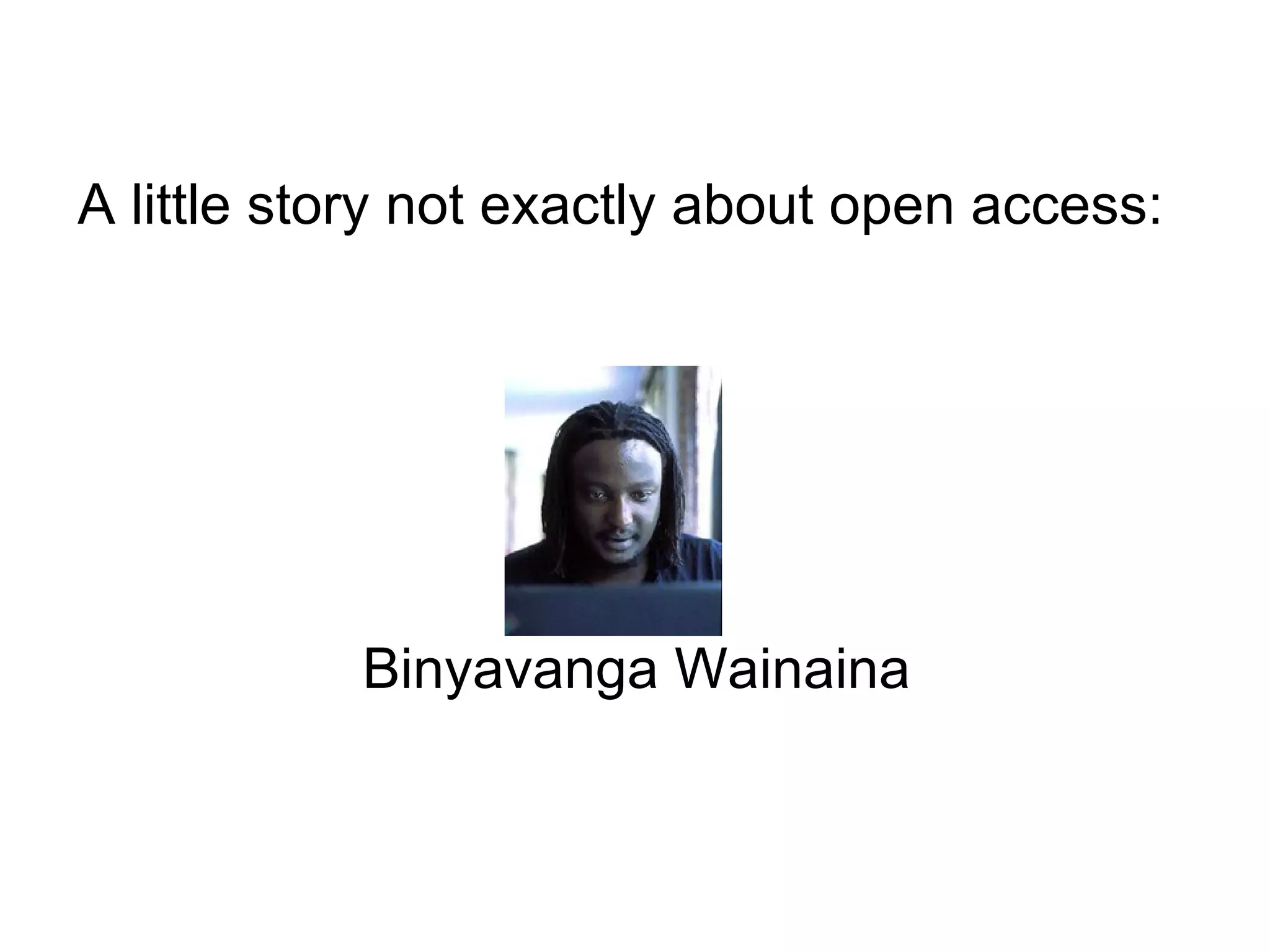
A little story not exactly about open access: Binyavanga Wainaina
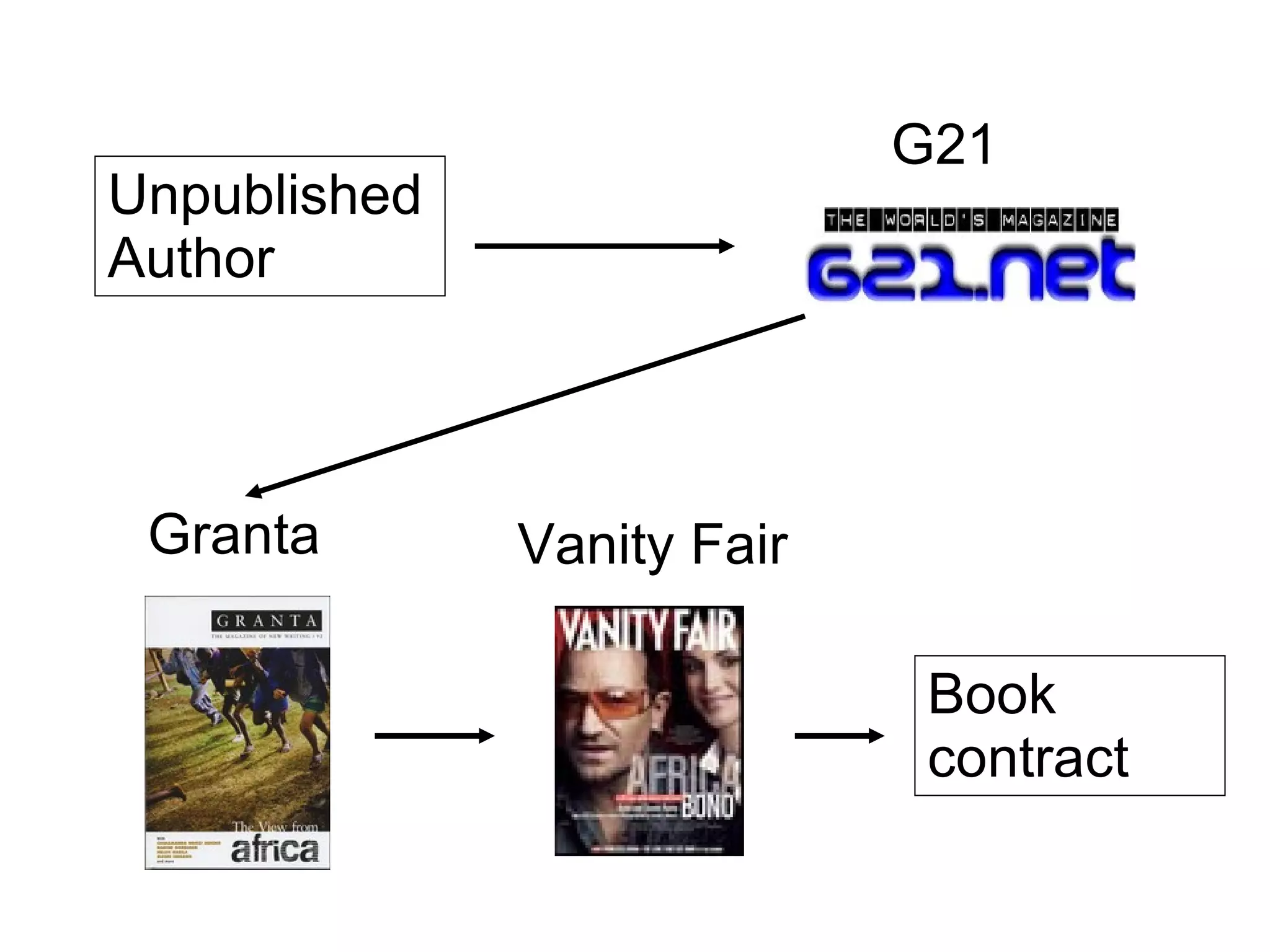
G21  Granta Unpublished Author Vanity Fair Book contract
Open access: Free to read (Often) also available to purchase Free to USE
Open access – not just the  “right”  thing to do But also, frequently, a sound publishing  strategy  for authors and publishers How so?
Human Sciences Research Council  South Africa ( www.hsrc.ac.za ) Went open access in 2001 Put all its publications online Print  sales went up by 300% as a result
Questions Why do authors [of books published by Pratham] write? Why does Pratham publish books?
Observations Reading is a “good” Stories can be universally appealing School subject matter is largely the same anywhere in the world Collaboration is a “good”
Free High School Science Texts  www.fhsst.org 7 subjects, over 15 books All written by graduate students And totally free to be re-used/ built upon
Wikipedia ~ 10 million articles ~ 75,000 active contributors And growing!
Open access textbook initiatives in India: Karnataka textbooks online http://dsert.kar.nic.in/textbooksonline/first.asp NCERT http://www.ncert.nic.in/textbooks/testing/Instructions.htm
The Potential Open access books Contribute to an existing global pool Use resources from the global pool Collaborative workspace
The Potential Collaboration Encourage a vast group of volunteers Organise them Grow faster; better Get people  actually   involved
The Potential Create a model To be adopted by other NGOs To be adopted in the public sector? That delivers better quality
A few endnotes “ Free” is not incompatible with good business sense 75,000 heads are better than one Access to the internet is limited, but accessible content can yet serve as a catalyst through NGO facilitators (“proxies”)
In conclusion Open access is a  simple ,  practical  and  efficient  way to significantly  shake things up : the question we might ask ourselves is,  what we have got to lose ?

A little story not exactly about open access...

  • 1.
    A little storynot exactly about open access: Binyavanga Wainaina
  • 2.
    G21 GrantaUnpublished Author Vanity Fair Book contract
  • 3.
    Open access: Freeto read (Often) also available to purchase Free to USE
  • 4.
    Open access –not just the “right” thing to do But also, frequently, a sound publishing strategy for authors and publishers How so?
  • 5.
    Human Sciences ResearchCouncil South Africa ( www.hsrc.ac.za ) Went open access in 2001 Put all its publications online Print sales went up by 300% as a result
  • 6.
    Questions Why doauthors [of books published by Pratham] write? Why does Pratham publish books?
  • 7.
    Observations Reading isa “good” Stories can be universally appealing School subject matter is largely the same anywhere in the world Collaboration is a “good”
  • 8.
    Free High SchoolScience Texts www.fhsst.org 7 subjects, over 15 books All written by graduate students And totally free to be re-used/ built upon
  • 9.
    Wikipedia ~ 10million articles ~ 75,000 active contributors And growing!
  • 10.
    Open access textbookinitiatives in India: Karnataka textbooks online http://dsert.kar.nic.in/textbooksonline/first.asp NCERT http://www.ncert.nic.in/textbooks/testing/Instructions.htm
  • 11.
    The Potential Openaccess books Contribute to an existing global pool Use resources from the global pool Collaborative workspace
  • 12.
    The Potential CollaborationEncourage a vast group of volunteers Organise them Grow faster; better Get people actually involved
  • 13.
    The Potential Createa model To be adopted by other NGOs To be adopted in the public sector? That delivers better quality
  • 14.
    A few endnotes“ Free” is not incompatible with good business sense 75,000 heads are better than one Access to the internet is limited, but accessible content can yet serve as a catalyst through NGO facilitators (“proxies”)
  • 15.
    In conclusion Openaccess is a simple , practical and efficient way to significantly shake things up : the question we might ask ourselves is, what we have got to lose ?