LEFT MAIN AND
CHRONIC TOTAL
OCCLUSIONS –
FORGET BYPASS!
DR. TAN CHONG HIOK
2 VERY SPECIAL
SUBSETS IN CORONARY
ARTERY DISEASE
•Unprotected Left Main disease
•Chronic Total Occlustion (CTO)
UNPROTECTED LEFT MAIN
DISEASE
•Significant disease of Left Main in a person
who has not under gone CABG of the LAD
&/0r LCx
OVER THE YEARS
•Has be battle ground for Surgeons and
Interventionists
•The argument has always been CABG is
better
•But ‘Better’ is a relative term: Better than
What?
GUIDELINES HAVE EVOLVED
OVER THE YEARS
•From a firm Class III
•Now a Class IIa/IIb depending on the
situation
•Not based on a whim but trial data
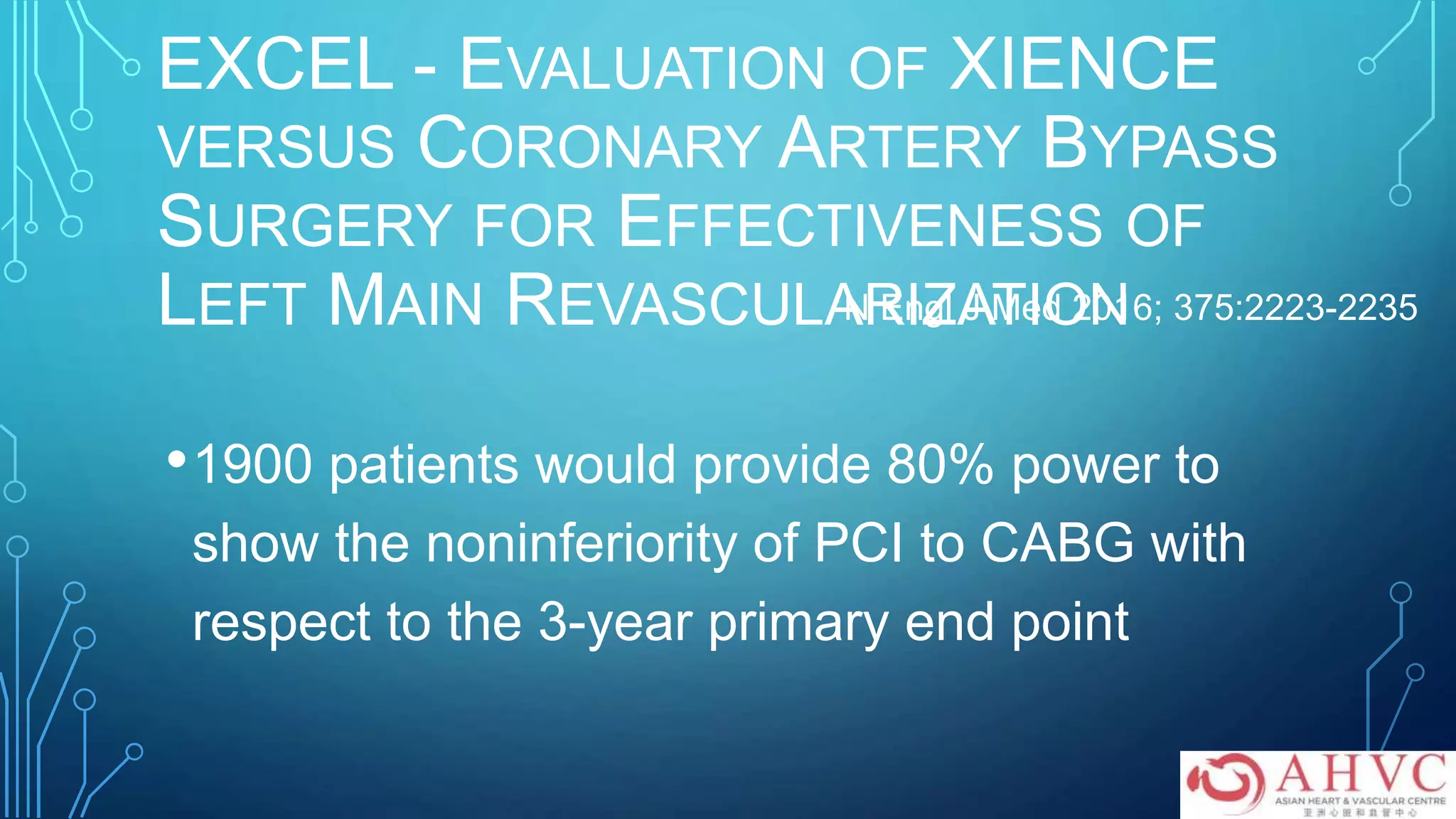
EXCEL - EVALUATION OF XIENCE
VERSUS CORONARY ARTERY BYPASS
SURGERY FOR EFFECTIVENESS OF
LEFT MAIN REVASCULARIZATION
•1900 patients would provide 80% power to
show the noninferiority of PCI to CABG with
respect to the 3-year primary end point
N Engl J Med 2016; 375:2223-2235
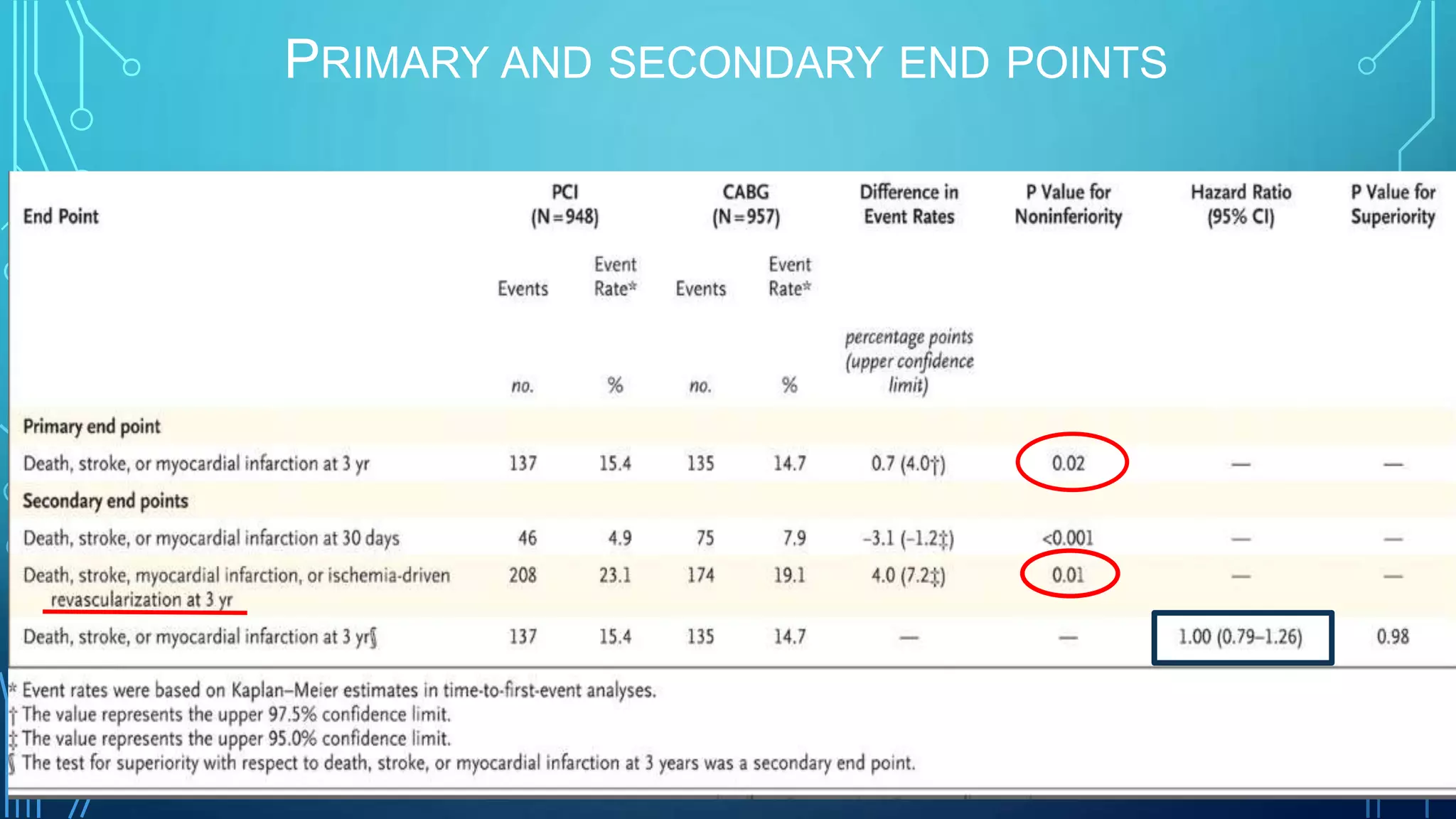
PRIMARY AND SECONDARY END POINTS
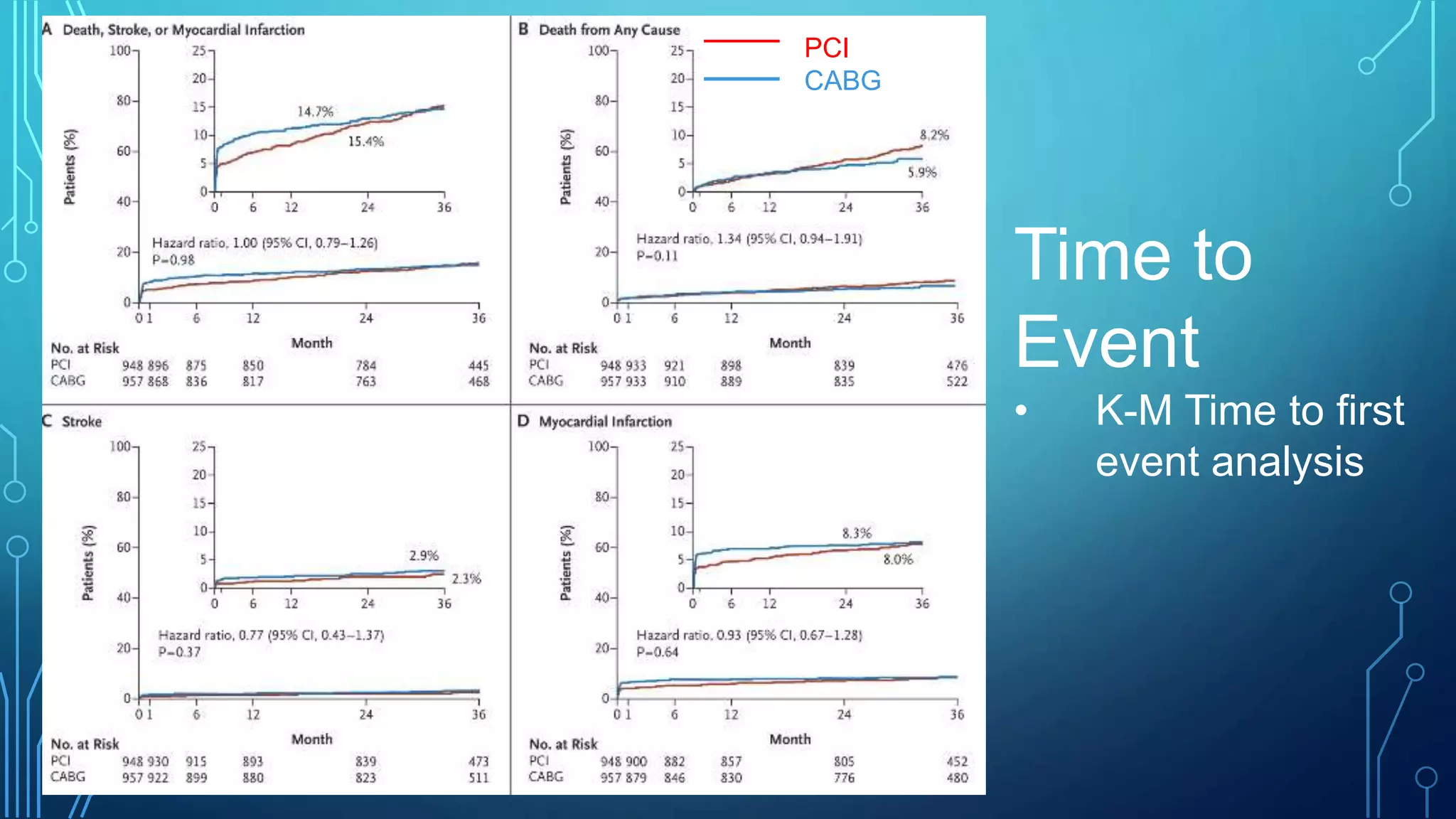
Time to
Event
• K-M Time to first
event analysis
PCI
CABG
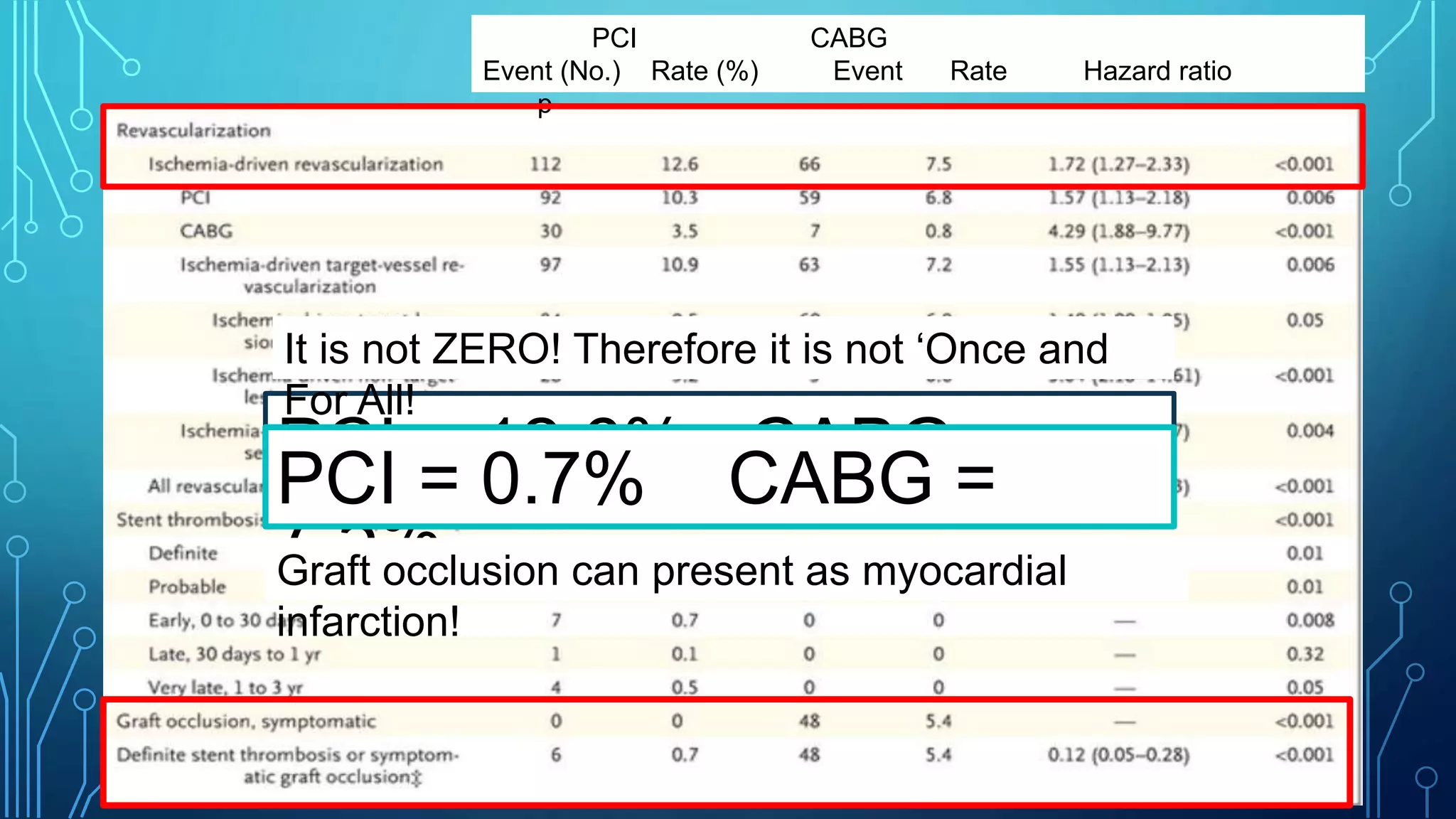
PCI CABG
Event (No.) Rate (%) Event Rate Hazard ratio
p
PCI = 12.6% CABG =
7.5%
PCI = 0.7% CABG =
5.4%!
It is not ZERO! Therefore it is not ‘Once and
For All!
Graft occlusion can present as myocardial
infarction!
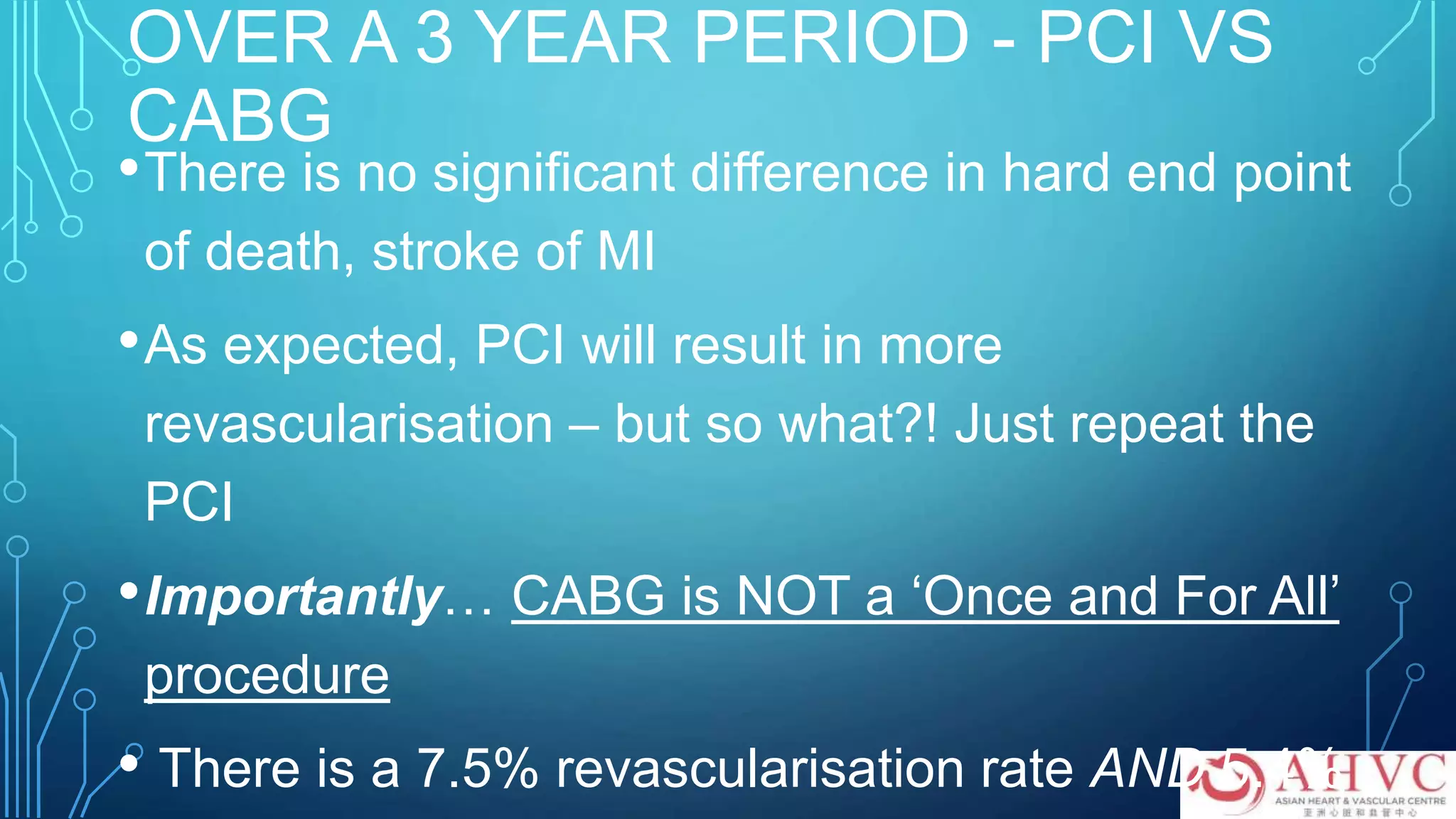
OVER A 3 YEAR PERIOD - PCI VS
CABG
•There is no significant difference in hard end point
of death, stroke of MI
•As expected, PCI will result in more
revascularisation – but so what?! Just repeat the
PCI
•Importantly… CABG is NOT a ‘Once and For All’
procedure
• There is a 7.5% revascularisation rate AND 5.4%
GUESS WHAT IS THE METHOD OF
REVASCULARISATION FOR GRAFT
OCCLUSION?
THINGS TO NOTE
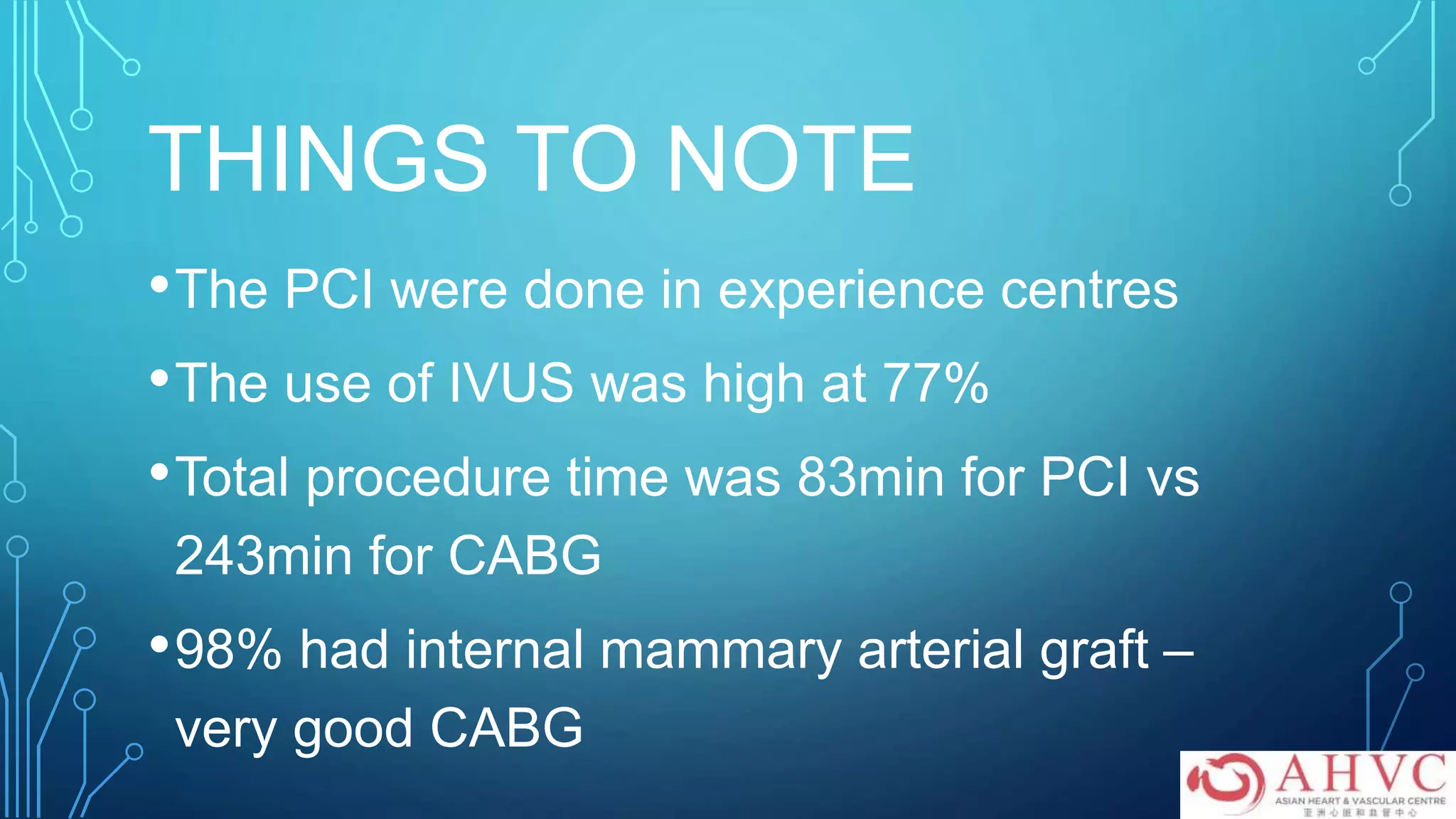
•The PCI were done in experience centres
•The use of IVUS was high at 77%
•Total procedure time was 83min for PCI vs
243min for CABG
•98% had internal mammary arterial graft –
very good CABG
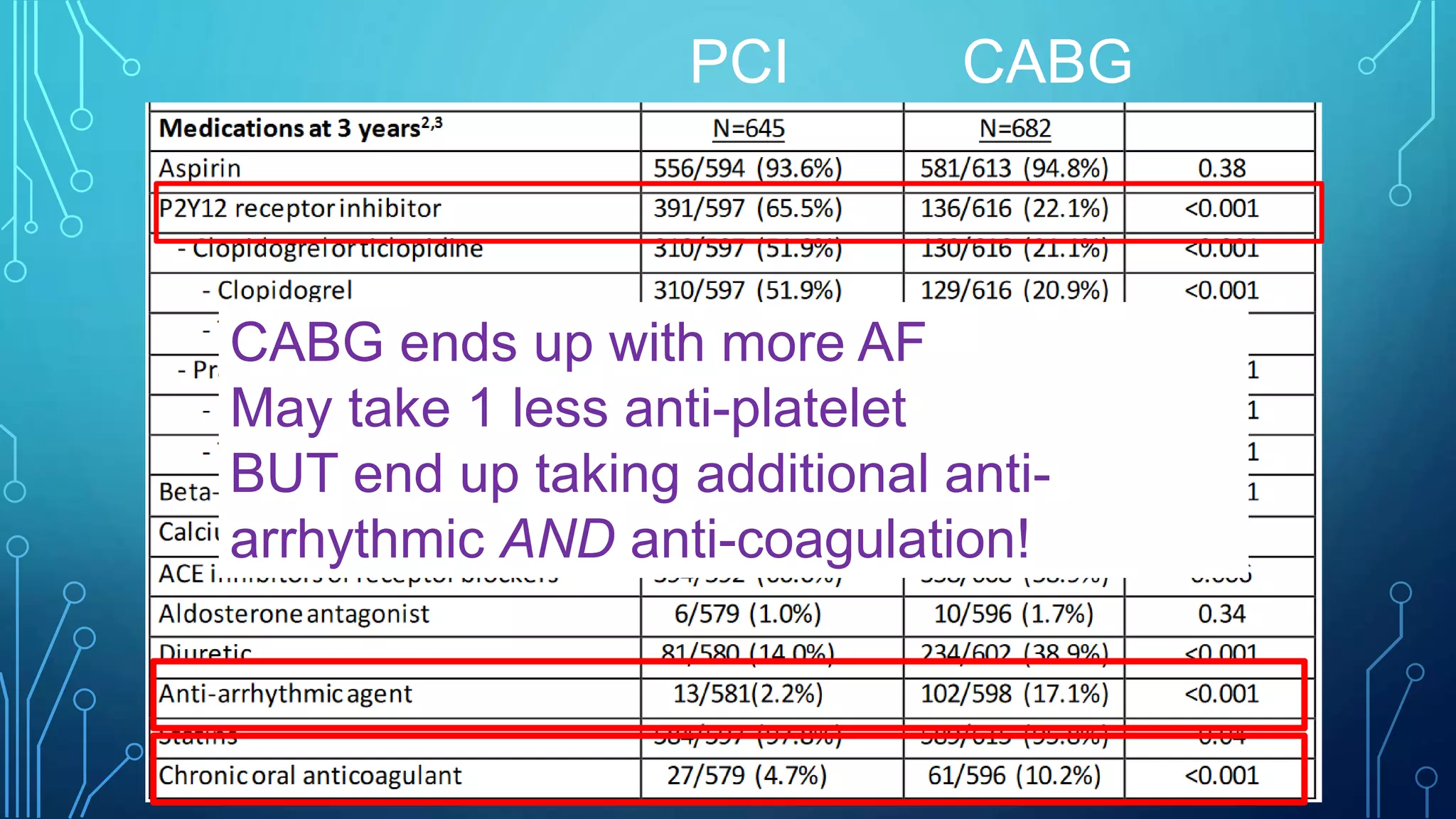
PCI CABG
CABG ends up with more AF
May take 1 less anti-platelet
BUT end up taking additional anti-
arrhythmic AND anti-coagulation!
•Let me share my data
•Presented in PCR SingLive
2016
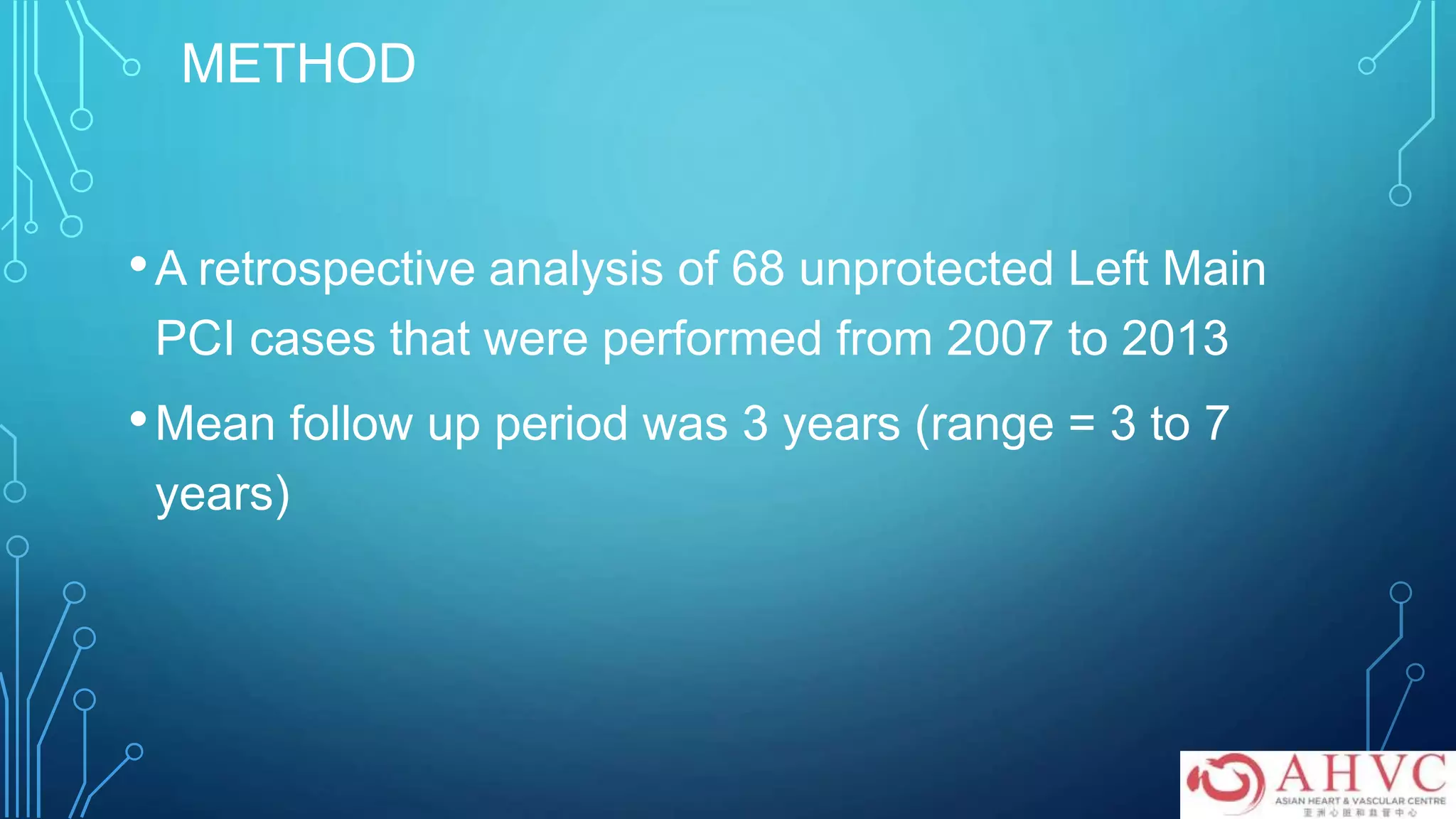
METHOD
•A retrospective analysis of 68 unprotected Left Main
PCI cases that were performed from 2007 to 2013
•Mean follow up period was 3 years (range = 3 to 7
years)
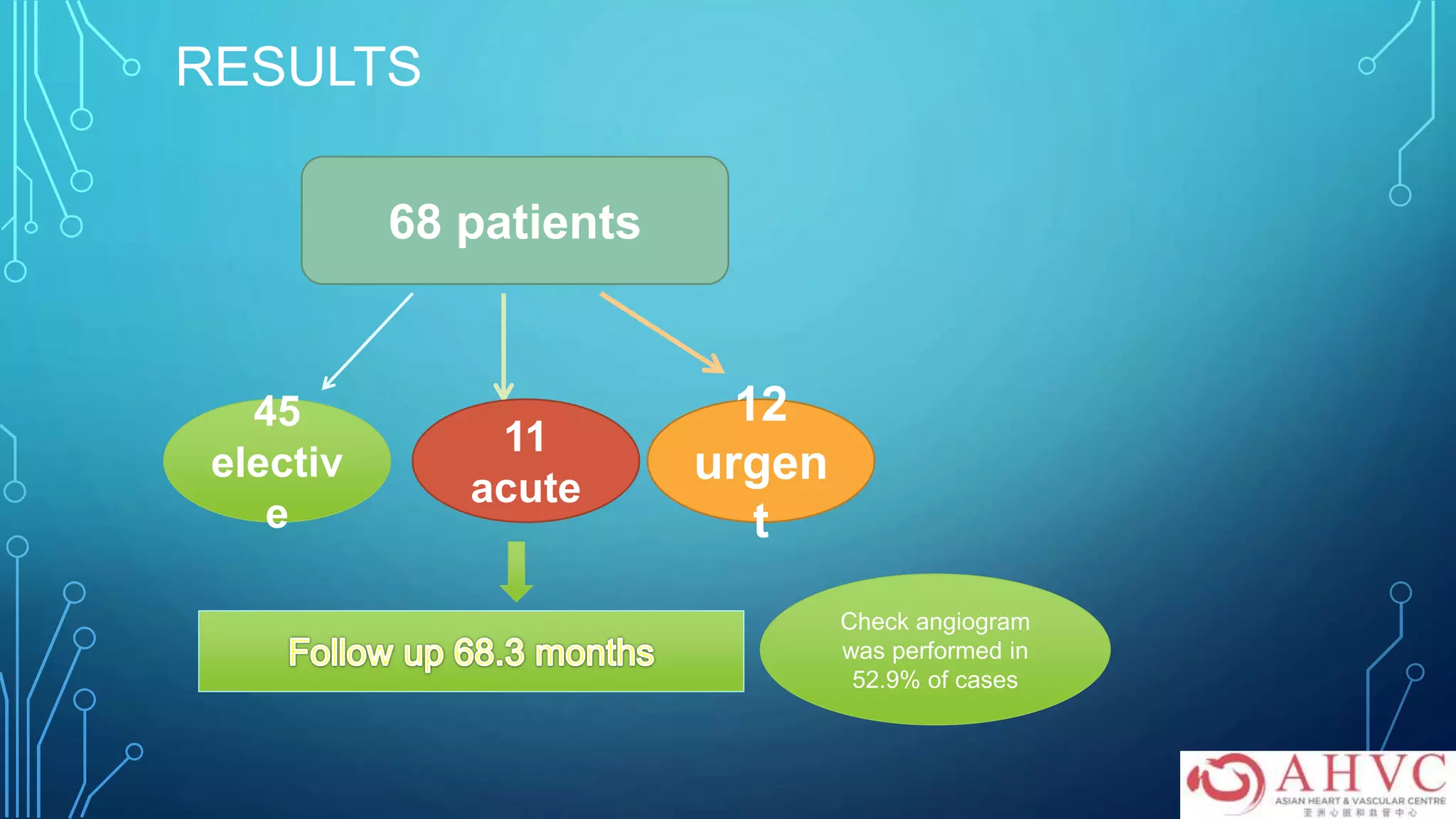
RESULTS
68 patients
45
electiv
e
11
acute
12
urgen
t
Check angiogram
was performed in
52.9% of cases
RESULTS
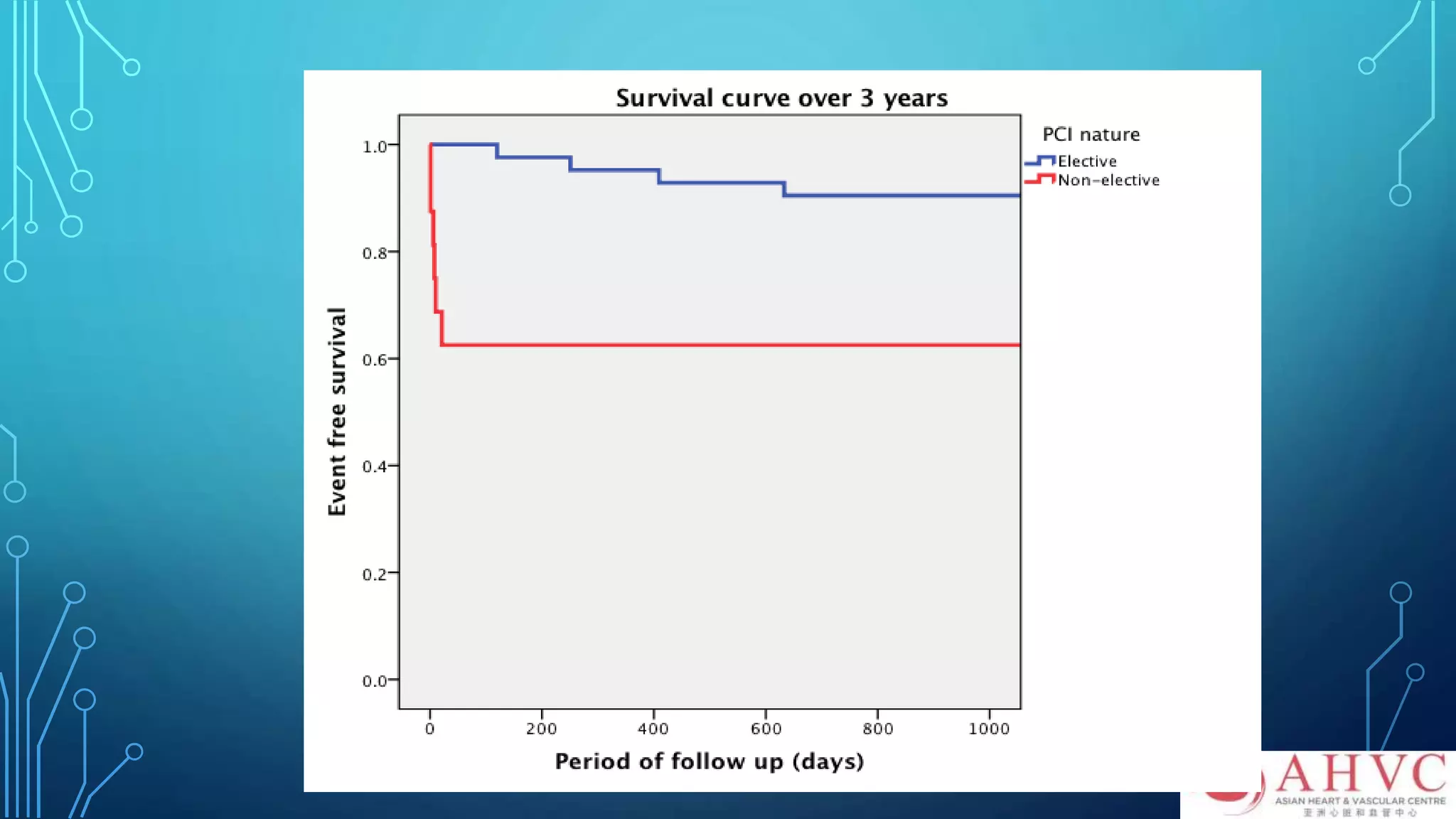
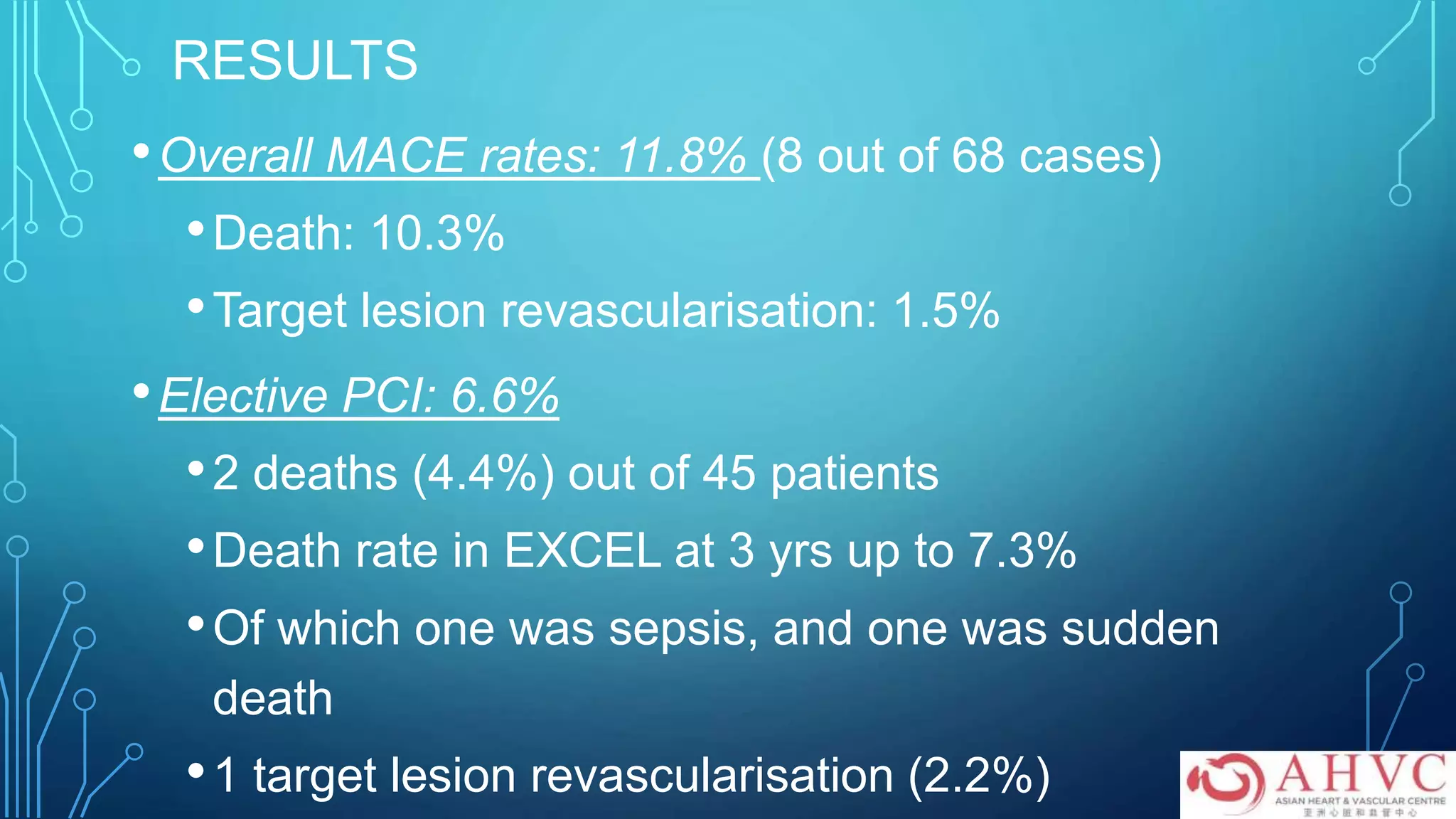
•Overall MACE rates: 11.8% (8 out of 68 cases)
•Death: 10.3%
•Target lesion revascularisation: 1.5%
•Elective PCI: 6.6%
•2 deaths (4.4%) out of 45 patients
•Death rate in EXCEL at 3 yrs up to 7.3%
•Of which one was sepsis, and one was sudden
death
•1 target lesion revascularisation (2.2%)
RESULTS
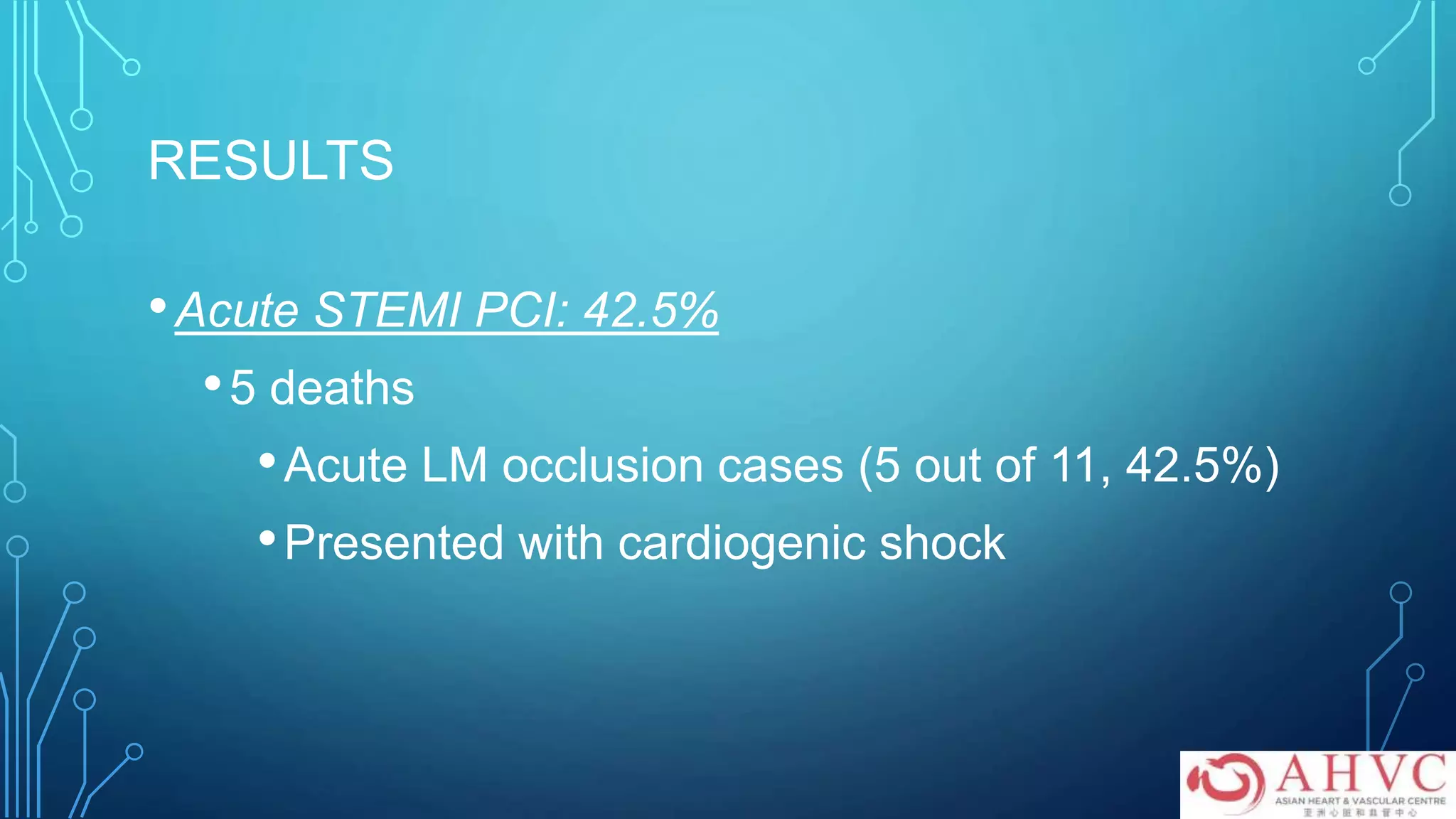
•Acute STEMI PCI: 42.5%
•5 deaths
•Acute LM occlusion cases (5 out of 11, 42.5%)
•Presented with cardiogenic shock
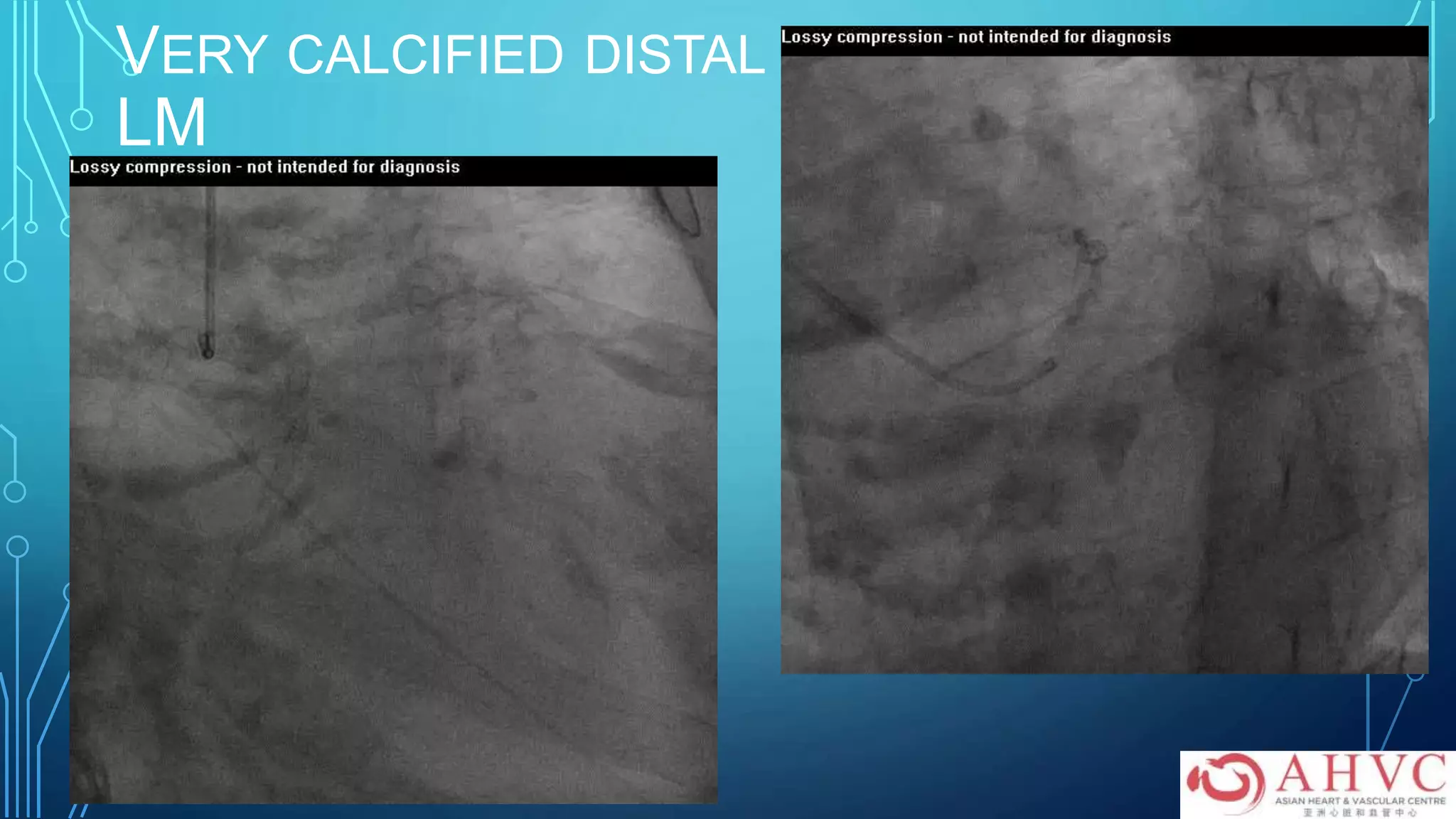
LET’S SEE SOME EXAMPLE
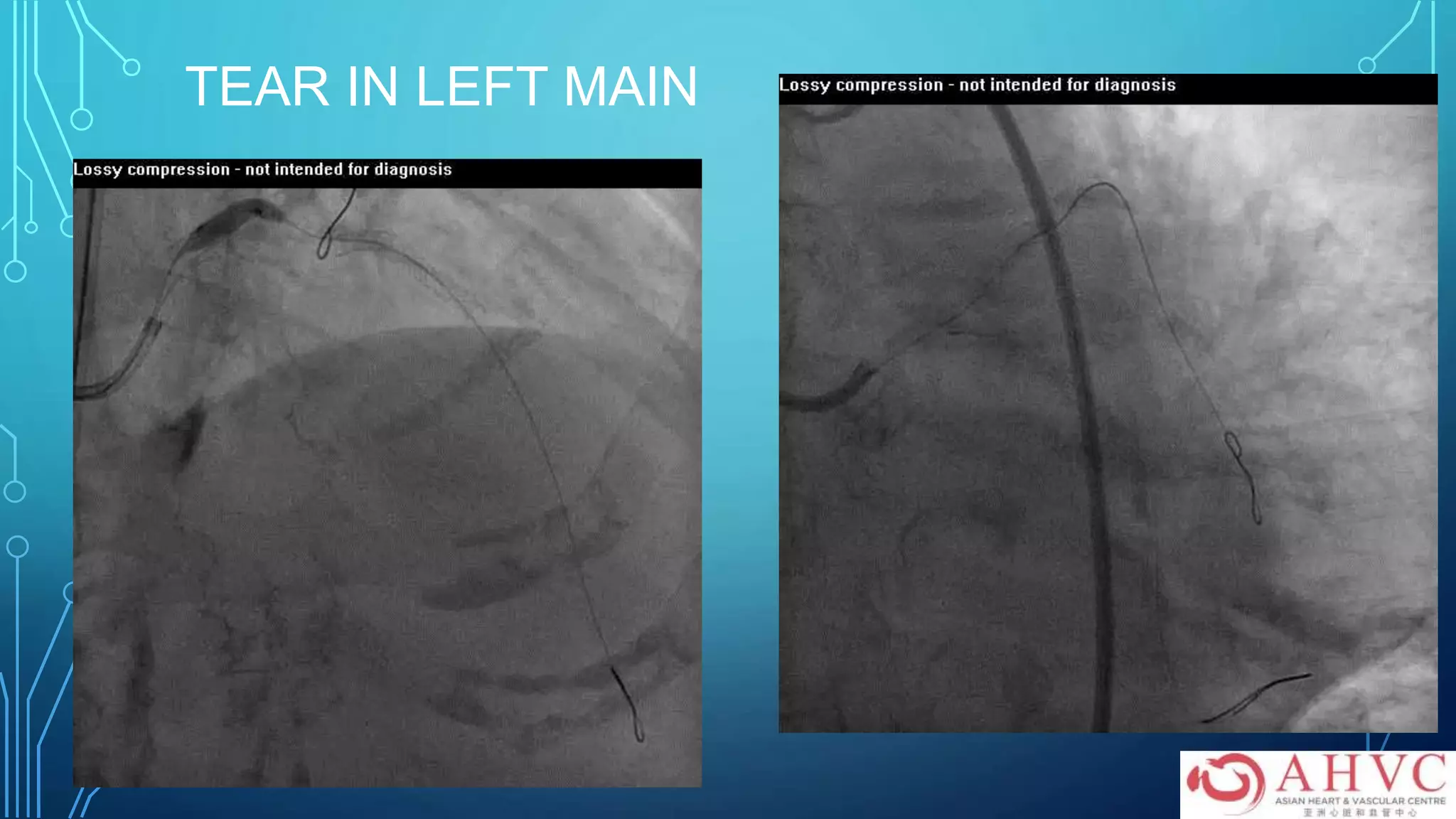
•87 year old gentleman
•Angina
•Not good condition for CABG
VERY CALCIFIED DISTAL
LM
TEAR IN LEFT MAIN
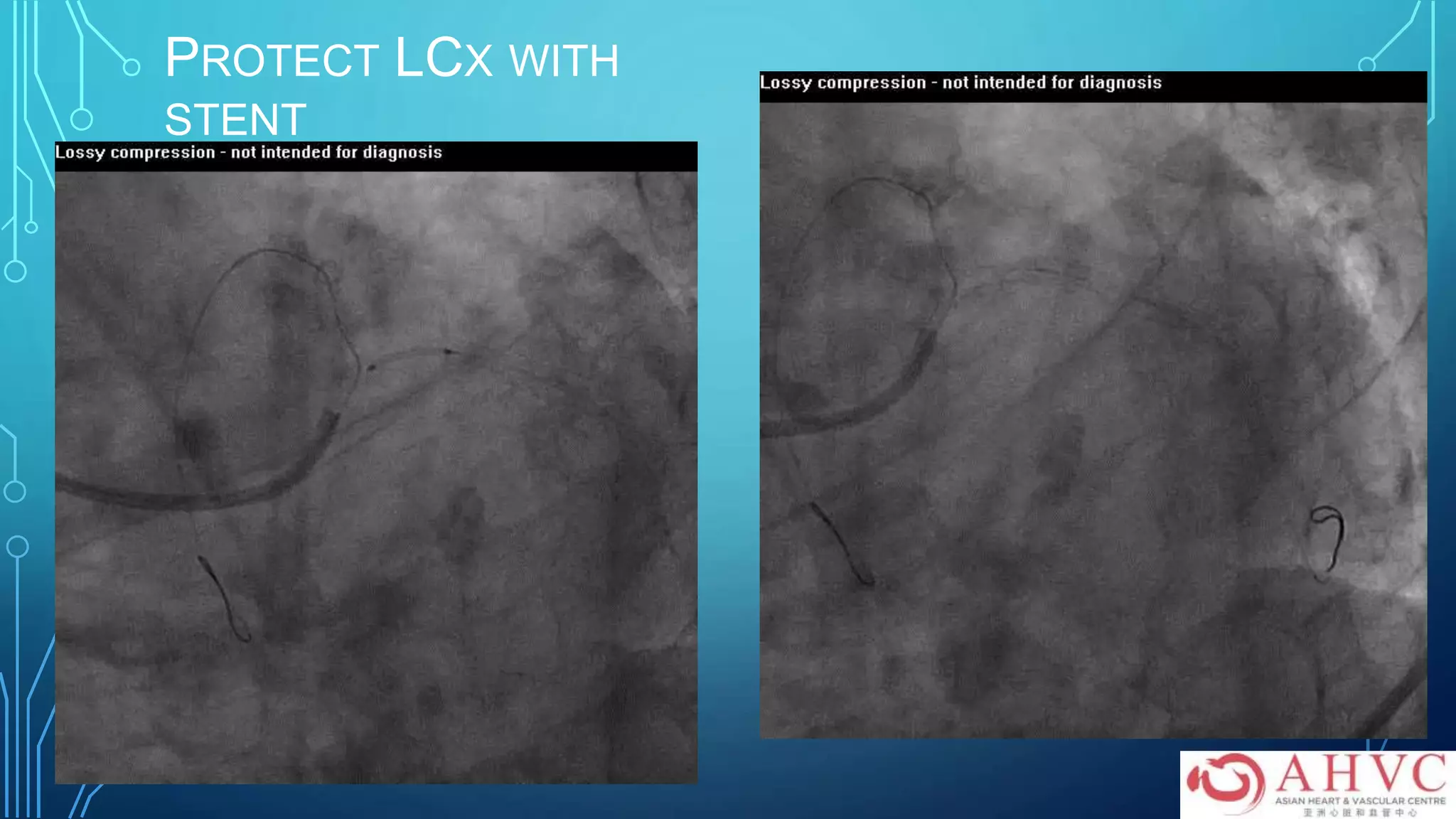
PROTECT LCX WITH
STENT
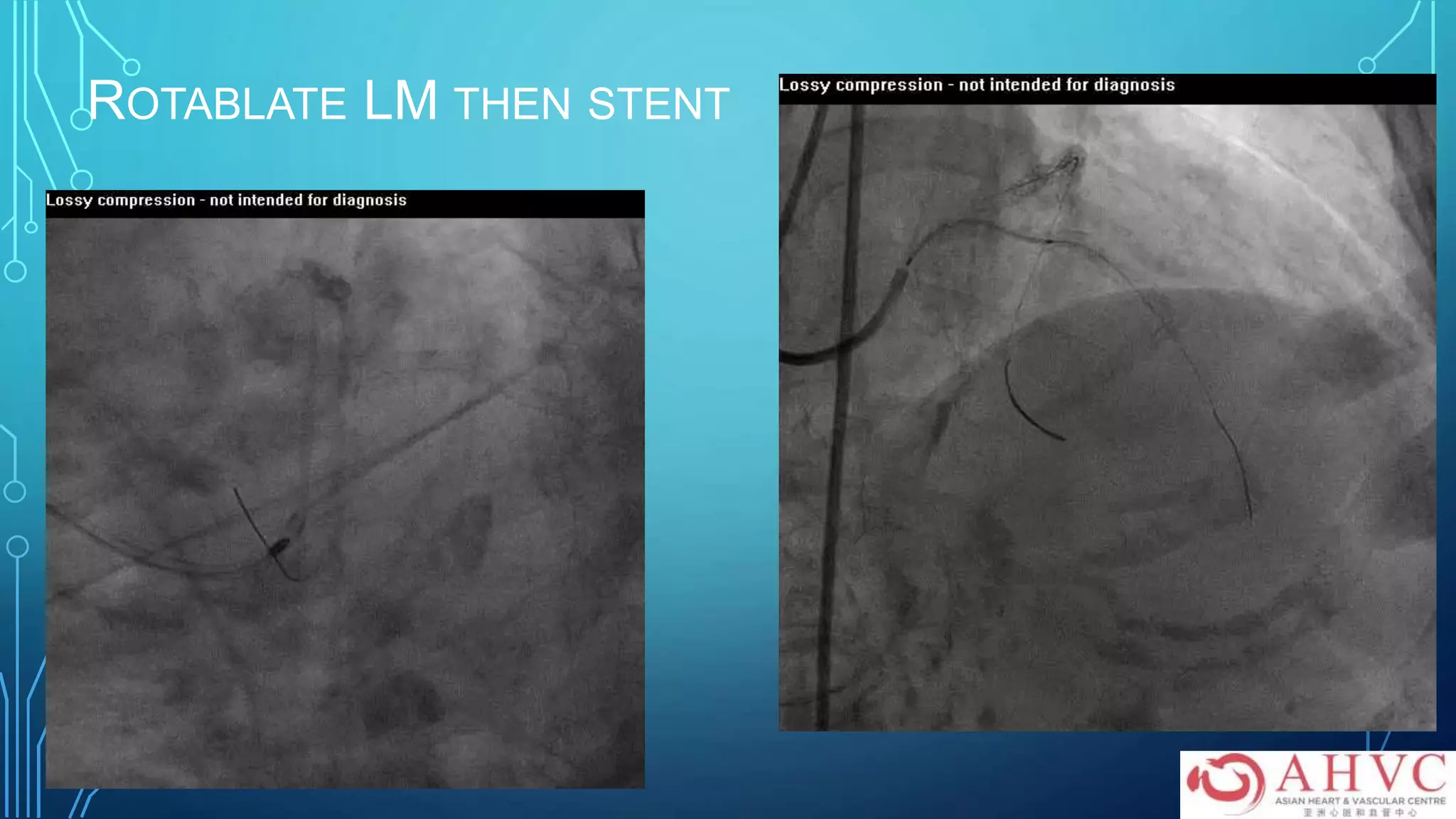
ROTABLATE LM THEN STENT
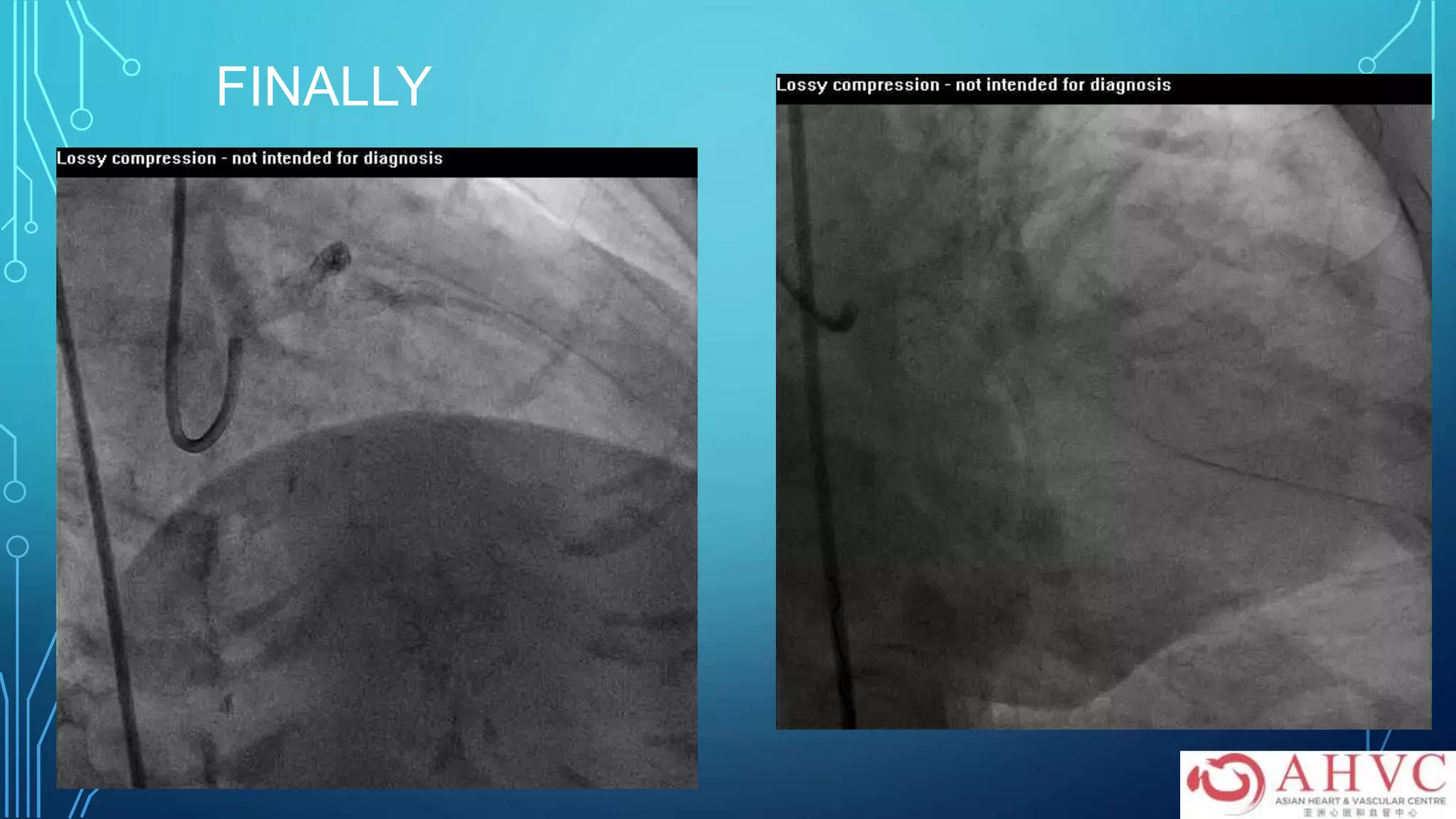
FINALLY
CONCLUSION
•LM stenting in the non-urgent setting is safe
and has low MACE rate at 3 years
•Needs to be done in experienced hands
•Use of IVUS is strongly advocated
•It is a viable alternative to CABG
CHRONIC TOTAL
OCCLUSION-
THE FINAL FRONTIER OF
PCI
DR. TAN CHONG HIOK
ASIA HEART AND VASCULAR CENTRE
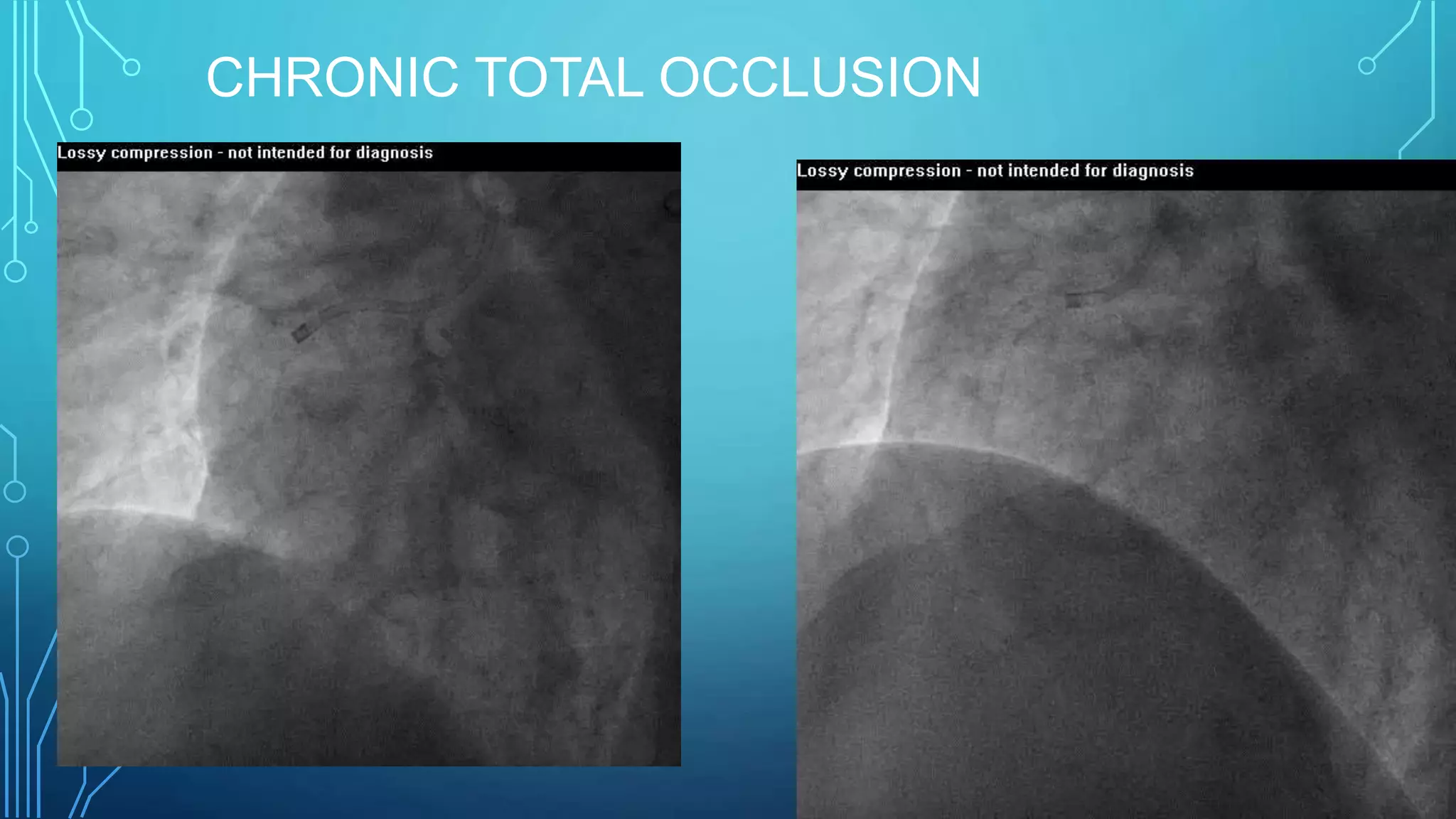
CHRONIC TOTAL OCCLUSION
15-30%
85%
CTO Non-CTO
Success
50%
Failur
e50%
Not tried
70%
WHAT’S THE BIG
DEAL?
Of those sent for
Angiogram
15-30% have a CTO
Only 30% of CTO will
undergo an attempt
Only half of which will
succeed
SO WHAT?...
•Although at present there is no randomised control
trial on treatment of CTO
•But…
•There are 3 possible benefit to opening a CTO
•Improvement in symptoms
•Improvement in LV function
•Improvement in survival
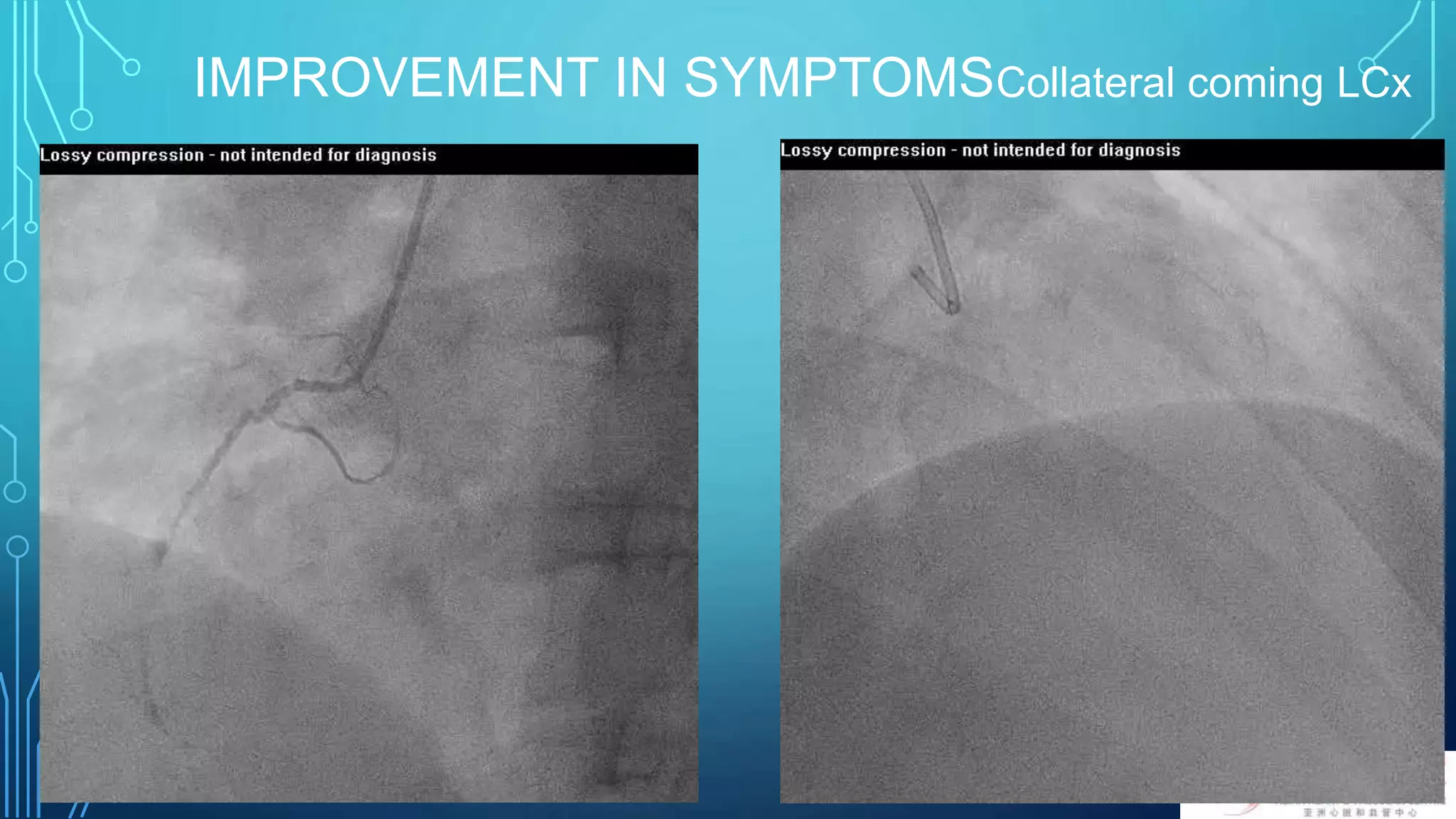
IMPROVEMENT IN SYMPTOMSCollateral coming LCx
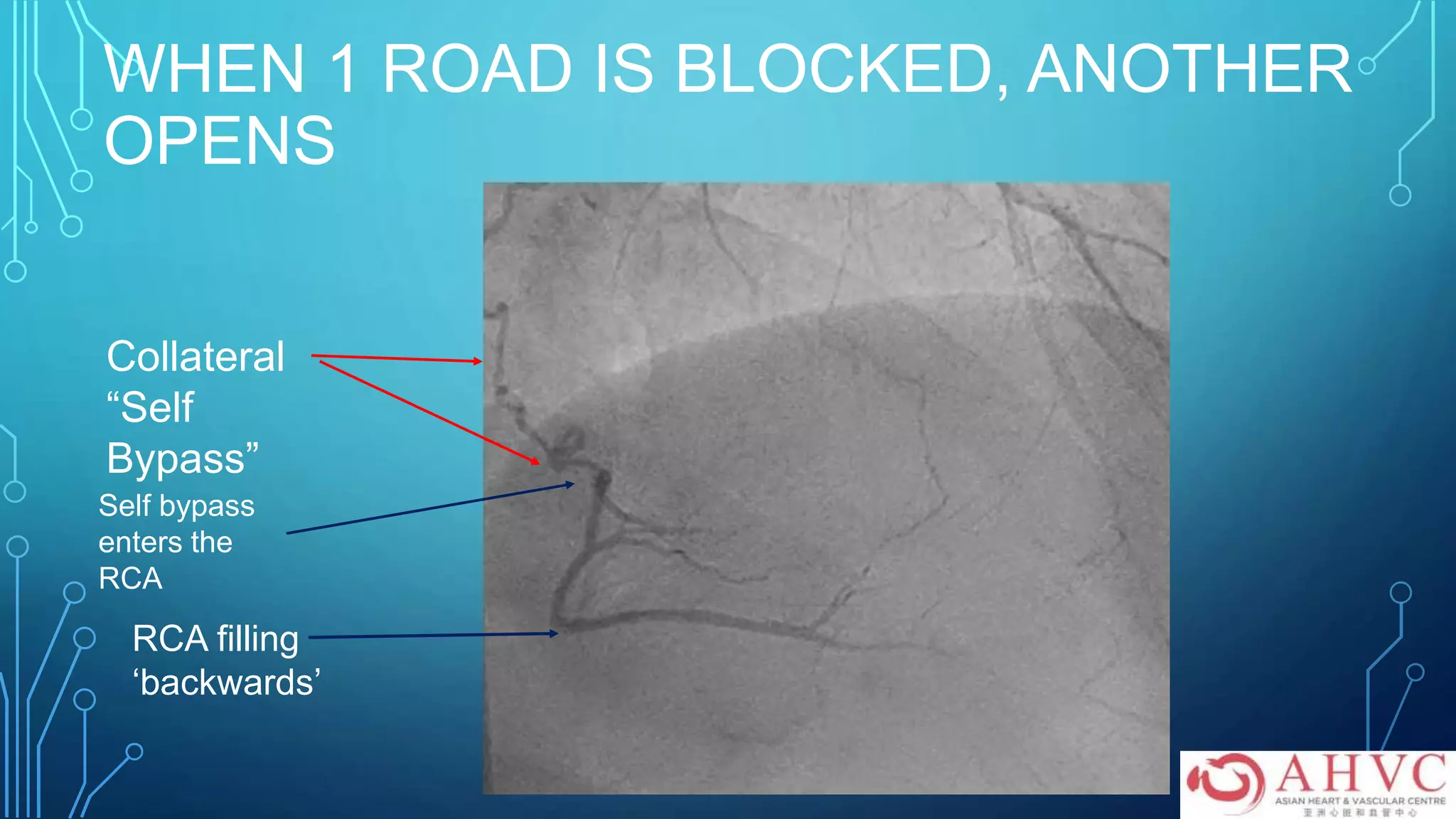
WHEN 1 ROAD IS BLOCKED, ANOTHER
OPENS
Collateral
“Self
Bypass”
Self bypass
enters the
RCA
RCA filling
‘backwards’
SYMPTOM IMPROVEMENT
•If collaterals are insufficient to provide
adequate blood flow
•During physical stress
•Symptoms will be alleviated with
revascularisation of the CTO vessel
IMPROVE LV FUNCTION
•MRI studies have demonstrated improved
LV function 5 months after successful
opening of a CTO vessel
•The benefits were greater in patients with
viable myocardium supplied by the CTO.
•This is due to abolition of the chronic
ischaemia resulting in myocardial
hibernation
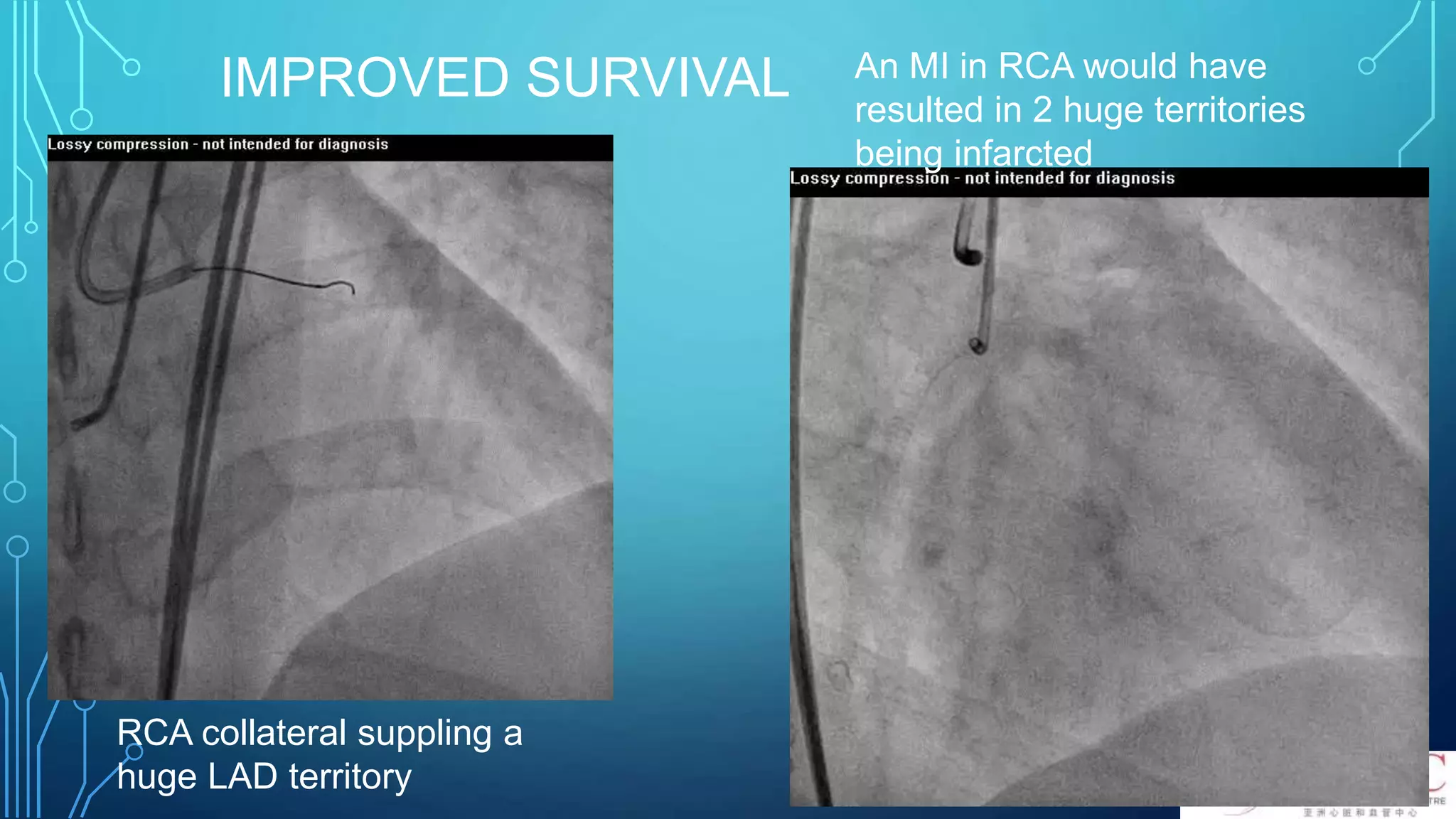
IMPROVED SURVIVAL An MI in RCA would have
resulted in 2 huge territories
being infarcted
RCA collateral suppling a
huge LAD territory
IMPROVED SURVIVAL
•Observational studies found that mortality
was significantly reduced in the successful
PCI group during an average follow-up of 6
years
•Several observational studies suggest that
the improvements in LV function may result
in improved long-term survival
•Granted that randomised studies are not
easy to conduct
IF THERE IS BENEFIT IN
REVASCULARISING CTO
•Why is it that not all doctors treat CTO?
•Technically very demanding
•It is considered as a ‘sub-specialty’ in
Interventional cardiology
•Techniques and devices used are quite
specific for CTO
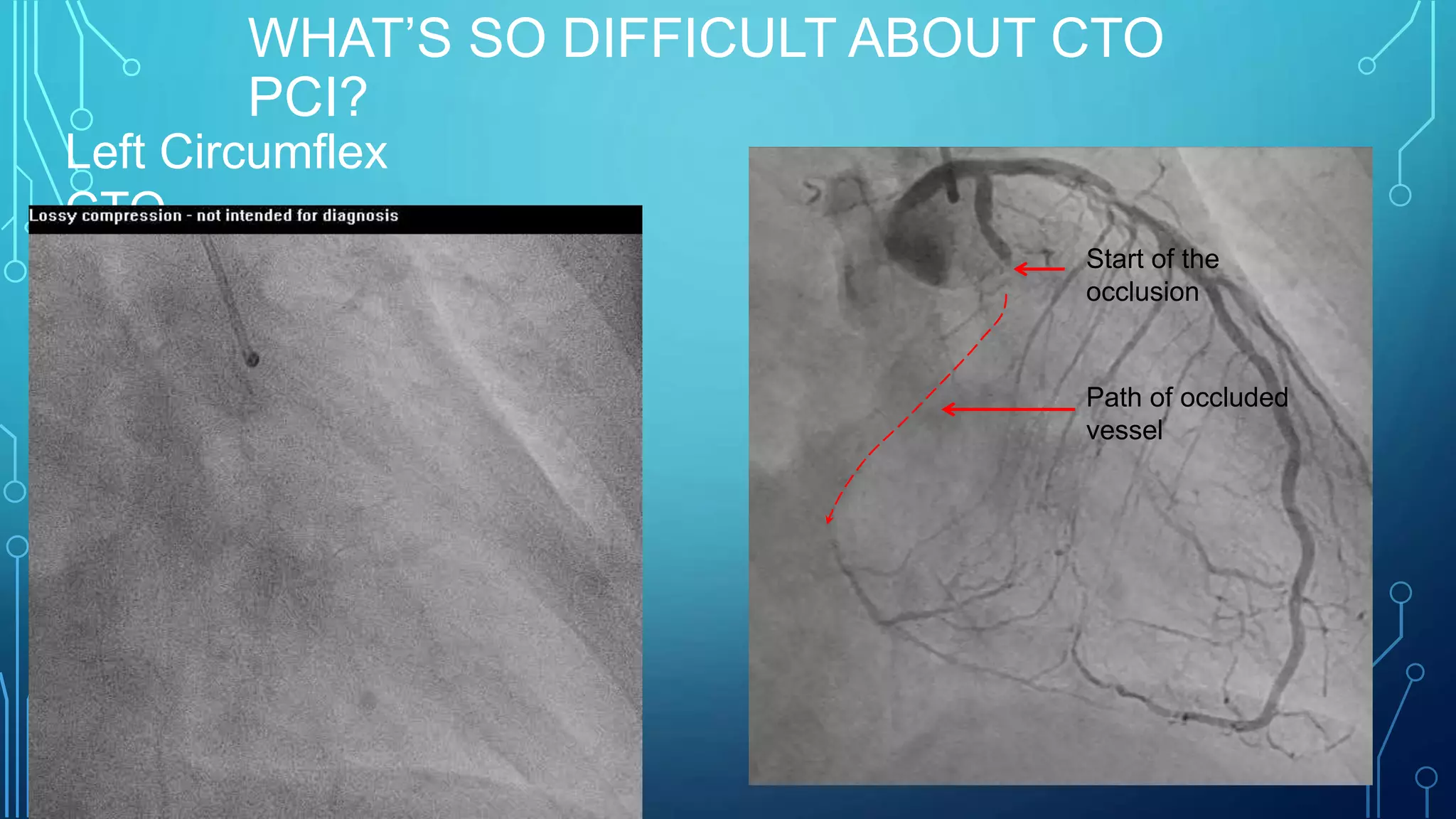
WHAT’S SO DIFFICULT ABOUT CTO
PCI?
Left Circumflex
CTO
Start of the
occlusion
Path of occluded
vessel
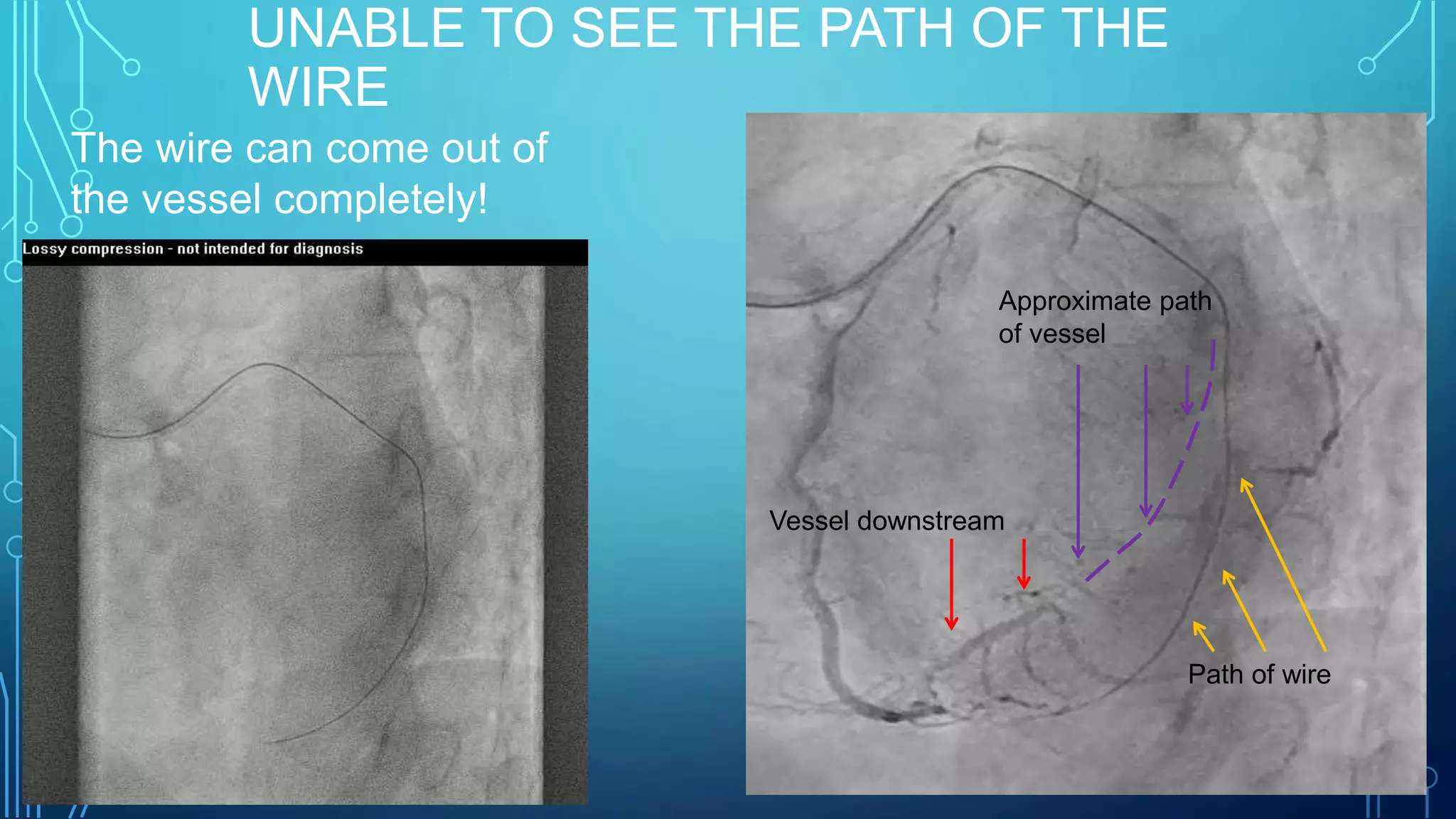
UNABLE TO SEE THE PATH OF THE
WIRE
The wire can come out of
the vessel completely!
Approximate path
of vessel
Vessel downstream
Path of wire
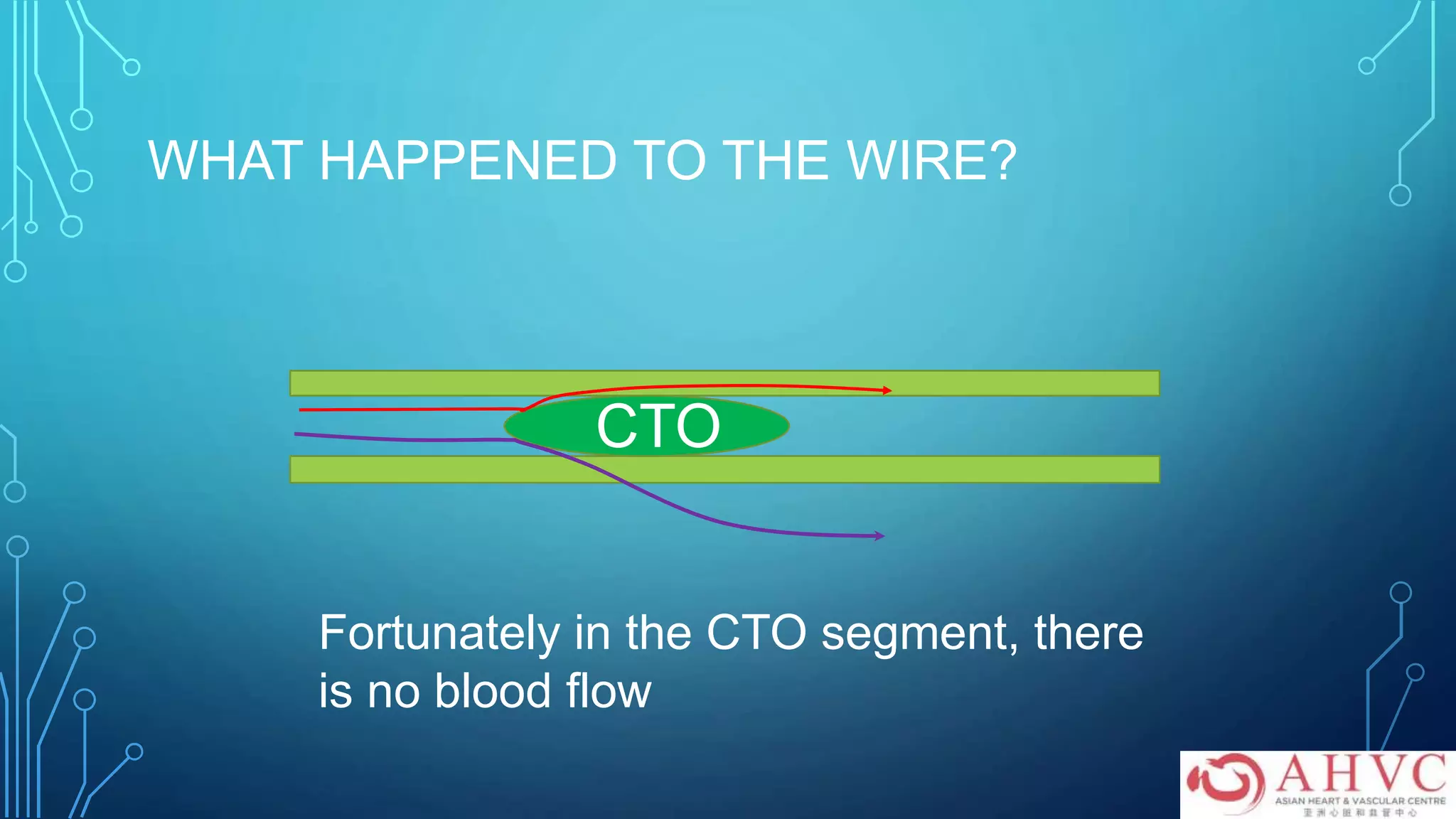
WHAT HAPPENED TO THE WIRE?
CTO
Fortunately in the CTO segment, there
is no blood flow
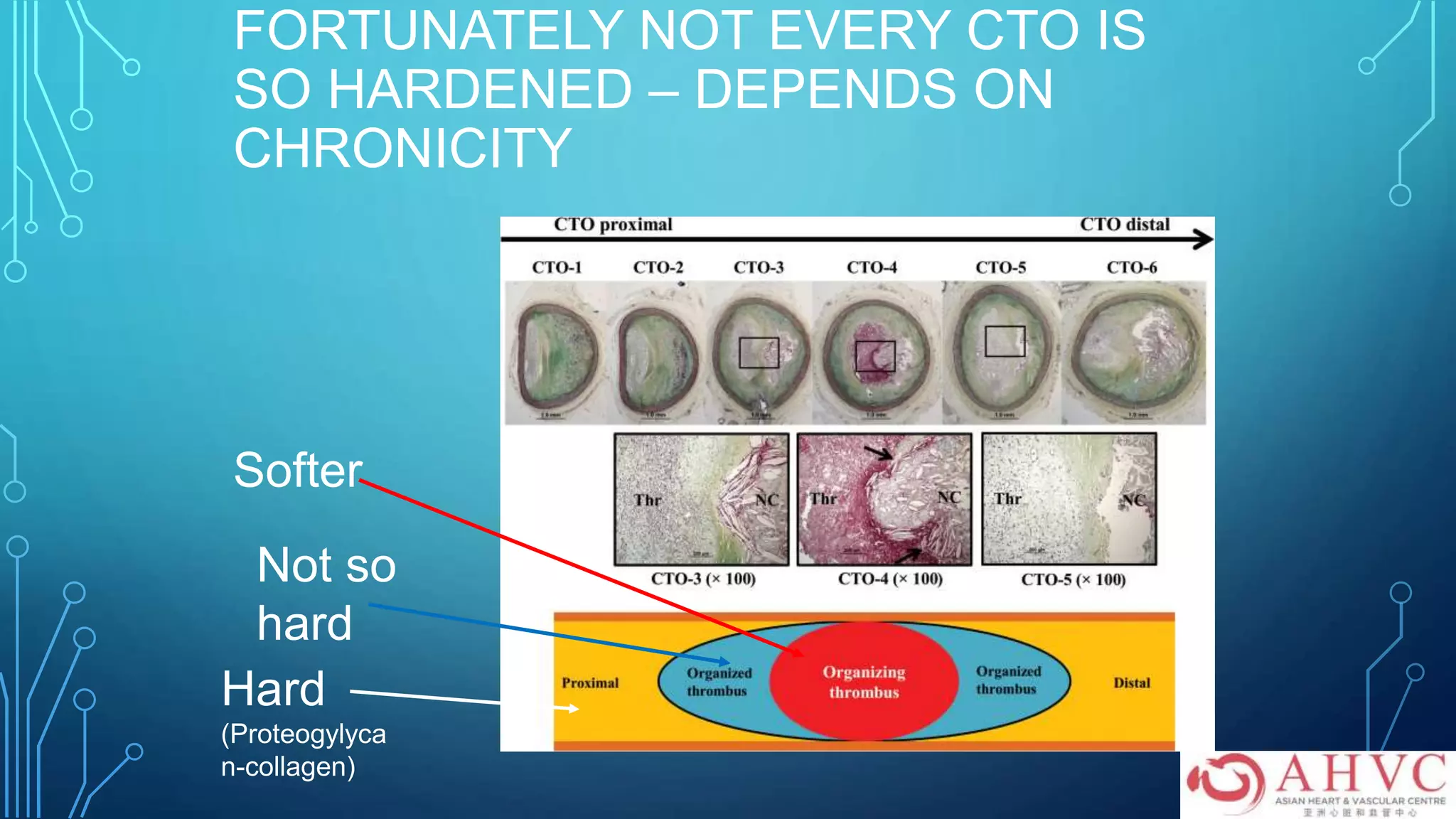
FORTUNATELY NOT EVERY CTO IS
SO HARDENED – DEPENDS ON
CHRONICITY
Hard
(Proteogylyca
n-collagen)
Not so
hard
Softer
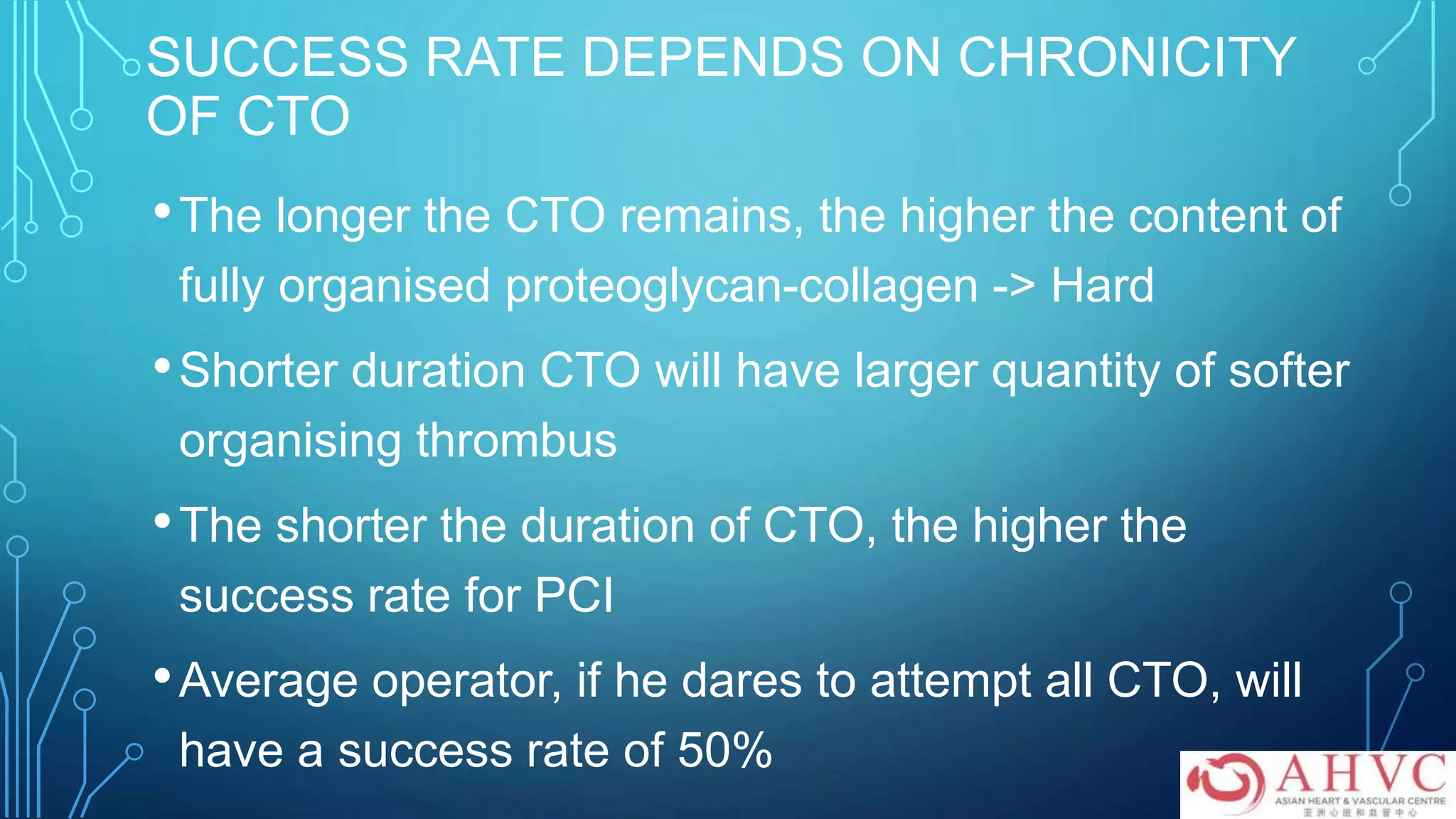
SUCCESS RATE DEPENDS ON CHRONICITY
OF CTO
•The longer the CTO remains, the higher the content of
fully organised proteoglycan-collagen -> Hard
•Shorter duration CTO will have larger quantity of softer
organising thrombus
•The shorter the duration of CTO, the higher the
success rate for PCI
•Average operator, if he dares to attempt all CTO, will
have a success rate of 50%
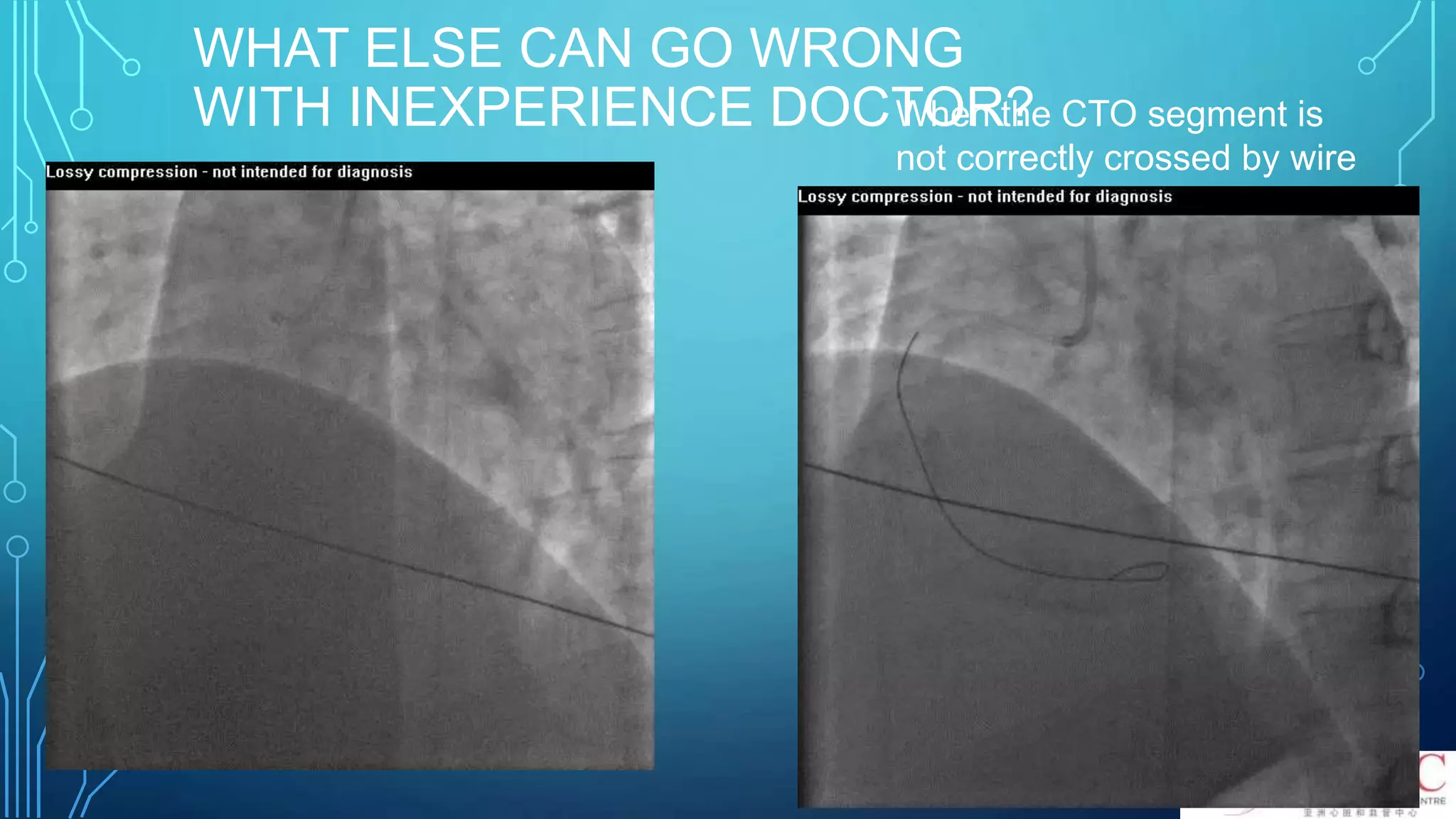
WHAT ELSE CAN GO WRONG
WITH INEXPERIENCE DOCTOR?When the CTO segment is
not correctly crossed by wire
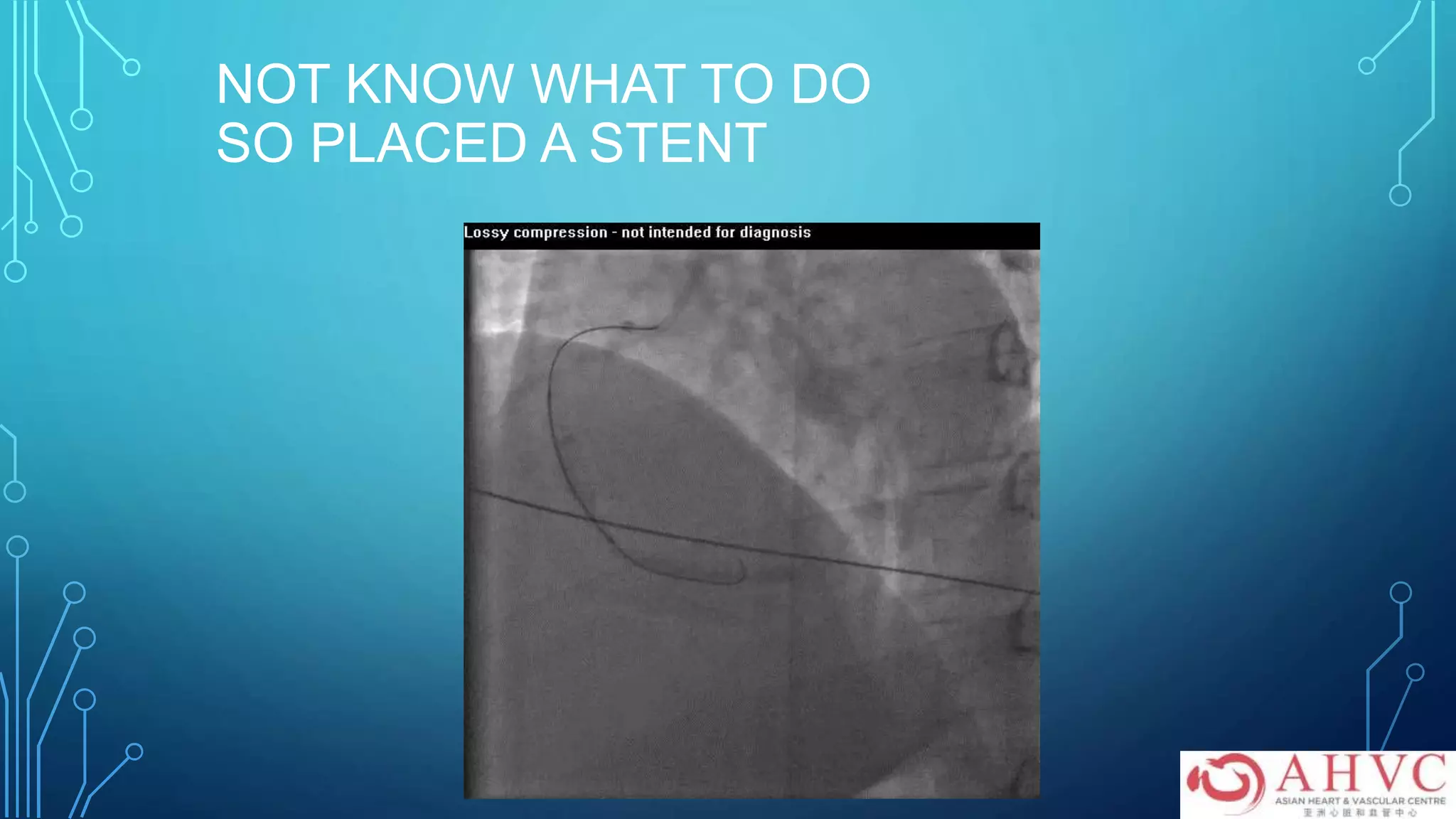
NOT KNOW WHAT TO DO
SO PLACED A STENT
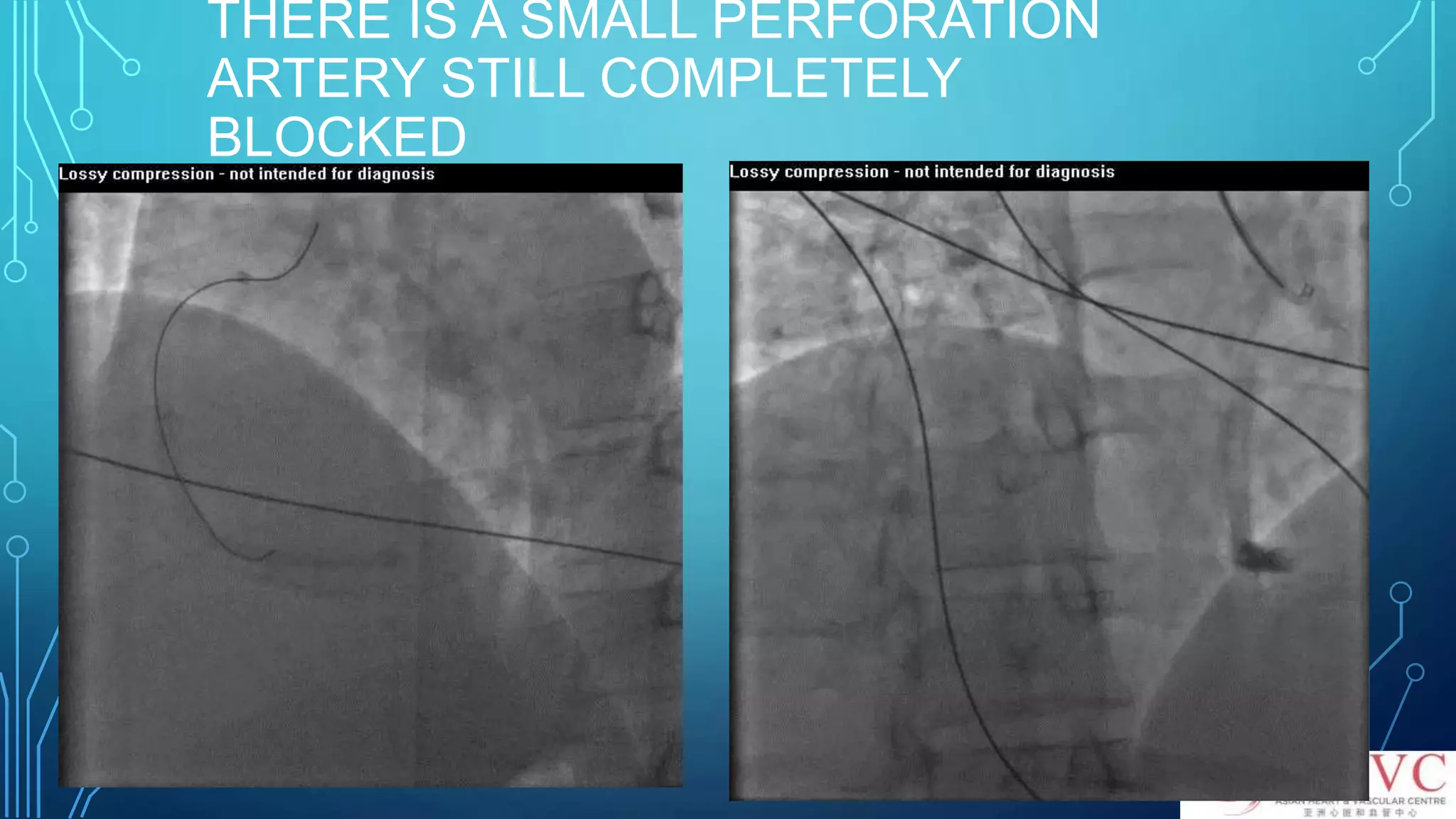
THERE IS A SMALL PERFORATION
ARTERY STILL COMPLETELY
BLOCKED
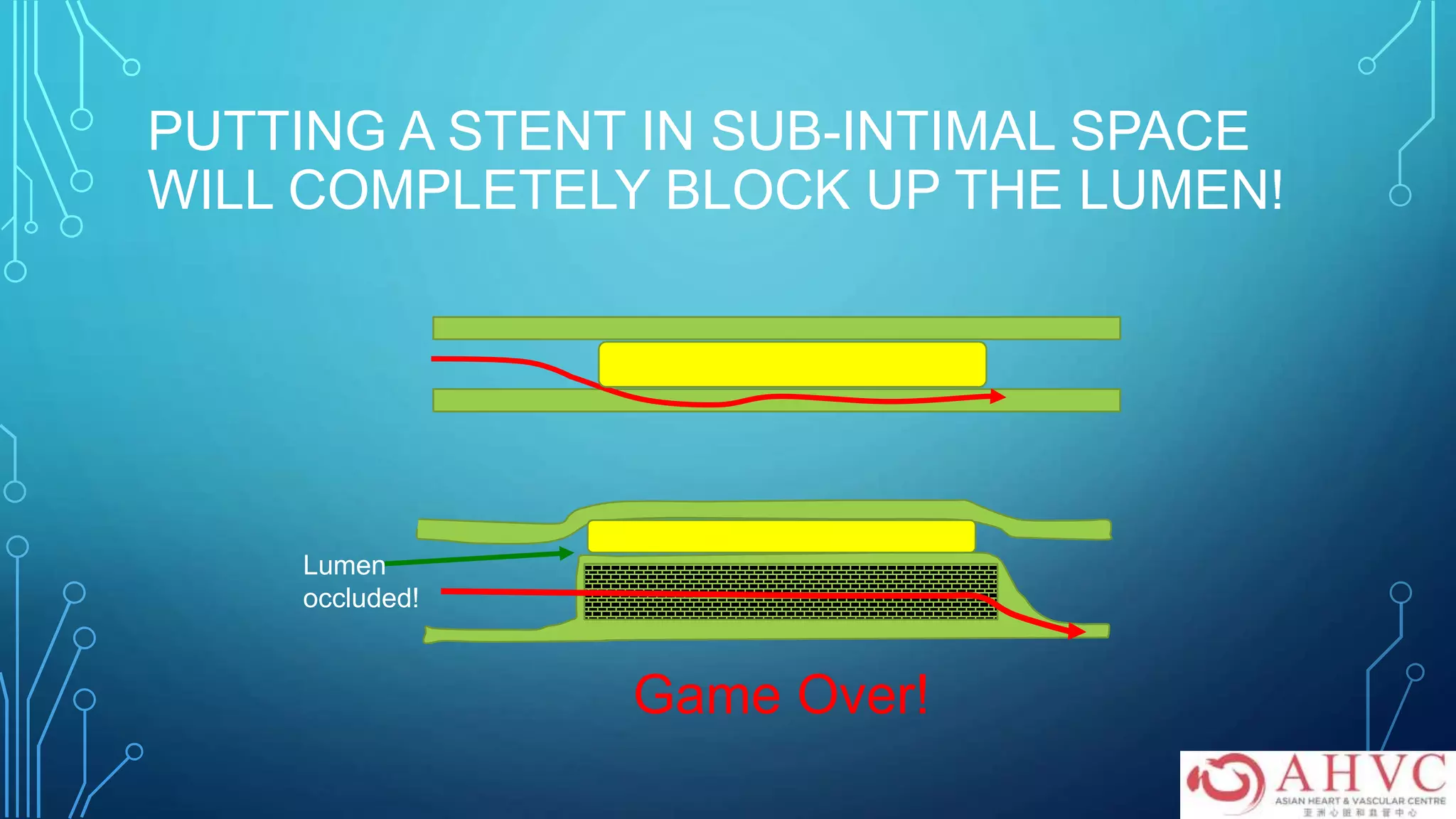
PUTTING A STENT IN SUB-INTIMAL SPACE
WILL COMPLETELY BLOCK UP THE LUMEN!
Lumen
occluded!
Game Over!
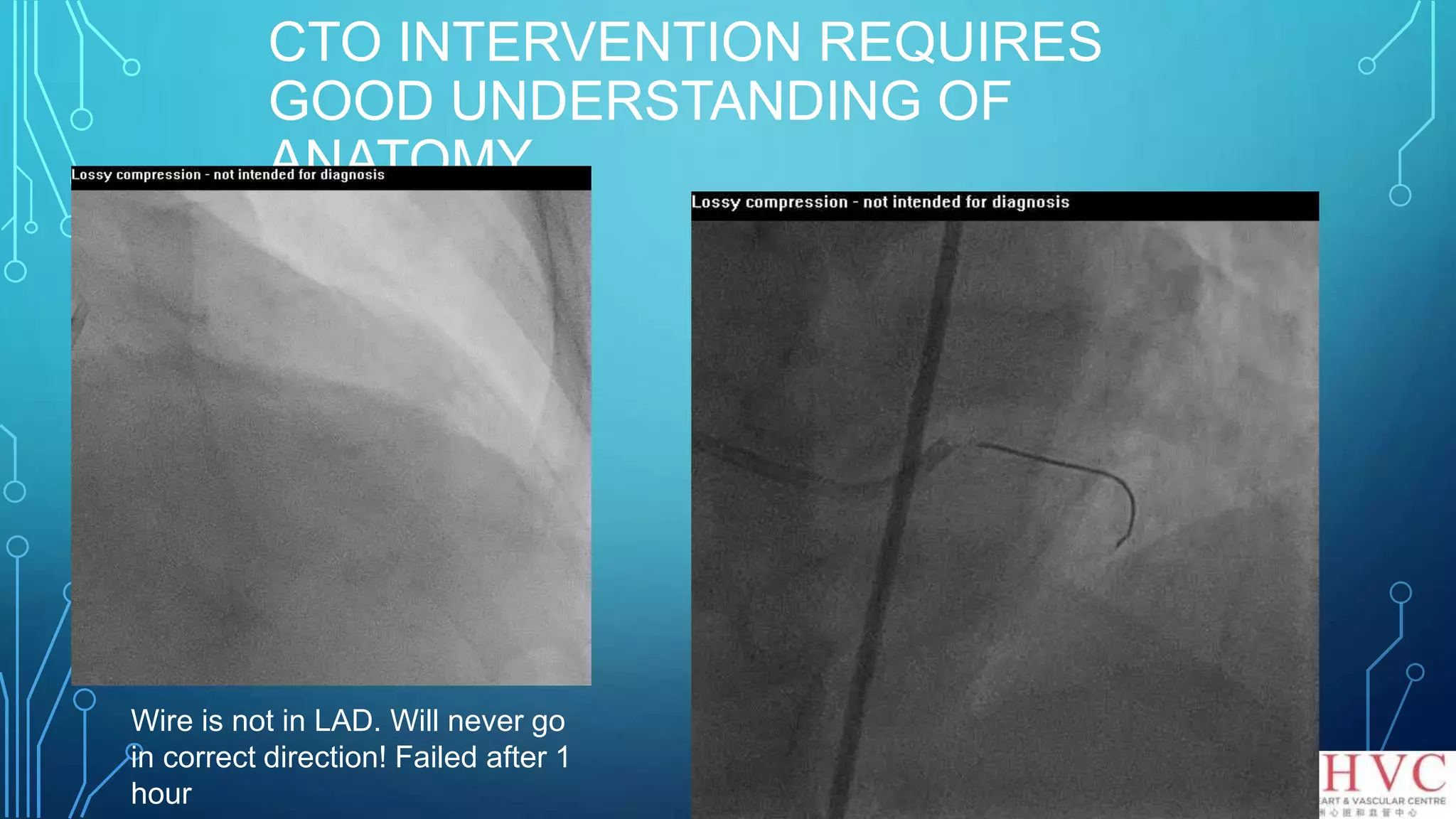
CTO INTERVENTION REQUIRES
GOOD UNDERSTANDING OF
ANATOMY
Wire is not in LAD. Will never go
in correct direction! Failed after 1
hour
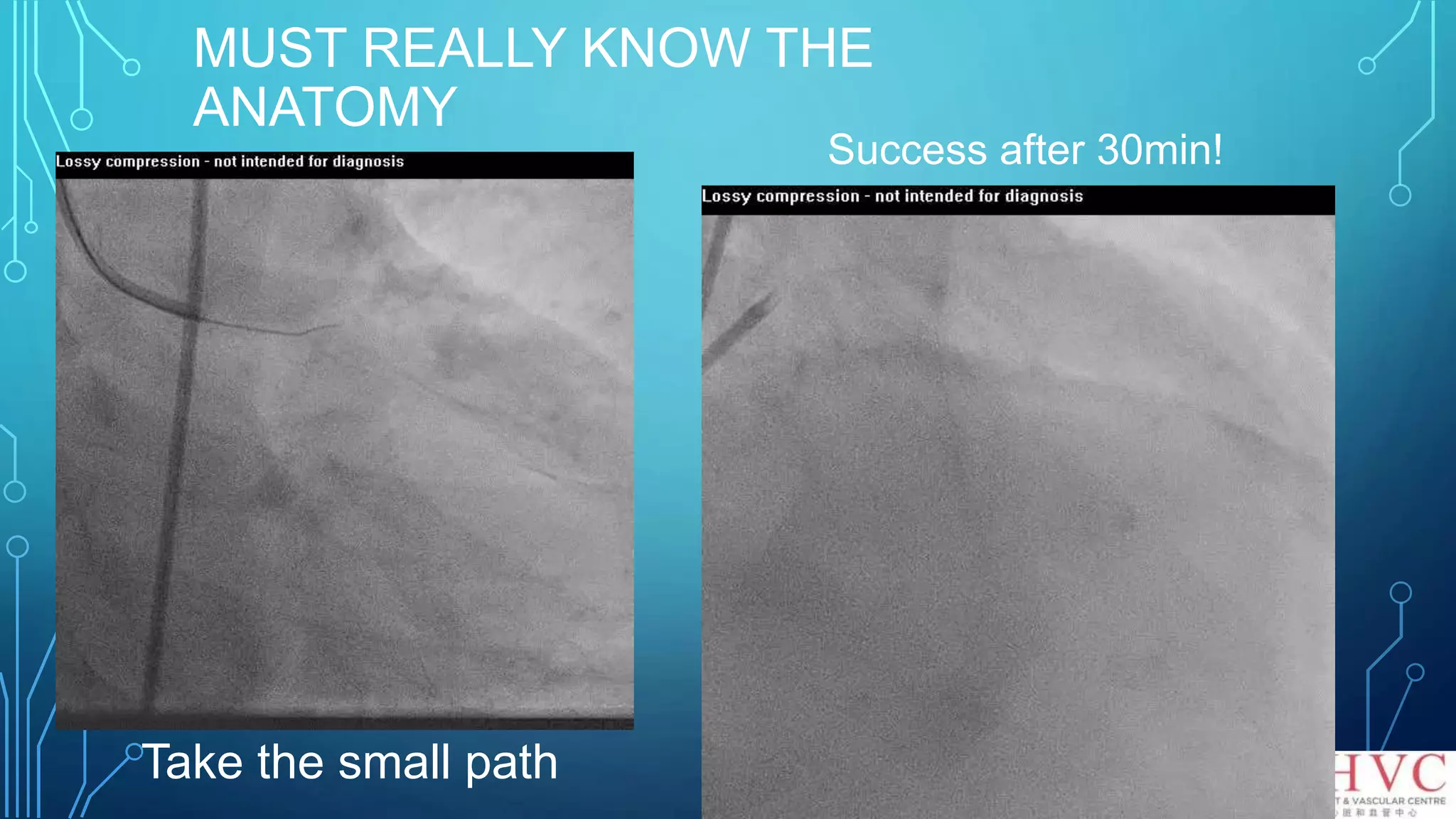
MUST REALLY KNOW THE
ANATOMY
Take the small path
Success after 30min!
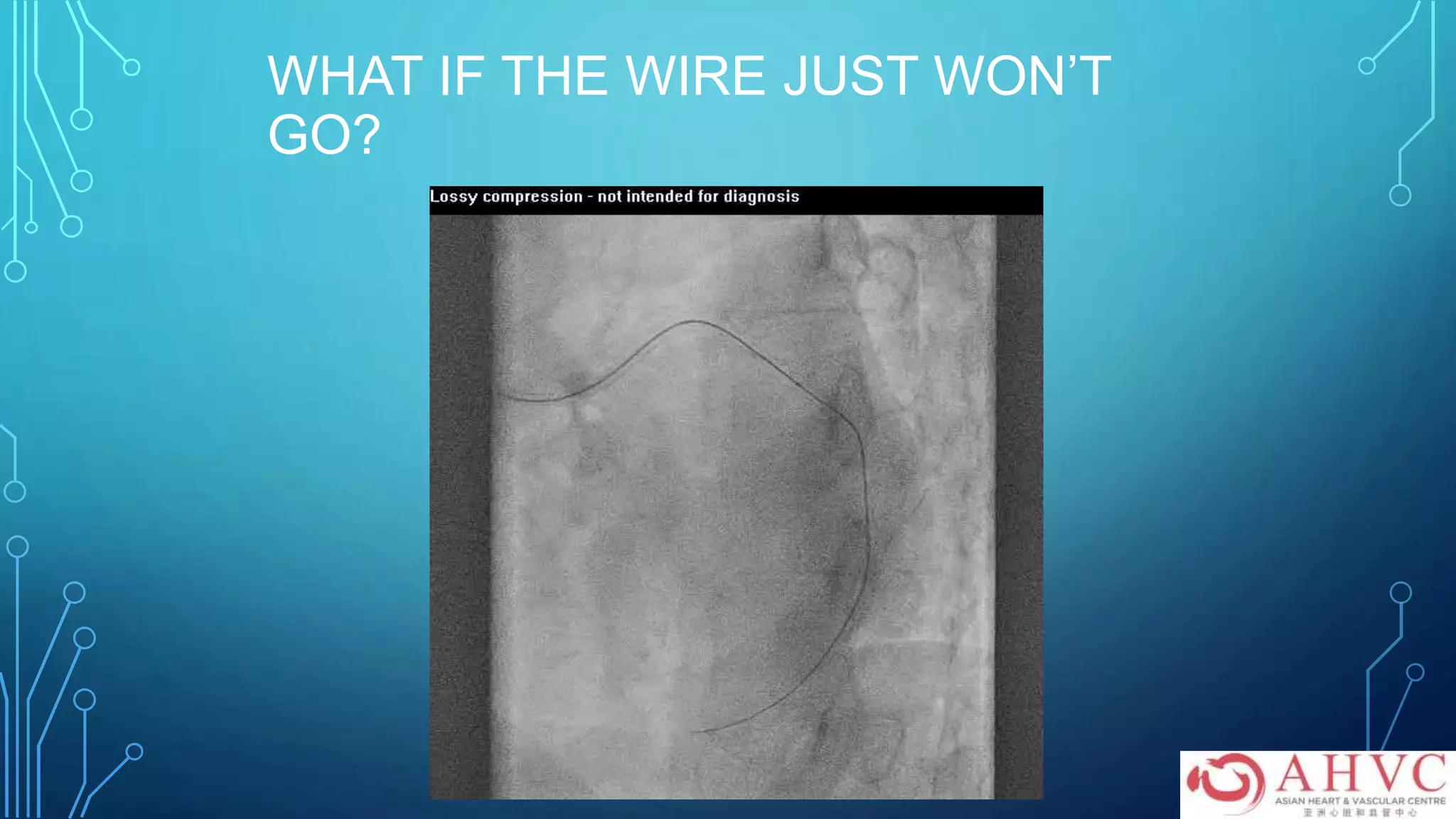
WHAT IF THE WIRE JUST WON’T
GO?
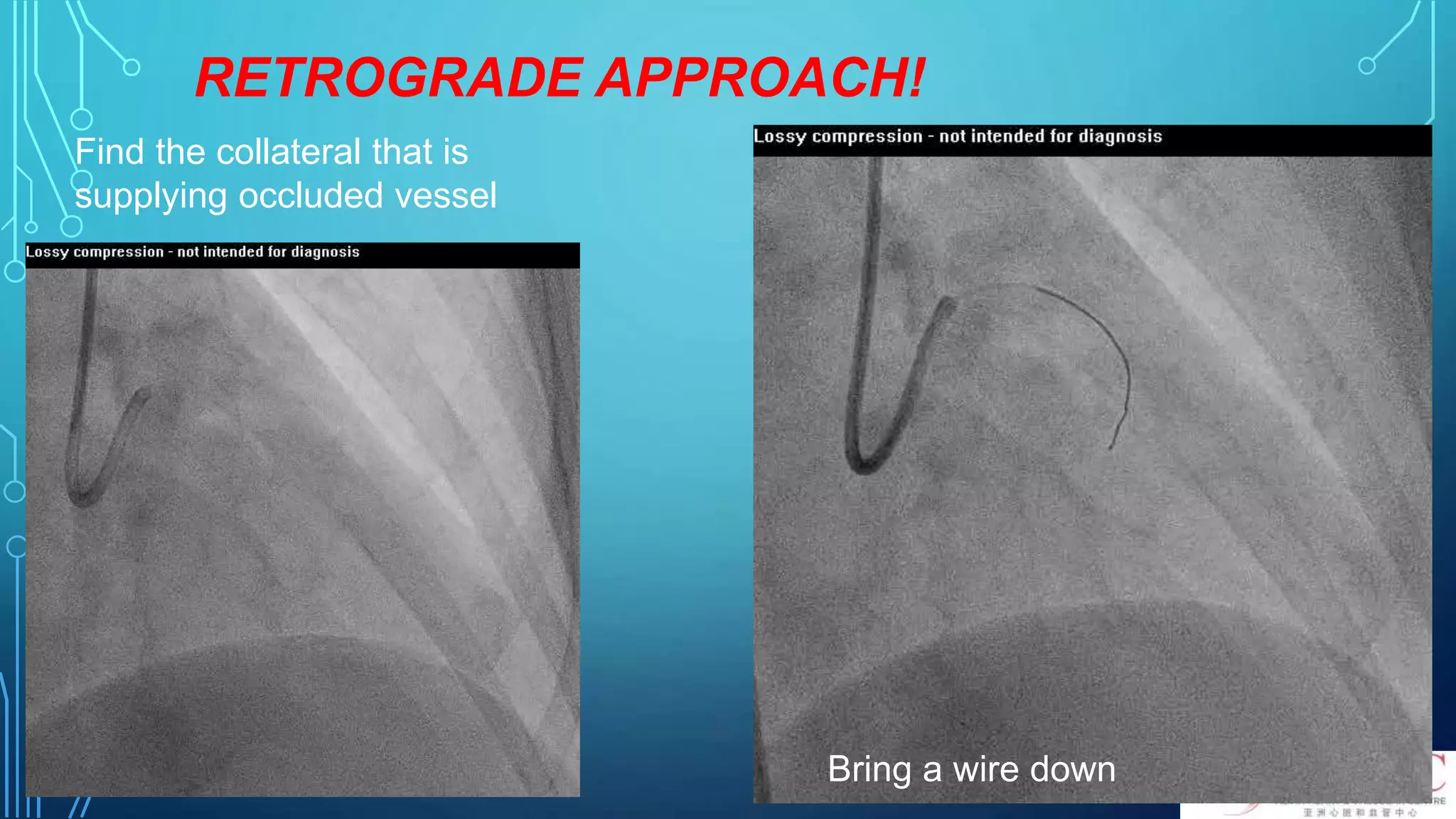
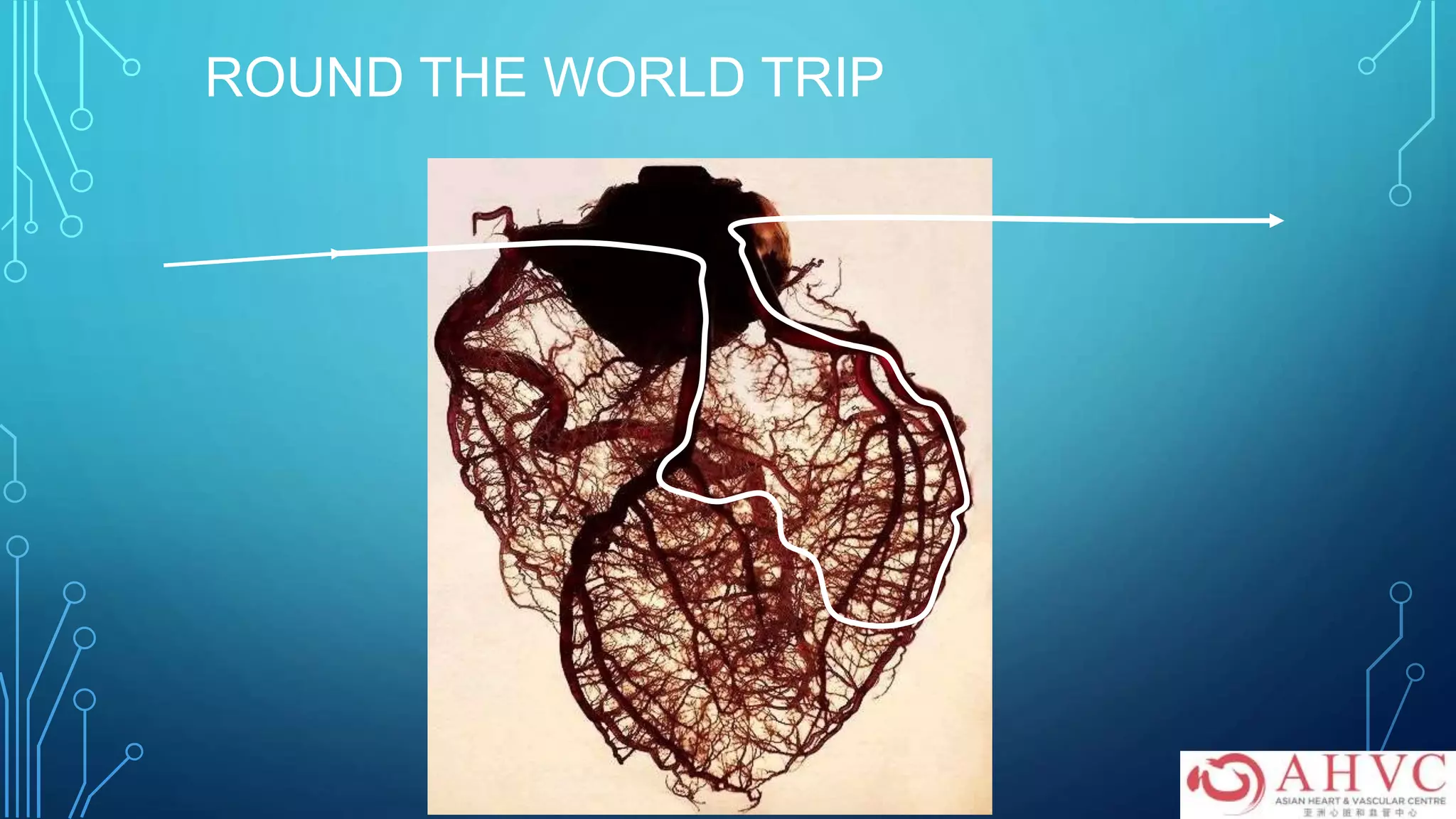
RETROGRADE APPROACH!
Find the collateral that is
supplying occluded vessel
Bring a wire down
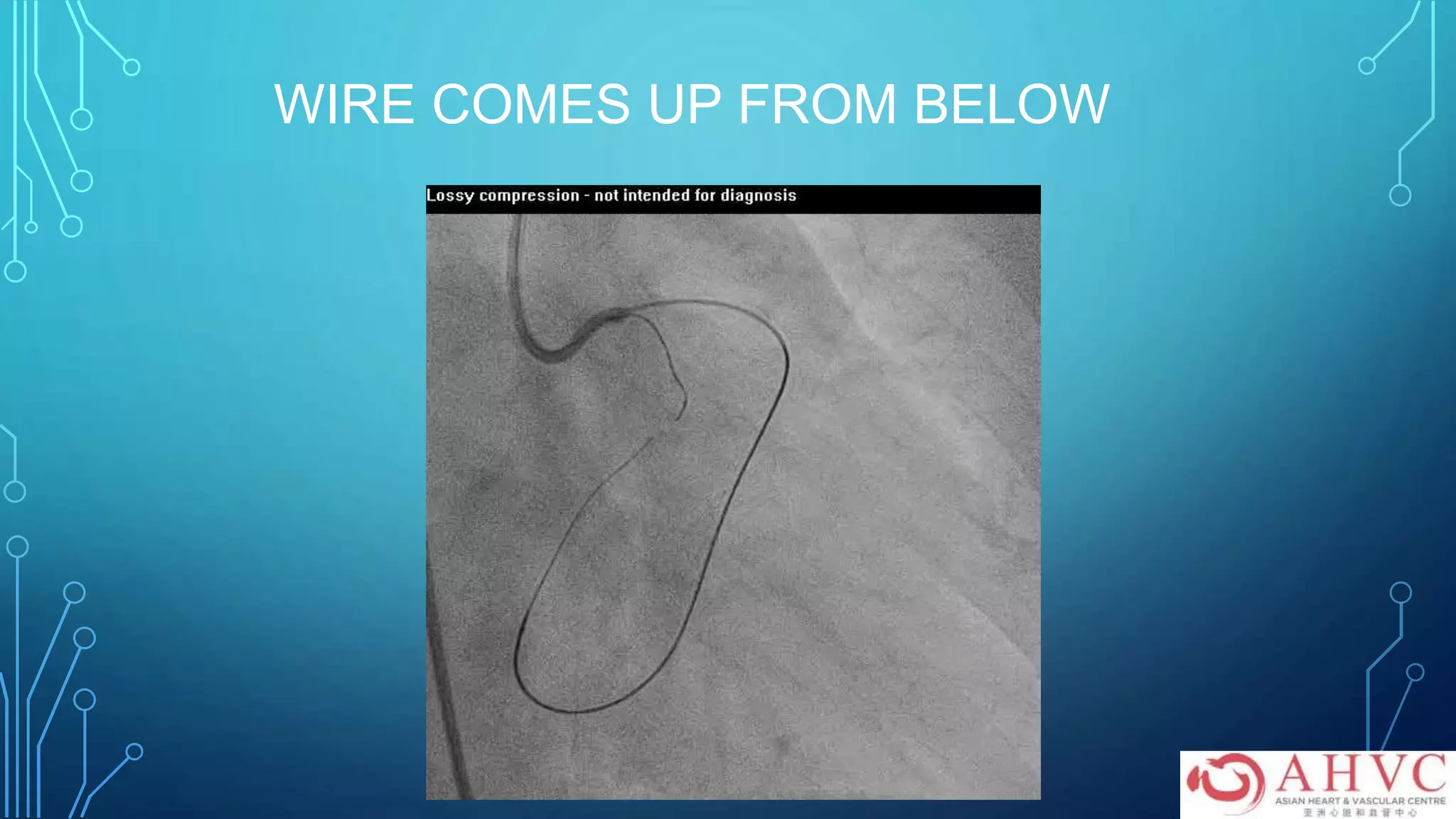
WIRE COMES UP FROM BELOW
ROUND THE WORLD TRIP
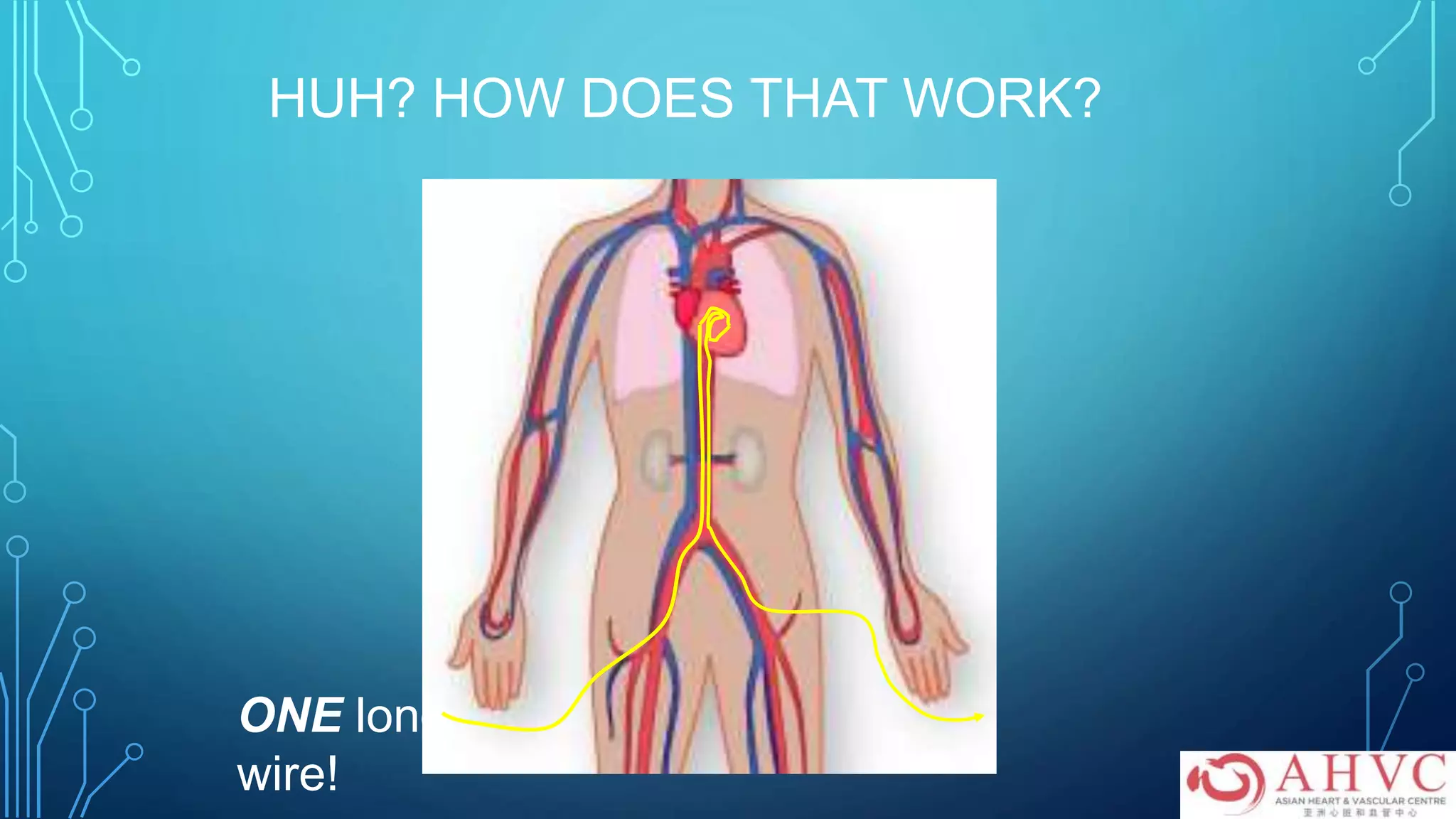
HUH? HOW DOES THAT WORK?
ONE long
wire!
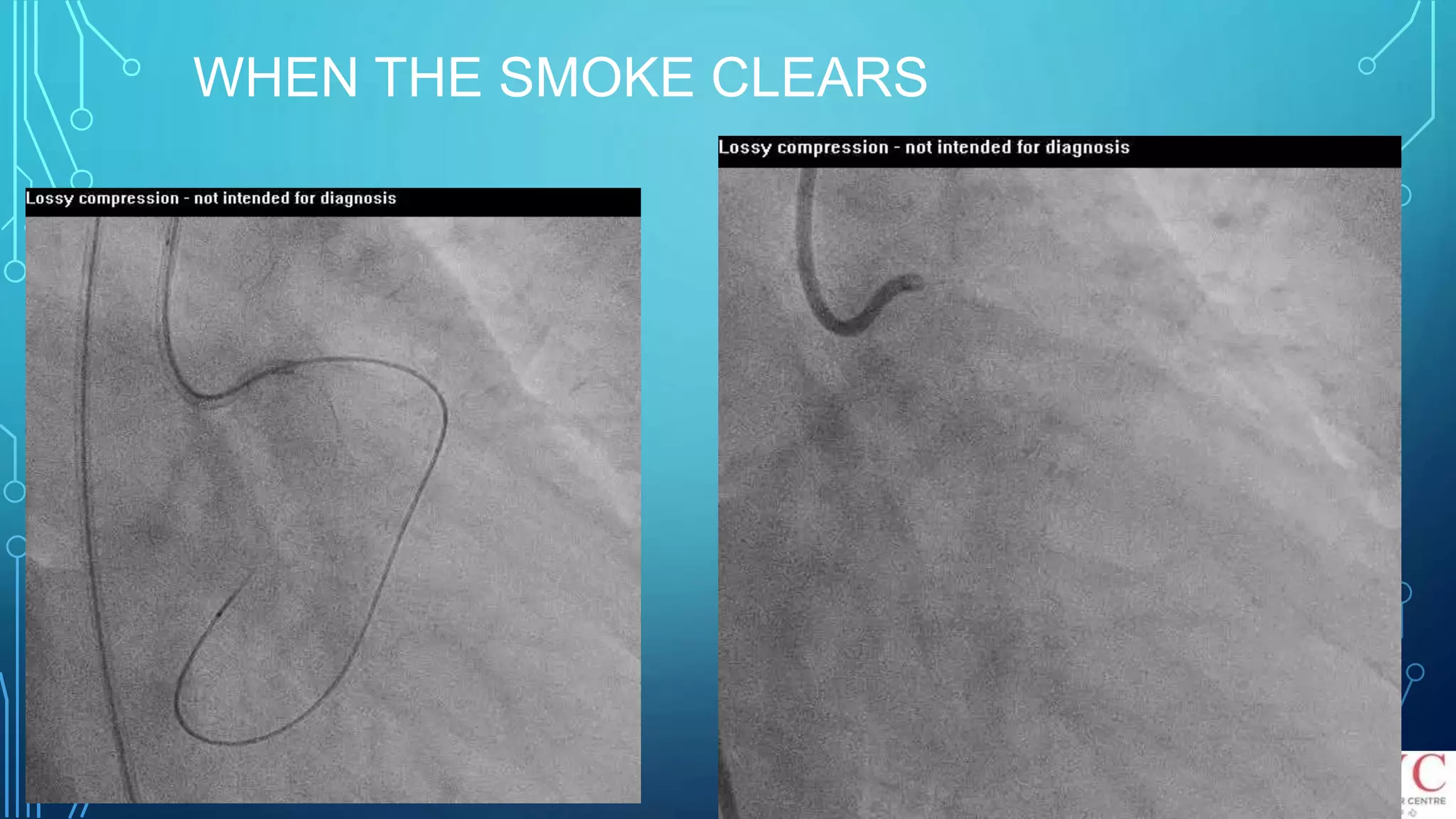
WHEN THE SMOKE CLEARS
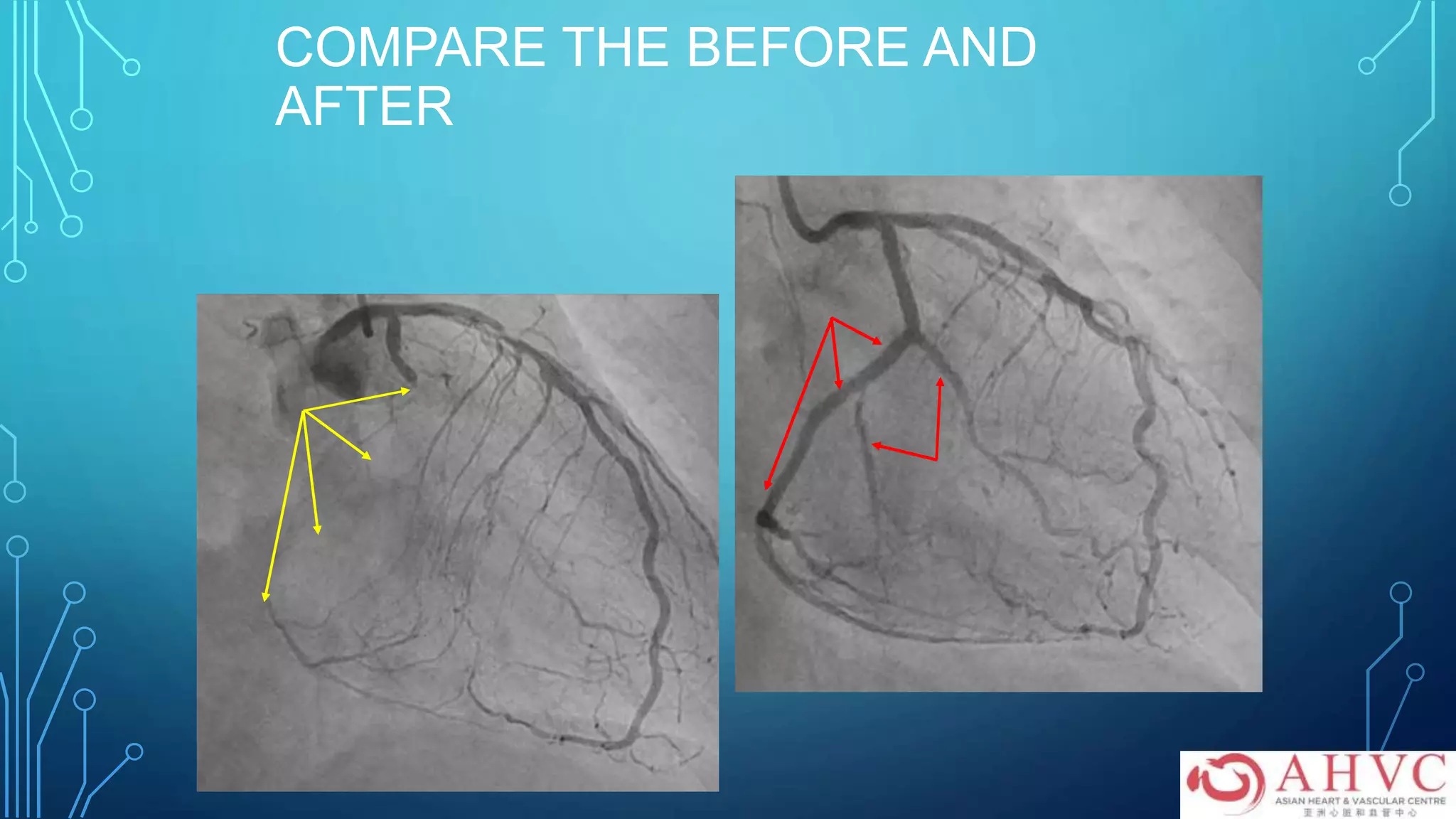
COMPARE THE BEFORE AND
AFTER
CAN ALL DOCTORS DO THIS?
•No
WORLD WIDE
•Limited number of people have good
experience in this technique
•Many cardiologists know and seen
•Few have tried and succeeded
•In Singapore
•Only a handful have done it
SINGAPORE
•Over the last 15 years I have done more than
100 fully documented retro-grade cases –
highest case load locally
•Done and taught more than 500 cases of
ante-grade CTO
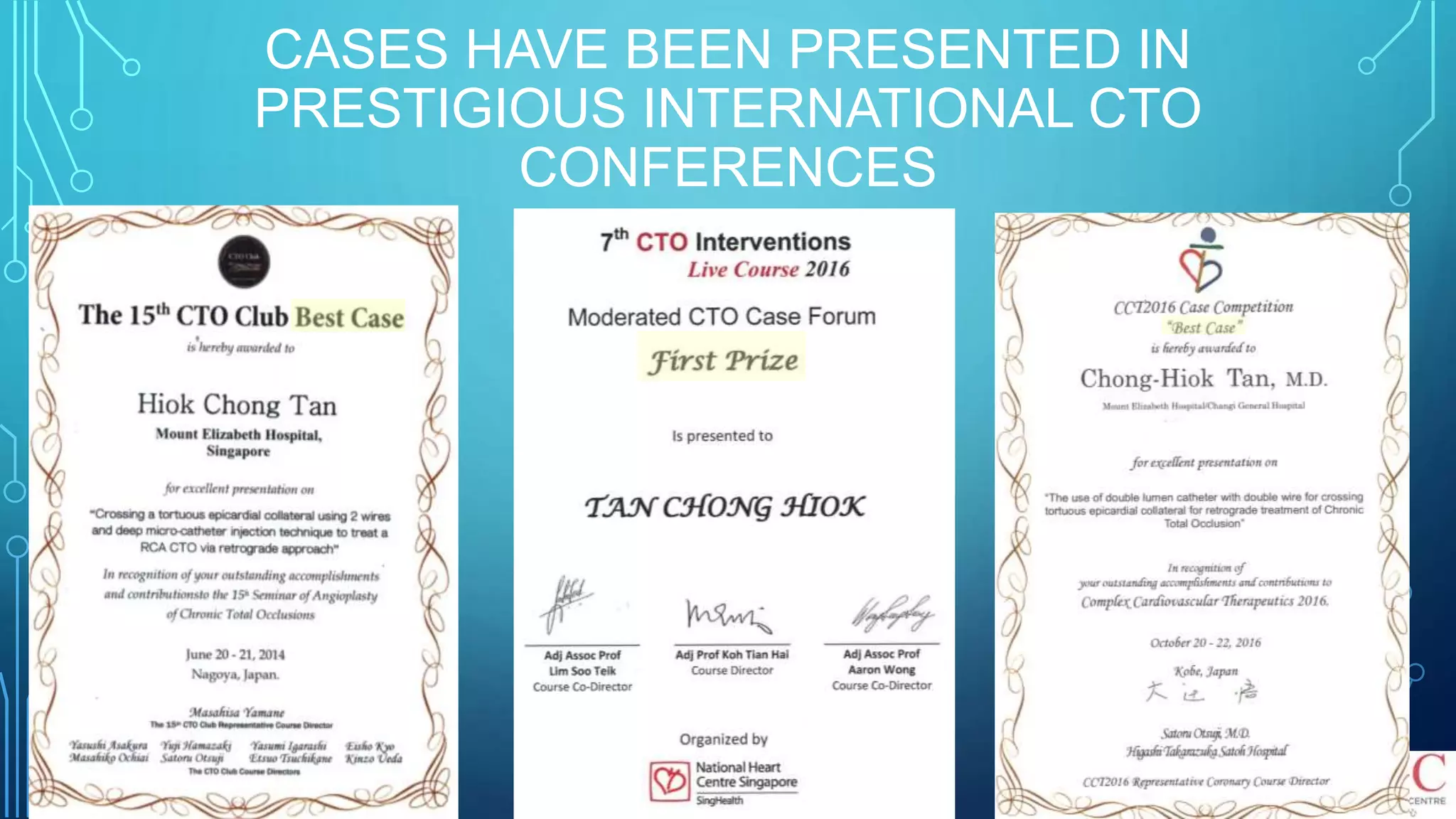
CASES HAVE BEEN PRESENTED IN
PRESTIGIOUS INTERNATIONAL CTO
CONFERENCES
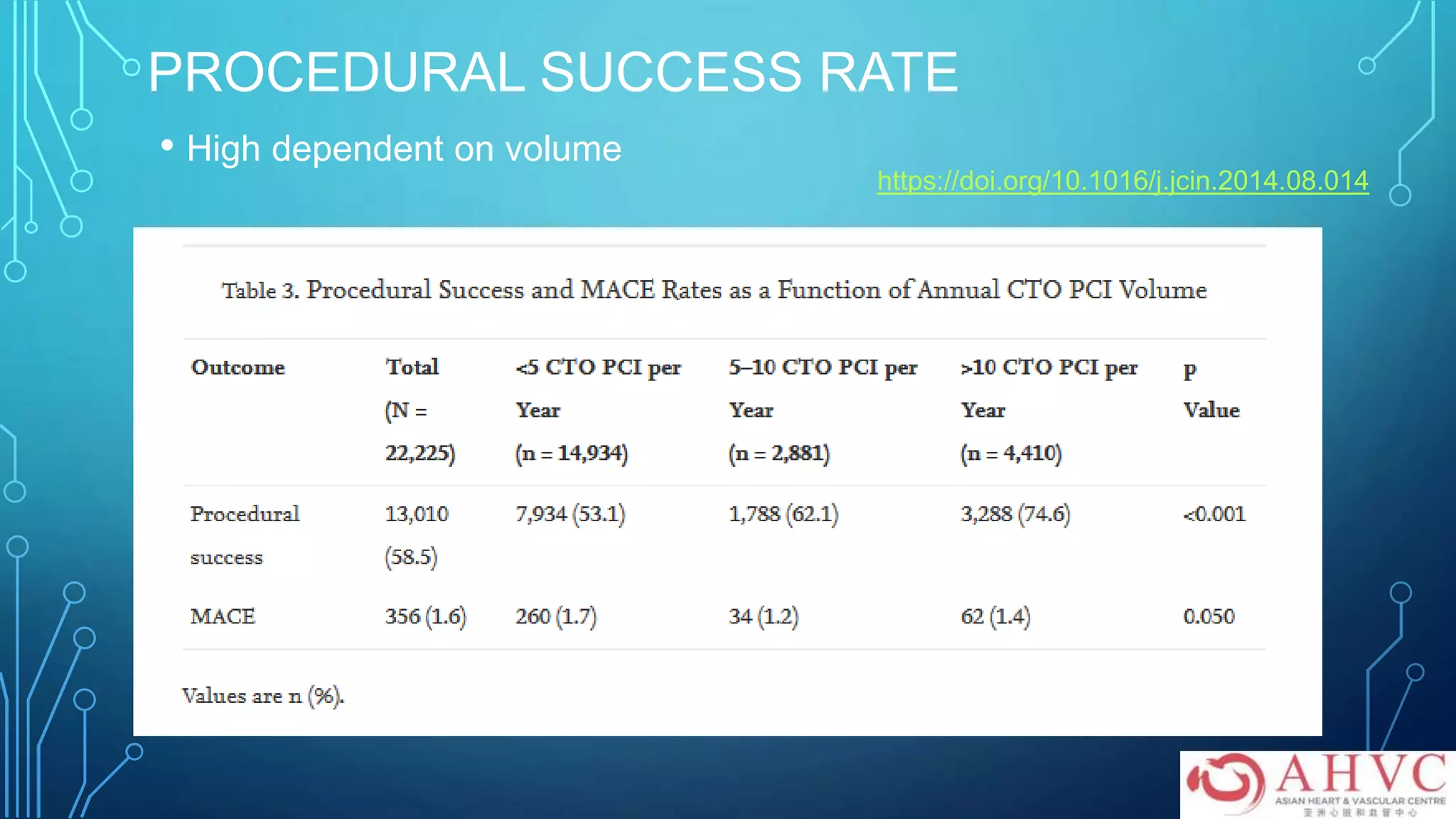
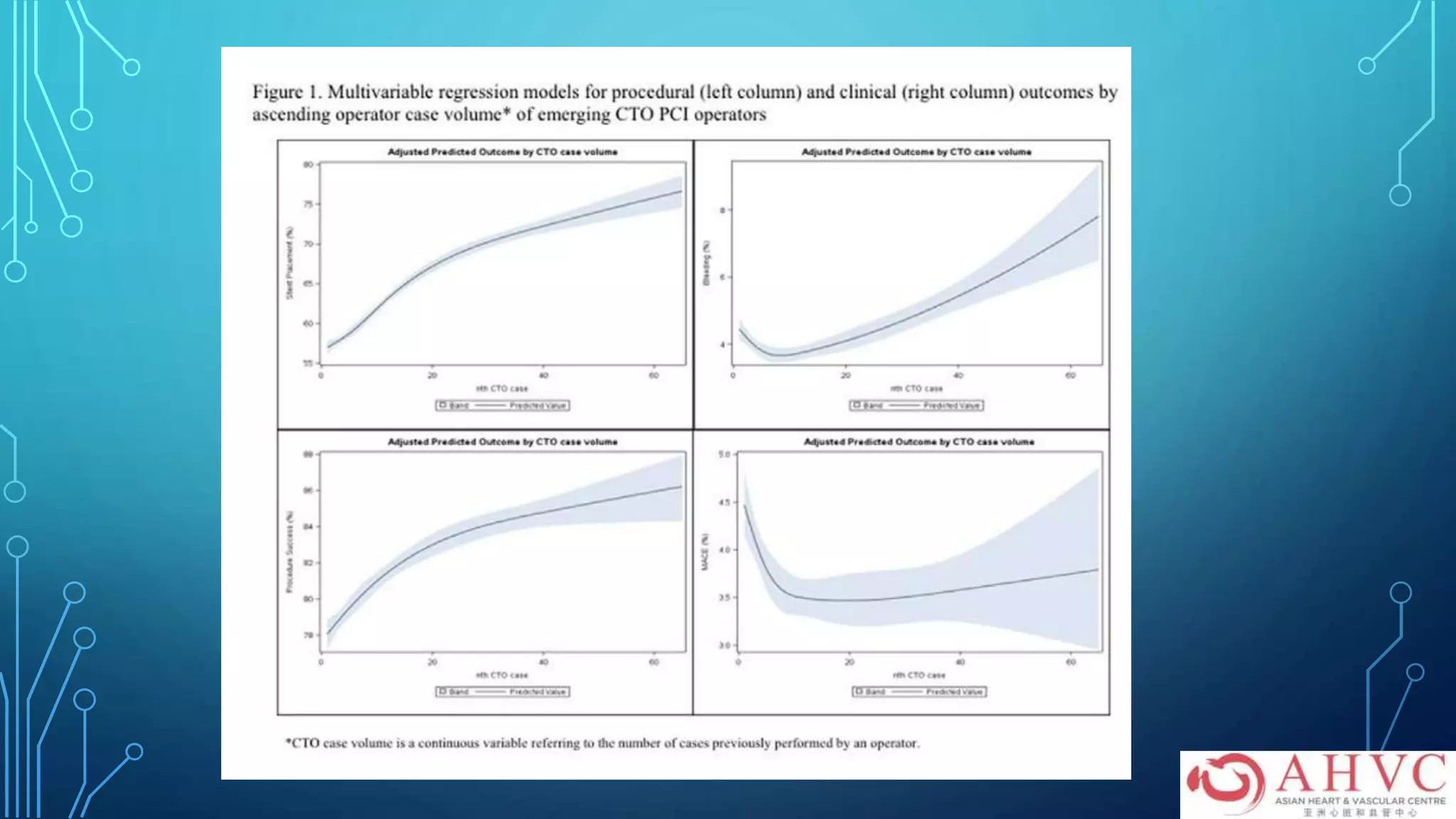
PROCEDURAL SUCCESS RATE
• High dependent on volume
https://doi.org/10.1016/j.jcin.2014.08.014
CTO SUCCESS
RATE
50%50%
Success rate of General
Interventionist
Success
Failure
95%
5%
Success rate of world
Masters
Success
Failure
87%
13%
My Success Rate
Success
Failure
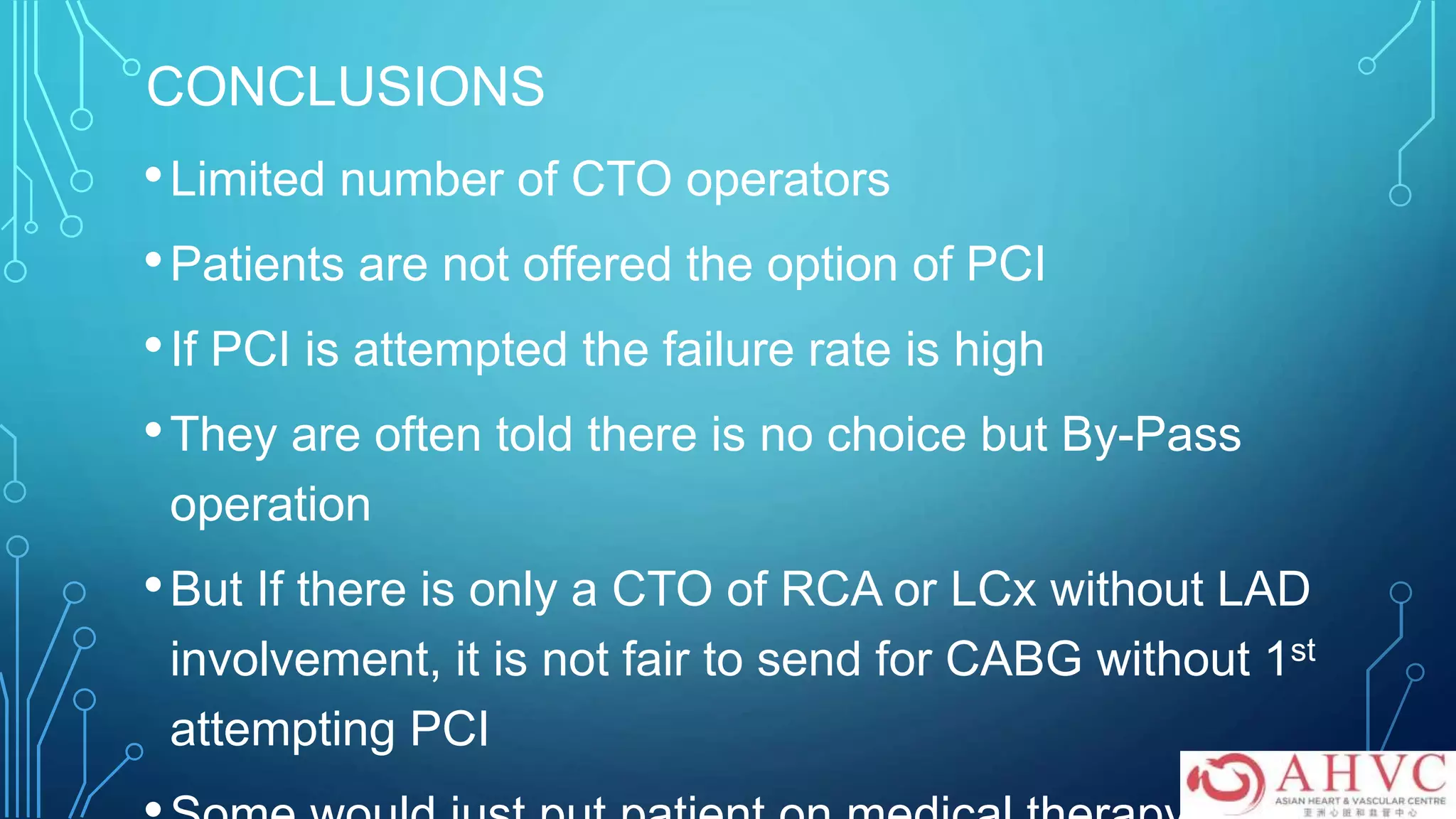
CONCLUSIONS
•Limited number of CTO operators
•Patients are not offered the option of PCI
•If PCI is attempted the failure rate is high
•They are often told there is no choice but By-Pass
operation
•But If there is only a CTO of RCA or LCx without LAD
involvement, it is not fair to send for CABG without 1st
attempting PCI
SOME PEOPLE WOULD SAY
•Go for By-Pass operation
•Just go for one procedure
•Can have full revscularisation
•It’s a once-for-all procedure
•No need for staged procedure
•Surgeons always say ‘I see all these people with
rings that get blocked up whom at the end all
come see me!’
•6 Days after discharged for By-Pass
•LIMA to LAD
•SVG to RCA
•SVG to OM
•Presented with Inferior Myocardial Infarction
•Acute ST elevation in inferior leads
50 YEAR OLD MAN
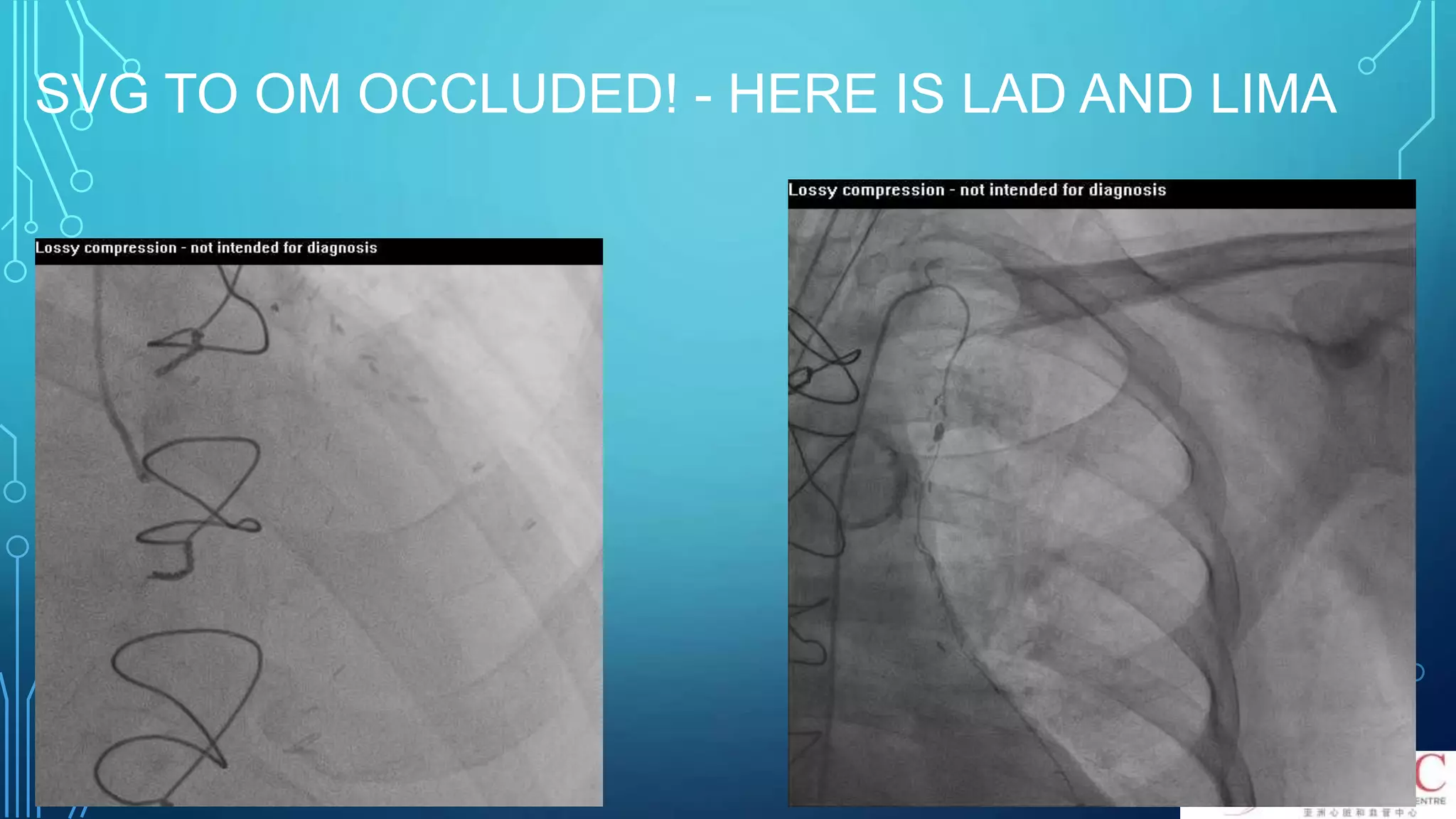
SVG TO OM OCCLUDED! - HERE IS LAD AND LIMA
OM GRAFT COMPLETELY BLOCKED!
RCA GRAFT OCCLUDED AT
ANASTAMOSIS
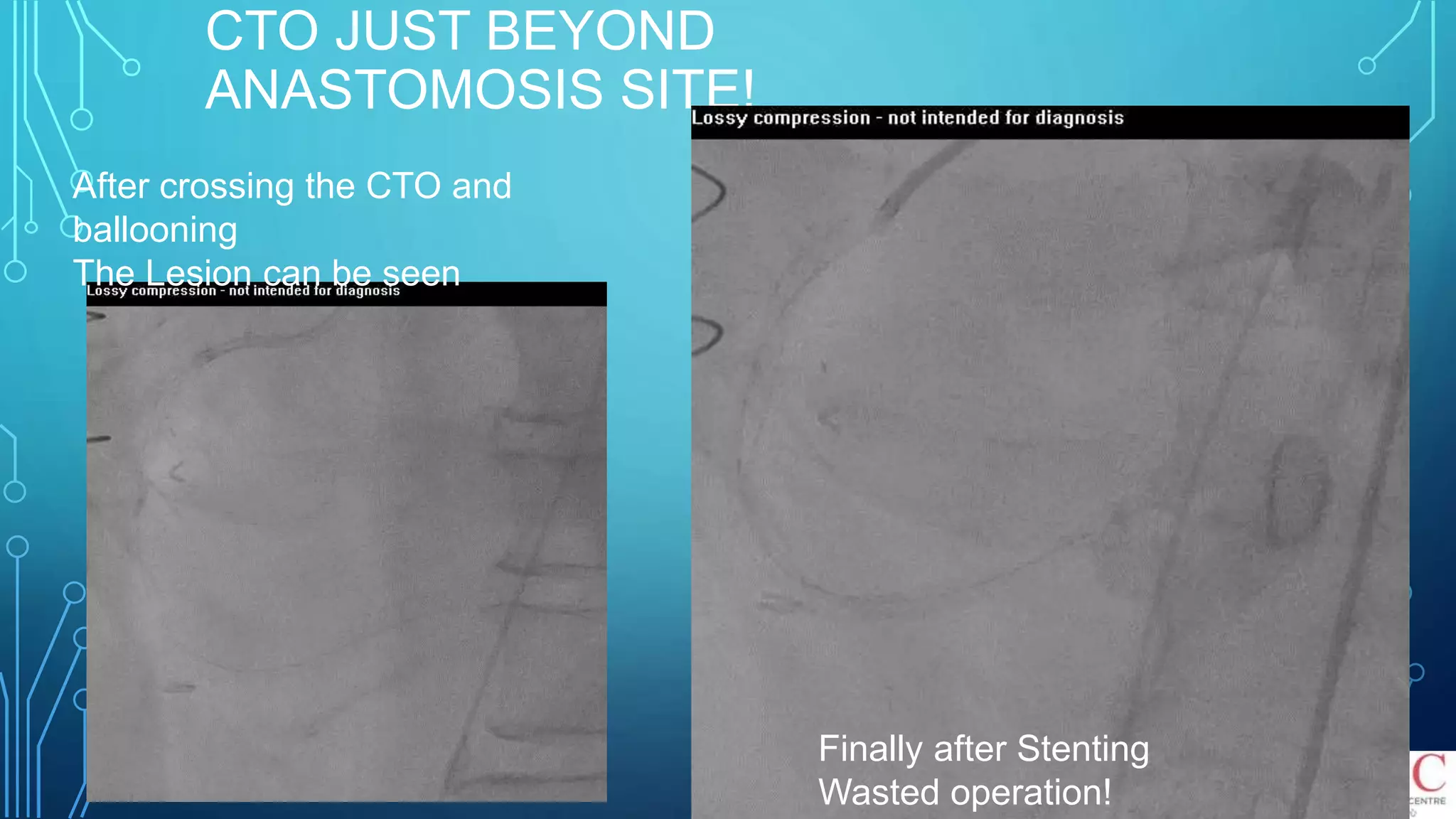
CTO JUST BEYOND
ANASTOMOSIS SITE!
After crossing the CTO and
ballooning
The Lesion can be seen
Finally after Stenting
Wasted operation!
CONCLUSION
• CTO’s are reasonably common
• Patients are often inadequately treated
• Failure rate for PCI is high
• Patients are not offered the option of 2nd opinion
• Some are sent for unnecessary bypass
• Even bypass is not a solution sometimes
• There is good chance of successful PCI if performed by
experienced operator who has done at least 100 cases of CTO
and is proficient in Retrograde approach
THANK YOU

Is Bypass Operation Still The Only Option For Left Main Disease And Completely Occluded Artery?

  • 1.
    LEFT MAIN AND CHRONICTOTAL OCCLUSIONS – FORGET BYPASS! DR. TAN CHONG HIOK
  • 2.
    2 VERY SPECIAL SUBSETSIN CORONARY ARTERY DISEASE •Unprotected Left Main disease •Chronic Total Occlustion (CTO)
  • 3.
    UNPROTECTED LEFT MAIN DISEASE •Significantdisease of Left Main in a person who has not under gone CABG of the LAD &/0r LCx
  • 4.
    OVER THE YEARS •Hasbe battle ground for Surgeons and Interventionists •The argument has always been CABG is better •But ‘Better’ is a relative term: Better than What?
  • 5.
    GUIDELINES HAVE EVOLVED OVERTHE YEARS •From a firm Class III •Now a Class IIa/IIb depending on the situation •Not based on a whim but trial data
  • 6.
    EXCEL - EVALUATIONOF XIENCE VERSUS CORONARY ARTERY BYPASS SURGERY FOR EFFECTIVENESS OF LEFT MAIN REVASCULARIZATION •1900 patients would provide 80% power to show the noninferiority of PCI to CABG with respect to the 3-year primary end point N Engl J Med 2016; 375:2223-2235
  • 7.
  • 8.
    Time to Event • K-MTime to first event analysis PCI CABG
  • 9.
    PCI CABG Event (No.)Rate (%) Event Rate Hazard ratio p PCI = 12.6% CABG = 7.5% PCI = 0.7% CABG = 5.4%! It is not ZERO! Therefore it is not ‘Once and For All! Graft occlusion can present as myocardial infarction!
  • 10.
    OVER A 3YEAR PERIOD - PCI VS CABG •There is no significant difference in hard end point of death, stroke of MI •As expected, PCI will result in more revascularisation – but so what?! Just repeat the PCI •Importantly… CABG is NOT a ‘Once and For All’ procedure • There is a 7.5% revascularisation rate AND 5.4%
  • 11.
    GUESS WHAT ISTHE METHOD OF REVASCULARISATION FOR GRAFT OCCLUSION?
  • 12.
    THINGS TO NOTE •ThePCI were done in experience centres •The use of IVUS was high at 77% •Total procedure time was 83min for PCI vs 243min for CABG •98% had internal mammary arterial graft – very good CABG
  • 13.
    PCI CABG CABG endsup with more AF May take 1 less anti-platelet BUT end up taking additional anti- arrhythmic AND anti-coagulation!
  • 14.
    •Let me sharemy data •Presented in PCR SingLive 2016
  • 15.
    METHOD •A retrospective analysisof 68 unprotected Left Main PCI cases that were performed from 2007 to 2013 •Mean follow up period was 3 years (range = 3 to 7 years)
  • 16.
  • 18.
    RESULTS •Overall MACE rates:11.8% (8 out of 68 cases) •Death: 10.3% •Target lesion revascularisation: 1.5% •Elective PCI: 6.6% •2 deaths (4.4%) out of 45 patients •Death rate in EXCEL at 3 yrs up to 7.3% •Of which one was sepsis, and one was sudden death •1 target lesion revascularisation (2.2%)
  • 19.
    RESULTS •Acute STEMI PCI:42.5% •5 deaths •Acute LM occlusion cases (5 out of 11, 42.5%) •Presented with cardiogenic shock
  • 20.
    LET’S SEE SOMEEXAMPLE •87 year old gentleman •Angina •Not good condition for CABG
  • 21.
  • 22.
  • 23.
  • 24.
  • 25.
  • 26.
    CONCLUSION •LM stenting inthe non-urgent setting is safe and has low MACE rate at 3 years •Needs to be done in experienced hands •Use of IVUS is strongly advocated •It is a viable alternative to CABG
  • 27.
    CHRONIC TOTAL OCCLUSION- THE FINALFRONTIER OF PCI DR. TAN CHONG HIOK ASIA HEART AND VASCULAR CENTRE
  • 28.
  • 29.
    15-30% 85% CTO Non-CTO Success 50% Failur e50% Not tried 70% WHAT’STHE BIG DEAL? Of those sent for Angiogram 15-30% have a CTO Only 30% of CTO will undergo an attempt Only half of which will succeed
  • 30.
    SO WHAT?... •Although atpresent there is no randomised control trial on treatment of CTO •But… •There are 3 possible benefit to opening a CTO •Improvement in symptoms •Improvement in LV function •Improvement in survival
  • 31.
  • 32.
    WHEN 1 ROADIS BLOCKED, ANOTHER OPENS Collateral “Self Bypass” Self bypass enters the RCA RCA filling ‘backwards’
  • 33.
    SYMPTOM IMPROVEMENT •If collateralsare insufficient to provide adequate blood flow •During physical stress •Symptoms will be alleviated with revascularisation of the CTO vessel
  • 34.
    IMPROVE LV FUNCTION •MRIstudies have demonstrated improved LV function 5 months after successful opening of a CTO vessel •The benefits were greater in patients with viable myocardium supplied by the CTO. •This is due to abolition of the chronic ischaemia resulting in myocardial hibernation
  • 35.
    IMPROVED SURVIVAL AnMI in RCA would have resulted in 2 huge territories being infarcted RCA collateral suppling a huge LAD territory
  • 36.
    IMPROVED SURVIVAL •Observational studiesfound that mortality was significantly reduced in the successful PCI group during an average follow-up of 6 years •Several observational studies suggest that the improvements in LV function may result in improved long-term survival •Granted that randomised studies are not easy to conduct
  • 37.
    IF THERE ISBENEFIT IN REVASCULARISING CTO •Why is it that not all doctors treat CTO? •Technically very demanding •It is considered as a ‘sub-specialty’ in Interventional cardiology •Techniques and devices used are quite specific for CTO
  • 38.
    WHAT’S SO DIFFICULTABOUT CTO PCI? Left Circumflex CTO Start of the occlusion Path of occluded vessel
  • 39.
    UNABLE TO SEETHE PATH OF THE WIRE The wire can come out of the vessel completely! Approximate path of vessel Vessel downstream Path of wire
  • 40.
    WHAT HAPPENED TOTHE WIRE? CTO Fortunately in the CTO segment, there is no blood flow
  • 41.
    FORTUNATELY NOT EVERYCTO IS SO HARDENED – DEPENDS ON CHRONICITY Hard (Proteogylyca n-collagen) Not so hard Softer
  • 42.
    SUCCESS RATE DEPENDSON CHRONICITY OF CTO •The longer the CTO remains, the higher the content of fully organised proteoglycan-collagen -> Hard •Shorter duration CTO will have larger quantity of softer organising thrombus •The shorter the duration of CTO, the higher the success rate for PCI •Average operator, if he dares to attempt all CTO, will have a success rate of 50%
  • 43.
    WHAT ELSE CANGO WRONG WITH INEXPERIENCE DOCTOR?When the CTO segment is not correctly crossed by wire
  • 44.
    NOT KNOW WHATTO DO SO PLACED A STENT
  • 45.
    THERE IS ASMALL PERFORATION ARTERY STILL COMPLETELY BLOCKED
  • 46.
    PUTTING A STENTIN SUB-INTIMAL SPACE WILL COMPLETELY BLOCK UP THE LUMEN! Lumen occluded! Game Over!
  • 47.
    CTO INTERVENTION REQUIRES GOODUNDERSTANDING OF ANATOMY Wire is not in LAD. Will never go in correct direction! Failed after 1 hour
  • 48.
    MUST REALLY KNOWTHE ANATOMY Take the small path Success after 30min!
  • 49.
    WHAT IF THEWIRE JUST WON’T GO?
  • 50.
    RETROGRADE APPROACH! Find thecollateral that is supplying occluded vessel Bring a wire down
  • 51.
    WIRE COMES UPFROM BELOW
  • 52.
  • 53.
    HUH? HOW DOESTHAT WORK? ONE long wire!
  • 54.
  • 55.
  • 56.
    CAN ALL DOCTORSDO THIS? •No
  • 57.
    WORLD WIDE •Limited numberof people have good experience in this technique •Many cardiologists know and seen •Few have tried and succeeded •In Singapore •Only a handful have done it
  • 58.
    SINGAPORE •Over the last15 years I have done more than 100 fully documented retro-grade cases – highest case load locally •Done and taught more than 500 cases of ante-grade CTO
  • 59.
    CASES HAVE BEENPRESENTED IN PRESTIGIOUS INTERNATIONAL CTO CONFERENCES
  • 60.
    PROCEDURAL SUCCESS RATE •High dependent on volume https://doi.org/10.1016/j.jcin.2014.08.014
  • 62.
    CTO SUCCESS RATE 50%50% Success rateof General Interventionist Success Failure 95% 5% Success rate of world Masters Success Failure 87% 13% My Success Rate Success Failure
  • 63.
    CONCLUSIONS •Limited number ofCTO operators •Patients are not offered the option of PCI •If PCI is attempted the failure rate is high •They are often told there is no choice but By-Pass operation •But If there is only a CTO of RCA or LCx without LAD involvement, it is not fair to send for CABG without 1st attempting PCI
  • 64.
    SOME PEOPLE WOULDSAY •Go for By-Pass operation •Just go for one procedure •Can have full revscularisation •It’s a once-for-all procedure •No need for staged procedure •Surgeons always say ‘I see all these people with rings that get blocked up whom at the end all come see me!’
  • 65.
    •6 Days afterdischarged for By-Pass •LIMA to LAD •SVG to RCA •SVG to OM •Presented with Inferior Myocardial Infarction •Acute ST elevation in inferior leads 50 YEAR OLD MAN
  • 66.
    SVG TO OMOCCLUDED! - HERE IS LAD AND LIMA
  • 67.
    OM GRAFT COMPLETELYBLOCKED! RCA GRAFT OCCLUDED AT ANASTAMOSIS
  • 68.
    CTO JUST BEYOND ANASTOMOSISSITE! After crossing the CTO and ballooning The Lesion can be seen Finally after Stenting Wasted operation!
  • 69.
    CONCLUSION • CTO’s arereasonably common • Patients are often inadequately treated • Failure rate for PCI is high • Patients are not offered the option of 2nd opinion • Some are sent for unnecessary bypass • Even bypass is not a solution sometimes • There is good chance of successful PCI if performed by experienced operator who has done at least 100 cases of CTO and is proficient in Retrograde approach
  • 70.