Recent Publications & Research
in CTO: 2013-14
Carlo Di Mario, MD, FACC, FRCP
Ismail Dogu Kilic, MD
Gianluca Caiazzo, MD
Nikolaos Konstantinidis, MD
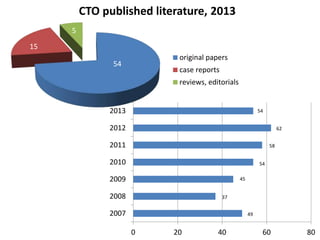
CTO published literature, 2013
original papers
case reports
reviews, editorials
54
15
5
0 20 40 60 80
2007
2008
2009
2010
2011
2012
2013
37
49
45
54
58
62
54
• Pathology
• Physiology
• Epidemiology
• Outcome Data
• Imaging
• Technical approach
• Stents in CTO
EuroCTO Course 2014:
Rapid Review of the Recent CTO Literature
Sakamura, …, Virmani et al, Eur Heart J. 2013 Oct 14
Comparison of pathology of chronic total occlusion
with and without coronary artery bypass graft
95 CTOs from 82 patients were divided into CTO with CABG(n:34) ,CTO without CABG—of
long-duration (n:49) and short-duration (n:12); histopathological comparison of the
plaque characteristics of CTO, proximal and distal lumen morphology, and negative
remodeling between groups; a total of 1127 sections were evaluated
Representative images of long-duration CTO and short-
duration CTO
Differences in plaque characteristics
• necrotic core area was highest in SD CTO
(18.6%) (LD-CTO: 7.8%; CTO+CABG: 4.5%; P ¼ 0.02)
• calcified area was greatest in CTO+CABG
(29.2%) (LD-CTO: 16.8%; SD-CTO: 12.1%; P ¼ 0.009);
• negative remodeling was least in SD-CTO
[remodeling index (RI) 0.86] [CTO+CABG (RI): 0.72
and LD-CTO (RI): 0.68; P , 0.001]
• Approximately 50% of proximal lumens
showed characteristics of abrupt closure
• the majority of distal lumen patterns were
tapered(79%) (P , 0.0001).
• Pathology
• Physiology
• Epidemiology
• Outcome Data
• Imaging
• Technical approach
• Stents in CTO
New York CTO/LM Course:
Rapid Review of the Recent CTO Literature
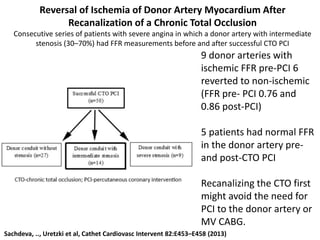
Reversal of Ischemia of Donor Artery Myocardium After
Recanalization of a Chronic Total Occlusion
Consecutive series of patients with severe angina in which a donor artery with intermediate
stenosis (30–70%) had FFR measurements before and after successful CTO PCI
Sachdeva, .., Uretzki et al, Cathet Cardiovasc Intervent 82:E453–E458 (2013)
9 donor arteries with
ischemic FFR pre-PCI 6
reverted to non-ischemic
(FFR pre- PCI 0.76 and
0.86 post-PCI)
5 patients had normal FFR
in the donor artery pre-
and post-CTO PCI
Recanalizing the CTO first
might avoid the need for
PCI to the donor artery or
MV CABG.
• Pathology
• Physiology
• Epidemiology
• Outcome Data
• Imaging
• Technical approach
• Stents in CTO
EuroCTO Course 2014: :
Rapid Review of the Recent CTO Literature
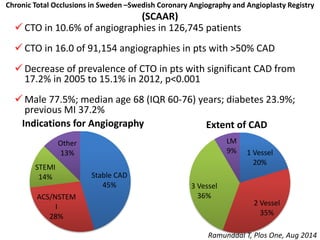
Chronic Total Occlusions in Sweden –Swedish Coronary Angiography and Angioplasty Registry
(SCAAR)
Ramunddal T, Plos One, Aug 2014
Stable CAD
45%
ACS/NSTEM
I
28%
STEMI
14%
Other
13%
Sales
Indications for Angiography
1 Vessel
20%
2 Vessel
35%
3 Vessel
36%
LM
9%
Sales
Extent of CAD
 CTO in 10.6% of angiographies in 126,745 patients
 CTO in 16.0 of 91,154 angiographies in pts with >50% CAD
 Decrease of prevalence of CTO in pts with significant CAD from
17.2% in 2005 to 15.1% in 2012, p<0.001
 Male 77.5%; median age 68 (IQR 60-76) years; diabetes 23.9%;
previous MI 37.2%
Ramunddal T, Plos One, Aug 2014
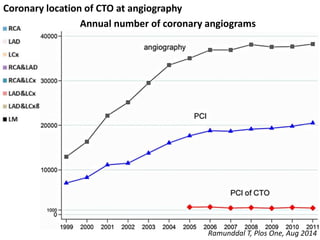
Coronary location of CTO at angiography
Annual number of coronary angiograms
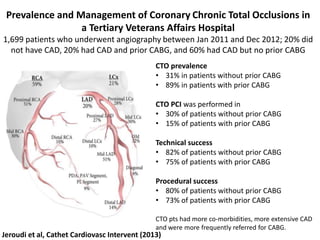
Prevalence and Management of Coronary Chronic Total Occlusions in
a Tertiary Veterans Affairs Hospital
1,699 patients who underwent angiography between Jan 2011 and Dec 2012; 20% did
not have CAD, 20% had CAD and prior CABG, and 60% had CAD but no prior CABG
Jeroudi et al, Cathet Cardiovasc Intervent (2013)
CTO prevalence
• 31% in patients without prior CABG
• 89% in patients with prior CABG
CTO PCI was performed in
• 30% of patients without prior CABG
• 15% of patients with prior CABG
Technical success
• 82% of patients without prior CABG
• 75% of patients with prior CABG
Procedural success
• 80% of patients without prior CABG
• 73% of patients with prior CABG
CTO pts had more co-morbidities, more extensive CAD
and were more frequently referred for CABG.
• Pathology
• Physiology
• Epidemiology
• Outcome Data
• Imaging
• Technical approach
• Stents in CTO
EuroCTO Course 2014: :
Rapid Review of the Recent CTO Literature
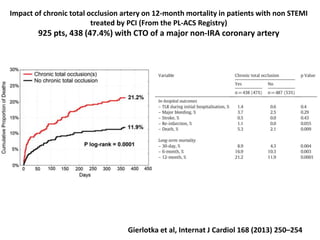
Impact of chronic total occlusion artery on 12-month mortality in patients with non STEMI
treated by PCI (From the PL-ACS Registry)
925 pts, 438 (47.4%) with CTO of a major non-IRA coronary artery
Gierlotka et al, Internat J Cardiol 168 (2013) 250–254
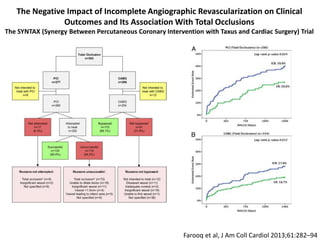
The Negative Impact of Incomplete Angiographic Revascularization on Clinical
Outcomes and Its Association With Total Occlusions
The SYNTAX (Synergy Between Percutaneous Coronary Intervention with Taxus and Cardiac Surgery) Trial
Farooq et al, J Am Coll Cardiol 2013;61:282–94
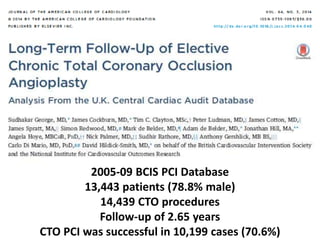
2005-09 BCIS PCI Database
13,443 patients (78.8% male)
14,439 CTO procedures
Follow-up of 2.65 years
CTO PCI was successful in 10,199 cases (70.6%)
Survival and CTO Success
• Successful PCI of at least 1 CTO was associated with improved survival (hazard ratio [HR]:
0.72; 95% CI: 0.62 to 0.83; p < 0.001)
Sudhakar et al. J Am Coll Cardiol. 2014;64:235-243
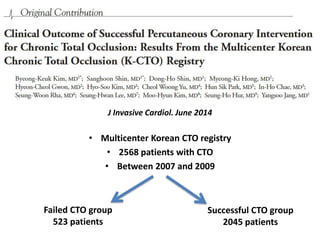
J Invasive Cardiol. June 2014
• Multicenter Korean CTO registry
• 2568 patients with CTO
• Between 2007 and 2009
Successful CTO group
2045 patients
Failed CTO group
523 patients
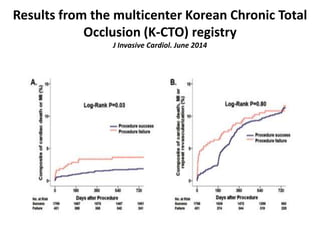
Results from the multicenter Korean Chronic Total
Occlusion (K-CTO) registry
J Invasive Cardiol. June 2014
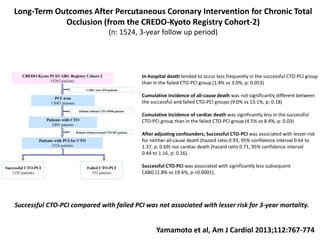
Long-Term Outcomes After Percutaneous Coronary Intervention for Chronic Total
Occlusion (from the CREDO-Kyoto Registry Cohort-2)
(n: 1524, 3-year follow up period)
Yamamoto et al, Am J Cardiol 2013;112:767-774
In-hospital death tended to occur less frequently in the successful CTO-PCI group
than in the failed CTO-PCI group (1.4% vs 3.0%, p: 0.053)
Cumulative incidence of all-cause death was not significantly different between
the successful and failed CTO-PCI groups (9.0% vs 13.1%, p: 0.18)
Cumulative incidence of cardiac death was significantly less in the successful
CTO-PCI group than in the failed CTO-PCI group (4.5% vs 8.4%, p: 0.03)
After adjusting confounders, Successful CTO-PCI was associated with lesser risk
for neither all-cause death (hazard ratio 0.93, 95% confidence interval 0.64 to
1.37, p: 0.69) nor cardiac death (hazard ratio 0.71, 95% confidence interval
0.44 to 1.16, p: 0.16).
Successful CTO-PCI was associated with significantly less subsequent
CABG (1.8% vs 19.6%, p <0.0001).
Successful CTO-PCI compared with failed PCI was not associated with lesser risk for 3-year mortality.
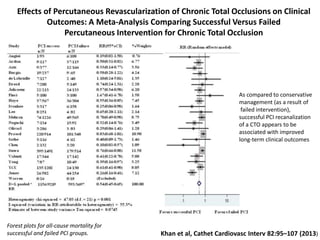
Effects of Percutaneous Revascularization of Chronic Total Occlusions on Clinical
Outcomes: A Meta-Analysis Comparing Successful Versus Failed
Percutaneous Intervention for Chronic Total Occlusion
Khan et al, Cathet Cardiovasc Interv 82:95–107 (2013)
As compared to conservative
management (as a result of
failed intervention),
successful PCI recanalization
of a CTO appears to be
associated with improved
long-term clinical outcomes
Forest plots for all-cause mortality for
successful and failed PCI groups.
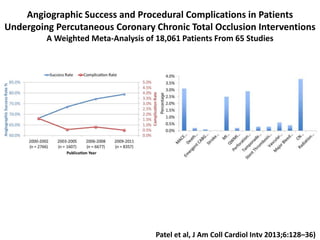
Angiographic Success and Procedural Complications in Patients
Undergoing Percutaneous Coronary Chronic Total Occlusion Interventions
A Weighted Meta-Analysis of 18,061 Patients From 65 Studies
Patel et al, J Am Coll Cardiol Intv 2013;6:128–36)
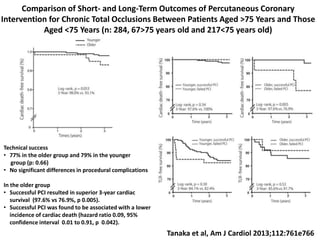
Tanaka et al, Am J Cardiol 2013;112:761e766
Technical success
• 77% in the older group and 79% in the younger
group (p: 0.66)
• No significant differences in procedural complications
In the older group
• Successful PCI resulted in superior 3-year cardiac
survival (97.6% vs 76.9%, p 0.005).
• Successful PCI was found to be associated with a lower
incidence of cardiac death (hazard ratio 0.09, 95%
confidence interval 0.01 to 0.91, p 0.042).
Comparison of Short- and Long-Term Outcomes of Percutaneous Coronary
Intervention for Chronic Total Occlusions Between Patients Aged >75 Years and Those
Aged <75 Years (n: 284, 67>75 years old and 217<75 years old)
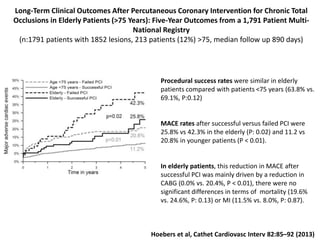
Long-Term Clinical Outcomes After Percutaneous Coronary Intervention for Chronic Total
Occlusions in Elderly Patients (>75 Years): Five-Year Outcomes from a 1,791 Patient Multi-
National Registry
(n:1791 patients with 1852 lesions, 213 patients (12%) >75, median follow up 890 days)
Hoebers et al, Cathet Cardiovasc Interv 82:85–92 (2013)
Procedural success rates were similar in elderly
patients compared with patients <75 years (63.8% vs.
69.1%, P:0.12)
MACE rates after successful versus failed PCI were
25.8% vs 42.3% in the elderly (P: 0.02) and 11.2 vs
20.8% in younger patients (P < 0.01).
In elderly patients, this reduction in MACE after
successful PCI was mainly driven by a reduction in
CABG (0.0% vs. 20.4%, P < 0.01), there were no
significant differences in terms of mortality (19.6%
vs. 24.6%, P: 0.13) or MI (11.5% vs. 8.0%, P: 0.87).
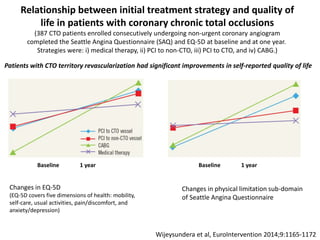
Wijeysundera et al, EuroIntervention 2014;9:1165-1172
Relationship between initial treatment strategy and quality of
life in patients with coronary chronic total occlusions
(387 CTO patients enrolled consecutively undergoing non-urgent coronary angiogram
completed the Seattle Angina Questionnaire (SAQ) and EQ-5D at baseline and at one year.
Strategies were: i) medical therapy, ii) PCI to non-CTO, iii) PCI to CTO, and iv) CABG.)
Changes in EQ-5D
(EQ-5D covers five dimensions of health: mobility,
self-care, usual activities, pain/discomfort, and
anxiety/depression)
Baseline 1 year
Patients with CTO territory revascularization had significant improvements in self-reported quality of life
Changes in physical limitation sub-domain
of Seattle Angina Questionnaire
Baseline 1 year
• Pathology
• Physiology
• Epidemiology
• Outcome Data
• Imaging
• Technical approach
• Stents in CTO
EuroCTO Course 2014: :
Rapid Review of the Recent CTO Literature
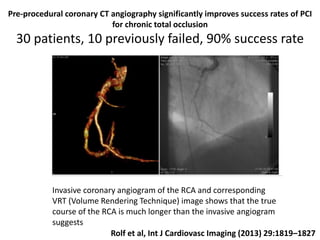
Pre-procedural coronary CT angiography significantly improves success rates of PCI
for chronic total occlusion
30 patients, 10 previously failed, 90% success rate
Rolf et al, Int J Cardiovasc Imaging (2013) 29:1819–1827
Invasive coronary angiogram of the RCA and corresponding
VRT (Volume Rendering Technique) image shows that the true
course of the RCA is much longer than the invasive angiogram
suggests
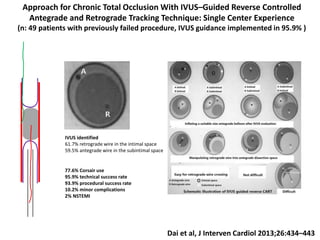
Approach for Chronic Total Occlusion With IVUS–Guided Reverse Controlled
Antegrade and Retrograde Tracking Technique: Single Center Experience
(n: 49 patients with previously failed procedure, IVUS guidance implemented in 95.9% )
Dai et al, J Interven Cardiol 2013;26:434–443
IVUS identified
61.7% retrograde wire in the intimal space
59.5% antegrade wire in the subintimal space
77.6% Corsair use
95.9% technical success rate
93.9% procedural success rate
10.2% minor complications
2% NSTEMI
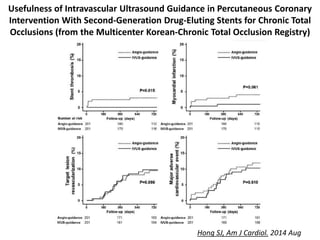
Usefulness of Intravascular Ultrasound Guidance in Percutaneous Coronary
Intervention With Second-Generation Drug-Eluting Stents for Chronic Total
Occlusions (from the Multicenter Korean-Chronic Total Occlusion Registry)
Hong SJ, Am J Cardiol. 2014 Aug
• Pathology
• Physiology
• Epidemiology
• Outcome Data
• Imaging
• Technical approach
• Stents in CTO
EuroCTO Course 2014: :
Rapid Review of the Recent CTO Literature
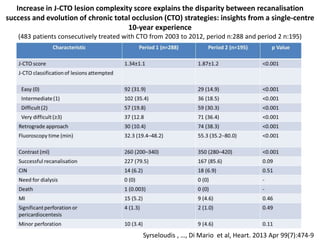
Increase in J-CTO lesion complexity score explains the disparity between recanalisation
success and evolution of chronic total occlusion (CTO) strategies: insights from a single-centre
10-year experience
(483 patients consecutively treated with CTO from 2003 to 2012, period n:288 and period 2 n:195)
Syrseloudis , …, Di Mario et al, Heart. 2013 Apr 99(7):474-9
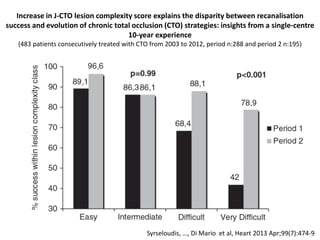
Increase in J-CTO lesion complexity score explains the disparity between recanalisation
success and evolution of chronic total occlusion (CTO) strategies: insights from a single-centre
10-year experience
(483 patients consecutively treated with CTO from 2003 to 2012, period n:288 and period 2 n:195)
Syrseloudis, …, Di Mario et al, Heart 2013 Apr;99(7):474-9
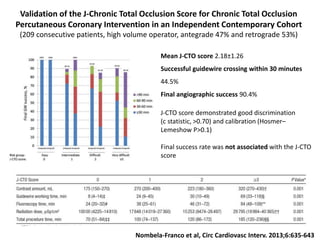
Validation of the J-Chronic Total Occlusion Score for Chronic Total Occlusion
Percutaneous Coronary Intervention in an Independent Contemporary Cohort
(209 consecutive patients, high volume operator, antegrade 47% and retrograde 53%)
Nombela-Franco et al, Circ Cardiovasc Interv. 2013;6:635-643
Mean J-CTO score 2.18±1.26
Successful guidewire crossing within 30 minutes
44.5%
Final angiographic success 90.4%
J-CTO score demonstrated good discrimination
(c statistic, >0.70) and calibration (Hosmer–
Lemeshow P>0.1)
Final success rate was not associated with the J-CTO
score
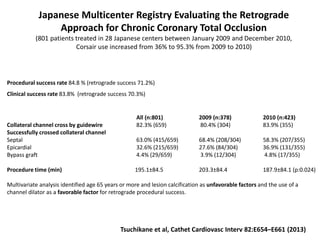
Japanese Multicenter Registry Evaluating the Retrograde
Approach for Chronic Coronary Total Occlusion
(801 patients treated in 28 Japanese centers between January 2009 and December 2010,
Corsair use increased from 36% to 95.3% from 2009 to 2010)
Tsuchikane et al, Cathet Cardiovasc Interv 82:E654–E661 (2013)
Procedural success rate 84.8 % (retrograde success 71.2%)
Clinical success rate 83.8% (retrograde success 70.3%)
All (n:801) 2009 (n:378) 2010 (n:423)
Collateral channel cross by guidewire 82.3% (659) 80.4% (304) 83.9% (355)
Successfully crossed collateral channel
Septal 63.0% (415/659) 68.4% (208/304) 58.3% (207/355)
Epicardial 32.6% (215/659) 27.6% (84/304) 36.9% (131/355)
Bypass graft 4.4% (29/659) 3.9% (12/304) 4.8% (17/355)
Procedure time (min) 195.1±84.5 203.3±84.4 187.9±84.1 (p:0.024)
Multivariate analysis identified age 65 years or more and lesion calcification as unfavorable factors and the use of a
channel dilator as a favorable factor for retrograde procedural success.
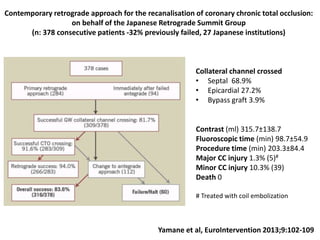
Contemporary retrograde approach for the recanalisation of coronary chronic total occlusion:
on behalf of the Japanese Retrograde Summit Group
(n: 378 consecutive patients -32% previously failed, 27 Japanese institutions)
Yamane et al, EuroIntervention 2013;9:102-109
Collateral channel crossed
• Septal 68.9%
• Epicardial 27.2%
• Bypass graft 3.9%
Contrast (ml) 315.7±138.7
Fluoroscopic time (min) 98.7±54.9
Procedure time (min) 203.3±84.4
Major CC injury 1.3% (5)#
Minor CC injury 10.3% (39)
Death 0
# Treated with coil embolization
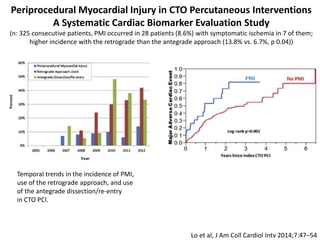
Periprocedural Myocardial Injury in CTO Percutaneous Interventions
A Systematic Cardiac Biomarker Evaluation Study
(n: 325 consecutive patients, PMI occurred in 28 patients (8.6%) with symptomatic ischemia in 7 of them;
higher incidence with the retrograde than the antegrade approach (13.8% vs. 6.7%, p 0.04))
Lo et al, J Am Coll Cardiol Intv 2014;7:47–54
Temporal trends in the incidence of PMI,
use of the retrograde approach, and use
of the antegrade dissection/re-entry
in CTO PCI.
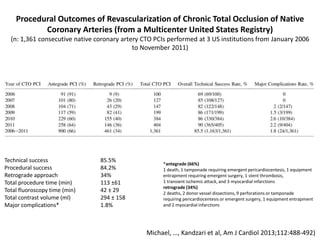
Procedural Outcomes of Revascularization of Chronic Total Occlusion of Native
Coronary Arteries (from a Multicenter United States Registry)
(n: 1,361 consecutive native coronary artery CTO PCIs performed at 3 US institutions from January 2006
to November 2011)
Michael, …, Kandzari et al, Am J Cardiol 2013;112:488-492)
Technical success 85.5%
Procedural success 84.2%
Retrograde approach 34%
Total procedure time (min) 113 ±61
Total fluoroscopy time (min) 42 ± 29
Total contrast volume (ml) 294 ± 158
Major complications* 1.8%
*antegrade (66%)
1 death, 1 tamponade requiring emergent pericardiocentesis, 1 equipment
entrapment requiring emergent surgery, 1 stent thrombosis,
1 transient ischemic attack, and 3 myocardial infarctions
retrograde (34%)
2 deaths, 2 donor vessel dissections, 9 perforations or tamponade
requiring pericardiocentesis or emergent surgery, 1 equipment entrapment
and 2 myocardial infarctions
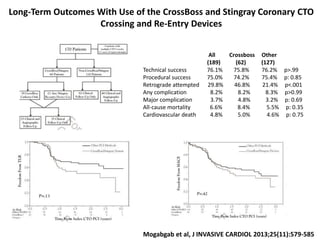
Long-Term Outcomes With Use of the CrossBoss and Stingray Coronary CTO
Crossing and Re-Entry Devices
Mogabgab et al, J INVASIVE CARDIOL 2013;25(11):579-585
All Crossboss Other
(189) (62) (127)
Technical success 76.1% 75.8% 76.2% p>.99
Procedural success 75.0% 74.2% 75.4% p: 0.85
Retrograde attempted 29.8% 46.8% 21.4% p<.001
Any complication 8.2% 8.2% 8.3% p>0.99
Major complication 3.7% 4.8% 3.2% p: 0.69
All-cause mortality 6.6% 8.4% 5.5% p: 0.35
Cardiovascular death 4.8% 5.0% 4.6% p: 0.75
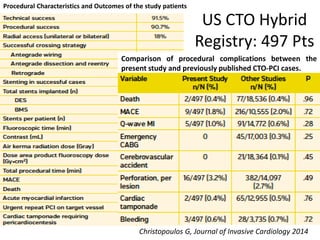
US CTO Hybrid
Registry: 497 Pts
Christopoulos G, Journal of Invasive Cardiology 2014
Procedural Characteristics and Outcomes of the study patients
Comparison of procedural complications between the
present study and previously published CTO-PCI cases.
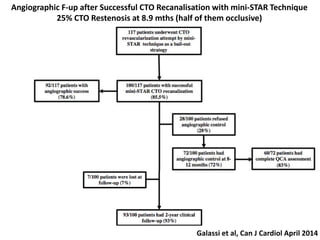
Angiographic F-up after Successful CTO Recanalisation with mini-STAR Technique
25% CTO Restenosis at 8.9 mths (half of them occlusive)
Galassi et al, Can J Cardiol April 2014
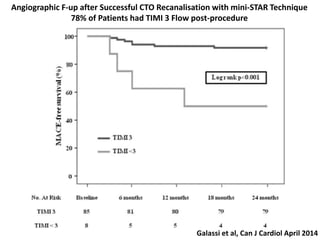
Angiographic F-up after Successful CTO Recanalisation with mini-STAR Technique
78% of Patients had TIMI 3 Flow post-procedure
Galassi et al, Can J Cardiol April 2014
• Pathology
• Physiology
• Epidemiology
• Outcome Data
• Imaging
• Technical approach
• Stents in CTO
EuroCTO Course 2014: :
Rapid Review of the Recent CTO Literature
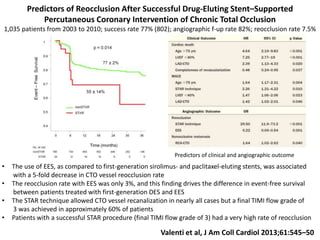
Predictors of Reocclusion After Successful Drug-Eluting Stent–Supported
Percutaneous Coronary Intervention of Chronic Total Occlusion
1,035 patients from 2003 to 2010; success rate 77% (802); angiographic f-up rate 82%; reocclusion rate 7.5%
Valenti et al, J Am Coll Cardiol 2013;61:545–50
Predictors of clinical and angiographic outcome
• The use of EES, as compared to first-generation sirolimus- and paclitaxel-eluting stents, was associated
with a 5-fold decrease in CTO vessel reocclusion rate
• The reocclusion rate with EES was only 3%, and this finding drives the difference in event-free survival
between patients treated with first-generation DES and EES
• The STAR technique allowed CTO vessel recanalization in nearly all cases but a final TIMI flow grade of
3 was achieved in approximately 60% of patients
• Patients with a successful STAR procedure (final TIMI flow grade of 3) had a very high rate of reocclusion
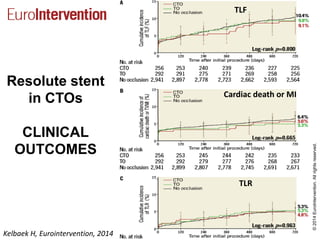
©2014EuroIntervention.Allrightsreserved.
Resolute stent
in CTOs
CLINICAL
OUTCOMES
Kelbaek H, Eurointervention, 2014
TLF
Cardiac death or MI
TLR
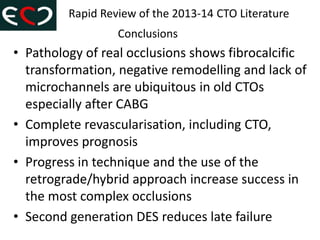
• Pathology of real occlusions shows fibrocalcific
transformation, negative remodelling and lack of
microchannels are ubiquitous in old CTOs
especially after CABG
• Complete revascularisation, including CTO,
improves prognosis
• Progress in technique and the use of the
retrograde/hybrid approach increase success in
the most complex occlusions
• Second generation DES reduces late failure
Rapid Review of the 2013-14 CTO Literature
Conclusions

08:25 Di Mario - Recent Pubblications and Research

  • 1.
    Recent Publications &Research in CTO: 2013-14 Carlo Di Mario, MD, FACC, FRCP Ismail Dogu Kilic, MD Gianluca Caiazzo, MD Nikolaos Konstantinidis, MD
  • 2.
    CTO published literature,2013 original papers case reports reviews, editorials 54 15 5 0 20 40 60 80 2007 2008 2009 2010 2011 2012 2013 37 49 45 54 58 62 54
  • 3.
    • Pathology • Physiology •Epidemiology • Outcome Data • Imaging • Technical approach • Stents in CTO EuroCTO Course 2014: Rapid Review of the Recent CTO Literature
  • 4.
    Sakamura, …, Virmaniet al, Eur Heart J. 2013 Oct 14 Comparison of pathology of chronic total occlusion with and without coronary artery bypass graft 95 CTOs from 82 patients were divided into CTO with CABG(n:34) ,CTO without CABG—of long-duration (n:49) and short-duration (n:12); histopathological comparison of the plaque characteristics of CTO, proximal and distal lumen morphology, and negative remodeling between groups; a total of 1127 sections were evaluated Representative images of long-duration CTO and short- duration CTO Differences in plaque characteristics • necrotic core area was highest in SD CTO (18.6%) (LD-CTO: 7.8%; CTO+CABG: 4.5%; P ¼ 0.02) • calcified area was greatest in CTO+CABG (29.2%) (LD-CTO: 16.8%; SD-CTO: 12.1%; P ¼ 0.009); • negative remodeling was least in SD-CTO [remodeling index (RI) 0.86] [CTO+CABG (RI): 0.72 and LD-CTO (RI): 0.68; P , 0.001] • Approximately 50% of proximal lumens showed characteristics of abrupt closure • the majority of distal lumen patterns were tapered(79%) (P , 0.0001).
  • 5.
    • Pathology • Physiology •Epidemiology • Outcome Data • Imaging • Technical approach • Stents in CTO New York CTO/LM Course: Rapid Review of the Recent CTO Literature
  • 6.
    Reversal of Ischemiaof Donor Artery Myocardium After Recanalization of a Chronic Total Occlusion Consecutive series of patients with severe angina in which a donor artery with intermediate stenosis (30–70%) had FFR measurements before and after successful CTO PCI Sachdeva, .., Uretzki et al, Cathet Cardiovasc Intervent 82:E453–E458 (2013) 9 donor arteries with ischemic FFR pre-PCI 6 reverted to non-ischemic (FFR pre- PCI 0.76 and 0.86 post-PCI) 5 patients had normal FFR in the donor artery pre- and post-CTO PCI Recanalizing the CTO first might avoid the need for PCI to the donor artery or MV CABG.
  • 7.
    • Pathology • Physiology •Epidemiology • Outcome Data • Imaging • Technical approach • Stents in CTO EuroCTO Course 2014: : Rapid Review of the Recent CTO Literature
  • 8.
    Chronic Total Occlusionsin Sweden –Swedish Coronary Angiography and Angioplasty Registry (SCAAR) Ramunddal T, Plos One, Aug 2014 Stable CAD 45% ACS/NSTEM I 28% STEMI 14% Other 13% Sales Indications for Angiography 1 Vessel 20% 2 Vessel 35% 3 Vessel 36% LM 9% Sales Extent of CAD  CTO in 10.6% of angiographies in 126,745 patients  CTO in 16.0 of 91,154 angiographies in pts with >50% CAD  Decrease of prevalence of CTO in pts with significant CAD from 17.2% in 2005 to 15.1% in 2012, p<0.001  Male 77.5%; median age 68 (IQR 60-76) years; diabetes 23.9%; previous MI 37.2%
  • 9.
    Ramunddal T, PlosOne, Aug 2014 Coronary location of CTO at angiography Annual number of coronary angiograms
  • 10.
    Prevalence and Managementof Coronary Chronic Total Occlusions in a Tertiary Veterans Affairs Hospital 1,699 patients who underwent angiography between Jan 2011 and Dec 2012; 20% did not have CAD, 20% had CAD and prior CABG, and 60% had CAD but no prior CABG Jeroudi et al, Cathet Cardiovasc Intervent (2013) CTO prevalence • 31% in patients without prior CABG • 89% in patients with prior CABG CTO PCI was performed in • 30% of patients without prior CABG • 15% of patients with prior CABG Technical success • 82% of patients without prior CABG • 75% of patients with prior CABG Procedural success • 80% of patients without prior CABG • 73% of patients with prior CABG CTO pts had more co-morbidities, more extensive CAD and were more frequently referred for CABG.
  • 11.
    • Pathology • Physiology •Epidemiology • Outcome Data • Imaging • Technical approach • Stents in CTO EuroCTO Course 2014: : Rapid Review of the Recent CTO Literature
  • 12.
    Impact of chronictotal occlusion artery on 12-month mortality in patients with non STEMI treated by PCI (From the PL-ACS Registry) 925 pts, 438 (47.4%) with CTO of a major non-IRA coronary artery Gierlotka et al, Internat J Cardiol 168 (2013) 250–254
  • 13.
    The Negative Impactof Incomplete Angiographic Revascularization on Clinical Outcomes and Its Association With Total Occlusions The SYNTAX (Synergy Between Percutaneous Coronary Intervention with Taxus and Cardiac Surgery) Trial Farooq et al, J Am Coll Cardiol 2013;61:282–94
  • 14.
    2005-09 BCIS PCIDatabase 13,443 patients (78.8% male) 14,439 CTO procedures Follow-up of 2.65 years CTO PCI was successful in 10,199 cases (70.6%)
  • 15.
    Survival and CTOSuccess • Successful PCI of at least 1 CTO was associated with improved survival (hazard ratio [HR]: 0.72; 95% CI: 0.62 to 0.83; p < 0.001) Sudhakar et al. J Am Coll Cardiol. 2014;64:235-243
  • 16.
    J Invasive Cardiol.June 2014 • Multicenter Korean CTO registry • 2568 patients with CTO • Between 2007 and 2009 Successful CTO group 2045 patients Failed CTO group 523 patients
  • 17.
    Results from themulticenter Korean Chronic Total Occlusion (K-CTO) registry J Invasive Cardiol. June 2014
  • 18.
    Long-Term Outcomes AfterPercutaneous Coronary Intervention for Chronic Total Occlusion (from the CREDO-Kyoto Registry Cohort-2) (n: 1524, 3-year follow up period) Yamamoto et al, Am J Cardiol 2013;112:767-774 In-hospital death tended to occur less frequently in the successful CTO-PCI group than in the failed CTO-PCI group (1.4% vs 3.0%, p: 0.053) Cumulative incidence of all-cause death was not significantly different between the successful and failed CTO-PCI groups (9.0% vs 13.1%, p: 0.18) Cumulative incidence of cardiac death was significantly less in the successful CTO-PCI group than in the failed CTO-PCI group (4.5% vs 8.4%, p: 0.03) After adjusting confounders, Successful CTO-PCI was associated with lesser risk for neither all-cause death (hazard ratio 0.93, 95% confidence interval 0.64 to 1.37, p: 0.69) nor cardiac death (hazard ratio 0.71, 95% confidence interval 0.44 to 1.16, p: 0.16). Successful CTO-PCI was associated with significantly less subsequent CABG (1.8% vs 19.6%, p <0.0001). Successful CTO-PCI compared with failed PCI was not associated with lesser risk for 3-year mortality.
  • 19.
    Effects of PercutaneousRevascularization of Chronic Total Occlusions on Clinical Outcomes: A Meta-Analysis Comparing Successful Versus Failed Percutaneous Intervention for Chronic Total Occlusion Khan et al, Cathet Cardiovasc Interv 82:95–107 (2013) As compared to conservative management (as a result of failed intervention), successful PCI recanalization of a CTO appears to be associated with improved long-term clinical outcomes Forest plots for all-cause mortality for successful and failed PCI groups.
  • 20.
    Angiographic Success andProcedural Complications in Patients Undergoing Percutaneous Coronary Chronic Total Occlusion Interventions A Weighted Meta-Analysis of 18,061 Patients From 65 Studies Patel et al, J Am Coll Cardiol Intv 2013;6:128–36)
  • 21.
    Tanaka et al,Am J Cardiol 2013;112:761e766 Technical success • 77% in the older group and 79% in the younger group (p: 0.66) • No significant differences in procedural complications In the older group • Successful PCI resulted in superior 3-year cardiac survival (97.6% vs 76.9%, p 0.005). • Successful PCI was found to be associated with a lower incidence of cardiac death (hazard ratio 0.09, 95% confidence interval 0.01 to 0.91, p 0.042). Comparison of Short- and Long-Term Outcomes of Percutaneous Coronary Intervention for Chronic Total Occlusions Between Patients Aged >75 Years and Those Aged <75 Years (n: 284, 67>75 years old and 217<75 years old)
  • 22.
    Long-Term Clinical OutcomesAfter Percutaneous Coronary Intervention for Chronic Total Occlusions in Elderly Patients (>75 Years): Five-Year Outcomes from a 1,791 Patient Multi- National Registry (n:1791 patients with 1852 lesions, 213 patients (12%) >75, median follow up 890 days) Hoebers et al, Cathet Cardiovasc Interv 82:85–92 (2013) Procedural success rates were similar in elderly patients compared with patients <75 years (63.8% vs. 69.1%, P:0.12) MACE rates after successful versus failed PCI were 25.8% vs 42.3% in the elderly (P: 0.02) and 11.2 vs 20.8% in younger patients (P < 0.01). In elderly patients, this reduction in MACE after successful PCI was mainly driven by a reduction in CABG (0.0% vs. 20.4%, P < 0.01), there were no significant differences in terms of mortality (19.6% vs. 24.6%, P: 0.13) or MI (11.5% vs. 8.0%, P: 0.87).
  • 23.
    Wijeysundera et al,EuroIntervention 2014;9:1165-1172 Relationship between initial treatment strategy and quality of life in patients with coronary chronic total occlusions (387 CTO patients enrolled consecutively undergoing non-urgent coronary angiogram completed the Seattle Angina Questionnaire (SAQ) and EQ-5D at baseline and at one year. Strategies were: i) medical therapy, ii) PCI to non-CTO, iii) PCI to CTO, and iv) CABG.) Changes in EQ-5D (EQ-5D covers five dimensions of health: mobility, self-care, usual activities, pain/discomfort, and anxiety/depression) Baseline 1 year Patients with CTO territory revascularization had significant improvements in self-reported quality of life Changes in physical limitation sub-domain of Seattle Angina Questionnaire Baseline 1 year
  • 24.
    • Pathology • Physiology •Epidemiology • Outcome Data • Imaging • Technical approach • Stents in CTO EuroCTO Course 2014: : Rapid Review of the Recent CTO Literature
  • 25.
    Pre-procedural coronary CTangiography significantly improves success rates of PCI for chronic total occlusion 30 patients, 10 previously failed, 90% success rate Rolf et al, Int J Cardiovasc Imaging (2013) 29:1819–1827 Invasive coronary angiogram of the RCA and corresponding VRT (Volume Rendering Technique) image shows that the true course of the RCA is much longer than the invasive angiogram suggests
  • 26.
    Approach for ChronicTotal Occlusion With IVUS–Guided Reverse Controlled Antegrade and Retrograde Tracking Technique: Single Center Experience (n: 49 patients with previously failed procedure, IVUS guidance implemented in 95.9% ) Dai et al, J Interven Cardiol 2013;26:434–443 IVUS identified 61.7% retrograde wire in the intimal space 59.5% antegrade wire in the subintimal space 77.6% Corsair use 95.9% technical success rate 93.9% procedural success rate 10.2% minor complications 2% NSTEMI
  • 27.
    Usefulness of IntravascularUltrasound Guidance in Percutaneous Coronary Intervention With Second-Generation Drug-Eluting Stents for Chronic Total Occlusions (from the Multicenter Korean-Chronic Total Occlusion Registry) Hong SJ, Am J Cardiol. 2014 Aug
  • 28.
    • Pathology • Physiology •Epidemiology • Outcome Data • Imaging • Technical approach • Stents in CTO EuroCTO Course 2014: : Rapid Review of the Recent CTO Literature
  • 29.
    Increase in J-CTOlesion complexity score explains the disparity between recanalisation success and evolution of chronic total occlusion (CTO) strategies: insights from a single-centre 10-year experience (483 patients consecutively treated with CTO from 2003 to 2012, period n:288 and period 2 n:195) Syrseloudis , …, Di Mario et al, Heart. 2013 Apr 99(7):474-9
  • 30.
    Increase in J-CTOlesion complexity score explains the disparity between recanalisation success and evolution of chronic total occlusion (CTO) strategies: insights from a single-centre 10-year experience (483 patients consecutively treated with CTO from 2003 to 2012, period n:288 and period 2 n:195) Syrseloudis, …, Di Mario et al, Heart 2013 Apr;99(7):474-9
  • 31.
    Validation of theJ-Chronic Total Occlusion Score for Chronic Total Occlusion Percutaneous Coronary Intervention in an Independent Contemporary Cohort (209 consecutive patients, high volume operator, antegrade 47% and retrograde 53%) Nombela-Franco et al, Circ Cardiovasc Interv. 2013;6:635-643 Mean J-CTO score 2.18±1.26 Successful guidewire crossing within 30 minutes 44.5% Final angiographic success 90.4% J-CTO score demonstrated good discrimination (c statistic, >0.70) and calibration (Hosmer– Lemeshow P>0.1) Final success rate was not associated with the J-CTO score
  • 32.
    Japanese Multicenter RegistryEvaluating the Retrograde Approach for Chronic Coronary Total Occlusion (801 patients treated in 28 Japanese centers between January 2009 and December 2010, Corsair use increased from 36% to 95.3% from 2009 to 2010) Tsuchikane et al, Cathet Cardiovasc Interv 82:E654–E661 (2013) Procedural success rate 84.8 % (retrograde success 71.2%) Clinical success rate 83.8% (retrograde success 70.3%) All (n:801) 2009 (n:378) 2010 (n:423) Collateral channel cross by guidewire 82.3% (659) 80.4% (304) 83.9% (355) Successfully crossed collateral channel Septal 63.0% (415/659) 68.4% (208/304) 58.3% (207/355) Epicardial 32.6% (215/659) 27.6% (84/304) 36.9% (131/355) Bypass graft 4.4% (29/659) 3.9% (12/304) 4.8% (17/355) Procedure time (min) 195.1±84.5 203.3±84.4 187.9±84.1 (p:0.024) Multivariate analysis identified age 65 years or more and lesion calcification as unfavorable factors and the use of a channel dilator as a favorable factor for retrograde procedural success.
  • 33.
    Contemporary retrograde approachfor the recanalisation of coronary chronic total occlusion: on behalf of the Japanese Retrograde Summit Group (n: 378 consecutive patients -32% previously failed, 27 Japanese institutions) Yamane et al, EuroIntervention 2013;9:102-109 Collateral channel crossed • Septal 68.9% • Epicardial 27.2% • Bypass graft 3.9% Contrast (ml) 315.7±138.7 Fluoroscopic time (min) 98.7±54.9 Procedure time (min) 203.3±84.4 Major CC injury 1.3% (5)# Minor CC injury 10.3% (39) Death 0 # Treated with coil embolization
  • 34.
    Periprocedural Myocardial Injuryin CTO Percutaneous Interventions A Systematic Cardiac Biomarker Evaluation Study (n: 325 consecutive patients, PMI occurred in 28 patients (8.6%) with symptomatic ischemia in 7 of them; higher incidence with the retrograde than the antegrade approach (13.8% vs. 6.7%, p 0.04)) Lo et al, J Am Coll Cardiol Intv 2014;7:47–54 Temporal trends in the incidence of PMI, use of the retrograde approach, and use of the antegrade dissection/re-entry in CTO PCI.
  • 35.
    Procedural Outcomes ofRevascularization of Chronic Total Occlusion of Native Coronary Arteries (from a Multicenter United States Registry) (n: 1,361 consecutive native coronary artery CTO PCIs performed at 3 US institutions from January 2006 to November 2011) Michael, …, Kandzari et al, Am J Cardiol 2013;112:488-492) Technical success 85.5% Procedural success 84.2% Retrograde approach 34% Total procedure time (min) 113 ±61 Total fluoroscopy time (min) 42 ± 29 Total contrast volume (ml) 294 ± 158 Major complications* 1.8% *antegrade (66%) 1 death, 1 tamponade requiring emergent pericardiocentesis, 1 equipment entrapment requiring emergent surgery, 1 stent thrombosis, 1 transient ischemic attack, and 3 myocardial infarctions retrograde (34%) 2 deaths, 2 donor vessel dissections, 9 perforations or tamponade requiring pericardiocentesis or emergent surgery, 1 equipment entrapment and 2 myocardial infarctions
  • 36.
    Long-Term Outcomes WithUse of the CrossBoss and Stingray Coronary CTO Crossing and Re-Entry Devices Mogabgab et al, J INVASIVE CARDIOL 2013;25(11):579-585 All Crossboss Other (189) (62) (127) Technical success 76.1% 75.8% 76.2% p>.99 Procedural success 75.0% 74.2% 75.4% p: 0.85 Retrograde attempted 29.8% 46.8% 21.4% p<.001 Any complication 8.2% 8.2% 8.3% p>0.99 Major complication 3.7% 4.8% 3.2% p: 0.69 All-cause mortality 6.6% 8.4% 5.5% p: 0.35 Cardiovascular death 4.8% 5.0% 4.6% p: 0.75
  • 37.
    US CTO Hybrid Registry:497 Pts Christopoulos G, Journal of Invasive Cardiology 2014 Procedural Characteristics and Outcomes of the study patients Comparison of procedural complications between the present study and previously published CTO-PCI cases.
  • 38.
    Angiographic F-up afterSuccessful CTO Recanalisation with mini-STAR Technique 25% CTO Restenosis at 8.9 mths (half of them occlusive) Galassi et al, Can J Cardiol April 2014
  • 39.
    Angiographic F-up afterSuccessful CTO Recanalisation with mini-STAR Technique 78% of Patients had TIMI 3 Flow post-procedure Galassi et al, Can J Cardiol April 2014
  • 40.
    • Pathology • Physiology •Epidemiology • Outcome Data • Imaging • Technical approach • Stents in CTO EuroCTO Course 2014: : Rapid Review of the Recent CTO Literature
  • 41.
    Predictors of ReocclusionAfter Successful Drug-Eluting Stent–Supported Percutaneous Coronary Intervention of Chronic Total Occlusion 1,035 patients from 2003 to 2010; success rate 77% (802); angiographic f-up rate 82%; reocclusion rate 7.5% Valenti et al, J Am Coll Cardiol 2013;61:545–50 Predictors of clinical and angiographic outcome • The use of EES, as compared to first-generation sirolimus- and paclitaxel-eluting stents, was associated with a 5-fold decrease in CTO vessel reocclusion rate • The reocclusion rate with EES was only 3%, and this finding drives the difference in event-free survival between patients treated with first-generation DES and EES • The STAR technique allowed CTO vessel recanalization in nearly all cases but a final TIMI flow grade of 3 was achieved in approximately 60% of patients • Patients with a successful STAR procedure (final TIMI flow grade of 3) had a very high rate of reocclusion
  • 42.
  • 43.
    • Pathology ofreal occlusions shows fibrocalcific transformation, negative remodelling and lack of microchannels are ubiquitous in old CTOs especially after CABG • Complete revascularisation, including CTO, improves prognosis • Progress in technique and the use of the retrograde/hybrid approach increase success in the most complex occlusions • Second generation DES reduces late failure Rapid Review of the 2013-14 CTO Literature Conclusions

Editor's Notes

  • #3 Original papers AND experimental research together (collagenases eurointervention)
  • #15 In-hospital mortality for the +CTO and −CTO patients was 5.3% and 2.1%, respectively (p=0.009) 12-month mortality for the +CTO and −CTO was 21.1% and 11.9%, respectively (p=0.0001).
  • #47 US multicenter registry, showing technical success and complication rates rising hand in hand with the rise in retrograde CTO PCI percentage over the total CTO PCI number
  • #52 Not found average risk
  • #53 Not found average risk
  • #64 Procedural costs do not exceed reimbursement (contribution margin)