IS Audit and
Internal Controls
BHARATH RAO
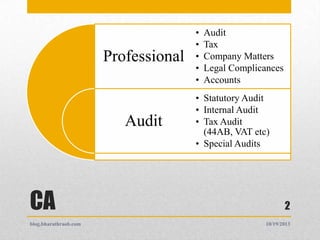
Professional

Audit

CA
blog.bharathraob.com

•
•
•
•
•

Audit
Tax
Company Matters
Legal Complicances
Accounts

• Statutory Audit
• Internal Audit
• Tax Audit
(44AB, VAT etc)
• Special Audits

2
10/19/2013
•
•
•
•
•
•

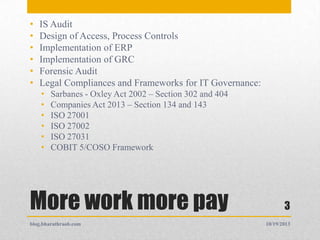
IS Audit
Design of Access, Process Controls
Implementation of ERP
Implementation of GRC
Forensic Audit
Legal Compliances and Frameworks for IT Governance:
•
•
•
•
•
•

Sarbanes - Oxley Act 2002 – Section 302 and 404
Companies Act 2013 – Section 134 and 143
ISO 27001
ISO 27002
ISO 27031
COBIT 5/COSO Framework

More work more pay
blog.bharathraob.com

3
10/19/2013
Risk

Terms
blog.bharathraob.com

4
10/19/2013
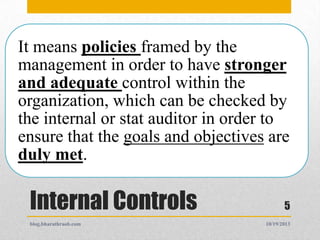
It means policies framed by the
management in order to have stronger
and adequate control within the
organization, which can be checked by
the internal or stat auditor in order to
ensure that the goals and objectives are
duly met.

Internal Controls
blog.bharathraob.com

5
10/19/2013
Control
Environment

Risk
Assessment

Information
and
Communication

Control
Activities

Monitoring

Components of Internal
Controls
blog.bharathraob.com

6
10/19/2013
General
Controls

IS
Controls

Formula of Internal
Control
blog.bharathraob.com

Internal
Controls

7
10/19/2013
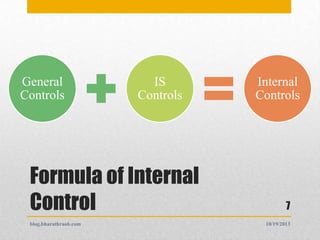
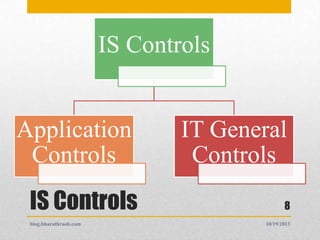
IS Controls

Application
Controls
IS Controls
blog.bharathraob.com

IT General
Controls
8
10/19/2013
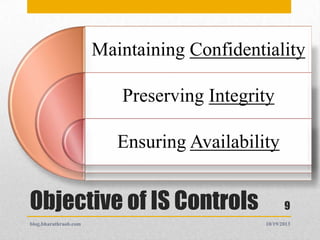
Maintaining Confidentiality
Preserving Integrity

Ensuring Availability

Objective of IS Controls
blog.bharathraob.com

9
10/19/2013
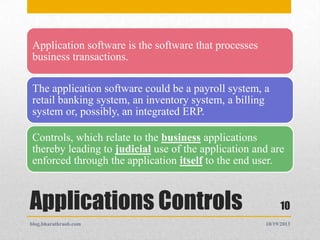
Application software is the software that processes
business transactions.

The application software could be a payroll system, a
retail banking system, an inventory system, a billing
system or, possibly, an integrated ERP.
Controls, which relate to the business applications
thereby leading to judicial use of the application and are
enforced through the application itself to the end user.

Applications Controls
blog.bharathraob.com

10
10/19/2013
•
•
•
•
•
•
•

General Ledger
Fixed Assets
Inventory Control
Sales
Manufacturing Resource Planning (MRP)
Human Resources
And, everyone’s favorite – Payroll…

Examples of Applications
blog.bharathraob.com

11
10/19/2013
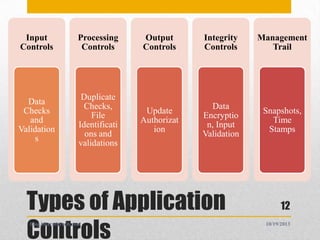
Input
Controls

Processing
Controls

Output
Controls

Integrity
Controls

Management
Trail

Data
Checks
and
Validation
s

Duplicate
Checks,
File
Identificati
ons and
validations

Update
Authorizat
ion

Data
Encryptio
n, Input
Validation

Snapshots,
Time
Stamps

Types of Application
Controls
blog.bharathraob.com

12
10/19/2013
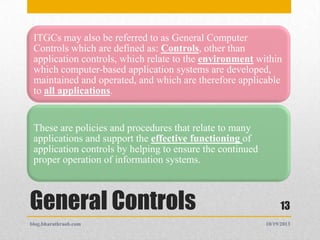
ITGCs may also be referred to as General Computer
Controls which are defined as: Controls, other than
application controls, which relate to the environment within
which computer-based application systems are developed,
maintained and operated, and which are therefore applicable
to all applications.

These are policies and procedures that relate to many
applications and support the effective functioning of
application controls by helping to ensure the continued
proper operation of information systems.

General Controls
blog.bharathraob.com

13
10/19/2013
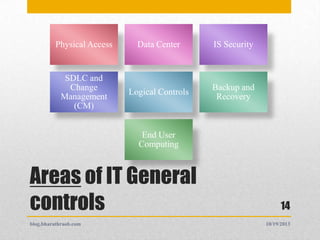
Physical Access

Data Center

IS Security

SDLC and
Change
Management
(CM)

Logical Controls

Backup and
Recovery

End User
Computing

Areas of IT General
controls
blog.bharathraob.com

14
10/19/2013
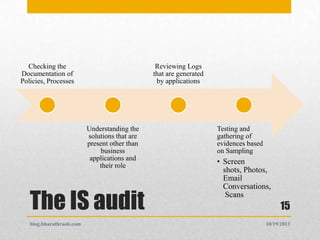
Checking the
Documentation of
Policies, Processes

Reviewing Logs
that are generated
by applications

Understanding the
solutions that are
present other than
business
applications and
their role

The IS audit
blog.bharathraob.com

Testing and
gathering of
evidences based
on Sampling

• Screen
shots, Photos,
Email
Conversations,
Scans

15
10/19/2013
• Link

RCM – Risk control matrix
blog.bharathraob.com

16
10/19/2013
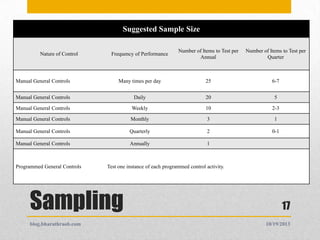
Suggested Sample Size
Frequency of Performance

Number of Items to Test per
Annual

Number of Items to Test per
Quarter

Manual General Controls

Many times per day

25

6-7

Manual General Controls

Daily

20

5

Manual General Controls

Weekly

10

2-3

Manual General Controls

Monthly

3

1

Manual General Controls

Quarterly

2

0-1

Manual General Controls

Annually

1

Nature of Control

Programmed General Controls

Test one instance of each programmed control activity.

Sampling
blog.bharathraob.com

17
10/19/2013
• BHARATH RAO B
• +91 96113 19421 | bharath@bharathraob.com
• www.bharathraob.com
blog.bharathraob.com
/bharathraob

Thank you
blog.bharathraob.com

18
10/19/2013

IS Audit and Internal Controls

Editor's Notes

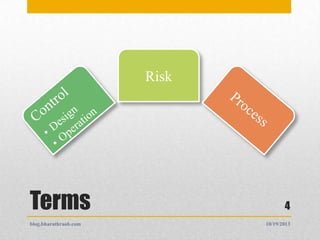
  • #5 Control: It literally means Internal Controls that is present in an business environment. It can be IT Controls or non IT Controls.Design: It refers to the working part of the control which is a summary on paper/blue print. Basically a working model of the control on paper.Operation: Actual performance of the Control is assessed here.Risk: It is the rate at which there is a threat to the business which has arisen from a specific happening/non happening.Process: A set of tasks make a work flow. A set of work flows make a process. A process is controlled by a “Process owner” or “ Function head”. Eg. HR Process, Procurement Process
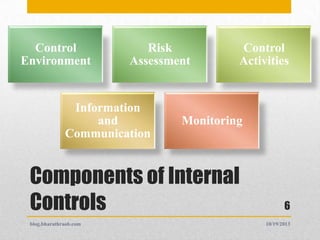
  • #7 Control Environment The control environment sets the tone of an organization, influencing the control consciousness of its people. It is the foundation for all other components of internal control, providing discipline and structure. Control environment factors include the integrity, ethical values and competence of the entity's people; management's philosophy and operating style; the way management assigns authority and responsibility, and organizes and develops its people; and the attention and direction provided by the board of directors. Risk Assessment Every entity faces a variety of risks from external and internal sources that must be assessed. A precondition to risk assessment is establishment of objectives, linked at different levels and internally consistent. Risk assessment is the identification and analysis of relevant risks to achievement of the objectives, forming a basis for determining how the risks should be managed. Because economic, industry, regulatory and operating conditions will continue to change, mechanisms are needed to identify and deal with the special risks associated with change. Control Activities Control activities are the policies and procedures that help ensure management directives are carried out. They help ensure that necessary actions are taken to address risks to achievement of the entity's objectives. Control activities occur throughout the organization, at all levels and in all functions. They include a range of activities as diverse as approvals, authorizations, verifications, reconciliations, reviews of operating performance, security of assets and segregation of duties. Information and Communication Pertinent information must be identified, captured and communicated in a form and timeframe that enable people to carry out their responsibilities. Information systems produce reports, containing operational, financial and compliance-related information, that make it possible to run and control the business. They deal not only with internally generated data, but also information about external events, activities and conditions necessary to informed business decision-making and external reporting. Effective communication also must occur in a broader sense, flowing down, across and up the organization. All personnel must receive a clear message from top management that control responsibilities must be taken seriously. They must understand their own role in the internal control system, as well as how individual activities relate to the work of others. They must have a means of communicating significant information upstream. There also needs to be effective communication with external parties, such as customers, suppliers, regulators and shareholders.Monitoring Internal control systems need to be monitored--a process that assesses the quality of the system's performance over time. This is accomplished through ongoing monitoring activities, separate evaluations or a combination of the two. Ongoing monitoring occurs in the course of operations. It includes regular management and supervisory activities, and other actions personnel take in performing their duties. The scope and frequency of separate evaluations will depend primarily on an assessment of risks and the effectiveness of ongoing monitoring procedures. Internal control deficiencies should be reported upstream, with serious matters reported to top management and the board.
  • #15 Examples of controls in the areas:Physical Access – Security Personnel, Physical Locks, Bio Metric LocksData Center – Biometric locks, Presence of server racks, Presence of AC, Fire ExtinguishersIS Security – Firewall, Antivirus, Anti Spyware, Timely Updataion of patches and updates of AV and other softwaresSDLC and CM – Documetned Process for procuring software. Documented Process of incorporating changes to the acquired software.Logical Controls – Disabling of USB Ports, Automatic screen lockBackup and Recovery – Daily Backup of data and environment (OS), Restoration Practice trialEnd User computing – Logging of user activity, Review