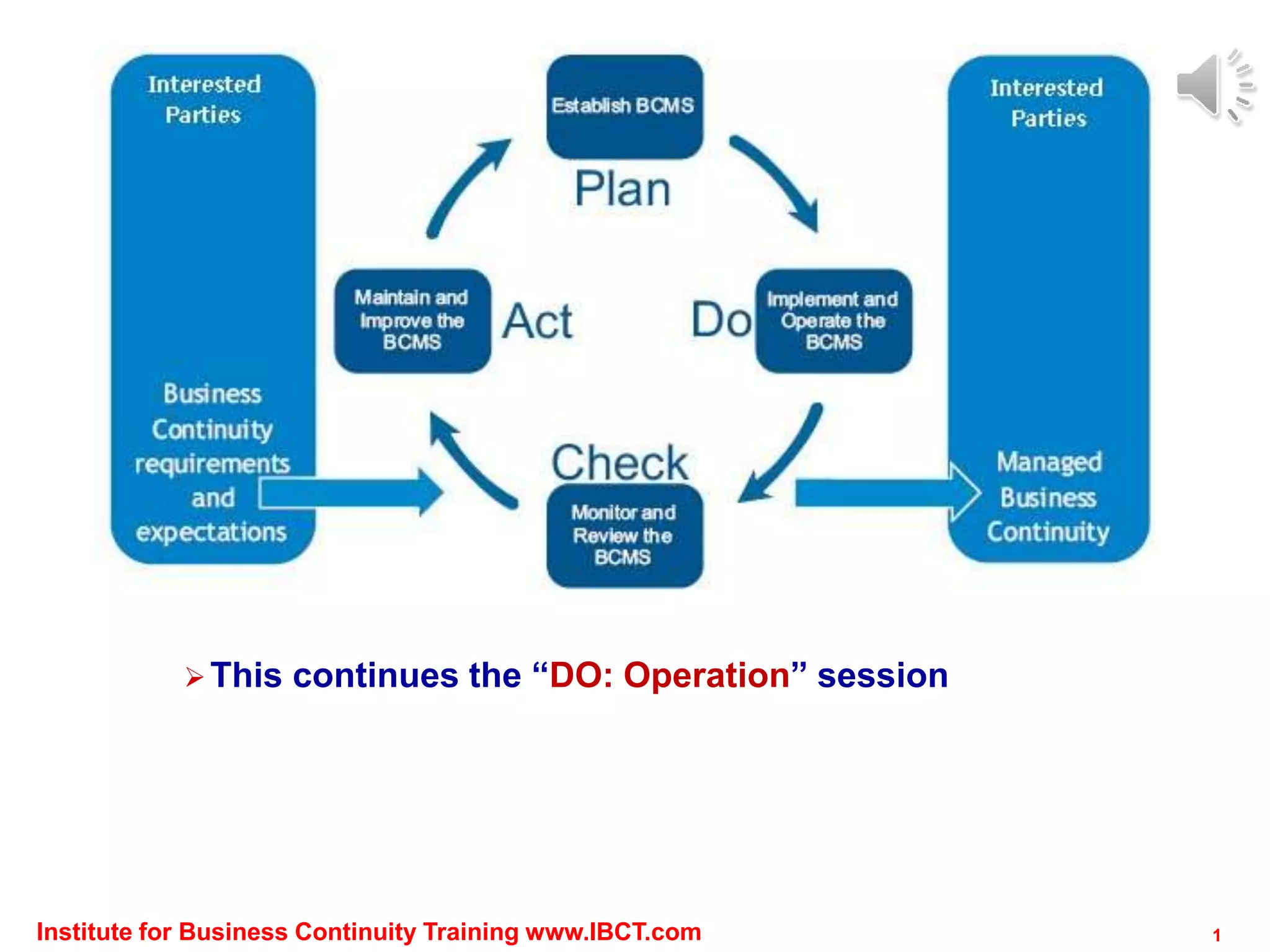
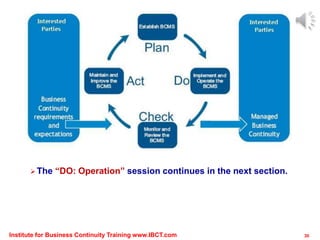
This continues the “DO: Operation” session
Institute for Business Continuity Training www.IBCT.com 1
Risk Assessments
In Business Continuity, we tend
to use the
Business Unit Risk
Assessment method.
2Institute for Business Continuity Training www.IBCT.com
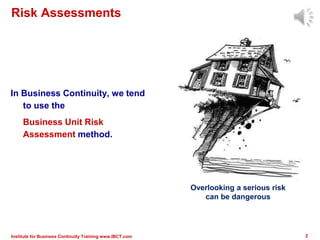
Overlooking a serious risk
can be dangerous
Threats to Key Business Activities
Institute for Business Continuity Training www.IBCT.com 3
 If we are only going to look at the negative effects of risk
(threats), then we do not actually need to conduct a
traditional risk assessment at all. Instead, we need to
perform a more focused vulnerability/threat assessment.
This means that we focus only on those potentially
disruptive incidents that could have a negative impact on
our operations, and only as they apply to that subset of
business operations known as our key business activities.
There is a very short list of such threats and most of
them are common to all organizations.
Institute for Business Continuity Training www.IBCT.com 4
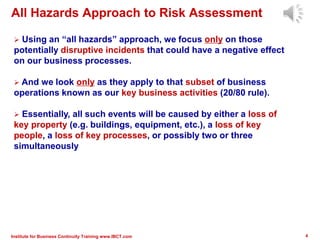
 Using an “all hazards” approach, we focus only on those
potentially disruptive incidents that could have a negative effect
on our business processes.
 And we look only as they apply to that subset of business
operations known as our key business activities (20/80 rule).
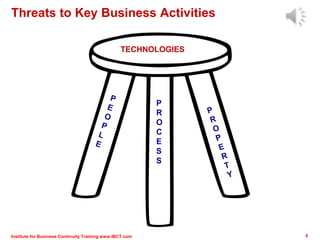
 Essentially, all such events will be caused by either a loss of
key property (e.g. buildings, equipment, etc.), a loss of key
people, a loss of key processes, or possibly two or three
simultaneously
All Hazards Approach to Risk Assessment
Threats to Key Business Activities
P
R
O
C
E
S
S
TECHNOLOGIES
Institute for Business Continuity Training www.IBCT.com 5
Threats to Key Business Activities
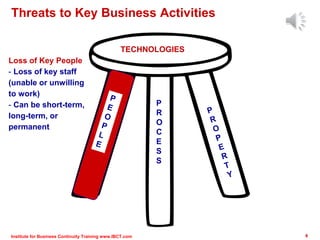
Loss of Key People
- Loss of key staff
(unable or unwilling
to work)
- Can be short-term,
long-term, or
permanent
P
R
O
C
E
S
S
Institute for Business Continuity Training www.IBCT.com 6
TECHNOLOGIES
Threats to Key Business Activities
P
R
O
C
E
S
S
Institute for Business Continuity Training www.IBCT.com 7
TECHNOLOGIES
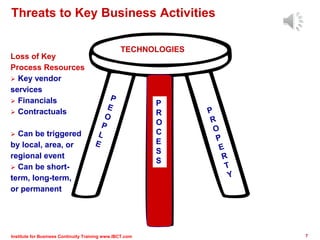
Loss of Key
Process Resources
 Key vendor
services
 Financials
 Contractuals
 Can be triggered
by local, area, or
regional event
 Can be short-
term, long-term,
or permanent
Threats to Key Business Activities
P
R
O
C
E
S
S
Institute for Business Continuity Training www.IBCT.com 8
TECHNOLOGIES
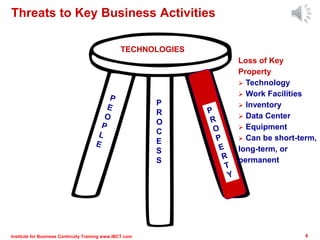
Loss of Key
Property
 Technology
 Work Facilities
 Inventory
 Data Center
 Equipment
 Can be short-term,
long-term, or
permanent
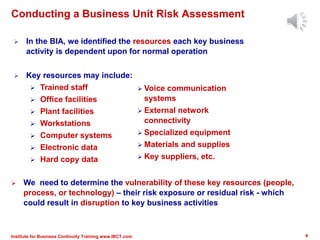
 In the BIA, we identified the resources each key business
activity is dependent upon for normal operation
 Key resources may include:
 Trained staff
 Office facilities
 Plant facilities
 Workstations
 Computer systems
 Electronic data
 Hard copy data
 Voice communication
systems
 External network
connectivity
 Specialized equipment
 Materials and supplies
 Key suppliers, etc.
 We need to determine the vulnerability of these key resources (people,
process, or technology) – their risk exposure or residual risk - which
could result in disruption to key business activities
9Institute for Business Continuity Training www.IBCT.com
Conducting a Business Unit Risk Assessment
Threats to Key Business Activities
Institute for Business Continuity Training www.IBCT.com 10
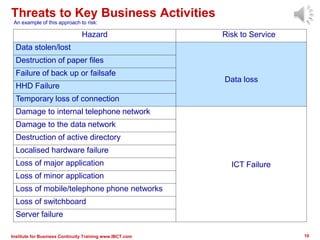
An example of this approach to risk:
Hazard Risk to Service
Data stolen/lost
Data loss
Destruction of paper files
Failure of back up or failsafe
HHD Failure
Temporary loss of connection
Damage to internal telephone network
ICT Failure
Damage to the data network
Destruction of active directory
Localised hardware failure
Loss of major application
Loss of minor application
Loss of mobile/telephone phone networks
Loss of switchboard
Server failure
Threats to Key Business Activities
Institute for Business Continuity Training www.IBCT.com 11
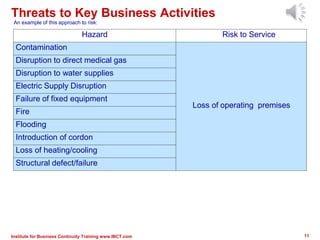
An example of this approach to risk:
Hazard Risk to Service
Contamination
Loss of operating premises
Disruption to direct medical gas
Disruption to water supplies
Electric Supply Disruption
Failure of fixed equipment
Fire
Flooding
Introduction of cordon
Loss of heating/cooling
Structural defect/failure
Threats to Key Business Activities
Institute for Business Continuity Training www.IBCT.com 12
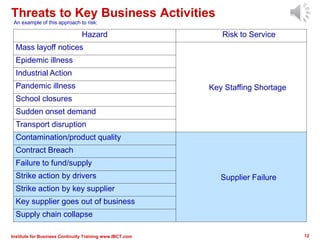
An example of this approach to risk:
Hazard Risk to Service
Mass layoff notices
Key Staffing Shortage
Epidemic illness
Industrial Action
Pandemic illness
School closures
Sudden onset demand
Transport disruption
Contamination/product quality
Supplier Failure
Contract Breach
Failure to fund/supply
Strike action by drivers
Strike action by key supplier
Key supplier goes out of business
Supply chain collapse
Protective measures may include:
 Cross-training of staff
 Building security
 Alternate work locations
 Backup computer systems
 Off-site data backups
 In-bound call redirection
 Redundant communication links
 Regular equipment maintenance
 Backup power systems
 Alternate suppliers, etc.
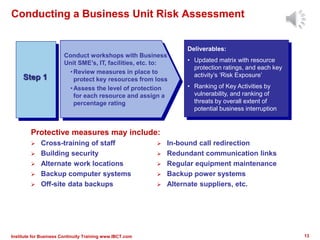
Step 1
Deliverables:
• Updated matrix with resource
protection ratings, and each key
activity’s ‘Risk Exposure’
• Ranking of Key Activities by
vulnerability, and ranking of
threats by overall extent of
potential business interruption
Conduct workshops with Business
Unit SME’s, IT, facilities, etc. to:
•Review measures in place to
protect key resources from loss
•Assess the level of protection
for each resource and assign a
percentage rating
13Institute for Business Continuity Training www.IBCT.com
Conducting a Business Unit Risk Assessment
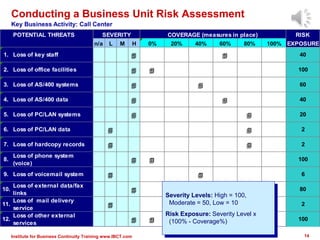
POTENTIAL THREATS SEVERITY COVERAGE (measures in place) RISK
n/a L M H 0% 20% 40% 60% 80% 100% EXPOSURE
1. Loss of key staff 4 4 40
2. Loss of office facilities 4 4 100
3. Loss of AS/400 systems 4 4 60
4. Loss of AS/400 data 4 4 40
5. Loss of PC/LAN systems 4 4 20
6. Loss of PC/LAN data 4 4 2
7. Loss of hardcopy records 4 4 2
8.
Loss of phone system
(voice)
4 4 100
9. Loss of voicemail system 4 4 6
10.
Loss of external data/fax
links
4 4 80
11.
Loss of mail delivery
service
4 4 2
12.
Loss of other external
services
4 4 100
Severity Levels: High = 100,
Moderate = 50, Low = 10
Risk Exposure: Severity Level x
(100% - Coverage%)
Conducting a Business Unit Risk Assessment
Key Business Activity: Call Center
14Institute for Business Continuity Training www.IBCT.com
Conducting a Business Unit Risk Assessment
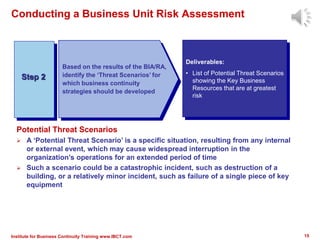
Potential Threat Scenarios
 A ‘Potential Threat Scenario’ is a specific situation, resulting from any internal
or external event, which may cause widespread interruption in the
organization’s operations for an extended period of time
 Such a scenario could be a catastrophic incident, such as destruction of a
building, or a relatively minor incident, such as failure of a single piece of key
equipment
Step 2
Deliverables:
• List of Potential Threat Scenarios
showing the Key Business
Resources that are at greatest
risk
Based on the results of the BIA/RA,
identify the ‘Threat Scenarios’ for
which business continuity
strategies should be developed
15Institute for Business Continuity Training www.IBCT.com
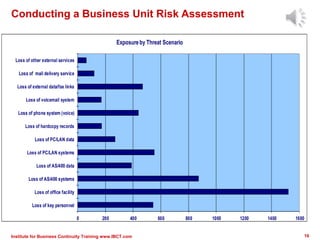
0 200 400 600 800 1000 1200 1400 1600
Loss of key personnel
Loss of office facility
Loss of AS/400 systems
Loss of AS/400 data
Loss of PC/LAN systems
Loss of PC/LAN data
Loss of hardcopy records
Loss of phone system (voice)
Loss of voicemail system
Loss of external data/fax links
Loss of mail delivery service
Loss of other external services
Exposureby Threat Scenario
Conducting a Business Unit Risk Assessment
16Institute for Business Continuity Training www.IBCT.com
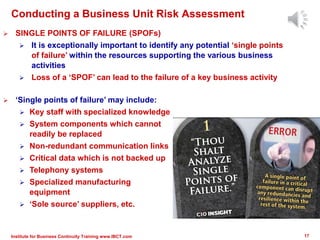
 ‘Single points of failure’ may include:
 Key staff with specialized knowledge
 System components which cannot
readily be replaced
 Non-redundant communication links
 Critical data which is not backed up
 Telephony systems
 Specialized manufacturing
equipment
 ‘Sole source’ suppliers, etc.
Conducting a Business Unit Risk Assessment
 SINGLE POINTS OF FAILURE (SPOFs)
 It is exceptionally important to identify any potential ‘single points
of failure’ within the resources supporting the various business
activities
 Loss of a ‘SPOF’ can lead to the failure of a key business activity
17Institute for Business Continuity Training www.IBCT.com
Conducting a Business Unit Risk Assessment
Step 3
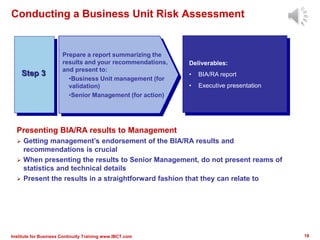
Presenting BIA/RA results to Management
 Getting management’s endorsement of the BIA/RA results and
recommendations is crucial
 When presenting the results to Senior Management, do not present reams of
statistics and technical details
 Present the results in a straightforward fashion that they can relate to
Deliverables:
• BIA/RA report
• Executive presentation
Prepare a report summarizing the
results and your recommendations,
and present to:
•Business Unit management (for
validation)
•Senior Management (for action)
18Institute for Business Continuity Training www.IBCT.com
Risk Assessment Summary
 One of the primary goals of a BCMS is to prevent avoidable
interruptions in the company’s operations
 Hence, it is essential to understand the threats to continued
operation, and the company’s vulnerability to those threats
 Identifying the KBAs’ resource dependencies and the risks facing
those resources (residual risk/risk exposure) will help in the
development of strategies and plans
 Ranking of the key business activities’ risk exposure (threat
scenarios) helps determine which activities require continuity
strategies
19Institute for Business Continuity Training www.IBCT.com
The Keys to Success
 Conducting a BIA/RA is not rocket science, but …
 every department must follow a consistent methodology to
ensure the results will be meaningful
 standard data collection formats and terminology must be
used to avoid misinterpretation, and facilitate analysis and
reporting
 participants must be guided through the process, not just left
to fend for themselves
 The use of templates or software tools alone will not ensure these
goals are met – you have to know what you are trying to
accomplish, and how to do it!
20Institute for Business Continuity Training www.IBCT.com
Institute for Business Continuity Training www.IBCT.com 21
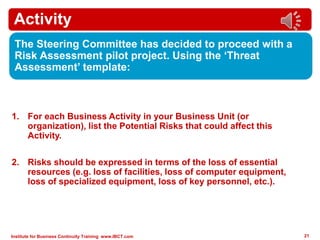
Activity
The Steering Committee has decided to proceed with a
Risk Assessment pilot project. Using the ‘Threat
Assessment’ template:
1. For each Business Activity in your Business Unit (or
organization), list the Potential Risks that could affect this
Activity.
2. Risks should be expressed in terms of the loss of essential
resources (e.g. loss of facilities, loss of computer equipment,
loss of specialized equipment, loss of key personnel, etc.).
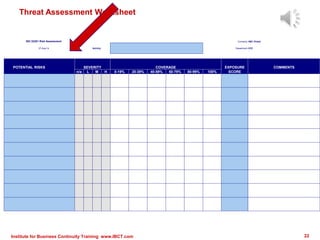
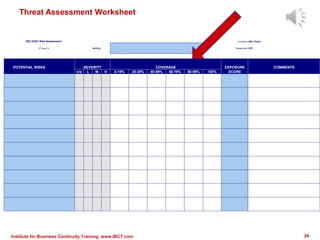
Threat Assessment Worksheet
ISO 22301 Risk Assessment Company: ABC Global
27-Aug-14 Activity: Department: XYZ
POTENTIAL RISKS SEVERITY COVERAGE EXPOSURE COMMENTS
n/a L M H 0-19% 20-39% 40-59% 60-79% 80-99% 100% SCORE
Institute for Business Continuity Training www.IBCT.com 22
Institute for Business Continuity Training www.IBCT.com 23
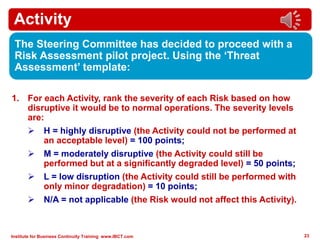
Activity
The Steering Committee has decided to proceed with a
Risk Assessment pilot project. Using the ‘Threat
Assessment’ template:
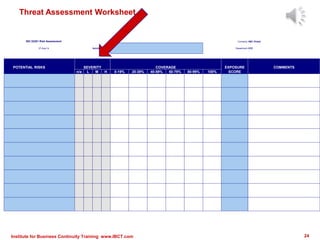
1. For each Activity, rank the severity of each Risk based on how
disruptive it would be to normal operations. The severity levels
are:
 H = highly disruptive (the Activity could not be performed at
an acceptable level) = 100 points;
 M = moderately disruptive (the Activity could still be
performed but at a significantly degraded level) = 50 points;
 L = low disruption (the Activity could still be performed with
only minor degradation) = 10 points;
 N/A = not applicable (the Risk would not affect this Activity).
Threat Assessment Worksheet
ISO 22301 Risk Assessment Company: ABC Global
27-Aug-14 Activity: Department: XYZ
POTENTIAL RISKS SEVERITY COVERAGE EXPOSURE COMMENTS
n/a L M H 0-19% 20-39% 40-59% 60-79% 80-99% 100% SCORE
Institute for Business Continuity Training www.IBCT.com 24
Institute for Business Continuity Training www.IBCT.com 25
Activity
The Steering Committee has decided to proceed with a
Risk Assessment pilot project. Using the ‘Threat
Assessment’ template:
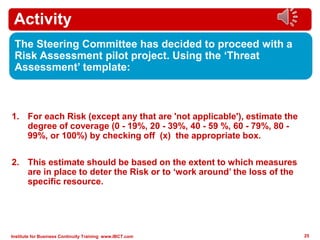
1. For each Risk (except any that are 'not applicable'), estimate the
degree of coverage (0 - 19%, 20 - 39%, 40 - 59 %, 60 - 79%, 80 -
99%, or 100%) by checking off (x) the appropriate box.
2. This estimate should be based on the extent to which measures
are in place to deter the Risk or to ‘work around’ the loss of the
specific resource.
Threat Assessment Worksheet
ISO 22301 Risk Assessment Company: ABC Global
27-Aug-14 Activity: Department: XYZ
POTENTIAL RISKS SEVERITY COVERAGE EXPOSURE COMMENTS
n/a L M H 0-19% 20-39% 40-59% 60-79% 80-99% 100% SCORE
Institute for Business Continuity Training www.IBCT.com 26
Institute for Business Continuity Training www.IBCT.com 27
Activity
The Steering Committee has decided to proceed with a
Risk Assessment pilot project. Using the ‘Threat
Assessment’ template:
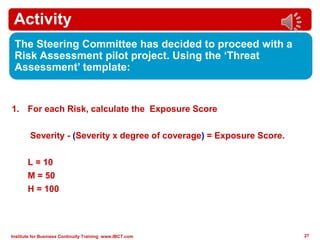
1. For each Risk, calculate the Exposure Score
Severity - (Severity x degree of coverage) = Exposure Score.
L = 10
M = 50
H = 100
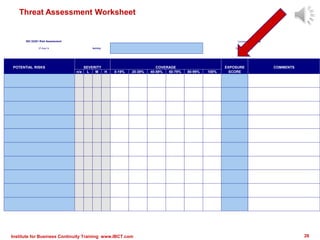
Threat Assessment Worksheet
ISO 22301 Risk Assessment Company: ABC Global
27-Aug-14 Activity: Department: XYZ
POTENTIAL RISKS SEVERITY COVERAGE EXPOSURE COMMENTS
n/a L M H 0-19% 20-39% 40-59% 60-79% 80-99% 100% SCORE
Institute for Business Continuity Training www.IBCT.com 28
 New terms:
 MTPD/MAO
 MBCO
 RTO
 RPO
 SPOFs
 A BIA/Risk Assessment enables you to:
 Identify all company business activities
 Determine the consequences of interrupting these activities
 Prioritize the time-sensitivity of these consequences
 Identify the most time-sensitive business activities (80/20 rule)
 Determine minimum resources necessary to maintain the most
time-sensitive business activities
 Identify those key business activities that are most exposed to
interruption – and need strong protective measures (strategies)
Points to Remember
29Institute for Business Continuity Training www.IBCT.com
The “DO: Operation” session continues in the next section.
Institute for Business Continuity Training www.IBCT.com 30

Business Continuity Planning

  • 1.
    This continues the“DO: Operation” session Institute for Business Continuity Training www.IBCT.com 1
  • 2.
    Risk Assessments In BusinessContinuity, we tend to use the Business Unit Risk Assessment method. 2Institute for Business Continuity Training www.IBCT.com Overlooking a serious risk can be dangerous
  • 3.
    Threats to KeyBusiness Activities Institute for Business Continuity Training www.IBCT.com 3  If we are only going to look at the negative effects of risk (threats), then we do not actually need to conduct a traditional risk assessment at all. Instead, we need to perform a more focused vulnerability/threat assessment. This means that we focus only on those potentially disruptive incidents that could have a negative impact on our operations, and only as they apply to that subset of business operations known as our key business activities. There is a very short list of such threats and most of them are common to all organizations.
  • 4.
    Institute for BusinessContinuity Training www.IBCT.com 4  Using an “all hazards” approach, we focus only on those potentially disruptive incidents that could have a negative effect on our business processes.  And we look only as they apply to that subset of business operations known as our key business activities (20/80 rule).  Essentially, all such events will be caused by either a loss of key property (e.g. buildings, equipment, etc.), a loss of key people, a loss of key processes, or possibly two or three simultaneously All Hazards Approach to Risk Assessment
  • 5.
    Threats to KeyBusiness Activities P R O C E S S TECHNOLOGIES Institute for Business Continuity Training www.IBCT.com 5
  • 6.
    Threats to KeyBusiness Activities Loss of Key People - Loss of key staff (unable or unwilling to work) - Can be short-term, long-term, or permanent P R O C E S S Institute for Business Continuity Training www.IBCT.com 6 TECHNOLOGIES
  • 7.
    Threats to KeyBusiness Activities P R O C E S S Institute for Business Continuity Training www.IBCT.com 7 TECHNOLOGIES Loss of Key Process Resources  Key vendor services  Financials  Contractuals  Can be triggered by local, area, or regional event  Can be short- term, long-term, or permanent
  • 8.
    Threats to KeyBusiness Activities P R O C E S S Institute for Business Continuity Training www.IBCT.com 8 TECHNOLOGIES Loss of Key Property  Technology  Work Facilities  Inventory  Data Center  Equipment  Can be short-term, long-term, or permanent
  • 9.
     In theBIA, we identified the resources each key business activity is dependent upon for normal operation  Key resources may include:  Trained staff  Office facilities  Plant facilities  Workstations  Computer systems  Electronic data  Hard copy data  Voice communication systems  External network connectivity  Specialized equipment  Materials and supplies  Key suppliers, etc.  We need to determine the vulnerability of these key resources (people, process, or technology) – their risk exposure or residual risk - which could result in disruption to key business activities 9Institute for Business Continuity Training www.IBCT.com Conducting a Business Unit Risk Assessment
  • 10.
    Threats to KeyBusiness Activities Institute for Business Continuity Training www.IBCT.com 10 An example of this approach to risk: Hazard Risk to Service Data stolen/lost Data loss Destruction of paper files Failure of back up or failsafe HHD Failure Temporary loss of connection Damage to internal telephone network ICT Failure Damage to the data network Destruction of active directory Localised hardware failure Loss of major application Loss of minor application Loss of mobile/telephone phone networks Loss of switchboard Server failure
  • 11.
    Threats to KeyBusiness Activities Institute for Business Continuity Training www.IBCT.com 11 An example of this approach to risk: Hazard Risk to Service Contamination Loss of operating premises Disruption to direct medical gas Disruption to water supplies Electric Supply Disruption Failure of fixed equipment Fire Flooding Introduction of cordon Loss of heating/cooling Structural defect/failure
  • 12.
    Threats to KeyBusiness Activities Institute for Business Continuity Training www.IBCT.com 12 An example of this approach to risk: Hazard Risk to Service Mass layoff notices Key Staffing Shortage Epidemic illness Industrial Action Pandemic illness School closures Sudden onset demand Transport disruption Contamination/product quality Supplier Failure Contract Breach Failure to fund/supply Strike action by drivers Strike action by key supplier Key supplier goes out of business Supply chain collapse
  • 13.
    Protective measures mayinclude:  Cross-training of staff  Building security  Alternate work locations  Backup computer systems  Off-site data backups  In-bound call redirection  Redundant communication links  Regular equipment maintenance  Backup power systems  Alternate suppliers, etc. Step 1 Deliverables: • Updated matrix with resource protection ratings, and each key activity’s ‘Risk Exposure’ • Ranking of Key Activities by vulnerability, and ranking of threats by overall extent of potential business interruption Conduct workshops with Business Unit SME’s, IT, facilities, etc. to: •Review measures in place to protect key resources from loss •Assess the level of protection for each resource and assign a percentage rating 13Institute for Business Continuity Training www.IBCT.com Conducting a Business Unit Risk Assessment
  • 14.
    POTENTIAL THREATS SEVERITYCOVERAGE (measures in place) RISK n/a L M H 0% 20% 40% 60% 80% 100% EXPOSURE 1. Loss of key staff 4 4 40 2. Loss of office facilities 4 4 100 3. Loss of AS/400 systems 4 4 60 4. Loss of AS/400 data 4 4 40 5. Loss of PC/LAN systems 4 4 20 6. Loss of PC/LAN data 4 4 2 7. Loss of hardcopy records 4 4 2 8. Loss of phone system (voice) 4 4 100 9. Loss of voicemail system 4 4 6 10. Loss of external data/fax links 4 4 80 11. Loss of mail delivery service 4 4 2 12. Loss of other external services 4 4 100 Severity Levels: High = 100, Moderate = 50, Low = 10 Risk Exposure: Severity Level x (100% - Coverage%) Conducting a Business Unit Risk Assessment Key Business Activity: Call Center 14Institute for Business Continuity Training www.IBCT.com
  • 15.
    Conducting a BusinessUnit Risk Assessment Potential Threat Scenarios  A ‘Potential Threat Scenario’ is a specific situation, resulting from any internal or external event, which may cause widespread interruption in the organization’s operations for an extended period of time  Such a scenario could be a catastrophic incident, such as destruction of a building, or a relatively minor incident, such as failure of a single piece of key equipment Step 2 Deliverables: • List of Potential Threat Scenarios showing the Key Business Resources that are at greatest risk Based on the results of the BIA/RA, identify the ‘Threat Scenarios’ for which business continuity strategies should be developed 15Institute for Business Continuity Training www.IBCT.com
  • 16.
    0 200 400600 800 1000 1200 1400 1600 Loss of key personnel Loss of office facility Loss of AS/400 systems Loss of AS/400 data Loss of PC/LAN systems Loss of PC/LAN data Loss of hardcopy records Loss of phone system (voice) Loss of voicemail system Loss of external data/fax links Loss of mail delivery service Loss of other external services Exposureby Threat Scenario Conducting a Business Unit Risk Assessment 16Institute for Business Continuity Training www.IBCT.com
  • 17.
     ‘Single pointsof failure’ may include:  Key staff with specialized knowledge  System components which cannot readily be replaced  Non-redundant communication links  Critical data which is not backed up  Telephony systems  Specialized manufacturing equipment  ‘Sole source’ suppliers, etc. Conducting a Business Unit Risk Assessment  SINGLE POINTS OF FAILURE (SPOFs)  It is exceptionally important to identify any potential ‘single points of failure’ within the resources supporting the various business activities  Loss of a ‘SPOF’ can lead to the failure of a key business activity 17Institute for Business Continuity Training www.IBCT.com
  • 18.
    Conducting a BusinessUnit Risk Assessment Step 3 Presenting BIA/RA results to Management  Getting management’s endorsement of the BIA/RA results and recommendations is crucial  When presenting the results to Senior Management, do not present reams of statistics and technical details  Present the results in a straightforward fashion that they can relate to Deliverables: • BIA/RA report • Executive presentation Prepare a report summarizing the results and your recommendations, and present to: •Business Unit management (for validation) •Senior Management (for action) 18Institute for Business Continuity Training www.IBCT.com
  • 19.
    Risk Assessment Summary One of the primary goals of a BCMS is to prevent avoidable interruptions in the company’s operations  Hence, it is essential to understand the threats to continued operation, and the company’s vulnerability to those threats  Identifying the KBAs’ resource dependencies and the risks facing those resources (residual risk/risk exposure) will help in the development of strategies and plans  Ranking of the key business activities’ risk exposure (threat scenarios) helps determine which activities require continuity strategies 19Institute for Business Continuity Training www.IBCT.com
  • 20.
    The Keys toSuccess  Conducting a BIA/RA is not rocket science, but …  every department must follow a consistent methodology to ensure the results will be meaningful  standard data collection formats and terminology must be used to avoid misinterpretation, and facilitate analysis and reporting  participants must be guided through the process, not just left to fend for themselves  The use of templates or software tools alone will not ensure these goals are met – you have to know what you are trying to accomplish, and how to do it! 20Institute for Business Continuity Training www.IBCT.com
  • 21.
    Institute for BusinessContinuity Training www.IBCT.com 21 Activity The Steering Committee has decided to proceed with a Risk Assessment pilot project. Using the ‘Threat Assessment’ template: 1. For each Business Activity in your Business Unit (or organization), list the Potential Risks that could affect this Activity. 2. Risks should be expressed in terms of the loss of essential resources (e.g. loss of facilities, loss of computer equipment, loss of specialized equipment, loss of key personnel, etc.).
  • 22.
    Threat Assessment Worksheet ISO22301 Risk Assessment Company: ABC Global 27-Aug-14 Activity: Department: XYZ POTENTIAL RISKS SEVERITY COVERAGE EXPOSURE COMMENTS n/a L M H 0-19% 20-39% 40-59% 60-79% 80-99% 100% SCORE Institute for Business Continuity Training www.IBCT.com 22
  • 23.
    Institute for BusinessContinuity Training www.IBCT.com 23 Activity The Steering Committee has decided to proceed with a Risk Assessment pilot project. Using the ‘Threat Assessment’ template: 1. For each Activity, rank the severity of each Risk based on how disruptive it would be to normal operations. The severity levels are:  H = highly disruptive (the Activity could not be performed at an acceptable level) = 100 points;  M = moderately disruptive (the Activity could still be performed but at a significantly degraded level) = 50 points;  L = low disruption (the Activity could still be performed with only minor degradation) = 10 points;  N/A = not applicable (the Risk would not affect this Activity).
  • 24.
    Threat Assessment Worksheet ISO22301 Risk Assessment Company: ABC Global 27-Aug-14 Activity: Department: XYZ POTENTIAL RISKS SEVERITY COVERAGE EXPOSURE COMMENTS n/a L M H 0-19% 20-39% 40-59% 60-79% 80-99% 100% SCORE Institute for Business Continuity Training www.IBCT.com 24
  • 25.
    Institute for BusinessContinuity Training www.IBCT.com 25 Activity The Steering Committee has decided to proceed with a Risk Assessment pilot project. Using the ‘Threat Assessment’ template: 1. For each Risk (except any that are 'not applicable'), estimate the degree of coverage (0 - 19%, 20 - 39%, 40 - 59 %, 60 - 79%, 80 - 99%, or 100%) by checking off (x) the appropriate box. 2. This estimate should be based on the extent to which measures are in place to deter the Risk or to ‘work around’ the loss of the specific resource.
  • 26.
    Threat Assessment Worksheet ISO22301 Risk Assessment Company: ABC Global 27-Aug-14 Activity: Department: XYZ POTENTIAL RISKS SEVERITY COVERAGE EXPOSURE COMMENTS n/a L M H 0-19% 20-39% 40-59% 60-79% 80-99% 100% SCORE Institute for Business Continuity Training www.IBCT.com 26
  • 27.
    Institute for BusinessContinuity Training www.IBCT.com 27 Activity The Steering Committee has decided to proceed with a Risk Assessment pilot project. Using the ‘Threat Assessment’ template: 1. For each Risk, calculate the Exposure Score Severity - (Severity x degree of coverage) = Exposure Score. L = 10 M = 50 H = 100
  • 28.
    Threat Assessment Worksheet ISO22301 Risk Assessment Company: ABC Global 27-Aug-14 Activity: Department: XYZ POTENTIAL RISKS SEVERITY COVERAGE EXPOSURE COMMENTS n/a L M H 0-19% 20-39% 40-59% 60-79% 80-99% 100% SCORE Institute for Business Continuity Training www.IBCT.com 28
  • 29.
     New terms: MTPD/MAO  MBCO  RTO  RPO  SPOFs  A BIA/Risk Assessment enables you to:  Identify all company business activities  Determine the consequences of interrupting these activities  Prioritize the time-sensitivity of these consequences  Identify the most time-sensitive business activities (80/20 rule)  Determine minimum resources necessary to maintain the most time-sensitive business activities  Identify those key business activities that are most exposed to interruption – and need strong protective measures (strategies) Points to Remember 29Institute for Business Continuity Training www.IBCT.com
  • 30.
    The “DO: Operation”session continues in the next section. Institute for Business Continuity Training www.IBCT.com 30