CE-402 Irrigation Engineering
1
02. Methods of Irrigation
B.Sc. Civil Engineering 8th Semester
Muhammad Ajmal (PhD)
Lecturer
Agri. Engg. Deptt.
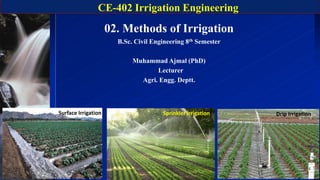
Surface Irrigation Sprinkler Irrigation Drip Irrigation
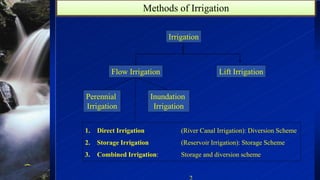
Irrigation
Flow Irrigation Lift Irrigation
Perennial
Irrigation
Inundation
Irrigation
1. Direct Irrigation (River Canal Irrigation): Diversion Scheme
2. Storage Irrigation (Reservoir Irrigation): Storage Scheme
3. Combined Irrigation: Storage and diversion scheme
Methods of Irrigation
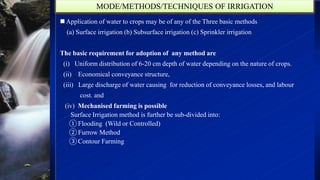
 Application of water to crops may be of any of the Three basic methods
(a) Surface irrigation (b) Subsurface irrigation (c) Sprinkler irrigation
The basic requirement for adoption of any method are
(i) Uniform distribution of 6-20 cm depth of water depending on the nature of crops.
(ii) Economical conveyance structure,
(iii) Large discharge of water causing for reduction of conveyance losses, and labour
cost. and
(iv) Mechanised farming is possible
Surface Irrigation method is further be sub-divided into:
①Flooding (Wild or Controlled)
②Furrow Method
③Contour Farming
MODE/METHODS/TECHNIQUES OF IRRIGATION
Controlled flooding is further be sub-divided into: (i)Free Flooding (ii) Contour Laterals
Flooding (iii) Border Flooding (iv) Checks Flooding (v) Basin Flooding (vi) Furrow
Irrigation
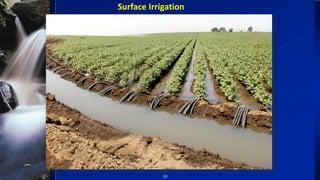
Free Flooding or Ordinary Flooding: In this type of irrigation ditches are excavated in
field, either on contour (known as contour flooding) or up and down known as free flooding.
When water is applied on field with out levees it is known as wild flooding or if levees are
there it is controlled flooding.
Border Flooding: In this method land is divided into a number of strips, separated by low
levees called border. Water is allow to flow along the strips and be prevented by levees.
(Standard dimensions of Border is 100-400 m of length with 10- 20 m of width). After
completion of one strip water may be diverted to an other strip and in this way irrigation has
to be completed.
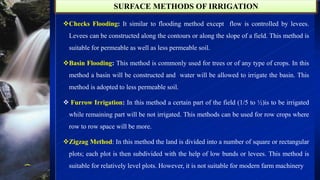
SURFACE METHODS OF IRRIGATION
❖Checks Flooding: It similar to flooding method except flow is controlled by levees.
Levees can be constructed along the contours or along the slope of a field. This method is
suitable for permeable as well as less permeable soil.
❖Basin Flooding: This method is commonly used for trees or of any type of crops. In this
method a basin will be constructed and water will be allowed to irrigate the basin. This
method is adopted to less permeable soil.
❖ Furrow Irrigation: In this method a certain part of the field (1/5 to ½)is to be irrigated
while remaining part will be not irrigated. This methods can be used for row crops where
row to row space will be more.
❖Zigzag Method: In this method the land is divided into a number of square or rectangular
plots; each plot is then subdivided with the help of low bunds or levees. This method is
suitable for relatively level plots. However, it is not suitable for modern farm machinery
SURFACE METHODS OF IRRIGATION
Sprinkler and Drip Methods of Irrigations
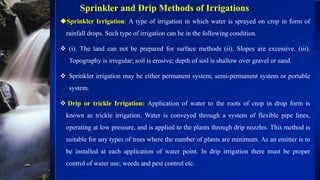
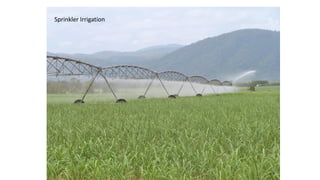
Sprinkler Irrigation: A type of irrigation in which water is sprayed on crop in form of
rainfall drops. Such type of irrigation can be in the following condition.
❖ (i). The land can not be prepared for surface methods (ii). Slopes are excessive. (iii).
Topography is irregular; soil is erosive; depth of soil is shallow over gravel or sand.
❖ Sprinkler irrigation may be either permanent system; semi-permanent system or portable
system.
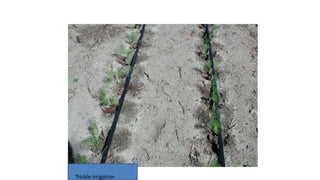
❖ Drip or trickle Irrigation: Application of water to the roots of crop in drop form is
known as trickle irrigation. Water is conveyed through a system of flexible pipe lines,
operating at low pressure, and is applied to the plants through drip nozzles. This method is
suitable for any types of trees where the number of plants are minimum. As an emitter is to
be installed at each application of water point. In drip irrigation there must be proper
control of water use; weeds and pest control etc.
Sprinkler Irrigation
8
Trickle Irrigation
9
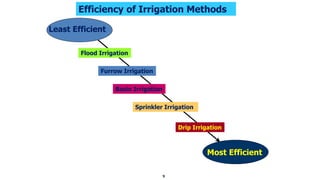
Least Efficient
Most Efficient
Flood Irrigation
Furrow Irrigation
Basin Irrigation
Sprinkler Irrigation
Drip Irrigation
Efficiency of Irrigation Methods
Surface Irrigation
10
Planning a Water resource Project
 Planning a water resource means how much water is needed for an area, what
must be the maximum capacity of a canal system. The following basic information
essential to know about the capacity of canal at certain durations.
Basic Definitions:
 Gross Commanded Area (GCA)
The total area lying between drainage boundaries of a watershed which can be
irrigated or commanded by a canal system.
 Culturable Commanded Area (CCA): It is the area which is irrigated to grow
crops. It is further classified as:
1. Culturable Cultivated Area: It is the area on which crop is grown at a particular
time or in crop season.
2. Culturable Uncultivated Area: It is that area in which crop is not sown in a
particular season.
Some Basic Definitions
❖ In Pakistan there are two main seasons ; Kharif season (Summer ) starts
from 1st April to end of September. Main crops are Maize, Cotton,
Tobacco etc. Rabi season (Winter) started from 1st October and end at
the end of March. The main crops grown in such season are wheat, barley,
potatoes etc.
❖ Intensity of irrigation is defined as the percentage of Culturable
commanded area proposed to be irrigated either a crop season or during a
year.
❖ For example if CCA of an irrigation field is 120 hectares, out of which 90
hectares of the land is cultivated during Kharif season, the intensity of
irrigation during Kharif season will be (90/120) * 100 = 75 %. The
intensity of irrigation during Rabi crop will be (60/120) * 100 = 50%.
❖ However, the yearly intensity of irrigation is equal to the sum of the two,
i.e. equal to 125 %. It means yearly intensity of irrigation is > 100%.
Some Basic Definitions
❖ Duty represents the irrigation capacity of a unit of water. It is the relation
between the volume of water applied and the area of a crop irrigated during
the entire period of the growth of that crop. It is denoted by D. Like if one
cumec of water is applied to 100 hectares of field throughout the base
period B days then the duty will be 100 hectares / m3sec -1 for B days.
❖ Delta is the total depth of water required by a crop during the entire period
the crop is in the field and is denoted by the symbol Δ.
❖ Crop Period is the time in days, that a crops takes from the instant of its
sowing to that of its harvesting.
❖ Base Period for a crop refers to the whole period of cultivation from the
time when irrigation water is first issued for preparation of the ground for
planting the crop to its last water before harvesting and is denoted by B.
❖ Kor Period and Kor depth: Crops need maximum water at the start of 1st
watering . The depth of such water is kor water and the no. of days to apply
such water is known as kor period.
Relation between Duty and Delta
 Let there is a crop of base period (or kor period) B days. Let one m3/sec (cumec) of water
be applied to this crop on the field for B days.
 The volume of water applied to this crop for B days are
V = (60 x 60 x 24 x B) m3 = 86400 B m3
 As duty is the number of hectares to be irrigated by one cumec of discharge till the
maturity of crop so this quantity of water (Volume) irrigate D hectares. Then
 Depth of water applied = Volume / Area = 8.64 B/ D meters. Let this depth is Δ. So
Δ = 8.64 x B/D
Example: Water is released at the rate of 5 cumecs at the head of a canal. If the duty at the
field is 100 hectares/ cumec and the loss of water in transit is 30%, find the area of the land
that can be irrigated.
Given Data: Q = 5 m3/sec; D = 100 hect/ cumec; losses = 30%;
Required: Area at field?
Solution:
Area = Duty / Discharge = duty/ Q = [100 hectares / (m3/sec) /( 5 m3/ sec)] = 500 hectares at
the upstream of canal.
Area at the field = (100-30)/(100) * 500 = 350 hectares Answer
Irrigation Efficiencies
❖ Efficient use of water is essential for optimum utilization of water for crop
production. Various types of efficiencies are
❖ Water Conveyance Efficiency: It is defined as the ratio of water diverted from
a source to deliver to a farm. Such efficiency show the losses in conveyance
system.
❖ Mathematically 𝐸𝑐 =
𝑊𝑓
𝑊𝑟
𝑋100. Where Wf is water delivered to farm and Wr
is the water supplied or diverted from a source.
❖ Water Application Efficiency: The ratio of the quantity of water stored into the
root zone of the crop to the quantity of water diverted to the field
❖ Mathematically 𝐸𝑎 =
𝑊𝑠
𝑊𝑓
× 100. Where Ws is water stored in the root zone
during irrigation and Wf is the water delivered to the field Wf = Ws +Rf + Df
where Rf is the runoff from the farm and Df is the deep percolation. It an also be
written as 𝐸𝑎 =
𝑊𝑓−(𝑅𝑓+𝐷𝑓)
𝑊𝑓
× 100
❖ Water Use Efficiency: It is defined as the ratio of water beneficially used
including leaching requirements to the quantity of water delivered.
❖ Mathematically 𝐸𝑢 =
𝑊𝑢
𝑊𝑑
𝑋100. Where Wu is water used beneficially and
Wd is the water delivered.
❖ Water Storage Efficiency: The ratio of the water stored into the root zone
during irrigation to the water needed in the root zone before irrigation.
❖ Mathematically 𝐸𝑠 =
𝑊𝑠
𝑊𝑛
× 100. Where Ws is water stored in the root zone
during irrigation and Wn is the water needed in the root zone before irrigation.
❖ Water Distribution Efficiency: Its evaluates the degree to which water is
uniformly distributed throughout the root zone. The more uniformly the water
is distributed , the better will be the crop response.
❖ Mathematically 𝐸𝑑 = 100[1 − 𝑦/𝑑] where y is the deviation in depth of water
stored in the root zone during irrigation;
d is the average depth of water stored in the root zone during irrigation.
Irrigation Efficiencies
Determination of Irrigation Requirements of Crops
 In order to determine the irrigation requirements of certain crops the following
terms are used.
 Consumptive use or Evapo-transpiration: The depth of water consumed by
evaporation and transpiration during crop growth, including water consumed
by accompanying weed growth.
 Effective Rainfall (Re): The part of rainfall during the growing period of a
crop that is available to meet the evapo-transpiration need of crop.
 Consumptive Irrigation Requirements (CIR): It is the amount of irrigation
water required in order to meet the evapotranspiration needs of the crop during
its full growth. It is, therefore, nothing but the consumptive use itself, but
exclusive of effective precipitation, stored soil moisture, or ground water.
When the last two are ignored, then we can write CIR = Cu – Re
 Net Irrigation Requirement (NIR): It is the amount of irrigation water required in
order to meet the evapo-transpiration need of the crop as well as other needs such as
leaching. Therefore NIR = Cu – Re + water lost as percolation in satisfying other needs
such as leaching.
 Field Irrigation Requirement (FIR): It is the amount of water required to meet ‘net
irrigation requirements’ plus the water lost in percolation in the field water courses,
field channels and in field applications of water. 𝐹𝐼𝑅 =
𝑁𝐼𝑅
𝐸𝑎
 Gross Irrigation Requirement (GIR): It is the sum of water required to satisfy the
field irrigation requirement and the water lost as conveyance losses in distributaries up
to the field.
 𝐺𝐼𝑅 =
𝐹𝐼𝑅
𝐸𝑐
; where Ec is the conveyance efficiency
 Time Factor: It is the ratio of the number of days the canal has actually run to the
number of days of irrigation Period. Like if the number of days of irrigation is 15 and
canal run for 5 days. Then Time factor = 5/15 = 0.33
 Capacity Factor: it is the ratio of actual supply to full supply of the canal
Determination of Irrigation Requirements of Crops
Water Resources of Pakistan
 The water supply available to agriculture is derived from three main sources, rainfall
which occurs directly on the crop areas, surface water from rivers or storage
reservoirs, and usable ground water from the aquifers.
 Rainfall is normally inadequate to sustain more than a very low level of agricultural
production, particularly in the semi-arid conditions of Pakistan.
 Pakistan has one of the largest irrigation systems in the world comprising three major
reservoirs with a design capacity of about 20 Billion Cubic Meters (BCM), 23
barrages, headworks and siphons, 45 main irrigation canals commanding an area of
about 16.6 million hectares.
 Irrigated agriculture is the backbone for economy of the country where over 93% of
the available water resources are consumed.
 Irrigation is used on 80% of all arable land and meets almost 90% of all food and
fibers requirements.
 Agriculture is the single larges sector of economy accounting for about a quarter of
the country’s gross Domestic Products (GDP).
 It employs 44% of the labor force, supports 75% of the population and accounts for
60% of foreign exchange.
Water Resources of Pakistan
 The increased population, urbanization, industrialization and agricultural
activities however widened the gap between water demand and supply. The
water shortfall that was 11% in 2004, is expected to increase to 31% by 2025.
The per capita water availability which was about 5600m3 in 1947 has now
reduced to about 1000 m3converting the country to a water scare condition.
 Due to poor maintenance and old irrigation system, the overall efficiency is less
than 40%. Out of 142 BCM of water available at the canal headworks, only 55
BCM is used by crops. The remaining 87 BCM (60%) is lost during conveyance
through canal distributaries, minors, watercourses and in fields.
 In Pakistan the development of rainfed area is completely ignored. The dry
farming is practiced on about 12 Mha that is 40% of the Culturable land. It just
contribute less than 10% to the total production. The main reasons for this low
productivity are (i) low and erratic rainfall (ii) soil erosion (iii) poor use of land
and water resources due to small and fragmented land holdings and (iv) low
agricultural inputs.
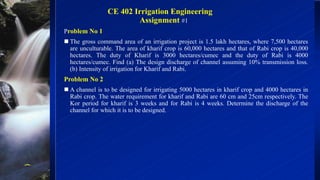
CE 402 Irrigation Engineering
Assignment #1
Problem No 1
 The gross command area of an irrigation project is 1.5 lakh hectares, where 7,500 hectares
are unculturable. The area of kharif crop is 60,000 hectares and that of Rabi crop is 40,000
hectares. The duty of Kharif is 3000 hectares/cumec and the duty of Rabi is 4000
hectares/cumec. Find (a) The design discharge of channel assuming 10% transmission loss.
(b) Intensity of irrigation for Kharif and Rabi.
Problem No 2
 A channel is to be designed for irrigating 5000 hectares in kharif crop and 4000 hectares in
Rabi crop. The water requirement for kharif and Rabi are 60 cm and 25cm respectively. The
Kor period for kharif is 3 weeks and for Rabi is 4 weeks. Determine the discharge of the
channel for which it is to be designed.
Questions?
10 of 10

01. Methods of Irrigation.pdf

  • 1.
    CE-402 Irrigation Engineering 1 02.Methods of Irrigation B.Sc. Civil Engineering 8th Semester Muhammad Ajmal (PhD) Lecturer Agri. Engg. Deptt. Surface Irrigation Sprinkler Irrigation Drip Irrigation
  • 2.
    Irrigation Flow Irrigation LiftIrrigation Perennial Irrigation Inundation Irrigation 1. Direct Irrigation (River Canal Irrigation): Diversion Scheme 2. Storage Irrigation (Reservoir Irrigation): Storage Scheme 3. Combined Irrigation: Storage and diversion scheme Methods of Irrigation
  • 3.
     Application ofwater to crops may be of any of the Three basic methods (a) Surface irrigation (b) Subsurface irrigation (c) Sprinkler irrigation The basic requirement for adoption of any method are (i) Uniform distribution of 6-20 cm depth of water depending on the nature of crops. (ii) Economical conveyance structure, (iii) Large discharge of water causing for reduction of conveyance losses, and labour cost. and (iv) Mechanised farming is possible Surface Irrigation method is further be sub-divided into: ①Flooding (Wild or Controlled) ②Furrow Method ③Contour Farming MODE/METHODS/TECHNIQUES OF IRRIGATION
  • 4.
    Controlled flooding isfurther be sub-divided into: (i)Free Flooding (ii) Contour Laterals Flooding (iii) Border Flooding (iv) Checks Flooding (v) Basin Flooding (vi) Furrow Irrigation Free Flooding or Ordinary Flooding: In this type of irrigation ditches are excavated in field, either on contour (known as contour flooding) or up and down known as free flooding. When water is applied on field with out levees it is known as wild flooding or if levees are there it is controlled flooding. Border Flooding: In this method land is divided into a number of strips, separated by low levees called border. Water is allow to flow along the strips and be prevented by levees. (Standard dimensions of Border is 100-400 m of length with 10- 20 m of width). After completion of one strip water may be diverted to an other strip and in this way irrigation has to be completed. SURFACE METHODS OF IRRIGATION
  • 5.
    ❖Checks Flooding: Itsimilar to flooding method except flow is controlled by levees. Levees can be constructed along the contours or along the slope of a field. This method is suitable for permeable as well as less permeable soil. ❖Basin Flooding: This method is commonly used for trees or of any type of crops. In this method a basin will be constructed and water will be allowed to irrigate the basin. This method is adopted to less permeable soil. ❖ Furrow Irrigation: In this method a certain part of the field (1/5 to ½)is to be irrigated while remaining part will be not irrigated. This methods can be used for row crops where row to row space will be more. ❖Zigzag Method: In this method the land is divided into a number of square or rectangular plots; each plot is then subdivided with the help of low bunds or levees. This method is suitable for relatively level plots. However, it is not suitable for modern farm machinery SURFACE METHODS OF IRRIGATION
  • 6.
    Sprinkler and DripMethods of Irrigations Sprinkler Irrigation: A type of irrigation in which water is sprayed on crop in form of rainfall drops. Such type of irrigation can be in the following condition. ❖ (i). The land can not be prepared for surface methods (ii). Slopes are excessive. (iii). Topography is irregular; soil is erosive; depth of soil is shallow over gravel or sand. ❖ Sprinkler irrigation may be either permanent system; semi-permanent system or portable system. ❖ Drip or trickle Irrigation: Application of water to the roots of crop in drop form is known as trickle irrigation. Water is conveyed through a system of flexible pipe lines, operating at low pressure, and is applied to the plants through drip nozzles. This method is suitable for any types of trees where the number of plants are minimum. As an emitter is to be installed at each application of water point. In drip irrigation there must be proper control of water use; weeds and pest control etc.
  • 7.
  • 8.
  • 9.
    9 Least Efficient Most Efficient FloodIrrigation Furrow Irrigation Basin Irrigation Sprinkler Irrigation Drip Irrigation Efficiency of Irrigation Methods
  • 10.
  • 11.
    Planning a Waterresource Project  Planning a water resource means how much water is needed for an area, what must be the maximum capacity of a canal system. The following basic information essential to know about the capacity of canal at certain durations. Basic Definitions:  Gross Commanded Area (GCA) The total area lying between drainage boundaries of a watershed which can be irrigated or commanded by a canal system.  Culturable Commanded Area (CCA): It is the area which is irrigated to grow crops. It is further classified as: 1. Culturable Cultivated Area: It is the area on which crop is grown at a particular time or in crop season. 2. Culturable Uncultivated Area: It is that area in which crop is not sown in a particular season.
  • 12.
    Some Basic Definitions ❖In Pakistan there are two main seasons ; Kharif season (Summer ) starts from 1st April to end of September. Main crops are Maize, Cotton, Tobacco etc. Rabi season (Winter) started from 1st October and end at the end of March. The main crops grown in such season are wheat, barley, potatoes etc. ❖ Intensity of irrigation is defined as the percentage of Culturable commanded area proposed to be irrigated either a crop season or during a year. ❖ For example if CCA of an irrigation field is 120 hectares, out of which 90 hectares of the land is cultivated during Kharif season, the intensity of irrigation during Kharif season will be (90/120) * 100 = 75 %. The intensity of irrigation during Rabi crop will be (60/120) * 100 = 50%. ❖ However, the yearly intensity of irrigation is equal to the sum of the two, i.e. equal to 125 %. It means yearly intensity of irrigation is > 100%.
  • 13.
    Some Basic Definitions ❖Duty represents the irrigation capacity of a unit of water. It is the relation between the volume of water applied and the area of a crop irrigated during the entire period of the growth of that crop. It is denoted by D. Like if one cumec of water is applied to 100 hectares of field throughout the base period B days then the duty will be 100 hectares / m3sec -1 for B days. ❖ Delta is the total depth of water required by a crop during the entire period the crop is in the field and is denoted by the symbol Δ. ❖ Crop Period is the time in days, that a crops takes from the instant of its sowing to that of its harvesting. ❖ Base Period for a crop refers to the whole period of cultivation from the time when irrigation water is first issued for preparation of the ground for planting the crop to its last water before harvesting and is denoted by B. ❖ Kor Period and Kor depth: Crops need maximum water at the start of 1st watering . The depth of such water is kor water and the no. of days to apply such water is known as kor period.
  • 14.
    Relation between Dutyand Delta  Let there is a crop of base period (or kor period) B days. Let one m3/sec (cumec) of water be applied to this crop on the field for B days.  The volume of water applied to this crop for B days are V = (60 x 60 x 24 x B) m3 = 86400 B m3  As duty is the number of hectares to be irrigated by one cumec of discharge till the maturity of crop so this quantity of water (Volume) irrigate D hectares. Then  Depth of water applied = Volume / Area = 8.64 B/ D meters. Let this depth is Δ. So Δ = 8.64 x B/D Example: Water is released at the rate of 5 cumecs at the head of a canal. If the duty at the field is 100 hectares/ cumec and the loss of water in transit is 30%, find the area of the land that can be irrigated. Given Data: Q = 5 m3/sec; D = 100 hect/ cumec; losses = 30%; Required: Area at field? Solution: Area = Duty / Discharge = duty/ Q = [100 hectares / (m3/sec) /( 5 m3/ sec)] = 500 hectares at the upstream of canal. Area at the field = (100-30)/(100) * 500 = 350 hectares Answer
  • 15.
    Irrigation Efficiencies ❖ Efficientuse of water is essential for optimum utilization of water for crop production. Various types of efficiencies are ❖ Water Conveyance Efficiency: It is defined as the ratio of water diverted from a source to deliver to a farm. Such efficiency show the losses in conveyance system. ❖ Mathematically 𝐸𝑐 = 𝑊𝑓 𝑊𝑟 𝑋100. Where Wf is water delivered to farm and Wr is the water supplied or diverted from a source. ❖ Water Application Efficiency: The ratio of the quantity of water stored into the root zone of the crop to the quantity of water diverted to the field ❖ Mathematically 𝐸𝑎 = 𝑊𝑠 𝑊𝑓 × 100. Where Ws is water stored in the root zone during irrigation and Wf is the water delivered to the field Wf = Ws +Rf + Df where Rf is the runoff from the farm and Df is the deep percolation. It an also be written as 𝐸𝑎 = 𝑊𝑓−(𝑅𝑓+𝐷𝑓) 𝑊𝑓 × 100
  • 16.
    ❖ Water UseEfficiency: It is defined as the ratio of water beneficially used including leaching requirements to the quantity of water delivered. ❖ Mathematically 𝐸𝑢 = 𝑊𝑢 𝑊𝑑 𝑋100. Where Wu is water used beneficially and Wd is the water delivered. ❖ Water Storage Efficiency: The ratio of the water stored into the root zone during irrigation to the water needed in the root zone before irrigation. ❖ Mathematically 𝐸𝑠 = 𝑊𝑠 𝑊𝑛 × 100. Where Ws is water stored in the root zone during irrigation and Wn is the water needed in the root zone before irrigation. ❖ Water Distribution Efficiency: Its evaluates the degree to which water is uniformly distributed throughout the root zone. The more uniformly the water is distributed , the better will be the crop response. ❖ Mathematically 𝐸𝑑 = 100[1 − 𝑦/𝑑] where y is the deviation in depth of water stored in the root zone during irrigation; d is the average depth of water stored in the root zone during irrigation. Irrigation Efficiencies
  • 17.
    Determination of IrrigationRequirements of Crops  In order to determine the irrigation requirements of certain crops the following terms are used.  Consumptive use or Evapo-transpiration: The depth of water consumed by evaporation and transpiration during crop growth, including water consumed by accompanying weed growth.  Effective Rainfall (Re): The part of rainfall during the growing period of a crop that is available to meet the evapo-transpiration need of crop.  Consumptive Irrigation Requirements (CIR): It is the amount of irrigation water required in order to meet the evapotranspiration needs of the crop during its full growth. It is, therefore, nothing but the consumptive use itself, but exclusive of effective precipitation, stored soil moisture, or ground water. When the last two are ignored, then we can write CIR = Cu – Re
  • 18.
     Net IrrigationRequirement (NIR): It is the amount of irrigation water required in order to meet the evapo-transpiration need of the crop as well as other needs such as leaching. Therefore NIR = Cu – Re + water lost as percolation in satisfying other needs such as leaching.  Field Irrigation Requirement (FIR): It is the amount of water required to meet ‘net irrigation requirements’ plus the water lost in percolation in the field water courses, field channels and in field applications of water. 𝐹𝐼𝑅 = 𝑁𝐼𝑅 𝐸𝑎  Gross Irrigation Requirement (GIR): It is the sum of water required to satisfy the field irrigation requirement and the water lost as conveyance losses in distributaries up to the field.  𝐺𝐼𝑅 = 𝐹𝐼𝑅 𝐸𝑐 ; where Ec is the conveyance efficiency  Time Factor: It is the ratio of the number of days the canal has actually run to the number of days of irrigation Period. Like if the number of days of irrigation is 15 and canal run for 5 days. Then Time factor = 5/15 = 0.33  Capacity Factor: it is the ratio of actual supply to full supply of the canal Determination of Irrigation Requirements of Crops
  • 19.
    Water Resources ofPakistan  The water supply available to agriculture is derived from three main sources, rainfall which occurs directly on the crop areas, surface water from rivers or storage reservoirs, and usable ground water from the aquifers.  Rainfall is normally inadequate to sustain more than a very low level of agricultural production, particularly in the semi-arid conditions of Pakistan.  Pakistan has one of the largest irrigation systems in the world comprising three major reservoirs with a design capacity of about 20 Billion Cubic Meters (BCM), 23 barrages, headworks and siphons, 45 main irrigation canals commanding an area of about 16.6 million hectares.  Irrigated agriculture is the backbone for economy of the country where over 93% of the available water resources are consumed.  Irrigation is used on 80% of all arable land and meets almost 90% of all food and fibers requirements.  Agriculture is the single larges sector of economy accounting for about a quarter of the country’s gross Domestic Products (GDP).  It employs 44% of the labor force, supports 75% of the population and accounts for 60% of foreign exchange.
  • 20.
    Water Resources ofPakistan  The increased population, urbanization, industrialization and agricultural activities however widened the gap between water demand and supply. The water shortfall that was 11% in 2004, is expected to increase to 31% by 2025. The per capita water availability which was about 5600m3 in 1947 has now reduced to about 1000 m3converting the country to a water scare condition.  Due to poor maintenance and old irrigation system, the overall efficiency is less than 40%. Out of 142 BCM of water available at the canal headworks, only 55 BCM is used by crops. The remaining 87 BCM (60%) is lost during conveyance through canal distributaries, minors, watercourses and in fields.  In Pakistan the development of rainfed area is completely ignored. The dry farming is practiced on about 12 Mha that is 40% of the Culturable land. It just contribute less than 10% to the total production. The main reasons for this low productivity are (i) low and erratic rainfall (ii) soil erosion (iii) poor use of land and water resources due to small and fragmented land holdings and (iv) low agricultural inputs.
  • 21.
    CE 402 IrrigationEngineering Assignment #1 Problem No 1  The gross command area of an irrigation project is 1.5 lakh hectares, where 7,500 hectares are unculturable. The area of kharif crop is 60,000 hectares and that of Rabi crop is 40,000 hectares. The duty of Kharif is 3000 hectares/cumec and the duty of Rabi is 4000 hectares/cumec. Find (a) The design discharge of channel assuming 10% transmission loss. (b) Intensity of irrigation for Kharif and Rabi. Problem No 2  A channel is to be designed for irrigating 5000 hectares in kharif crop and 4000 hectares in Rabi crop. The water requirement for kharif and Rabi are 60 cm and 25cm respectively. The Kor period for kharif is 3 weeks and for Rabi is 4 weeks. Determine the discharge of the channel for which it is to be designed.
  • 22.