Indian Commodity Exchange Limited  Presentation : Iron Ore Derivatives1
What are DerivativesDerivative is a financial instrument (or, more simply, an agreement between two parties) that has a value, based on the expected future pricemovements of the asset to which it is linked—called the underlying asset—  as a share or a currency or a commodity  Most common derivatives are swaps, futures, and optionsDerivatives are usually broadly categorized by:the type of underlying asset (e.g., equity derivatives, foreign exchange derivatives, interest rate derivatives, commodity derivatives or credit derivatives); the relationship between the underlying asset and the derivative (e.g., forward, option, swap); the market in which they trade (e.g., exchange-traded or over-the-counter); their pay-off profile.  2
Why Commodity Derivatives…Dynamic Price DiscoveryTransparency – Information DisseminationHedging ToolEven smaller players reap same advantage as big onesTakes care of counter party defaultEasy to sell / buy in liquid marketLeverage3
Iron Ore Derivatives4
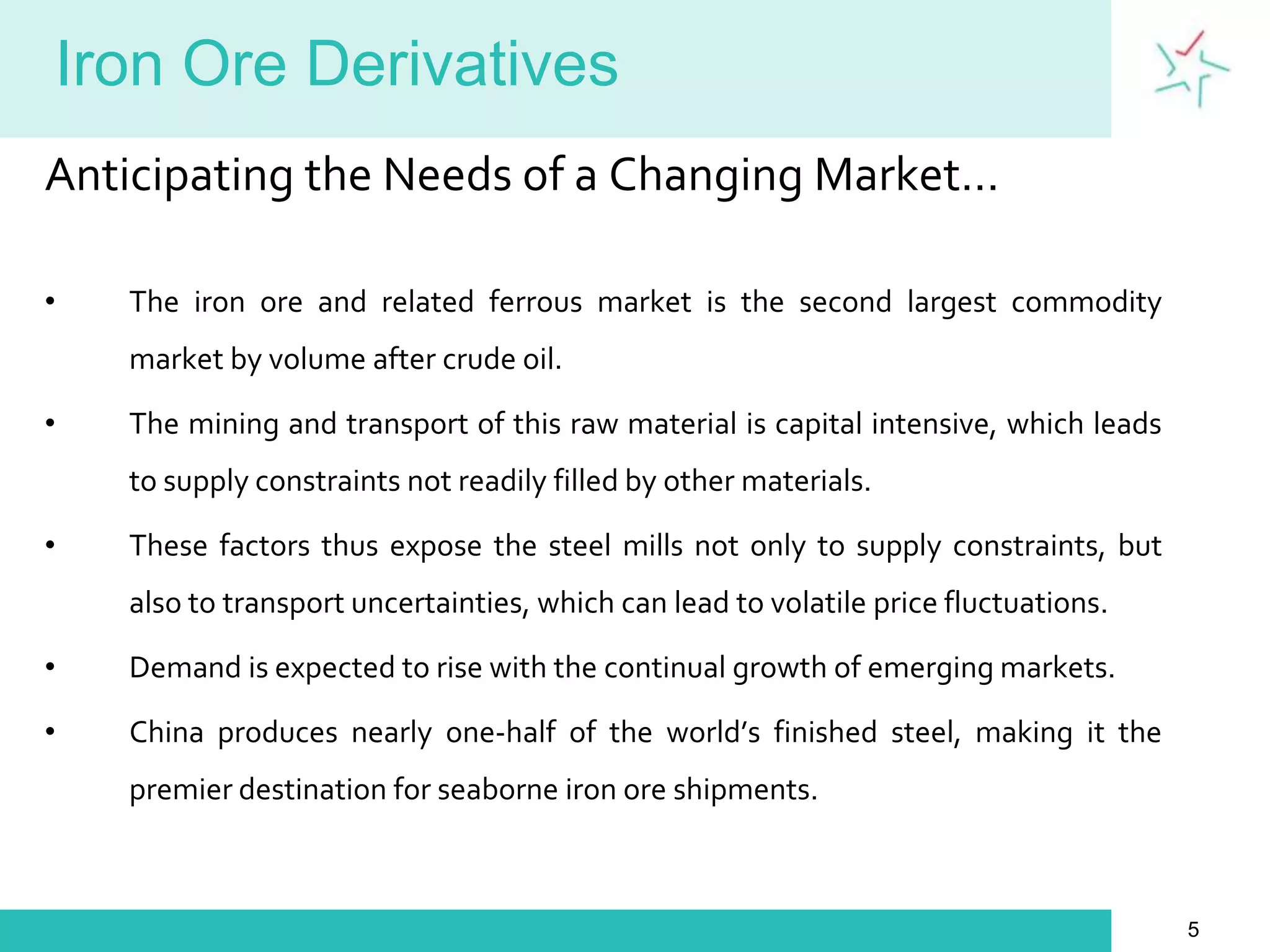
Iron Ore DerivativesAnticipating the Needs of a Changing Market…The iron ore and related ferrous market is the second largest commodity market by volume after crude oil.
The mining and transport of this raw material is capital intensive, which leads to supply constraints not readily filled by other materials.
These factors thus expose the steel mills not only to supply constraints, but also to transport uncertainties, which can lead to volatile price fluctuations.
Demand is expected to rise with the continual growth of emerging markets.
China produces nearly one-half of the world’s finished steel, making it the premier destination for seaborne iron ore shipments.5
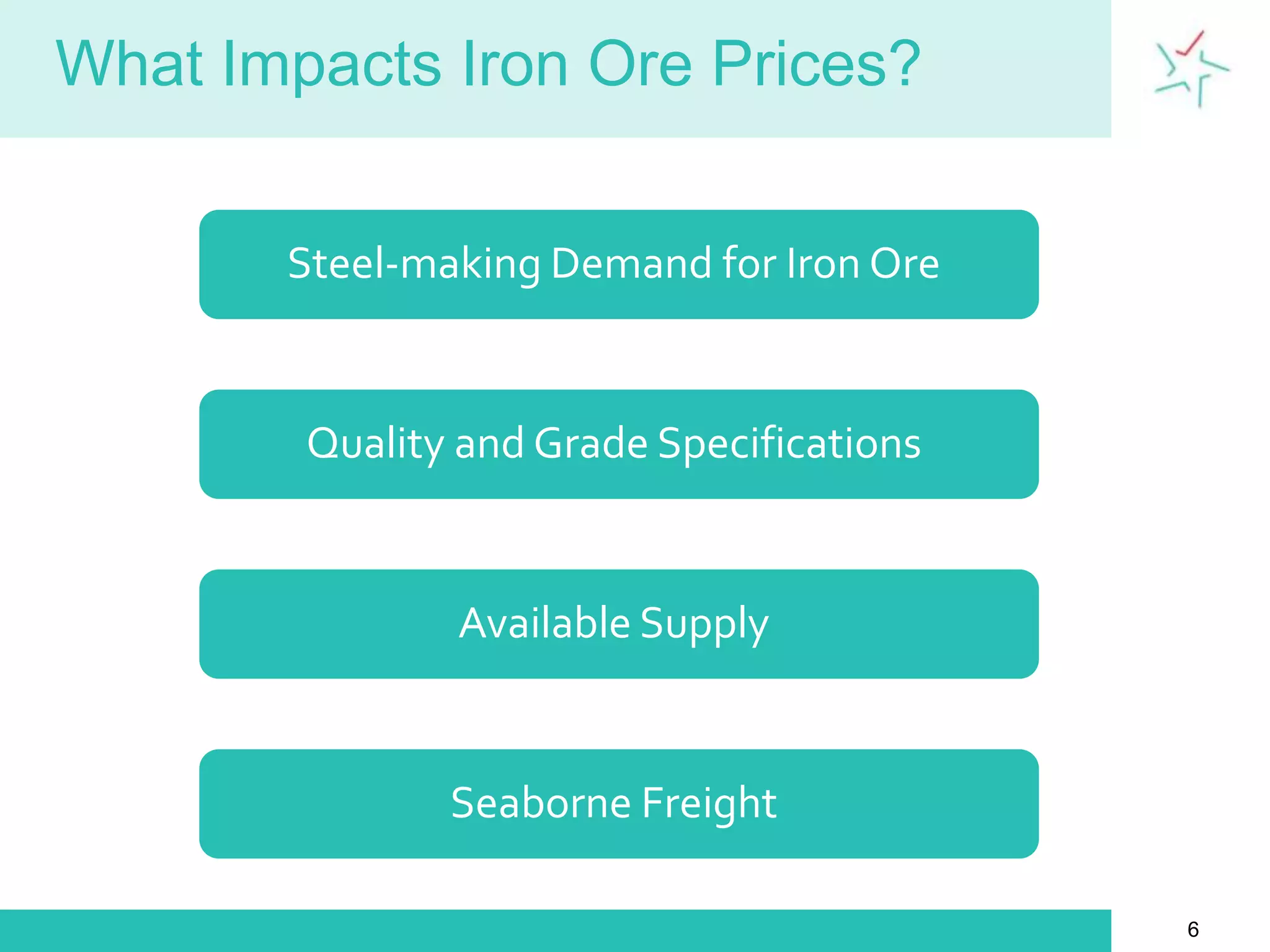
What Impacts Iron Ore Prices?Steel-making Demand for Iron OreQuality and Grade SpecificationsAvailable SupplySeaborne Freight 6
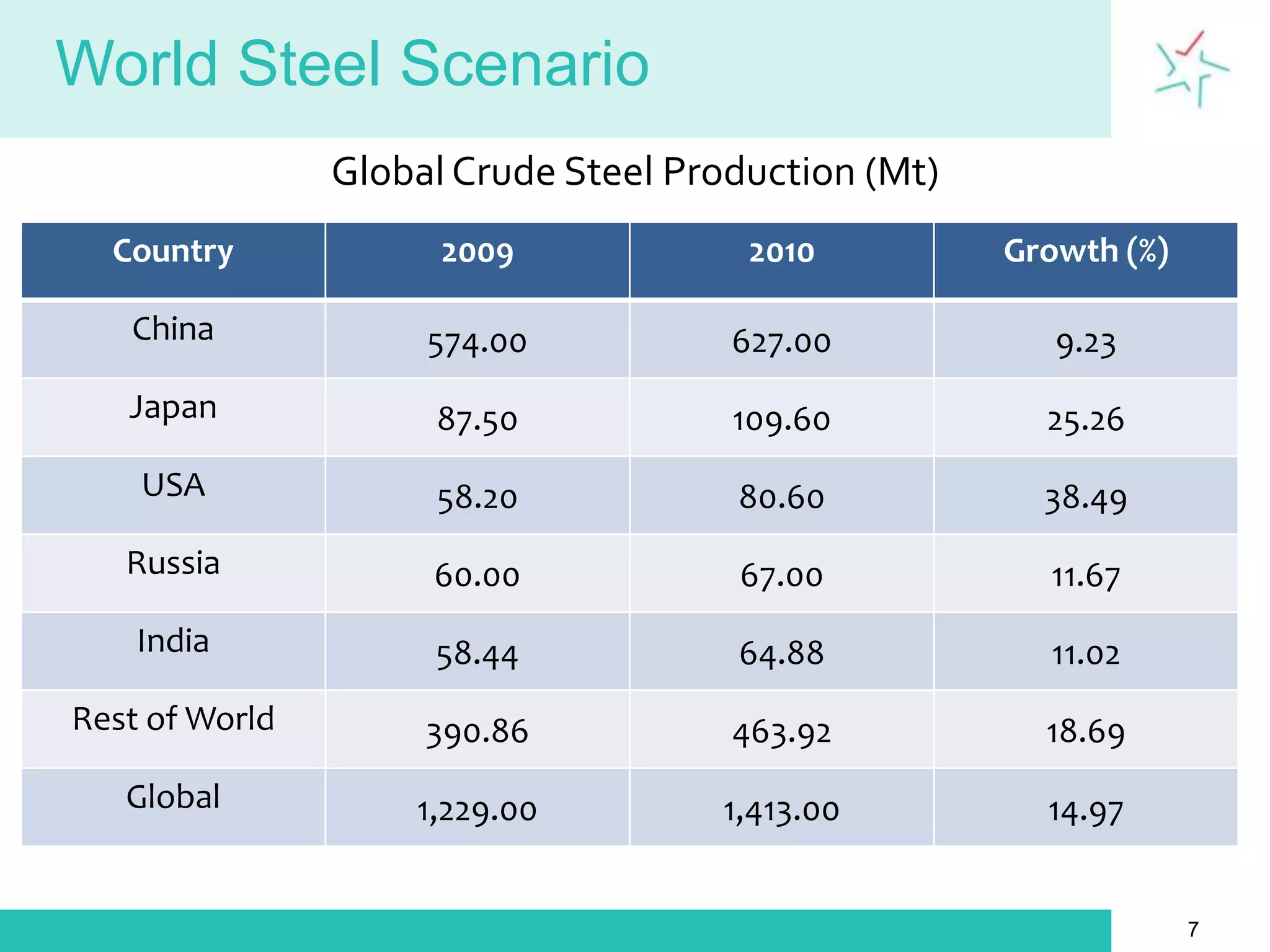
World Steel ScenarioGlobal Crude Steel Production (Mt)7
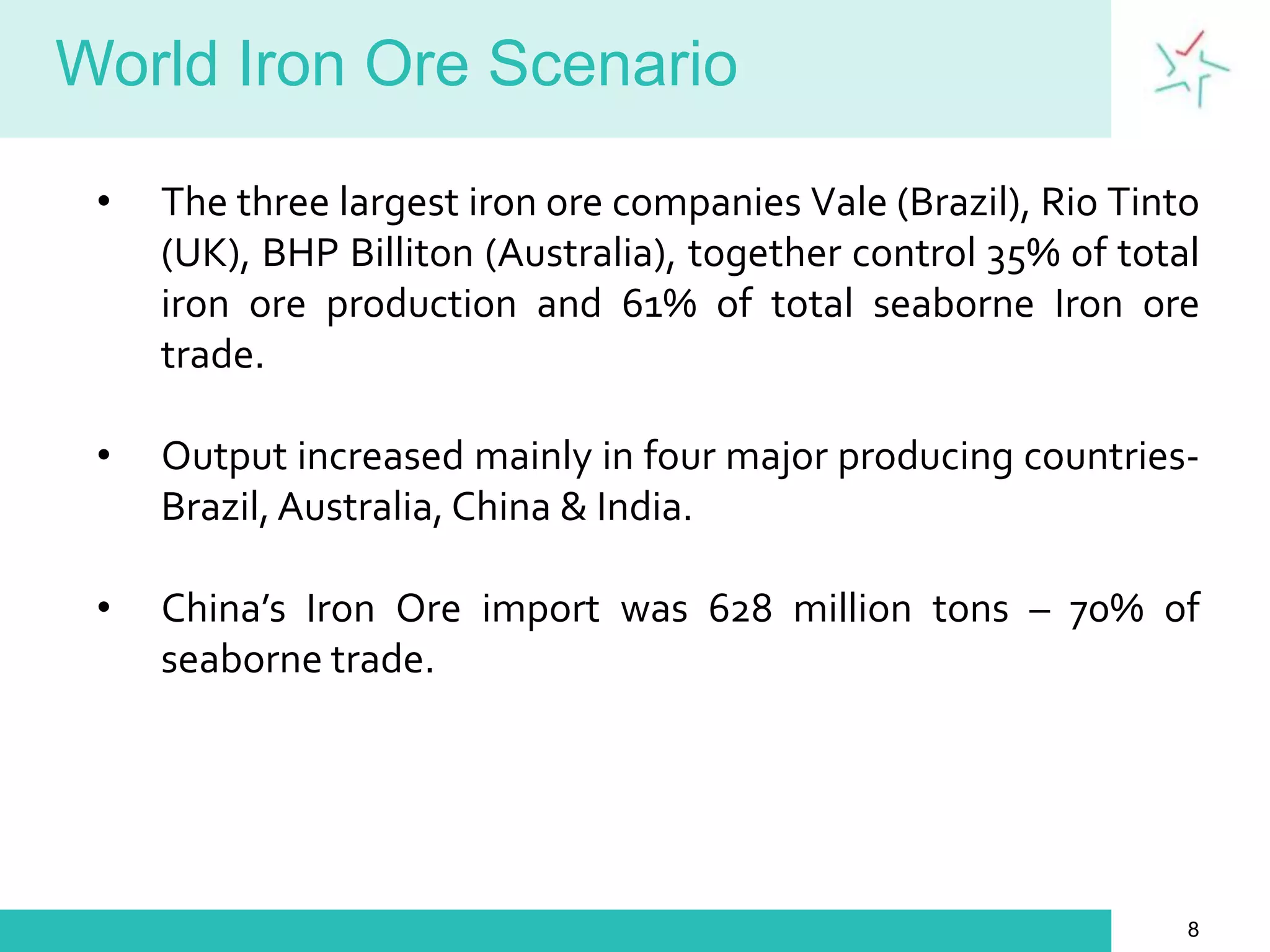
World Iron Ore ScenarioThe three largest iron ore companies Vale (Brazil), Rio Tinto (UK), BHP Billiton (Australia), together control 35% of total iron ore production and 61% of total seaborne Iron ore trade.
Output increased mainly in four major producing countries- Brazil, Australia, China & India.
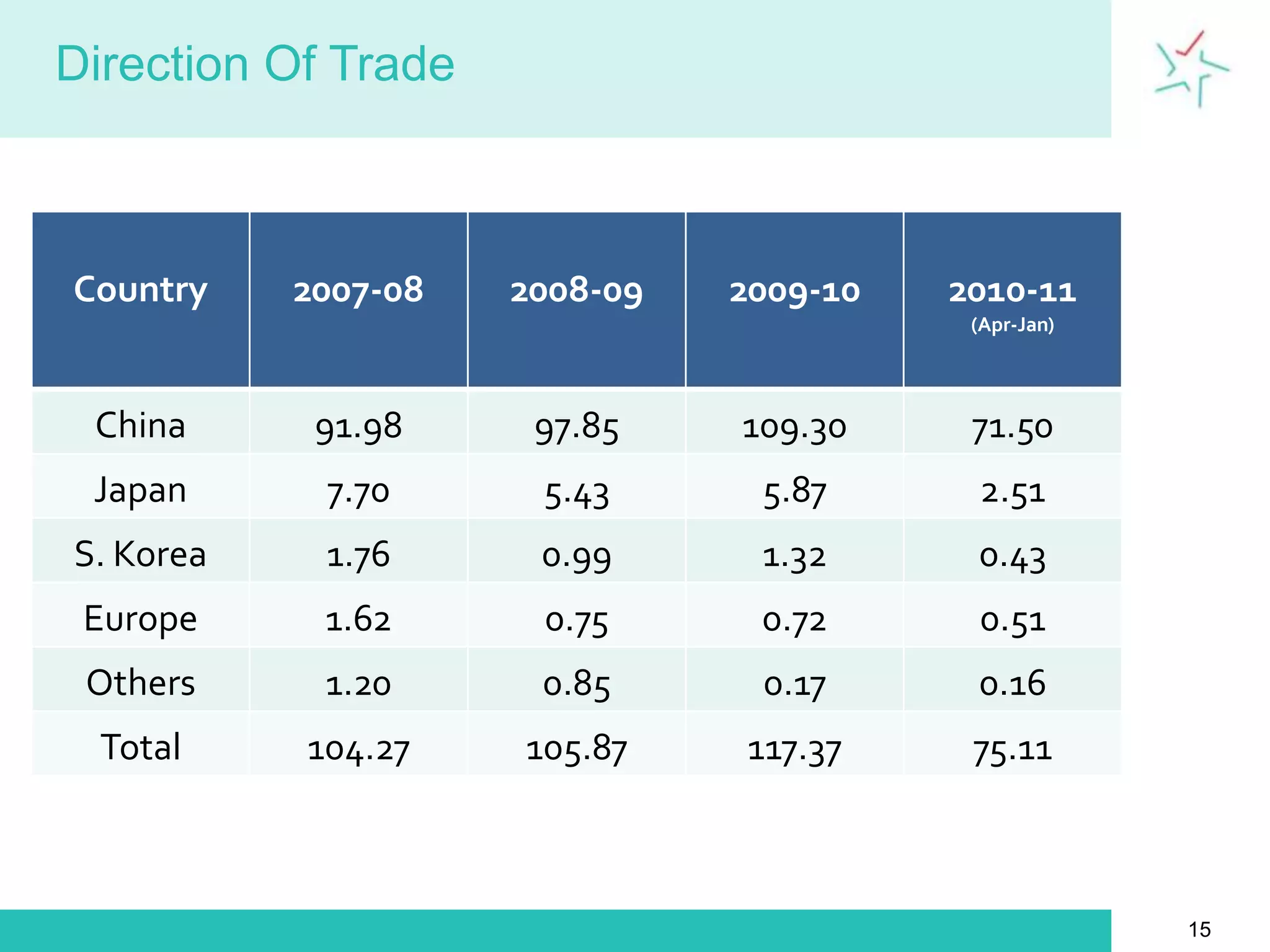
China’s Iron Ore import was 628 million tons – 70% of seaborne trade.8
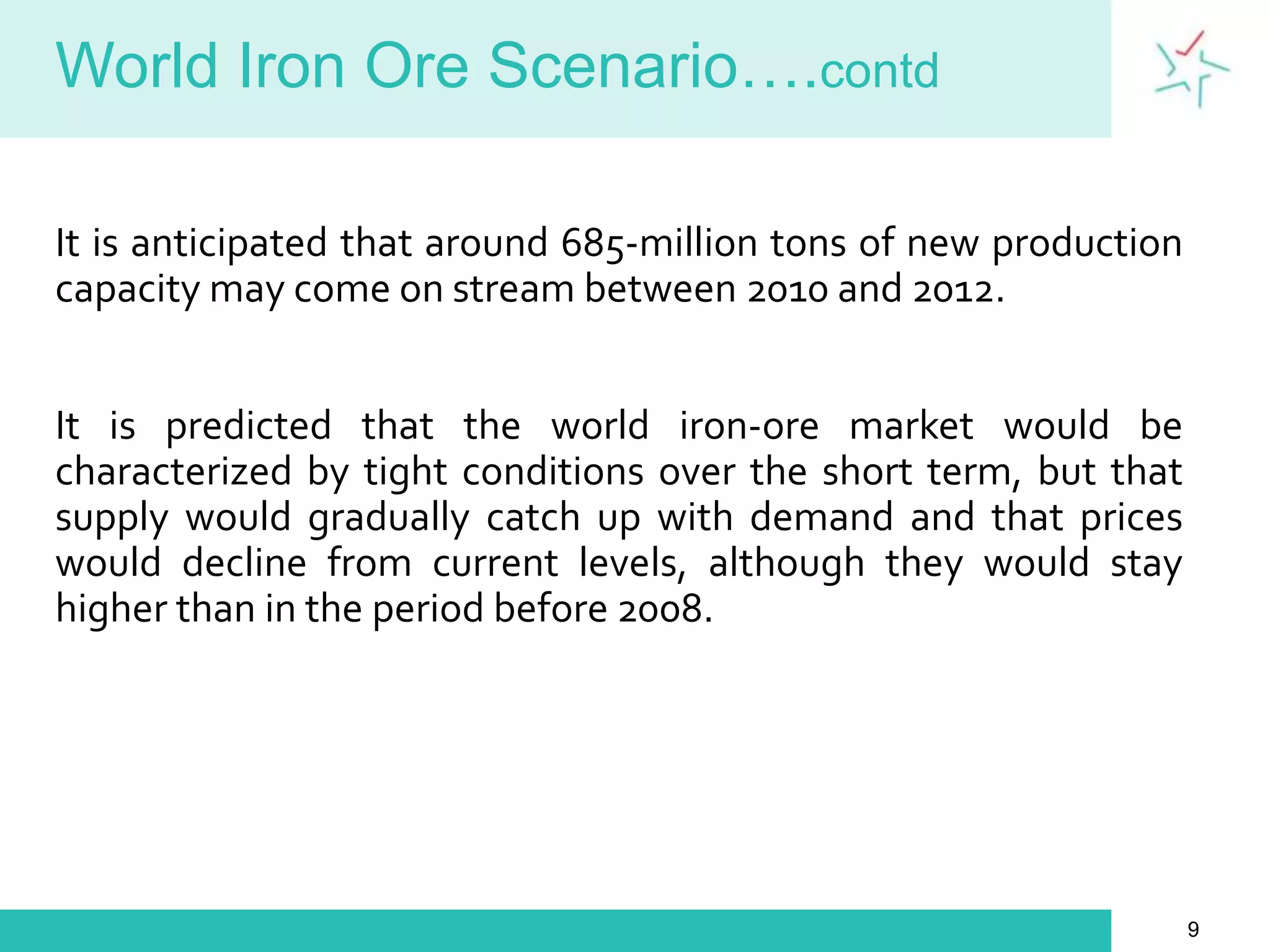
World Iron Ore Scenario….contdIt is anticipated that around 685-million tons of new production capacity may come on stream between 2010 and 2012.It is predicted that the world iron-ore market would be characterized by tight conditions over the short term, but that supply would gradually catch up with demand and that prices would decline from current levels, although they would stay higher than in the period before 2008.9
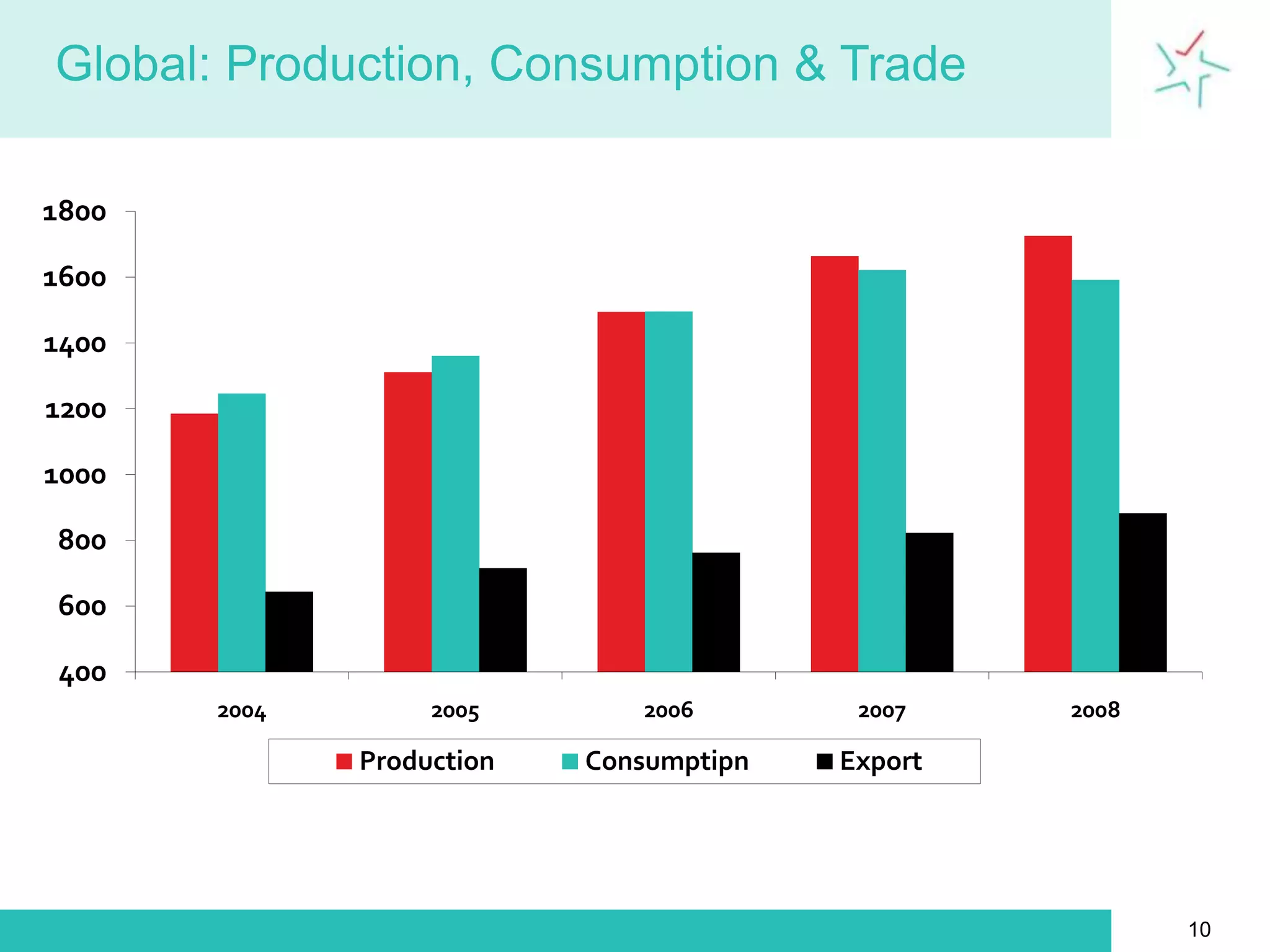
Global: Production, Consumption & Trade10
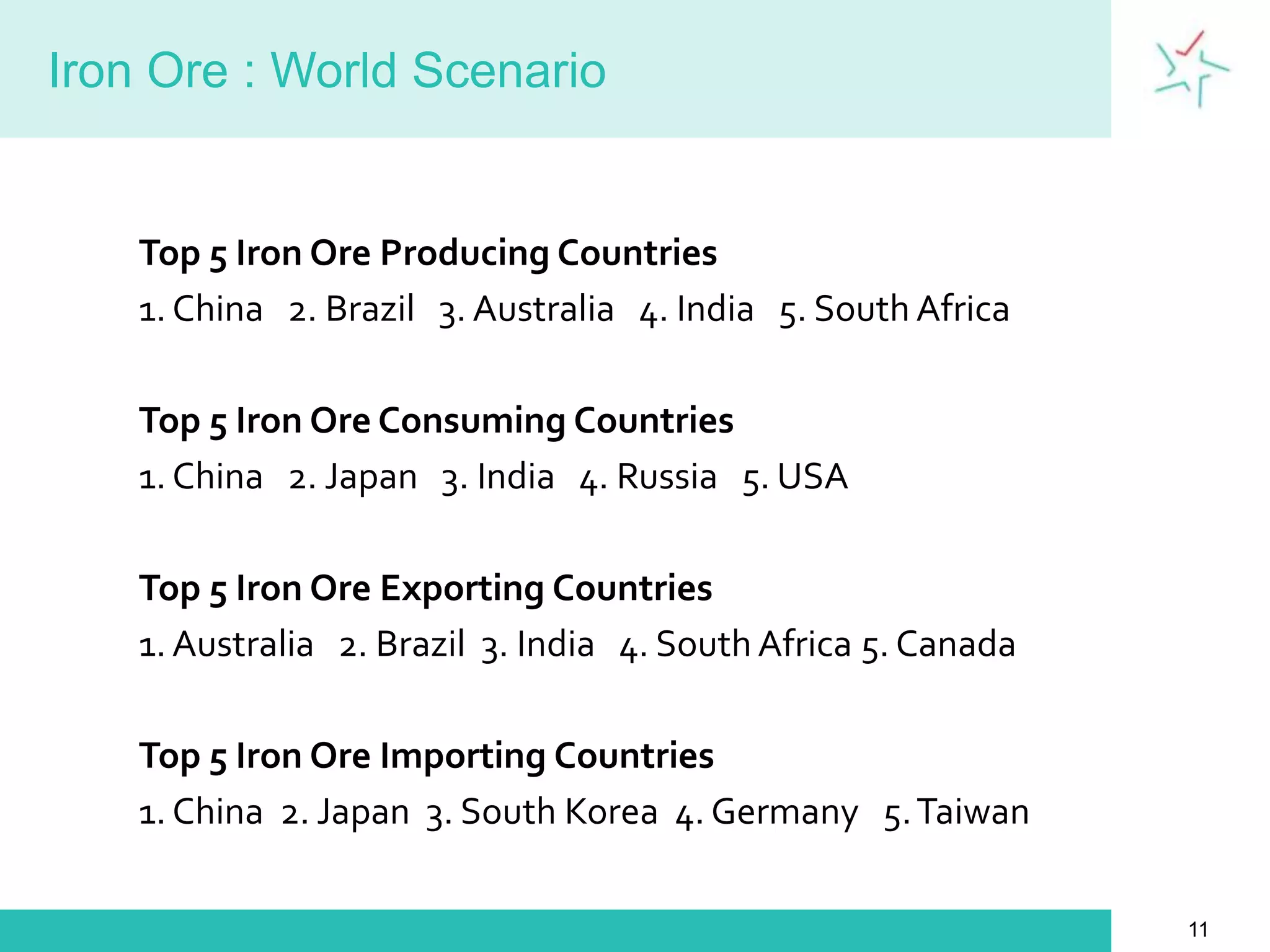
Top 5 Iron Ore Producing Countries 1. China   2. Brazil   3. Australia   4. India   5. South AfricaTop 5 Iron Ore Consuming Countries 1. China   2. Japan   3. India   4. Russia   5. USATop 5 Iron Ore Exporting Countries 1. Australia   2. Brazil  3. India   4. South Africa 5. CanadaTop 5 Iron Ore Importing Countries 1. China  2. Japan  3. South Korea  4. Germany   5. Taiwan Iron Ore : World Scenario11
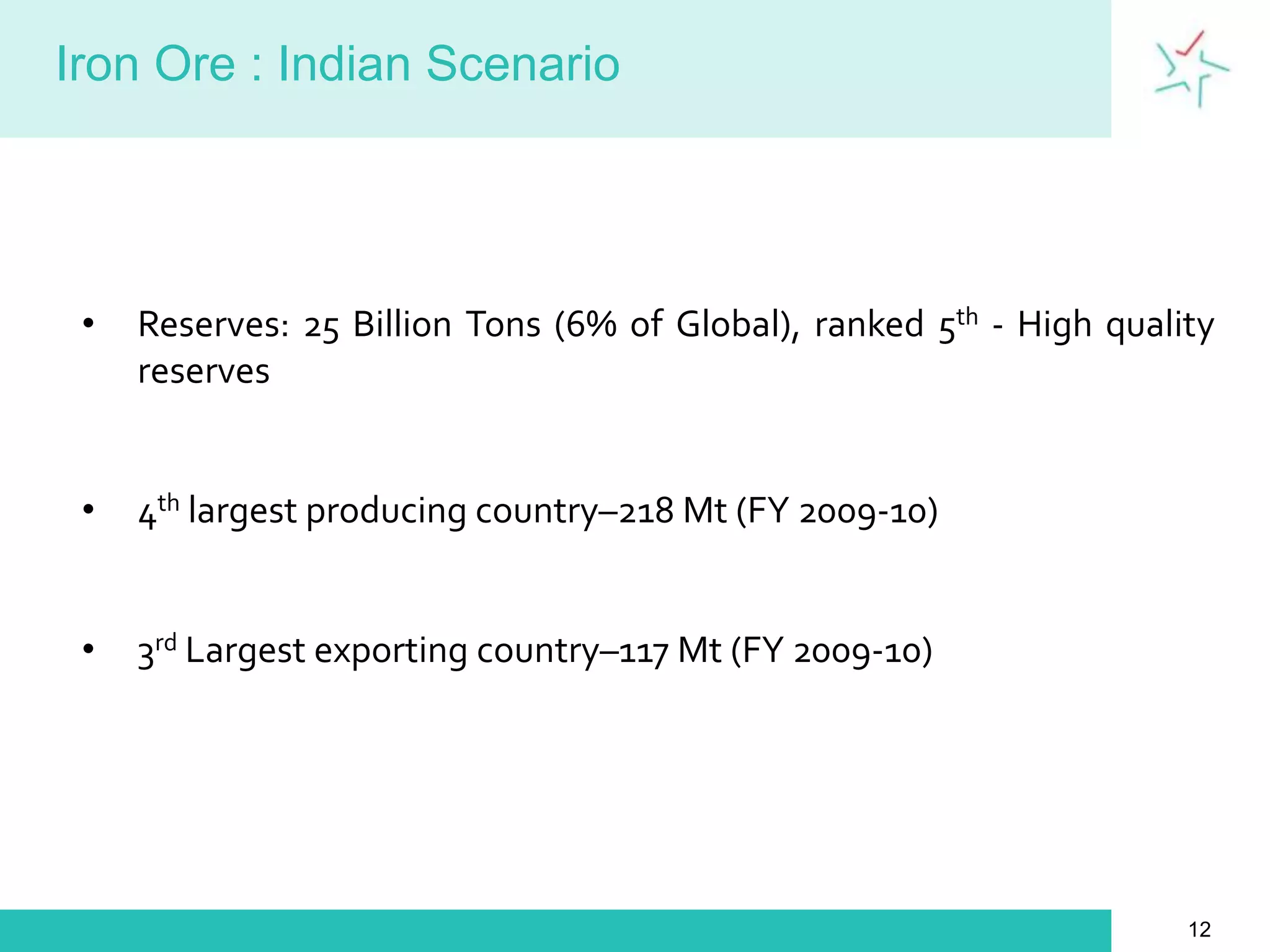
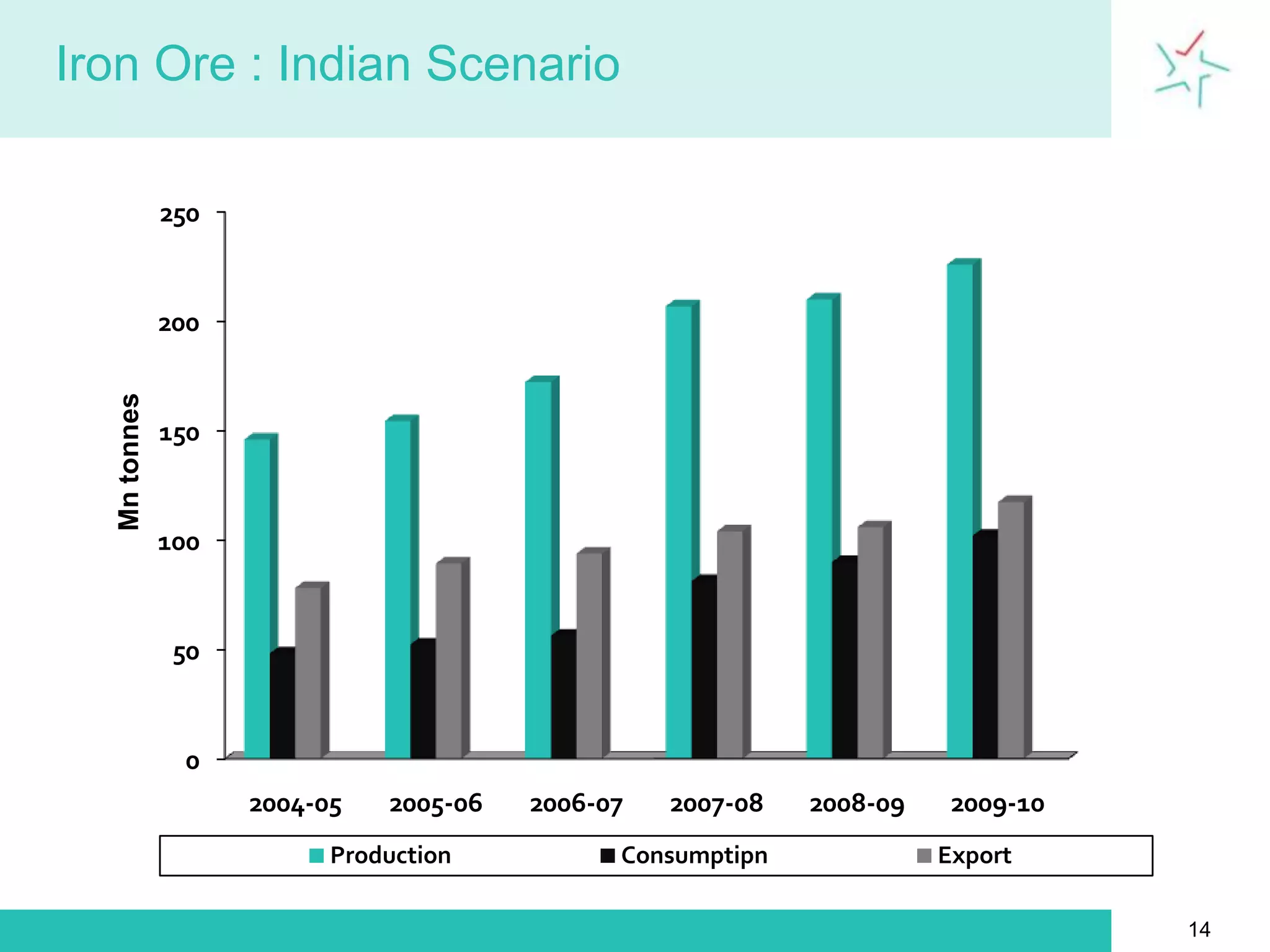
Iron Ore : Indian ScenarioReserves: 25 Billion Tons (6% of Global), ranked 5th - High quality reserves
4th largest producing country–218 Mt (FY 2009-10)
3rd Largest exporting country–117 Mt (FY 2009-10)12
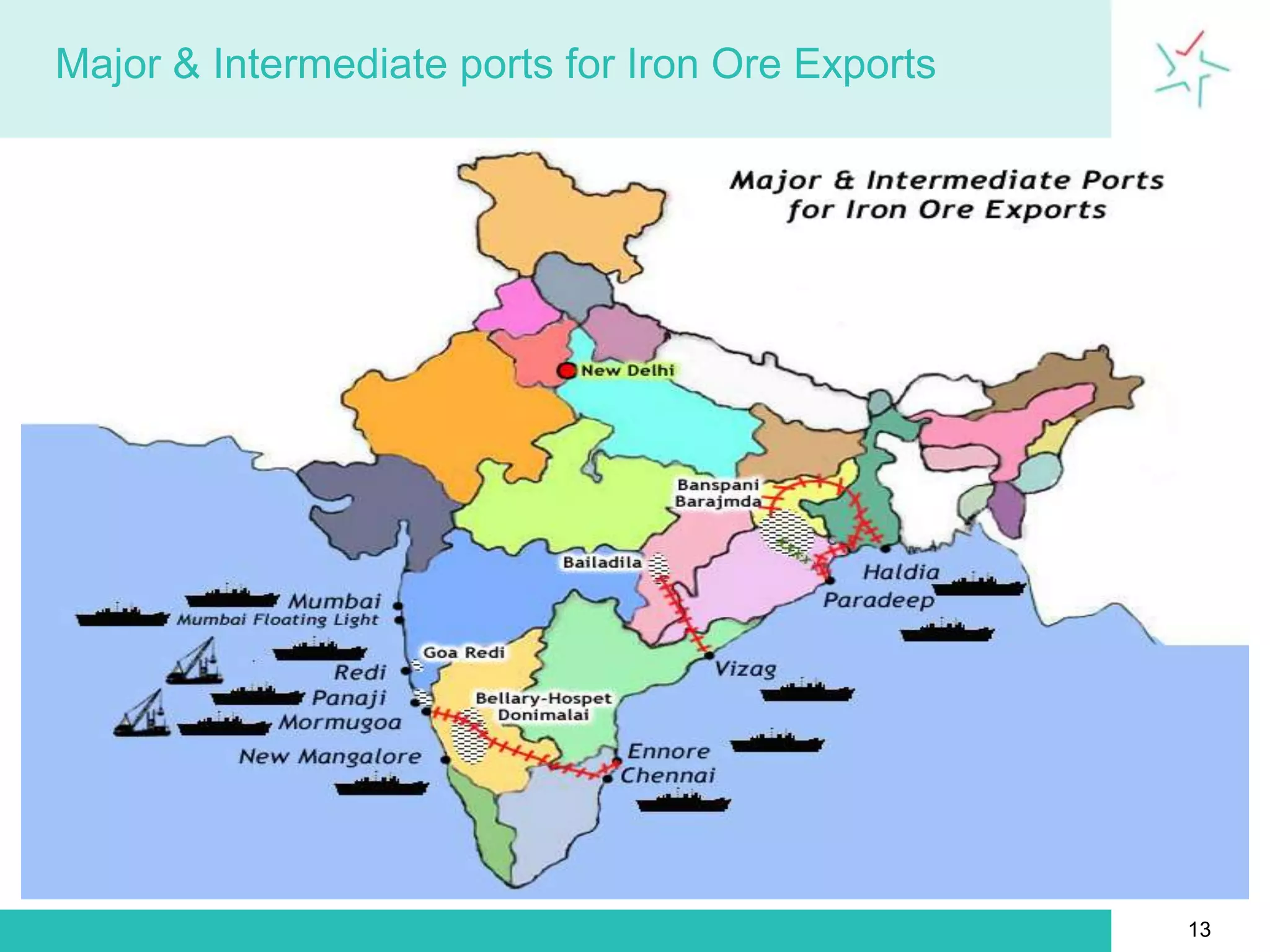
Major & Intermediate ports for Iron Ore Exports13
Iron Ore : Indian Scenario14
Direction Of Trade15
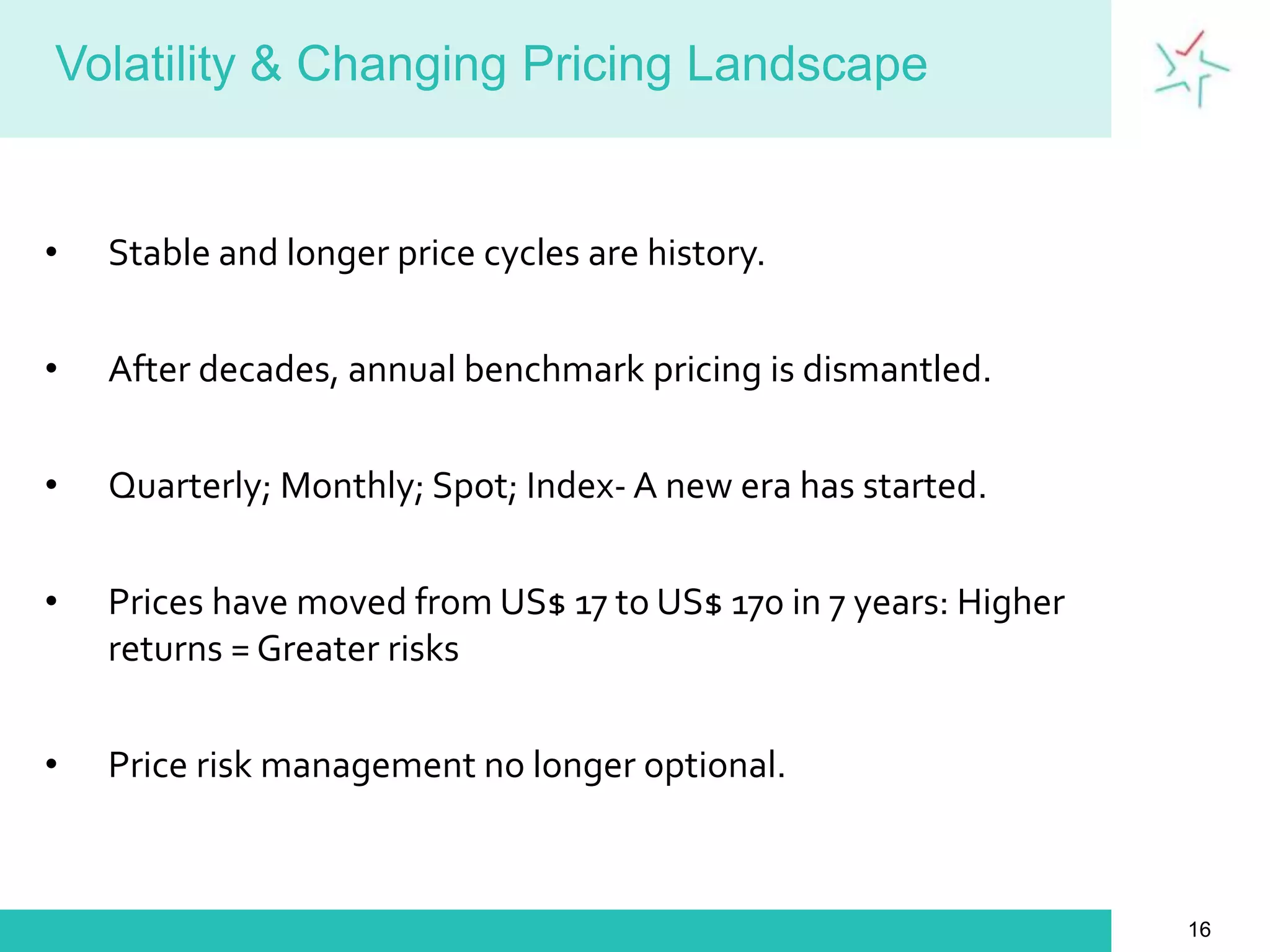
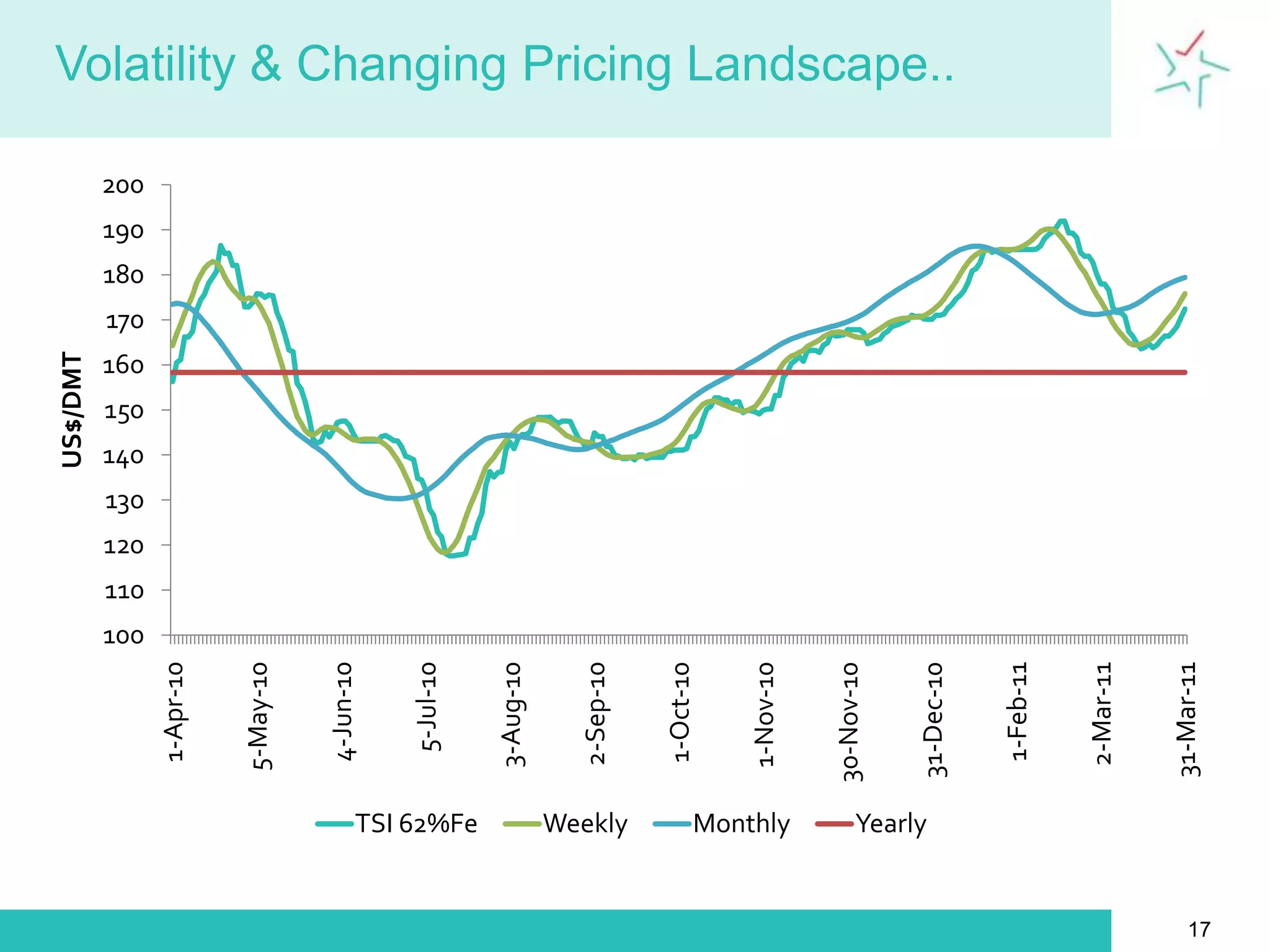
Volatility & Changing Pricing LandscapeStable and longer price cycles are history.
After decades, annual benchmark pricing is dismantled.
Quarterly; Monthly; Spot; Index- A new era has started.
Prices have moved from US$ 17 to US$ 170 in 7 years: Higher returns = Greater risks
Price risk management no longer optional.16
Volatility & Changing Pricing Landscape..17
…. Iron Ore is moving in the direction of setting prices as Copper, Nickel or other base metals are on a completely transparent Exchange under the full control against any type of manipulations ….Source: Iron Ore Market 2009-2011 (UNCTAD)18
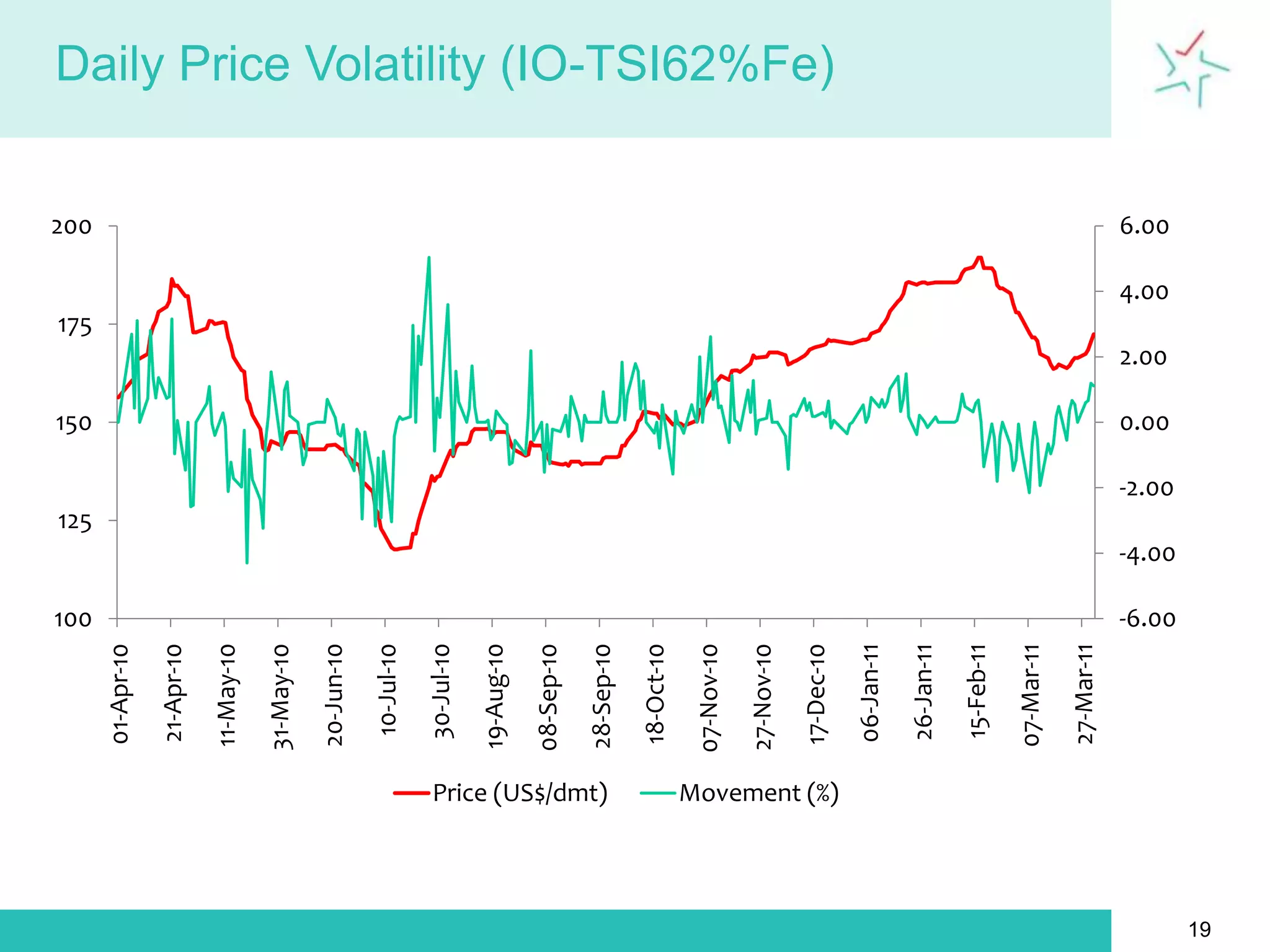
Daily Price Volatility (IO-TSI62%Fe)19
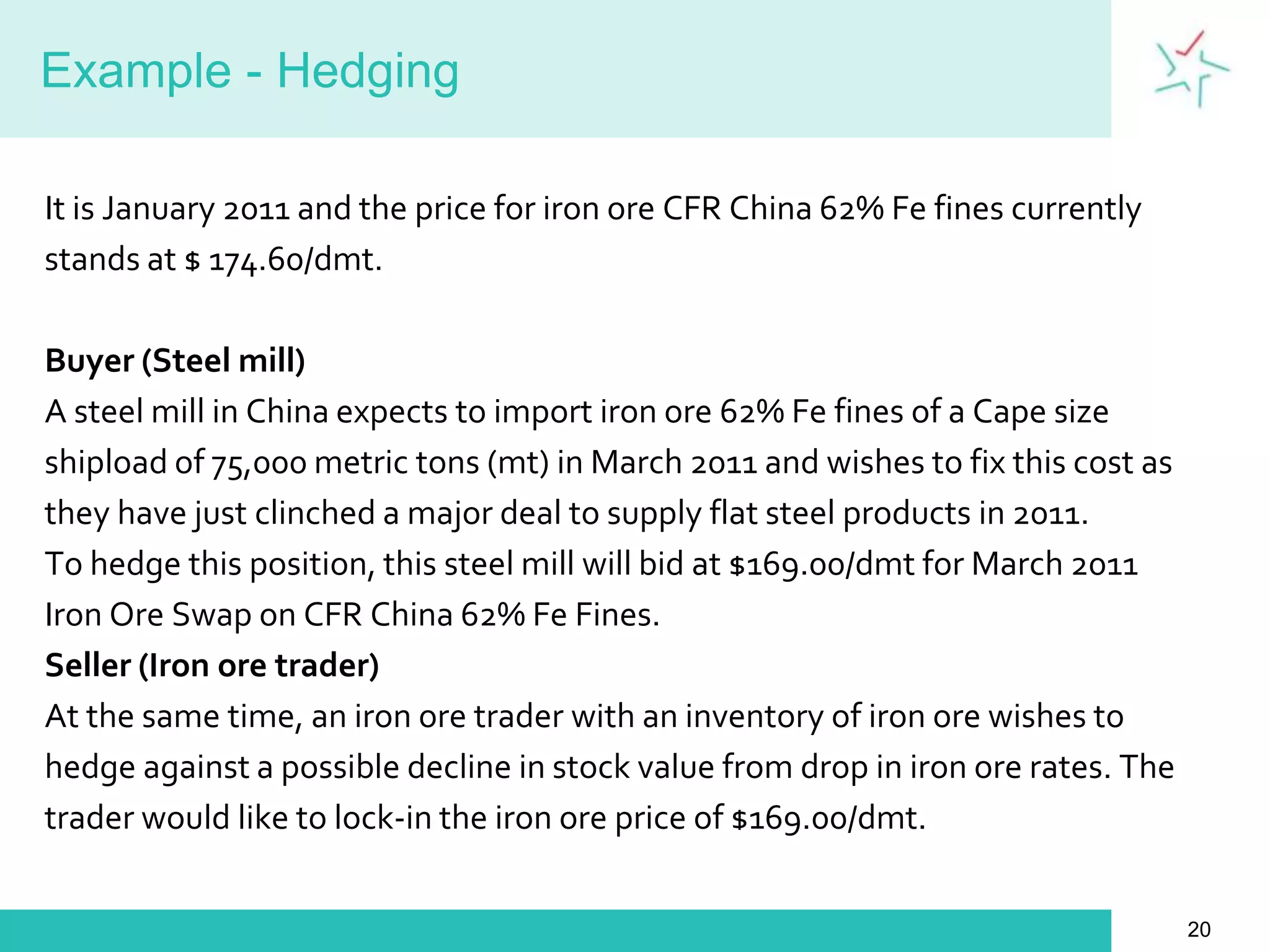
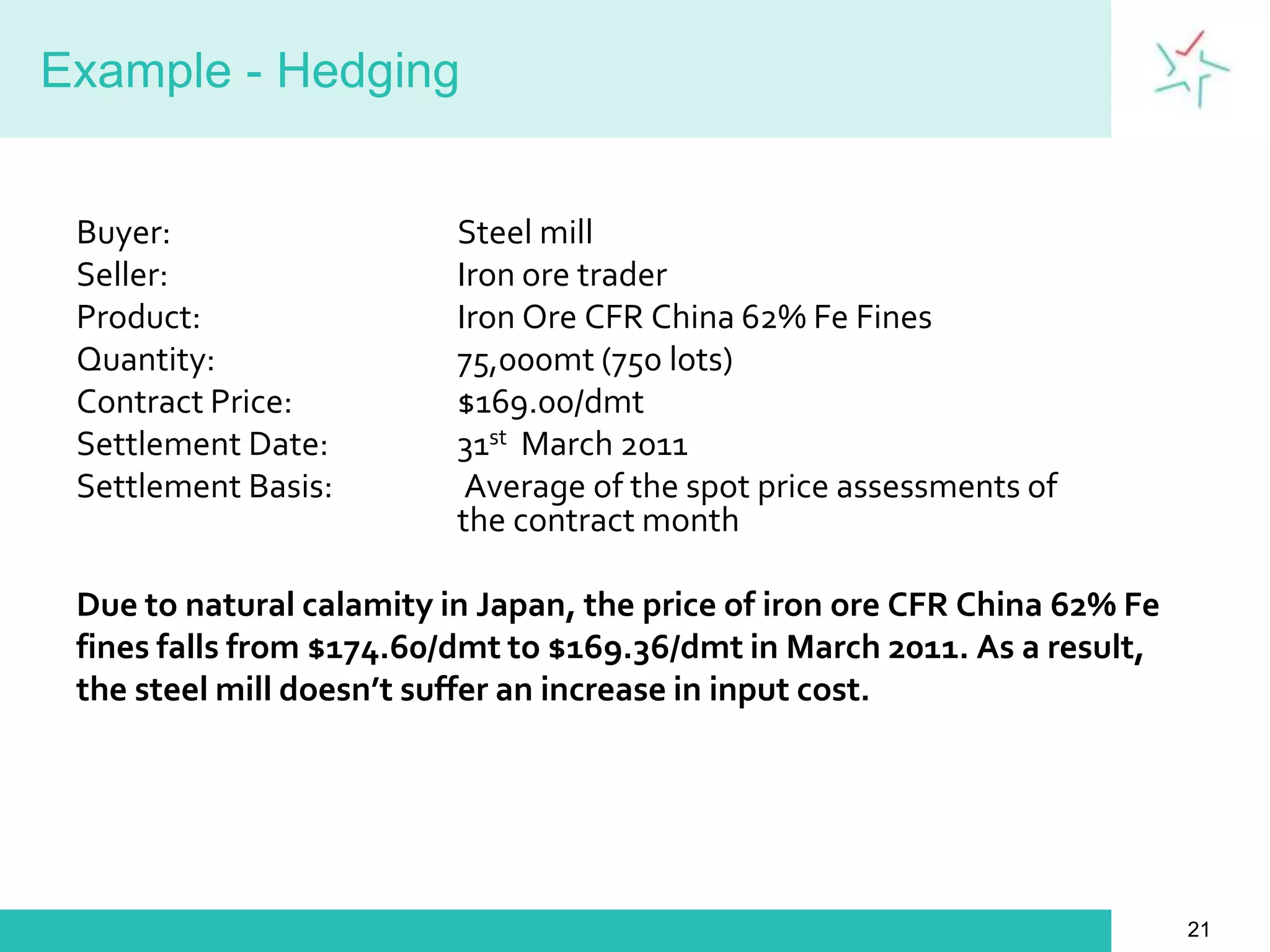
  Example - HedgingIt is January 2011 and the price for iron ore CFR China 62% Fe fines currentlystands at $ 174.60/dmt.Buyer (Steel mill)A steel mill in China expects to import iron ore 62% Fe fines of a Cape sizeshipload of 75,000 metric tons (mt) in March 2011 and wishes to fix this cost asthey have just clinched a major deal to supply flat steel products in 2011.To hedge this position, this steel mill will bid at $169.00/dmt for March 2011Iron Ore Swap on CFR China 62% Fe Fines.Seller (Iron ore trader)At the same time, an iron ore trader with an inventory of iron ore wishes tohedge against a possible decline in stock value from drop in iron ore rates. Thetrader would like to lock-in the iron ore price of $169.00/dmt.20
  Example - HedgingBuyer:			Steel millSeller: 			Iron ore traderProduct:			Iron Ore CFR China 62% Fe FinesQuantity:		75,000mt (750 lots)Contract Price:		$169.00/dmtSettlement Date:		31st  March 2011Settlement Basis:	 Average of the spot price assessments of 				the contract monthDue to natural calamity in Japan, the price of iron ore CFR China 62% Fe fines falls from $174.60/dmt to $169.36/dmt in March 2011. As a result, the steel mill doesn’t suffer an increase in input cost.21
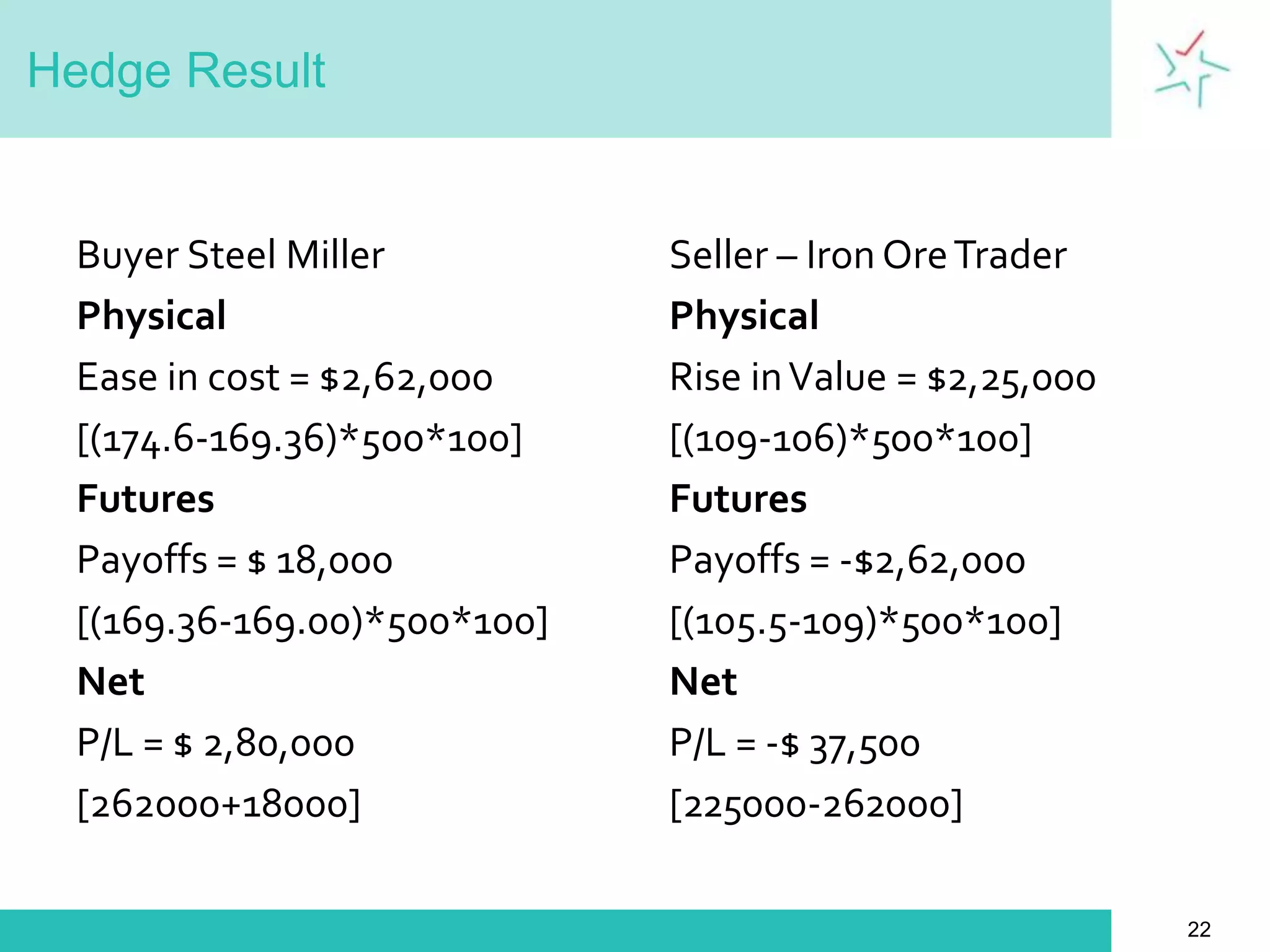
 Hedge ResultBuyer Steel MillerPhysicalEase in cost = $2,62,000[(174.6-169.36)*500*100]FuturesPayoffs = $ 18,000[(169.36-169.00)*500*100]NetP/L = $ 2,80,000[262000+18000]Seller – Iron Ore TraderPhysicalRise in Value = $2,25,000[(109-106)*500*100]FuturesPayoffs = -$2,62,000[(105.5-109)*500*100]NetP/L = -$ 37,500[225000-262000]22
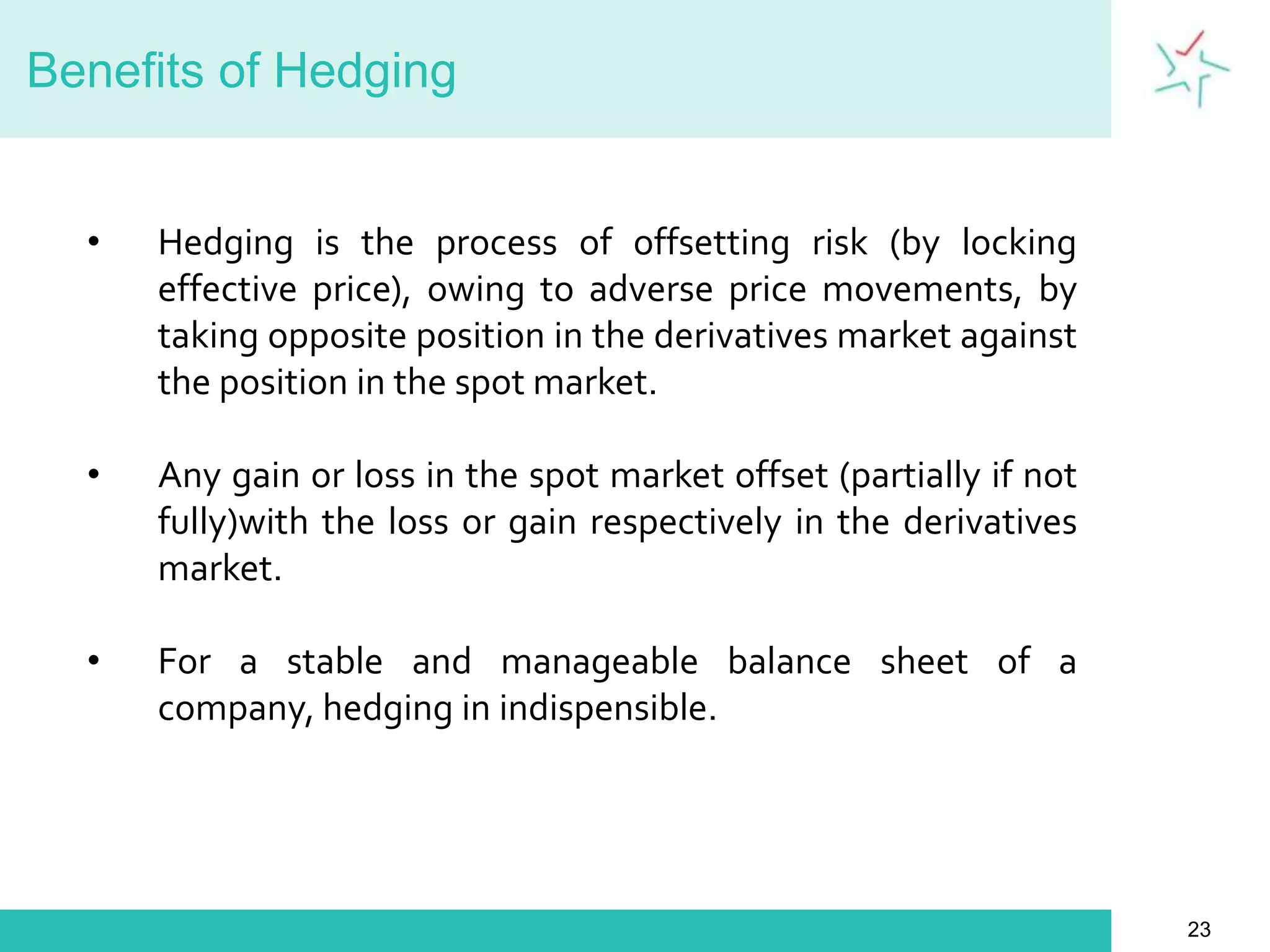
 Benefits of HedgingHedging is the process of offsetting risk (by locking effective price), owing to adverse price movements, by taking opposite position in the derivatives market against the position in the spot market.
Any gain or loss in the spot market offset (partially if not fully)with the loss or gain respectively in the derivatives market.

IRON ORE

  • 1.
    Indian Commodity ExchangeLimited Presentation : Iron Ore Derivatives1
  • 2.
    What are DerivativesDerivativeis a financial instrument (or, more simply, an agreement between two parties) that has a value, based on the expected future pricemovements of the asset to which it is linked—called the underlying asset— as a share or a currency or a commodity Most common derivatives are swaps, futures, and optionsDerivatives are usually broadly categorized by:the type of underlying asset (e.g., equity derivatives, foreign exchange derivatives, interest rate derivatives, commodity derivatives or credit derivatives); the relationship between the underlying asset and the derivative (e.g., forward, option, swap); the market in which they trade (e.g., exchange-traded or over-the-counter); their pay-off profile. 2
  • 3.
    Why Commodity Derivatives…DynamicPrice DiscoveryTransparency – Information DisseminationHedging ToolEven smaller players reap same advantage as big onesTakes care of counter party defaultEasy to sell / buy in liquid marketLeverage3
  • 4.
  • 5.
    Iron Ore DerivativesAnticipatingthe Needs of a Changing Market…The iron ore and related ferrous market is the second largest commodity market by volume after crude oil.
  • 6.
    The mining andtransport of this raw material is capital intensive, which leads to supply constraints not readily filled by other materials.
  • 7.
    These factors thusexpose the steel mills not only to supply constraints, but also to transport uncertainties, which can lead to volatile price fluctuations.
  • 8.
    Demand is expectedto rise with the continual growth of emerging markets.
  • 9.
    China produces nearlyone-half of the world’s finished steel, making it the premier destination for seaborne iron ore shipments.5
  • 10.
    What Impacts IronOre Prices?Steel-making Demand for Iron OreQuality and Grade SpecificationsAvailable SupplySeaborne Freight 6
  • 11.
    World Steel ScenarioGlobalCrude Steel Production (Mt)7
  • 12.
    World Iron OreScenarioThe three largest iron ore companies Vale (Brazil), Rio Tinto (UK), BHP Billiton (Australia), together control 35% of total iron ore production and 61% of total seaborne Iron ore trade.
  • 13.
    Output increased mainlyin four major producing countries- Brazil, Australia, China & India.
  • 14.
    China’s Iron Oreimport was 628 million tons – 70% of seaborne trade.8
  • 15.
    World Iron OreScenario….contdIt is anticipated that around 685-million tons of new production capacity may come on stream between 2010 and 2012.It is predicted that the world iron-ore market would be characterized by tight conditions over the short term, but that supply would gradually catch up with demand and that prices would decline from current levels, although they would stay higher than in the period before 2008.9
  • 16.
  • 17.
    Top 5 IronOre Producing Countries 1. China 2. Brazil 3. Australia 4. India 5. South AfricaTop 5 Iron Ore Consuming Countries 1. China 2. Japan 3. India 4. Russia 5. USATop 5 Iron Ore Exporting Countries 1. Australia 2. Brazil 3. India 4. South Africa 5. CanadaTop 5 Iron Ore Importing Countries 1. China 2. Japan 3. South Korea 4. Germany 5. Taiwan Iron Ore : World Scenario11
  • 18.
    Iron Ore :Indian ScenarioReserves: 25 Billion Tons (6% of Global), ranked 5th - High quality reserves
  • 19.
    4th largest producingcountry–218 Mt (FY 2009-10)
  • 20.
    3rd Largest exportingcountry–117 Mt (FY 2009-10)12
  • 21.
    Major & Intermediateports for Iron Ore Exports13
  • 22.
    Iron Ore :Indian Scenario14
  • 23.
  • 24.
    Volatility & ChangingPricing LandscapeStable and longer price cycles are history.
  • 25.
    After decades, annualbenchmark pricing is dismantled.
  • 26.
    Quarterly; Monthly; Spot;Index- A new era has started.
  • 27.
    Prices have movedfrom US$ 17 to US$ 170 in 7 years: Higher returns = Greater risks
  • 28.
    Price risk managementno longer optional.16
  • 29.
    Volatility & ChangingPricing Landscape..17
  • 30.
    …. Iron Oreis moving in the direction of setting prices as Copper, Nickel or other base metals are on a completely transparent Exchange under the full control against any type of manipulations ….Source: Iron Ore Market 2009-2011 (UNCTAD)18
  • 31.
    Daily Price Volatility(IO-TSI62%Fe)19
  • 32.
    Example- HedgingIt is January 2011 and the price for iron ore CFR China 62% Fe fines currentlystands at $ 174.60/dmt.Buyer (Steel mill)A steel mill in China expects to import iron ore 62% Fe fines of a Cape sizeshipload of 75,000 metric tons (mt) in March 2011 and wishes to fix this cost asthey have just clinched a major deal to supply flat steel products in 2011.To hedge this position, this steel mill will bid at $169.00/dmt for March 2011Iron Ore Swap on CFR China 62% Fe Fines.Seller (Iron ore trader)At the same time, an iron ore trader with an inventory of iron ore wishes tohedge against a possible decline in stock value from drop in iron ore rates. Thetrader would like to lock-in the iron ore price of $169.00/dmt.20
  • 33.
    Example- HedgingBuyer: Steel millSeller: Iron ore traderProduct: Iron Ore CFR China 62% Fe FinesQuantity: 75,000mt (750 lots)Contract Price: $169.00/dmtSettlement Date: 31st March 2011Settlement Basis: Average of the spot price assessments of the contract monthDue to natural calamity in Japan, the price of iron ore CFR China 62% Fe fines falls from $174.60/dmt to $169.36/dmt in March 2011. As a result, the steel mill doesn’t suffer an increase in input cost.21
  • 34.
    Hedge ResultBuyerSteel MillerPhysicalEase in cost = $2,62,000[(174.6-169.36)*500*100]FuturesPayoffs = $ 18,000[(169.36-169.00)*500*100]NetP/L = $ 2,80,000[262000+18000]Seller – Iron Ore TraderPhysicalRise in Value = $2,25,000[(109-106)*500*100]FuturesPayoffs = -$2,62,000[(105.5-109)*500*100]NetP/L = -$ 37,500[225000-262000]22
  • 35.
    Benefits ofHedgingHedging is the process of offsetting risk (by locking effective price), owing to adverse price movements, by taking opposite position in the derivatives market against the position in the spot market.
  • 36.
    Any gain orloss in the spot market offset (partially if not fully)with the loss or gain respectively in the derivatives market.
  • 37.
    For a stableand manageable balance sheet of a company, hedging in indispensible. 23
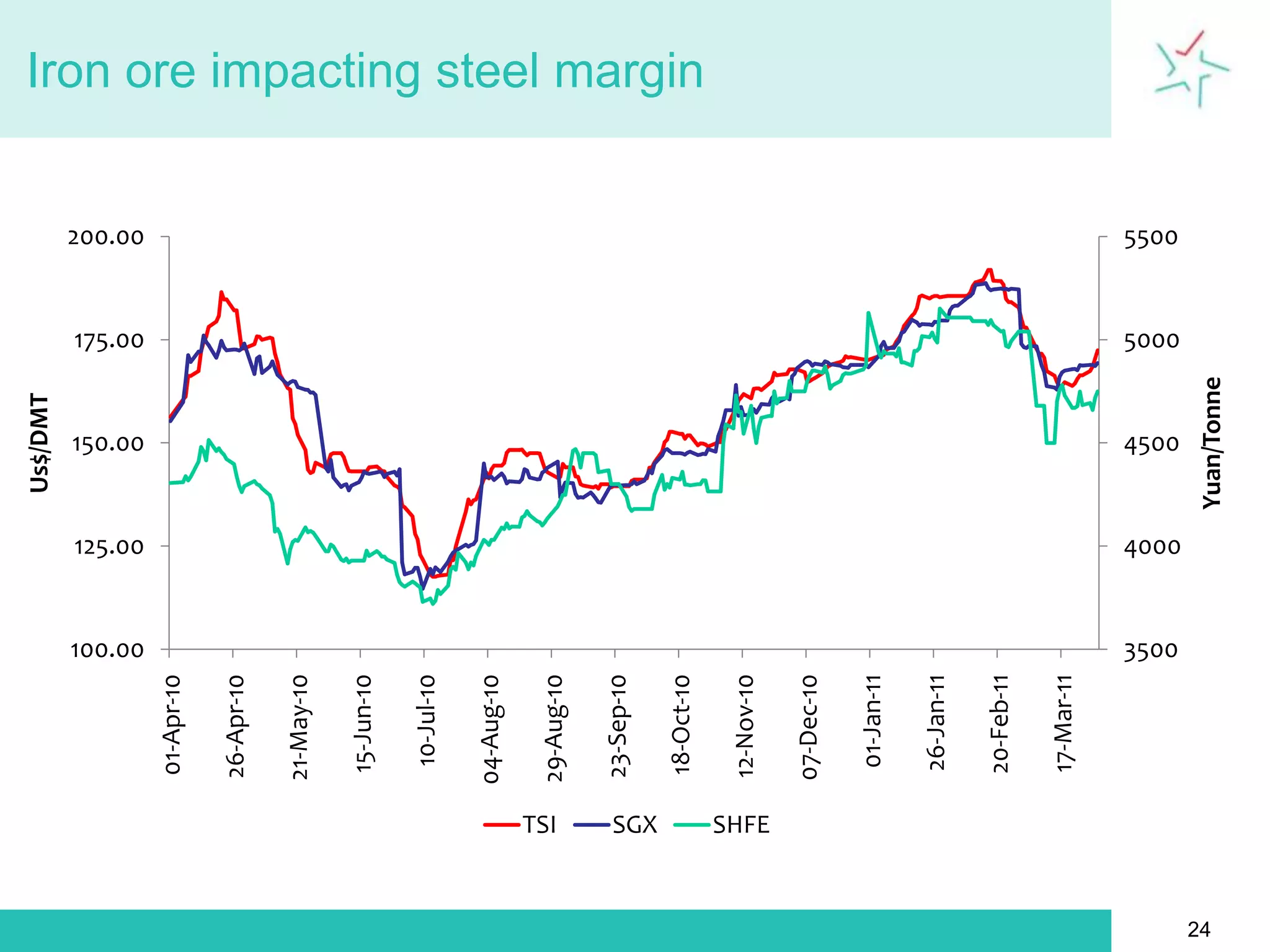
  • 38.
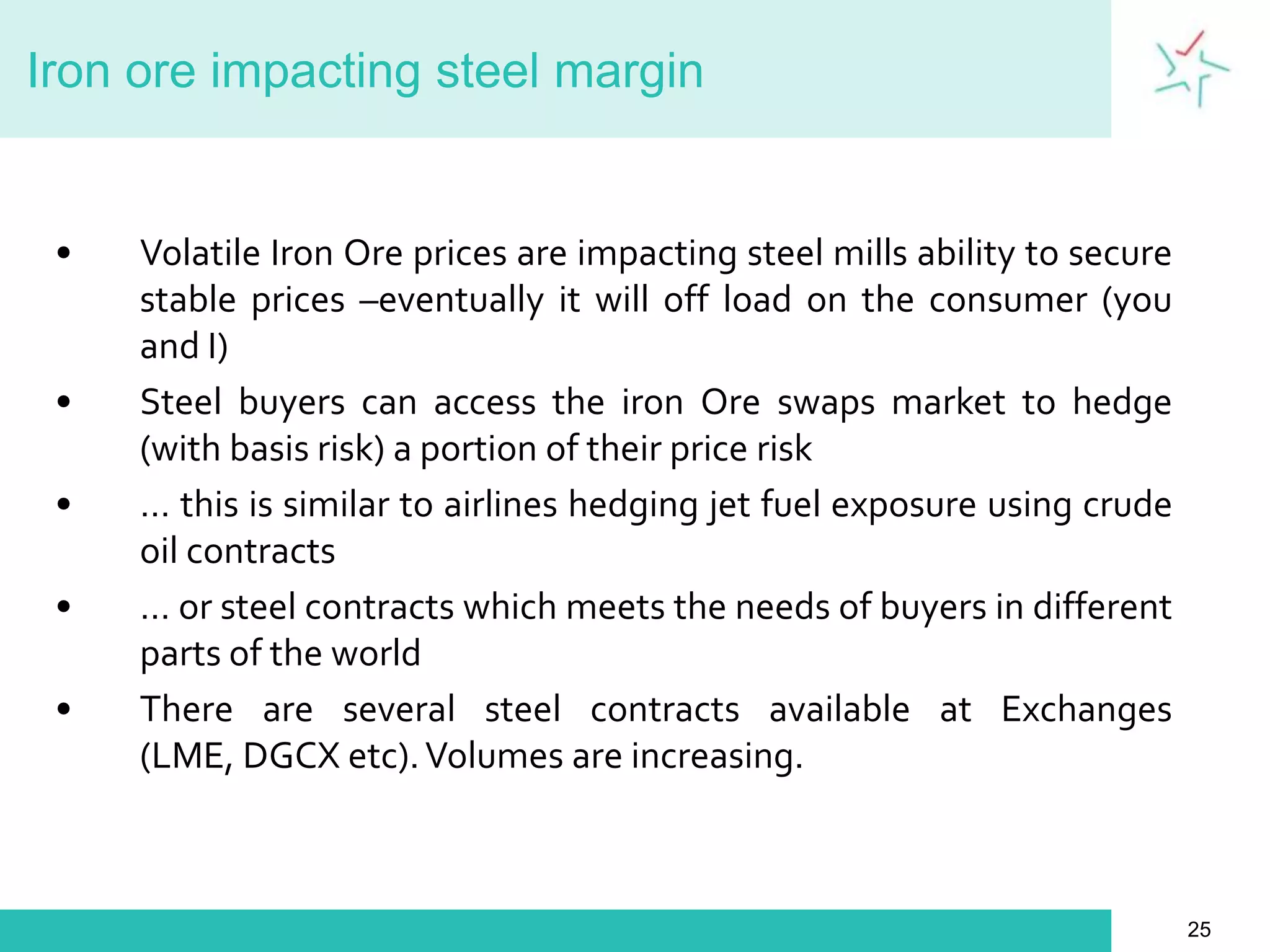
    Iron oreimpacting steel margin24
  • 39.
    Iron oreimpacting steel marginVolatile Iron Ore prices are impacting steel mills ability to secure stable prices –eventually it will off load on the consumer (you and I)
  • 40.
    Steel buyers canaccess the iron Ore swaps market to hedge (with basis risk) a portion of their price risk
  • 41.
    … this issimilar to airlines hedging jet fuel exposure using crude oil contracts
  • 42.
    … or steelcontracts which meets the needs of buyers in different parts of the world
  • 43.
    There are severalsteel contracts available at Exchanges (LME, DGCX etc). Volumes are increasing.25
  • 44.
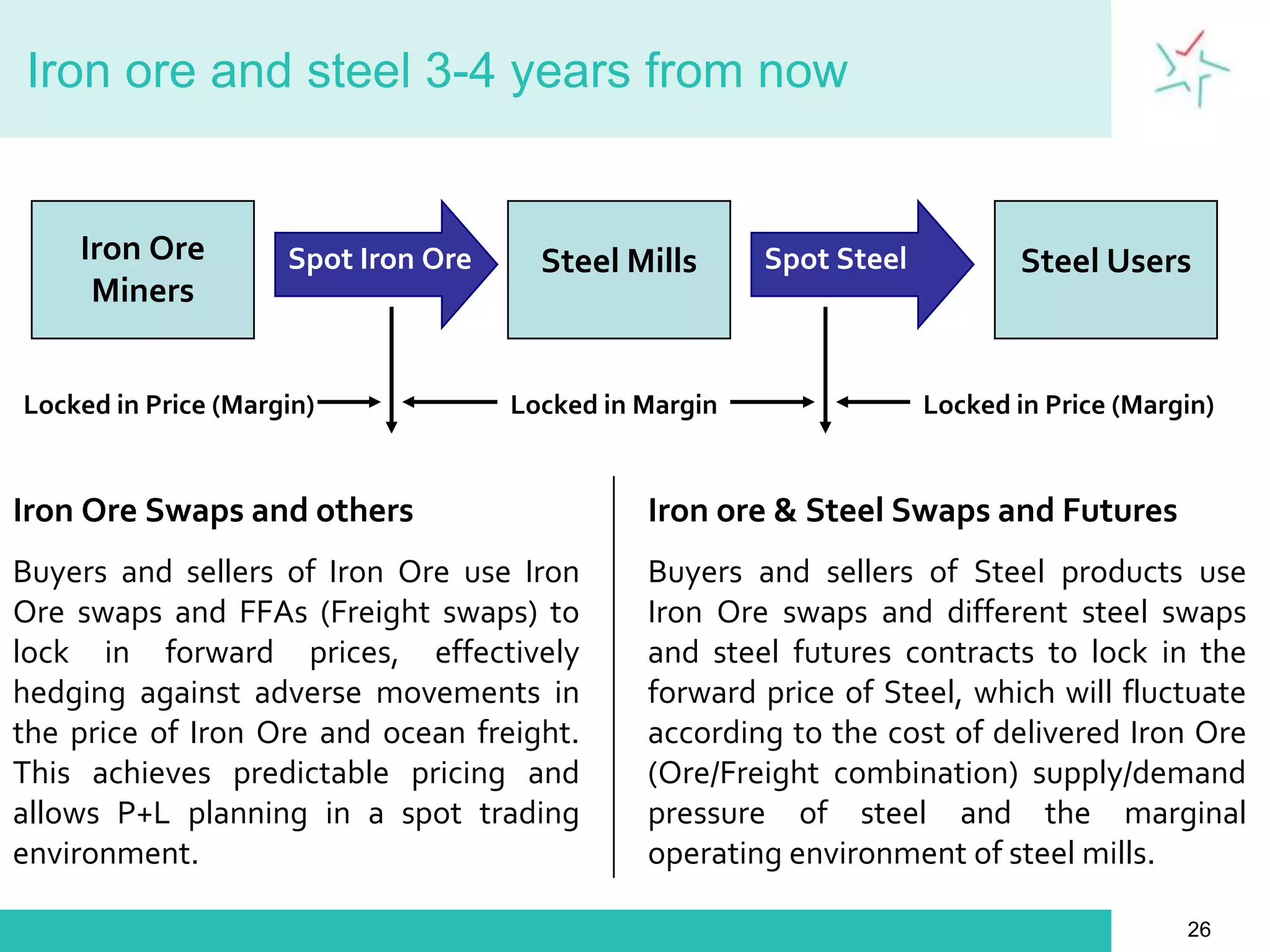
    Iron oreand steel 3-4 years from nowIron Ore MinersSteel MillsSteel UsersSpot Iron OreSpot SteelLocked in Price (Margin)Locked in Price (Margin)Locked in MarginIron Ore Swaps and othersBuyers and sellers of Iron Ore use Iron Ore swaps and FFAs (Freight swaps) to lock in forward prices, effectively hedging against adverse movements in the price of Iron Ore and ocean freight. This achieves predictable pricing and allows P+L planning in a spot trading environment.Iron ore & Steel Swaps and FuturesBuyers and sellers of Steel products use Iron Ore swaps and different steel swaps and steel futures contracts to lock in the forward price of Steel, which will fluctuate according to the cost of delivered Iron Ore (Ore/Freight combination) supply/demand pressure of steel and the marginal operating environment of steel mills.26
  • 45.
    INDIAN World’s 1stExchange to launch an Iron Ore Future Contract…27
  • 46.
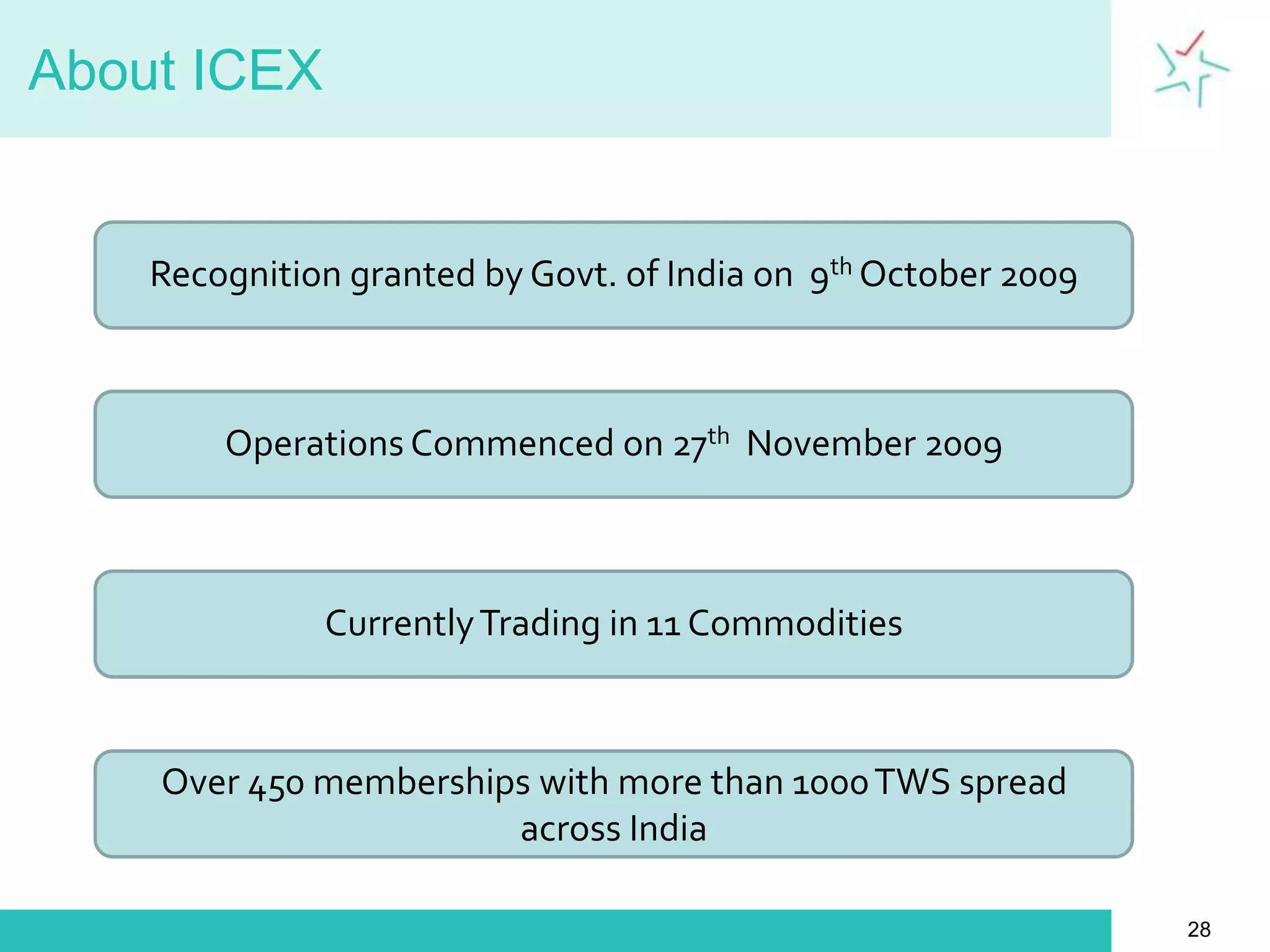
    About ICEXRecognitiongranted by Govt. of India on 9th October 2009Operations Commenced on 27th November 2009Currently Trading in 11 CommoditiesOver 450 memberships with more than 1000 TWS spread across India28
  • 47.
  • 48.
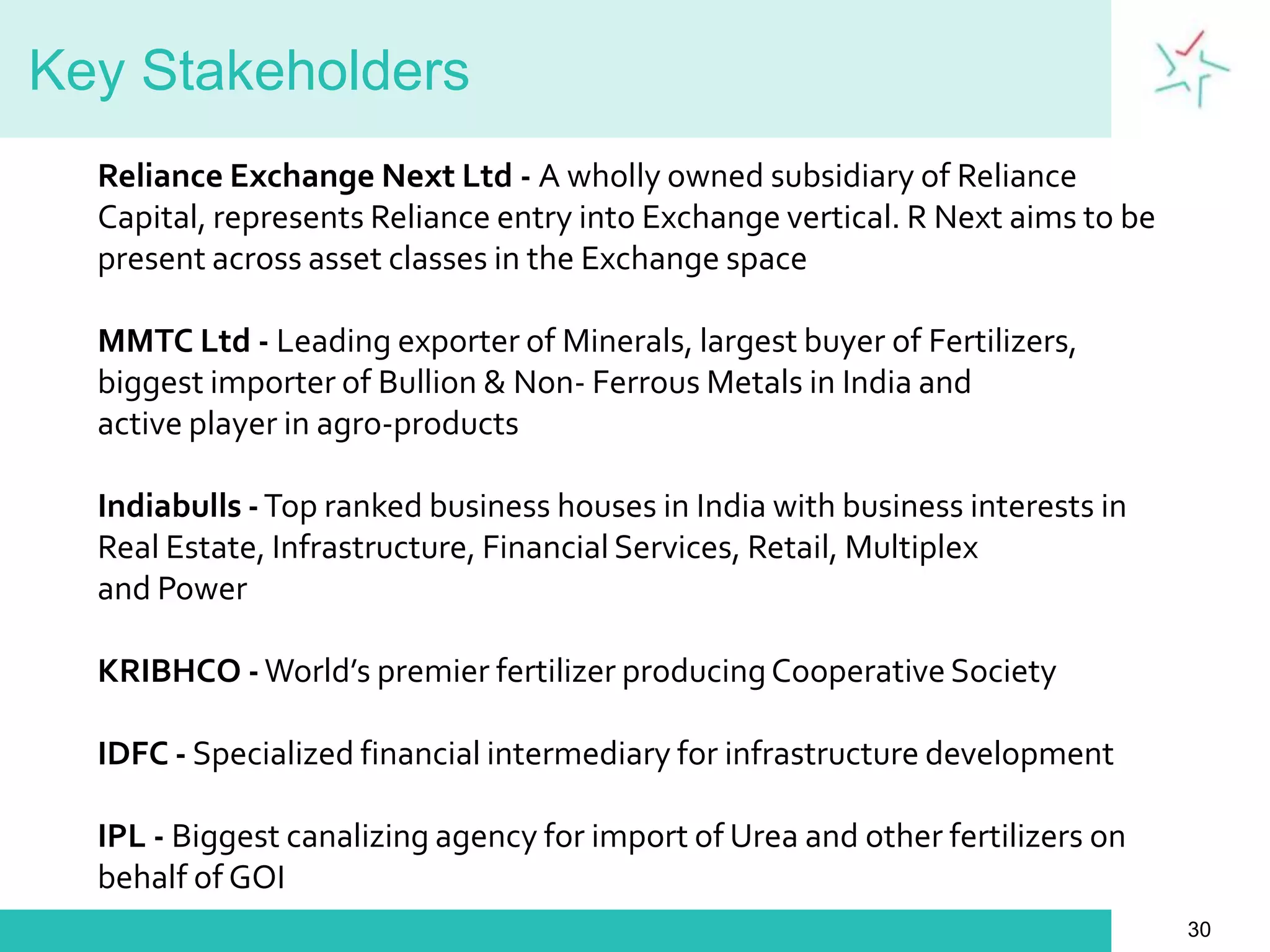
    Key StakeholdersRelianceExchange Next Ltd - A wholly owned subsidiary of Reliance Capital, represents Reliance entry into Exchange vertical. R Next aims to be present across asset classes in the Exchange spaceMMTC Ltd - Leading exporter of Minerals, largest buyer of Fertilizers, biggest importer of Bullion & Non- Ferrous Metals in India and active player in agro-productsIndiabulls- Top ranked business houses in India with business interests inReal Estate, Infrastructure, Financial Services, Retail, Multiplexand PowerKRIBHCO -World’s premier fertilizer producing Cooperative SocietyIDFC- Specialized financial intermediary for infrastructure developmentIPL - Biggest canalizing agency for import of Urea and other fertilizers onbehalf of GOI30
  • 49.
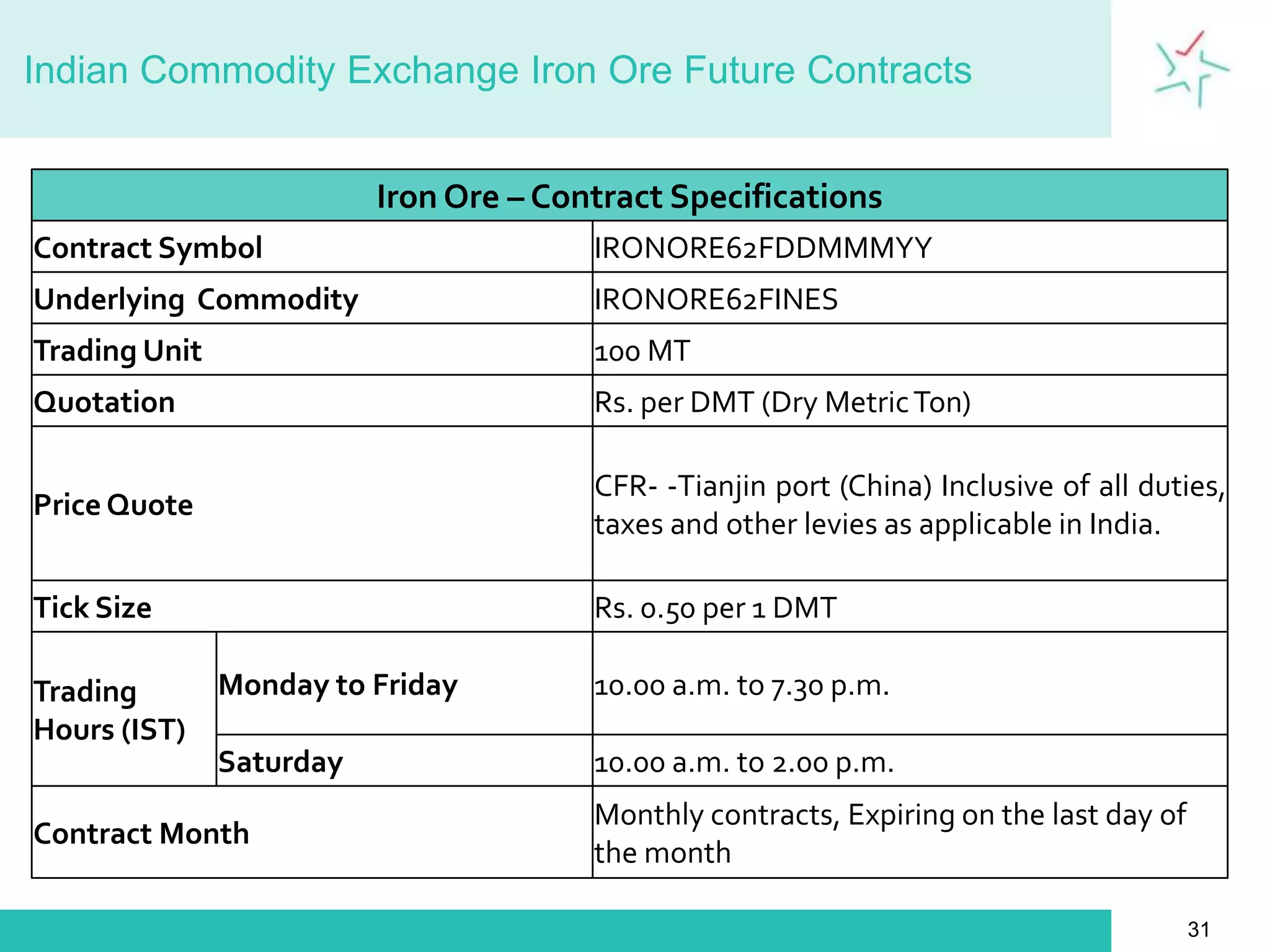
    Indian Commodity ExchangeIron Ore Future Contracts31
  • 50.
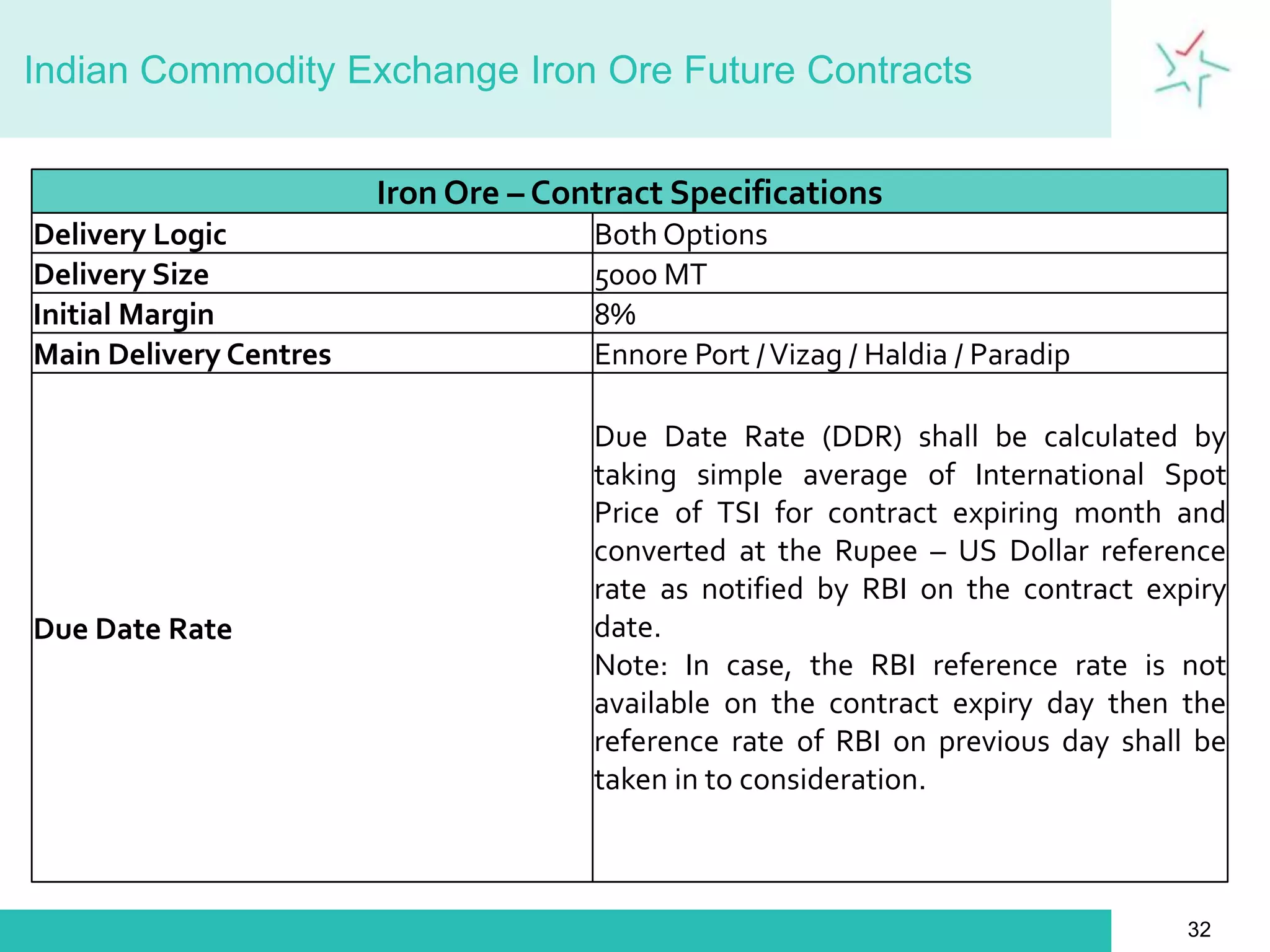
    Indian Commodity ExchangeIron Ore Future Contracts32
  • 51.
    Our Associations– Our Strengths33
  • 52.
    Factors EffectingPricesGrade of Iron Ore
  • 53.
  • 54.
  • 55.
  • 56.
  • 57.
    Big Players (Big– Trio) Decision in Pricing Mechanism
  • 58.
  • 59.
    Benefits ofFuture Trading in Iron OreMeasure of hedging the price volatility of Iron ore as prices are very volatile
  • 60.
    Price stabilization-in timesof violent price fluctuation
  • 61.
  • 62.
    Standardized contracts guaranteethe quality and quantity of iron.
  • 63.
    The exchange guaranteesperformance of the contract irrespective of buyer and/or seller
  • 64.
    The Exchange hasset up a SGF-Settlement guaranteed
  • 65.
  • 66.
    Thank YouFor moreinformation, please visit our website at www.icexindia.com