International Research Journal of Engineering and Technology (IRJET) e-ISSN: 2395-0056
Volume: 06 Issue: 05 | May 2019 www.irjet.net p-ISSN: 2395-0072
© 2019, IRJET | Impact Factor value: 7.211 | ISO 9001:2008 Certified Journal | Page 1448
Voice Controlled Robotic Vehicle
Dipesh Diwakar1, Ashok Choudhary2, Ashu Singh3, Prof Nazish Fatima4
1,2,3,4Keystone School of Engineering
-------------------------------------------------------------------------***------------------------------------------------------------------------
Abstract - Voice controlled robotic system is very ben-
eficial in areas where there is high risk for humans to
enter.Voice controlled robotic system is controlled
through voice commands via android device. The inte-
gration of control unit with Bluetooth device is
achieved using a Bluetooth module to capture and
read the voice commands. The robotic vehicle oper-
ates as per the command received via android device,
for this Arduino is integrated in the system. The con-
trolling device may be any smart phone having an An-
droid Operating System. The transmitter uses an an-
droid application required for transmitting the data.
The receiver end reads these commands and inter-
prets them into controlling the robotic vehicle. The
android device sends commands to move the vehicle in
forward, backward, right and left directions. After re-
ceiving the commands, Arduino operates the motors in
order to move the vehicle in four directions. The com-
munication between android device and receiver is
sent as serial communication data.Arduino program is
designed to move the motor through a motor driver
circuit as per the commands sent by android device.A
robotic arm is mounted at the front of the system to
make changes in the environment along with Lcd
screen to view the received commands. An obstacle
detector is added to protect the system from object on
the way by using an ultrasonic sensor.
Keywords- Arduino UNO, Android Application
I. Introduction
Voice controlled robotic system aims at achieving success-
ful places where human intervention is at high risk such as
hot or sub zero temperature environment, war fields, dis-
aster affected zone, etc. It also aims to fulfil the task as-
signed to the user through various commands. The voice
commands to the robotic system are sent through Blue-
tooth via an Android device. These commands are received
on the robotic system via Bluetooth module mounted on it.
A robotic arm is mounted at the front of the system to
make changes in the environment along with an lcd screen
to view the received commands. The motor driver circuit is
used to control the speed of robotic system. An obstacle
detector is added to protect the system from object on the
way by using an ultrasonic sensor. The whole circuitry is
powered using a 12V rechargeable battery mounted on the
system. When we say voice control the first term to be
considered is Speech Recognition i.e., making the system to
understand human voice. Speech Recognition is a technol-
ogy where the system understands the words not its
meaning given through speech. Speech is an ideal method
for robotic control and communication.The purpose of our
research is to provide simpler robot’s hardware architec-
ture but with powerful computational platforms so that
robot’s designer can focus on their research and tests in-
stead of Bluetooth connection infrastructure. This simple
architecture is also useful for educational robotics, because
students can builds their own robots with low cost.
II. LITERATURE SURVEY
Worldwide investment in industrial robots up 19% in
2003. In first half of 2004, orders robots were up another
18% to the highest level ever recorded. Worldwide growth
in the period 2004-2007 forecast at an average annual rate
of about 7%. Over 600,000 household robots in use – sev-
eral millions in the next few years.
UNECE issues its 2004 World Robotics survey
We refer the navigation system from ARDUINO BASED
VOICE CONTROLLED ROBOT and author of K.Kannan and
Dr. J Selvakumar. They are defining the modes of speak-
ing Robot.
There are generally three modes of speaking, including:
• Isolated word (or phrase) mode: In which the user
speaks individual words (or phrases) drawn from a
specified vocabulary.
• Connected word mode: In which the user speaks fluent
speech consisting entirely of words from a specified vo-
cabulary (e.g., telephone numbers).
• Continuous speech mode: In which the user can speak
fluently from a large (often unlimited) vocabulary.
We refer the Voice Recognition system from SPEECH
RECOGNITION FOR ROBOTIC CONTROL and author of
Prof. Bhuvaneshwari Jolad and Mohnish Arora. They
define how to recognise voice of Robot.
• Small vocabulary systems which provide recognition
capability for up to 100 words.
• Medium vocabulary systems which provide recognition
capability for from 100 to 1000 words.
• Large vocabulary systems which provide recognition
capability for over 1000 words.
International Research Journal of Engineering and Technology (IRJET) e-ISSN: 2395-0056
Volume: 06 Issue: 05 | May 2019 www.irjet.net p-ISSN: 2395-0072
© 2019, IRJET | Impact Factor value: 7.211 | ISO 9001:2008 Certified Journal | Page 1449
• Speaker dependent systems which have been custom
tailored to each Individual talker.
• Speaker independent systems which work on broad
populations of talkers, most of which the system has
never encountered or adapted to.
• Speaker adaptive systems which customise their
knowledge to each individual user over time while the
system is in use.
We refer the communication system from VOICE CON-
TROLLED ROBOTIC VEHICLE and author Rohan Ganu and
Chetna Bhatia. They define how to Robot communicate
• One-way communication: In which each user spoken
input is acted upon.
• System-driven dialog systems: In which the system is the
sole initiator of a dialog, requesting information from the
user via verbal input.
• Natural dialogue systems: In which the machine con-
ducts a conversation with the speaker, solicits inputs,
acts in response to user inputs, or even tries to clarify
ambiguity in the conversation.
III. METHODOLOGY
COMPONENT
1. Arduino Uno
2. LCD Screen
3. Motor Driver
4. Ultrasonic Sensor
5. Bluetooth Module
1. ARDUINO UNO
Arduino uno a micro controller board based on the AT-
mega328P. It has 14 digital input/output pins .It also has 6
analog inputs, a 16 MHz quartz crystal, a USB connection, a
power jack, and a reset button. It is the most widely used
and user friendly micro controller. Simply connect it to a
computer with a USB cable or power it with an AC-to-DC
adapter or battery to get started.
2. LCD SCREEN
LCD screen is a flat-panel display, electronic visual display
that uses the light-modulating properties of liquid crystals
and the liquid crystals do not emit light directly. LCDs are
available to display arbitrary images. It has a wide range of
applications including computer monitors, televisions, in-
strument panels, aircraft cockpit displays.
3. MOTOR DRIVER
L293D has quadruple high current half-H drivers.
Wide Supply-Voltage Range: 4.5V to 36V.
High-Noise-Immunity Inputs.
Output Current 600mA Per Channel
Peak Output Current1.2A Per Channel.
4. ULTRASONIC SENSOR
HC-05 is the ultrasonic ranging sensor. This economical
sensor provides 2cm to 400cm of non-contact measure-
ment functionality with a ranging accuracy that can reach
up to 3mm. Each HC-05 module includes an ultrasonic
transmitter, a receiver and a control circuit. There are only
four pins on the HC-05:- VCC, Trigger, Receive, and GND.
5. BLUETOOTH MODULE
Bluetooth module has a typical -80dBm sensitivity and up
to +4dBm RF transmit power.It has a PIO control, UART
interface with programmable baud rate, integrated anten-
na and an edge connector. Its auto-pairing pin is”1234” as
default pin and it auto-reconnect in 30 min when discon-
nected as a result of beyond the range of connection.
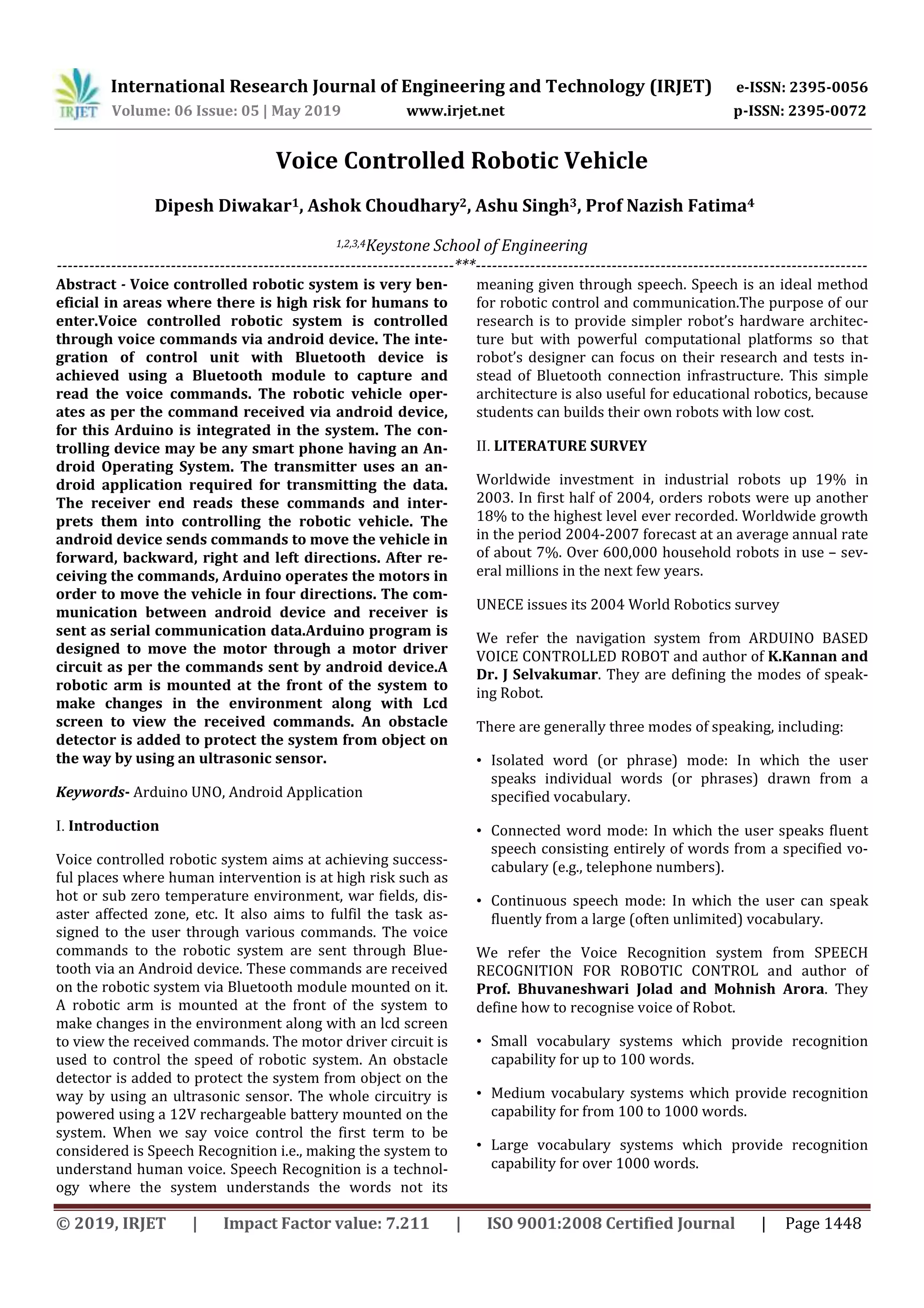
IV. BLOCK DIAGRAM
V. IMPLEMENTATION
In this proposed system a speech recognition module is
not required to recognize human voice to control robot. In
this system an android application is used to recognize and
process human voice which is further converted into text
(making use of google speech to text converter). This text
is transferred to the robot using Bluetooth. This text is fur-
ther processed by the controller to control the robot ac-
cordingly. Here implementation includes following proce-
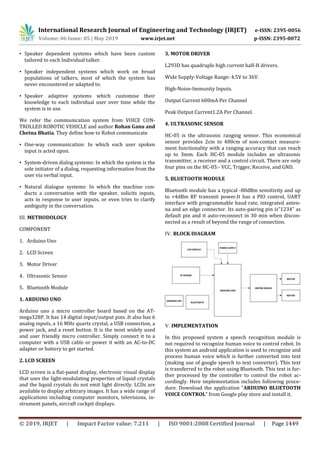
dure. Download the application “ARDUINO BLUETOOTH
VOICE CONTROL” from Google play store and install it.
International Research Journal of Engineering and Technology (IRJET) e-ISSN: 2395-0056
Volume: 06 Issue: 05 | May 2019 www.irjet.net p-ISSN: 2395-0072
© 2019, IRJET | Impact Factor value: 7.211 | ISO 9001:2008 Certified Journal | Page 1450
VI. COMMANDS
1. Forward – moves the vehicle in forward direction.
2. Backward - moves the vehicle in backward direc-
tion.
3. Left – moves the vehicle towards left.
4. Right – moves the vehicle towards right.
5. Stop – stops the vehicle.
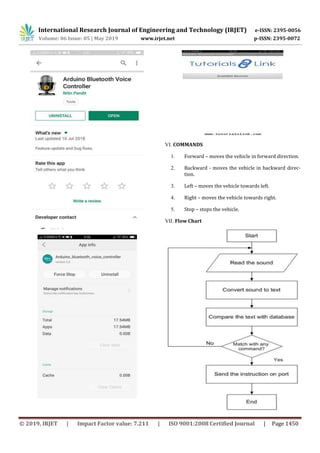
VII. Flow Chart
International Research Journal of Engineering and Technology (IRJET) e-ISSN: 2395-0056
Volume: 06 Issue: 05 | May 2019 www.irjet.net p-ISSN: 2395-0072
© 2019, IRJET | Impact Factor value: 7.211 | ISO 9001:2008 Certified Journal | Page 1451
VIII. Algorithm
• The voice commands should be trained to the serial
communication module.
• Then the stored voice commands are represented in
the form of binary numbers such as move forward –
001, move backward – 010 etc.
• These binary values are transmitted via Bluetooth
module which is a transceiver.
• The transmitted binary values are then received by
another Bluetooth module which is present on the re-
ceiver side.
• Atmega Controller will take those binary values and
performs action(DC motors) according to the binary
values.
IX. ADVANTAGES
• It can be used to bring and place small objects.
• It is the one of the important stage of Human robots.
• Command and control of appliances and equipment.
X. RESULTS AND CONCLUSION
The voice controlling commands are successfully transmit-
ted via Bluetooth technology and on reception; the desired
operations successfully take place. This project reduces
human efforts at places or situations where human inter-
ventions are difficult. Such systems can be brought into use
at places such as industries, military and defence, research
purposes, etc.
XI. REFERENCES
1. Byoung-Kyun Shim ; Yoo-Ki Cho ; Jong-Baem Won;Sung-
HyunHan Control, Automation and Systems (IC-
CAS),2011A study on real-time control of mobile robot
with based on voice command, 11th International Con-
ference on Publication Year: 2011 www.migi.com for
selecting motors and other robotic concepts.
2. Sung-Won Jung ; Ki-Won Sung ; Moon-Youl Park ; Eon-
Uck Kang ;Won-Jun Hwang ; Jong-Dae Won; Woo-Song
Lee ; Sung-Hyun Han Robotics (ISR), 2013.
3. Potts, J. and Sukittanon, S. (2012) “ Exploiting bluetooth
on android mobile mobile devices for home security
application”, proceedings of Southeastcan, 15-18 March
2012, Orlando, Florida, USA .
4. Thomas R. Kurfess, "Robotics and Automation Hand-
book", 2004, Taylor & Francis Group, CRC Press, UK.
5. Balakrishnan M, Gowthaman S, Kumaran SJ, Sabhapathy
GR. A smart spy robot charged and controlled by wire-
less systems. InInnovations in Information, Embedded
and Communication Systems (ICIIECS), 2015 Interna-
tional Conference on 2015 Mar 19 (pp. 1-4). IEEE.
6. Pahuja R, Kumar N. Android Mobile Phone Controlled
Bluetooth Robot Using 8051 Microcontroller. Interna-
tional Journal of Scientific Engineering and Research
(IJSER). 2014 Jul; 2(7).
7. Yeole AR, Bramhankar SM, Wani MD, Mahajan MP.
Smart phone controlled robot using ATMEGA328 mi-
crocontroller. Int. J. Innovative Res. Comput. Commun.
Eng. 2015 Jan; 3:191-7.
8. Gonde D, Jadhav S, Lokhande M. Robot Control using
Android Smartphone. Journal of Android and IOS Appli-
cations and Testing. 2016 May 6.
9. Saravana Kumar K, Mannu Nayyar,Reshma M, Biju Jo-
seph” Android controlled robot with image transfer” .
International Journal of Advanced Multidisciplinary Re-
search 2(3): (2015).
10. Naik YM, Deshpande CM, Shah RR, Kulkarni RR.
ANDROID CONTROLLED SPY-ROBOT.
International Journal of Software and Web Sciences.
2013:54-7.
11. Rahul Kumar, Ushapreethi P, Pravin R. Ku-
bade,Hrushikesh B. Kulkarni “Android Phone controlled
Bluetooth Robot” International Research Journal of En-
gineering and Technology (IRJET) Volume: 03 Issue: 04
| Apr-2016.
12. Jha A, Singh A, Turna R, Chauhan S. War Field Spy-
ing Robot with Night Vision Camera. Journal of Network
Communication and Emerging Technology. 2015 May;
2(1).
13. Chanda P, Mukherjee PK, Modak S, Nath A. Gesture
Controlled Robot using Arduino and Android. Interna-
tional Journal. 2016 Jun; 6(6).
14. Ramani R, Valarmathy S, SuthanthiraVanitha N,
Selvaraju S, Thiruppathi M, Thangam R. Vehicle tracking
and locking system based on GSM and GPS. Internation-
al Journal of Intelligent Systems and Applications. 2013
Aug 1; 5(9):86.
15.Shome S, Bera RN. SMS Tracking System with Doppler
Radar to Enhance Car Security for Intelligent Transport
System. International Journal of Intelligent Systems and
Applications. 2015 Jan 1; 7(2):

IRJET- Voice Controlled Robotic Vehicle

  • 1.
    International Research Journalof Engineering and Technology (IRJET) e-ISSN: 2395-0056 Volume: 06 Issue: 05 | May 2019 www.irjet.net p-ISSN: 2395-0072 © 2019, IRJET | Impact Factor value: 7.211 | ISO 9001:2008 Certified Journal | Page 1448 Voice Controlled Robotic Vehicle Dipesh Diwakar1, Ashok Choudhary2, Ashu Singh3, Prof Nazish Fatima4 1,2,3,4Keystone School of Engineering -------------------------------------------------------------------------***------------------------------------------------------------------------ Abstract - Voice controlled robotic system is very ben- eficial in areas where there is high risk for humans to enter.Voice controlled robotic system is controlled through voice commands via android device. The inte- gration of control unit with Bluetooth device is achieved using a Bluetooth module to capture and read the voice commands. The robotic vehicle oper- ates as per the command received via android device, for this Arduino is integrated in the system. The con- trolling device may be any smart phone having an An- droid Operating System. The transmitter uses an an- droid application required for transmitting the data. The receiver end reads these commands and inter- prets them into controlling the robotic vehicle. The android device sends commands to move the vehicle in forward, backward, right and left directions. After re- ceiving the commands, Arduino operates the motors in order to move the vehicle in four directions. The com- munication between android device and receiver is sent as serial communication data.Arduino program is designed to move the motor through a motor driver circuit as per the commands sent by android device.A robotic arm is mounted at the front of the system to make changes in the environment along with Lcd screen to view the received commands. An obstacle detector is added to protect the system from object on the way by using an ultrasonic sensor. Keywords- Arduino UNO, Android Application I. Introduction Voice controlled robotic system aims at achieving success- ful places where human intervention is at high risk such as hot or sub zero temperature environment, war fields, dis- aster affected zone, etc. It also aims to fulfil the task as- signed to the user through various commands. The voice commands to the robotic system are sent through Blue- tooth via an Android device. These commands are received on the robotic system via Bluetooth module mounted on it. A robotic arm is mounted at the front of the system to make changes in the environment along with an lcd screen to view the received commands. The motor driver circuit is used to control the speed of robotic system. An obstacle detector is added to protect the system from object on the way by using an ultrasonic sensor. The whole circuitry is powered using a 12V rechargeable battery mounted on the system. When we say voice control the first term to be considered is Speech Recognition i.e., making the system to understand human voice. Speech Recognition is a technol- ogy where the system understands the words not its meaning given through speech. Speech is an ideal method for robotic control and communication.The purpose of our research is to provide simpler robot’s hardware architec- ture but with powerful computational platforms so that robot’s designer can focus on their research and tests in- stead of Bluetooth connection infrastructure. This simple architecture is also useful for educational robotics, because students can builds their own robots with low cost. II. LITERATURE SURVEY Worldwide investment in industrial robots up 19% in 2003. In first half of 2004, orders robots were up another 18% to the highest level ever recorded. Worldwide growth in the period 2004-2007 forecast at an average annual rate of about 7%. Over 600,000 household robots in use – sev- eral millions in the next few years. UNECE issues its 2004 World Robotics survey We refer the navigation system from ARDUINO BASED VOICE CONTROLLED ROBOT and author of K.Kannan and Dr. J Selvakumar. They are defining the modes of speak- ing Robot. There are generally three modes of speaking, including: • Isolated word (or phrase) mode: In which the user speaks individual words (or phrases) drawn from a specified vocabulary. • Connected word mode: In which the user speaks fluent speech consisting entirely of words from a specified vo- cabulary (e.g., telephone numbers). • Continuous speech mode: In which the user can speak fluently from a large (often unlimited) vocabulary. We refer the Voice Recognition system from SPEECH RECOGNITION FOR ROBOTIC CONTROL and author of Prof. Bhuvaneshwari Jolad and Mohnish Arora. They define how to recognise voice of Robot. • Small vocabulary systems which provide recognition capability for up to 100 words. • Medium vocabulary systems which provide recognition capability for from 100 to 1000 words. • Large vocabulary systems which provide recognition capability for over 1000 words.
  • 2.
    International Research Journalof Engineering and Technology (IRJET) e-ISSN: 2395-0056 Volume: 06 Issue: 05 | May 2019 www.irjet.net p-ISSN: 2395-0072 © 2019, IRJET | Impact Factor value: 7.211 | ISO 9001:2008 Certified Journal | Page 1449 • Speaker dependent systems which have been custom tailored to each Individual talker. • Speaker independent systems which work on broad populations of talkers, most of which the system has never encountered or adapted to. • Speaker adaptive systems which customise their knowledge to each individual user over time while the system is in use. We refer the communication system from VOICE CON- TROLLED ROBOTIC VEHICLE and author Rohan Ganu and Chetna Bhatia. They define how to Robot communicate • One-way communication: In which each user spoken input is acted upon. • System-driven dialog systems: In which the system is the sole initiator of a dialog, requesting information from the user via verbal input. • Natural dialogue systems: In which the machine con- ducts a conversation with the speaker, solicits inputs, acts in response to user inputs, or even tries to clarify ambiguity in the conversation. III. METHODOLOGY COMPONENT 1. Arduino Uno 2. LCD Screen 3. Motor Driver 4. Ultrasonic Sensor 5. Bluetooth Module 1. ARDUINO UNO Arduino uno a micro controller board based on the AT- mega328P. It has 14 digital input/output pins .It also has 6 analog inputs, a 16 MHz quartz crystal, a USB connection, a power jack, and a reset button. It is the most widely used and user friendly micro controller. Simply connect it to a computer with a USB cable or power it with an AC-to-DC adapter or battery to get started. 2. LCD SCREEN LCD screen is a flat-panel display, electronic visual display that uses the light-modulating properties of liquid crystals and the liquid crystals do not emit light directly. LCDs are available to display arbitrary images. It has a wide range of applications including computer monitors, televisions, in- strument panels, aircraft cockpit displays. 3. MOTOR DRIVER L293D has quadruple high current half-H drivers. Wide Supply-Voltage Range: 4.5V to 36V. High-Noise-Immunity Inputs. Output Current 600mA Per Channel Peak Output Current1.2A Per Channel. 4. ULTRASONIC SENSOR HC-05 is the ultrasonic ranging sensor. This economical sensor provides 2cm to 400cm of non-contact measure- ment functionality with a ranging accuracy that can reach up to 3mm. Each HC-05 module includes an ultrasonic transmitter, a receiver and a control circuit. There are only four pins on the HC-05:- VCC, Trigger, Receive, and GND. 5. BLUETOOTH MODULE Bluetooth module has a typical -80dBm sensitivity and up to +4dBm RF transmit power.It has a PIO control, UART interface with programmable baud rate, integrated anten- na and an edge connector. Its auto-pairing pin is”1234” as default pin and it auto-reconnect in 30 min when discon- nected as a result of beyond the range of connection. IV. BLOCK DIAGRAM V. IMPLEMENTATION In this proposed system a speech recognition module is not required to recognize human voice to control robot. In this system an android application is used to recognize and process human voice which is further converted into text (making use of google speech to text converter). This text is transferred to the robot using Bluetooth. This text is fur- ther processed by the controller to control the robot ac- cordingly. Here implementation includes following proce- dure. Download the application “ARDUINO BLUETOOTH VOICE CONTROL” from Google play store and install it.
  • 3.
    International Research Journalof Engineering and Technology (IRJET) e-ISSN: 2395-0056 Volume: 06 Issue: 05 | May 2019 www.irjet.net p-ISSN: 2395-0072 © 2019, IRJET | Impact Factor value: 7.211 | ISO 9001:2008 Certified Journal | Page 1450 VI. COMMANDS 1. Forward – moves the vehicle in forward direction. 2. Backward - moves the vehicle in backward direc- tion. 3. Left – moves the vehicle towards left. 4. Right – moves the vehicle towards right. 5. Stop – stops the vehicle. VII. Flow Chart
  • 4.
    International Research Journalof Engineering and Technology (IRJET) e-ISSN: 2395-0056 Volume: 06 Issue: 05 | May 2019 www.irjet.net p-ISSN: 2395-0072 © 2019, IRJET | Impact Factor value: 7.211 | ISO 9001:2008 Certified Journal | Page 1451 VIII. Algorithm • The voice commands should be trained to the serial communication module. • Then the stored voice commands are represented in the form of binary numbers such as move forward – 001, move backward – 010 etc. • These binary values are transmitted via Bluetooth module which is a transceiver. • The transmitted binary values are then received by another Bluetooth module which is present on the re- ceiver side. • Atmega Controller will take those binary values and performs action(DC motors) according to the binary values. IX. ADVANTAGES • It can be used to bring and place small objects. • It is the one of the important stage of Human robots. • Command and control of appliances and equipment. X. RESULTS AND CONCLUSION The voice controlling commands are successfully transmit- ted via Bluetooth technology and on reception; the desired operations successfully take place. This project reduces human efforts at places or situations where human inter- ventions are difficult. Such systems can be brought into use at places such as industries, military and defence, research purposes, etc. XI. REFERENCES 1. Byoung-Kyun Shim ; Yoo-Ki Cho ; Jong-Baem Won;Sung- HyunHan Control, Automation and Systems (IC- CAS),2011A study on real-time control of mobile robot with based on voice command, 11th International Con- ference on Publication Year: 2011 www.migi.com for selecting motors and other robotic concepts. 2. Sung-Won Jung ; Ki-Won Sung ; Moon-Youl Park ; Eon- Uck Kang ;Won-Jun Hwang ; Jong-Dae Won; Woo-Song Lee ; Sung-Hyun Han Robotics (ISR), 2013. 3. Potts, J. and Sukittanon, S. (2012) “ Exploiting bluetooth on android mobile mobile devices for home security application”, proceedings of Southeastcan, 15-18 March 2012, Orlando, Florida, USA . 4. Thomas R. Kurfess, "Robotics and Automation Hand- book", 2004, Taylor & Francis Group, CRC Press, UK. 5. Balakrishnan M, Gowthaman S, Kumaran SJ, Sabhapathy GR. A smart spy robot charged and controlled by wire- less systems. InInnovations in Information, Embedded and Communication Systems (ICIIECS), 2015 Interna- tional Conference on 2015 Mar 19 (pp. 1-4). IEEE. 6. Pahuja R, Kumar N. Android Mobile Phone Controlled Bluetooth Robot Using 8051 Microcontroller. Interna- tional Journal of Scientific Engineering and Research (IJSER). 2014 Jul; 2(7). 7. Yeole AR, Bramhankar SM, Wani MD, Mahajan MP. Smart phone controlled robot using ATMEGA328 mi- crocontroller. Int. J. Innovative Res. Comput. Commun. Eng. 2015 Jan; 3:191-7. 8. Gonde D, Jadhav S, Lokhande M. Robot Control using Android Smartphone. Journal of Android and IOS Appli- cations and Testing. 2016 May 6. 9. Saravana Kumar K, Mannu Nayyar,Reshma M, Biju Jo- seph” Android controlled robot with image transfer” . International Journal of Advanced Multidisciplinary Re- search 2(3): (2015). 10. Naik YM, Deshpande CM, Shah RR, Kulkarni RR. ANDROID CONTROLLED SPY-ROBOT. International Journal of Software and Web Sciences. 2013:54-7. 11. Rahul Kumar, Ushapreethi P, Pravin R. Ku- bade,Hrushikesh B. Kulkarni “Android Phone controlled Bluetooth Robot” International Research Journal of En- gineering and Technology (IRJET) Volume: 03 Issue: 04 | Apr-2016. 12. Jha A, Singh A, Turna R, Chauhan S. War Field Spy- ing Robot with Night Vision Camera. Journal of Network Communication and Emerging Technology. 2015 May; 2(1). 13. Chanda P, Mukherjee PK, Modak S, Nath A. Gesture Controlled Robot using Arduino and Android. Interna- tional Journal. 2016 Jun; 6(6). 14. Ramani R, Valarmathy S, SuthanthiraVanitha N, Selvaraju S, Thiruppathi M, Thangam R. Vehicle tracking and locking system based on GSM and GPS. Internation- al Journal of Intelligent Systems and Applications. 2013 Aug 1; 5(9):86. 15.Shome S, Bera RN. SMS Tracking System with Doppler Radar to Enhance Car Security for Intelligent Transport System. International Journal of Intelligent Systems and Applications. 2015 Jan 1; 7(2):