International Research Journal of Engineering and Technology (IRJET) e-ISSN: 2395 -0056
Volume: 04 Issue: 06 | June-2017 www.irjet.net p-ISSN: 2395-0072
© 2017, IRJET | Impact Factor value: 5.181 | ISO 9001:2008 Certified Journal | Page 191
VOICE CONTROLLED ROBOTIC VEHICLE
Prof. Bhuvaneshwari Jolad1, Mohnish Arora2, Rohan Ganu3, Chetan Bhatia4
1,2,3,4Dept. of Electronics and Telecommunication Engineering,
DR. D. Y. Patil Institute of Technology, Pimpri, Pune
---------------------------------------------------------------------***---------------------------------------------------------------------
Abstract - The paper is designed to control a robotic
vehicle by voice commands for remote operation. An ARM
series microcontroller is used together with an Android
Application for the desired operation.
The Android Application is connected to the Bluetooth
module (HC-05)present on the Robot via Bluetooth. The
commands are sent to the robot using push buttons or voice
commands present on the android application. At the
receiving end two dc servo motors are interfaced to the
microcontroller where they are used for the movement of the
vehicle. The RF transmitter of the Bluetooth can take either
switch press or voice commands which are converted to
encoded digital data for the advantage of adequate range
(up to 100 meters) from the robot. The receiver decodes the
data before feeding it to another microcontroller to drive DC
motors via motor driver IC for necessary work. This
technology has an advantage over long communication
range as compared to RF technology. Further the project can
be developed using IoT technology where a user can control
the robot from any corner of the world.
Key Words: Bluetooth module, Android Application, IoT
(Internet of things), DC Servo motor.
1. INTRODUCTION
“In proposed design, we wish to control the movements of
the vehicle using voice commands from the user. These
commands will be issued at the Android Application on
the user’s phone which is connected to the robot using a
Bluetooth Module. The commands issued will then be
relayed over an RF channel and will be received by the
Module. The goal of Voice Controlled Robotic Vehicle
(VCRV) is to listen and act on the commands received from
the user. Here, the system will require the training from
the user (for the accent) after which the device will start
understanding the commands issued. This is done by
adding commands to the controller through a code.”
1.1 All about Voice Recognition
The process of enabling a computer to identify and
respond to sound produced in human speech. Voice
recognition is the process of taking spoken word as an
input to the program. Voice recognition is the ability of the
machine to receive and interpret dictation, or to
understand and carry out spoken commands.
1.2 Why Voice Recognition?
Both speech and voice recognition use recordings of
human voice, but they do different things with it. Voice
recognition stripes out personal differences to detect the
words. Speech recognition typically disregards the
language and meaning to detect the physical person
behind the speech. For our project, if we want to make it
user friendly than Voice Recognition is the best
methodology to control this robot.
1.3 Briefing
The proposed topic involves voice recognizing. Voice
recognition is the process of capturing spoken words and
commands using a microphone or telephone and
converting them into a digitally stored set of words. Two
factors decide the accuracy of the proposed voice
recognition system: Accuracy in detecting the human
words and processing those words at the desired speed so
that the commands are executed with the least delay.
2. DESCRIPTION OF ROBOT
2.1 Transmitter
On the Transmitter section, commands are given to
the Mobile Application through the micro-phone of the
mobile handset. This mobile handset is connected to the
moving vehicle via Bluetooth module. The mobile
application used, is programmed in such a way that the
voice commands given to the handset are received by the
micro-phone and these analog voice commands are
converted to digital word sequences (A to D conversion).
These stored sequences are than transmitted to the robot
via Bluetooth transceiver module and are sent to the
transceiver controller (MAX 232).
2.2Receiver
MAX 232 transceiver is used to decode the
received signal and for serial communication with the
Bluetooth module. The controller compares these digital
signals with the stored programme commands in it and
convert them into voice strings. The voice strings are then
used to run the servo motors for the desired interval of
time.
International Research Journal of Engineering and Technology (IRJET) e-ISSN: 2395 -0056
Volume: 04 Issue: 06 | June-2017 www.irjet.net p-ISSN: 2395-0072
© 2017, IRJET | Impact Factor value: 5.181 | ISO 9001:2008 Certified Journal | Page 192
2.3 Transducers
 MQ6 Gas sensor are used to detect the gases in
the vicinity. As soon as a gas is detected it turn on
the buzzer and the level of gas is shown on the
LCD.
 LM35 is the temperature sensor used to detect
the temperature in the desired vicinity. The
sensor detects the temperature and if it exceeds
50°C it turns on the buzzer. Thus, it acts as
temperature detector.
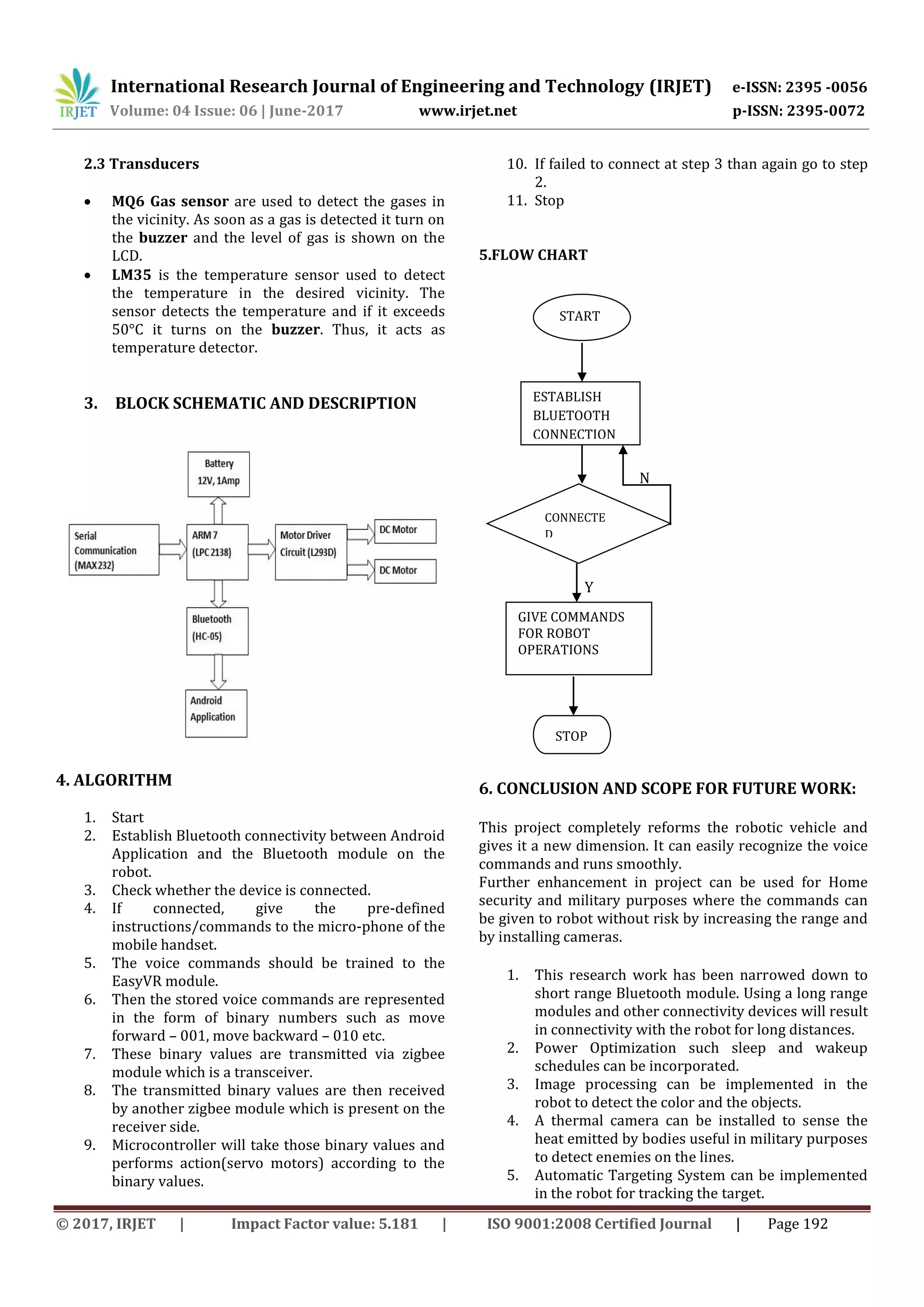
3. BLOCK SCHEMATIC AND DESCRIPTION
4. ALGORITHM
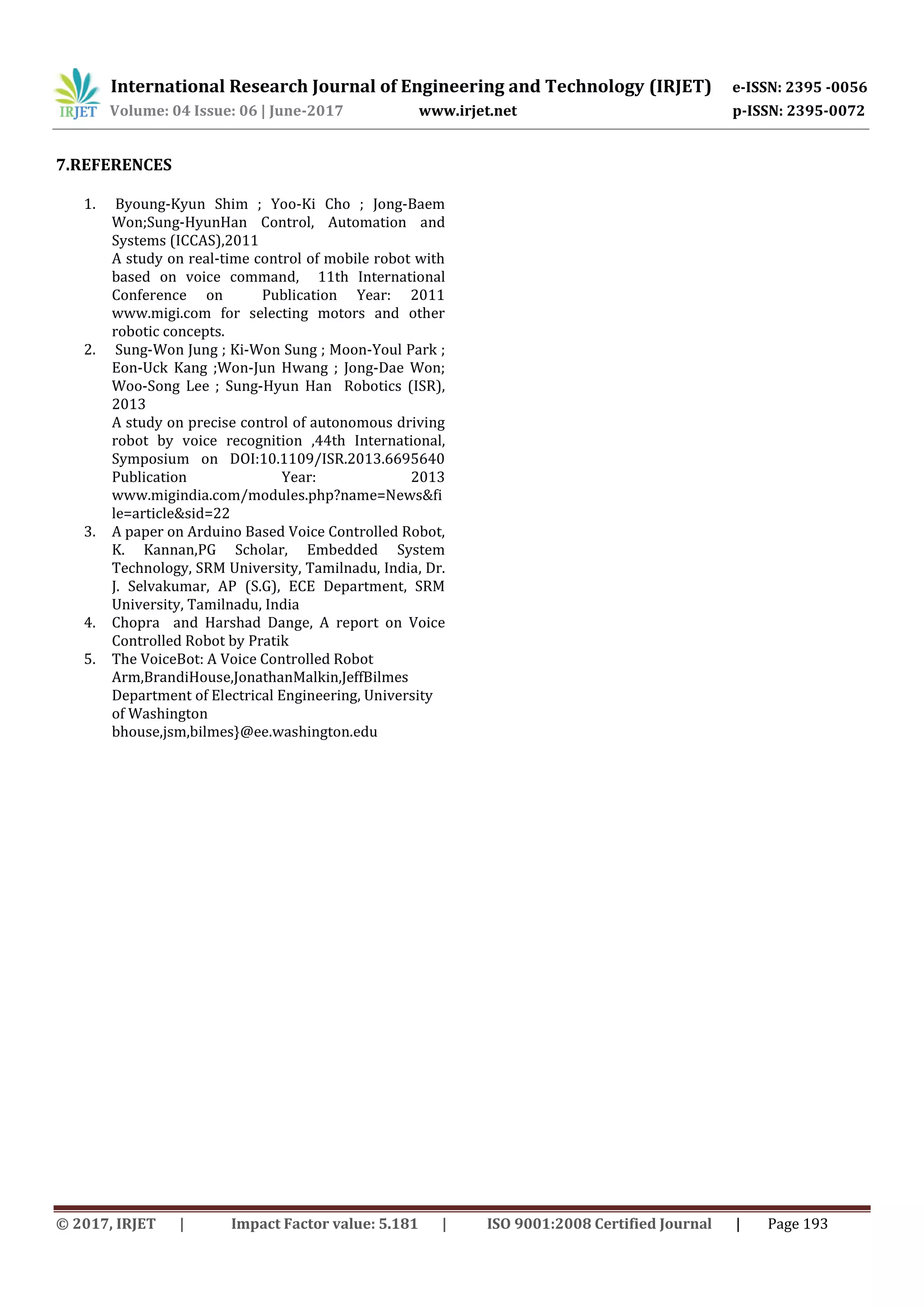
1. Start
2. Establish Bluetooth connectivity between Android
Application and the Bluetooth module on the
robot.
3. Check whether the device is connected.
4. If connected, give the pre-defined
instructions/commands to the micro-phone of the
mobile handset.
5. The voice commands should be trained to the
EasyVR module.
6. Then the stored voice commands are represented
in the form of binary numbers such as move
forward – 001, move backward – 010 etc.
7. These binary values are transmitted via zigbee
module which is a transceiver.
8. The transmitted binary values are then received
by another zigbee module which is present on the
receiver side.
9. Microcontroller will take those binary values and
performs action(servo motors) according to the
binary values.
10. If failed to connect at step 3 than again go to step
2.
11. Stop
5.FLOW CHART
N
Y
6. CONCLUSION AND SCOPE FOR FUTURE WORK:
This project completely reforms the robotic vehicle and
gives it a new dimension. It can easily recognize the voice
commands and runs smoothly.
Further enhancement in project can be used for Home
security and military purposes where the commands can
be given to robot without risk by increasing the range and
by installing cameras.
1. This research work has been narrowed down to
short range Bluetooth module. Using a long range
modules and other connectivity devices will result
in connectivity with the robot for long distances.
2. Power Optimization such sleep and wakeup
schedules can be incorporated.
3. Image processing can be implemented in the
robot to detect the color and the objects.
4. A thermal camera can be installed to sense the
heat emitted by bodies useful in military purposes
to detect enemies on the lines.
5. Automatic Targeting System can be implemented
in the robot for tracking the target.
START
ESTABLISH
BLUETOOTH
CONNECTION
CONNECTE
D
GIVE COMMANDS
FOR ROBOT
OPERATIONS
STOP
International Research Journal of Engineering and Technology (IRJET) e-ISSN: 2395 -0056
Volume: 04 Issue: 06 | June-2017 www.irjet.net p-ISSN: 2395-0072
© 2017, IRJET | Impact Factor value: 5.181 | ISO 9001:2008 Certified Journal | Page 193
7.REFERENCES
1. Byoung-Kyun Shim ; Yoo-Ki Cho ; Jong-Baem
Won;Sung-HyunHan Control, Automation and
Systems (ICCAS),2011
A study on real-time control of mobile robot with
based on voice command, 11th International
Conference on Publication Year: 2011
www.migi.com for selecting motors and other
robotic concepts.
2. Sung-Won Jung ; Ki-Won Sung ; Moon-Youl Park ;
Eon-Uck Kang ;Won-Jun Hwang ; Jong-Dae Won;
Woo-Song Lee ; Sung-Hyun Han Robotics (ISR),
2013
A study on precise control of autonomous driving
robot by voice recognition ,44th International,
Symposium on DOI:10.1109/ISR.2013.6695640
Publication Year: 2013
www.migindia.com/modules.php?name=News&fi
le=article&sid=22
3. A paper on Arduino Based Voice Controlled Robot,
K. Kannan,PG Scholar, Embedded System
Technology, SRM University, Tamilnadu, India, Dr.
J. Selvakumar, AP (S.G), ECE Department, SRM
University, Tamilnadu, India
4. Chopra and Harshad Dange, A report on Voice
Controlled Robot by Pratik
5. The VoiceBot: A Voice Controlled Robot
Arm,BrandiHouse,JonathanMalkin,JeffBilmes
Department of Electrical Engineering, University
of Washington
bhouse,jsm,bilmes}@ee.washington.edu

Voice Controlled Robotic Vehicle

  • 1.
    International Research Journalof Engineering and Technology (IRJET) e-ISSN: 2395 -0056 Volume: 04 Issue: 06 | June-2017 www.irjet.net p-ISSN: 2395-0072 © 2017, IRJET | Impact Factor value: 5.181 | ISO 9001:2008 Certified Journal | Page 191 VOICE CONTROLLED ROBOTIC VEHICLE Prof. Bhuvaneshwari Jolad1, Mohnish Arora2, Rohan Ganu3, Chetan Bhatia4 1,2,3,4Dept. of Electronics and Telecommunication Engineering, DR. D. Y. Patil Institute of Technology, Pimpri, Pune ---------------------------------------------------------------------***--------------------------------------------------------------------- Abstract - The paper is designed to control a robotic vehicle by voice commands for remote operation. An ARM series microcontroller is used together with an Android Application for the desired operation. The Android Application is connected to the Bluetooth module (HC-05)present on the Robot via Bluetooth. The commands are sent to the robot using push buttons or voice commands present on the android application. At the receiving end two dc servo motors are interfaced to the microcontroller where they are used for the movement of the vehicle. The RF transmitter of the Bluetooth can take either switch press or voice commands which are converted to encoded digital data for the advantage of adequate range (up to 100 meters) from the robot. The receiver decodes the data before feeding it to another microcontroller to drive DC motors via motor driver IC for necessary work. This technology has an advantage over long communication range as compared to RF technology. Further the project can be developed using IoT technology where a user can control the robot from any corner of the world. Key Words: Bluetooth module, Android Application, IoT (Internet of things), DC Servo motor. 1. INTRODUCTION “In proposed design, we wish to control the movements of the vehicle using voice commands from the user. These commands will be issued at the Android Application on the user’s phone which is connected to the robot using a Bluetooth Module. The commands issued will then be relayed over an RF channel and will be received by the Module. The goal of Voice Controlled Robotic Vehicle (VCRV) is to listen and act on the commands received from the user. Here, the system will require the training from the user (for the accent) after which the device will start understanding the commands issued. This is done by adding commands to the controller through a code.” 1.1 All about Voice Recognition The process of enabling a computer to identify and respond to sound produced in human speech. Voice recognition is the process of taking spoken word as an input to the program. Voice recognition is the ability of the machine to receive and interpret dictation, or to understand and carry out spoken commands. 1.2 Why Voice Recognition? Both speech and voice recognition use recordings of human voice, but they do different things with it. Voice recognition stripes out personal differences to detect the words. Speech recognition typically disregards the language and meaning to detect the physical person behind the speech. For our project, if we want to make it user friendly than Voice Recognition is the best methodology to control this robot. 1.3 Briefing The proposed topic involves voice recognizing. Voice recognition is the process of capturing spoken words and commands using a microphone or telephone and converting them into a digitally stored set of words. Two factors decide the accuracy of the proposed voice recognition system: Accuracy in detecting the human words and processing those words at the desired speed so that the commands are executed with the least delay. 2. DESCRIPTION OF ROBOT 2.1 Transmitter On the Transmitter section, commands are given to the Mobile Application through the micro-phone of the mobile handset. This mobile handset is connected to the moving vehicle via Bluetooth module. The mobile application used, is programmed in such a way that the voice commands given to the handset are received by the micro-phone and these analog voice commands are converted to digital word sequences (A to D conversion). These stored sequences are than transmitted to the robot via Bluetooth transceiver module and are sent to the transceiver controller (MAX 232). 2.2Receiver MAX 232 transceiver is used to decode the received signal and for serial communication with the Bluetooth module. The controller compares these digital signals with the stored programme commands in it and convert them into voice strings. The voice strings are then used to run the servo motors for the desired interval of time.
  • 2.
    International Research Journalof Engineering and Technology (IRJET) e-ISSN: 2395 -0056 Volume: 04 Issue: 06 | June-2017 www.irjet.net p-ISSN: 2395-0072 © 2017, IRJET | Impact Factor value: 5.181 | ISO 9001:2008 Certified Journal | Page 192 2.3 Transducers  MQ6 Gas sensor are used to detect the gases in the vicinity. As soon as a gas is detected it turn on the buzzer and the level of gas is shown on the LCD.  LM35 is the temperature sensor used to detect the temperature in the desired vicinity. The sensor detects the temperature and if it exceeds 50°C it turns on the buzzer. Thus, it acts as temperature detector. 3. BLOCK SCHEMATIC AND DESCRIPTION 4. ALGORITHM 1. Start 2. Establish Bluetooth connectivity between Android Application and the Bluetooth module on the robot. 3. Check whether the device is connected. 4. If connected, give the pre-defined instructions/commands to the micro-phone of the mobile handset. 5. The voice commands should be trained to the EasyVR module. 6. Then the stored voice commands are represented in the form of binary numbers such as move forward – 001, move backward – 010 etc. 7. These binary values are transmitted via zigbee module which is a transceiver. 8. The transmitted binary values are then received by another zigbee module which is present on the receiver side. 9. Microcontroller will take those binary values and performs action(servo motors) according to the binary values. 10. If failed to connect at step 3 than again go to step 2. 11. Stop 5.FLOW CHART N Y 6. CONCLUSION AND SCOPE FOR FUTURE WORK: This project completely reforms the robotic vehicle and gives it a new dimension. It can easily recognize the voice commands and runs smoothly. Further enhancement in project can be used for Home security and military purposes where the commands can be given to robot without risk by increasing the range and by installing cameras. 1. This research work has been narrowed down to short range Bluetooth module. Using a long range modules and other connectivity devices will result in connectivity with the robot for long distances. 2. Power Optimization such sleep and wakeup schedules can be incorporated. 3. Image processing can be implemented in the robot to detect the color and the objects. 4. A thermal camera can be installed to sense the heat emitted by bodies useful in military purposes to detect enemies on the lines. 5. Automatic Targeting System can be implemented in the robot for tracking the target. START ESTABLISH BLUETOOTH CONNECTION CONNECTE D GIVE COMMANDS FOR ROBOT OPERATIONS STOP
  • 3.
    International Research Journalof Engineering and Technology (IRJET) e-ISSN: 2395 -0056 Volume: 04 Issue: 06 | June-2017 www.irjet.net p-ISSN: 2395-0072 © 2017, IRJET | Impact Factor value: 5.181 | ISO 9001:2008 Certified Journal | Page 193 7.REFERENCES 1. Byoung-Kyun Shim ; Yoo-Ki Cho ; Jong-Baem Won;Sung-HyunHan Control, Automation and Systems (ICCAS),2011 A study on real-time control of mobile robot with based on voice command, 11th International Conference on Publication Year: 2011 www.migi.com for selecting motors and other robotic concepts. 2. Sung-Won Jung ; Ki-Won Sung ; Moon-Youl Park ; Eon-Uck Kang ;Won-Jun Hwang ; Jong-Dae Won; Woo-Song Lee ; Sung-Hyun Han Robotics (ISR), 2013 A study on precise control of autonomous driving robot by voice recognition ,44th International, Symposium on DOI:10.1109/ISR.2013.6695640 Publication Year: 2013 www.migindia.com/modules.php?name=News&fi le=article&sid=22 3. A paper on Arduino Based Voice Controlled Robot, K. Kannan,PG Scholar, Embedded System Technology, SRM University, Tamilnadu, India, Dr. J. Selvakumar, AP (S.G), ECE Department, SRM University, Tamilnadu, India 4. Chopra and Harshad Dange, A report on Voice Controlled Robot by Pratik 5. The VoiceBot: A Voice Controlled Robot Arm,BrandiHouse,JonathanMalkin,JeffBilmes Department of Electrical Engineering, University of Washington bhouse,jsm,bilmes}@ee.washington.edu