VISVESVARAYA TECHNOLOGICAL UNIVERSITY
Department of Computer Science & Engineering
Project Presentation on
DESIGN OF A ROBOT USING ARDUINO
Presented By
G N Meghana – 1ST19CS035
Poornima K – 1ST19CS093
Sulu Padma Kumar – 1ST19CS135
Sahana V – 1ST19CS117
Under the Guidance of
Dr. K. Balakrishnan
Associate Professor
Dept. of CSE
CONTENTS
Introduction
Problem Statement
Objectives and Scope
Design and Analysis
System Architecture
Flow Diagram
Implementation
Results
Execution of the project
INTRODUCTION
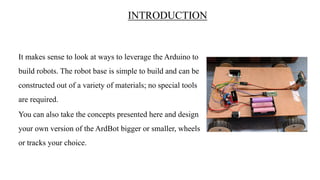
It makes sense to look at ways to leverage the Arduino to
build robots. The robot base is simple to build and can be
constructed out of a variety of materials; no special tools
are required.
You can also take the concepts presented here and design
your own version of the ArdBot bigger or smaller, wheels
or tracks your choice.
PROBLEM STATEMENT
• Objective show that it is indeed possible for a user to learn to effectively manipulate
real world objects with only verbal voice as a control mechanism.
• The proposed results provide strong evidence that the further development of voice-
controlled robotics will be successful.
• This system would find wide variety of applications. Mainly systems such as household
appliances like washing machines microwave ovens etc. will become voice controlled
in future.
• In such case this research will work out practically satisfying the need of the day
efficiently.
OBJECTIVES AND SCOPE
 The main objective is to construct the android guided Arduino Car by extracting the powers of
both the open source technologies- Android and Arduino Programming.
 To develop an android application that will provide user an interface to interact with the Arduino
powered car.
 To produce Arduino car that is controlled by android phone remote which can be used in various
fields, like defence, scientific expeditions and so on.
 The remote in this project is android device which has an inbuilt Bluetooth module.
 Physical barriers like doors, walls, etc. do not effect in controlling the car.
DESIGN AND ANALYSIS
SYSTEM ARCHITECTURE
• In this proposed device we perform a variety of research on control style variants
for robots. It shows that it’s feasible to study to successfully manipulate actual
world objects with solely voice (human voice) as a control mechanism.
• The reason of this lookup is to provide simple robotic hardware architecture so
that this shape can focal point on Bluetooth connection infrastructure. It is also
beneficial for academic robotics due to the fact human beings can construct their
personal robots with low cost.
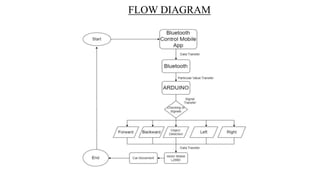
• When the app is operating in the system, a microphone on the mobile is used to
identify user voice commands.
• Commands are interpreted and the program utilizes Google's speech-recognition
software to translate voice to text within the app. The text will then be sent with
the aid of Bluetooth to the receiver part.
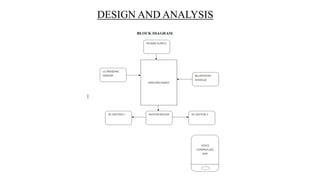
• The MCU will operate at 16MHz clock speed. The digital Arduino I / O pins 3, 4, 5 and 6 are
programmed as output pins in this design.
• For serial communication with the Bluetooth unit, pins 0 and 1 of Arduino are used. Text
obtained with the aid of Bluetooth is forwarded to Arduino Nano microcontroller panel by the
usage of UART serial conversation protocol.
• The voice commands to the robotic device are dispatched via Bluetooth with the aid of an
Android device.
• These commands are received on the robotic device by using Bluetooth module set up on it.
• The motor driver circuit is used to manipulate the velocity of the car. The complete circuitry is
powered by the usage of a 12V rechargeable battery hooked up on the system.
SYSTEM ARCHITECTURE
FLOW DIAGRAM
IMPLEMENTATION
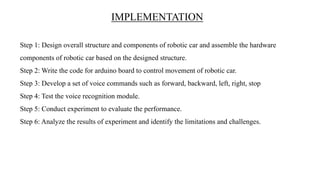
Step 1: Design overall structure and components of robotic car and assemble the hardware
components of robotic car based on the designed structure.
Step 2: Write the code for arduino board to control movement of robotic car.
Step 3: Develop a set of voice commands such as forward, backward, left, right, stop
Step 4: Test the voice recognition module.
Step 5: Conduct experiment to evaluate the performance.
Step 6: Analyze the results of experiment and identify the limitations and challenges.
RESULTS
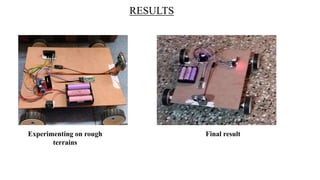
Experimenting on rough
terrains
Final result
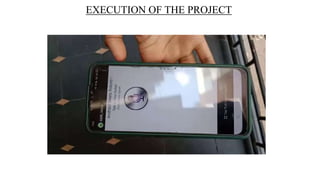
EXECUTION OF THE PROJECT

final project presentation.pptx

  • 1.
    VISVESVARAYA TECHNOLOGICAL UNIVERSITY Departmentof Computer Science & Engineering Project Presentation on DESIGN OF A ROBOT USING ARDUINO Presented By G N Meghana – 1ST19CS035 Poornima K – 1ST19CS093 Sulu Padma Kumar – 1ST19CS135 Sahana V – 1ST19CS117 Under the Guidance of Dr. K. Balakrishnan Associate Professor Dept. of CSE
  • 2.
    CONTENTS Introduction Problem Statement Objectives andScope Design and Analysis System Architecture Flow Diagram Implementation Results Execution of the project
  • 3.
    INTRODUCTION It makes senseto look at ways to leverage the Arduino to build robots. The robot base is simple to build and can be constructed out of a variety of materials; no special tools are required. You can also take the concepts presented here and design your own version of the ArdBot bigger or smaller, wheels or tracks your choice.
  • 4.
    PROBLEM STATEMENT • Objectiveshow that it is indeed possible for a user to learn to effectively manipulate real world objects with only verbal voice as a control mechanism. • The proposed results provide strong evidence that the further development of voice- controlled robotics will be successful. • This system would find wide variety of applications. Mainly systems such as household appliances like washing machines microwave ovens etc. will become voice controlled in future. • In such case this research will work out practically satisfying the need of the day efficiently.
  • 5.
    OBJECTIVES AND SCOPE The main objective is to construct the android guided Arduino Car by extracting the powers of both the open source technologies- Android and Arduino Programming.  To develop an android application that will provide user an interface to interact with the Arduino powered car.  To produce Arduino car that is controlled by android phone remote which can be used in various fields, like defence, scientific expeditions and so on.  The remote in this project is android device which has an inbuilt Bluetooth module.  Physical barriers like doors, walls, etc. do not effect in controlling the car.
  • 6.
  • 7.
    SYSTEM ARCHITECTURE • Inthis proposed device we perform a variety of research on control style variants for robots. It shows that it’s feasible to study to successfully manipulate actual world objects with solely voice (human voice) as a control mechanism. • The reason of this lookup is to provide simple robotic hardware architecture so that this shape can focal point on Bluetooth connection infrastructure. It is also beneficial for academic robotics due to the fact human beings can construct their personal robots with low cost. • When the app is operating in the system, a microphone on the mobile is used to identify user voice commands. • Commands are interpreted and the program utilizes Google's speech-recognition software to translate voice to text within the app. The text will then be sent with the aid of Bluetooth to the receiver part.
  • 8.
    • The MCUwill operate at 16MHz clock speed. The digital Arduino I / O pins 3, 4, 5 and 6 are programmed as output pins in this design. • For serial communication with the Bluetooth unit, pins 0 and 1 of Arduino are used. Text obtained with the aid of Bluetooth is forwarded to Arduino Nano microcontroller panel by the usage of UART serial conversation protocol. • The voice commands to the robotic device are dispatched via Bluetooth with the aid of an Android device. • These commands are received on the robotic device by using Bluetooth module set up on it. • The motor driver circuit is used to manipulate the velocity of the car. The complete circuitry is powered by the usage of a 12V rechargeable battery hooked up on the system. SYSTEM ARCHITECTURE
  • 9.
  • 10.
    IMPLEMENTATION Step 1: Designoverall structure and components of robotic car and assemble the hardware components of robotic car based on the designed structure. Step 2: Write the code for arduino board to control movement of robotic car. Step 3: Develop a set of voice commands such as forward, backward, left, right, stop Step 4: Test the voice recognition module. Step 5: Conduct experiment to evaluate the performance. Step 6: Analyze the results of experiment and identify the limitations and challenges.
  • 11.
  • 12.