Vidya Pratishthan’s
Kamalnayan BajajInstitute of Engineering and Technology,
Baramati
Department of Electrical Engineering
SE Electrical
2023-24
A PROJECT BASED LEARNING PRESENTATION
on
Design of Smart Home Automation System using Ardiuno
Presented by
1. Dhumal Swaraj(2326074)
2. Dhumal Rushikesh(2326060)
3. Shipalkar Sanket(2326069)
4. Wagh Varun(2326072)
5. Yadav Akhilesh(2326073)
Guided by
Mr. D. S. Yeole
INTRODUCTION
• Home automationinvolves introducing a degree of
computerized or automatic control certain electrical
and electronic system in a building and homes.
• The lighting, temperature control, etc. a simple home
Automation system. Which contains A REMOTE
mobile host controller and (Home appliances).
• The client modules communicate with host controllers
through a wireless device such as a Bluetooth enabled
mobile phone, in this case, an aurdino base smart
home.
4.
LITERATURE SURVEY
[1] S.Das, S. Ganguly, S. Ghosh, R. Sarker and D. Sengupta, "A
bluetooth based sophisticated home automation system using
smartphone," 2016 International Conference on Intelligent Control
Power and Instrumentation (ICICPI), Kolkata, India, 2016, pp. 236-
240, doi: 10.1109/ICICPI.2016.7859709.
• This paper presents a cost-effective smart home automation system
using Arduino (microcontroller) and an Android app.
• The Arduino platform now uses a Bluetooth chip, eliminating the
need for personal computers.
• The proposed smart home system incorporates devices like lights and
DC servomotors to demonstrate its feasibility, reliability, and quick
operation.
• The system has been tested and found to function properly, including
switching, servomotor position control, DC motor speed control, and
light intensity control.
5.
LITERATURE SURVEY
[2] A.Raza et al., "A Home Automation Through Android
Mobile App By Using Arduino UNO," 2020 IEEE 23rd
International Multitopic Conference (INMIC), Bahawalpur,
Pakistan, 2020, pp. 1-6, doi:
10.1109/INMIC50486.2020.9318084.
• As energy consumption rises, it's crucial to prevent overuse
in all areas.
• Home automation can improve people's lives by reducing
stress, increasing energy efficiency, and saving time,
resulting in a smarter home.
• Home automation, also known as smart home technology,
has advanced significantly and will continue to do so in
response to changing needs and benefits.
6.
LITERATURE SURVEY
[3]V. R.Reddy, S. Anusha, O. Rajeswari, B. H. Chandana and S.
F. Sujana, "Android Home Automation using PIC Micro
Controller and Bluetooth," 2019 International Conference on
Intelligent Sustainable Systems (ICISS), Palladam, India, 2019, pp.
328-331, doi: 10.1109/ISS1.2019.8907984.
• The project's strategy involves controlling electrical loads using an
Android app.
• Bluetooth-enabled Android devices monitor electrical loads.
Frequently turning on and off these switches caused distress and
inconvenience for those with physical disabilities.
• The device aids Android devices in transmitting incoming data.
The term "Android device" refers to any device running the
Android operating system, including phones and tablets.
• The app provides a powerful graphical user interface (GUI) to
achieve this.
7.
LITERATURE SURVEY
[4] R.Piyare and M. Tazil, "Bluetooth based home automation
system using cell phone," 2011 IEEE 15th International
Symposium on Consumer Electronics (ISCE), Singapore, 2011,
pp. 192-195, doi: 10.1109/ISCE.2011.5973811.
• Technology is a never-ending process.
• Designing a product with cutting-edge technology to improve
the lives of others is a significant community contribution.
• This paper describes the design and implementation of a low-
cost, flexible, and secure cell phone-based home automation
system.
• The design utilizes a standalone Arduino BT board, with home
appliances connected via relays to its input and output ports.
• The cell phone and Arduino BT board communicate wirelessly.
8.
LITERATURE SURVEY
[5] N.M. Morshed, G. M. Muid-Ur-Rahman, M. R.
Karim and H. U. Zaman, "Microcontroller based home
automation system using Bluetooth, GSM, Wi-Fi and
DTMF," 2015 International Conference on Advances in
Electrical Engineering (ICAEE), Dhaka, Bangladesh,
2015, pp. 101-104, doi: 10.1109/ICAEE.2015.7506806.
• Automation has a significant impact on the economy.
• Engineers aim to integrate automated devices with functional instruments to
create complex systems for a wide range of applications and human activities.
• This paper presents a low-cost, flexible, and standalone home automation
system.
• We can control home appliances from both indoor and outdoor locations.
• Our system uses a PIR Sensor to detect intruders.
• All electrical loads are automated in this system.
• The internet module uses Twitter to notify the status of home appliances.
9.
LITERATURE SURVEY
[6] A.Gurek, C. Gur, C. Gurakin, M. Akdeniz, S. K. Metin and
I. Korkmaz, "An Android based home automation
system," 2013 High Capacity Optical Networks and
Emerging/Enabling Technologies, Magosa, Cyprus, 2013, pp.
121-125, doi: 10.1109/HONET.2013.6729769.
• The number of network-enabled digital devices in homes has
rapidly increased over the years.
• As the Internet expands, owners are requesting remote control
and monitoring of their in-home appliances.
• Networking these appliances creates a home automation system.
• This paper introduces an Android-based home automation
system that enables multiple users to control appliances via an
app or website.
10.
LITERATURE SURVEY
[7] R.A. Ramlee, M. A. Othman, M. H. Leong, M. M. Ismail
and S. S. S. Ranjit, "Smart home system using android
application," 2013 International Conference of Information
and Communication Technology (ICoICT), Bandung,
Indonesia, 2013, pp. 277-280, doi:
10.1109/ICoICT.2013.6574587.
• This paper presents the design of a low-cost Home
Automation System (HAS) with wireless remote control.
• This system aims to support the elderly and disabled in their
homes.
• The smart home concept enhances living standards at home
• The main control system uses Bluetooth technology for
remote access from a PC, laptop, or smartphone.
11.
LITERATURE SURVEY
[8] P.Suesaowaluk, "Home Automation System Based
Mobile Application," 2020 2nd World Symposium on Artificial
Intelligence (WSAI), Guangzhou, China, 2020, pp. 97-102,
doi: 10.1109/WSAI49636.2020.9143317.
• Home automation, also known as smart home systems, aims
to make it easier to control and manage household tasks.
• Additionally, they can adjust to meet the needs of residents
and improve their quality of life.
• This paper explores how a mobile application can be used to
remotely control home appliances through voice commands
and graphical user interfaces.
• The user interface uses Google Assistant for voice commands
and the Blynk App for graphics.
12.
LITERATURE SURVEY
[9] P.Thakar, V. Savaliya, M. Pant, U. Joshi, A. Desai
and A. Kadam, "Smart Homes Using Android," 2018
2nd International Conference on Trends in Electronics
and Informatics (ICOEI), Tirunelveli, India, 2018, pp.
1251-1256, doi: 10.1109/ICOEI.2018.8553952.
• This project aims to create a cost-effective home automation system
with an Android app that serves as a remote and utilizes all connected
appliances, simplifying daily life.
• Electricity conservation aims to minimize waste and maximize
utilization.
• Simple steps include turning off electrical appliances when leaving a
room.
• People are motivated to conserve electricity due to the potential
savings on their annual energy bills.
13.
LITERATURE SURVEY
[10] B.Debnath, R. Dey and S. Roy, "Smart Switching System
Using Bluetooth Technology," 2019 Amity International
Conference on Artificial Intelligence (AICAI), Dubai, United Arab
Emirates, 2019, pp. 760-763, doi: 10.1109/AICAI.2019.8701298.
• In today's digital age, being "SMART" extends beyond smartphones and
computers.
• Home appliances can be controlled using a smartphone.
• An Android app controls everyday devices.
• This project also requires a bluetooth module, microcontroller, relay
board, and bulb.
• This paper describes the overall system architecture, including both
hardware and software components.
• This venture is designed to be cost-effective and easily implementable
in a familiar environment.
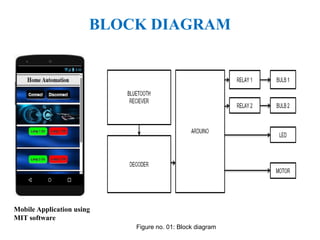
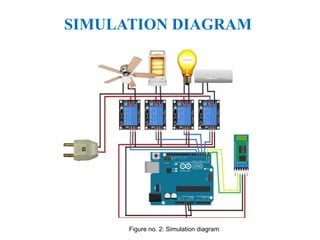
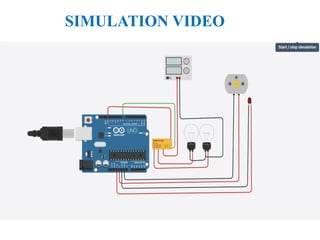
Home automation:
• Homeautomation is a network of hardware, communication, and
electronic interfaces that work to integrate everyday devices
with one another via the Internet.
• Each device has sensors and is connected through Bluetooth, so
you can manage them from your smartphone or tablet whether
you're at home, or miles away.
WORKING
19.
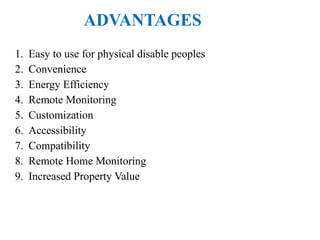
1. Easy touse for physical disable peoples
2. Convenience
3. Energy Efficiency
4. Remote Monitoring
5. Customization
6. Accessibility
7. Compatibility
8. Remote Home Monitoring
9. Increased Property Value
ADVANTAGES
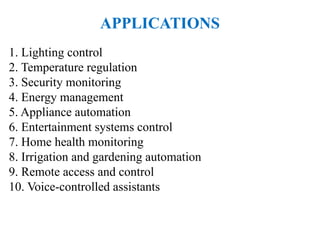
APPLICATIONS
1. Lighting control
2.Temperature regulation
3. Security monitoring
4. Energy management
5. Appliance automation
6. Entertainment systems control
7. Home health monitoring
8. Irrigation and gardening automation
9. Remote access and control
10. Voice-controlled assistants
22.
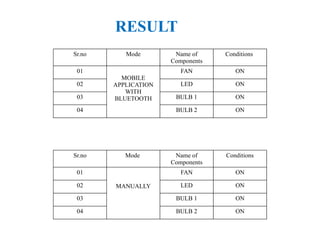
RESULT
Sr.no Mode Nameof
Components
Conditions
01
MOBILE
APPLICATION
WITH
BLUETOOTH
FAN ON
02 LED ON
03 BULB 1 ON
04 BULB 2 ON
Sr.no Mode Name of
Components
Conditions
01
MANUALLY
FAN ON
02 LED ON
03 BULB 1 ON
04 BULB 2 ON
23.
FUTURE SCOPE
• AIintegration
• GSM expansion
• IoT expansion
• Renewable energy
• Self-learning systems
• Smart city integration
• Health monitoring
• Healthcare collaboration
• Enhanced user experience
24.
Conclusion
Home automation usingBluetooth was
discussed in this paper. In all techniques, researchers
addressed control of device using Bluetooth and
internet/wired. Researchers are used various type of
microcontroller to control the appliances.
Mostly people, However, the researcher Not
addressed if the person forgot to switch off the devices.
Researchers need to address this problem also.
Project Exhibition
Paste thephoto or softcopy of certificate for each
group member who have ,
✔published a research paper in journal/ conference or
✔participated in Project exhibition or
✔paper Presentation competition or
✔filed a patent
![LITERATURE SURVEY
[1] S. Das, S. Ganguly, S. Ghosh, R. Sarker and D. Sengupta, "A
bluetooth based sophisticated home automation system using
smartphone," 2016 International Conference on Intelligent Control
Power and Instrumentation (ICICPI), Kolkata, India, 2016, pp. 236-
240, doi: 10.1109/ICICPI.2016.7859709.
• This paper presents a cost-effective smart home automation system
using Arduino (microcontroller) and an Android app.
• The Arduino platform now uses a Bluetooth chip, eliminating the
need for personal computers.
• The proposed smart home system incorporates devices like lights and
DC servomotors to demonstrate its feasibility, reliability, and quick
operation.
• The system has been tested and found to function properly, including
switching, servomotor position control, DC motor speed control, and
light intensity control.](https://image.slidesharecdn.com/review4-250423082255-4c4d7333/85/Review-4-pptx-electrical-engineering-ppt-4-320.jpg)
![LITERATURE SURVEY
[2] A. Raza et al., "A Home Automation Through Android
Mobile App By Using Arduino UNO," 2020 IEEE 23rd
International Multitopic Conference (INMIC), Bahawalpur,
Pakistan, 2020, pp. 1-6, doi:
10.1109/INMIC50486.2020.9318084.
• As energy consumption rises, it's crucial to prevent overuse
in all areas.
• Home automation can improve people's lives by reducing
stress, increasing energy efficiency, and saving time,
resulting in a smarter home.
• Home automation, also known as smart home technology,
has advanced significantly and will continue to do so in
response to changing needs and benefits.](https://image.slidesharecdn.com/review4-250423082255-4c4d7333/85/Review-4-pptx-electrical-engineering-ppt-5-320.jpg)
![LITERATURE SURVEY
[3]V. R. Reddy, S. Anusha, O. Rajeswari, B. H. Chandana and S.
F. Sujana, "Android Home Automation using PIC Micro
Controller and Bluetooth," 2019 International Conference on
Intelligent Sustainable Systems (ICISS), Palladam, India, 2019, pp.
328-331, doi: 10.1109/ISS1.2019.8907984.
• The project's strategy involves controlling electrical loads using an
Android app.
• Bluetooth-enabled Android devices monitor electrical loads.
Frequently turning on and off these switches caused distress and
inconvenience for those with physical disabilities.
• The device aids Android devices in transmitting incoming data.
The term "Android device" refers to any device running the
Android operating system, including phones and tablets.
• The app provides a powerful graphical user interface (GUI) to
achieve this.](https://image.slidesharecdn.com/review4-250423082255-4c4d7333/85/Review-4-pptx-electrical-engineering-ppt-6-320.jpg)
![LITERATURE SURVEY
[4] R. Piyare and M. Tazil, "Bluetooth based home automation
system using cell phone," 2011 IEEE 15th International
Symposium on Consumer Electronics (ISCE), Singapore, 2011,
pp. 192-195, doi: 10.1109/ISCE.2011.5973811.
• Technology is a never-ending process.
• Designing a product with cutting-edge technology to improve
the lives of others is a significant community contribution.
• This paper describes the design and implementation of a low-
cost, flexible, and secure cell phone-based home automation
system.
• The design utilizes a standalone Arduino BT board, with home
appliances connected via relays to its input and output ports.
• The cell phone and Arduino BT board communicate wirelessly.](https://image.slidesharecdn.com/review4-250423082255-4c4d7333/85/Review-4-pptx-electrical-engineering-ppt-7-320.jpg)
![LITERATURE SURVEY
[5] N. M. Morshed, G. M. Muid-Ur-Rahman, M. R.
Karim and H. U. Zaman, "Microcontroller based home
automation system using Bluetooth, GSM, Wi-Fi and
DTMF," 2015 International Conference on Advances in
Electrical Engineering (ICAEE), Dhaka, Bangladesh,
2015, pp. 101-104, doi: 10.1109/ICAEE.2015.7506806.
• Automation has a significant impact on the economy.
• Engineers aim to integrate automated devices with functional instruments to
create complex systems for a wide range of applications and human activities.
• This paper presents a low-cost, flexible, and standalone home automation
system.
• We can control home appliances from both indoor and outdoor locations.
• Our system uses a PIR Sensor to detect intruders.
• All electrical loads are automated in this system.
• The internet module uses Twitter to notify the status of home appliances.](https://image.slidesharecdn.com/review4-250423082255-4c4d7333/85/Review-4-pptx-electrical-engineering-ppt-8-320.jpg)
![LITERATURE SURVEY
[6] A. Gurek, C. Gur, C. Gurakin, M. Akdeniz, S. K. Metin and
I. Korkmaz, "An Android based home automation
system," 2013 High Capacity Optical Networks and
Emerging/Enabling Technologies, Magosa, Cyprus, 2013, pp.
121-125, doi: 10.1109/HONET.2013.6729769.
• The number of network-enabled digital devices in homes has
rapidly increased over the years.
• As the Internet expands, owners are requesting remote control
and monitoring of their in-home appliances.
• Networking these appliances creates a home automation system.
• This paper introduces an Android-based home automation
system that enables multiple users to control appliances via an
app or website.](https://image.slidesharecdn.com/review4-250423082255-4c4d7333/85/Review-4-pptx-electrical-engineering-ppt-9-320.jpg)
![LITERATURE SURVEY
[7] R. A. Ramlee, M. A. Othman, M. H. Leong, M. M. Ismail
and S. S. S. Ranjit, "Smart home system using android
application," 2013 International Conference of Information
and Communication Technology (ICoICT), Bandung,
Indonesia, 2013, pp. 277-280, doi:
10.1109/ICoICT.2013.6574587.
• This paper presents the design of a low-cost Home
Automation System (HAS) with wireless remote control.
• This system aims to support the elderly and disabled in their
homes.
• The smart home concept enhances living standards at home
• The main control system uses Bluetooth technology for
remote access from a PC, laptop, or smartphone.](https://image.slidesharecdn.com/review4-250423082255-4c4d7333/85/Review-4-pptx-electrical-engineering-ppt-10-320.jpg)
![LITERATURE SURVEY
[8] P. Suesaowaluk, "Home Automation System Based
Mobile Application," 2020 2nd World Symposium on Artificial
Intelligence (WSAI), Guangzhou, China, 2020, pp. 97-102,
doi: 10.1109/WSAI49636.2020.9143317.
• Home automation, also known as smart home systems, aims
to make it easier to control and manage household tasks.
• Additionally, they can adjust to meet the needs of residents
and improve their quality of life.
• This paper explores how a mobile application can be used to
remotely control home appliances through voice commands
and graphical user interfaces.
• The user interface uses Google Assistant for voice commands
and the Blynk App for graphics.](https://image.slidesharecdn.com/review4-250423082255-4c4d7333/85/Review-4-pptx-electrical-engineering-ppt-11-320.jpg)
![LITERATURE SURVEY
[9] P. Thakar, V. Savaliya, M. Pant, U. Joshi, A. Desai
and A. Kadam, "Smart Homes Using Android," 2018
2nd International Conference on Trends in Electronics
and Informatics (ICOEI), Tirunelveli, India, 2018, pp.
1251-1256, doi: 10.1109/ICOEI.2018.8553952.
• This project aims to create a cost-effective home automation system
with an Android app that serves as a remote and utilizes all connected
appliances, simplifying daily life.
• Electricity conservation aims to minimize waste and maximize
utilization.
• Simple steps include turning off electrical appliances when leaving a
room.
• People are motivated to conserve electricity due to the potential
savings on their annual energy bills.](https://image.slidesharecdn.com/review4-250423082255-4c4d7333/85/Review-4-pptx-electrical-engineering-ppt-12-320.jpg)
![LITERATURE SURVEY
[10] B. Debnath, R. Dey and S. Roy, "Smart Switching System
Using Bluetooth Technology," 2019 Amity International
Conference on Artificial Intelligence (AICAI), Dubai, United Arab
Emirates, 2019, pp. 760-763, doi: 10.1109/AICAI.2019.8701298.
• In today's digital age, being "SMART" extends beyond smartphones and
computers.
• Home appliances can be controlled using a smartphone.
• An Android app controls everyday devices.
• This project also requires a bluetooth module, microcontroller, relay
board, and bulb.
• This paper describes the overall system architecture, including both
hardware and software components.
• This venture is designed to be cost-effective and easily implementable
in a familiar environment.](https://image.slidesharecdn.com/review4-250423082255-4c4d7333/85/Review-4-pptx-electrical-engineering-ppt-13-320.jpg)
![REFERENCES
[1] B. Koyuncu, “PC remote control of appliances by using telephone lines,’’ IEEE Transactions on Consumer
Electronics, vol. 41, no. 1. February 1995.
[2] L. Cogkun and H. Ardam, “A Remote Controller for Home and Office Appliances By Telephone,’’ IEEE
Transactions on Consumer Electronics, vol. 44, no. 4, November 1998.
[3] H. ElKamchouchi and A. ElShafee, “Design and Prototype Implementation of SMS Based Home
Automation System,’’ 2012 IEEE International Conference on Electronics Design, Systems and Applications
(ICEDSA).
[4] R.Piyare and M.Tazil, “Bluetooth Based Home Automation System using Cell-phone,’’ 2011 IEEE 15th
International Symposium on Consumer Electronics.
[5] N. David, A. Chima, A. Ugochukwu and E. Obinna, “Design of a home automation system using
arduino,” International Journal of Scientific & Engineering Research, vol. 6, Issue 6, pp. 795-801, June2015.
[6] Shiu Kumar, “Ubiquitous Smart Home System Using Android Application,” International Journal of
Computer Networks & Communications (IJCNC), vol. 6, no. 1, pp. 33-43, January 2014.
[7] M. O. A. Bader , I. M. A. Iman, H. M. A. Mahdi, H. A. A. Sami and S. S. Mohamed, “Design and
Implementation of a Reliable Wireless RealTime Home Automation System Based on Arduino Uno Single-
Board Microcontroller,”International journal of control, Automation and systems, vol. 3, no. 3, pp. 11-15,
2014.
[8] R. Piyare1 and S. R. Lee1, “Smart Home-Control and Monitoring System Using Smart Phone”,
Independent Computer Consultants Association 2013, ASTL vol. 24, pp 83 - 86, 2013 © SERSC 2013.
[9] Q. wu, F. wang and Y. lin, “A mobile-agent based distributed intelligent control System architecture for
home automation,” Systems, Man, and Cybernetics, 2001 IEEE International Conference, vol . 3, pp. 1599 –
1605.
[10] M. G. Golzar and H. Tajozzakerin, “A New Intelligent Remote Control System for Home Automation
and Reduce Energy Consumption,” 2010 Fourth Asia International Conference on Mathematical/Analytical
Modelling and Computer Simulation.](https://image.slidesharecdn.com/review4-250423082255-4c4d7333/85/Review-4-pptx-electrical-engineering-ppt-25-320.jpg)



![AKHIL[1][1].pdf[1].pptx electrical engineering](https://cdn.slidesharecdn.com/ss_thumbnails/akhil11-250423082731-ca623661-thumbnail.jpg?width=640&height=640&fit=bounds)


