International Research Journal of Engineering and Technology (IRJET) e-ISSN: 2395-0056
Volume: 06 Issue: 05 | May 2019 www.irjet.net p-ISSN: 2395-0072
© 2019, IRJET | Impact Factor value: 7.211 | ISO 9001:2008 Certified Journal | Page 6308
Easy, Efficient and Integrated Billing System
Anshuman Chauhan1, Ayushi Singh2, Swati Singh3
1Research student , Department of Computer science and Engineering, ABES Institute of Technology,
Ghaziabad, India
2Research student, Department of Computer science and Engineering, ABES Institute of Technology,
Ghaziabad, India
3Associate professor, Department of Computer science and Engineering, ABES Institute of Technology,
Ghaziabad, India
---------------------------------------------------------------------***----------------------------------------------------------------------
Abstract - In recent years, the demand for electricity has increased in households with the use of different appliances. This
raises a concern to many developed and developing nations with the demand in immediate increase of electricity. There is a
need for consumers or people to track their daily power usage in houses. This research work focuses on a Smart Metering data
for distributing the electricity smartly and efficiently to the consumers. The main drawback of previously used traditional
meters is that they do not provide information to the consumers, which is accomplished with the help of Smart Meter. A Smart
Meter helps consumer to know the information of consumption of electricity for appliances in their respective houses. The aim
of this research work is to measure and analyze power consumption using Smart Meter data by conducting case study on the
energy expenditure by understanding the behavior of consumers and its correlation with electricity spot prices motivated to
perform this research various households. In addition of saving electricity, Smart Meter data illustrates the behavior of
consumers in using devices. As power consumption is increasing day by day there should be more focus on understanding
consumption patterns i.e. measurement and analysis of consumption over time is required. In case of developing nations, the
technology of employing smart electricity meters is still unaware to many common people and electricity utilities. So, there is
a large necessity for saving energy by installing these meters. The traditional method of energy meter billing is a long
outdated, inefficient and time consuming one and people have to stand in long queues just to pay their bills. It was replaced
long back with the new and a better efficient method of metering. The paper here presents an innovative system which is an
up gradation to the latest energy metering method yet to be implemented also along with the designing of a website providing
access to the billing information from anywhere round the globe. In addition the consumer will also informed about his usage
through messaging service on his mobile. The communication takes place through a small addition of hardware to the
traditional system .This can be done with the help of Arduino and photodiode. The meter readings are sent time to time from
the electricity meter having the web portal. Accordingly the database is also periodically updated. The website is designed for
the user’s convenience. After the necessary authentication the users can gain access to the information regarding their
electricity bills from any place. Also the problem of increasing electricity thefts would be slightly under control with the
additional theft detection part.
Key Words: Meter, Arduino Uno, Java, Gateway through SMS and Website.
1. INTRODUCTION
The current procedure with regard to the billing process for electricity is not a fully automated system. It involves manual
processes from the time the Meter reader starts reading the meter until the system is updated with the current reading. A
meter reader visits a house, does the meter reading, and then manually calculates the amount considering the units. To
overcome problems with this manual approach a few solutions are identified . One of the main reasons for inefficiency in
DISCOMs today is regular meter reading, bill generation and bill collection. At today there is no mechanism that integrates
all these and provides easy, hassle free and efficient way of bill collections. Users of the system Utilities/DISCOMs s who
are distributing electricity –domestic, industrial and commercial are the bill payers in the system. As we can see that it all
encompassing and covers the entire populace and citizenry of the country’s is also pertinent to note that domestic
consumers are varied regions and sections of the society. When to obtain meter reading when desired so meter reader
doesn’t need to visit each customer for the consumed readings. In case of a customer defaulter, no need send a person of
utility to cut-off the customer connection. Utility can cut-off and reconnect the customer connection can check the
status of electricity are being transferred be making use of Arduino. That include people from rural and remote areas of
nation who have difficulty in access to internet. So, the solution should be able to cover them also. Desired outcome. An
efficient and integrated meter reading, bill generation and bill payment mechanism that can provide end to end solution.
At one hand it should increase the revenue collection for DISCOMs and reduce the cost of collection. An automatic remote
meter reading system and Arduino and photodiode.
International Research Journal of Engineering and Technology (IRJET) e-ISSN: 2395-0056
Volume: 06 Issue: 05 | May 2019 www.irjet.net p-ISSN: 2395-0072
© 2019, IRJET | Impact Factor value: 7.211 | ISO 9001:2008 Certified Journal | Page 6309
1.1 OVERVIEW OF PROPOSED SYSTEM
The proposed system consist of Electronic meter, The proposed system is automatic do not need to go and check manually.
Consumer will be notified about the power usage and current billed amount by SMS. Also consumer can check details by
visiting online portal at any time. There are two ways that consumer will come to know the details of bill. One is on mobile
through and second is by visiting Website.
1.2 IDEA OF APPROACH
International Research Journal of Engineering and Technology (IRJET) e-ISSN: 2395-0056
Volume: 06 Issue: 05 | May 2019 www.irjet.net p-ISSN: 2395-0072
© 2019, IRJET | Impact Factor value: 7.211 | ISO 9001:2008 Certified Journal | Page 6310
2. TECHNOLOGY USED
HTML: Hypertext markup language is a text-based approach to describing how content contained within an HTML file is
structured. This markup tells a web browser how to display the text, images and other forms of multimedia on a webpage.
CSS: Cascading style sheets language used for describing the presentation of a document written in a markup language like
html. CSS is a cornerstone technology of the World Wide Web, alongside html and JavaScript
JSP: Java server pages is a technology that helps software developers create dynamically generated web page based on
html, xml or other document types .To deploy and run java server pages, a compatible web server with a servlet container,
such as Apache Tomcat or Jelly is required.
JAVA SERLET: Java Servlet is a software component that extends the capabilities of a server. Although servlets can
respond to any types of request, they most commonly implement web container for hosting web applications on web
server and thus qualify as a server side servlet web API.
C++: C++ is a general purpose programming language that was developed by Bjarne Stroustrup as an extension of the C
language, or "C with Classes". It has imperative, object oriented and generic programming features, while also providing
facilities for low-level memory manipulation. It is almost always implemented as a compiled language.
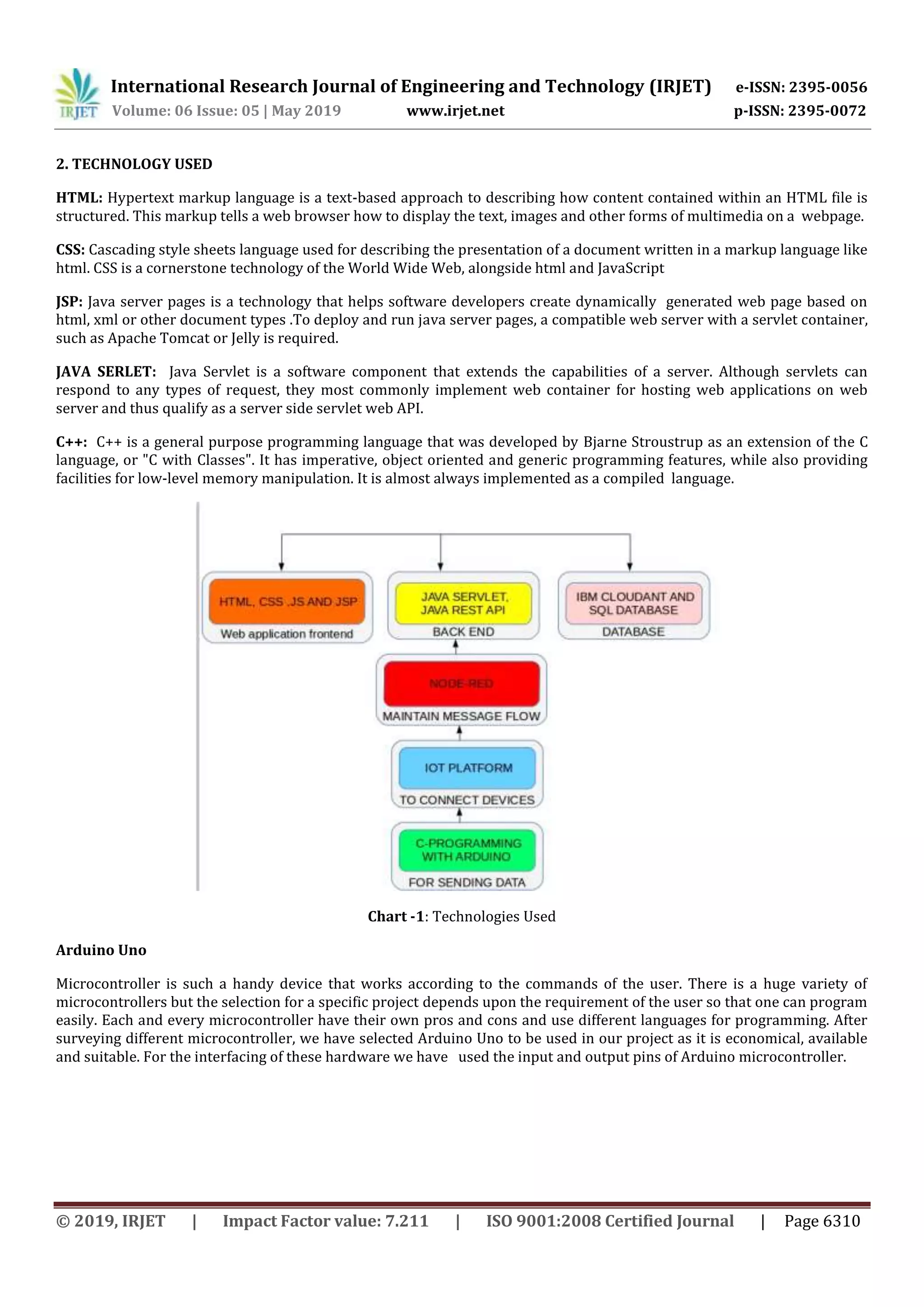
Chart -1: Technologies Used
Arduino Uno
Microcontroller is such a handy device that works according to the commands of the user. There is a huge variety of
microcontrollers but the selection for a specific project depends upon the requirement of the user so that one can program
easily. Each and every microcontroller have their own pros and cons and use different languages for programming. After
surveying different microcontroller, we have selected Arduino Uno to be used in our project as it is economical, available
and suitable. For the interfacing of these hardware we have used the input and output pins of Arduino microcontroller.
International Research Journal of Engineering and Technology (IRJET) e-ISSN: 2395-0056
Volume: 06 Issue: 05 | May 2019 www.irjet.net p-ISSN: 2395-0072
© 2019, IRJET | Impact Factor value: 7.211 | ISO 9001:2008 Certified Journal | Page 6311
Fig -1: Arduino
Energy Meter
It is a tool that is used for the measurement of energy consumption by the user. Actually, the calibration of energy meter is
done in kilowatt hour (kWh). The two main categories of energy meter are analog and digital. Analog meter is
conventional and nowadays obsolete, instead of this digital meter is used for energy consumption measurement because
of accurate result and it has eliminated the parallax error. On the other hand, it has benefit for personnel too in terms of
taking readings easily. This project has been designed for digital energy meter.
Photodiode
A photodiode is a semiconductor device that captures light signals from the meter and with the help of Arduino it sends
the electronic signals to the web portal. This is basically used to capture the light signal. The current is generated when
photons are absorbed in the photodiode. Photodiodes may contain optical filters, built-in lenses, and may have large or
small surface areas
3. CONCLUSION
This project will help in designing a system that it does not require manual labor for its bill collection and regular meter
reading. This project will help the consumers to check their regular electricity consumption and can optimize the use of it.
It will also provide a platform to pay their bills online, this will not only reduce the size of the long queues but it will also
help the people to pay their bills from their homes .The consumer will be notified after every 30 days, if after 7 days of the
generation of the electricity bill the consumer was not able to pay the bill that he had to pay the bill on time otherwise his
electricity will be cut off. The main motive of the project is to design a system that requires less manual power and make
the system digitalize.
REFERENCES
[1] N. Mohan, T.M. Undeland and W.P. Robbins, “Power Electronic Converters, Applications and Design”, 2nd Edition, John
Wiley and sons Inc., New York, 1995
[2] “Methodology for Establishing Baseline AT&C Losses”, Power Finance Corporation Limited, India, September, 2009.
[3] http://www.silicon.ac.in/sitbbsr/nwetmaterials/Power-Distribution-Losses.pdf
[4] J.P Navani, N.K. Sharma and S. Sapra “Technical and Non-Technical Losses in Power System and its Economic
Consequence in Indian Economy”, International Journal of Electronics and Computer Science Engineering, Vol.1, No. 2, pp.
757-761, 2012.
[5] Energy statistics 2012, Nineteenth Issue, Central Statistics Office, Ministry of Statistics and Program Implementation,
Govt. of India, New Delhi, March 2012.
[6] S. S. Mustafa, M.H. Yasen and H.H. Abdullah, “Evaluation of Electric Energy Losses in Kirkuk Distribution Electric
System Area”, Iraqi Journal of Electrical and Electronic Engineering, Vol.7, No.2, pp.144-150, 2011.
[7] P. Kadurek et al., “Theft Detection and Smart Metering Practices and Expectations in the Netherlands” Proc. IEEE PES
Innovative Smart Grid Technologies Conf. Europe (ISGT Europe), pp. 1–6, 2010.
International Research Journal of Engineering and Technology (IRJET) e-ISSN: 2395-0056
Volume: 06 Issue: 05 | May 2019 www.irjet.net p-ISSN: 2395-0072
© 2019, IRJET | Impact Factor value: 7.211 | ISO 9001:2008 Certified Journal | Page 6312
[8] H.O. Bansal, S. Mohan and H.P. Agrawal, “A Critical Analysis of Distributed Generation and its Implications”,
International Conference on Renewable Energy, Jaipur, 2011.
[9] http://blog.vitria.com/bid/91948/The-Evolution-Benefits-of-Smart-Meters
[10]http://www.powerengineeringint.com/articles/print/volume-19/issue-5/features/the-evolution-of-smart-meters-
towards-a-supersmart-grid.html

IRJET- Easy, Efficient and Integrated Billing System

  • 1.
    International Research Journalof Engineering and Technology (IRJET) e-ISSN: 2395-0056 Volume: 06 Issue: 05 | May 2019 www.irjet.net p-ISSN: 2395-0072 © 2019, IRJET | Impact Factor value: 7.211 | ISO 9001:2008 Certified Journal | Page 6308 Easy, Efficient and Integrated Billing System Anshuman Chauhan1, Ayushi Singh2, Swati Singh3 1Research student , Department of Computer science and Engineering, ABES Institute of Technology, Ghaziabad, India 2Research student, Department of Computer science and Engineering, ABES Institute of Technology, Ghaziabad, India 3Associate professor, Department of Computer science and Engineering, ABES Institute of Technology, Ghaziabad, India ---------------------------------------------------------------------***---------------------------------------------------------------------- Abstract - In recent years, the demand for electricity has increased in households with the use of different appliances. This raises a concern to many developed and developing nations with the demand in immediate increase of electricity. There is a need for consumers or people to track their daily power usage in houses. This research work focuses on a Smart Metering data for distributing the electricity smartly and efficiently to the consumers. The main drawback of previously used traditional meters is that they do not provide information to the consumers, which is accomplished with the help of Smart Meter. A Smart Meter helps consumer to know the information of consumption of electricity for appliances in their respective houses. The aim of this research work is to measure and analyze power consumption using Smart Meter data by conducting case study on the energy expenditure by understanding the behavior of consumers and its correlation with electricity spot prices motivated to perform this research various households. In addition of saving electricity, Smart Meter data illustrates the behavior of consumers in using devices. As power consumption is increasing day by day there should be more focus on understanding consumption patterns i.e. measurement and analysis of consumption over time is required. In case of developing nations, the technology of employing smart electricity meters is still unaware to many common people and electricity utilities. So, there is a large necessity for saving energy by installing these meters. The traditional method of energy meter billing is a long outdated, inefficient and time consuming one and people have to stand in long queues just to pay their bills. It was replaced long back with the new and a better efficient method of metering. The paper here presents an innovative system which is an up gradation to the latest energy metering method yet to be implemented also along with the designing of a website providing access to the billing information from anywhere round the globe. In addition the consumer will also informed about his usage through messaging service on his mobile. The communication takes place through a small addition of hardware to the traditional system .This can be done with the help of Arduino and photodiode. The meter readings are sent time to time from the electricity meter having the web portal. Accordingly the database is also periodically updated. The website is designed for the user’s convenience. After the necessary authentication the users can gain access to the information regarding their electricity bills from any place. Also the problem of increasing electricity thefts would be slightly under control with the additional theft detection part. Key Words: Meter, Arduino Uno, Java, Gateway through SMS and Website. 1. INTRODUCTION The current procedure with regard to the billing process for electricity is not a fully automated system. It involves manual processes from the time the Meter reader starts reading the meter until the system is updated with the current reading. A meter reader visits a house, does the meter reading, and then manually calculates the amount considering the units. To overcome problems with this manual approach a few solutions are identified . One of the main reasons for inefficiency in DISCOMs today is regular meter reading, bill generation and bill collection. At today there is no mechanism that integrates all these and provides easy, hassle free and efficient way of bill collections. Users of the system Utilities/DISCOMs s who are distributing electricity –domestic, industrial and commercial are the bill payers in the system. As we can see that it all encompassing and covers the entire populace and citizenry of the country’s is also pertinent to note that domestic consumers are varied regions and sections of the society. When to obtain meter reading when desired so meter reader doesn’t need to visit each customer for the consumed readings. In case of a customer defaulter, no need send a person of utility to cut-off the customer connection. Utility can cut-off and reconnect the customer connection can check the status of electricity are being transferred be making use of Arduino. That include people from rural and remote areas of nation who have difficulty in access to internet. So, the solution should be able to cover them also. Desired outcome. An efficient and integrated meter reading, bill generation and bill payment mechanism that can provide end to end solution. At one hand it should increase the revenue collection for DISCOMs and reduce the cost of collection. An automatic remote meter reading system and Arduino and photodiode.
  • 2.
    International Research Journalof Engineering and Technology (IRJET) e-ISSN: 2395-0056 Volume: 06 Issue: 05 | May 2019 www.irjet.net p-ISSN: 2395-0072 © 2019, IRJET | Impact Factor value: 7.211 | ISO 9001:2008 Certified Journal | Page 6309 1.1 OVERVIEW OF PROPOSED SYSTEM The proposed system consist of Electronic meter, The proposed system is automatic do not need to go and check manually. Consumer will be notified about the power usage and current billed amount by SMS. Also consumer can check details by visiting online portal at any time. There are two ways that consumer will come to know the details of bill. One is on mobile through and second is by visiting Website. 1.2 IDEA OF APPROACH
  • 3.
    International Research Journalof Engineering and Technology (IRJET) e-ISSN: 2395-0056 Volume: 06 Issue: 05 | May 2019 www.irjet.net p-ISSN: 2395-0072 © 2019, IRJET | Impact Factor value: 7.211 | ISO 9001:2008 Certified Journal | Page 6310 2. TECHNOLOGY USED HTML: Hypertext markup language is a text-based approach to describing how content contained within an HTML file is structured. This markup tells a web browser how to display the text, images and other forms of multimedia on a webpage. CSS: Cascading style sheets language used for describing the presentation of a document written in a markup language like html. CSS is a cornerstone technology of the World Wide Web, alongside html and JavaScript JSP: Java server pages is a technology that helps software developers create dynamically generated web page based on html, xml or other document types .To deploy and run java server pages, a compatible web server with a servlet container, such as Apache Tomcat or Jelly is required. JAVA SERLET: Java Servlet is a software component that extends the capabilities of a server. Although servlets can respond to any types of request, they most commonly implement web container for hosting web applications on web server and thus qualify as a server side servlet web API. C++: C++ is a general purpose programming language that was developed by Bjarne Stroustrup as an extension of the C language, or "C with Classes". It has imperative, object oriented and generic programming features, while also providing facilities for low-level memory manipulation. It is almost always implemented as a compiled language. Chart -1: Technologies Used Arduino Uno Microcontroller is such a handy device that works according to the commands of the user. There is a huge variety of microcontrollers but the selection for a specific project depends upon the requirement of the user so that one can program easily. Each and every microcontroller have their own pros and cons and use different languages for programming. After surveying different microcontroller, we have selected Arduino Uno to be used in our project as it is economical, available and suitable. For the interfacing of these hardware we have used the input and output pins of Arduino microcontroller.
  • 4.
    International Research Journalof Engineering and Technology (IRJET) e-ISSN: 2395-0056 Volume: 06 Issue: 05 | May 2019 www.irjet.net p-ISSN: 2395-0072 © 2019, IRJET | Impact Factor value: 7.211 | ISO 9001:2008 Certified Journal | Page 6311 Fig -1: Arduino Energy Meter It is a tool that is used for the measurement of energy consumption by the user. Actually, the calibration of energy meter is done in kilowatt hour (kWh). The two main categories of energy meter are analog and digital. Analog meter is conventional and nowadays obsolete, instead of this digital meter is used for energy consumption measurement because of accurate result and it has eliminated the parallax error. On the other hand, it has benefit for personnel too in terms of taking readings easily. This project has been designed for digital energy meter. Photodiode A photodiode is a semiconductor device that captures light signals from the meter and with the help of Arduino it sends the electronic signals to the web portal. This is basically used to capture the light signal. The current is generated when photons are absorbed in the photodiode. Photodiodes may contain optical filters, built-in lenses, and may have large or small surface areas 3. CONCLUSION This project will help in designing a system that it does not require manual labor for its bill collection and regular meter reading. This project will help the consumers to check their regular electricity consumption and can optimize the use of it. It will also provide a platform to pay their bills online, this will not only reduce the size of the long queues but it will also help the people to pay their bills from their homes .The consumer will be notified after every 30 days, if after 7 days of the generation of the electricity bill the consumer was not able to pay the bill that he had to pay the bill on time otherwise his electricity will be cut off. The main motive of the project is to design a system that requires less manual power and make the system digitalize. REFERENCES [1] N. Mohan, T.M. Undeland and W.P. Robbins, “Power Electronic Converters, Applications and Design”, 2nd Edition, John Wiley and sons Inc., New York, 1995 [2] “Methodology for Establishing Baseline AT&C Losses”, Power Finance Corporation Limited, India, September, 2009. [3] http://www.silicon.ac.in/sitbbsr/nwetmaterials/Power-Distribution-Losses.pdf [4] J.P Navani, N.K. Sharma and S. Sapra “Technical and Non-Technical Losses in Power System and its Economic Consequence in Indian Economy”, International Journal of Electronics and Computer Science Engineering, Vol.1, No. 2, pp. 757-761, 2012. [5] Energy statistics 2012, Nineteenth Issue, Central Statistics Office, Ministry of Statistics and Program Implementation, Govt. of India, New Delhi, March 2012. [6] S. S. Mustafa, M.H. Yasen and H.H. Abdullah, “Evaluation of Electric Energy Losses in Kirkuk Distribution Electric System Area”, Iraqi Journal of Electrical and Electronic Engineering, Vol.7, No.2, pp.144-150, 2011. [7] P. Kadurek et al., “Theft Detection and Smart Metering Practices and Expectations in the Netherlands” Proc. IEEE PES Innovative Smart Grid Technologies Conf. Europe (ISGT Europe), pp. 1–6, 2010.
  • 5.
    International Research Journalof Engineering and Technology (IRJET) e-ISSN: 2395-0056 Volume: 06 Issue: 05 | May 2019 www.irjet.net p-ISSN: 2395-0072 © 2019, IRJET | Impact Factor value: 7.211 | ISO 9001:2008 Certified Journal | Page 6312 [8] H.O. Bansal, S. Mohan and H.P. Agrawal, “A Critical Analysis of Distributed Generation and its Implications”, International Conference on Renewable Energy, Jaipur, 2011. [9] http://blog.vitria.com/bid/91948/The-Evolution-Benefits-of-Smart-Meters [10]http://www.powerengineeringint.com/articles/print/volume-19/issue-5/features/the-evolution-of-smart-meters- towards-a-supersmart-grid.html