International Research Journal of Engineering and Technology (IRJET) e-ISSN: 2395-0056
Volume: 06 Issue: 05 | May 2019 www.irjet.net p-ISSN: 2395-0072
© 2019, IRJET | Impact Factor value: 7.211 | ISO 9001:2008 Certified Journal | Page 6486
LED Revolution: Deep UV LED
Pramod Sharma1, M.Z. Khan2, A.K. Choubey3
1Research Scholar, Dept. of Physics, Dr. C. V. Raman University, Kota, Bilaspur, Chattisgarh, India
2Associate Professor, Dept. of Physics, Dr. C. V. Raman University, Kota, Bilaspur, Chattisgarh, India
3Assistant Professor, Dept. of Physics, CCET, Bhilai, Chattisgarh, India
---------------------------------------------------------------------***---------------------------------------------------------------------
Abstract - The Deep UV-light emitting diode (DULED) has
been attracting attention in the world as a new UV source
that can replace conventional mercury gas-filled lamps in
water disinfection applications. . We have studied the
distinct advantages, fabrication, characteristics and
application of DULED.
Key Words: LED, DULED, UV source
1. INTRODUCTION
LED is semiconductor device that emits light due to
Electro- luminescence effect [1], PN Junction Diode, which
emits light when forward, biased. Light Emitting Diodes
are almost everywhere. LEDs can find everywhere e.g. in
Cars, Bikes, Street Lights, Home Lighting, Office Lighting,
Mobile Phones, Televisions and many more.
Light-emitting diode (LED) is a semiconductor light
source that emits light when current flows through it.
Electrons in the semiconductor recombine with electron
holes, releasing energy in the form of photons. This effect
is called electro -luminescence.[1] The color of the light
(corresponding to the energy of the photons) is
determined by the energy required for electrons to cross
the band gap of the semiconductor.[2] White light is
obtained by using multiple semiconductors or a layer of
light-emitting phosphor on the semiconductor device.[3]
Appearing as practical electronic components in 1962, the
earliest LEDs emitted low-intensity infrared light. [4]
Infrared LEDs are used in remote-control circuits, such as
those used with a wide variety of consumer electronics.
The first visible-light LEDs were of low intensity and
limited to red. Modern LEDs are available across the
visible, ultraviolet, and infrared wavelengths, with high
light output
The reason for such wide range of implementation of LEDs
is its advantages over traditional incandescent bulbs and
the recent compact fluorescent lamps (CFL).
Advantages of LEDs over incandescent and CFL light
sources are mentioned below:
1. Low Power Consumption
2. Small Size
3. Fast Switching
4. Physically Robust
5. Long Lasting
2. Basics of Deep UV-LED (DULED)
The new LED is Deep-UV LED (DULED) which attracted in
a whole world and great deal of attention, especially in the
hygiene field. This is because the possibilities of expanding
Deep-UV light applications to equipment such as water
purification devices have further increased.
2.1 Materials of Deep UV LED (DULED):
Deep Ultraviolet light-emitting diodes (DUV-LED) made
from aluminum gallium nitride (AlGaN) efficiently transfer
electrical energy to optical energy due to the growth of one
of its bottom layers in a step-like fashion.
KBe2BO3F2 (KBBF) is another type of materials practically
usable deep ultraviolet (DUV) nonlinear optical (NLO)
crystal so far that can generate DUV coherent light by the
direct second harmonic generation. Other materials are
Fused Silica, CaF2, MgF2[5] .
2.1 Application of Deep UV LED (DULED)
The compact size and low power consumption of the UV
LEDs help make these instruments practical. Solid state
ultraviolet light emitting diodes (UV LEDs) have
numerous applications in biomedical industry. LEDs are
used for purifying air and water, treating skin diseases,
disinfecting surfaces, for industrial (photo-chemical)
curing, printing, for forensic investigations and forgery
detection [6–10]. Through the years, the UV
electromagnetic radiation was primarily based on tube
technology first developed in 1901 [11]. Though UV
lamps are able to generate high output levels there are
several drawbacks of UV lamps: lamps are fragile, can be a
biological hazard, since they contain mercury and high
voltages resulting in ozone production, require proper
disposal techniques, have short lifetimes, and a fixed
spectral power distribution. UV lamps cannot be dimmed.
High pressure mercury lamps operate at high
temperatures and may not be used in processes that
require lower temperatures, for example, for photo-
chemicallycuring polymers [12].
Deep-UV LEDs have a superior advantage compared to
mercury lamps, such as small size, high efficiency, zero
International Research Journal of Engineering and Technology (IRJET) e-ISSN: 2395-0056
Volume: 06 Issue: 05 | May 2019 www.irjet.net p-ISSN: 2395-0072
© 2019, IRJET | Impact Factor value: 7.211 | ISO 9001:2008 Certified Journal | Page 6487
warm-up time. For this reason, as a general view in the UV
light field, mercury lamps will replace LEDs in a natural
transition.
While LED device manufacturers focus on accelerating the
development of Deep-UV LEDs. It is widely recognized
that compact, efficient, long-lived, low- power, affordable
deep-UV (DUV) sources would dramatically push LIF
detection forward. (Here DUV covers wavelengths of 200–
250nm.) In comparison to violet, UV-A, and UV-B (see
Figure 1), DUV wavelengths offer LIF detection that is
more sensitive because of strong fluorescence cross
sections from fluorescent amino acids in proteins, and
more discriminating because it targets intrinsic biological
properties rather than growth-media residues. It is also
less susceptible to threat- washing techniques, residual
threat moisture, and ambient.
2. Design of Deep UV LED (DUVLED)
Light emitting diodes are very promising efficient light
sources. Advanced visible LEDs can deliver more lumens
per watt than any other lighting technology [13]. Both
red [14] and blue [13] light emitting diodes
demonstrated wall plug efficiencies of over 60%. The LED
theory [15] and experiments show that LED WPE could,
in principle, exceed 100%.
Typical DUV LEDs are considerably less efficient than their
visible counterparts. DUV LED’s decreased efficiency is
due to poor transparency of semiconductor layers to UV
light, poor UV light reflectivity of n- and p-contacts, and
low conductivity of semiconductor heterostructure.
Nevertheless, significant improvement has been achieved
by fabricating more transparent semiconductor layers, by
improving reflectivity of contacts, by chip encapsulation
and by growth of semiconductor layers with low density of
threading dislocations. All these improvements allow to
predict possibility of achieving 20% wall plug efficiency
for DUV LED.
Figure 1 shows the general schematic of the LED flip chip
design. The location of different regions is indicated on
the figure. The Figure 1 (a) show a traditional device
containing p-GaN layer and p contact with low
reflectivity, whereas Figure 1 (b) shows an advanced
device with p-AlGaN transparent layer and reflective p
contact.
(a)
(b)
Fig1. Schematic of LED flip chip design
Figure 1 shows the general schematic of the LED flip chip
design. The location of different regions is indicated on
the figure. The Figure 1 (a) show a traditional device
containing p-GaN layer and p contact with low
reflectivity, whereas Figure 1 (b) shows an advanced
device with p-AlGaN transparent layer and reflective p
contact.
Typical DUV LEDs are considerably less efficient than their
visible counterparts. DUV LED’s decreased efficiency is
due to poor transparency of semiconductor layers to UV
light, poor UV light reflectivity of n- and p-contacts, and
low conductivity of semiconductor hetero-structure.
International Research Journal of Engineering and Technology (IRJET) e-ISSN: 2395-0056
Volume: 06 Issue: 05 | May 2019 www.irjet.net p-ISSN: 2395-0072
© 2019, IRJET | Impact Factor value: 7.211 | ISO 9001:2008 Certified Journal | Page 6488
Nevertheless, significant improvement has been achieved
by fabricating more transparent semiconductor layers, by
improving reflectivity of contacts, by chip encapsulation
and by growth of semiconductor layers with low density of
threading dislocations. All these improvements allow to
predict possibility of achieving 20% wall plug efficiency
for DUV LED.
3. Fabrication of Deep UV LED (DULED):
Kazunobu Kojima of Tohoku University specializes in
quantum optoelectronics, which studies the quantum
effects of light on solid-state semiconductor materials. He
and colleagues in Japan used a variety of specialized
microscopic techniques to understand how the structure
of AlGaN-based LEDs affects their efficiency. Hey
fabricated an AlGaN-based LED by growing a layer of
aluminium nitride on top of a sapphire substrate with a
very small one degree off-angle. Next, they grew a cladding
layer of AlGaN with silicon impurities on top of the
aluminium nitride layer. Three AlGaN 'quantum wells'
were then grown on top of this. Quantum wells are very
thin layers that confine subatomic particles called
electrons and holes within the dimension that is
perpendicular to the layers' surface, without restricting
their movement in the other dimensions. The top quantum
well was finally covered with an electron-blocking layer
formed of aluminium nitride and AlGaN with magnesium
impurities. The microscopic investigations revealed that
terraced steps form between the bottom aluminium
nitride and AlGaN layers. These steps affect the shapes of
the quantum well layers above them. Gallium-rich stripes
form that connect the bottom steps to the small distortions
they cause in the upper quantum well layers. These stripes
represent micropaths of electric current in the AlGaN
cladding layer. These micropaths, together with a strong
localization of movement of electrons and holes within the
quantum well layers, appears to increase the LEDs'
efficiency in converting electrical energy to optical energy,
the researchers say.
3.1 Characteristics of DULED:
A Deep-UV LED(DULED) is an LED that emits light in the
wavelength range called "UV-C" (100 to 280 nm).
Currently, the development of Deep-UV LEDs is becoming
particularly active. This is because the demand for Deep-
UV LEDs has increased dramatically as an alternative
device to replace mercury lamps, which have been the
main light sources used for UV light application equipment
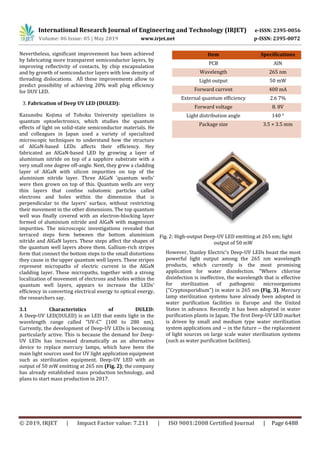
such as sterilization equipment. Deep-UV LED with an
output of 50 mW emitting at 265 nm (Fig. 2); the company
has already established mass production technology, and
plans to start mass production in 2017.
Fig. 2: High-output Deep-UV LED emitting at 265 nm; light
output of 50 mW
However, Stanley Electric's Deep-UV LEDs boast the most
powerful light output among the 265 nm wavelength
products, which currently is the most promising
application for water disinfection. "Where chlorine
disinfection is ineffective, the wavelength that is effective
for sterilization of pathogenic microorganisms
("Cryptosporidium") in water is 265 nm (Fig. 3). Mercury
lamp sterilization systems have already been adopted in
water purification facilities in Europe and the United
States in advance. Recently it has been adopted in water
purification plants in Japan. The first Deep-UV LED market
is driven by small and medium type water sterilization
system applications and ― in the future ― the replacement
of light sources on large scale water sterilization systems
(such as water purification facilities).
Item Specifications
PCB AlN
Wavelength 265 nm
Light output 50 mW
Forward current 400 mA
External quantum efficiency 2.6 7%
Forward voltage 8. 8V
Light distribution angle 140 °
Package size 3.5 × 3.5 mm
International Research Journal of Engineering and Technology (IRJET) e-ISSN: 2395-0056
Volume: 06 Issue: 05 | May 2019 www.irjet.net p-ISSN: 2395-0072
© 2019, IRJET | Impact Factor value: 7.211 | ISO 9001:2008 Certified Journal | Page 6489
Fig. 3: Deep-UV light emitting at 265 nm, effective for
sterilization of the pathogenic microorganism
"Cryptosporidium"
Photon Systems offers DUV LEDs with center wavelengths
of 280 and 255nm and a choice of a flat window,
hemispheric lens or ball lens. Although UV LEDs have a
much lower radiance and a much broader line width than
a laser, they are useful devices for building compact and
lower cost instruments. Due to the spectral line width of
20nm FWHM, the LEDs are useful for fluorescence based
detection but not Raman. Here at Photon Systems we use
UV LEDs in our TraC trace chemical detector and NaDos
personal exposure monitor.
4. CONCLUSION
We have studied the distinct features of advantages of
LEDs, DULED, fabrication, characteristics Deep-UV LED
with an output of 50 mW emitting at 265 nm ,Stanley
Electric's Deep-UV LEDs boast the most powerful light
output among the 265 nm wavelength products, which
currently is the most promising application for water
disinfection. , Where chlorine disinfection is ineffective,
the wavelength that is effective for sterilization of
pathogenic microorganisms ("Cryptosporidium") in water
is 265 nm. Deep-UV LEDs have a superior advantage
compared to mercury lamps, such as small size, high
efficiency, zero warm-up time. Deep-UV light applications
to equipment such as water purification devices have
further increased.
REFERENCES
[1] “LED”, Encyclopedia Britannica. Retrieved January
12, 2019.
[2] Edwards, Kimberly D. “Light Emitting Diodes”
(PDF). University of California at Irvine. P. 2. Retrieved
January 12, 2019.
[3] Lighting Research Center. “How is white light
made with LEDs?”. Rensselaer Polytechnic Institute.
Retrieved January 12, 2019.
[4] Okon, Thomas M.; Biard, James R. (2015). “The
First Practical LED” (PDF). EdisonTechCenter.org.
Edison Tech Center. Retrieved February 2, 2016.
[5] Selection of Materials for UV Optics. James
Johnson, 2008, pp 1-6.
[6] M. S. Shur and R. Gaska, “Deep-Ultraviolet Light-
Emitting Diodes,” IEEE Transactions on Electron
Devices, vol. 57, no. 1, pp. 12– 25, 2010.
[7] D. Birtalan, “Compound Semiconductor,” vol. 16,
no. 2, pp. 28–30, Feb. 2010.
[8] D. Birtalan, Optoelectronics: infrared- visible-
ultraviolet devices and applications, 2nd ed.Boca
Raton: CRC Press, 2009.
[9] M. Shur, M. Shatalov, A. Dobrinsky and R. Gaska,
“Deep Ultraviolet Light- Emitting Diodes,” in GaN
and ZnO-based Materials and Devices, vol. 156, S.
Pearton, Ed. Berlin, Heidelberg: Springer Berlin
Heidelberg, 2012, pp. 83–120.
[10] P. Hewitt, “Method of Manufacturing Electric
Lamps,” US Patent. No. 682692, Issue date: Sep 17, 1901.
[11] S. Volk, “Phoseon Technology Ships the Highest
Performing UV LED Curing Lamps on theMarket,”
http://www.phoseon.com, March 7 2012, Phoseon
Technology,
http://www.phoseon.com/Press%20Releases/Fir
ePower_Shipping_Now_Marc h2012.pdf
[12] G. Meneghesso, “Is reliability of LEDs sufficient for
massive market penetration?” Journal of Physics D:
Applied Physics, http://iopscience.iop.org/0022-
3727/page/ Recent % 20 results % 20 on % 20 the % 20
degradation %20 of %20white %20LEDs %20 For
%20lighting
[13] News, Osram, “Osram red LED prototype breaks
200lm/W efficiency barrier” Semiconductor Today,
11 October 2011,
http://www.semiconductortoday.com/news_ite
ms/2011/OCT/OSRAM_11101 1.html
[14] A. Zukauskas, M. Shur, and R. Gaska,
Introduction to solid-state lighting. New York:
Wiley- Inter science, 2002, ISBN: 978- 0-471-21574-5.
[15] P. Santhanam, D. Gray, and R. Ram,
“Thermoelectrically Pumped Light-Emitting Diodes
Operating above Unity Efficiency,” Physical
Review Letters, vol. 108, no. 9, p. 097403, Feb.2012.
BIOGRAPHIES
Mr Pramod Sharma, Research
Scholar, Dept. of Physics, Dr. C. V.
Raman University, Kota, Bilaspur,
Chhattisgarh, India.
Dr. M. Z. Khan, Associate
Professor, Dept. of Physics, Dr. C.
V. Raman University, Kota,
Bilaspur, Chattisgarh, India.
Research field: Luminescence,
Fly ash.
1’st Au
International Research Journal of Engineering and Technology (IRJET) e-ISSN: 2395-0056
Volume: 06 Issue: 05 | May 2019 www.irjet.net p-ISSN: 2395-0072
© 2019, IRJET | Impact Factor value: 7.211 | ISO 9001:2008 Certified Journal | Page 6490
Dr. A. K. Choubey, Assistant
Professor, Dept. of Physics, CCET,
Bhilai, Chattisgarh, India.
3rd

IRJET- LED Revolution: Deep UV LED

  • 1.
    International Research Journalof Engineering and Technology (IRJET) e-ISSN: 2395-0056 Volume: 06 Issue: 05 | May 2019 www.irjet.net p-ISSN: 2395-0072 © 2019, IRJET | Impact Factor value: 7.211 | ISO 9001:2008 Certified Journal | Page 6486 LED Revolution: Deep UV LED Pramod Sharma1, M.Z. Khan2, A.K. Choubey3 1Research Scholar, Dept. of Physics, Dr. C. V. Raman University, Kota, Bilaspur, Chattisgarh, India 2Associate Professor, Dept. of Physics, Dr. C. V. Raman University, Kota, Bilaspur, Chattisgarh, India 3Assistant Professor, Dept. of Physics, CCET, Bhilai, Chattisgarh, India ---------------------------------------------------------------------***--------------------------------------------------------------------- Abstract - The Deep UV-light emitting diode (DULED) has been attracting attention in the world as a new UV source that can replace conventional mercury gas-filled lamps in water disinfection applications. . We have studied the distinct advantages, fabrication, characteristics and application of DULED. Key Words: LED, DULED, UV source 1. INTRODUCTION LED is semiconductor device that emits light due to Electro- luminescence effect [1], PN Junction Diode, which emits light when forward, biased. Light Emitting Diodes are almost everywhere. LEDs can find everywhere e.g. in Cars, Bikes, Street Lights, Home Lighting, Office Lighting, Mobile Phones, Televisions and many more. Light-emitting diode (LED) is a semiconductor light source that emits light when current flows through it. Electrons in the semiconductor recombine with electron holes, releasing energy in the form of photons. This effect is called electro -luminescence.[1] The color of the light (corresponding to the energy of the photons) is determined by the energy required for electrons to cross the band gap of the semiconductor.[2] White light is obtained by using multiple semiconductors or a layer of light-emitting phosphor on the semiconductor device.[3] Appearing as practical electronic components in 1962, the earliest LEDs emitted low-intensity infrared light. [4] Infrared LEDs are used in remote-control circuits, such as those used with a wide variety of consumer electronics. The first visible-light LEDs were of low intensity and limited to red. Modern LEDs are available across the visible, ultraviolet, and infrared wavelengths, with high light output The reason for such wide range of implementation of LEDs is its advantages over traditional incandescent bulbs and the recent compact fluorescent lamps (CFL). Advantages of LEDs over incandescent and CFL light sources are mentioned below: 1. Low Power Consumption 2. Small Size 3. Fast Switching 4. Physically Robust 5. Long Lasting 2. Basics of Deep UV-LED (DULED) The new LED is Deep-UV LED (DULED) which attracted in a whole world and great deal of attention, especially in the hygiene field. This is because the possibilities of expanding Deep-UV light applications to equipment such as water purification devices have further increased. 2.1 Materials of Deep UV LED (DULED): Deep Ultraviolet light-emitting diodes (DUV-LED) made from aluminum gallium nitride (AlGaN) efficiently transfer electrical energy to optical energy due to the growth of one of its bottom layers in a step-like fashion. KBe2BO3F2 (KBBF) is another type of materials practically usable deep ultraviolet (DUV) nonlinear optical (NLO) crystal so far that can generate DUV coherent light by the direct second harmonic generation. Other materials are Fused Silica, CaF2, MgF2[5] . 2.1 Application of Deep UV LED (DULED) The compact size and low power consumption of the UV LEDs help make these instruments practical. Solid state ultraviolet light emitting diodes (UV LEDs) have numerous applications in biomedical industry. LEDs are used for purifying air and water, treating skin diseases, disinfecting surfaces, for industrial (photo-chemical) curing, printing, for forensic investigations and forgery detection [6–10]. Through the years, the UV electromagnetic radiation was primarily based on tube technology first developed in 1901 [11]. Though UV lamps are able to generate high output levels there are several drawbacks of UV lamps: lamps are fragile, can be a biological hazard, since they contain mercury and high voltages resulting in ozone production, require proper disposal techniques, have short lifetimes, and a fixed spectral power distribution. UV lamps cannot be dimmed. High pressure mercury lamps operate at high temperatures and may not be used in processes that require lower temperatures, for example, for photo- chemicallycuring polymers [12]. Deep-UV LEDs have a superior advantage compared to mercury lamps, such as small size, high efficiency, zero
  • 2.
    International Research Journalof Engineering and Technology (IRJET) e-ISSN: 2395-0056 Volume: 06 Issue: 05 | May 2019 www.irjet.net p-ISSN: 2395-0072 © 2019, IRJET | Impact Factor value: 7.211 | ISO 9001:2008 Certified Journal | Page 6487 warm-up time. For this reason, as a general view in the UV light field, mercury lamps will replace LEDs in a natural transition. While LED device manufacturers focus on accelerating the development of Deep-UV LEDs. It is widely recognized that compact, efficient, long-lived, low- power, affordable deep-UV (DUV) sources would dramatically push LIF detection forward. (Here DUV covers wavelengths of 200– 250nm.) In comparison to violet, UV-A, and UV-B (see Figure 1), DUV wavelengths offer LIF detection that is more sensitive because of strong fluorescence cross sections from fluorescent amino acids in proteins, and more discriminating because it targets intrinsic biological properties rather than growth-media residues. It is also less susceptible to threat- washing techniques, residual threat moisture, and ambient. 2. Design of Deep UV LED (DUVLED) Light emitting diodes are very promising efficient light sources. Advanced visible LEDs can deliver more lumens per watt than any other lighting technology [13]. Both red [14] and blue [13] light emitting diodes demonstrated wall plug efficiencies of over 60%. The LED theory [15] and experiments show that LED WPE could, in principle, exceed 100%. Typical DUV LEDs are considerably less efficient than their visible counterparts. DUV LED’s decreased efficiency is due to poor transparency of semiconductor layers to UV light, poor UV light reflectivity of n- and p-contacts, and low conductivity of semiconductor heterostructure. Nevertheless, significant improvement has been achieved by fabricating more transparent semiconductor layers, by improving reflectivity of contacts, by chip encapsulation and by growth of semiconductor layers with low density of threading dislocations. All these improvements allow to predict possibility of achieving 20% wall plug efficiency for DUV LED. Figure 1 shows the general schematic of the LED flip chip design. The location of different regions is indicated on the figure. The Figure 1 (a) show a traditional device containing p-GaN layer and p contact with low reflectivity, whereas Figure 1 (b) shows an advanced device with p-AlGaN transparent layer and reflective p contact. (a) (b) Fig1. Schematic of LED flip chip design Figure 1 shows the general schematic of the LED flip chip design. The location of different regions is indicated on the figure. The Figure 1 (a) show a traditional device containing p-GaN layer and p contact with low reflectivity, whereas Figure 1 (b) shows an advanced device with p-AlGaN transparent layer and reflective p contact. Typical DUV LEDs are considerably less efficient than their visible counterparts. DUV LED’s decreased efficiency is due to poor transparency of semiconductor layers to UV light, poor UV light reflectivity of n- and p-contacts, and low conductivity of semiconductor hetero-structure.
  • 3.
    International Research Journalof Engineering and Technology (IRJET) e-ISSN: 2395-0056 Volume: 06 Issue: 05 | May 2019 www.irjet.net p-ISSN: 2395-0072 © 2019, IRJET | Impact Factor value: 7.211 | ISO 9001:2008 Certified Journal | Page 6488 Nevertheless, significant improvement has been achieved by fabricating more transparent semiconductor layers, by improving reflectivity of contacts, by chip encapsulation and by growth of semiconductor layers with low density of threading dislocations. All these improvements allow to predict possibility of achieving 20% wall plug efficiency for DUV LED. 3. Fabrication of Deep UV LED (DULED): Kazunobu Kojima of Tohoku University specializes in quantum optoelectronics, which studies the quantum effects of light on solid-state semiconductor materials. He and colleagues in Japan used a variety of specialized microscopic techniques to understand how the structure of AlGaN-based LEDs affects their efficiency. Hey fabricated an AlGaN-based LED by growing a layer of aluminium nitride on top of a sapphire substrate with a very small one degree off-angle. Next, they grew a cladding layer of AlGaN with silicon impurities on top of the aluminium nitride layer. Three AlGaN 'quantum wells' were then grown on top of this. Quantum wells are very thin layers that confine subatomic particles called electrons and holes within the dimension that is perpendicular to the layers' surface, without restricting their movement in the other dimensions. The top quantum well was finally covered with an electron-blocking layer formed of aluminium nitride and AlGaN with magnesium impurities. The microscopic investigations revealed that terraced steps form between the bottom aluminium nitride and AlGaN layers. These steps affect the shapes of the quantum well layers above them. Gallium-rich stripes form that connect the bottom steps to the small distortions they cause in the upper quantum well layers. These stripes represent micropaths of electric current in the AlGaN cladding layer. These micropaths, together with a strong localization of movement of electrons and holes within the quantum well layers, appears to increase the LEDs' efficiency in converting electrical energy to optical energy, the researchers say. 3.1 Characteristics of DULED: A Deep-UV LED(DULED) is an LED that emits light in the wavelength range called "UV-C" (100 to 280 nm). Currently, the development of Deep-UV LEDs is becoming particularly active. This is because the demand for Deep- UV LEDs has increased dramatically as an alternative device to replace mercury lamps, which have been the main light sources used for UV light application equipment such as sterilization equipment. Deep-UV LED with an output of 50 mW emitting at 265 nm (Fig. 2); the company has already established mass production technology, and plans to start mass production in 2017. Fig. 2: High-output Deep-UV LED emitting at 265 nm; light output of 50 mW However, Stanley Electric's Deep-UV LEDs boast the most powerful light output among the 265 nm wavelength products, which currently is the most promising application for water disinfection. "Where chlorine disinfection is ineffective, the wavelength that is effective for sterilization of pathogenic microorganisms ("Cryptosporidium") in water is 265 nm (Fig. 3). Mercury lamp sterilization systems have already been adopted in water purification facilities in Europe and the United States in advance. Recently it has been adopted in water purification plants in Japan. The first Deep-UV LED market is driven by small and medium type water sterilization system applications and ― in the future ― the replacement of light sources on large scale water sterilization systems (such as water purification facilities). Item Specifications PCB AlN Wavelength 265 nm Light output 50 mW Forward current 400 mA External quantum efficiency 2.6 7% Forward voltage 8. 8V Light distribution angle 140 ° Package size 3.5 × 3.5 mm
  • 4.
    International Research Journalof Engineering and Technology (IRJET) e-ISSN: 2395-0056 Volume: 06 Issue: 05 | May 2019 www.irjet.net p-ISSN: 2395-0072 © 2019, IRJET | Impact Factor value: 7.211 | ISO 9001:2008 Certified Journal | Page 6489 Fig. 3: Deep-UV light emitting at 265 nm, effective for sterilization of the pathogenic microorganism "Cryptosporidium" Photon Systems offers DUV LEDs with center wavelengths of 280 and 255nm and a choice of a flat window, hemispheric lens or ball lens. Although UV LEDs have a much lower radiance and a much broader line width than a laser, they are useful devices for building compact and lower cost instruments. Due to the spectral line width of 20nm FWHM, the LEDs are useful for fluorescence based detection but not Raman. Here at Photon Systems we use UV LEDs in our TraC trace chemical detector and NaDos personal exposure monitor. 4. CONCLUSION We have studied the distinct features of advantages of LEDs, DULED, fabrication, characteristics Deep-UV LED with an output of 50 mW emitting at 265 nm ,Stanley Electric's Deep-UV LEDs boast the most powerful light output among the 265 nm wavelength products, which currently is the most promising application for water disinfection. , Where chlorine disinfection is ineffective, the wavelength that is effective for sterilization of pathogenic microorganisms ("Cryptosporidium") in water is 265 nm. Deep-UV LEDs have a superior advantage compared to mercury lamps, such as small size, high efficiency, zero warm-up time. Deep-UV light applications to equipment such as water purification devices have further increased. REFERENCES [1] “LED”, Encyclopedia Britannica. Retrieved January 12, 2019. [2] Edwards, Kimberly D. “Light Emitting Diodes” (PDF). University of California at Irvine. P. 2. Retrieved January 12, 2019. [3] Lighting Research Center. “How is white light made with LEDs?”. Rensselaer Polytechnic Institute. Retrieved January 12, 2019. [4] Okon, Thomas M.; Biard, James R. (2015). “The First Practical LED” (PDF). EdisonTechCenter.org. Edison Tech Center. Retrieved February 2, 2016. [5] Selection of Materials for UV Optics. James Johnson, 2008, pp 1-6. [6] M. S. Shur and R. Gaska, “Deep-Ultraviolet Light- Emitting Diodes,” IEEE Transactions on Electron Devices, vol. 57, no. 1, pp. 12– 25, 2010. [7] D. Birtalan, “Compound Semiconductor,” vol. 16, no. 2, pp. 28–30, Feb. 2010. [8] D. Birtalan, Optoelectronics: infrared- visible- ultraviolet devices and applications, 2nd ed.Boca Raton: CRC Press, 2009. [9] M. Shur, M. Shatalov, A. Dobrinsky and R. Gaska, “Deep Ultraviolet Light- Emitting Diodes,” in GaN and ZnO-based Materials and Devices, vol. 156, S. Pearton, Ed. Berlin, Heidelberg: Springer Berlin Heidelberg, 2012, pp. 83–120. [10] P. Hewitt, “Method of Manufacturing Electric Lamps,” US Patent. No. 682692, Issue date: Sep 17, 1901. [11] S. Volk, “Phoseon Technology Ships the Highest Performing UV LED Curing Lamps on theMarket,” http://www.phoseon.com, March 7 2012, Phoseon Technology, http://www.phoseon.com/Press%20Releases/Fir ePower_Shipping_Now_Marc h2012.pdf [12] G. Meneghesso, “Is reliability of LEDs sufficient for massive market penetration?” Journal of Physics D: Applied Physics, http://iopscience.iop.org/0022- 3727/page/ Recent % 20 results % 20 on % 20 the % 20 degradation %20 of %20white %20LEDs %20 For %20lighting [13] News, Osram, “Osram red LED prototype breaks 200lm/W efficiency barrier” Semiconductor Today, 11 October 2011, http://www.semiconductortoday.com/news_ite ms/2011/OCT/OSRAM_11101 1.html [14] A. Zukauskas, M. Shur, and R. Gaska, Introduction to solid-state lighting. New York: Wiley- Inter science, 2002, ISBN: 978- 0-471-21574-5. [15] P. Santhanam, D. Gray, and R. Ram, “Thermoelectrically Pumped Light-Emitting Diodes Operating above Unity Efficiency,” Physical Review Letters, vol. 108, no. 9, p. 097403, Feb.2012. BIOGRAPHIES Mr Pramod Sharma, Research Scholar, Dept. of Physics, Dr. C. V. Raman University, Kota, Bilaspur, Chhattisgarh, India. Dr. M. Z. Khan, Associate Professor, Dept. of Physics, Dr. C. V. Raman University, Kota, Bilaspur, Chattisgarh, India. Research field: Luminescence, Fly ash. 1’st Au
  • 5.
    International Research Journalof Engineering and Technology (IRJET) e-ISSN: 2395-0056 Volume: 06 Issue: 05 | May 2019 www.irjet.net p-ISSN: 2395-0072 © 2019, IRJET | Impact Factor value: 7.211 | ISO 9001:2008 Certified Journal | Page 6490 Dr. A. K. Choubey, Assistant Professor, Dept. of Physics, CCET, Bhilai, Chattisgarh, India. 3rd