International Research Journal of Engineering and Technology (IRJET) e-ISSN: 2395-0056
Volume: 07 Issue: 03 | Mar 2020 www.irjet.net p-ISSN: 2395-0072
© 2020, IRJET | Impact Factor value: 7.34 | ISO 9001:2008 Certified Journal | Page 2789
Control System for Aquarium Maintenance
P.Saraswathi1, Matheswari.R2, Dhivya.O3, Krishnaveni.N4
[1]Assistant Professor-III, Department of Information Technology, Velammal College of Engineering and
Technology, Madurai, Tamil Nadu, India.
[2][3][4]Department of Information Technology, Velammal College of Engineering and Technology, Madurai,
Tamil Nadu, India
------------------------------------------------------------------------***-------------------------------------------------------------------------
Abstract-Water quality affects the health level of fish, one
of parameters that must be maintained is ammonia levels.
Ammonia levels which are left high will be harmful to the
health of fish. In this study, a control and monitoring system
on ammonia level for fish cultivation has been designed that
are also useful for measuring the quality of water in an
aquarium. Measurements conducted on this study have two
main variables, namely pH and ammonia levels. The sensors
namely pH sensor, thermistor, MQ-137 gas sensor and TDS
sensor are used equipped with Arduino microcontroller as a
controller.
Keywords- TDS Sensor, MQ-137, thermistor.
1. INTRODUCTION
Cultivation is one of the alternative activities in
increasing fisheries production. To produce superior
fish/shrimp commodities, the maintenance process must
pay attention to internal aspects including the origin and
quality of seeds; and external factors include aquaculture
quality, feeding, technology used, and controlling pests
and diseases. The main problems that are often found are
poor water quality in ponds or artificial ponds during the
maintenance period. Apart from the quality of water that
must be maintained clean, another thing that is actually
also very common and should be wary of is the increase in
pH and ammonia levels in the pond or artificial ponds.
Increasing ammonia and pH levels can be a poison for fish.
Ammonia levels that are too high can cause fish to be
unable to extract energy from feed efficiently so that it
may cause death. This death will certainly harm fish
farmers. Management of water quality during the
maintenance process is absolutely necessary. Some water
quality parameters that are often measured and affect the
growth of shrimp and fish are dissolved oxygen (DO),
temperature, pH, salinity, ammonia, and alkalinity. In this
study a control system and monitoring are designed to
maintain the pH and ammonia levels contained in a mini
plane. One device that uses remote control technology
with an ARM-based embedded system (Advanced RISC
Machine) is the Raspberry. Raspberry is a mini computer
that can work like a personal computer or Single Board
Computer (SBC).To begin the research, information about
the effects of ammonia on the fish cultivation and/or
aquarium is required. The reference source obtained said
that the increase in ammonia caused by overfishing of fish
could increase ammonia levels in the waters. The
concentration of ammonia itself must be maintained so
that the value remains below 0.2mg/l. Besides the
increase in temperature and changes in pH also affect the
increase in ammonia levels.
2. EXISTING SYSTEM
One of parameters that must be maintained is
ammonia levels. Ammonia levels which are left high will
be harmful to the health of fish. In this study, a control and
monitoring system on ammonia level for fish cultivation
has been designed that are also useful for measuring the
quality of water in an aquarium. Measurements conducted
on this study have two main variables, namely pH and
ammonia levels. Two sensors namely pH sensor and MQ-
135 gas sensor are used equipped with Arduino
microcontroller as a controller and data acquisition.
RaspberryPi 3B as Single Board Computer is utilized as
processor and serves as Internet of Things (IoT). In the
system, the pH is kept neutral (6.5 - 7.5). When the value
exceeds the limit, automatic control will channel the liquid
acetic acid (CH3COOH) to the aquarium to balance pH
level. The results of the tests show that the system can
perform controls automatically and manually.
3. PROPOSED SYSTEM
Many people feed the pet fish in the aquarium
tanks that need to be properly set up and maintained, or
the fish will be destined to an unpleasant and short life.
Therefore, it is critical to monitor water conditions closely
and improve the water quality for the mini aquarium
tanks. By the smart solution, this paper proposes the Fish
Talk system that utilizes the aquarium sensors to drive the
actuators in real time. We describe the relationship
between the aquarium sensors and the actuators and give
concrete examples about the threshold settingThe
monitoring of temperature, Ph value of water, ammonia,
TDS value water will be measured. The temperature will
be maintained in particular range by using heater for
aquarium. The TDS also maintained by using water filter
for aquarium. Both will be maintained automatically. The
process will also give alert to the user if the values exceed
limits
International Research Journal of Engineering and Technology (IRJET) e-ISSN: 2395-0056
Volume: 07 Issue: 03 | Mar 2020 www.irjet.net p-ISSN: 2395-0072
© 2020, IRJET | Impact Factor value: 7.34 | ISO 9001:2008 Certified Journal | Page 2790
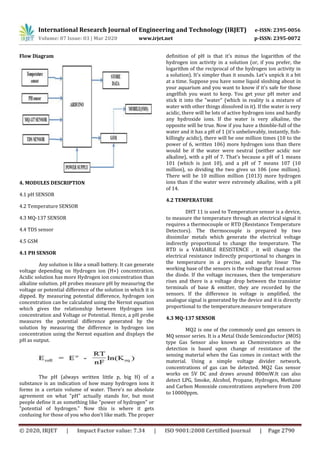
Flow Diagram
4. MODULES DESCRIPTION
4.1 pH SENSOR
4.2 Temperature SENSOR
4.3 MQ-137 SENSOR
4.4 TDS sensor
4.5 GSM
4.1 PH SENSOR
Any solution is like a small battery. It can generate
voltage depending on Hydrogen ion (H+) concentration.
Acidic solution has more Hydrogen ion concentration than
alkaline solution. pH probes measure pH by measuring the
voltage or potential difference of the solution in which it is
dipped. By measuring potential difference, hydrogen ion
concentration can be calculated using the Nernst equation
which gives the relationship between Hydrogen ion
concentration and Voltage or Potential. Hence, a pH probe
measures the potential difference generated by the
solution by measuring the difference in hydrogen ion
concentration using the Nernst equation and displays the
pH as output.
The pH (always written little p, big H) of a
substance is an indication of how many hydrogen ions it
forms in a certain volume of water. There's no absolute
agreement on what "pH" actually stands for, but most
people define it as something like "power of hydrogen" or
"potential of hydrogen." Now this is where it gets
confusing for those of you who don't like math. The proper
definition of pH is that it's minus the logarithm of the
hydrogen ion activity in a solution (or, if you prefer, the
logarithm of the reciprocal of the hydrogen ion activity in
a solution). It's simpler than it sounds. Let's unpick it a bit
at a time. Suppose you have some liquid sloshing about in
your aquarium and you want to know if it's safe for those
angelfish you want to keep. You get your pH meter and
stick it into the "water" (which in reality is a mixture of
water with other things dissolved in it). If the water is very
acidic, there will be lots of active hydrogen ions and hardly
any hydroxide ions. If the water is very alkaline, the
opposite will be true. Now if you have a thimble-full of the
water and it has a pH of 1 (it's unbelievably, instantly, fish-
killingly acidic), there will be one million times (10 to the
power of 6, written 106) more hydrogen ions than there
would be if the water were neutral (neither acidic nor
alkaline), with a pH of 7. That's because a pH of 1 means
101 (which is just 10), and a pH of 7 means 107 (10
million), so dividing the two gives us 106 (one million).
There will be 10 million million (1013) more hydrogen
ions than if the water were extremely alkaline, with a pH
of 14.
4.2 TEMPERATURE
DHT 11 is used to Temperature sensor is a device,
to measure the temperature through an electrical signal it
requires a thermocouple or RTD (Resistance Temperature
Detectors). The thermocouple is prepared by two
dissimilar metals which generate the electrical voltage
indirectly proportional to change the temperature. The
RTD is a VARIABLE RESISTENCE , it will change the
electrical resistance indirectly proportional to changes in
the temperature in a precise, and nearly linear The
working base of the sensors is the voltage that read across
the diode. If the voltage increases, then the temperature
rises and there is a voltage drop between the transistor
terminals of base & emitter, they are recorded by the
sensors. If the difference in voltage is amplified, the
analogue signal is generated by the device and it is directly
proportional to the temperature.measure temperature
4.3 MQ-137 SENSOR
MQ2 is one of the commonly used gas sensors in
MQ sensor series. It is a Metal Oxide Semiconductor (MOS)
type Gas Sensor also known as Chemiresistors as the
detection is based upon change of resistance of the
sensing material when the Gas comes in contact with the
material. Using a simple voltage divider network,
concentrations of gas can be detected. MQ2 Gas sensor
works on 5V DC and draws around 800mW.It can also
detect LPG, Smoke, Alcohol, Propane, Hydrogen, Methane
and Carbon Monoxide concentrations anywhere from 200
to 10000ppm.
International Research Journal of Engineering and Technology (IRJET) e-ISSN: 2395-0056
Volume: 07 Issue: 03 | Mar 2020 www.irjet.net p-ISSN: 2395-0072
© 2020, IRJET | Impact Factor value: 7.34 | ISO 9001:2008 Certified Journal | Page 2791
4.4 TDS SENSOR
PPM is calculated from the EC of a fluid, EC is the
inverse of the electrical resistance of the fluid. We are
estimating the EC or PPM of a fluid by measuring the
resistance between two probes [The plug pins] when the
plug is submerged in the liquid of interest. Ec
measurement needs to be done using AC or the liquid of
interest is polarised and will give bad readings. This has
got to be a great example of asking why instead of just
accepting a statement as fact, it turns out we can take a
very fast DC reading without suffering polarisation.
Temperature Compensation: Temperature has an effect on
the conductivity of fluids so it is essential that we
compensate for this.
CALCULATION
EC = EC25*( 1 + a (T - 25))
R=(1000/(EC*K)) +Ra
Min temp=0 [we arnt going to care about EC if the pond is
frozen]
Max Temp = 40 *C [I doubt a pond should be above this]
Minimum EC 25=0.3 EC= 0.3*(1+0.019*(0-25) Min EC=
0.16 S/sm
Maximum EC 25= 3 EC= 0.3*(1+0.019*(40-25) Max EC =
3.9 S/cm
Min Resistance = 1000/(MaxEC*K)+25 = 1000(3.9*2.88)
=114 ohms
Max Resitance = 1000/(MinEC*K)+25 = 1000/(0.16*2.88)
= 2195 ohms
R1
Now we have enough information to calculate a
good value for R1 to get the best resolution over our
intended measuring range. We could sum it all up
mathematically and differentiate to find the peak, but that
hurts my head so I just did a quick excel spreadsheet for
the Voltage divider for the EC I expect to see:
4.5 GSM MODULE
GSM stands for Global System for Mobile communication.
Today, GSM is used by more than 800 million end users
spread across 190 countries which represents around 70
percent of today’s digital wireless market. So, let’s see how
it works.In GSM, geographical area is divided into
hexagonal cells whose side depends upon power of
transmitter and load on transmitter (number of end user).
At the center of cell, there is a base station consisting of a
transceiver (combination of transmitter and receiver) and
an antenna.GSM is combination of TDMA (Time Division
Multiple Access), FDMA (Frequency Division Multiple
Access) and Frequency hopping.
Working:
GSM is combination of TDMA (Time Division Multiple
Access), FDMA (Frequency Division Multiple Access) and
Frequency hopping. Initially, GSM use two frequency
bands of 25 MHz width: 890 to 915 MHz frequency band
for up-link and 935 to 960 MHz frequency for down-link.
Later on, two 75 MHz band were added. 1710 to 1785
International Research Journal of Engineering and Technology (IRJET) e-ISSN: 2395-0056
Volume: 07 Issue: 03 | Mar 2020 www.irjet.net p-ISSN: 2395-0072
© 2020, IRJET | Impact Factor value: 7.34 | ISO 9001:2008 Certified Journal | Page 2792
MHz for up-link and 1805 to 1880 MHz for down-link. Up-
link is the link from ground station to a satellite and down-
link is the link from a satellite down to one or more
ground stations or receivers. GSM divides the 25 MHz
band into 124 channels each having 200 KHz width and
remaining 200 KHz is left unused as a guard band to avoid
interference.
5. CONCLUSION
We showed how to intelligently monitor and maintaining
the fish through a automate mechanism such that the
ammonia, pH level, temperature, and TDS. Our solution
allows the designer to quickly deploy intelligent control
for various water conditions. We have developed model to
daily monitoring experiments to investigate the effects of
daily changes in aquarium and loss on the water condition.
Though we are able to achieve all the goals but still we
think that lots of advancement can be done for this
project. It is mainly helpful in hobby in fish keeping. Our
project is the combination of aqua phonics and IoT
technology.
REFERENCES
[1] M. Yilmaz, P. T. Krein, “Review of Battery Charger
Topologies,Charging Power Levels, and Infrastructure for
Plug-In Electric and Hybrid Vehicles,” IEEE Trans. Power
Electron., vol. 28, no. 5, pp. 2151-2169, May 2013.
[2] H. Wu, Y. Li, Y. Xing, “LLC Resonant Converter With
Semi active Variable-Structure Rectifier (SA-VSR) for Wide
Output Voltage Range Application,” IEEE Trans. Power
Electron., vol. 31, no. 5, pp. 3389-3394, May 2016.
[3] H. Park, J. Jung, “Power Stage and Feedback Loop
Design for LLC Resonant Converter in High Switching
Frequency Operation,” IEEE Trans. Power Electron., vol.
32, no. 10, pp. 7770-7782, Oct. 2017.
[4] G. Yang, F. Xiao, X. Fan, R. Wang, J. Liu, “Three-Phase
Three-Level Phase-Shifted PWM DC–DC Converter for
Electric Ship MVDC Application,” IEEE J. Emerging Sel.
Topics Power Electron., vol. 5, no. 1, pp. 162-170, Mar.
2017.
[5] L. Zhao, H. Li, X. Wu, J. Zhang, “An Improved Phase-
Shifted Full-Bridge Converter With Wide-Range ZVS and
Reduced Filter Requirement,” IEEE Trans. Ind. Electron.,
vol. 65, no. 3, pp. 2167-2176, Mar. 2018.
[6] Z. Hu, L. Wang, H. Wang, Y. Liu, P. C. Sen, “An Accurate
Design Algorithm for LLC Resonant Converters—Part I,”
IEEE Trans. Power Electron., vol. 31, no. 8, pp. 5435-5447,
Aug. 2016.
[7] Z. Hu, L. Wang, Y. Qiu, Y. Liu, P. C. Sen, “An Accurate
Design Algorithm for LLC Resonant Converters—Part II,”
IEEE Trans. Power Electron., vol. 31, no.8, pp. 5448-5460,
Aug. 2016.
[8] Lee, G. W. Moon, “Analysis and Design of Phase-Shifted
Dual H-Bridge Converter with a Wide ZVS Range and
Reduced Output Filter,” IEEE Trans. Ind. Electron., vol. 60,
no. 10, pp. 4415-4426, Oct. 2013.
[9] Demirel, B. Erkmen, “A Very Low-Profile Dual Output
LLC Resonant
Converter for LCD/LED TV Applications,” IEEE Trans.
Power Electron.,vol. 29, no. 7, pp. 3514-3524, Jul. 2014.
[10] R. Williams, C. Bingham, D. A. Stone, M. P. Foster,
“Analysis of Dual-Output Resonant Power Converters
Through Use of Linear Load Approximations,” IEEE Trans.
Power Electron., vol. 27, no. 9, pp. 4051-4059, Sep. 2012.

IRJET - Control System for Aquarium Maintenance

  • 1.
    International Research Journalof Engineering and Technology (IRJET) e-ISSN: 2395-0056 Volume: 07 Issue: 03 | Mar 2020 www.irjet.net p-ISSN: 2395-0072 © 2020, IRJET | Impact Factor value: 7.34 | ISO 9001:2008 Certified Journal | Page 2789 Control System for Aquarium Maintenance P.Saraswathi1, Matheswari.R2, Dhivya.O3, Krishnaveni.N4 [1]Assistant Professor-III, Department of Information Technology, Velammal College of Engineering and Technology, Madurai, Tamil Nadu, India. [2][3][4]Department of Information Technology, Velammal College of Engineering and Technology, Madurai, Tamil Nadu, India ------------------------------------------------------------------------***------------------------------------------------------------------------- Abstract-Water quality affects the health level of fish, one of parameters that must be maintained is ammonia levels. Ammonia levels which are left high will be harmful to the health of fish. In this study, a control and monitoring system on ammonia level for fish cultivation has been designed that are also useful for measuring the quality of water in an aquarium. Measurements conducted on this study have two main variables, namely pH and ammonia levels. The sensors namely pH sensor, thermistor, MQ-137 gas sensor and TDS sensor are used equipped with Arduino microcontroller as a controller. Keywords- TDS Sensor, MQ-137, thermistor. 1. INTRODUCTION Cultivation is one of the alternative activities in increasing fisheries production. To produce superior fish/shrimp commodities, the maintenance process must pay attention to internal aspects including the origin and quality of seeds; and external factors include aquaculture quality, feeding, technology used, and controlling pests and diseases. The main problems that are often found are poor water quality in ponds or artificial ponds during the maintenance period. Apart from the quality of water that must be maintained clean, another thing that is actually also very common and should be wary of is the increase in pH and ammonia levels in the pond or artificial ponds. Increasing ammonia and pH levels can be a poison for fish. Ammonia levels that are too high can cause fish to be unable to extract energy from feed efficiently so that it may cause death. This death will certainly harm fish farmers. Management of water quality during the maintenance process is absolutely necessary. Some water quality parameters that are often measured and affect the growth of shrimp and fish are dissolved oxygen (DO), temperature, pH, salinity, ammonia, and alkalinity. In this study a control system and monitoring are designed to maintain the pH and ammonia levels contained in a mini plane. One device that uses remote control technology with an ARM-based embedded system (Advanced RISC Machine) is the Raspberry. Raspberry is a mini computer that can work like a personal computer or Single Board Computer (SBC).To begin the research, information about the effects of ammonia on the fish cultivation and/or aquarium is required. The reference source obtained said that the increase in ammonia caused by overfishing of fish could increase ammonia levels in the waters. The concentration of ammonia itself must be maintained so that the value remains below 0.2mg/l. Besides the increase in temperature and changes in pH also affect the increase in ammonia levels. 2. EXISTING SYSTEM One of parameters that must be maintained is ammonia levels. Ammonia levels which are left high will be harmful to the health of fish. In this study, a control and monitoring system on ammonia level for fish cultivation has been designed that are also useful for measuring the quality of water in an aquarium. Measurements conducted on this study have two main variables, namely pH and ammonia levels. Two sensors namely pH sensor and MQ- 135 gas sensor are used equipped with Arduino microcontroller as a controller and data acquisition. RaspberryPi 3B as Single Board Computer is utilized as processor and serves as Internet of Things (IoT). In the system, the pH is kept neutral (6.5 - 7.5). When the value exceeds the limit, automatic control will channel the liquid acetic acid (CH3COOH) to the aquarium to balance pH level. The results of the tests show that the system can perform controls automatically and manually. 3. PROPOSED SYSTEM Many people feed the pet fish in the aquarium tanks that need to be properly set up and maintained, or the fish will be destined to an unpleasant and short life. Therefore, it is critical to monitor water conditions closely and improve the water quality for the mini aquarium tanks. By the smart solution, this paper proposes the Fish Talk system that utilizes the aquarium sensors to drive the actuators in real time. We describe the relationship between the aquarium sensors and the actuators and give concrete examples about the threshold settingThe monitoring of temperature, Ph value of water, ammonia, TDS value water will be measured. The temperature will be maintained in particular range by using heater for aquarium. The TDS also maintained by using water filter for aquarium. Both will be maintained automatically. The process will also give alert to the user if the values exceed limits
  • 2.
    International Research Journalof Engineering and Technology (IRJET) e-ISSN: 2395-0056 Volume: 07 Issue: 03 | Mar 2020 www.irjet.net p-ISSN: 2395-0072 © 2020, IRJET | Impact Factor value: 7.34 | ISO 9001:2008 Certified Journal | Page 2790 Flow Diagram 4. MODULES DESCRIPTION 4.1 pH SENSOR 4.2 Temperature SENSOR 4.3 MQ-137 SENSOR 4.4 TDS sensor 4.5 GSM 4.1 PH SENSOR Any solution is like a small battery. It can generate voltage depending on Hydrogen ion (H+) concentration. Acidic solution has more Hydrogen ion concentration than alkaline solution. pH probes measure pH by measuring the voltage or potential difference of the solution in which it is dipped. By measuring potential difference, hydrogen ion concentration can be calculated using the Nernst equation which gives the relationship between Hydrogen ion concentration and Voltage or Potential. Hence, a pH probe measures the potential difference generated by the solution by measuring the difference in hydrogen ion concentration using the Nernst equation and displays the pH as output. The pH (always written little p, big H) of a substance is an indication of how many hydrogen ions it forms in a certain volume of water. There's no absolute agreement on what "pH" actually stands for, but most people define it as something like "power of hydrogen" or "potential of hydrogen." Now this is where it gets confusing for those of you who don't like math. The proper definition of pH is that it's minus the logarithm of the hydrogen ion activity in a solution (or, if you prefer, the logarithm of the reciprocal of the hydrogen ion activity in a solution). It's simpler than it sounds. Let's unpick it a bit at a time. Suppose you have some liquid sloshing about in your aquarium and you want to know if it's safe for those angelfish you want to keep. You get your pH meter and stick it into the "water" (which in reality is a mixture of water with other things dissolved in it). If the water is very acidic, there will be lots of active hydrogen ions and hardly any hydroxide ions. If the water is very alkaline, the opposite will be true. Now if you have a thimble-full of the water and it has a pH of 1 (it's unbelievably, instantly, fish- killingly acidic), there will be one million times (10 to the power of 6, written 106) more hydrogen ions than there would be if the water were neutral (neither acidic nor alkaline), with a pH of 7. That's because a pH of 1 means 101 (which is just 10), and a pH of 7 means 107 (10 million), so dividing the two gives us 106 (one million). There will be 10 million million (1013) more hydrogen ions than if the water were extremely alkaline, with a pH of 14. 4.2 TEMPERATURE DHT 11 is used to Temperature sensor is a device, to measure the temperature through an electrical signal it requires a thermocouple or RTD (Resistance Temperature Detectors). The thermocouple is prepared by two dissimilar metals which generate the electrical voltage indirectly proportional to change the temperature. The RTD is a VARIABLE RESISTENCE , it will change the electrical resistance indirectly proportional to changes in the temperature in a precise, and nearly linear The working base of the sensors is the voltage that read across the diode. If the voltage increases, then the temperature rises and there is a voltage drop between the transistor terminals of base & emitter, they are recorded by the sensors. If the difference in voltage is amplified, the analogue signal is generated by the device and it is directly proportional to the temperature.measure temperature 4.3 MQ-137 SENSOR MQ2 is one of the commonly used gas sensors in MQ sensor series. It is a Metal Oxide Semiconductor (MOS) type Gas Sensor also known as Chemiresistors as the detection is based upon change of resistance of the sensing material when the Gas comes in contact with the material. Using a simple voltage divider network, concentrations of gas can be detected. MQ2 Gas sensor works on 5V DC and draws around 800mW.It can also detect LPG, Smoke, Alcohol, Propane, Hydrogen, Methane and Carbon Monoxide concentrations anywhere from 200 to 10000ppm.
  • 3.
    International Research Journalof Engineering and Technology (IRJET) e-ISSN: 2395-0056 Volume: 07 Issue: 03 | Mar 2020 www.irjet.net p-ISSN: 2395-0072 © 2020, IRJET | Impact Factor value: 7.34 | ISO 9001:2008 Certified Journal | Page 2791 4.4 TDS SENSOR PPM is calculated from the EC of a fluid, EC is the inverse of the electrical resistance of the fluid. We are estimating the EC or PPM of a fluid by measuring the resistance between two probes [The plug pins] when the plug is submerged in the liquid of interest. Ec measurement needs to be done using AC or the liquid of interest is polarised and will give bad readings. This has got to be a great example of asking why instead of just accepting a statement as fact, it turns out we can take a very fast DC reading without suffering polarisation. Temperature Compensation: Temperature has an effect on the conductivity of fluids so it is essential that we compensate for this. CALCULATION EC = EC25*( 1 + a (T - 25)) R=(1000/(EC*K)) +Ra Min temp=0 [we arnt going to care about EC if the pond is frozen] Max Temp = 40 *C [I doubt a pond should be above this] Minimum EC 25=0.3 EC= 0.3*(1+0.019*(0-25) Min EC= 0.16 S/sm Maximum EC 25= 3 EC= 0.3*(1+0.019*(40-25) Max EC = 3.9 S/cm Min Resistance = 1000/(MaxEC*K)+25 = 1000(3.9*2.88) =114 ohms Max Resitance = 1000/(MinEC*K)+25 = 1000/(0.16*2.88) = 2195 ohms R1 Now we have enough information to calculate a good value for R1 to get the best resolution over our intended measuring range. We could sum it all up mathematically and differentiate to find the peak, but that hurts my head so I just did a quick excel spreadsheet for the Voltage divider for the EC I expect to see: 4.5 GSM MODULE GSM stands for Global System for Mobile communication. Today, GSM is used by more than 800 million end users spread across 190 countries which represents around 70 percent of today’s digital wireless market. So, let’s see how it works.In GSM, geographical area is divided into hexagonal cells whose side depends upon power of transmitter and load on transmitter (number of end user). At the center of cell, there is a base station consisting of a transceiver (combination of transmitter and receiver) and an antenna.GSM is combination of TDMA (Time Division Multiple Access), FDMA (Frequency Division Multiple Access) and Frequency hopping. Working: GSM is combination of TDMA (Time Division Multiple Access), FDMA (Frequency Division Multiple Access) and Frequency hopping. Initially, GSM use two frequency bands of 25 MHz width: 890 to 915 MHz frequency band for up-link and 935 to 960 MHz frequency for down-link. Later on, two 75 MHz band were added. 1710 to 1785
  • 4.
    International Research Journalof Engineering and Technology (IRJET) e-ISSN: 2395-0056 Volume: 07 Issue: 03 | Mar 2020 www.irjet.net p-ISSN: 2395-0072 © 2020, IRJET | Impact Factor value: 7.34 | ISO 9001:2008 Certified Journal | Page 2792 MHz for up-link and 1805 to 1880 MHz for down-link. Up- link is the link from ground station to a satellite and down- link is the link from a satellite down to one or more ground stations or receivers. GSM divides the 25 MHz band into 124 channels each having 200 KHz width and remaining 200 KHz is left unused as a guard band to avoid interference. 5. CONCLUSION We showed how to intelligently monitor and maintaining the fish through a automate mechanism such that the ammonia, pH level, temperature, and TDS. Our solution allows the designer to quickly deploy intelligent control for various water conditions. We have developed model to daily monitoring experiments to investigate the effects of daily changes in aquarium and loss on the water condition. Though we are able to achieve all the goals but still we think that lots of advancement can be done for this project. It is mainly helpful in hobby in fish keeping. Our project is the combination of aqua phonics and IoT technology. REFERENCES [1] M. Yilmaz, P. T. Krein, “Review of Battery Charger Topologies,Charging Power Levels, and Infrastructure for Plug-In Electric and Hybrid Vehicles,” IEEE Trans. Power Electron., vol. 28, no. 5, pp. 2151-2169, May 2013. [2] H. Wu, Y. Li, Y. Xing, “LLC Resonant Converter With Semi active Variable-Structure Rectifier (SA-VSR) for Wide Output Voltage Range Application,” IEEE Trans. Power Electron., vol. 31, no. 5, pp. 3389-3394, May 2016. [3] H. Park, J. Jung, “Power Stage and Feedback Loop Design for LLC Resonant Converter in High Switching Frequency Operation,” IEEE Trans. Power Electron., vol. 32, no. 10, pp. 7770-7782, Oct. 2017. [4] G. Yang, F. Xiao, X. Fan, R. Wang, J. Liu, “Three-Phase Three-Level Phase-Shifted PWM DC–DC Converter for Electric Ship MVDC Application,” IEEE J. Emerging Sel. Topics Power Electron., vol. 5, no. 1, pp. 162-170, Mar. 2017. [5] L. Zhao, H. Li, X. Wu, J. Zhang, “An Improved Phase- Shifted Full-Bridge Converter With Wide-Range ZVS and Reduced Filter Requirement,” IEEE Trans. Ind. Electron., vol. 65, no. 3, pp. 2167-2176, Mar. 2018. [6] Z. Hu, L. Wang, H. Wang, Y. Liu, P. C. Sen, “An Accurate Design Algorithm for LLC Resonant Converters—Part I,” IEEE Trans. Power Electron., vol. 31, no. 8, pp. 5435-5447, Aug. 2016. [7] Z. Hu, L. Wang, Y. Qiu, Y. Liu, P. C. Sen, “An Accurate Design Algorithm for LLC Resonant Converters—Part II,” IEEE Trans. Power Electron., vol. 31, no.8, pp. 5448-5460, Aug. 2016. [8] Lee, G. W. Moon, “Analysis and Design of Phase-Shifted Dual H-Bridge Converter with a Wide ZVS Range and Reduced Output Filter,” IEEE Trans. Ind. Electron., vol. 60, no. 10, pp. 4415-4426, Oct. 2013. [9] Demirel, B. Erkmen, “A Very Low-Profile Dual Output LLC Resonant Converter for LCD/LED TV Applications,” IEEE Trans. Power Electron.,vol. 29, no. 7, pp. 3514-3524, Jul. 2014. [10] R. Williams, C. Bingham, D. A. Stone, M. P. Foster, “Analysis of Dual-Output Resonant Power Converters Through Use of Linear Load Approximations,” IEEE Trans. Power Electron., vol. 27, no. 9, pp. 4051-4059, Sep. 2012.