International Research Journal of Engineering and Technology (IRJET) e-ISSN: 2395-0056
Volume: 06 Issue: 07 | July 2019 www.irjet.net p-ISSN: 2395-0072
© 2019, IRJET | Impact Factor value: 7.211 | ISO 9001:2008 Certified Journal | Page 386
Analysis of File Conversion Program used for CNC Machine
Madhura M. Thombare1, Sunil S. Morade2
1Student, Department of Electronics & Telecommunication & K. K. Wagh Institute of Engineering, Nashik, India
2Professor, Department of Electronics & Telecommunication & K. K. Wagh Institute of Engineering, Nashik, India
---------------------------------------------------------------------***---------------------------------------------------------------------
Abstract - Computer numerical control (CNC) is a method for automating control of machine tools through the use ofsoftware
embedded in a microcomputer or processor attached to the tool. It is commonly used in manufacturing for machining metal and
plastic parts. Previously CNC machine is attached with computer and all the commandsaregivenusingcomputer. Now adaysDSP
processor is used in modern CNC systems having USB and SD card slots through whichwecanprogramCNCmachine. Theproblem
with the existing computer based system is it needs to connect to the CNC system as communication take place through theRS232
protocol. The use of RS232 is very inefficient and time consuming than the latest CNC systemsduetoitsslowspeed. Replacementof
RS232 by USB or SD card communication has increased the speed from 115.2Kbpsto12Mbps. InthisstudyDSPprocessorbyTexas
Instruments TMS320F2837xd is used which is dual core processor with features of flash programming. This study focuses on
understanding and analysing file conversion program to optimize the feed rates and reducing overall machining time of CNC
machine. The input to the file conversion program is tool path file generated fromCAMsoftwareandoutputisthefile withsuitable
feed rates and other parameters required by CNC machine.
Key Words: CNC, CAM, DSP, USB, SD card.
1. INTRODUCTION
CNC stands for Computer Numerical Control machine, when computers are used to control a Numerical Control (NC)
machine tool than the machine is called CNC machine. In other words the use of computers to control the machine tools like
lathe, mills, shaper etc is called CNC machine. The cutting operations performed by the CNC is called CNC machining, in CNC
machining, programs are designed or prepared first and then it is fed to the CNC machine. According to the program, CNC
controls the motion and speed of the machine tools. The main parts of CNC machine are:
1. Input Devices: These are the devices which are used to input the part program in the CNC machine. There are three
commonly used input devices and these are punch tape reader, magnetic tape reader, computer via RS-232-C
communication and DSP processors through SD Card or USB communication.
2. Machine Control Unit (MCU): It is the heart of the CNC machine. It performs all the controlling action of the CNC
machine, the various functions performed by the MCU are It readsthecodedinstructionsfedintoit,decodesthecoded
instructions, implements interpolation suchaslinear,circularandhelicaltogenerateaxismotioncommands,feedsthe
axis motion commands to the amplifier circuits for driving the axis mechanisms, receives the feedback signals of
position and speed for each axis drive and implements the auxiliarycontrol functionssuchascoolantorspindleon/off
and tool change.
3. Machine Tool: A CNC machine tool always has a slide table and a spindle to control of the position and speed. The
machine table is controlled in X and Y axis directions and the spindle is controlled in the Z axis direction.
4. Driving System: The driving system of a CNC machine consists of amplifier circuits, drivemotorsandball leadscrew.
The MCU feeds the signals like position and speed of each axis to the amplifier circuits. The control signals are than
augmented (increased) to actuate the drive motors and then this actuated drive motors rotate the ball lead screw to
position the machine table.
5. Feedback System: This system consists of transducers that acts like sensors. It is also known as measuring system;
this system contains position and speed transducers that continuously monitor the position and speed of the cutting
tool located at any instant. The MCU receives the signals from thesetransducersandit usesthedifference betweenthe
reference signals and feedback signals to generate the control signals for correcting the position and speed errors.
6. Display Unit: A monitor is used to display the programs, commands and other useful data of CNC machine.
Below figure 1 shows the block diagram of CNC machine
International Research Journal of Engineering and Technology (IRJET) e-ISSN: 2395-0056
Volume: 06 Issue: 07 | July 2019 www.irjet.net p-ISSN: 2395-0072
© 2019, IRJET | Impact Factor value: 7.211 | ISO 9001:2008 Certified Journal | Page 387
Fig -1: Block diagram of CNC machine
The user of CNC machine give commands to CNC machine for its operation and this commands are in the form of tool
path file, this file is generated using CAD/CAM software. This tool path file contains information regarding the distances of
points from X-Y axis, feed, plunge acceleration time, etc. But we cannot give this file as it is to CNC machine because the
parameters given by user are not always suitable to CNC machine. If that tool path file is given as it is then it may harm cutting
tool, crate vibrations or degrade life of CNC machine. So this file goes from various file conversion processes and finallyweget
file suitable for CNC machine. So main objective of this project is to understand the flow of file conversionutility,optimizefeed
rate and minimize machining time in tool path file.
Initially, the CNC technology was applied on basic metal cutting machines suchaslathe, millingmachines,etc.Then,to
increase flexibility of the machines in handling a variety of components and to finish them in a single setup on the same
machine, CNC concept was applied to develop a CNC machining centre for machining prismatic components combining
operations like milling, drilling, boring and tapping. It does so by taking computer-generated code and converting it with
software into electrical signals. The signals control the CNC motors anddirectthemto moveinsmall incrementsthatarehighly
precise and repetitive [7]. To get a CNC machine work properly, there needs a dictated software control to get the desired
results from a computer design. Traditional CNC machines programmed using CAM software, [3] this CAM (computer aided
manufacturing) program is the most difficult part. Note that the CAM doesn't actually run the machine, though it creates the
code for machine to follow. In addition, some machines have their own programming language and specificCAMisrequiredto
create NC code for the machine to understand. In these cases it can require a post processor that serves to bridge the gap in
communication [4]. The post processor usually makes it possible touseanymachineandtranslateanythingtothe neededcode
for specific machine and part.
There are many smaller model maker-hobbyist styledesktopCNCmachines[2].Ingeneral thesearelighterinweight,lessrigid,
less precise, slower and less expensive than their industrial counterparts, but can do well for machining objects for softer
materials like plastics, foam, and wax. Some desktop CNC machines may run a lot like a printer. Others have their own closed
command system and even dedicated CAM software. A few machines will alsoacceptstandardG-codeasinput;someindustrial
standard desktop machines do exist with dedicated controllers for doing precise and small work.
2. SYSTEM OVERVIEW
As the mathematical calculations required for numerical data goes onincreasingtheprocessingtimeforCNCwill also
increases. To reduce the processing time of machine the use of DSP processorinCNCsystemhasbeenincreasedtremendously.
The requirement of electrical drive systems increases by the request of high performance, large integration, ease of
programming and lower cost. Based on these new trends and requirements TI developed a new controller concept which
integrates a Digital Signal Processor (DSP) core with intelligent peripherals to achieve single chip solution. TI developed the
new controller family TMS320F2837xD to achieve the processing goals required in CNC machine. Due to the mathematical
calculations required for numerical data goes on increasing the processing time and complexity for CNC will also increase.
When someone is operating on CNC machine with some tool then he has to insure that it will not get damaged because of feed,
speed and plunge given by user in input tool path file. To prevent the damage of machine it is necessary to find out the
maximum acceptable feed and speed for the machine tool.
International Research Journal of Engineering and Technology (IRJET) e-ISSN: 2395-0056
Volume: 06 Issue: 07 | July 2019 www.irjet.net p-ISSN: 2395-0072
© 2019, IRJET | Impact Factor value: 7.211 | ISO 9001:2008 Certified Journal | Page 388
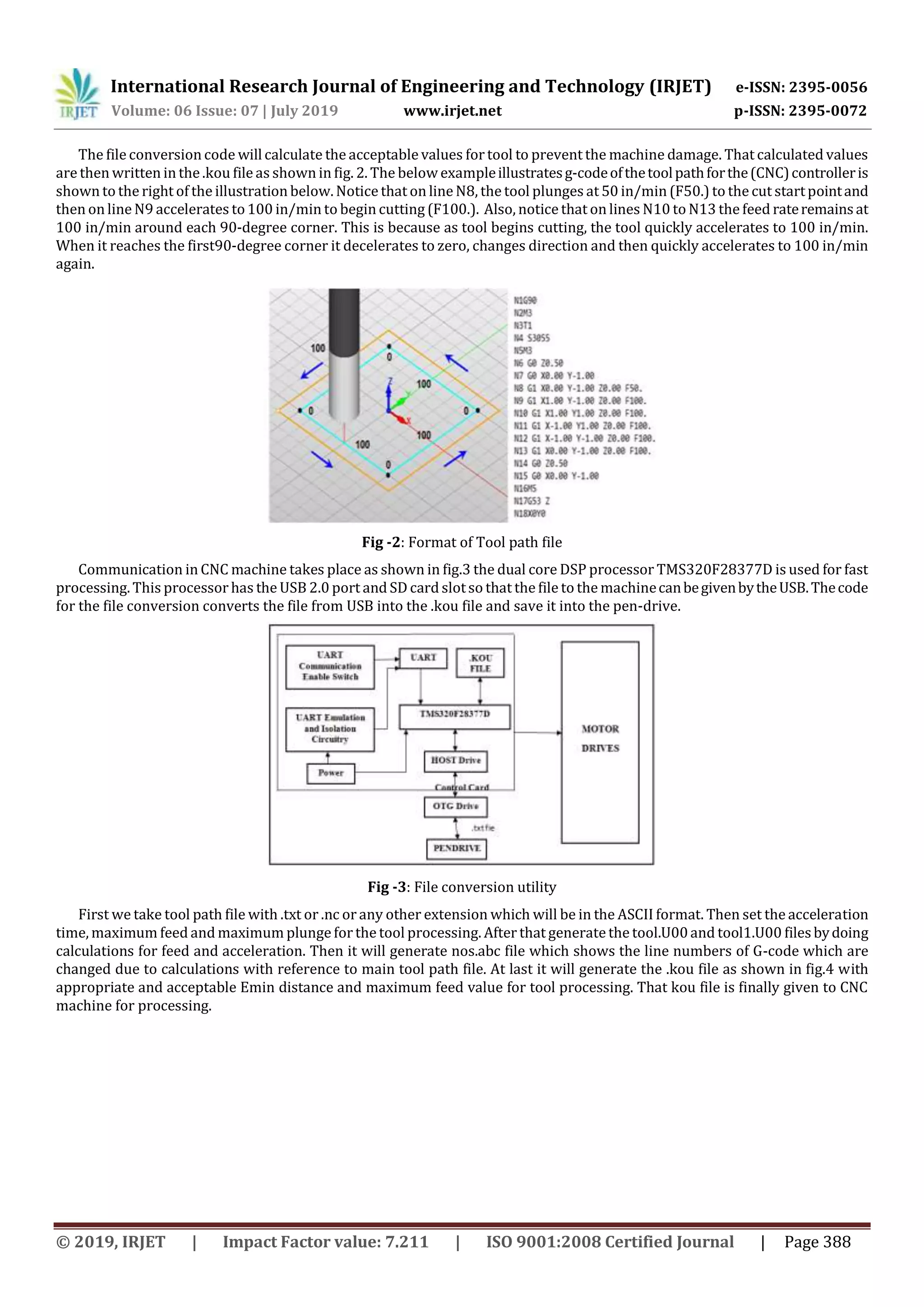
The file conversion code will calculate the acceptable values fortool to prevent the machine damage. That calculated values
are then written in the .kou file as shown in fig. 2. The below exampleillustratesg-codeofthetoolpathforthe(CNC)controlleris
shown to the right of the illustration below. Notice that on line N8, the tool plunges at 50 in/min (F50.) to the cut startpointand
then on line N9 accelerates to100 in/min to begin cutting (F100.). Also, notice that on lines N10 to N13 the feed rateremainsat
100 in/min around each 90-degree corner. This is because as tool begins cutting, the tool quickly accelerates to 100 in/min.
When it reaches the first90-degree corner it decelerates to zero, changes direction and then quickly accelerates to 100 in/min
again.
Fig -2: Format of Tool path file
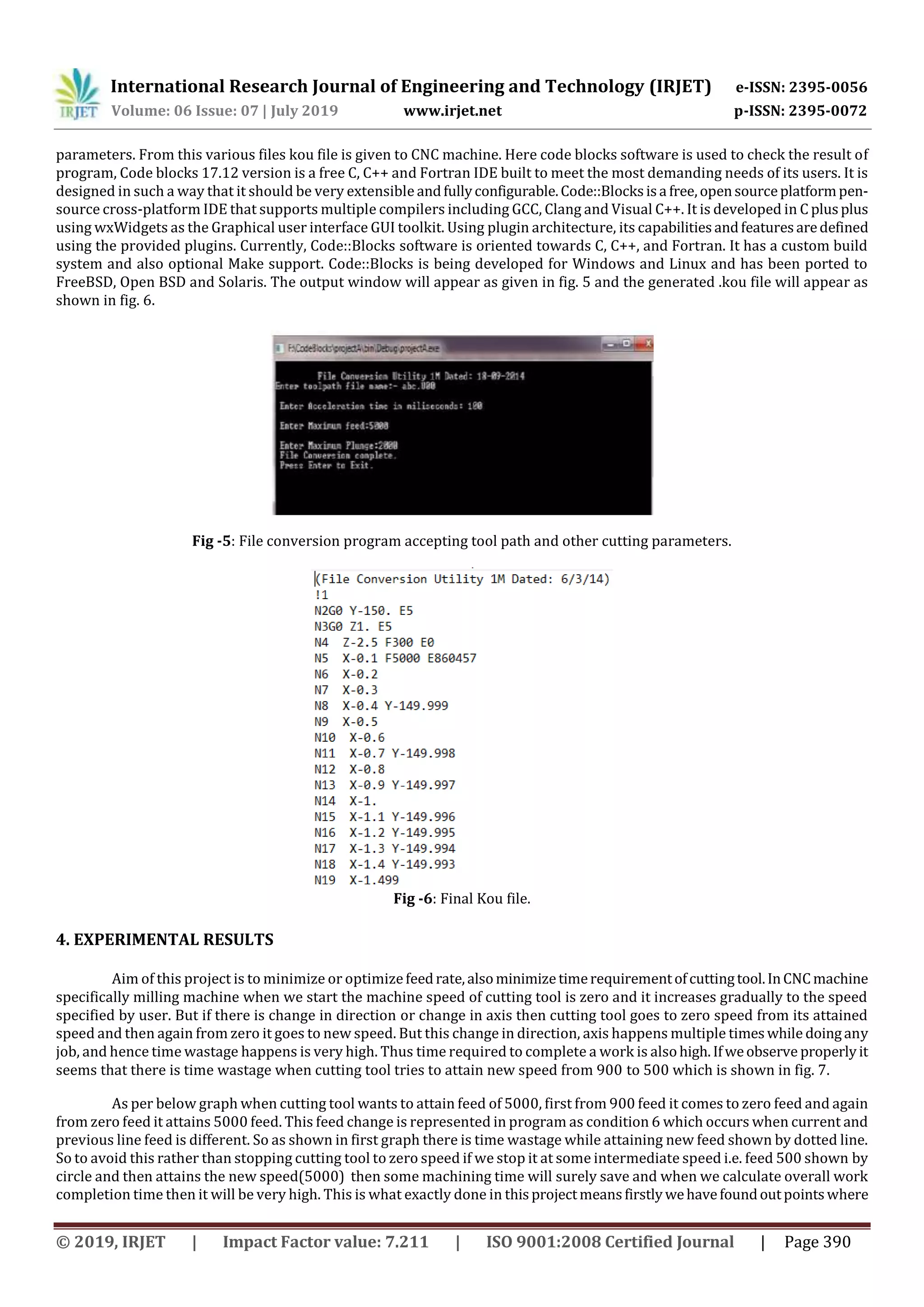
Communication in CNC machine takes place as shown in fig.3 the dual core DSP processor TMS320F28377D is used for fast
processing. This processor has the USB 2.0 port and SD card slotso that the file to the machinecanbegivenbytheUSB.Thecode
for the file conversion converts the file from USB into the .kou file and save it into the pen-drive.
Fig -3: File conversion utility
First we take tool path file with .txt or .nc or any other extension which will be in the ASCII format. Then set the acceleration
time, maximum feed and maximum plungefor the tool processing. After that generatethe tool.U00and tool1.U00 filesbydoing
calculations for feed and acceleration. Then it will generate nos.abc file which shows the line numbers of G-code which are
changed due to calculations with reference to main tool path file. At last it will generate the .kou file as shown in fig.4 with
appropriate and acceptable Emin distance and maximum feed value for tool processing. That kou file is finally given to CNC
machine for processing.
International Research Journal of Engineering and Technology (IRJET) e-ISSN: 2395-0056
Volume: 06 Issue: 07 | July 2019 www.irjet.net p-ISSN: 2395-0072
© 2019, IRJET | Impact Factor value: 7.211 | ISO 9001:2008 Certified Journal | Page 389
Fig -4: General flow of file conversion in CNC machine.
Steps to generate tool path file:
1. Read the .txt file from pen drive which is called as tool path file.
2. Convert .txt file into the tool.U00 file by doing some calculations of axis parameters.
3. Convert the tool.U00 file into tool1.U00 file by again doingthe calculations of maximumfeed and minimumlinear
distance (Emin) for tool processing.
4. Generate the nos.abc file which will indicate the line numbers Generate the .kou file by with suitable feed and
distance values
Initially file conversion program checks if tool path file is present or not. If it is present then write parameters like
acceleration time, feed and plunge into config file which is created by file conversion code. And if input tool path file is not
present then first accept it from user and ask for parameters like acceleration time, feed, and plunge. Finally write this
parameters into config file and calculate minimum distance Emin by formula given as,
Emin = [ (long) (Maxf / 60) ] * Acctime
Here, Maxf is maximum allowable feed.
Acctime is acceleration time.
The main function of the code generates the tool.U00 file after reading the tool path file and doing the required mathematical
calculations. The tool1.U00 file will be createdininterpritfunctionafterreadingthetool.U00fileandagaindoingthecalculations
for the total value. After generating the tool1.U00 file, the programwillgeneratethenos.abcfileinevaluatefunction.Thenos.abc
file will indicatethe line numbers where the feed value changes are supposed to occur. The nos.abc file iscreatedbyreadingthe
tool1.U00 file. The .kou is the final file to give to the CNC machine, the kou file will be generated in evaluate function in the code.
To create the kou file there is need to refer the two file. First is nos.abc file and second is tool path file. In kou file the required
feed and speed will get added for the tool processing.
3. SOFTWARE DESIGN
By giving feed, acceleration, plunge and tool path file as an input to file conversion code various files like kou, config
file, nos file, etc are generated. These files are generated after tremendous calculations on feed, acceleration, plunge, etc
International Research Journal of Engineering and Technology (IRJET) e-ISSN: 2395-0056
Volume: 06 Issue: 07 | July 2019 www.irjet.net p-ISSN: 2395-0072
© 2019, IRJET | Impact Factor value: 7.211 | ISO 9001:2008 Certified Journal | Page 390
parameters. From this various files kou file is given to CNC machine. Here code blocks software is used to check the result of
program, Code blocks 17.12 version is a free C, C++ and Fortran IDE built to meet the most demanding needs of its users. It is
designed in such a way that it should be very extensible andfullyconfigurable.Code::Blocksisa free,opensourceplatformpen-
source cross-platform IDE that supports multiple compilers including GCC, Clang and Visual C++. It is developed in C plusplus
using wxWidgets as the Graphical user interface GUI toolkit. Using plugin architecture, its capabilitiesandfeaturesaredefined
using the provided plugins. Currently, Code::Blocks software is oriented towards C, C++, and Fortran. It has a custom build
system and also optional Make support. Code::Blocks is being developed for Windows and Linux and has been ported to
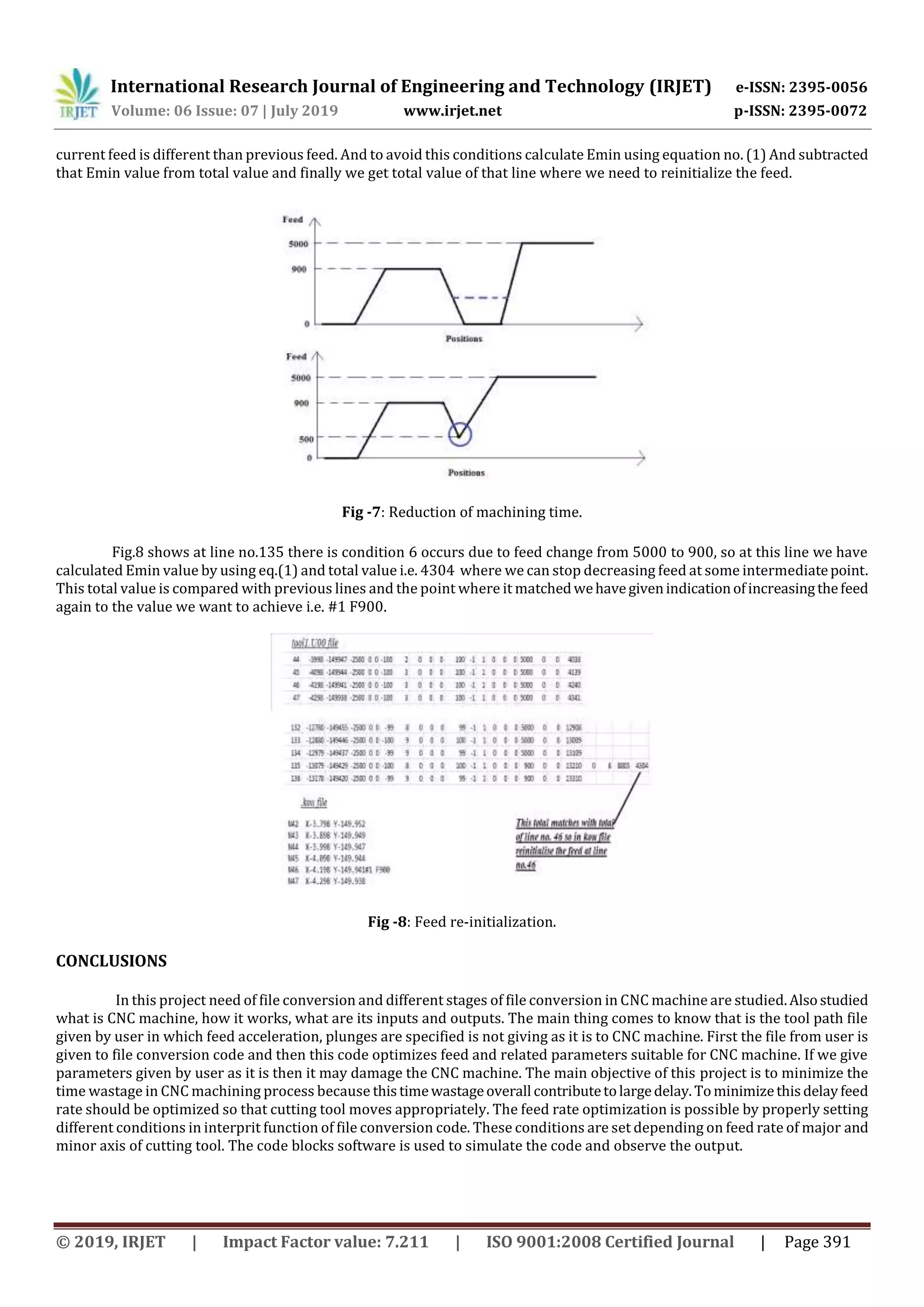
FreeBSD, Open BSD and Solaris. The output window will appear as given in fig. 5 and the generated .kou file will appear as
shown in fig. 6.
Fig -5: File conversion program accepting tool path and other cutting parameters.
Fig -6: Final Kou file.
Aim of this project is to minimize or optimizefeedrate,alsominimizetimerequirementofcuttingtool.InCNCmachine
specifically milling machine when we start the machine speed of cutting tool is zero and it increases gradually to the speed
specified by user. But if there is change in direction or change in axis then cutting tool goes to zero speed from its attained
speed and then again from zero it goes to new speed. But this change in direction, axis happens multiple timeswhile doingany
job, and hence time wastage happens is very high. Thus time required to complete a work is alsohigh.Ifweobserve properlyit
seems that there is time wastage when cutting tool tries to attain new speed from 900 to 500 which is shown in fig. 7.
As per below graph when cutting tool wants to attain feed of 5000, first from 900 feed it comes to zero feed and again
from zero feed it attains 5000 feed. This feed change is represented in program as condition 6 which occurs when current and
previous line feed is different. So as shown in first graph there is time wastage while attaining new feed shown by dotted line.
So to avoid this rather than stopping cutting tool to zero speed if we stop it at some intermediate speed i.e. feed 500 shown by
circle and then attains the new speed(5000) then some machining time will surely save and when we calculate overall work
completion time then it will be very high. This is what exactly done in thisprojectmeansfirstlywehavefoundoutpointswhere
4. EXPERIMENTAL RESULTS
International Research Journal of Engineering and Technology (IRJET) e-ISSN: 2395-0056
Volume: 06 Issue: 07 | July 2019 www.irjet.net p-ISSN: 2395-0072
© 2019, IRJET | Impact Factor value: 7.211 | ISO 9001:2008 Certified Journal | Page 391
current feed is different than previous feed. And to avoid this conditions calculate Emin using equation no. (1) And subtracted
that Emin value from total value and finally we get total value of that line where we need to reinitialize the feed.
Fig -7: Reduction of machining time.
Fig.8 shows at line no.135 there is condition 6 occurs due to feed change from 5000 to 900, so at this line we have
calculated Emin value by using eq.(1) and total value i.e. 4304 where we can stop decreasing feed at some intermediatepoint.
This total value is compared with previous lines and the point where it matchedwehavegivenindicationofincreasingthefeed
again to the value we want to achieve i.e. #1 F900.
Fig -8: Feed re-initialization.
CONCLUSIONS
In this project need of file conversion and different stages of file conversion in CNC machine are studied.Alsostudied
what is CNC machine, how it works, what are its inputs and outputs. The main thing comes to know that is the tool path file
given by user in which feed acceleration, plunges are specified is not giving as it is to CNC machine. First the file from user is
given to file conversion code and then this code optimizes feed and related parameters suitable for CNC machine. If we give
parameters given by user as it is then it may damage the CNC machine. The main objective of this project is to minimize the
time wastage in CNC machining process because thistimewastageoverall contributetolargedelay.Tominimizethisdelayfeed
rate should be optimized so that cutting tool moves appropriately. The feed rate optimization is possible by properly setting
different conditions in interprit function of file conversion code. These conditions are set depending on feed rate of major and
minor axis of cutting tool. The code blocks software is used to simulate the code and observe the output.
International Research Journal of Engineering and Technology (IRJET) e-ISSN: 2395-0056
Volume: 06 Issue: 07 | July 2019 www.irjet.net p-ISSN: 2395-0072
© 2019, IRJET | Impact Factor value: 7.211 | ISO 9001:2008 Certified Journal | Page 392
REFERENCES
[1] "ToolpathFeedrate Optimization: A Case Study Proceedings of the 2000 NSF Design and Manufacturing Research
Conference", Jan 3-6, 2000, Vancouver, British Columbia, Canada. .
[2] E. Missimer, Y. Li and R. West, "Real-time USB communication in the Quest operatingsystem",2013IEEE 19thReal-Time
and Embedded Technology and Applications Symposium (RTAS), Philadelphia, PA, 2013, pp. 11-20.
[3] J. W. Jeon, "Efficient acceleration and deceleration technique for short distance movement in industrial robots and CNC
machine tools,"Electronics Letters, vol. 36, no. 8, pp. 766-768, 2000
[4] TMS320F2837xD Dual-Core Delfino Microcontrollers Technical Reference Manual.
[5] F2837xD Workshop Workshop Guide and Lab Manual F2837xD-TTO by TI.
[6] T. C. Lu and S. L. Chen, "Genetic algorithm-based S-curve acceleration and deceleration for five-axis machine tools,"
International Journal of Advanced Manufacturing Technology, pp. 1-14, 2016.
[7] https://wiki.mcneel.com/rhino/cncbasics.
[8] https://pdfs.semanticscholar.org/b99e/cb86fcdce222c0182de991892482c2a19471.pdf
[9] Jin-Shiang Chang and Syh-Shiuh Yeh, Member, IAENG, “Development of an Interpolation Method for the
Acceleration/Deceleration Period Spanning Over Multiple Numerical Control Blocks in CNC Machine Tools”,Vol II IMECS
2018, March 14-16, Hong Kong, 2018.
[10] C. W. Cheng and M. C. Tsai, "Real-time variable feed rate NURBS curve interpolator for cnc machining," International
Journal of Advanced Manufacturing Technology, vol. 23, no. 11-12, pp. 865-873, 2004.

IRJET- Analysis of File Conversion Program Used for CNC Machine

  • 1.
    International Research Journalof Engineering and Technology (IRJET) e-ISSN: 2395-0056 Volume: 06 Issue: 07 | July 2019 www.irjet.net p-ISSN: 2395-0072 © 2019, IRJET | Impact Factor value: 7.211 | ISO 9001:2008 Certified Journal | Page 386 Analysis of File Conversion Program used for CNC Machine Madhura M. Thombare1, Sunil S. Morade2 1Student, Department of Electronics & Telecommunication & K. K. Wagh Institute of Engineering, Nashik, India 2Professor, Department of Electronics & Telecommunication & K. K. Wagh Institute of Engineering, Nashik, India ---------------------------------------------------------------------***--------------------------------------------------------------------- Abstract - Computer numerical control (CNC) is a method for automating control of machine tools through the use ofsoftware embedded in a microcomputer or processor attached to the tool. It is commonly used in manufacturing for machining metal and plastic parts. Previously CNC machine is attached with computer and all the commandsaregivenusingcomputer. Now adaysDSP processor is used in modern CNC systems having USB and SD card slots through whichwecanprogramCNCmachine. Theproblem with the existing computer based system is it needs to connect to the CNC system as communication take place through theRS232 protocol. The use of RS232 is very inefficient and time consuming than the latest CNC systemsduetoitsslowspeed. Replacementof RS232 by USB or SD card communication has increased the speed from 115.2Kbpsto12Mbps. InthisstudyDSPprocessorbyTexas Instruments TMS320F2837xd is used which is dual core processor with features of flash programming. This study focuses on understanding and analysing file conversion program to optimize the feed rates and reducing overall machining time of CNC machine. The input to the file conversion program is tool path file generated fromCAMsoftwareandoutputisthefile withsuitable feed rates and other parameters required by CNC machine. Key Words: CNC, CAM, DSP, USB, SD card. 1. INTRODUCTION CNC stands for Computer Numerical Control machine, when computers are used to control a Numerical Control (NC) machine tool than the machine is called CNC machine. In other words the use of computers to control the machine tools like lathe, mills, shaper etc is called CNC machine. The cutting operations performed by the CNC is called CNC machining, in CNC machining, programs are designed or prepared first and then it is fed to the CNC machine. According to the program, CNC controls the motion and speed of the machine tools. The main parts of CNC machine are: 1. Input Devices: These are the devices which are used to input the part program in the CNC machine. There are three commonly used input devices and these are punch tape reader, magnetic tape reader, computer via RS-232-C communication and DSP processors through SD Card or USB communication. 2. Machine Control Unit (MCU): It is the heart of the CNC machine. It performs all the controlling action of the CNC machine, the various functions performed by the MCU are It readsthecodedinstructionsfedintoit,decodesthecoded instructions, implements interpolation suchaslinear,circularandhelicaltogenerateaxismotioncommands,feedsthe axis motion commands to the amplifier circuits for driving the axis mechanisms, receives the feedback signals of position and speed for each axis drive and implements the auxiliarycontrol functionssuchascoolantorspindleon/off and tool change. 3. Machine Tool: A CNC machine tool always has a slide table and a spindle to control of the position and speed. The machine table is controlled in X and Y axis directions and the spindle is controlled in the Z axis direction. 4. Driving System: The driving system of a CNC machine consists of amplifier circuits, drivemotorsandball leadscrew. The MCU feeds the signals like position and speed of each axis to the amplifier circuits. The control signals are than augmented (increased) to actuate the drive motors and then this actuated drive motors rotate the ball lead screw to position the machine table. 5. Feedback System: This system consists of transducers that acts like sensors. It is also known as measuring system; this system contains position and speed transducers that continuously monitor the position and speed of the cutting tool located at any instant. The MCU receives the signals from thesetransducersandit usesthedifference betweenthe reference signals and feedback signals to generate the control signals for correcting the position and speed errors. 6. Display Unit: A monitor is used to display the programs, commands and other useful data of CNC machine. Below figure 1 shows the block diagram of CNC machine
  • 2.
    International Research Journalof Engineering and Technology (IRJET) e-ISSN: 2395-0056 Volume: 06 Issue: 07 | July 2019 www.irjet.net p-ISSN: 2395-0072 © 2019, IRJET | Impact Factor value: 7.211 | ISO 9001:2008 Certified Journal | Page 387 Fig -1: Block diagram of CNC machine The user of CNC machine give commands to CNC machine for its operation and this commands are in the form of tool path file, this file is generated using CAD/CAM software. This tool path file contains information regarding the distances of points from X-Y axis, feed, plunge acceleration time, etc. But we cannot give this file as it is to CNC machine because the parameters given by user are not always suitable to CNC machine. If that tool path file is given as it is then it may harm cutting tool, crate vibrations or degrade life of CNC machine. So this file goes from various file conversion processes and finallyweget file suitable for CNC machine. So main objective of this project is to understand the flow of file conversionutility,optimizefeed rate and minimize machining time in tool path file. Initially, the CNC technology was applied on basic metal cutting machines suchaslathe, millingmachines,etc.Then,to increase flexibility of the machines in handling a variety of components and to finish them in a single setup on the same machine, CNC concept was applied to develop a CNC machining centre for machining prismatic components combining operations like milling, drilling, boring and tapping. It does so by taking computer-generated code and converting it with software into electrical signals. The signals control the CNC motors anddirectthemto moveinsmall incrementsthatarehighly precise and repetitive [7]. To get a CNC machine work properly, there needs a dictated software control to get the desired results from a computer design. Traditional CNC machines programmed using CAM software, [3] this CAM (computer aided manufacturing) program is the most difficult part. Note that the CAM doesn't actually run the machine, though it creates the code for machine to follow. In addition, some machines have their own programming language and specificCAMisrequiredto create NC code for the machine to understand. In these cases it can require a post processor that serves to bridge the gap in communication [4]. The post processor usually makes it possible touseanymachineandtranslateanythingtothe neededcode for specific machine and part. There are many smaller model maker-hobbyist styledesktopCNCmachines[2].Ingeneral thesearelighterinweight,lessrigid, less precise, slower and less expensive than their industrial counterparts, but can do well for machining objects for softer materials like plastics, foam, and wax. Some desktop CNC machines may run a lot like a printer. Others have their own closed command system and even dedicated CAM software. A few machines will alsoacceptstandardG-codeasinput;someindustrial standard desktop machines do exist with dedicated controllers for doing precise and small work. 2. SYSTEM OVERVIEW As the mathematical calculations required for numerical data goes onincreasingtheprocessingtimeforCNCwill also increases. To reduce the processing time of machine the use of DSP processorinCNCsystemhasbeenincreasedtremendously. The requirement of electrical drive systems increases by the request of high performance, large integration, ease of programming and lower cost. Based on these new trends and requirements TI developed a new controller concept which integrates a Digital Signal Processor (DSP) core with intelligent peripherals to achieve single chip solution. TI developed the new controller family TMS320F2837xD to achieve the processing goals required in CNC machine. Due to the mathematical calculations required for numerical data goes on increasing the processing time and complexity for CNC will also increase. When someone is operating on CNC machine with some tool then he has to insure that it will not get damaged because of feed, speed and plunge given by user in input tool path file. To prevent the damage of machine it is necessary to find out the maximum acceptable feed and speed for the machine tool.
  • 3.
    International Research Journalof Engineering and Technology (IRJET) e-ISSN: 2395-0056 Volume: 06 Issue: 07 | July 2019 www.irjet.net p-ISSN: 2395-0072 © 2019, IRJET | Impact Factor value: 7.211 | ISO 9001:2008 Certified Journal | Page 388 The file conversion code will calculate the acceptable values fortool to prevent the machine damage. That calculated values are then written in the .kou file as shown in fig. 2. The below exampleillustratesg-codeofthetoolpathforthe(CNC)controlleris shown to the right of the illustration below. Notice that on line N8, the tool plunges at 50 in/min (F50.) to the cut startpointand then on line N9 accelerates to100 in/min to begin cutting (F100.). Also, notice that on lines N10 to N13 the feed rateremainsat 100 in/min around each 90-degree corner. This is because as tool begins cutting, the tool quickly accelerates to 100 in/min. When it reaches the first90-degree corner it decelerates to zero, changes direction and then quickly accelerates to 100 in/min again. Fig -2: Format of Tool path file Communication in CNC machine takes place as shown in fig.3 the dual core DSP processor TMS320F28377D is used for fast processing. This processor has the USB 2.0 port and SD card slotso that the file to the machinecanbegivenbytheUSB.Thecode for the file conversion converts the file from USB into the .kou file and save it into the pen-drive. Fig -3: File conversion utility First we take tool path file with .txt or .nc or any other extension which will be in the ASCII format. Then set the acceleration time, maximum feed and maximum plungefor the tool processing. After that generatethe tool.U00and tool1.U00 filesbydoing calculations for feed and acceleration. Then it will generate nos.abc file which shows the line numbers of G-code which are changed due to calculations with reference to main tool path file. At last it will generate the .kou file as shown in fig.4 with appropriate and acceptable Emin distance and maximum feed value for tool processing. That kou file is finally given to CNC machine for processing.
  • 4.
    International Research Journalof Engineering and Technology (IRJET) e-ISSN: 2395-0056 Volume: 06 Issue: 07 | July 2019 www.irjet.net p-ISSN: 2395-0072 © 2019, IRJET | Impact Factor value: 7.211 | ISO 9001:2008 Certified Journal | Page 389 Fig -4: General flow of file conversion in CNC machine. Steps to generate tool path file: 1. Read the .txt file from pen drive which is called as tool path file. 2. Convert .txt file into the tool.U00 file by doing some calculations of axis parameters. 3. Convert the tool.U00 file into tool1.U00 file by again doingthe calculations of maximumfeed and minimumlinear distance (Emin) for tool processing. 4. Generate the nos.abc file which will indicate the line numbers Generate the .kou file by with suitable feed and distance values Initially file conversion program checks if tool path file is present or not. If it is present then write parameters like acceleration time, feed and plunge into config file which is created by file conversion code. And if input tool path file is not present then first accept it from user and ask for parameters like acceleration time, feed, and plunge. Finally write this parameters into config file and calculate minimum distance Emin by formula given as, Emin = [ (long) (Maxf / 60) ] * Acctime Here, Maxf is maximum allowable feed. Acctime is acceleration time. The main function of the code generates the tool.U00 file after reading the tool path file and doing the required mathematical calculations. The tool1.U00 file will be createdininterpritfunctionafterreadingthetool.U00fileandagaindoingthecalculations for the total value. After generating the tool1.U00 file, the programwillgeneratethenos.abcfileinevaluatefunction.Thenos.abc file will indicatethe line numbers where the feed value changes are supposed to occur. The nos.abc file iscreatedbyreadingthe tool1.U00 file. The .kou is the final file to give to the CNC machine, the kou file will be generated in evaluate function in the code. To create the kou file there is need to refer the two file. First is nos.abc file and second is tool path file. In kou file the required feed and speed will get added for the tool processing. 3. SOFTWARE DESIGN By giving feed, acceleration, plunge and tool path file as an input to file conversion code various files like kou, config file, nos file, etc are generated. These files are generated after tremendous calculations on feed, acceleration, plunge, etc
  • 5.
    International Research Journalof Engineering and Technology (IRJET) e-ISSN: 2395-0056 Volume: 06 Issue: 07 | July 2019 www.irjet.net p-ISSN: 2395-0072 © 2019, IRJET | Impact Factor value: 7.211 | ISO 9001:2008 Certified Journal | Page 390 parameters. From this various files kou file is given to CNC machine. Here code blocks software is used to check the result of program, Code blocks 17.12 version is a free C, C++ and Fortran IDE built to meet the most demanding needs of its users. It is designed in such a way that it should be very extensible andfullyconfigurable.Code::Blocksisa free,opensourceplatformpen- source cross-platform IDE that supports multiple compilers including GCC, Clang and Visual C++. It is developed in C plusplus using wxWidgets as the Graphical user interface GUI toolkit. Using plugin architecture, its capabilitiesandfeaturesaredefined using the provided plugins. Currently, Code::Blocks software is oriented towards C, C++, and Fortran. It has a custom build system and also optional Make support. Code::Blocks is being developed for Windows and Linux and has been ported to FreeBSD, Open BSD and Solaris. The output window will appear as given in fig. 5 and the generated .kou file will appear as shown in fig. 6. Fig -5: File conversion program accepting tool path and other cutting parameters. Fig -6: Final Kou file. Aim of this project is to minimize or optimizefeedrate,alsominimizetimerequirementofcuttingtool.InCNCmachine specifically milling machine when we start the machine speed of cutting tool is zero and it increases gradually to the speed specified by user. But if there is change in direction or change in axis then cutting tool goes to zero speed from its attained speed and then again from zero it goes to new speed. But this change in direction, axis happens multiple timeswhile doingany job, and hence time wastage happens is very high. Thus time required to complete a work is alsohigh.Ifweobserve properlyit seems that there is time wastage when cutting tool tries to attain new speed from 900 to 500 which is shown in fig. 7. As per below graph when cutting tool wants to attain feed of 5000, first from 900 feed it comes to zero feed and again from zero feed it attains 5000 feed. This feed change is represented in program as condition 6 which occurs when current and previous line feed is different. So as shown in first graph there is time wastage while attaining new feed shown by dotted line. So to avoid this rather than stopping cutting tool to zero speed if we stop it at some intermediate speed i.e. feed 500 shown by circle and then attains the new speed(5000) then some machining time will surely save and when we calculate overall work completion time then it will be very high. This is what exactly done in thisprojectmeansfirstlywehavefoundoutpointswhere 4. EXPERIMENTAL RESULTS
  • 6.
    International Research Journalof Engineering and Technology (IRJET) e-ISSN: 2395-0056 Volume: 06 Issue: 07 | July 2019 www.irjet.net p-ISSN: 2395-0072 © 2019, IRJET | Impact Factor value: 7.211 | ISO 9001:2008 Certified Journal | Page 391 current feed is different than previous feed. And to avoid this conditions calculate Emin using equation no. (1) And subtracted that Emin value from total value and finally we get total value of that line where we need to reinitialize the feed. Fig -7: Reduction of machining time. Fig.8 shows at line no.135 there is condition 6 occurs due to feed change from 5000 to 900, so at this line we have calculated Emin value by using eq.(1) and total value i.e. 4304 where we can stop decreasing feed at some intermediatepoint. This total value is compared with previous lines and the point where it matchedwehavegivenindicationofincreasingthefeed again to the value we want to achieve i.e. #1 F900. Fig -8: Feed re-initialization. CONCLUSIONS In this project need of file conversion and different stages of file conversion in CNC machine are studied.Alsostudied what is CNC machine, how it works, what are its inputs and outputs. The main thing comes to know that is the tool path file given by user in which feed acceleration, plunges are specified is not giving as it is to CNC machine. First the file from user is given to file conversion code and then this code optimizes feed and related parameters suitable for CNC machine. If we give parameters given by user as it is then it may damage the CNC machine. The main objective of this project is to minimize the time wastage in CNC machining process because thistimewastageoverall contributetolargedelay.Tominimizethisdelayfeed rate should be optimized so that cutting tool moves appropriately. The feed rate optimization is possible by properly setting different conditions in interprit function of file conversion code. These conditions are set depending on feed rate of major and minor axis of cutting tool. The code blocks software is used to simulate the code and observe the output.
  • 7.
    International Research Journalof Engineering and Technology (IRJET) e-ISSN: 2395-0056 Volume: 06 Issue: 07 | July 2019 www.irjet.net p-ISSN: 2395-0072 © 2019, IRJET | Impact Factor value: 7.211 | ISO 9001:2008 Certified Journal | Page 392 REFERENCES [1] "ToolpathFeedrate Optimization: A Case Study Proceedings of the 2000 NSF Design and Manufacturing Research Conference", Jan 3-6, 2000, Vancouver, British Columbia, Canada. . [2] E. Missimer, Y. Li and R. West, "Real-time USB communication in the Quest operatingsystem",2013IEEE 19thReal-Time and Embedded Technology and Applications Symposium (RTAS), Philadelphia, PA, 2013, pp. 11-20. [3] J. W. Jeon, "Efficient acceleration and deceleration technique for short distance movement in industrial robots and CNC machine tools,"Electronics Letters, vol. 36, no. 8, pp. 766-768, 2000 [4] TMS320F2837xD Dual-Core Delfino Microcontrollers Technical Reference Manual. [5] F2837xD Workshop Workshop Guide and Lab Manual F2837xD-TTO by TI. [6] T. C. Lu and S. L. Chen, "Genetic algorithm-based S-curve acceleration and deceleration for five-axis machine tools," International Journal of Advanced Manufacturing Technology, pp. 1-14, 2016. [7] https://wiki.mcneel.com/rhino/cncbasics. [8] https://pdfs.semanticscholar.org/b99e/cb86fcdce222c0182de991892482c2a19471.pdf [9] Jin-Shiang Chang and Syh-Shiuh Yeh, Member, IAENG, “Development of an Interpolation Method for the Acceleration/Deceleration Period Spanning Over Multiple Numerical Control Blocks in CNC Machine Tools”,Vol II IMECS 2018, March 14-16, Hong Kong, 2018. [10] C. W. Cheng and M. C. Tsai, "Real-time variable feed rate NURBS curve interpolator for cnc machining," International Journal of Advanced Manufacturing Technology, vol. 23, no. 11-12, pp. 865-873, 2004.