Unchecked cell growth in lung tissue is indicative of lung cancer. Early identification of
cancerous cells in the lungs is essential for functions including the body's carbon dioxide
and oxygen elimination. The potential influence on patient diagnosis and treatment has led
to a great deal of interest in the application of deep learning to identify lymph node
invasion in CT scan and histology pictures. This approach consists of three stages:
preprocessing, feature extraction, and classification. In order to identify lung cancer, we
suggest using DenseNet's capability to continually propagate learnt characteristics
backward via each layer. Pre-processing methods like contrast enhancement and filtering
can be used to reduce undesired noise in the incoming image. Next, optimization techniques
like Otsu thresholding are used to achieve the required picture segmentation. Among the
![Computer Science & Engineering: An International Journal (CSEIJ), Vol 15, No 1, February 2025
DOI:10.5121/cseij.2025.15129 255
LUNG CANCER CLASSIFICATION USING
DENSENET MULTI MODEL
OPTIMIZATION TECHNIQUES
Balamurugan M, Narasimha Murthy G K, Nagaraju M L,
Rajesh Rao K, Vivek K
Department of MCA, Acharya Institute of Graduate Studies, Bangalore
ABSTRACT
Unchecked cell growth in lung tissue is indicative of lung cancer. Early identification of
cancerous cells in the lungs is essential for functions including the body's carbon dioxide
and oxygen elimination. The potential influence on patient diagnosis and treatment has led
to a great deal of interest in the application of deep learning to identify lymph node
invasion in CT scan and histology pictures. This approach consists of three stages:
preprocessing, feature extraction, and classification. In order to identify lung cancer, we
suggest using DenseNet's capability to continually propagate learnt characteristics
backward via each layer. Pre-processing methods like contrast enhancement and filtering
can be used to reduce undesired noise in the incoming image. Next, optimization techniques
like Otsu thresholding are used to achieve the required picture segmentation. Among the
suggested classifiers is the DenseNet classifier. Structure, hyperparameter optimization,
etc. are used in DenseNet's multi-process optimization. We use performance matrices like
accuracy, precision, recall, specificity, sensitivity, and F_Measure to execute the suggested
technique in MATLAB.
1. INTRODUCTION
The term "cancer" is wide. suggests a condition where uncontrollable cell growth and division are
brought on by alterations in the cells. The majority of bodily cells have set lifespans and
specialized roles. Apoptosis, however, is a component of the natural phenomena known as
apoptosis. The body instructs cells to die so that fresh, more functional cells can take their place.
The machinery needed to teach cancer cells to cease proliferating and die is absent. As a result,
they often develop inside the body, feeding other cells with nutrition and oxygen. Tumors,
immune system impairment, and other anomalies that impair normal bodily functions can all be
brought on by cancer cells. [1] Unchecked cell growth in lung tissue is a hallmark of lung cancer,
a malignant lung tumor. [2] The most common cause of death from cancer is lung cancer.
The primary goal of this study is to identify the existence of lung cancer cells using data and
symptoms from humans. This study investigates if lung cancer may be identified from a person's
body using artificial neural network models. The following are the study's objectives:
Human lung CT image identification is accomplished using the method proposed in this
study to construct DenseNet for lung cancer prediction.
The suggested technique comprises four processes: preprocessing, feature selection,
segmentation, and classification.](https://image.slidesharecdn.com/15125cseij29-251015035512-5e86f7a8/75/Lung-Cancer-Classification-using-Densenet-Multi-Model-Optimization-Techniques-1-2048.jpg)
![Computer Science & Engineering: An International Journal (CSEIJ), Vol 15, No 1, February 2025
256
The ineffectiveness of classification is attributed to the unwanted noise seen in the CT
images gathered here. One may use preprocessing techniques such as filtering and
contrast enhancement to eliminate unwanted noise from the input image.
After that, the image is segmented using Otsu thresholding and other optimization
techniques.
The categorization process then takes place.
2. LITERATURE REVIEW
In this field of study, Nasser, Ibrahim M., and associates developed several neural network-based
models for categorization, prediction, and diagnosis. Neural networks were suggested for many
purposes such as predicting the category of movies to watch [3], predicting the price range of
mobile phones predicting the category of animals [4], diagnosing tumors [5], and diagnosing
autism [6]. Abu Nasser together with others. Artificial neural networks serve as the foundation
for several categorization methods [7].
In their work, Jock et al. (2023) [8] suggested a neuro-heuristic method to deal with the minute
alterations in lung tissue structure that arise in cases of pneumonia, sarcoidosis, or cancer as well
as certain potential side effects of treatment. The outcomes of the method's testing showed how
promising the recently suggested approach was. The approach also has a minimal computing load
and is adaptable.
It was discovered by Rakshit S. et al. (2023) [9] that chest research is necessary to comprehend
what he is discussing. After that, DenseNet is used for categorization. Here, we go over how the
suggested model, the ResNet18 network, performs comparably to earlier tested models and
requires less parameters to train.
The usage of convolutional neural networks and machine learning techniques in medical image
processing are discussed by Justin Cole et al. (2022) [10]. In this section, we go over the
significance of deep learning in identifying specific medical disorders. The clinical and deep
learning components will be the main focus.
3. METHODOLOGY
In order to diagnose lung cancer, we first provide a dataset in this part that includes pictures from
chest CT scans and images from histology. Next, we'll go over the specifics about feature
selection, partitioning, and preprocessing in this post. Lastly, this part concludes with information
regarding the DenseNet architecture.
3.1. Dataset Description
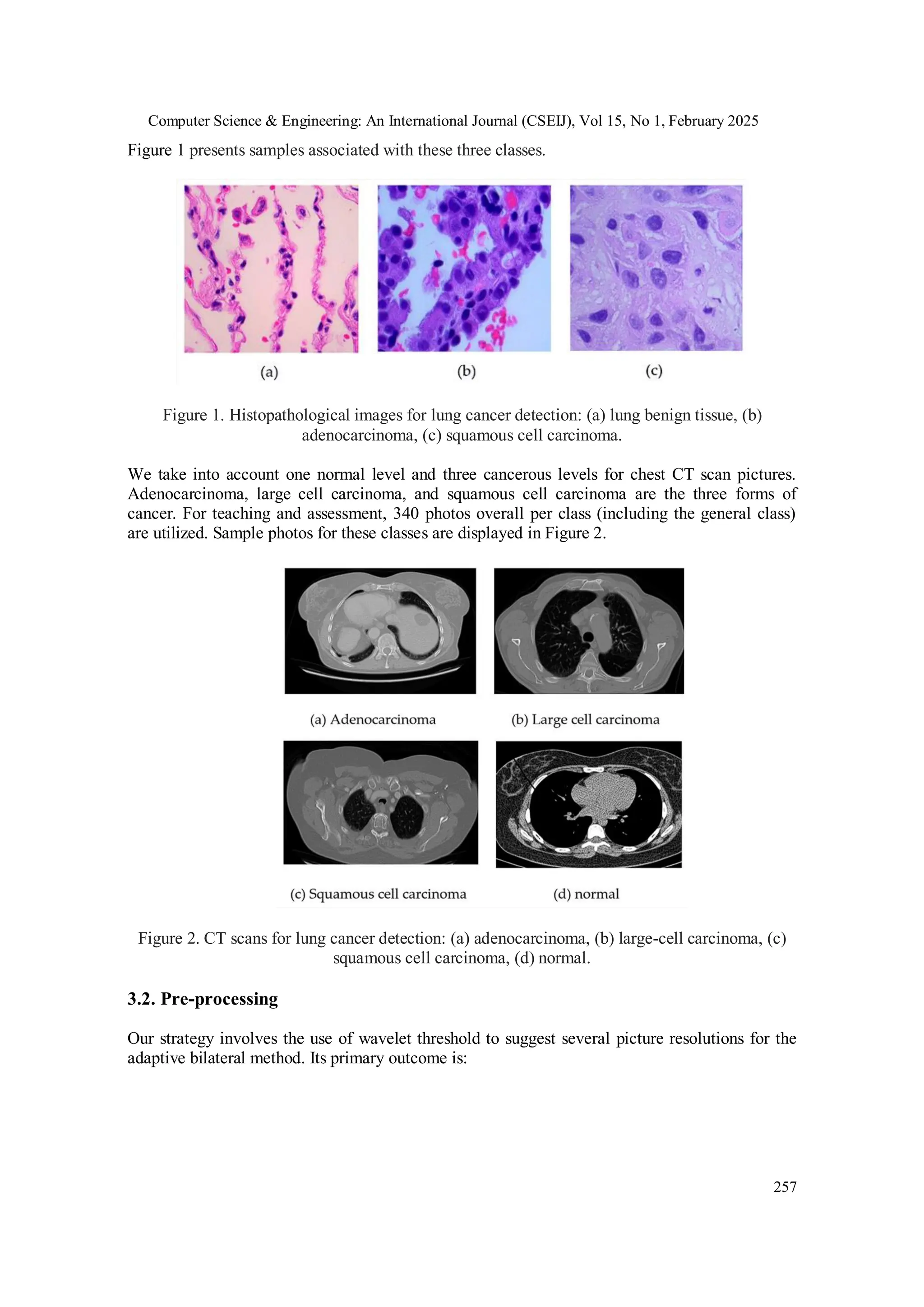
15,000 JPEG-formatted histopathology photos, each measuring 768 by 768 pixels, are included in
the collection. These photos adhere to HIPAA regulations, and the veracity of their sources has
been confirmed. At first, there were 750 lung tissue photographs in the collection; these were
split equally into three categories: 250 images of positive lung tissue, 250 images of lung
adenocarcinoma, and 250 images of lung squamous cell carcinoma.
Lung benign tissue;
Lung adenocarcinoma;
Lung squamous cell carcinoma.](https://image.slidesharecdn.com/15125cseij29-251015035512-5e86f7a8/75/Lung-Cancer-Classification-using-Densenet-Multi-Model-Optimization-Techniques-2-2048.jpg)
![Computer Science & Engineering: An International Journal (CSEIJ), Vol 15, No 1, February 2025
258
3.3. Adaptive bilateral Filter
To adjust different changes in picture resolution, the spatial domain (⁆d) and intensity domain
(r) parameters are employed on both sides. In order to investigate the best parameter values
through experimentation, it is necessary to alter the noise variance in picture denoising
applications. correlation between the parameters d, r, and n for the standard deviation. Using the
parameters d and r, we test the multivariate picture resolution and use the bilateral approach to
minimize the noise in the input image. Record the MSE and PSNR readings and repeat for
effective noise dispersion.
Figure 3: Architecture diagram of Adaptive bilateral method
Parameter d has a value range of 1.5 to 2.0, and the value of r varies dramatically as the standard
deviation n value varies. Figure 1. One of the best strategies to minimize noise is to alter the
analysis of various picture resolutions. It may raise the degree of picture resolution and
sequentially separate images from noise. Wavelet thresholding in conjunction with the adaptive
bifacial approach at different picture resolutions. Sub-bands are subjected to an adaptive
bidirectional technique to minimize low-frequency noise components.
A grayscale picture is created from the original. Non-linear bidirectional filters maintain picture
edges while lowering noise. Replace the intensity of each pixel with the weighted average of its
surrounding pixels. a pixel value weighted average derived from a Gaussian blur. This is
described as:
𝐵𝐹[𝐼]𝑝 =
1
𝑊
𝑝
∑ 𝐺𝜎𝑠(|𝑝 − 𝑞|)𝐺𝜎𝑟(𝐼𝑝 − 𝐼𝑞)𝐼𝑞
𝑞 ∈𝑆
Where Wp is normalization factor:
𝑊
𝑝 = ∑ 𝐺𝜎𝑠(|𝑝 − 𝑞|)𝐺𝜎𝑟(𝐼𝑝 − 𝐼𝑞)
𝑞 ∈𝑆
Where,
σs and σr - compute quantity of filtering input image
Gσs – To decrease distant pixels
Gσr – If decrease a gaussian the influence of pixels q with intensity value different from Ip.
To smooth bigger features and get the filter closer to a Gaussian blur, raise the parameter σs and
adjust the parameter σr to make the range more Gaussian-flat.](https://image.slidesharecdn.com/15125cseij29-251015035512-5e86f7a8/75/Lung-Cancer-Classification-using-Densenet-Multi-Model-Optimization-Techniques-4-2048.jpg)
![Computer Science & Engineering: An International Journal (CSEIJ), Vol 15, No 1, February 2025
259
3.4. Feature selection
The suggested ITEO algorithm for choosing predicted genes from cancer microarray gene
expression profiles is presented in this section. The algorithm uses the ITEO method, a packaged
gene selection technique that selects informative and relevant genes in advance using the
DenseNet classifier. The goal is to pick more informative genes in order to increase the DenseNet
classifier's accuracy performance. The suggested algorithm's solution representation is shown. It
is clear that characteristics are chosen for our suggested approach from tiny data sets that include
relevant genes. When compared to the original method that chooses genes based just on the initial
microarray data set, this enhances the optimization process.
3.5. Improved Thermal Exchange Optimization Algorithm
Thermal exchange is started by grouping objects together, and item temperatures are expressed at
each location in Thermal Exchange Optimization (TEO). Consequently, the revised location is
represented by the new temperature.
A few flaws in the fundamental heat exchange optimization technique are early convergence
problems and stability problems. To address these issues as much as feasible, we created a
modified version of the TEO algorithm in this instance.
Using L'evy Flying (LF) as the appropriate mechanic is the first solution. To overcome the
drawbacks of early convergence, metaheuristic algorithms frequently employ this method. This
technique may be mathematically described as follows. It adjusts the local search suitably by
using a random work strategy.
𝐿𝑒(𝑥) ≈
1
𝑥1+𝜏
𝑥 =
𝐴
|𝐵|
1
𝜏
𝜎2
= {
Γ(1 + 𝜏)
𝜏Γ(
1+𝜏
2
)
×
sin (
𝜋𝜏
2
)
21+
𝜏
2
}
2
𝜏
where A~N(0, σ2), B~N(0, σ2), τ signifies the L´evy index which is located in the range [0, 2]
(here, τ = 1.5 [25]), Γ(·) represents Gamma function, and w defines the step size. By assuming the
above equations, the updating formulation for the TEO algorithm is as follows:
𝑇𝑖,𝑗𝑛𝑒𝑤 = 𝑇
𝑗
𝑚𝑖𝑛
+ 𝐿𝑒(𝑇
𝑗
𝑚𝑎𝑥
− 𝑇
𝑗
𝑚𝑖𝑛
) exp(−𝛾𝑡)
Using the chaotic mechanism to accelerate the system's convergence is the second change. Here,
chaos correction is achieved by Singer characteristics [13]. This process in mind, rnd may be
updated in the following manner:
𝑟𝑛𝑑𝑖+1 = 1.07(7.9 × 𝑟𝑛𝑑𝑖 − 23.3 × 𝑟𝑛𝑑𝑖
2
+ 28.7 × 𝑟𝑛𝑑𝑖
3
− 13.3 × 𝑟𝑛𝑑𝑖
4
)𝑥
where rnd0 ϵ [0, 1].](https://image.slidesharecdn.com/15125cseij29-251015035512-5e86f7a8/75/Lung-Cancer-Classification-using-Densenet-Multi-Model-Optimization-Techniques-5-2048.jpg)
![Computer Science & Engineering: An International Journal (CSEIJ), Vol 15, No 1, February 2025
261
In (9), r1 and r2 are random numbers which is ranges from 0 to 1 and β is the constant value. σ is
calculated as,
𝜎 = (
Γ(1 + 𝛽) × sin (
𝜋𝛽
2
)
Γ(
1+𝛽
2
) × 𝛽 × 2𝛽−
1
2
In (10),Γ(𝑥) = (𝑥 − 1)!..
3.6. Segmentation
3.6.1. OTSU Thresholding
This strategy's goal is to identify pixels in a picture that belong to a certain comparable category
and then determine how close together neighboring pixels are in order to create a focussed image
object. It is challenging to extract background and subregions from medical pictures. There is a
greater "blurring" or "recognizing" of the contextual material of the prior item using the OTSU
segmentation method. This is the binary process with an adjustable threshold that OTSU
presented in 1979. The threshold classification rule (11) states that the biggest within-class
variation between context and target is used in this method. The features of gray value are used to
divide the picture into a foreground and a context image.The greatest distance exists between the
two zones when the thinnest threshold is crossed. Typically, the Otsu algorithm takes use of the
highest within-class variation. The disparity between the two regions is higher the larger the
variance value. This is due to the fact that variance may be used to determine a grayscale
distribution that is uniform. The distance between two areas is too short if certain contexts are
improperly separated into areas, or if some areas are erroneously divided into contexts.
Therefore, the likelihood of misdiagnosis resulting to cohesive splitting decreases with increasing
diversity across groups.
The fundamental ideas of OTSU-based threshold segmentation are as follows. Let nx be the
number of pixels and g be the gray value. following that
𝑃 = ∑ 𝑛𝑥 = 𝑛0 + 𝑛1 + 𝑛2 + ⋯+ 𝑛𝐿−1 …
𝐿−1
𝑥=0
Here, the number of pixels is represented by g=0, 1,..., L-1, and P. Assume there are two kinds of
pixels, C1 and C2. C1's pixel range is [0,x], while C2's pixel range is [x+1,L1].
𝜎𝐺𝑣
2
= ∑(𝑔 − 𝑚𝐺𝑣)2
𝐿−1
𝑔
𝜎𝐵𝑣
2
= 𝑃1(𝑚1 − 𝑚𝐺𝑣)2
+ 𝑃2(𝑚2 − 𝑚𝐺𝑣)2
The below-mentioned calculations are used to compute the mean intensities.
𝑚1 =
1
𝑃
∑ 𝑔. 𝑃
𝑔
𝑥
𝑔
𝑚2 =
1
𝑃
∑ 𝑔. 𝑃
𝑔
𝐿−1
𝑔=𝑥+1](https://image.slidesharecdn.com/15125cseij29-251015035512-5e86f7a8/75/Lung-Cancer-Classification-using-Densenet-Multi-Model-Optimization-Techniques-7-2048.jpg)
![Computer Science & Engineering: An International Journal (CSEIJ), Vol 15, No 1, February 2025
262
𝑚𝐺𝑣 = ∑ 𝑔. 𝑃
𝑔
𝐿−1
𝑔=0
where m Gv is the overall average intensity and m 1 and m 2 are the average intensities of C1 and
C2 pixels. Lastly, the optimal threshold is found using the ratio τ shown below.
𝜏 =
𝜎𝐵𝑣
2
𝜎𝐺𝑣
2
Fig 3: (A) Input CT image (B) Filtered output
Fig 3: (B) Extracted output (B) Segmented output
3.7. Classification
Important issues that are frequently encountered in deep learning models, such as disappearing
gradients and wasteful parameter consumption, are resolved by DenseNet [12]. The use of dense
connections, which guarantee that every layer is directly and feed-forward coupled to every other
layer, is a unique characteristic. This topology enhances learning stability and efficiency by
facilitating the easy exchange of information throughout the network. DenseNet's fundamental
building block is a small block made up of several layers, each of which transmits relevant
feature maps and receives input from all levels before it. These patterns of dense connections
encourage useful functional reuse across the network, efficiently using and combining
representations acquired at various depths. Furthermore, by addressing the vanishing gradient
issue, DenseNet adds shortcut connections that provide simpler gradient flow during training,
enhancing the effectiveness and performance of model training.
DenseNet incorporates transformation layers between compact blocks to control computational
cost and model complexity. In order to lower the number of channels and downsample the spatial
dimension, these transition layers usually include pooling and convolution techniques[13]. A
hyperparameter called growth rate controls how many more channels are added to each layer of](https://image.slidesharecdn.com/15125cseij29-251015035512-5e86f7a8/75/Lung-Cancer-Classification-using-Densenet-Multi-Model-Optimization-Techniques-8-2048.jpg)
![Computer Science & Engineering: An International Journal (CSEIJ), Vol 15, No 1, February 2025
263
dense block, which has an impact on the network's capacity for feature learning and
representation.
DenseNet frequently makes use of bottleneck layers within each dense block in addition to dense
connections. To increase computational efficiency, 1×1 and 3×3 convolutions make up these
bottleneck layers. Typically, the design is completed by a global average pooling layer that
lowers the spatial dimension to a 1x1 grid and a final classification layer.
The best thing about DenseNet is that, in comparison to other designs, it uses parameters more
effectively to build models with less parameters. Accuracy and training efficiency are increased
when these effective parameters are used in conjunction with dense connections. DenseNet has
been widely used in the field of computer vision since it has shown to be very successful for
picture classification tasks. DenseNet may be represented simply as follows:
Dense block: Let's say that l-th layer output, 𝑋𝑙, is the input of the Dense block, and 𝐻𝑙 is a
collection of convolution operations[14]. A function connecting the input to the output of 𝐻𝑙 is
then required. Layer L's output is the result of concatenating the outputs of every preceding layer
and the 𝐻𝑙 task.
Transformation layer: input, lth dense block's output (𝑋𝑙). "C" stands for "lower-than-max-
channel" compression factor. We next do the average pooling and convolution operations. The
transition layer's output may be stated as follows:
𝑋𝑙+1 = 𝐶𝑜𝑛𝑣(𝐴𝑣𝑔𝑃𝑜𝑜𝑙(𝑋𝑙)𝜃𝑙)
To improve parameter efficiency, the transition layer reduces the number of channels and spatial
dimensions.
Overall DenseNet Structure: Considering 𝑋0𝑋0 as the input picture, with 𝐻1𝐻1, 𝐻2𝐻2, …,
𝐻𝐿𝐻𝐿 as dense blocks, and 𝜃1𝜃1, 𝜃2𝜃2, …, 𝜃𝐿𝜃𝐿 as compression factors for every transition
layer. B is the growth rate, or the quantity of new channels that each layer adds.
A densely linked network is formed by a sequence of dense blocks joined by transition layers that
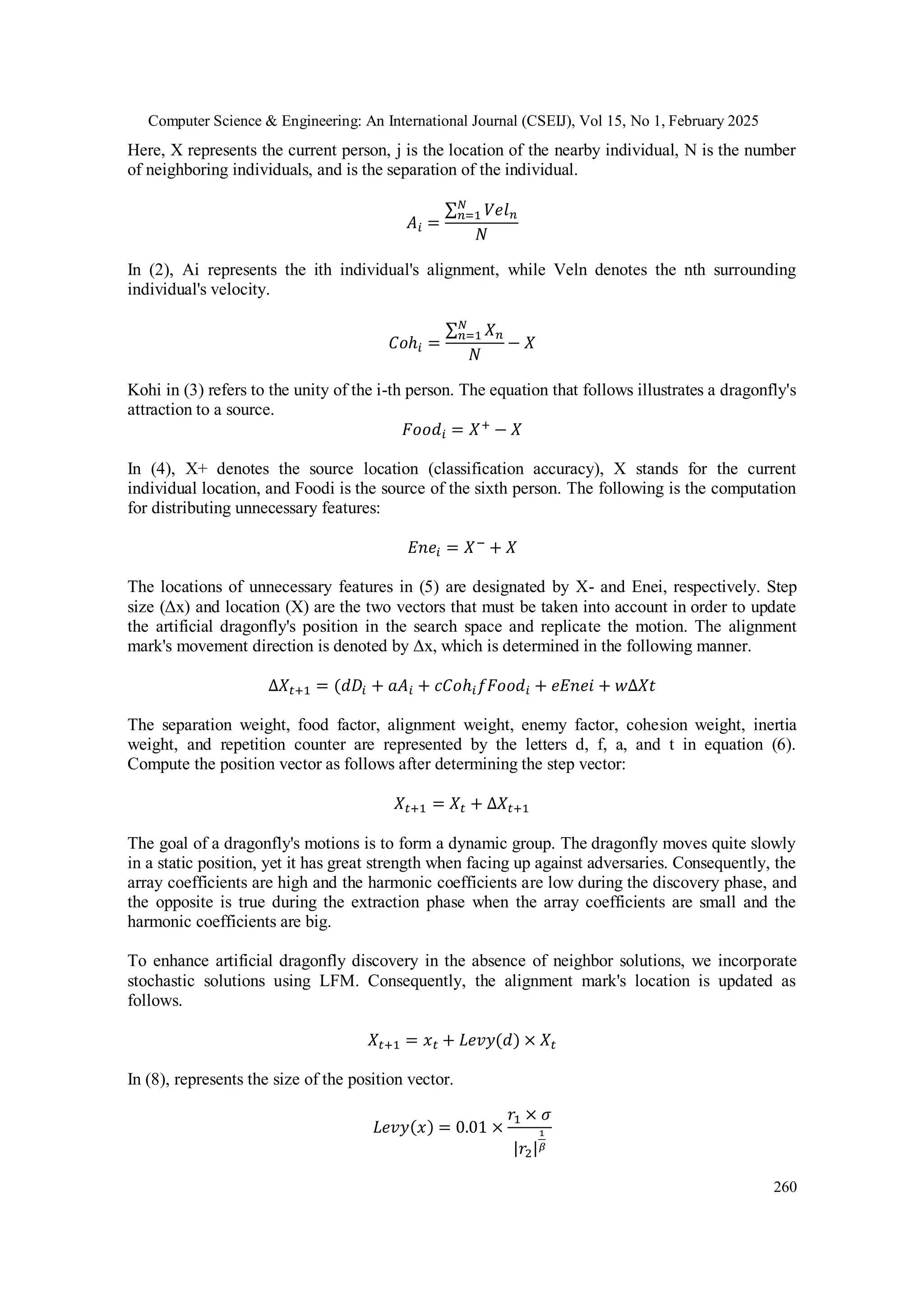
make up the overall structure. Figure 4 illustrates the DenseNet architecture for lung cancer
detection utilizing pictures from histology and chest CT scans.](https://image.slidesharecdn.com/15125cseij29-251015035512-5e86f7a8/75/Lung-Cancer-Classification-using-Densenet-Multi-Model-Optimization-Techniques-9-2048.jpg)
![Computer Science & Engineering: An International Journal (CSEIJ), Vol 15, No 1, February 2025
265
4. RESULTS AND DISCUSSION
We then evaluated the performance of the best pipeline, consisting of a FIFB network, for nodule
growth detection. A forecast is considered accurate if the diameter difference between the
expected and actual nodules has the same sign[15]. Consequently, we obtained an F1 score of
0.90, a recall of 0.92, and an accuracy of 0.88 out of 36 properly classified instances. The
confusion matrix is seen in the picture.
Figure 4. Confusion matrix for validation data (histopathological images): (a) DenseNet, (b) AlexNet, (c)
SqueezeNet.
4.1. Preprocessing
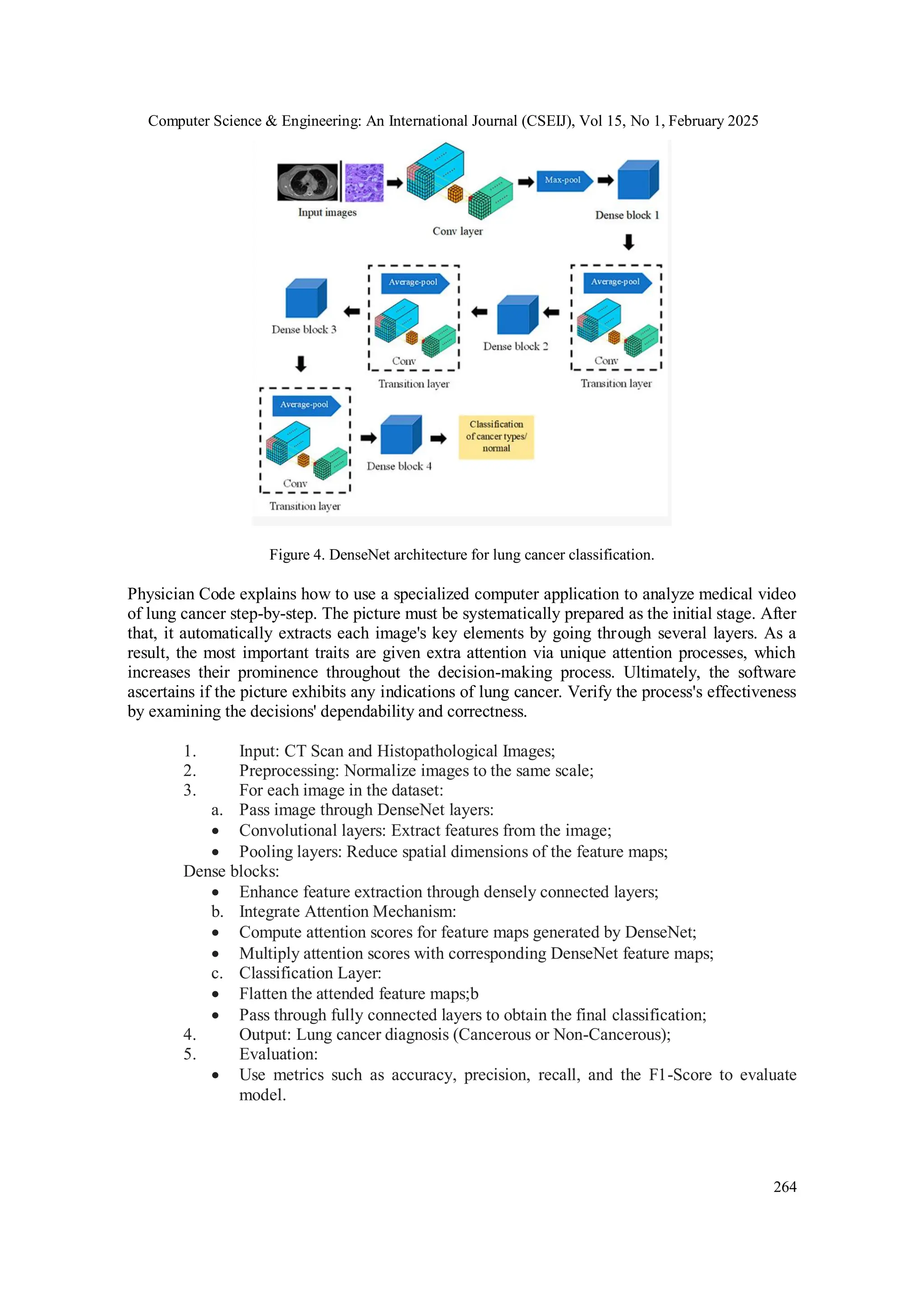
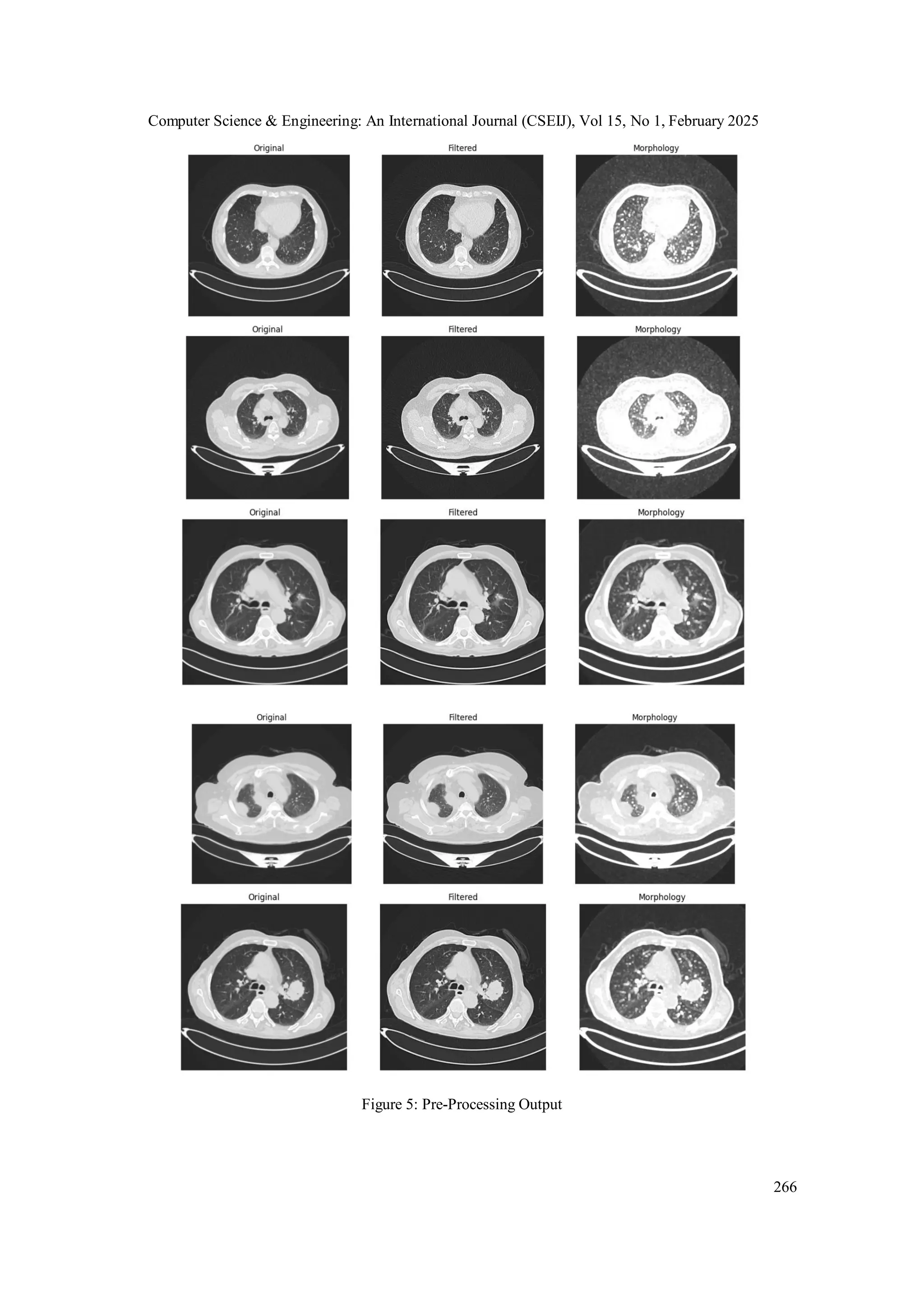
Sometimes the device takes pictures with low contrast and brightness, which might have an
impact on the surrounding area because of issues with the imaging structure and lighting. At this
stage, we produce pictures that more accurately depict the characteristics by applying image
upscaling algorithms. In order to do this, we sharpen the edges, boost contrast, and apply noise
filtering to the image. The comparative photographs' initial and enhanced iterations are displayed
in the table, accordingly.](https://image.slidesharecdn.com/15125cseij29-251015035512-5e86f7a8/75/Lung-Cancer-Classification-using-Densenet-Multi-Model-Optimization-Techniques-11-2048.jpg)
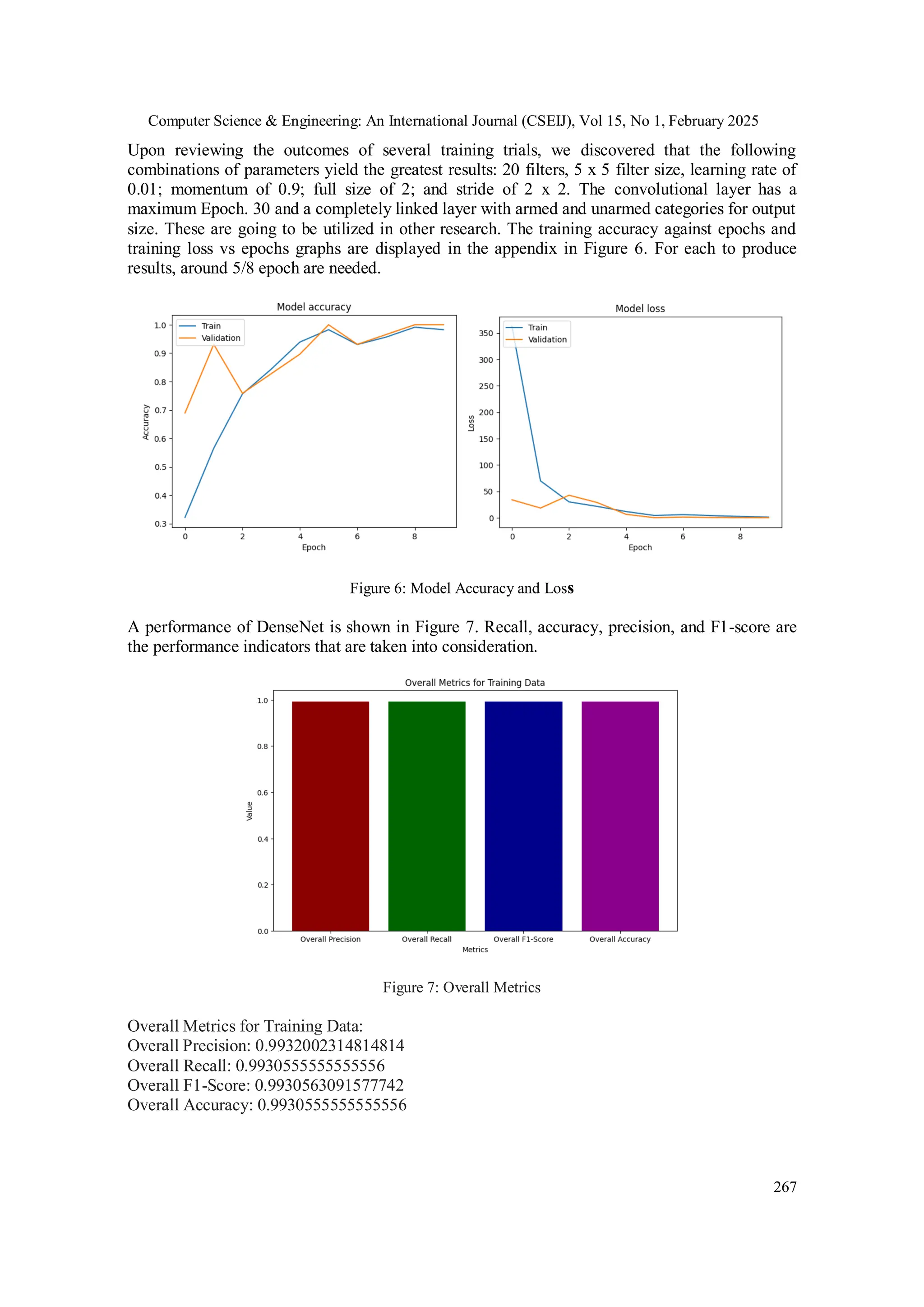
![Computer Science & Engineering: An International Journal (CSEIJ), Vol 15, No 1, February 2025
268
5. CONCLUSION
In this work, we propose to predict and categorize lung cancer by segmenting and interpreting
human lung CT images using DenseNet generation. To eliminate extraneous noise from the input
image, preprocessing methods like contrast enhancement and filtering may be taken into
consideration. After that, it is divided up using optimization methods like Otsu Thres holding.
The suggested classifier and DenseNet have been combined. In this work, we utilize the
suggested approach to identify lung cancer in CT scans of humans in order to construct the
DenseNet lung cancer prediction model. We utilize performance matrices like F_Measure,
Specificity, Sensitivity, Precision, Recall, and Recall in order to execute the suggested method in
MATLAB. This method's results were 99.5, 93.5, 95.5, 95.5, and 93.5 for accuracy, sensitivity,
specificity, and recall, respectively.
REFERENCES
[1] Uddin, J. Attention-Based DenseNet for Lung Cancer Classification Using CT Scan and
Histopathological Images. Designs 2024, 8, 27. https://doi.org/10.3390/designs8020027
[2] Tang, W.; Sun, J.; Wang, S.; Zhang, Y. Review of AlexNet for Medical Image
Classification. arXiv 2023, arXiv:2311.08655.
[3] Sethy, P.K.; Geetha Devi, A.; Padhan, B.; Behera, S.K.; Sreedhar, S.; Das, K. Lung Cancer
Histopathological Image Classification Using Wavelets and AlexNet. J. X-ray Sci.
Technol. 2023, 31, 211–221.
[4] Habib, M.A.; Zhou, H.; Iturria-Rivera, P.E.; Elsayed, M.; Bavand, M.; Gaigalas, R.; Ozcan, Y.;
Erol-Kantarci, M. Hierarchical Reinforcement Learning Based Traffic Steering in Multi-RAT 5G
Deployments. In Proceedings of the ICC 2023-IEEE International Conference on Communications,
Rome, Italy, 28 May–1 June 2023; pp. 100–105.
[5] Habib, M.A.; Zhou, H.; Iturria-Rivera, P.E.; Elsayed, M.; Bavand, M.; Gaigalas, R.; Furr, S.; Erol-
Kantarci, M. Traffic Steering for 5G Multi-RAT Deployments Using Deep Reinforcement Learning.
In Proceedings of the 2023 IEEE 20th Consumer Communications & Networking Conference
(CCNC), Las Vegas, NV, USA, 8–11 January 2023; pp. 164–169.
[6] Rajasekar, V.; Vaishnnave, M.P.; Premkumar, S.; Sarveshwaran, V.; Rangaraaj, V. Lung Cancer
Disease Prediction with CT Scan and Histopathological Images Feature Analysis Using Deep
Learning Techniques. Results Eng. 2023, 18, 101111.
[7] Raman, R.; Gupta, N.; Jeppu, Y. Framework for formal verification of machine learning based
complex system-of-Systems. Insight 2023, 26, 91–102.
[8] Ahmed, A.A.; Fawi, M.; Brychcy, A.; Abouzid, M.; Witt, M.; Kaczmarek, E. Development and
Validation of a Deep Learning Model for Histopathological Slide Analysis in Lung Cancer
Diagnosis. Cancers 2024, 16, 1506.
[9] Naseer, I.; Masood, T.; Akram, S.; Jaffar, A.; Rashid, M.; Iqbal, M.A. Lung Cancer Detection Using
Modified AlexNet Architecture and Support Vector Machine. Comput. Mater. Contin. 2023, 74,
2039–2054.
[10] Pradhan, M.; Sahu, R.K. Automatic detection of lung cancer using the potential of artificial
intelligence (ai). In Machine Learning and AI Techniques in Interactive Medical Image Analysis;
IGI Global: Hershey, PA, USA, 2023; pp. 106–123.
[11] Huang, P.; Li, C.; He, P.; Xiao, H.; Ping, Y.; Feng, P.; Tian, S.; Chen, H.; Mercaldo, F.; Santone,
A.; et al. MamlFormer: Priori-experience Guiding Transformer Network via Manifold Adversarial
Multi-modal Learning for Laryngeal Histopathological Grading. Inf. Fusion 2024, 102333.
[12] Kumar, Y.; Koul, A.; Singla, R.; Ijaz, M.F. Artificial intelligence in disease diagnosis: A systematic
literature review, synthesizing framework and future research agenda. J. Ambient Intell. Humaniz.
Comput. 2023, 14, 8459–8486.
[13] Al-Antari, M.A. Artificial intelligence for medical diagnostics—existing and future aI
technology! Diagnostics 2023, 13, 688.
[14] Ukwuoma, C.C.; Qin, Z.; Heyat, M.B.B.; Akhtar, F.; Bamisile, O.; Muaad, A.Y.; Addo, D.; Al-
Antari, M.A. A hybrid explainable ensemble transformer encoder for pneumonia identification from
chest X-ray images. J. Adv. Res. 2023, 48, 191–211.](https://image.slidesharecdn.com/15125cseij29-251015035512-5e86f7a8/75/Lung-Cancer-Classification-using-Densenet-Multi-Model-Optimization-Techniques-14-2048.jpg)
![Computer Science & Engineering: An International Journal (CSEIJ), Vol 15, No 1, February 2025
269
[15] Pradhan, M.; Sahu, R.K. Automatic detection of lung cancer using the potential of artificial
intelligence (ai). In Machine Learning and AI Techniques in Interactive Medical Image Analysis;
IGI Global: Hershey, PA, USA, 2023; pp. 106–123.](https://image.slidesharecdn.com/15125cseij29-251015035512-5e86f7a8/75/Lung-Cancer-Classification-using-Densenet-Multi-Model-Optimization-Techniques-15-2048.jpg)


