Auxochrome – any group which does not itself act as chromophore
but its presence brings about a shift of absorption bands towards
red end of the spectrum
Auxochrome when combined with chromophore, modifies the
position of absorption band relative to the parent chromophore
Chromophore + Auxochrome
New Chromophore
having higher λmax
Examples: -OH, -OR, -NH2 , -NHR, -NR2, -SH etc.
Instrumentation
Solvent- Should not absorb in the region under investigation
Solvent
1 mg sample 100ml
Solvents - ethanol, n-hexane, Benzene, Methyl alcohol, diethyl
ether etc.
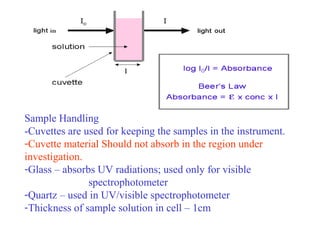
Sample Handling
-Cuvettes are used for keeping the samples in the instrument.
-Cuvette material Should not absorb in the region under
investigation.
-Glass – absorbs UV radiations; used only for visible
spectrophotometer
-Quartz – used in UV/visible spectrophotometer
-Thickness of sample solution in cell – 1cm
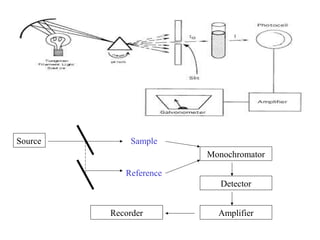
Source Sample
Reference
Monochromator
Detector
AmplifierRecorder
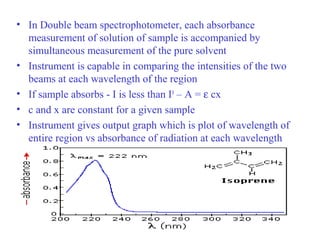
• In Double beam spectrophotometer, each absorbance
measurement of solution of sample is accompanied by
simultaneous measurement of the pure solvent
• Instrument is capable in comparing the intensities of the two
beams at each wavelength of the region
• If sample absorbs - I is less than I0
– A = ε cx
• c and x are constant for a given sample
• Instrument gives output graph which is plot of wavelength of
entire region vs absorbance of radiation at each wavelength
Applications-
• Extent of conjugation- extent of conjugation in polyenes can be
estimated. Addition of unsaturation shifts the absorption towards
longer wavelength.
• Distinction between conjugated and non-conjugated compounds-
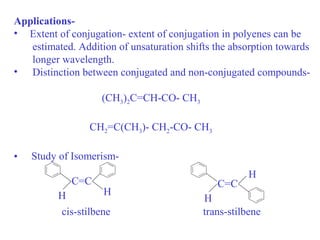
(CH3)2C=CH-CO- CH3
CH2=C(CH3)- CH2-CO- CH3
• Study of Isomerism-
C=C
HH
C=C
H
H
cis-stilbene trans-stilbene
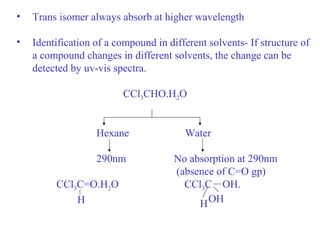
• Trans isomer always absorb at higher wavelength
• Identification of a compound in different solvents- If structure of
a compound changes in different solvents, the change can be
detected by uv-vis spectra.
CCl3CHO.H2O
Hexane Water
290nm No absorption at 290nm
(absence of C=O gp)
CCl3C=O.H2O CCl3C OH.
OHH H
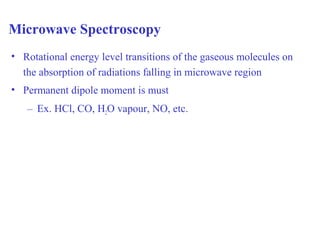
Microwave Spectroscopy
• Rotational energy level transitions of the gaseous molecules on
the absorption of radiations falling in microwave region
• Permanent dipole moment is must
– Ex. HCl, CO, H2O vapour, NO, etc.
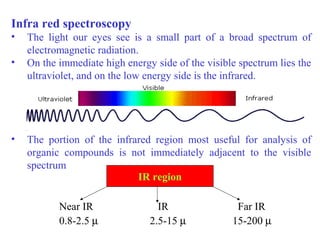
Infra red spectroscopy
• The light our eyes see is a small part of a broad spectrum of
electromagnetic radiation.
• On the immediate high energy side of the visible spectrum lies the
ultraviolet, and on the low energy side is the infrared.
• The portion of the infrared region most useful for analysis of
organic compounds is not immediately adjacent to the visible
spectrum
IR region
Near IR IR Far IR
0.8-2.5 µ 2.5-15 µ 15-200 µ
• Photon energies associated with infrared region are not large
enough to excite electrons, but may induce vibrational excitation
of covalently bonded atoms and groups.
• Absorption of IR radiations can be expressed in terms of
wavelength or wave number (ν) –preferred
ν = 1 / λ in cm
for ex.
λ = 2.5 µ = 2.5 x 10⁻⁴
cm
ν in cm-1
= 10,000 / λ in µ
NIR IR FIR
0.8 µ 2.5 µ 15 µ 200 µ
NIR IR FIR
0.8 µ 2.5 µ 15 µ 200 µ
12,500 4000 667 50 cm-1
λ
ν
• Change in intensity
Absorbance
Transmittance (preferred)
A = log (1 / T)
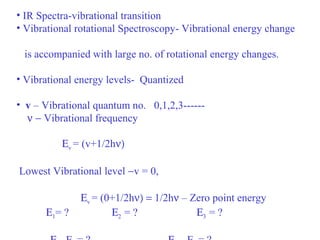
• IR Spectra-vibrational transition
• Vibrational rotational Spectroscopy- Vibrational energy change
is accompanied with large no. of rotational energy changes.
• Vibrational energy levels- Quantized
• v – Vibrational quantum no. 0,1,2,3------
ν − Vibrational frequency
Εv = (v+1/2hν)
Lowest Vibrational level −v = 0,
Εv = (0+1/2hν) = 1/2hν – Zero point energy
Ε1= ? Ε2 = ? Ε3 = ?
Ε1= 3/2 hν Ε2 = 5/2 hν Ε3 = 7/2 hν
Ε2- E1 = hν Ε1 – E0 = hν
All the vibrational energy levels are equally spaced by an spacing of hν
∆ v = + 1
∆ v = + 1 - Opertaive part
• The covalent bonds in molecules are not rigid sticks or rods, such as
found in molecular model kits, but are more like stiff springs that can
be stretched and bent.
• molecules- consisting of balls (atoms) of different sizes tied with
springs (bonds) of varying strength.
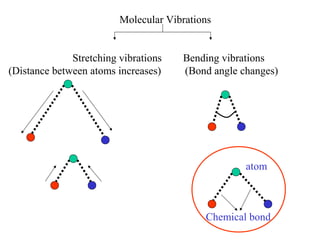
atom
Chemical bond
Molecular Vibrations
Stretching vibrations Bending vibrations
(Distance between atoms increases) (Bond angle changes)
atom
Chemical bond
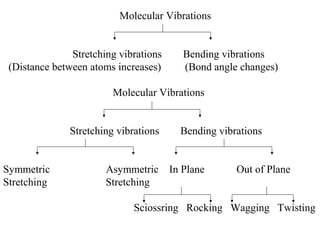
Molecular Vibrations
Stretching vibrations Bending vibrations
(Distance between atoms increases) (Bond angle changes)
Molecular Vibrations
Stretching vibrations Bending vibrations
Symmetric Asymmetric In Plane Out of Plane
Stretching Stretching
Sciossring Rocking Wagging Twisting
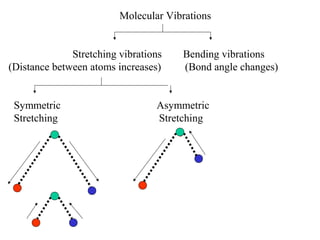
Molecular Vibrations
Stretching vibrations Bending vibrations
(Distance between atoms increases) (Bond angle changes)
Symmetric Asymmetric
Stretching Stretching
5
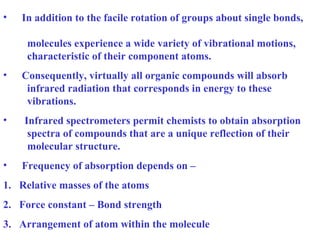
• In addition to the facile rotation of groups about single bonds,
molecules experience a wide variety of vibrational motions,
characteristic of their component atoms.
• Consequently, virtually all organic compounds will absorb
infrared radiation that corresponds in energy to these
vibrations.
• Infrared spectrometers permit chemists to obtain absorption
spectra of compounds that are a unique reflection of their
molecular structure.
• Frequency of absorption depends on –
1. Relative masses of the atoms
2. Force constant – Bond strength
3. Arrangement of atom within the molecule
Frequency of absorption - Calculation – Hook’s Law
ν= 1/2π √f/µ
f – Force constant
µ− Reduced mass
µ= m1 m2 / m1+m2
If Bond Strength increases vibrational frequency
or increases
Reduced mass decreases
If Bond Strength decreases vibrational frequency
or decreases
Reduced mass increases

IR spect

  • 1.
    Auxochrome – anygroup which does not itself act as chromophore but its presence brings about a shift of absorption bands towards red end of the spectrum Auxochrome when combined with chromophore, modifies the position of absorption band relative to the parent chromophore Chromophore + Auxochrome New Chromophore having higher λmax Examples: -OH, -OR, -NH2 , -NHR, -NR2, -SH etc.
  • 2.
    Instrumentation Solvent- Should notabsorb in the region under investigation Solvent 1 mg sample 100ml Solvents - ethanol, n-hexane, Benzene, Methyl alcohol, diethyl ether etc.
  • 3.
    Sample Handling -Cuvettes areused for keeping the samples in the instrument. -Cuvette material Should not absorb in the region under investigation. -Glass – absorbs UV radiations; used only for visible spectrophotometer -Quartz – used in UV/visible spectrophotometer -Thickness of sample solution in cell – 1cm
  • 4.
  • 5.
    • In Doublebeam spectrophotometer, each absorbance measurement of solution of sample is accompanied by simultaneous measurement of the pure solvent • Instrument is capable in comparing the intensities of the two beams at each wavelength of the region • If sample absorbs - I is less than I0 – A = ε cx • c and x are constant for a given sample • Instrument gives output graph which is plot of wavelength of entire region vs absorbance of radiation at each wavelength
  • 7.
    Applications- • Extent ofconjugation- extent of conjugation in polyenes can be estimated. Addition of unsaturation shifts the absorption towards longer wavelength. • Distinction between conjugated and non-conjugated compounds- (CH3)2C=CH-CO- CH3 CH2=C(CH3)- CH2-CO- CH3 • Study of Isomerism- C=C HH C=C H H cis-stilbene trans-stilbene
  • 8.
    • Trans isomeralways absorb at higher wavelength • Identification of a compound in different solvents- If structure of a compound changes in different solvents, the change can be detected by uv-vis spectra. CCl3CHO.H2O Hexane Water 290nm No absorption at 290nm (absence of C=O gp) CCl3C=O.H2O CCl3C OH. OHH H
  • 9.
    Microwave Spectroscopy • Rotationalenergy level transitions of the gaseous molecules on the absorption of radiations falling in microwave region • Permanent dipole moment is must – Ex. HCl, CO, H2O vapour, NO, etc.
  • 10.
    Infra red spectroscopy •The light our eyes see is a small part of a broad spectrum of electromagnetic radiation. • On the immediate high energy side of the visible spectrum lies the ultraviolet, and on the low energy side is the infrared. • The portion of the infrared region most useful for analysis of organic compounds is not immediately adjacent to the visible spectrum IR region Near IR IR Far IR 0.8-2.5 µ 2.5-15 µ 15-200 µ
  • 11.
    • Photon energiesassociated with infrared region are not large enough to excite electrons, but may induce vibrational excitation of covalently bonded atoms and groups. • Absorption of IR radiations can be expressed in terms of wavelength or wave number (ν) –preferred ν = 1 / λ in cm for ex. λ = 2.5 µ = 2.5 x 10⁻⁴ cm ν in cm-1 = 10,000 / λ in µ NIR IR FIR 0.8 µ 2.5 µ 15 µ 200 µ
  • 12.
    NIR IR FIR 0.8µ 2.5 µ 15 µ 200 µ 12,500 4000 667 50 cm-1 λ ν • Change in intensity Absorbance Transmittance (preferred) A = log (1 / T)
  • 14.
    • IR Spectra-vibrationaltransition • Vibrational rotational Spectroscopy- Vibrational energy change is accompanied with large no. of rotational energy changes. • Vibrational energy levels- Quantized • v – Vibrational quantum no. 0,1,2,3------ ν − Vibrational frequency Εv = (v+1/2hν) Lowest Vibrational level −v = 0, Εv = (0+1/2hν) = 1/2hν – Zero point energy Ε1= ? Ε2 = ? Ε3 = ?
  • 15.
    Ε1= 3/2 hνΕ2 = 5/2 hν Ε3 = 7/2 hν Ε2- E1 = hν Ε1 – E0 = hν All the vibrational energy levels are equally spaced by an spacing of hν ∆ v = + 1 ∆ v = + 1 - Opertaive part • The covalent bonds in molecules are not rigid sticks or rods, such as found in molecular model kits, but are more like stiff springs that can be stretched and bent. • molecules- consisting of balls (atoms) of different sizes tied with springs (bonds) of varying strength. atom Chemical bond
  • 16.
    Molecular Vibrations Stretching vibrationsBending vibrations (Distance between atoms increases) (Bond angle changes) atom Chemical bond
  • 17.
    Molecular Vibrations Stretching vibrationsBending vibrations (Distance between atoms increases) (Bond angle changes) Molecular Vibrations Stretching vibrations Bending vibrations Symmetric Asymmetric In Plane Out of Plane Stretching Stretching Sciossring Rocking Wagging Twisting
  • 18.
    Molecular Vibrations Stretching vibrationsBending vibrations (Distance between atoms increases) (Bond angle changes) Symmetric Asymmetric Stretching Stretching 5
  • 19.
    • In additionto the facile rotation of groups about single bonds, molecules experience a wide variety of vibrational motions, characteristic of their component atoms. • Consequently, virtually all organic compounds will absorb infrared radiation that corresponds in energy to these vibrations. • Infrared spectrometers permit chemists to obtain absorption spectra of compounds that are a unique reflection of their molecular structure. • Frequency of absorption depends on – 1. Relative masses of the atoms 2. Force constant – Bond strength 3. Arrangement of atom within the molecule
  • 20.
    Frequency of absorption- Calculation – Hook’s Law ν= 1/2π √f/µ f – Force constant µ− Reduced mass µ= m1 m2 / m1+m2 If Bond Strength increases vibrational frequency or increases Reduced mass decreases If Bond Strength decreases vibrational frequency or decreases Reduced mass increases