This document summarizes a study evaluating different multistage hydraulic fracturing patterns in naturally fractured reservoirs using a coupled geomechanics fracture and flow model. The study models three fracturing patterns - conventional, zipper, and alternating - in a field case with multiple horizontal wells. Simulation results show the zipper pattern provides the highest long-term production rates and cumulative oil volume over 20 years compared to the other patterns. The zipper pattern is recommended as the optimal completion strategy for this type of reservoir.
IPTC-18916-MS
Evaluation of MultistageHydraulic Fracturing Techniques for
Production Optimization in Naturally Fractured Reservoirs
Using Coupled Geomechanics Fracture and Flow Model
Theerapat Suppachoknirun, PTT Exploration and Production Plc.
Dr. Azra N. Tutuncu and Dr. Hossein Kazemi, Colorado School of Mines
2.
Introduction & Goal
Slide2
IPTC-18916-MS • Evaluation of Multistage Hydraulic Fracturing Techniques for Production Optimization in Naturally
Fractured Reservoirs Using Coupled Geomechanics Fracture and Flow Model • Theerapat Suppachoknirun
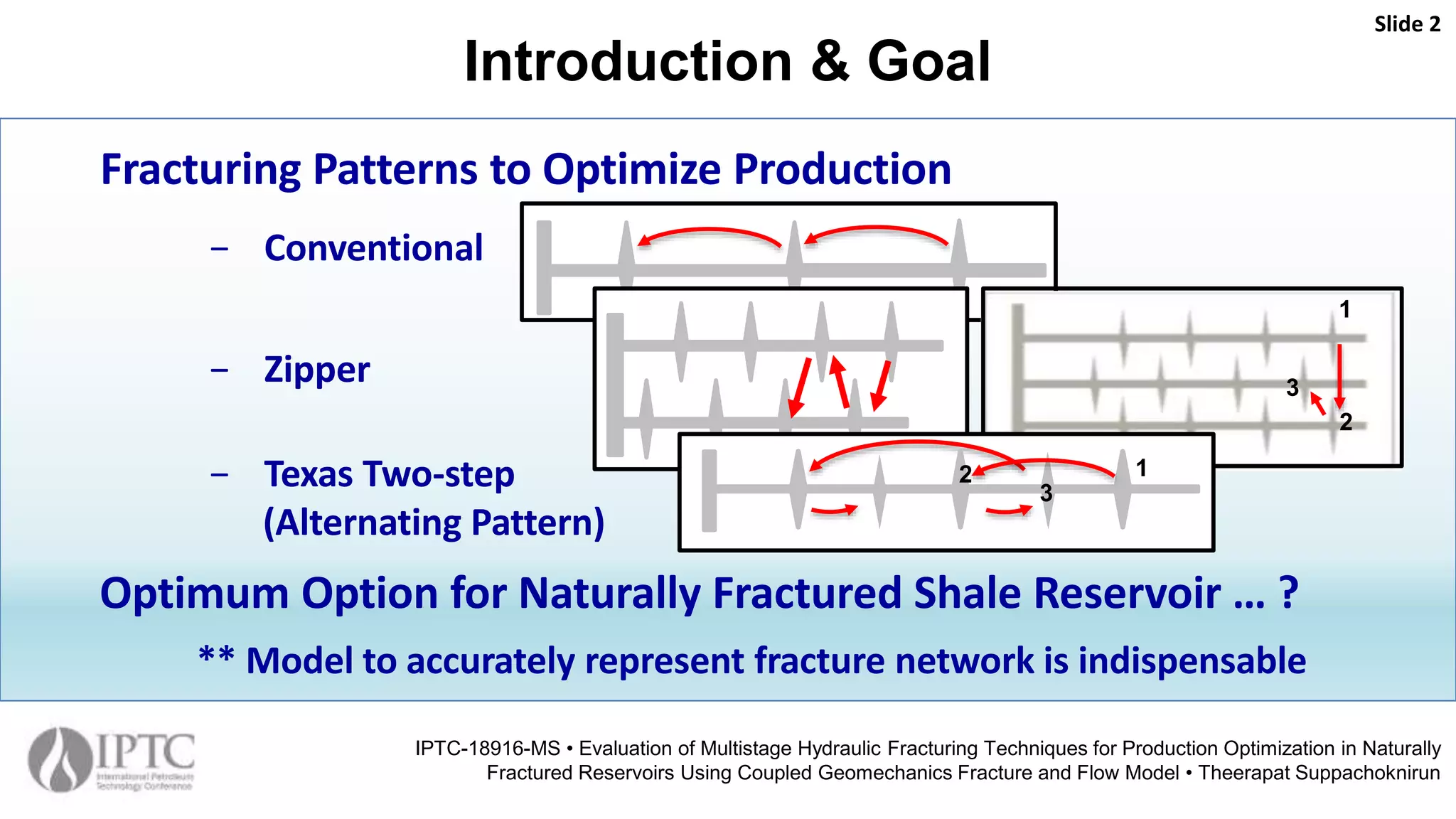
Fracturing Patterns to Optimize Production
− Conventional
− Zipper
− Texas Two-step
(Alternating Pattern)
Optimum Option for Naturally Fractured Shale Reservoir … ?
1
2
3
** Model to accurately represent fracture network is indispensable
12
3
3.
Presentation Outline
Slide 3
IPTC-18916-MS• Evaluation of Multistage Hydraulic Fracturing Techniques for Production Optimization in Naturally
Fractured Reservoirs Using Coupled Geomechanics Fracture and Flow Model • Theerapat Suppachoknirun
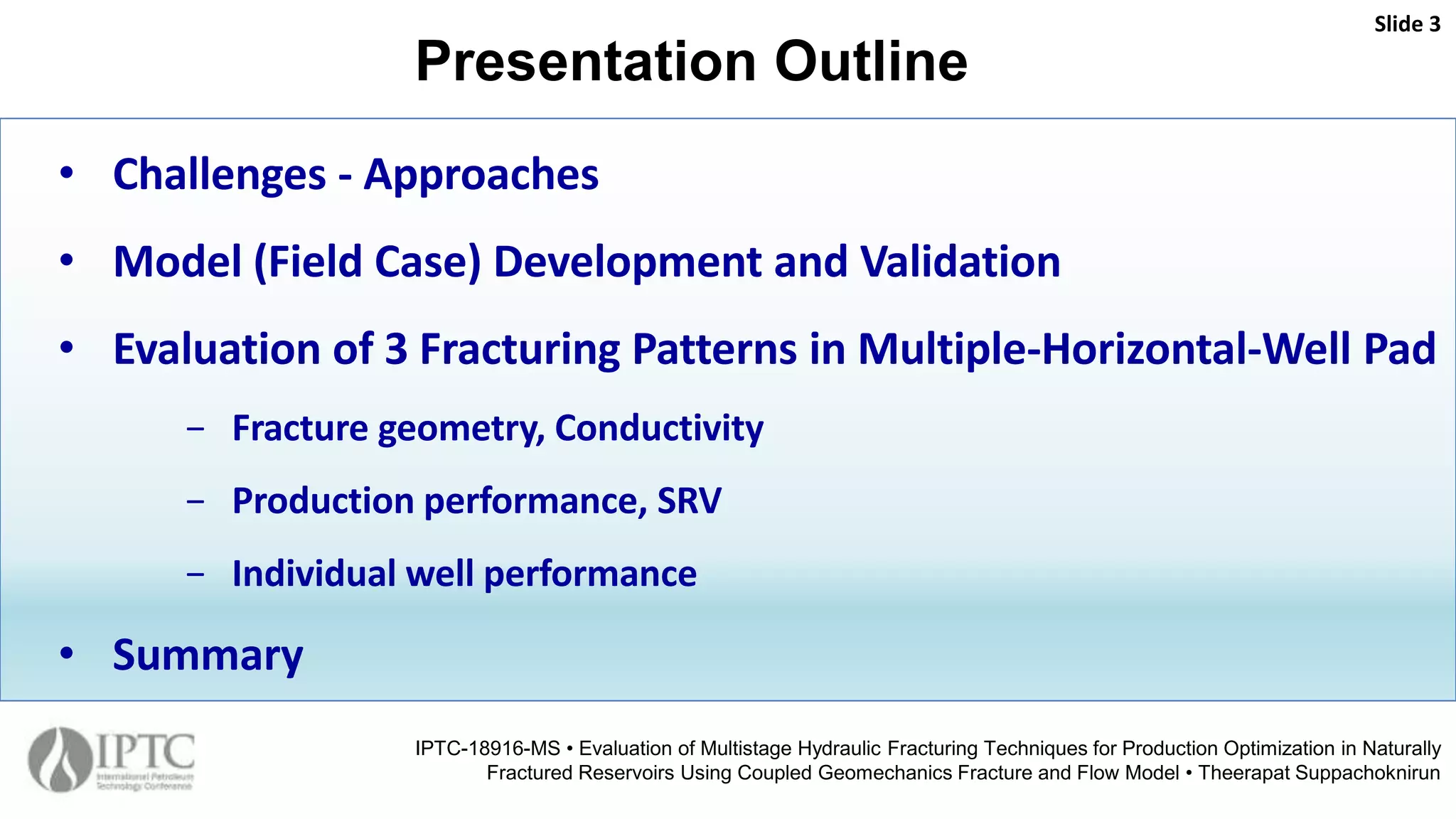
• Challenges - Approaches
• Model (Field Case) Development and Validation
• Evaluation of 3 Fracturing Patterns in Multiple-Horizontal-Well Pad
− Fracture geometry, Conductivity
− Production performance, SRV
− Individual well performance
• Summary
4.
Challenges and Approaches
Slide4
IPTC-18916-MS • Evaluation of Multistage Hydraulic Fracturing Techniques for Production Optimization in Naturally
Fractured Reservoirs Using Coupled Geomechanics Fracture and Flow Model • Theerapat Suppachoknirun
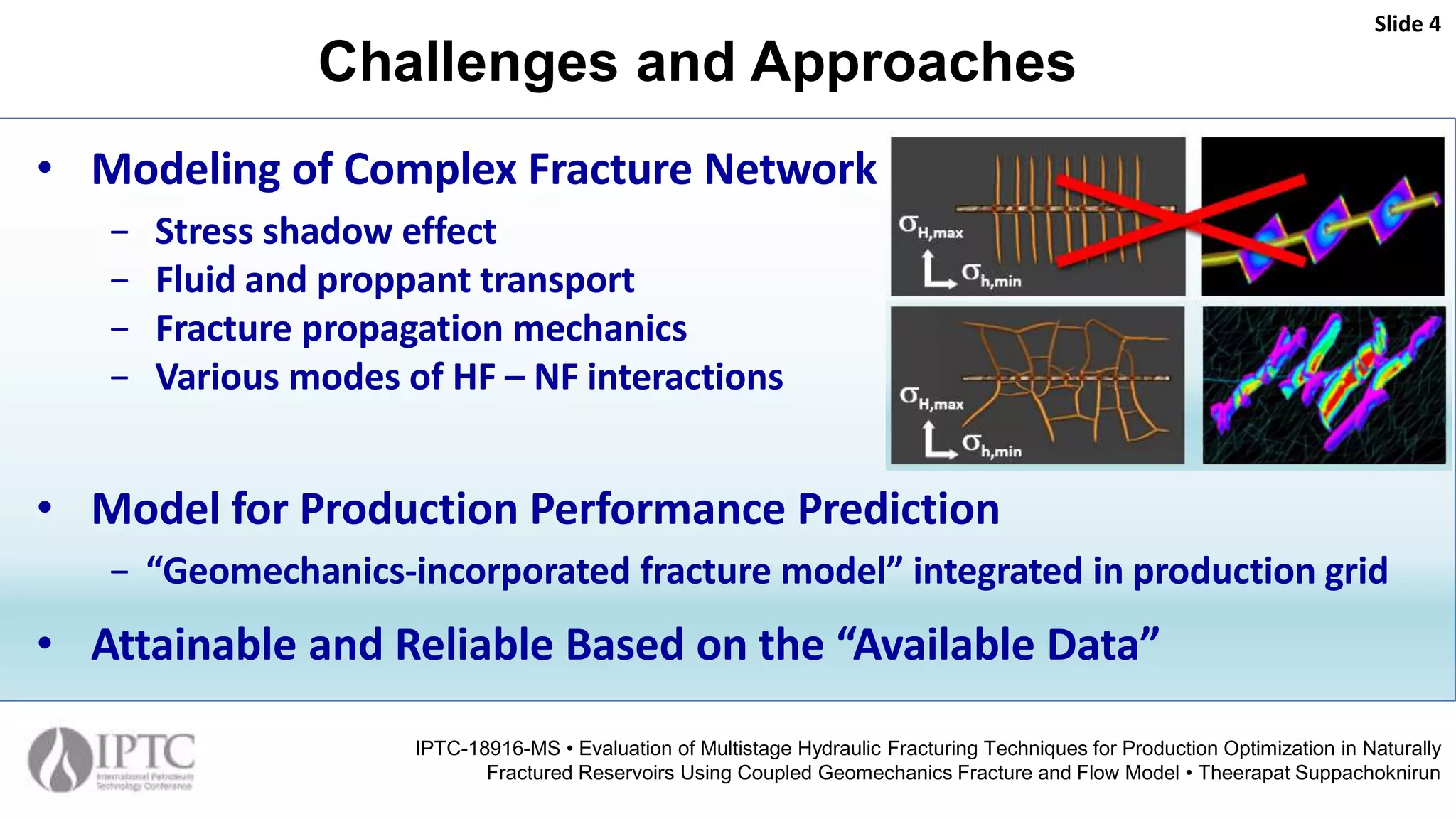
• Modeling of Complex Fracture Network
− Stress shadow effect
− Fluid and proppant transport
− Fracture propagation mechanics
− Various modes of HF – NF interactions
• Model for Production Performance Prediction
− “Geomechanics-incorporated fracture model” integrated in production grid
• Attainable and Reliable Based on the “Available Data”
5.
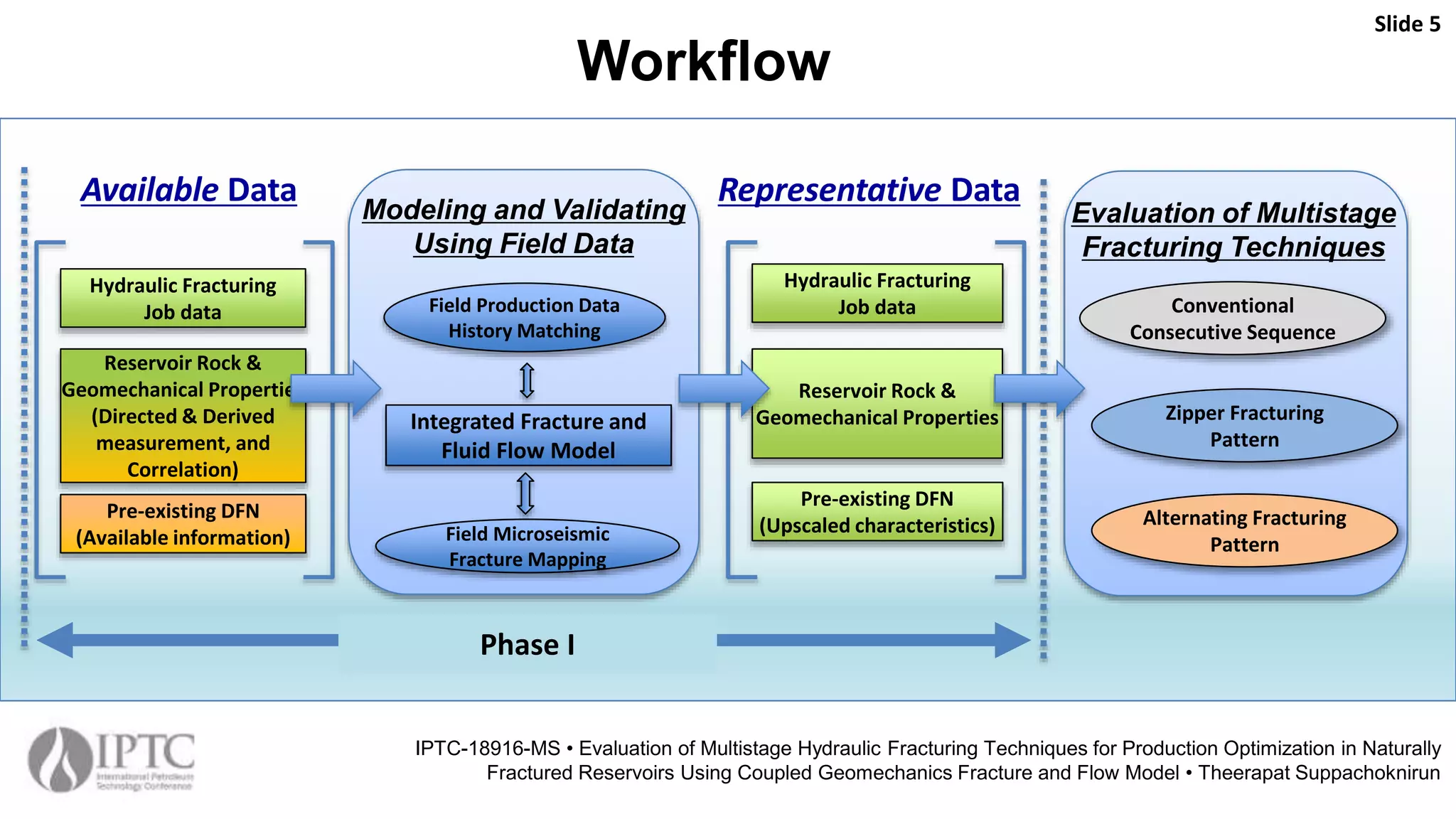
Workflow
Slide 5
IPTC-18916-MS •Evaluation of Multistage Hydraulic Fracturing Techniques for Production Optimization in Naturally
Fractured Reservoirs Using Coupled Geomechanics Fracture and Flow Model • Theerapat Suppachoknirun
Integrated Fracture and
Fluid Flow Model
Field Production Data
History Matching
Field Microseismic
Fracture Mapping
Evaluation of Multistage
Fracturing Techniques
Conventional
Consecutive Sequence
Zipper Fracturing
Pattern
Alternating Fracturing
Pattern
Modeling and Validating
Using Field Data
Phase I
Hydraulic Fracturing
Job data
Reservoir Rock &
Geomechanical Properties
Pre-existing DFN
(Upscaled characteristics)
Representative DataAvailable Data
Hydraulic Fracturing
Job data
Reservoir Rock &
Geomechanical Properties
(Directed & Derived
measurement, and
Correlation)
Pre-existing DFN
(Available information)
6.
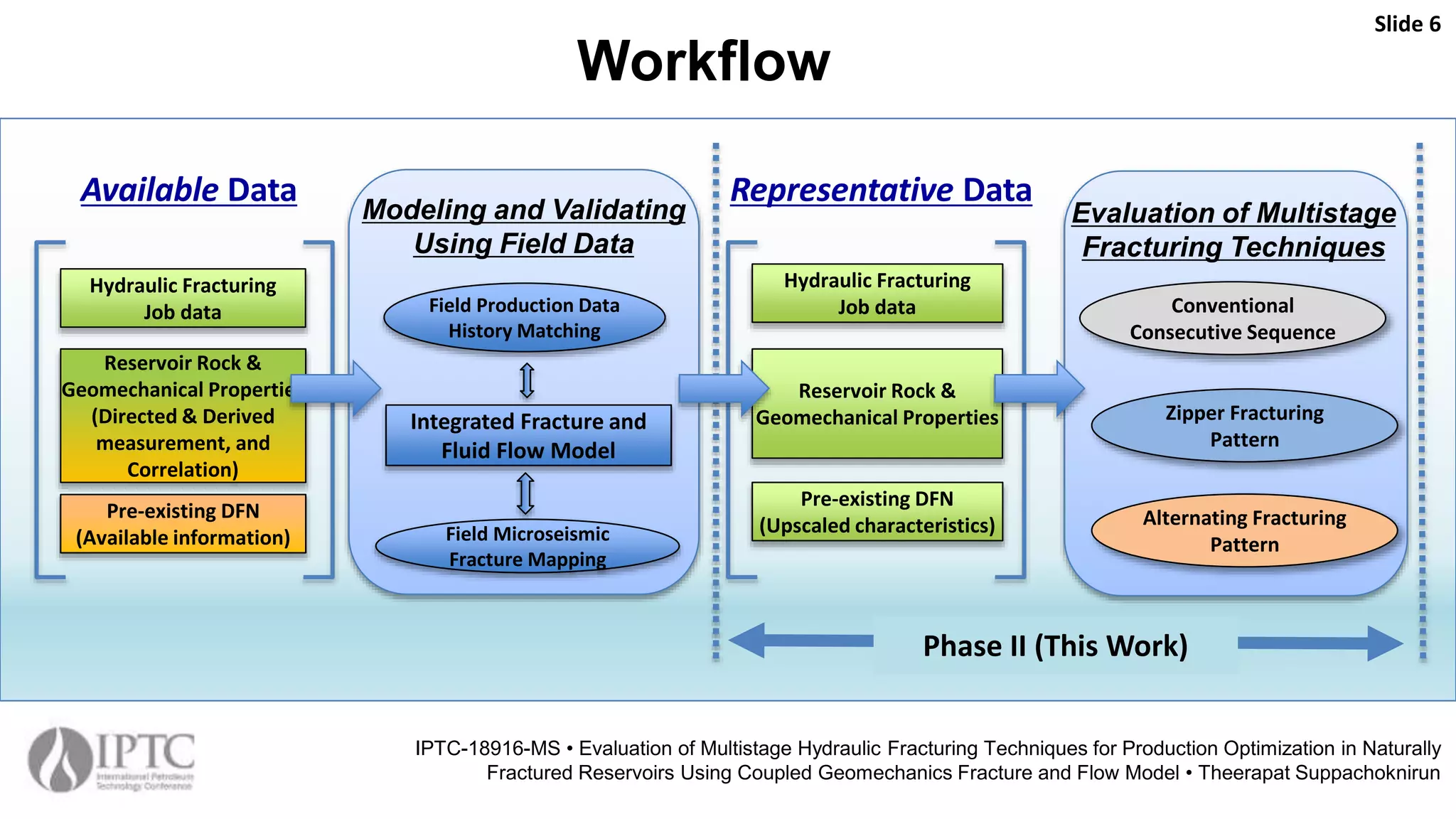
Workflow
Slide 6
IPTC-18916-MS •Evaluation of Multistage Hydraulic Fracturing Techniques for Production Optimization in Naturally
Fractured Reservoirs Using Coupled Geomechanics Fracture and Flow Model • Theerapat Suppachoknirun
Integrated Fracture and
Fluid Flow Model
Field Production Data
History Matching
Field Microseismic
Fracture Mapping
Evaluation of Multistage
Fracturing Techniques
Conventional
Consecutive Sequence
Zipper Fracturing
Pattern
Alternating Fracturing
Pattern
Modeling and Validating
Using Field Data
Hydraulic Fracturing
Job data
Reservoir Rock &
Geomechanical Properties
Pre-existing DFN
(Upscaled characteristics)
Available Data
Hydraulic Fracturing
Job data
Reservoir Rock &
Geomechanical Properties
(Directed & Derived
measurement, and
Correlation)
Pre-existing DFN
(Available information)
Phase II (This Work)
Representative Data
7.
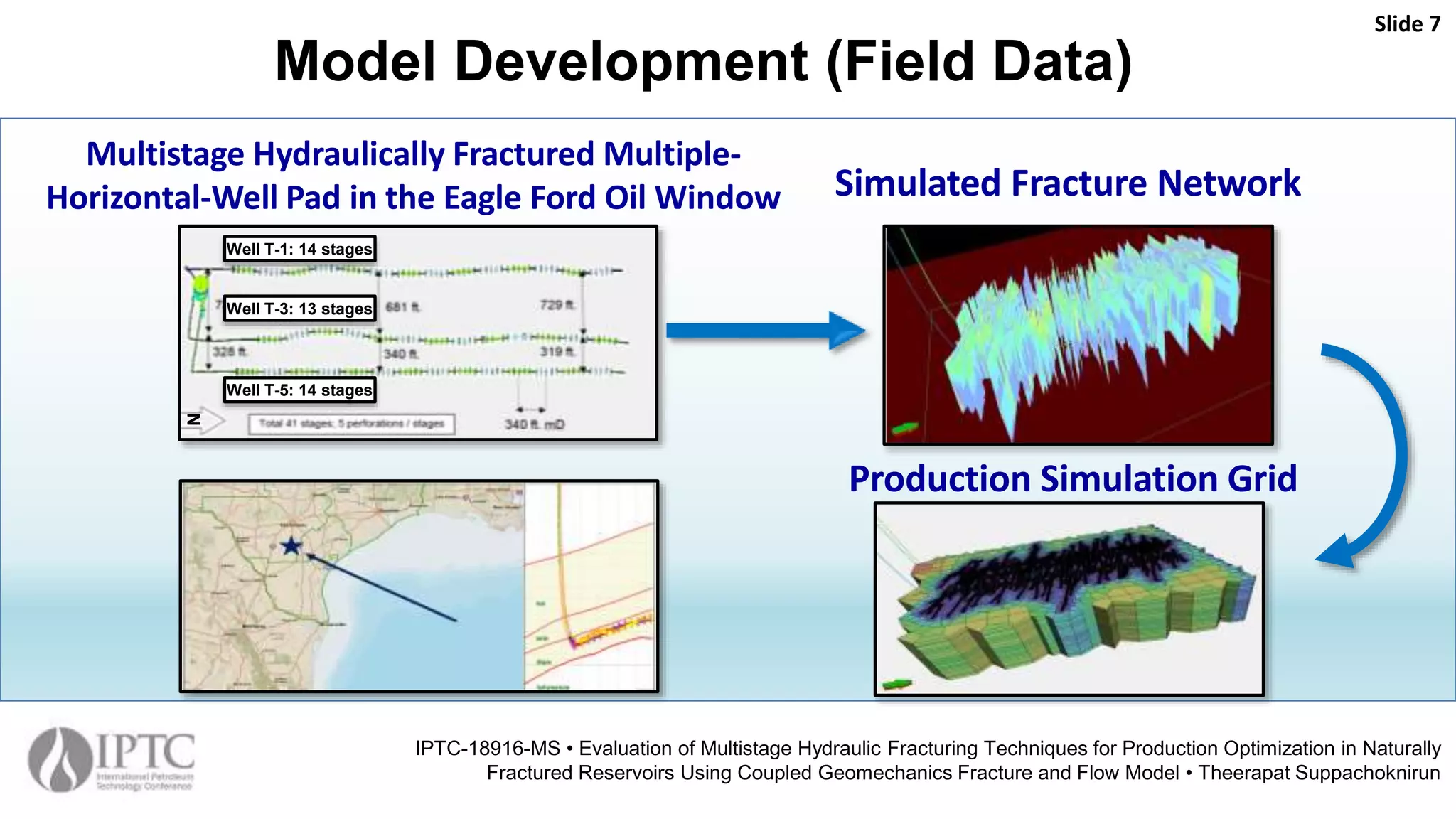
Model Development (FieldData)
Slide 7
IPTC-18916-MS • Evaluation of Multistage Hydraulic Fracturing Techniques for Production Optimization in Naturally
Fractured Reservoirs Using Coupled Geomechanics Fracture and Flow Model • Theerapat Suppachoknirun
Well T-1: 14 stages
Well T-3: 13 stages
Well T-5: 14 stages
N Simulated Fracture Network
Production Simulation Grid
Multistage Hydraulically Fractured Multiple-
Horizontal-Well Pad in the Eagle Ford Oil Window
8.
Model Validation: FieldData Matching
Slide 8
IPTC-18916-MS • Evaluation of Multistage Hydraulic Fracturing Techniques for Production Optimization in Naturally
Fractured Reservoirs Using Coupled Geomechanics Fracture and Flow Model • Theerapat Suppachoknirun
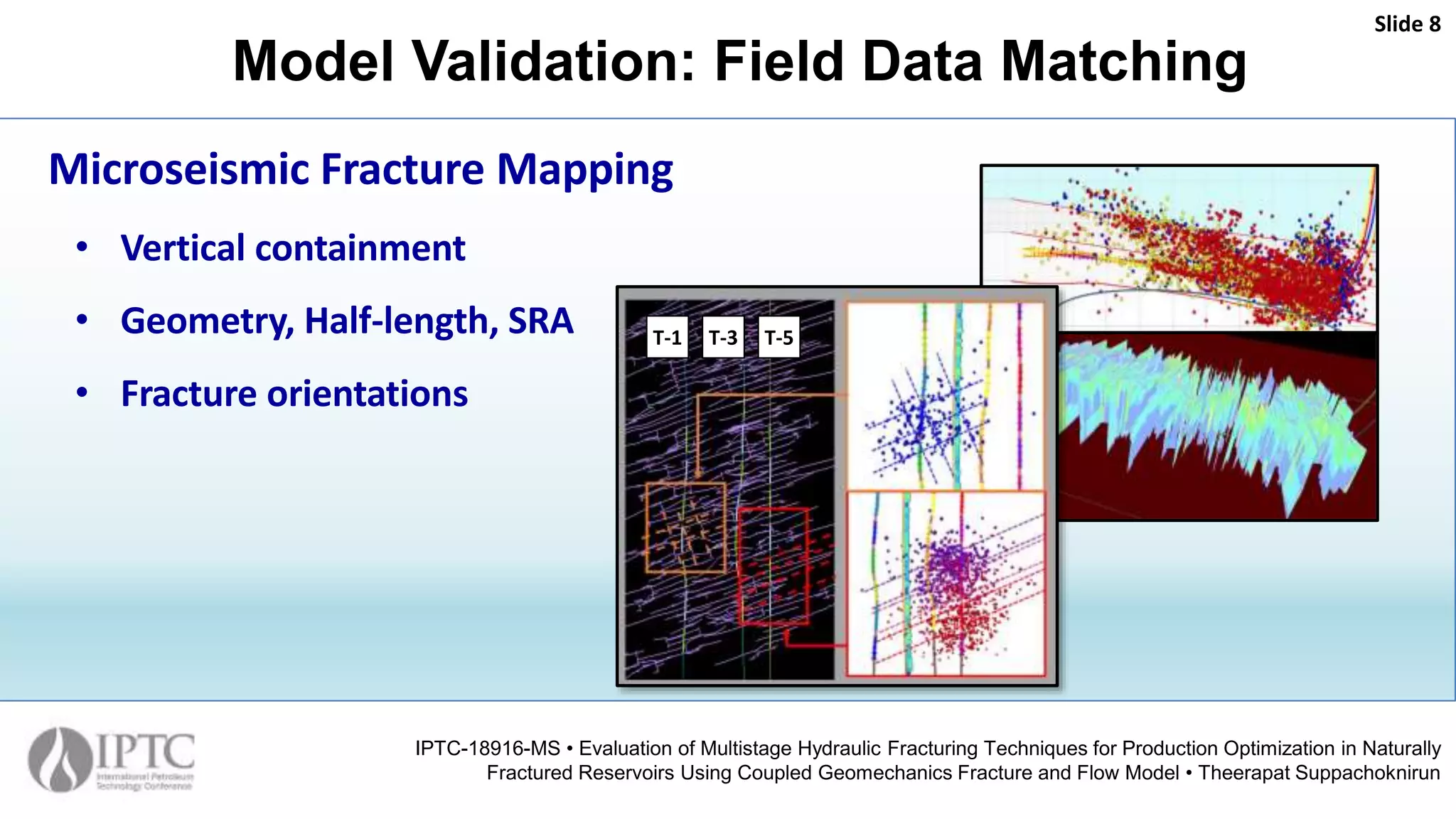
Microseismic Fracture Mapping
• Vertical containment
• Geometry, Half-length, SRA
• Fracture orientations
T-1 T-3 T-5
9.
Model Validation: FieldData Matching (cont.)
Slide 9
IPTC-18916-MS • Evaluation of Multistage Hydraulic Fracturing Techniques for Production Optimization in Naturally
Fractured Reservoirs Using Coupled Geomechanics Fracture and Flow Model • Theerapat Suppachoknirun
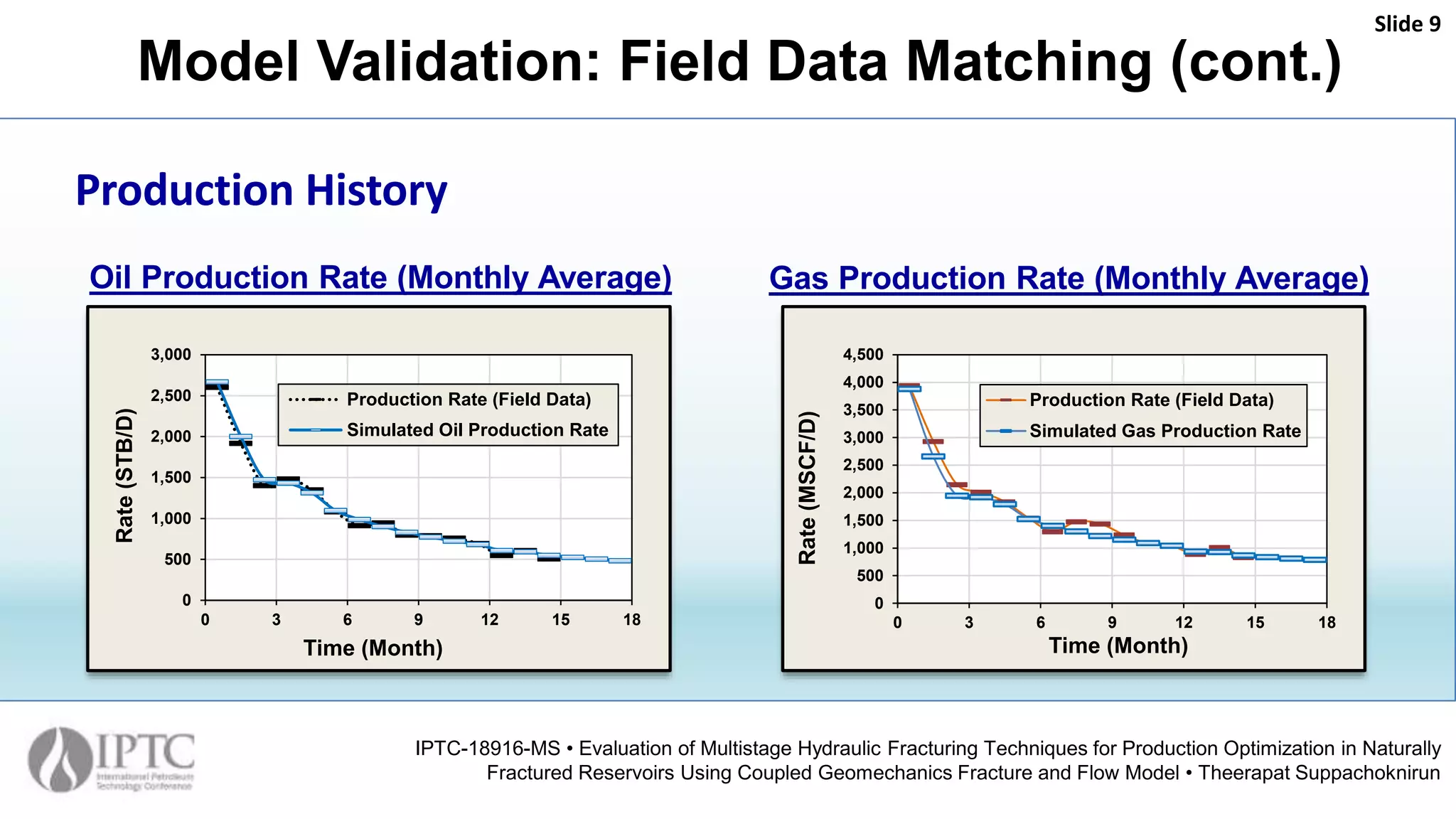
Production History
0
500
1,000
1,500
2,000
2,500
3,000
0 3 6 9 12 15 18
Rate(STB/D)
Time (Month)
Production Rate (Field Data)
Simulated Oil Production Rate
0
500
1,000
1,500
2,000
2,500
3,000
3,500
4,000
4,500
0 3 6 9 12 15 18
Rate(MSCF/D)
Time (Month)
Production Rate (Field Data)
Simulated Gas Production Rate
Oil Production Rate (Monthly Average) Gas Production Rate (Monthly Average)
10.
Simulation Case Study
Slide10
IPTC-18916-MS • Evaluation of Multistage Hydraulic Fracturing Techniques for Production Optimization in Naturally
Fractured Reservoirs Using Coupled Geomechanics Fracture and Flow Model • Theerapat Suppachoknirun
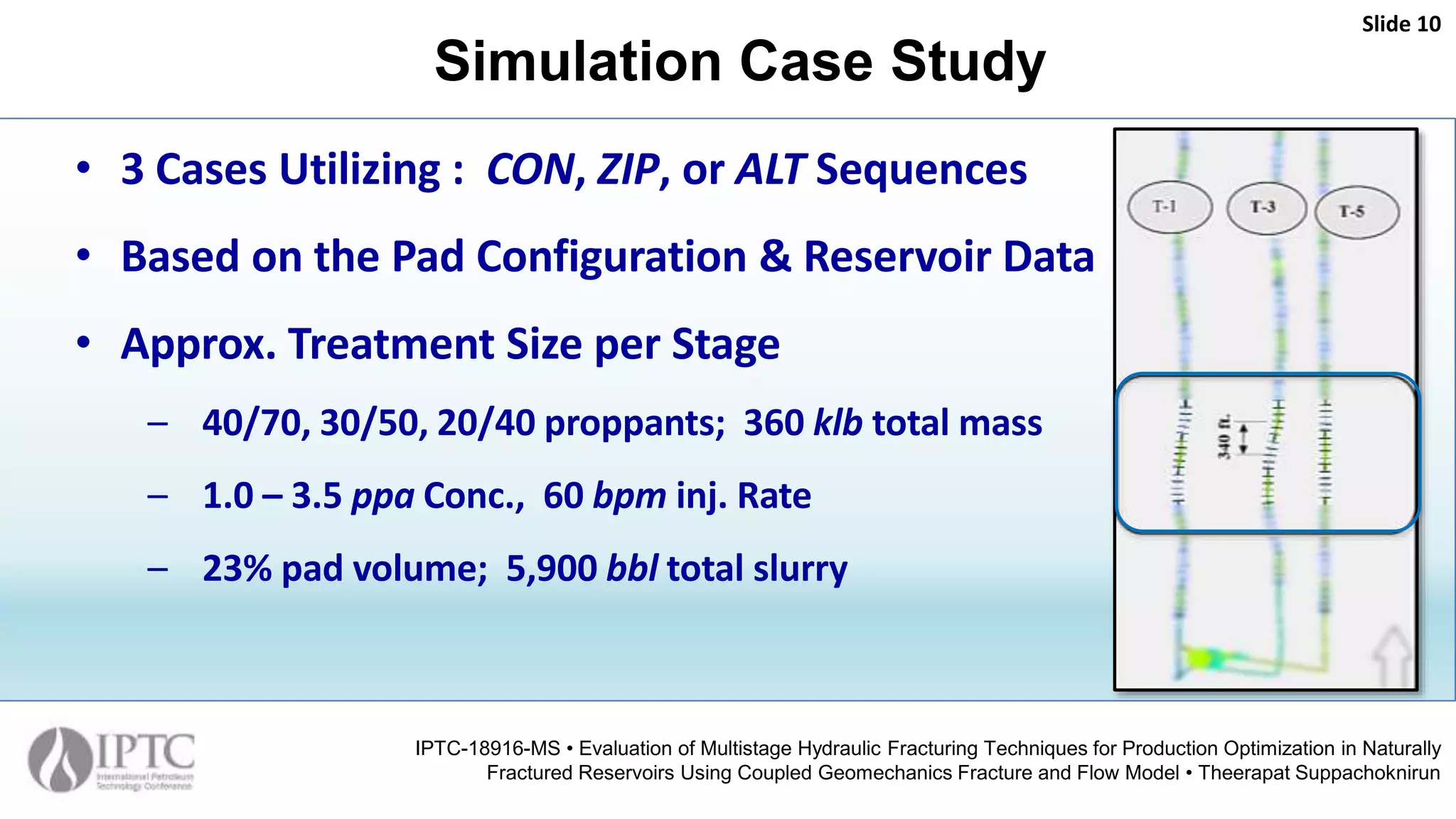
• 3 Cases Utilizing : CON, ZIP, or ALT Sequences
• Based on the Pad Configuration & Reservoir Data
• Approx. Treatment Size per Stage
– 40/70, 30/50, 20/40 proppants; 360 klb total mass
– 1.0 – 3.5 ppa Conc., 60 bpm inj. Rate
– 23% pad volume; 5,900 bbl total slurry
11.
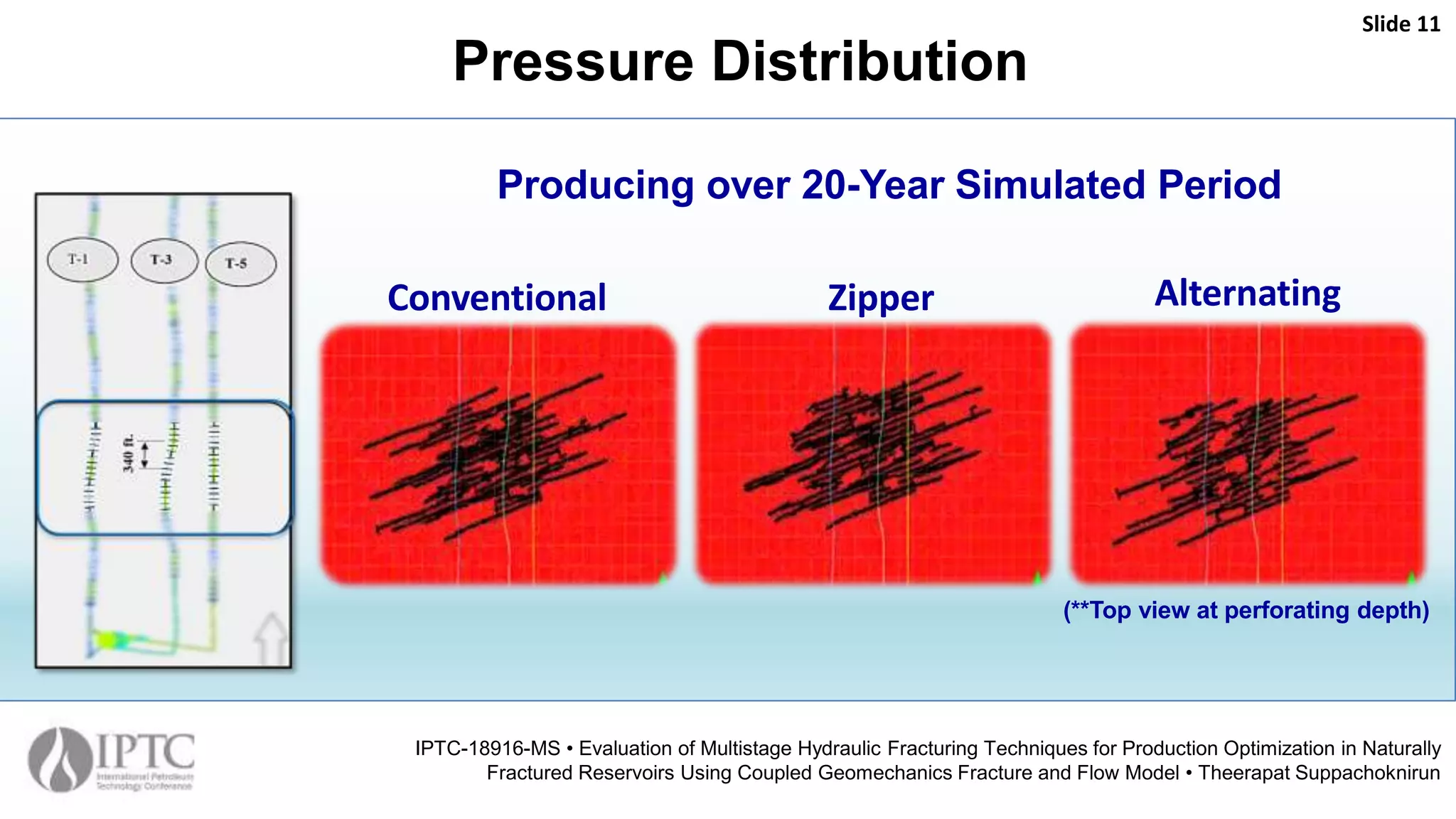
Pressure Distribution
Producing over20-Year Simulated Period
Slide 11
IPTC-18916-MS • Evaluation of Multistage Hydraulic Fracturing Techniques for Production Optimization in Naturally
Fractured Reservoirs Using Coupled Geomechanics Fracture and Flow Model • Theerapat Suppachoknirun
Conventional Zipper Alternating
(**Top view at perforating depth)
12.
Fracture Conductivity
Slide 12
IPTC-18916-MS• Evaluation of Multistage Hydraulic Fracturing Techniques for Production Optimization in Naturally
Fractured Reservoirs Using Coupled Geomechanics Fracture and Flow Model • Theerapat Suppachoknirun
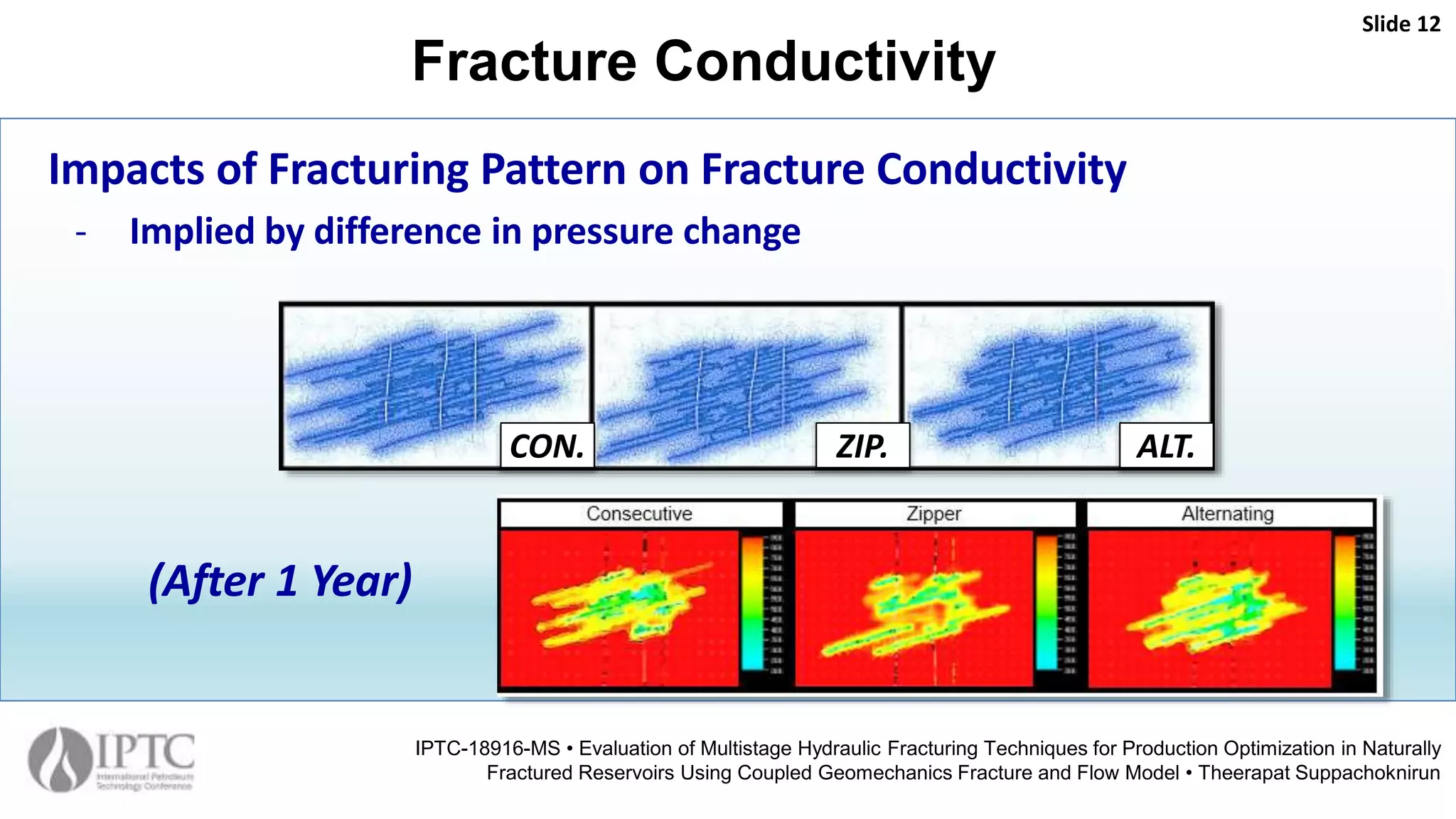
CON. ZIP. ALT.
(After 1 Year)
Impacts of Fracturing Pattern on Fracture Conductivity
- Implied by difference in pressure change
13.
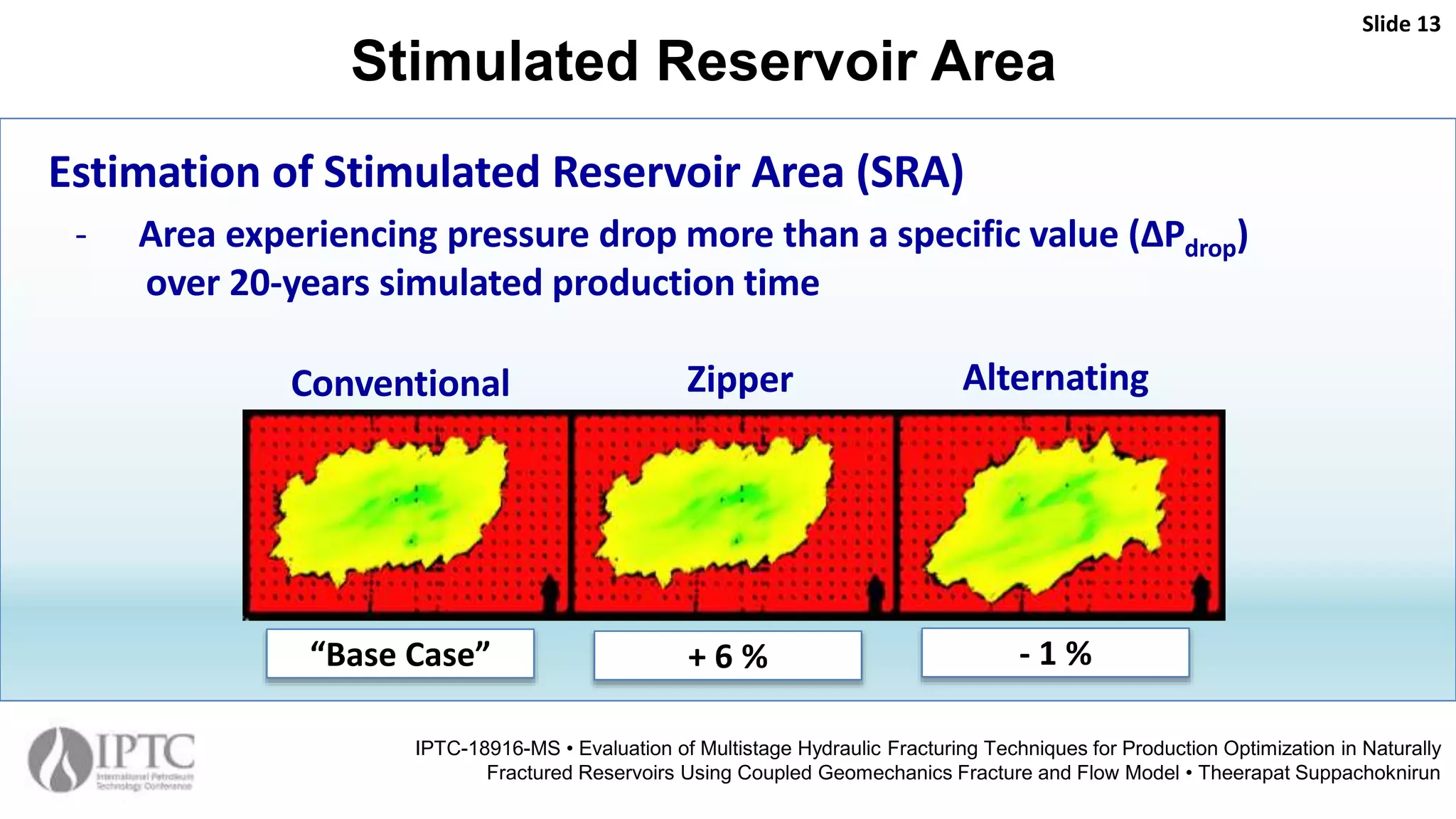
Stimulated Reservoir Area
Slide13
IPTC-18916-MS • Evaluation of Multistage Hydraulic Fracturing Techniques for Production Optimization in Naturally
Fractured Reservoirs Using Coupled Geomechanics Fracture and Flow Model • Theerapat Suppachoknirun
Estimation of Stimulated Reservoir Area (SRA)
- Area experiencing pressure drop more than a specific value (ΔPdrop)
over 20-years simulated production time
Conventional
+ 6 %“Base Case” - 1 %
Zipper Alternating
14.
IPTC-18916-MS • Evaluationof Multistage Hydraulic Fracturing Techniques for Production Optimization in Naturally
Fractured Reservoirs Using Coupled Geomechanics Fracture and Flow Model • Theerapat Suppachoknirun
Simulated Prod. Results & Comparison
Slide 14
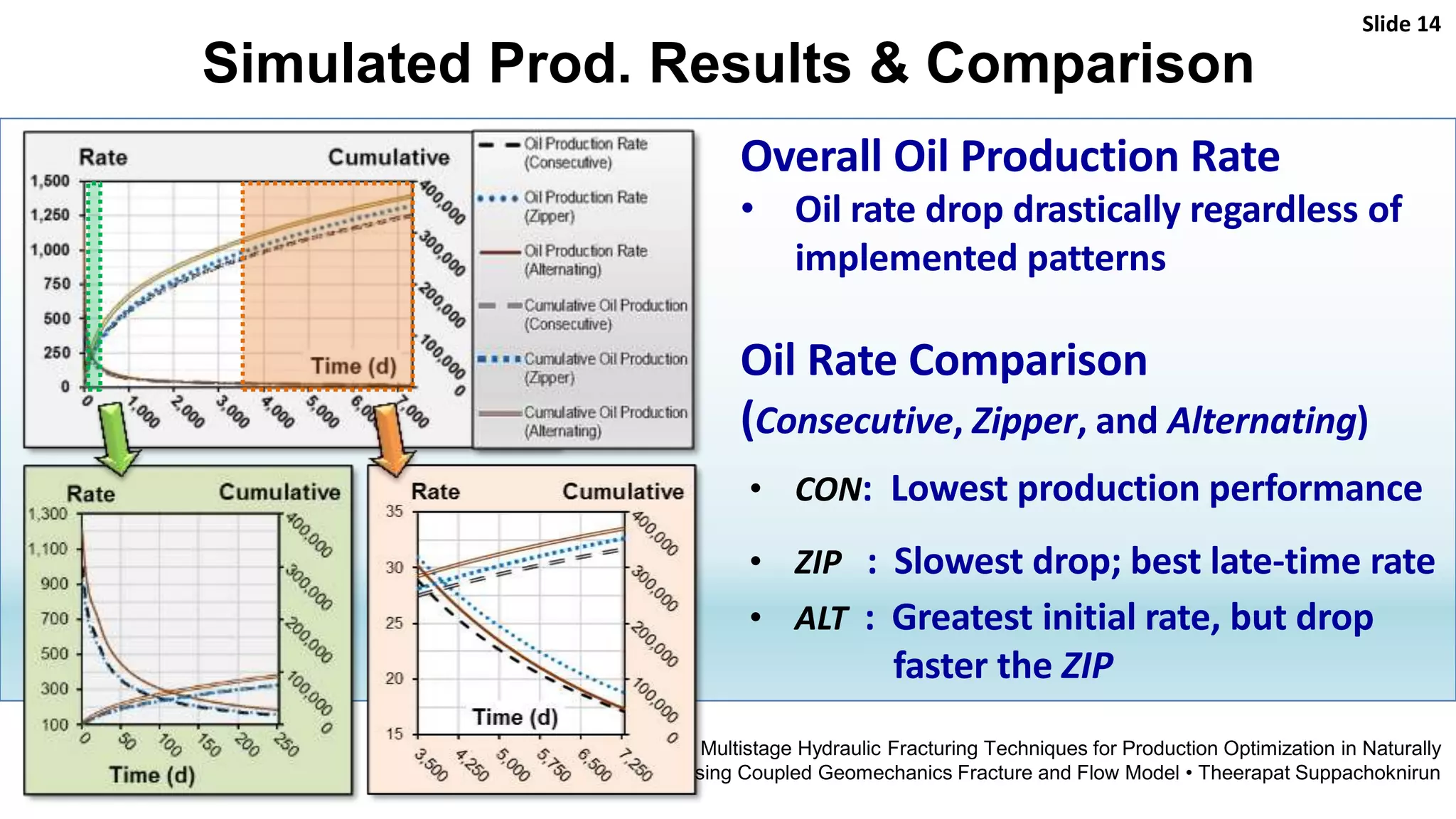
Overall Oil Production Rate
• Oil rate drop drastically regardless of
implemented patterns
Oil Rate Comparison
(Consecutive, Zipper, and Alternating)
• CON: Lowest production performance
• ZIP : Slowest drop; best late-time rate
• ALT : Greatest initial rate, but drop
faster the ZIP
15.
Simulated Prod. Results& Comparison (cont.)
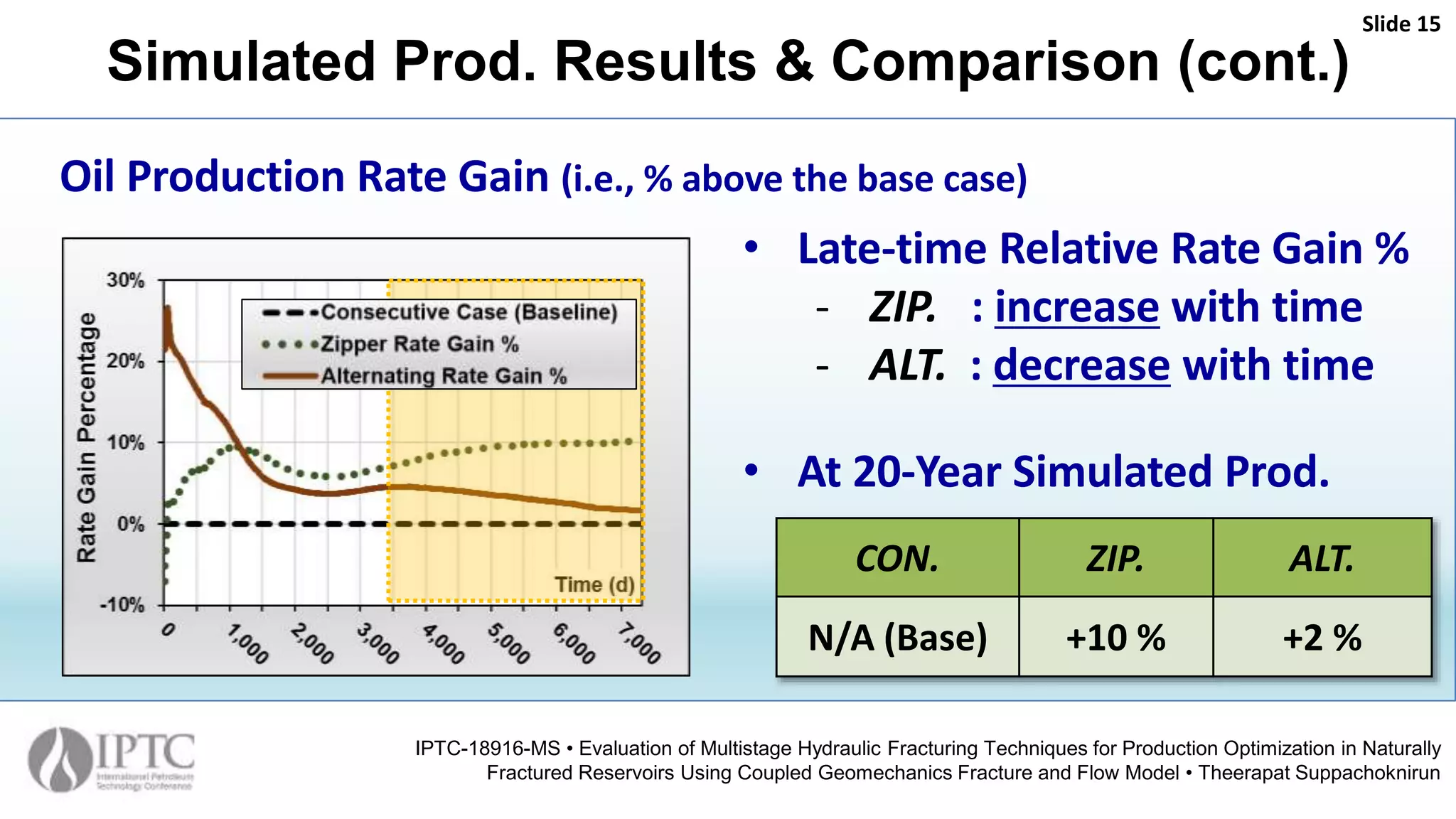
• Late-time Relative Rate Gain %
- ZIP. : increase with time
- ALT. : decrease with time
• At 20-Year Simulated Prod.
Slide 15
IPTC-18916-MS • Evaluation of Multistage Hydraulic Fracturing Techniques for Production Optimization in Naturally
Fractured Reservoirs Using Coupled Geomechanics Fracture and Flow Model • Theerapat Suppachoknirun
Oil Production Rate Gain (i.e., % above the base case)
CON. ZIP. ALT.
N/A (Base) +10 % +2 %
16.
Simulated Prod. Results& Comparison (cont.)
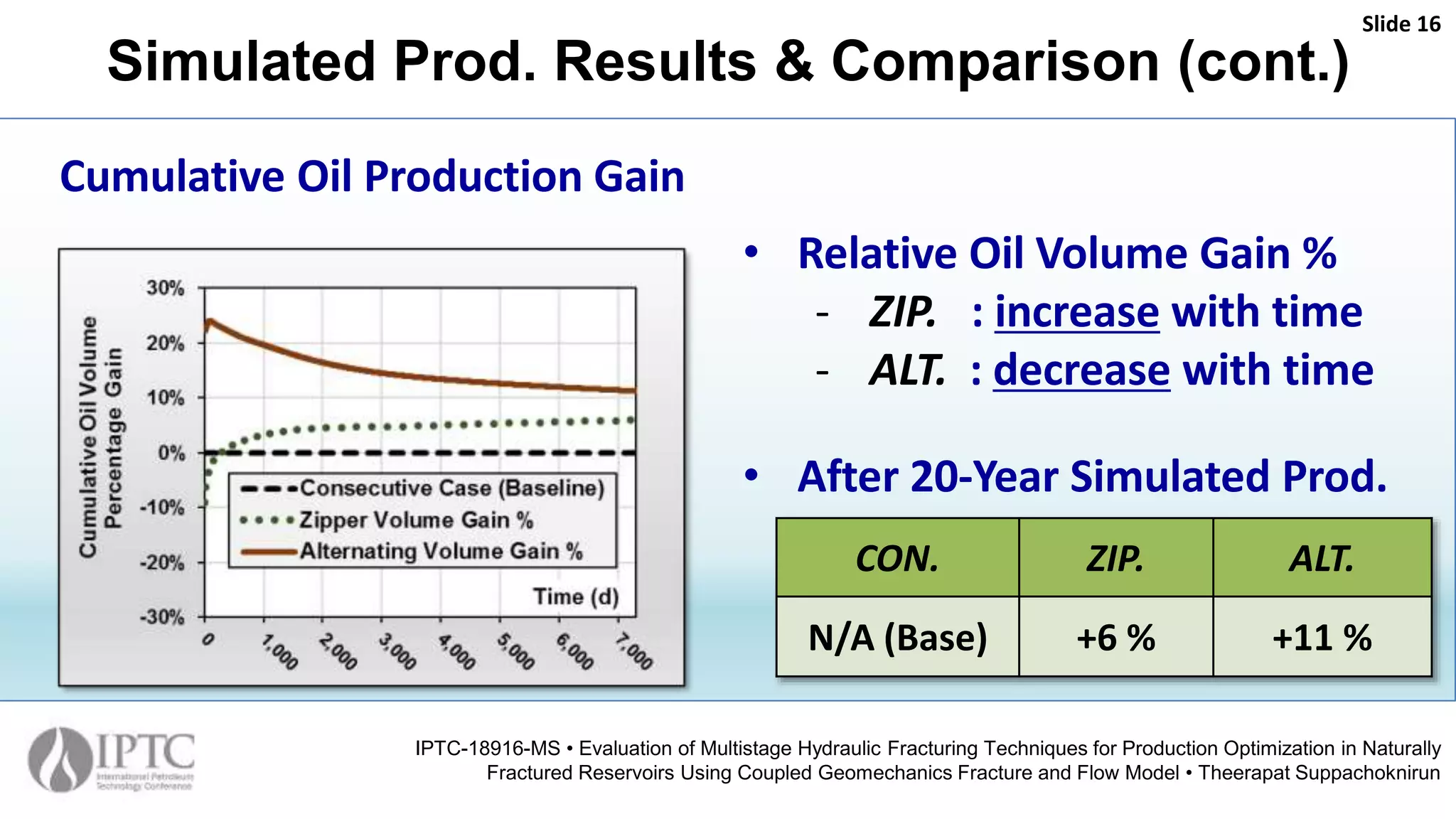
• Relative Oil Volume Gain %
- ZIP. : increase with time
- ALT. : decrease with time
• After 20-Year Simulated Prod.
Slide 16
IPTC-18916-MS • Evaluation of Multistage Hydraulic Fracturing Techniques for Production Optimization in Naturally
Fractured Reservoirs Using Coupled Geomechanics Fracture and Flow Model • Theerapat Suppachoknirun
Cumulative Oil Production Gain
CON. ZIP. ALT.
N/A (Base) +6 % +11 %
17.
Recommendation
Slide 17
IPTC-18916-MS •Evaluation of Multistage Hydraulic Fracturing Techniques for Production Optimization in Naturally
Fractured Reservoirs Using Coupled Geomechanics Fracture and Flow Model • Theerapat Suppachoknirun
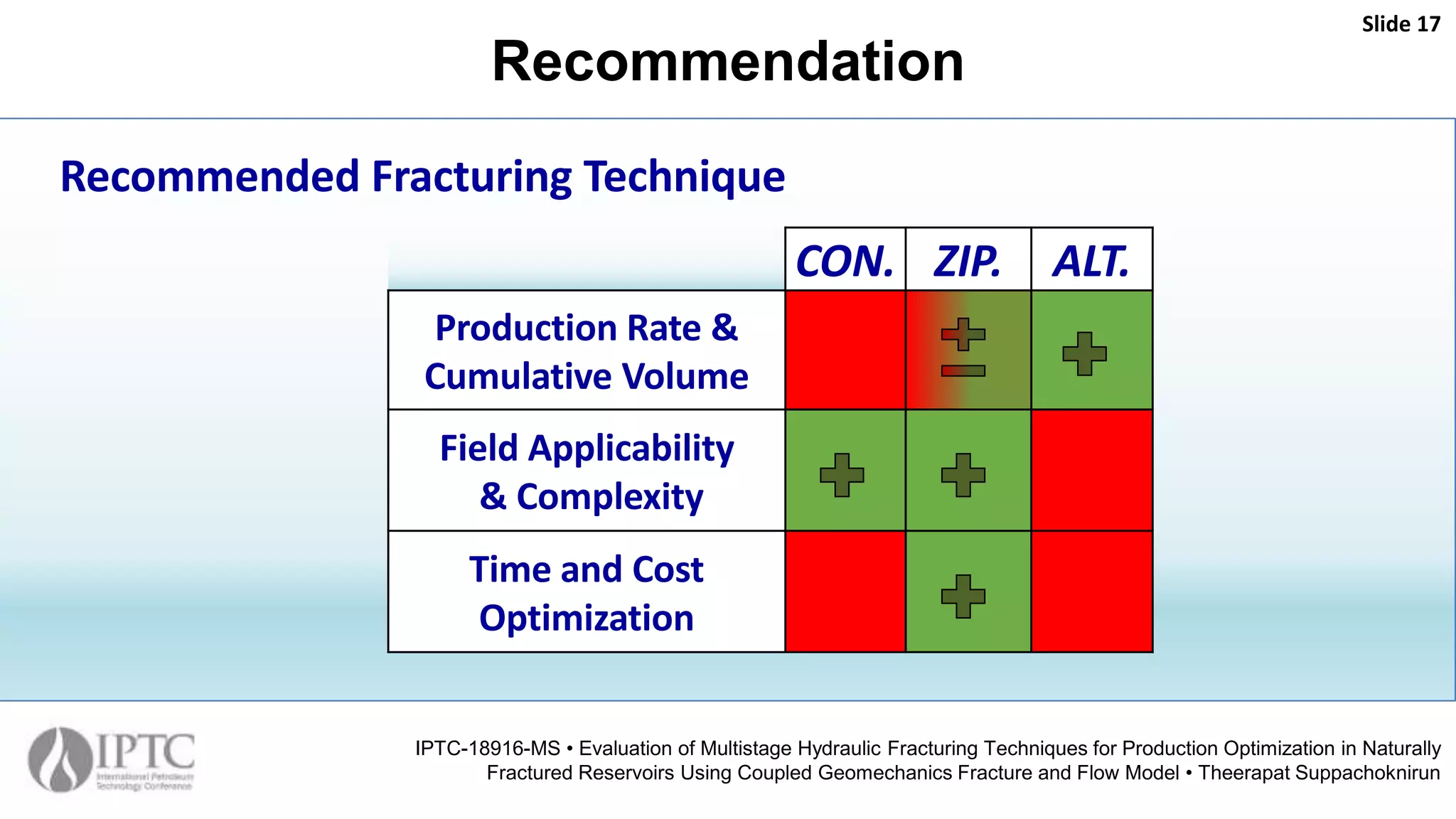
Recommended Fracturing Technique
CON. ZIP. ALT.
Production Rate &
Cumulative Volume
Field Applicability
& Complexity
Time and Cost
Optimization
18.
Individual Well Performance(Zipper Case)
Slide 18
IPTC-18916-MS • Evaluation of Multistage Hydraulic Fracturing Techniques for Production Optimization in Naturally
Fractured Reservoirs Using Coupled Geomechanics Fracture and Flow Model • Theerapat Suppachoknirun
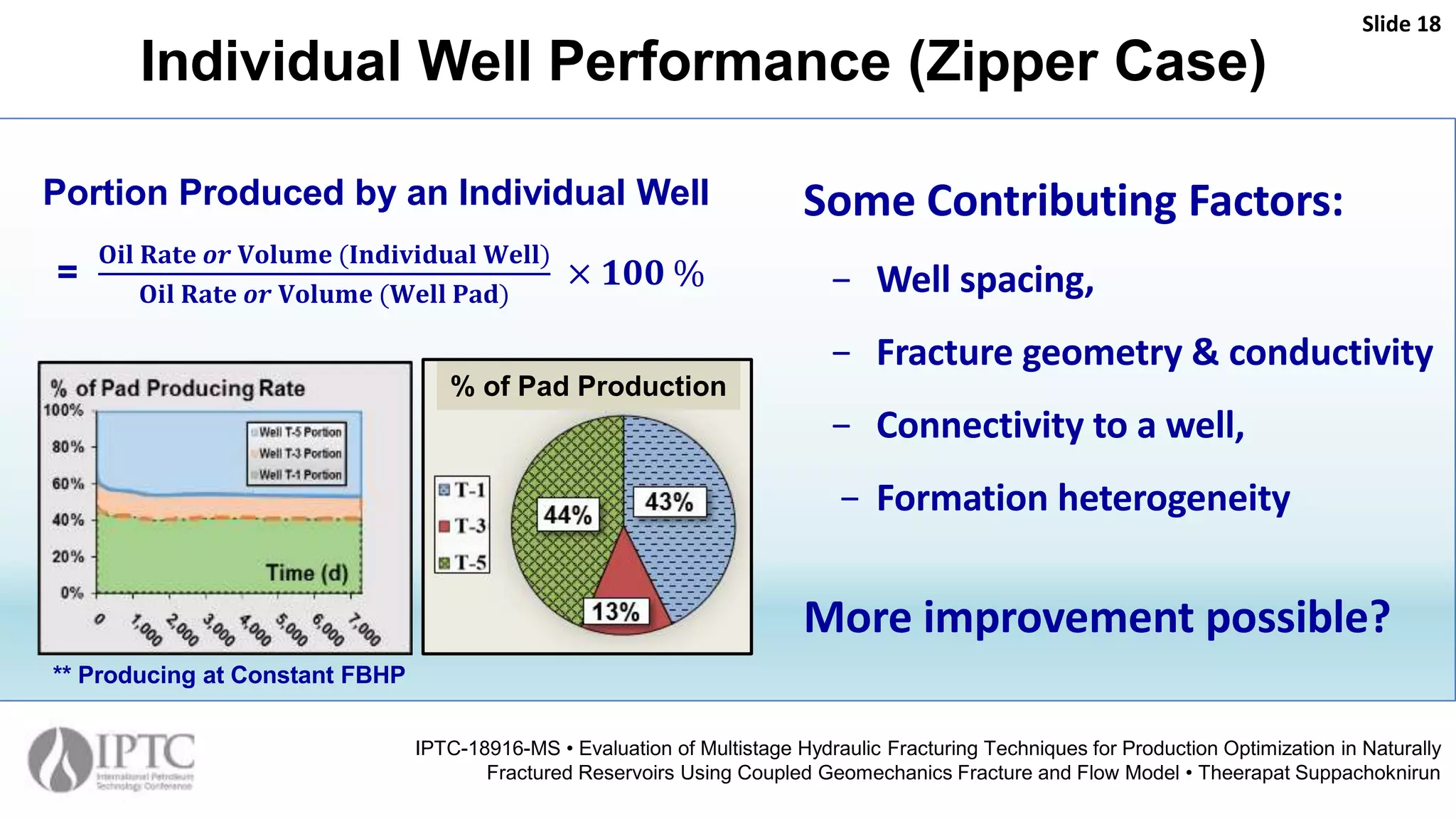
Portion Produced by an Individual Well
=
𝐎𝐢𝐥 𝐑𝐚𝐭𝐞 𝒐𝒓 𝐕𝐨𝐥𝐮𝐦𝐞 (𝐈𝐧𝐝𝐢𝐯𝐢𝐝𝐮𝐚𝐥 𝐖𝐞𝐥𝐥)
𝐎𝐢𝐥 𝐑𝐚𝐭𝐞 𝒐𝒓 𝐕𝐨𝐥𝐮𝐦𝐞 (𝐖𝐞𝐥𝐥 𝐏𝐚𝐝)
× 𝟏𝟎𝟎 %
** Producing at Constant FBHP
% of Pad Production
Some Contributing Factors:
− Well spacing,
− Fracture geometry & conductivity
− Connectivity to a well,
− Formation heterogeneity
More improvement possible?
19.
Summary
Slide 19
IPTC-18916-MS •Evaluation of Multistage Hydraulic Fracturing Techniques for Production Optimization in Naturally
Fractured Reservoirs Using Coupled Geomechanics Fracture and Flow Model • Theerapat Suppachoknirun
• Approach and Workflow to Develop “A Representative Model”
• Impacts of MS Fracturing Patterns on :
- Fracture Geometry, Fracture Conductivity, SRV
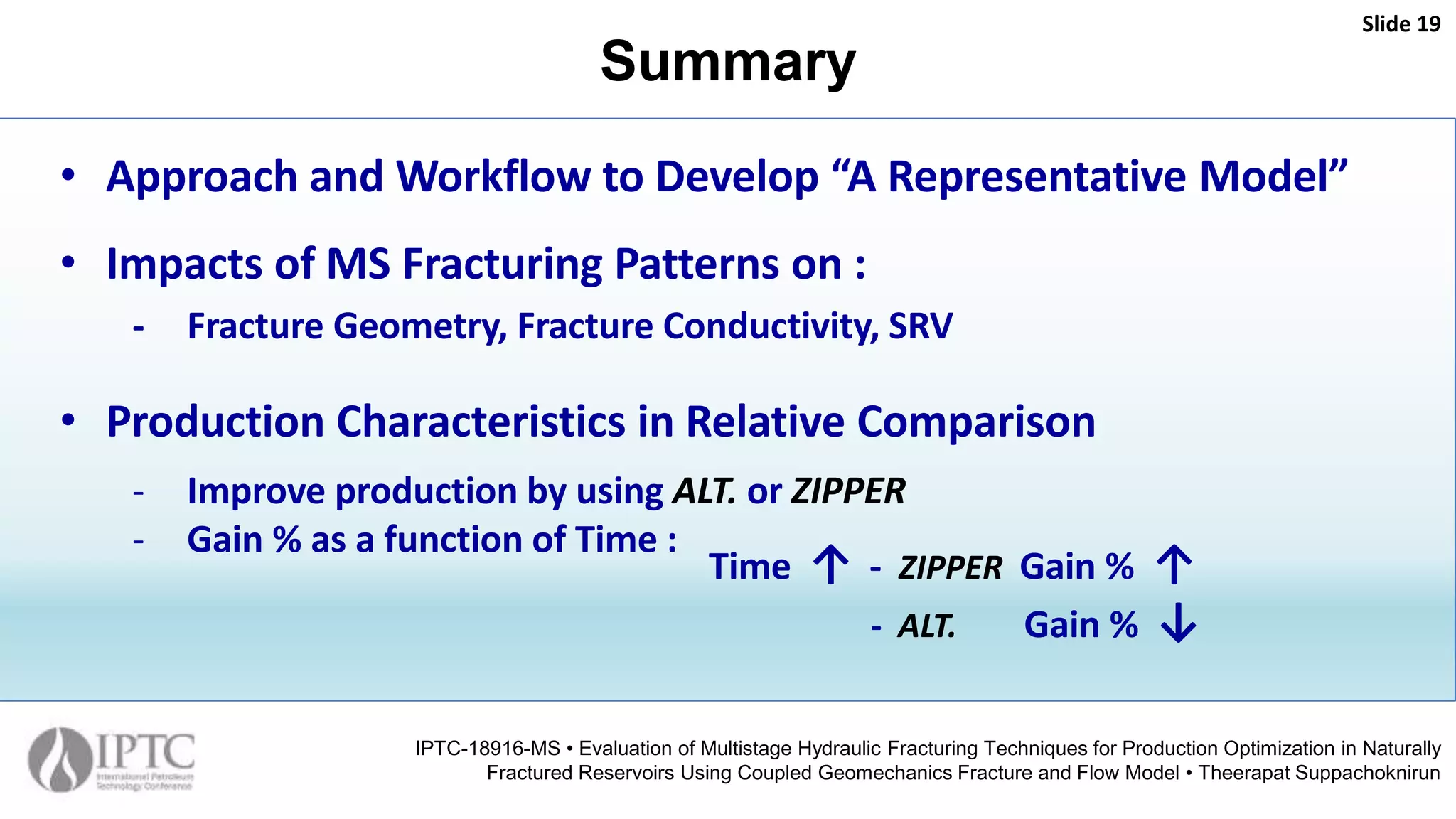
• Production Characteristics in Relative Comparison
- Improve production by using ALT. or ZIPPER
- Gain % as a function of Time :
Time ↑ - ZIPPER Gain % ↑
- ALT. Gain % ↓
20.
Summary (Cont.)
Slide 20
IPTC-18916-MS• Evaluation of Multistage Hydraulic Fracturing Techniques for Production Optimization in Naturally
Fractured Reservoirs Using Coupled Geomechanics Fracture and Flow Model • Theerapat Suppachoknirun
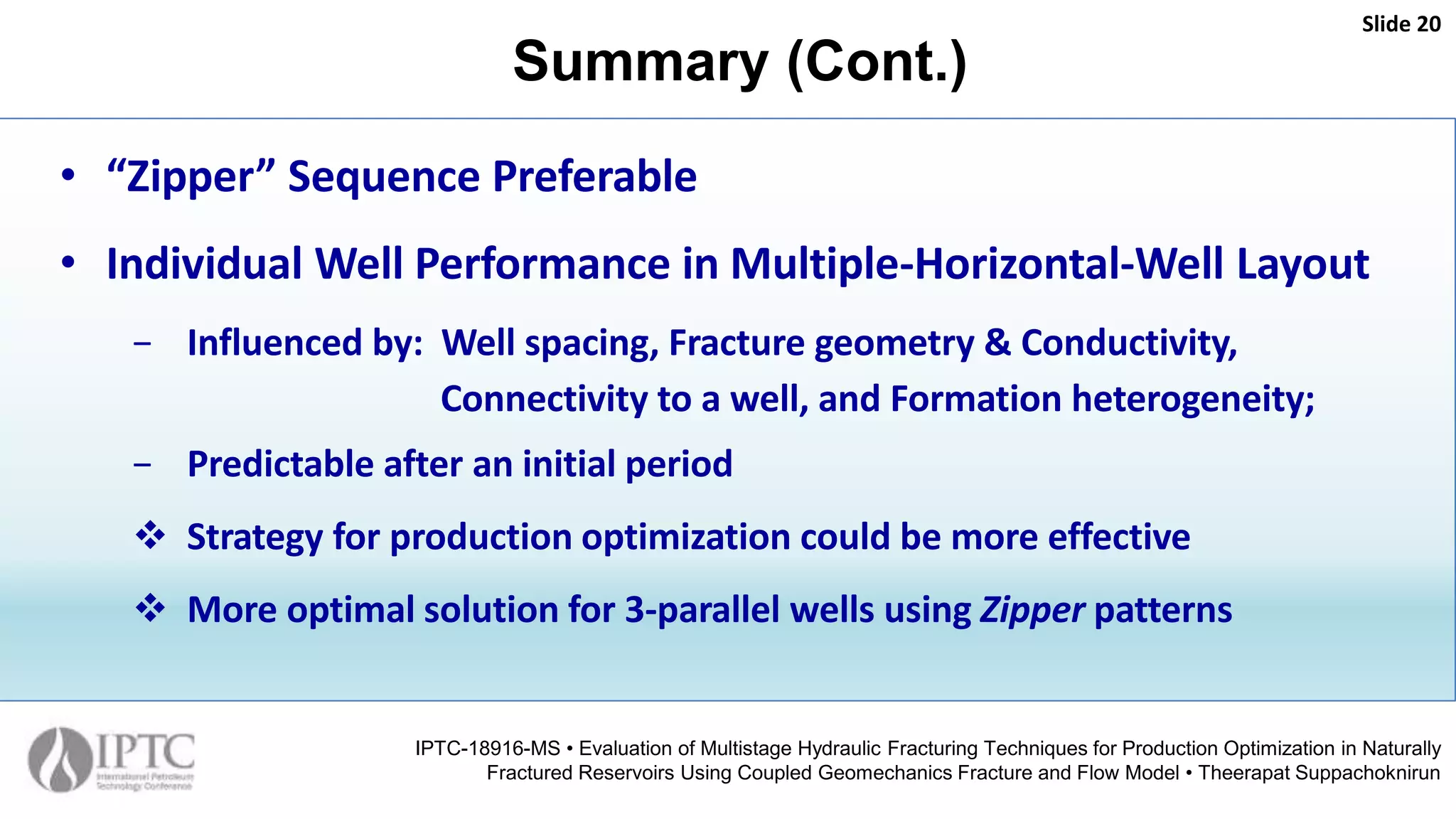
• “Zipper” Sequence Preferable
• Individual Well Performance in Multiple-Horizontal-Well Layout
− Influenced by: Well spacing, Fracture geometry & Conductivity,
Connectivity to a well, and Formation heterogeneity;
− Predictable after an initial period
Strategy for production optimization could be more effective
More optimal solution for 3-parallel wells using Zipper patterns
21.
Acknowledgements
PTT Explorationand Production Plc. (PTTEP)
Unconventional Natural Gas and Oil Institute (UNGI); and
Coupled Integrated Multiscale Measurements and Modeling
(CIMMM) Consortium
Colorado School of Mines
Slide 21
Thank You . . . Q & A