Permanent and Retrievable Packer
Removal
• Scope – all permanent packers and those
retrievables that require more than straight
pulls or J-actions.
• Reasons
• Techniques
– Rig based
– CT
3/14/2009 1
George E. King Engineering
GEKEngineering.com
Packer Removal Reasons
• Leaks
• Access to lower zones with full bore
equipment
• Recompletion with lift systems, etc.
3/14/2009 2
George E. King Engineering
GEKEngineering.com
Removal of a Drillable Packer
1. Most common – mill over outer slips and
packing element, retrieve or push to bottom.
2. Mill up with a flat bottom mill – mills the
entire packer up
3. Sand line drill – drill collars with a chisel bit,
run on braded line – chop the packer up.
3/14/2009 3
George E. King Engineering
GEKEngineering.com
Sand Line Drill
• Essentially a battering ram with a sharp tip.
• Series of drill collars with a rope rocket and a chisel
bit.
• Picked up 30 to 40 feet above the packer or plug and
dropped.
• Very effective removal.
• Used in shallow wells where cannot apply weight on
a conventional mill
• May damage the casing
• May not be able to control pressure below a packer
or plug when it breaks free.
3/14/2009 4
George E. King Engineering
GEKEngineering.com
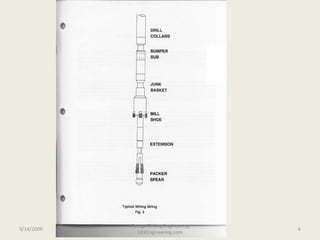
Mill Over the Slips
• A millshoe is run with a BHA
– Drill Collars - weight
– Bumper Sub - jar
– Junk Basket – catches small debris
– Mill Shoe – cuts slips and element
– Extension – reaches through bore of packer
– Packer Spear – grips packer ID after slips cut
3/14/2009 5
George E. King Engineering
GEKEngineering.com
3/14/2009 6
George E. King Engineering
GEKEngineering.com
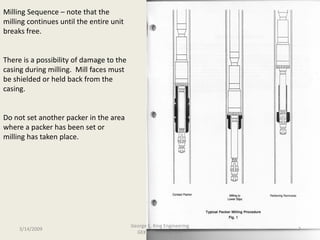
Milling Sequence – note that the
milling continues until the entire unit
breaks free.
There is a possibility of damage to the
casing during milling. Mill faces must
be shielded or held back from the
casing.
Do not set another packer in the area
where a packer has been set or
milling has taken place.
3/14/2009 7
George E. King Engineering
GEKEngineering.com
3/14/2009 8
George E. King Engineering
GEKEngineering.com
3/14/2009 9
George E. King Engineering
GEKEngineering.com
Push/Pull Choices
• Remove packer or push to bottom?
• Many wells do not have sufficient rat hole to
push packer to bottom or packer may have a
tailpipe. Also, this may interfere with later
operations.
• If packer is to be pushed to bottom, a mill
shoe of sufficient length is needed to
completely mill through the lower slips.
3/14/2009 10
George E. King Engineering
GEKEngineering.com
Pulling a Milled Packer
• An extension and packer spear is needed.
• The packer spear is stabbed into the packer
bore.
• On a plain bottom packer or packer with a
mill-out extension, a collet spear is used.
3/14/2009 11
George E. King Engineering
GEKEngineering.com
Spear and Collet Considerations
– The collet is larger than the ID of the packer with a millout
extension. The collet collapses on the down stroke &
engages in upstroke (has safety shear release)
– A nonsealing packer extension has an ID larger than the
packer bore and is at least 5 ft long – it will accept the
packer spear/collet and allow sufficient length to mill over
the packer (Collet is not engaged during milling).
– After packer is free, the collet engages and pulls the
packer.
– Do not rotate the mill until the collet is below the packer
ID and is free to turn.
3/14/2009 12
George E. King Engineering
GEKEngineering.com
The Packer Mill
• Millshoe is sized with inside cutting diameter
the same as the OD of the packer mandrel.
• The packer settling sleeve, slips, cones and
packing elements are milled away.
• The packer mandrel, bottom sub and tailpipe
remain intact and are pulled from the well.
3/14/2009 13
George E. King Engineering
GEKEngineering.com
Special Cases
• Packer with a seal bore extension directly below the
packer or a packer with a bottom sub with a
crossover back to the production tubing (no larger ID
below the packer bore to accept the collet) requires
a grapple.
• Do not run a millout extension below a lower seal
bore. The spear to pull this combination is so long
that the spear may twist-off or stick.
3/14/2009 14
George E. King Engineering
GEKEngineering.com
Grapples
• The grapple spear generally grips the seal
bore.
• If tailpipe is present, the grapple should
engage as shallow as possible in the seal bore
(the catch should be 1 to 2 feet into the seal
bore).
• The spear is engaged and remains stationary
as the mill burns over the packer.
3/14/2009 15
George E. King Engineering
GEKEngineering.com
Requirements
• Accurate installation drawing - ALL packer
components
• ID, OD and length or each component
• Materials of construction
• Knowledge of debris on top the packer
• Deviation of the well at the packer
• Hole obstructions above and below the packer
3/14/2009 16
George E. King Engineering
GEKEngineering.com
Running Procedures
1. Make up tools – record OD, thread, length,
weight,etc. on each piece
2. Use sufficient weight for application
3. Lower tools slowly past restrictions (BOP and ID
changes)
4. Monitor inside and outside fluid levels.
5. Have standby fluids for sweeps and control
6. Make sure there is no trapped pressure beneath
the packer or plug
7. Watch surge/swab forces when running/pulling
3/14/2009 17
George E. King Engineering
GEKEngineering.com
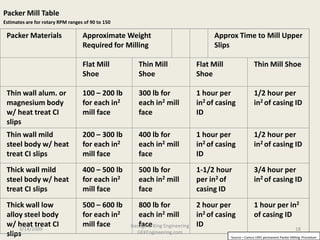
Packer Mill Table
Packer Materials Approximate Weight
Required for Milling
Approx Time to Mill Upper
Slips
Flat Mill
Shoe
Thin Mill
Shoe
Flat Mill
Shoe
Thin Mill Shoe
Thin wall alum. or
magnesium body
w/ heat treat CI
slips
100 – 200 lb
for each in2
mill face
300 lb for
each in2 mill
face
1 hour per
in2 of casing
ID
1/2 hour per
in2 of casing ID
Thin wall mild
steel body w/ heat
treat CI slips
200 – 300 lb
for each in2
mill face
400 lb for
each in2 mill
face
1 hour per
in2 of casing
ID
1/2 hour per
in2 of casing ID
Thick wall mild
steel body w/ heat
treat CI slips
400 – 500 lb
for each in2
mill face
500 lb for
each in2 mill
face
1-1/2 hour
per in2 of
casing ID
3/4 hour per
in2 of casing ID
Thick wall low
alloy steel body
w/ heat treat CI
slips
500 – 600 lb
for each in2
mill face
800 lb for
each in2 mill
face
2 hour per
in2 of casing
ID
1 hour per in2
of casing ID
Source – Camco 1991 permanent Packer Milling Procedure
Estimates are for rotary RPM ranges of 90 to 150
3/14/2009 18
George E. King Engineering
GEKEngineering.com
Preparing to Mill
• Establish pump circulation the top of the packer. Get
friction pressure of system.
• Circulation rate and fluid character must be sufficient
to clean the mill face and the hole of steel debris.
• Wash packer top clean.
• The amount of “pumpoff” (hydraulic lift) when
circulating while milling has to be offset with added
weight.
• Use drill-off test to determine RPM, weight and
pump pressure
3/14/2009 19
George E. King Engineering
GEKEngineering.com
Obstructions in the Packer Bore
• If obstructions in the packer bore are
encountered, remove the BHA and run in with
a special BHA to clean out the packer bore.
• Milling the packer spear through debris will
destroy the packer spear slips.
3/14/2009 20
George E. King Engineering
GEKEngineering.com
Retrieving the Packer
• After top slips are pulled, pick straight up, to
release unmilled lower slips.
• The remainder of the assembly is supported
on the collet or spear and can be pulled.
• Watch swab loads during pulling.
3/14/2009 21
George E. King Engineering
GEKEngineering.com
Cutting An Interior Mandrel – Case
History
• Attempted to pull a Retrievable Packer failed
after a chemical cut was made in the mandrel
area.
• The cut was made 4" too low.
• Solution - an RA tag should be located so that
the 20" area that needs to be cut can be
located.
3/14/2009 22
George E. King Engineering
GEKEngineering.com
CT Case History
• Experience with running coiled tubing through
a completion that has a 2.75" minimum ID
and then milling out a 7" EZSV bridge plug
below the tubing end.
3/14/2009 23
George E. King Engineering
GEKEngineering.com
CT Case History
• Case:
– A gas lift completion with a 2.75" ID X-Nipple as the
minimum ID.
– EZSV bridge plug is set inside 7", 29 ppf casing at a depth
of 9950' MD (well inclination at this depth = 14 degrees).
– The bridge plug is capped with 30 feet of cement.
– The 3-1/2" OD (2.992" ID) tubing end is about 300 feet
above the cement.
– The desire is to mill out the cement and EZSV using coiled
tubing and perf/reperf some deeper zones with through
tubing guns.
3/14/2009 24
George E. King Engineering
GEKEngineering.com
Options
• EZSV's drill much better with a rock bit than with
mills. Once the top slips are cut they can start to
spin. Cement below helps. – David Crockett
• Why drill out full bore? If a 2-3/4" hole drilled
through the concrete and EZSV could run perf guns
to TD. (The 14 deg angle will keep everything on the
low side of the hole. Drilling the EZSV off center with
a small mill might be easier than going through the
center. Sliding valve assembly is not rotionally locked
and it would spin under a mill. Going to the side will
cause chatter, but nothing will spin.
3/14/2009 25
George E. King Engineering
GEKEngineering.com
Other Methods
• First trip, use 2 1/2" pilot mill to drill through
cement and bridge plug.
• Second and third trips use possibly a under
reamer and open 2 1/2 hole in stages.
• Fourth trip, clean up trip.
3/14/2009 26
George E. King Engineering
GEKEngineering.com
Problems - Other Methods
• Bottle-beck completions with 7" liner and 3,6"
nipple at the bottom of the completion string.
• The challenge is passing the nipple prior to
cleaning up the liner. - Tore Hauge, Statoil
3/14/2009 27
George E. King Engineering
GEKEngineering.com
CT Removal of Packer
• use 2 7/8" Baker mud motor to make a pilot
hole
• run in with an under reamer to clean the well.
• Is removing the cement and EZSV (30' interval
of cement and plug) necessary? Pressure
drop across the restriction would probably be
close to nothing.
3/14/2009 28
George E. King Engineering
GEKEngineering.com
Nipple Milling Cautions
• Expand the nipple profile to maximum ID.
• Nipple profile was extended from 3,625" to 3,75".
The increase allowed 2-7/8" motor to pass.
• Done with a 2 7/8" left turning motor and a specially
made left hand step mill.
– (In the past we have on two occasions attempted to mill a
nipple profile with a right turning motor with disastrous
results: We unscrewed the completion below the packer
both times.)
3/14/2009 29
George E. King Engineering
GEKEngineering.com
Nipple Milling
• main lesson learned was the need for longer than
normal length on each step in the step mill.
– On the first attempt we probably had the motor and mill
jumping around due to an unstable BHA.
– On the second attempt the length on each step was
increased, the BHA was more stable and we managed to
mill through it.
– The entire BHA, incl. the end connector was made for left
hand operation.
– On a prior operation we did not "reverse" the entire BHA
and the whole thing just came apart.
3/14/2009 30
George E. King Engineering
GEKEngineering.com
Milling (Cement)
• Next – mill cement.
• Regular 2-7/8" motor and flat bottom mill.
• Flat bottom mill worked fine for the first 7 to 8
metres (worn) and had to POOH.
3/14/2009 31
George E. King Engineering
GEKEngineering.com
Problems and Solutions
• Stabilizing and centralizing the motor may be the
biggest challenge.
• If nipple is present, it would prevent use of flexible
stabilisers, so the motor would probably make a hole
on the "lower" part of the well bore.
• A long BHA would be recommended since the guns
that will go through are long and rigid.
• Watch hole cleaning hydraulics, especially at hole
diameter changes
3/14/2009 32
George E. King Engineering
GEKEngineering.com
Milling the Packer – What is required?
3/14/2009 33
George E. King Engineering
GEKEngineering.com
What will be done with the milled packer?
pushed to bottom?
retrieved from the well?
3/14/2009 34
George E. King Engineering
GEKEngineering.com
Milling ZXP packer
• TIH with a short catch spear
• Engage Tieback Recepticle - Pull to tear (rip)
threads and remove the tieback sleeve, TOH
with sleeve
• TIH with Metal Muncher mill or equivalent. Mill
+/- 30" of the packer, TOH
• TIH and cut casing below hanger, TOH
• TIH with spear and pull hanger assembly.
Source: Byron Cowart - June 2000
3/14/2009 35
George E. King Engineering
GEKEngineering.com

Packer milling

  • 1.
    Permanent and RetrievablePacker Removal • Scope – all permanent packers and those retrievables that require more than straight pulls or J-actions. • Reasons • Techniques – Rig based – CT 3/14/2009 1 George E. King Engineering GEKEngineering.com
  • 2.
    Packer Removal Reasons •Leaks • Access to lower zones with full bore equipment • Recompletion with lift systems, etc. 3/14/2009 2 George E. King Engineering GEKEngineering.com
  • 3.
    Removal of aDrillable Packer 1. Most common – mill over outer slips and packing element, retrieve or push to bottom. 2. Mill up with a flat bottom mill – mills the entire packer up 3. Sand line drill – drill collars with a chisel bit, run on braded line – chop the packer up. 3/14/2009 3 George E. King Engineering GEKEngineering.com
  • 4.
    Sand Line Drill •Essentially a battering ram with a sharp tip. • Series of drill collars with a rope rocket and a chisel bit. • Picked up 30 to 40 feet above the packer or plug and dropped. • Very effective removal. • Used in shallow wells where cannot apply weight on a conventional mill • May damage the casing • May not be able to control pressure below a packer or plug when it breaks free. 3/14/2009 4 George E. King Engineering GEKEngineering.com
  • 5.
    Mill Over theSlips • A millshoe is run with a BHA – Drill Collars - weight – Bumper Sub - jar – Junk Basket – catches small debris – Mill Shoe – cuts slips and element – Extension – reaches through bore of packer – Packer Spear – grips packer ID after slips cut 3/14/2009 5 George E. King Engineering GEKEngineering.com
  • 6.
    3/14/2009 6 George E.King Engineering GEKEngineering.com
  • 7.
    Milling Sequence –note that the milling continues until the entire unit breaks free. There is a possibility of damage to the casing during milling. Mill faces must be shielded or held back from the casing. Do not set another packer in the area where a packer has been set or milling has taken place. 3/14/2009 7 George E. King Engineering GEKEngineering.com
  • 8.
    3/14/2009 8 George E.King Engineering GEKEngineering.com
  • 9.
    3/14/2009 9 George E.King Engineering GEKEngineering.com
  • 10.
    Push/Pull Choices • Removepacker or push to bottom? • Many wells do not have sufficient rat hole to push packer to bottom or packer may have a tailpipe. Also, this may interfere with later operations. • If packer is to be pushed to bottom, a mill shoe of sufficient length is needed to completely mill through the lower slips. 3/14/2009 10 George E. King Engineering GEKEngineering.com
  • 11.
    Pulling a MilledPacker • An extension and packer spear is needed. • The packer spear is stabbed into the packer bore. • On a plain bottom packer or packer with a mill-out extension, a collet spear is used. 3/14/2009 11 George E. King Engineering GEKEngineering.com
  • 12.
    Spear and ColletConsiderations – The collet is larger than the ID of the packer with a millout extension. The collet collapses on the down stroke & engages in upstroke (has safety shear release) – A nonsealing packer extension has an ID larger than the packer bore and is at least 5 ft long – it will accept the packer spear/collet and allow sufficient length to mill over the packer (Collet is not engaged during milling). – After packer is free, the collet engages and pulls the packer. – Do not rotate the mill until the collet is below the packer ID and is free to turn. 3/14/2009 12 George E. King Engineering GEKEngineering.com
  • 13.
    The Packer Mill •Millshoe is sized with inside cutting diameter the same as the OD of the packer mandrel. • The packer settling sleeve, slips, cones and packing elements are milled away. • The packer mandrel, bottom sub and tailpipe remain intact and are pulled from the well. 3/14/2009 13 George E. King Engineering GEKEngineering.com
  • 14.
    Special Cases • Packerwith a seal bore extension directly below the packer or a packer with a bottom sub with a crossover back to the production tubing (no larger ID below the packer bore to accept the collet) requires a grapple. • Do not run a millout extension below a lower seal bore. The spear to pull this combination is so long that the spear may twist-off or stick. 3/14/2009 14 George E. King Engineering GEKEngineering.com
  • 15.
    Grapples • The grapplespear generally grips the seal bore. • If tailpipe is present, the grapple should engage as shallow as possible in the seal bore (the catch should be 1 to 2 feet into the seal bore). • The spear is engaged and remains stationary as the mill burns over the packer. 3/14/2009 15 George E. King Engineering GEKEngineering.com
  • 16.
    Requirements • Accurate installationdrawing - ALL packer components • ID, OD and length or each component • Materials of construction • Knowledge of debris on top the packer • Deviation of the well at the packer • Hole obstructions above and below the packer 3/14/2009 16 George E. King Engineering GEKEngineering.com
  • 17.
    Running Procedures 1. Makeup tools – record OD, thread, length, weight,etc. on each piece 2. Use sufficient weight for application 3. Lower tools slowly past restrictions (BOP and ID changes) 4. Monitor inside and outside fluid levels. 5. Have standby fluids for sweeps and control 6. Make sure there is no trapped pressure beneath the packer or plug 7. Watch surge/swab forces when running/pulling 3/14/2009 17 George E. King Engineering GEKEngineering.com
  • 18.
    Packer Mill Table PackerMaterials Approximate Weight Required for Milling Approx Time to Mill Upper Slips Flat Mill Shoe Thin Mill Shoe Flat Mill Shoe Thin Mill Shoe Thin wall alum. or magnesium body w/ heat treat CI slips 100 – 200 lb for each in2 mill face 300 lb for each in2 mill face 1 hour per in2 of casing ID 1/2 hour per in2 of casing ID Thin wall mild steel body w/ heat treat CI slips 200 – 300 lb for each in2 mill face 400 lb for each in2 mill face 1 hour per in2 of casing ID 1/2 hour per in2 of casing ID Thick wall mild steel body w/ heat treat CI slips 400 – 500 lb for each in2 mill face 500 lb for each in2 mill face 1-1/2 hour per in2 of casing ID 3/4 hour per in2 of casing ID Thick wall low alloy steel body w/ heat treat CI slips 500 – 600 lb for each in2 mill face 800 lb for each in2 mill face 2 hour per in2 of casing ID 1 hour per in2 of casing ID Source – Camco 1991 permanent Packer Milling Procedure Estimates are for rotary RPM ranges of 90 to 150 3/14/2009 18 George E. King Engineering GEKEngineering.com
  • 19.
    Preparing to Mill •Establish pump circulation the top of the packer. Get friction pressure of system. • Circulation rate and fluid character must be sufficient to clean the mill face and the hole of steel debris. • Wash packer top clean. • The amount of “pumpoff” (hydraulic lift) when circulating while milling has to be offset with added weight. • Use drill-off test to determine RPM, weight and pump pressure 3/14/2009 19 George E. King Engineering GEKEngineering.com
  • 20.
    Obstructions in thePacker Bore • If obstructions in the packer bore are encountered, remove the BHA and run in with a special BHA to clean out the packer bore. • Milling the packer spear through debris will destroy the packer spear slips. 3/14/2009 20 George E. King Engineering GEKEngineering.com
  • 21.
    Retrieving the Packer •After top slips are pulled, pick straight up, to release unmilled lower slips. • The remainder of the assembly is supported on the collet or spear and can be pulled. • Watch swab loads during pulling. 3/14/2009 21 George E. King Engineering GEKEngineering.com
  • 22.
    Cutting An InteriorMandrel – Case History • Attempted to pull a Retrievable Packer failed after a chemical cut was made in the mandrel area. • The cut was made 4" too low. • Solution - an RA tag should be located so that the 20" area that needs to be cut can be located. 3/14/2009 22 George E. King Engineering GEKEngineering.com
  • 23.
    CT Case History •Experience with running coiled tubing through a completion that has a 2.75" minimum ID and then milling out a 7" EZSV bridge plug below the tubing end. 3/14/2009 23 George E. King Engineering GEKEngineering.com
  • 24.
    CT Case History •Case: – A gas lift completion with a 2.75" ID X-Nipple as the minimum ID. – EZSV bridge plug is set inside 7", 29 ppf casing at a depth of 9950' MD (well inclination at this depth = 14 degrees). – The bridge plug is capped with 30 feet of cement. – The 3-1/2" OD (2.992" ID) tubing end is about 300 feet above the cement. – The desire is to mill out the cement and EZSV using coiled tubing and perf/reperf some deeper zones with through tubing guns. 3/14/2009 24 George E. King Engineering GEKEngineering.com
  • 25.
    Options • EZSV's drillmuch better with a rock bit than with mills. Once the top slips are cut they can start to spin. Cement below helps. – David Crockett • Why drill out full bore? If a 2-3/4" hole drilled through the concrete and EZSV could run perf guns to TD. (The 14 deg angle will keep everything on the low side of the hole. Drilling the EZSV off center with a small mill might be easier than going through the center. Sliding valve assembly is not rotionally locked and it would spin under a mill. Going to the side will cause chatter, but nothing will spin. 3/14/2009 25 George E. King Engineering GEKEngineering.com
  • 26.
    Other Methods • Firsttrip, use 2 1/2" pilot mill to drill through cement and bridge plug. • Second and third trips use possibly a under reamer and open 2 1/2 hole in stages. • Fourth trip, clean up trip. 3/14/2009 26 George E. King Engineering GEKEngineering.com
  • 27.
    Problems - OtherMethods • Bottle-beck completions with 7" liner and 3,6" nipple at the bottom of the completion string. • The challenge is passing the nipple prior to cleaning up the liner. - Tore Hauge, Statoil 3/14/2009 27 George E. King Engineering GEKEngineering.com
  • 28.
    CT Removal ofPacker • use 2 7/8" Baker mud motor to make a pilot hole • run in with an under reamer to clean the well. • Is removing the cement and EZSV (30' interval of cement and plug) necessary? Pressure drop across the restriction would probably be close to nothing. 3/14/2009 28 George E. King Engineering GEKEngineering.com
  • 29.
    Nipple Milling Cautions •Expand the nipple profile to maximum ID. • Nipple profile was extended from 3,625" to 3,75". The increase allowed 2-7/8" motor to pass. • Done with a 2 7/8" left turning motor and a specially made left hand step mill. – (In the past we have on two occasions attempted to mill a nipple profile with a right turning motor with disastrous results: We unscrewed the completion below the packer both times.) 3/14/2009 29 George E. King Engineering GEKEngineering.com
  • 30.
    Nipple Milling • mainlesson learned was the need for longer than normal length on each step in the step mill. – On the first attempt we probably had the motor and mill jumping around due to an unstable BHA. – On the second attempt the length on each step was increased, the BHA was more stable and we managed to mill through it. – The entire BHA, incl. the end connector was made for left hand operation. – On a prior operation we did not "reverse" the entire BHA and the whole thing just came apart. 3/14/2009 30 George E. King Engineering GEKEngineering.com
  • 31.
    Milling (Cement) • Next– mill cement. • Regular 2-7/8" motor and flat bottom mill. • Flat bottom mill worked fine for the first 7 to 8 metres (worn) and had to POOH. 3/14/2009 31 George E. King Engineering GEKEngineering.com
  • 32.
    Problems and Solutions •Stabilizing and centralizing the motor may be the biggest challenge. • If nipple is present, it would prevent use of flexible stabilisers, so the motor would probably make a hole on the "lower" part of the well bore. • A long BHA would be recommended since the guns that will go through are long and rigid. • Watch hole cleaning hydraulics, especially at hole diameter changes 3/14/2009 32 George E. King Engineering GEKEngineering.com
  • 33.
    Milling the Packer– What is required? 3/14/2009 33 George E. King Engineering GEKEngineering.com
  • 34.
    What will bedone with the milled packer? pushed to bottom? retrieved from the well? 3/14/2009 34 George E. King Engineering GEKEngineering.com
  • 35.
    Milling ZXP packer •TIH with a short catch spear • Engage Tieback Recepticle - Pull to tear (rip) threads and remove the tieback sleeve, TOH with sleeve • TIH with Metal Muncher mill or equivalent. Mill +/- 30" of the packer, TOH • TIH and cut casing below hanger, TOH • TIH with spear and pull hanger assembly. Source: Byron Cowart - June 2000 3/14/2009 35 George E. King Engineering GEKEngineering.com