The Teaching &
Learning Infrastructure
IP&T 692R
Fall 2013
Jon Mott
Chief Learning Officer, Learning Objects
Visiting Instructor, Brigham Young University
learning is ...
teaching is ...
intent
≠
outcome
goal strategy tactics
goals
learner
what do you
want your students
to become?
learning
strategy
learning
tactics
measuring success
goal articulation
=
defining success
technology
=
tactics
problems
(opportunities?)
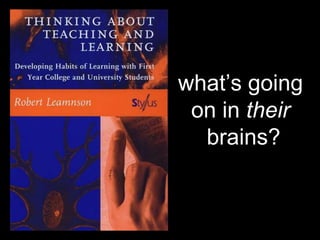
what’s going
on in their
brains?
“powering down”
≠
engaged
new technology
=
new possibilities
http://
information
overload
the future is now
what difference
does technology
make?
“If you can Google it,
don’t teach or
test it.”
David Wiley
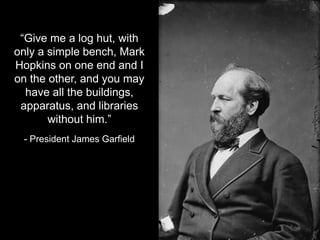
“Give me a log hut, with
only a simple bench, Mark
Hopkins on one end and I
on the other, and you may
have all the buildings,
apparatus, and libraries
without him.”
- President James Garfield
knowledgeable
knowledgeable
knowledge-able
Michael Wesch
“Nobody is smarter
than everybody.”
“Thirty years from
now the big
university
campuses will be
relics. Universities
won't survive. It's
as large a change
as when we first
got the printed
book.”
Peter Drucker
1997
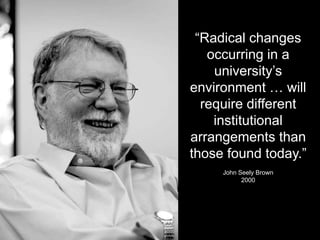
“Radical changes
occurring in a
university’s
environment … will
require different
institutional
arrangements than
those found today.”
John Seely Brown
2000
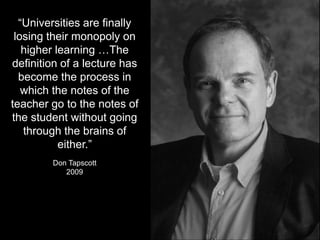
“Universities are finally
losing their monopoly on
higher learning …The
definition of a lecture has
become the process in
which the notes of the
teacher go to the notes of
the student without going
through the brains of
either.”
Don Tapscott
2009
a brief history
cms=erp?
BYU case study
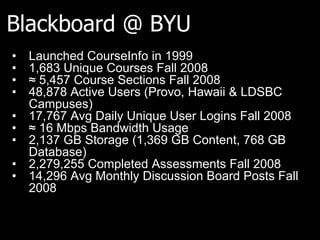
Blackboard @ BYU
• Launched CourseInfo in 1999
• 1,683 Unique Courses Fall 2008
• ≈ 5,457 Course Sections Fall 2008
• 48,878 Active Users (Provo, Hawaii & LDSBC
Campuses)
• 17,767 Avg Daily Unique User Logins Fall 2008
• ≈ 16 Mbps Bandwidth Usage
• 2,137 GB Storage (1,369 GB Content, 768 GB
Database)
• 2,279,255 Completed Assessments Fall 2008
• 14,296 Avg Monthly Discussion Board Posts Fall
2008
limits of
the LMS model
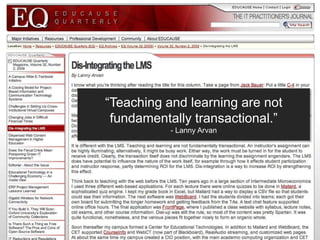
“Teaching and learning are not
fundamentally transactional.”
- Lanny Arvan
The Web is “a
world of pure
connection, free
of the arbitrary
constraints of
matter, distance
and time.”
David Weinberger
Feature Percentage
Course Materials / Documents 85.9%
Gradebook 78.0%
Announcements 68.9%
Email 68.1%
Assessments / Quizzes 30.7%
Discussion Board 13.5%
Other (e.g., Reserve, Dropbox) 12.2%
Virtual Classroom 2.0%
Lightweight Chat 0.4%
Bb Feature Usage @ BYU
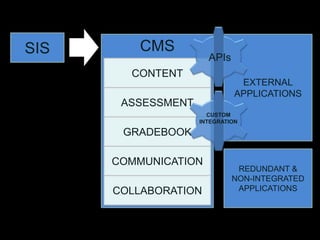
transactional
EXTERNAL
APPLICATIONS
SIS CMS
GRADEBOOK
CONTENT
ASSESSMENT
COMMUNICATION
COLLABORATION
APIs
CUSTOM
INTEGRATION
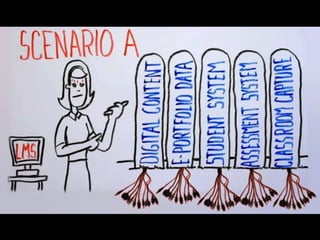
REDUNDANT &
NON-INTEGRATED
APPLICATIONS
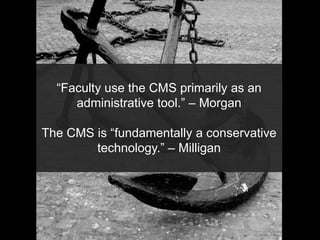
“Faculty use the CMS primarily as an
administrative tool.” – Morgan
The CMS is “fundamentally a conservative
technology.” – Milligan
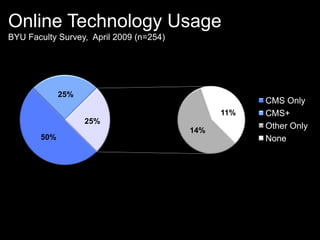
50%
25%
14%
11%
25%
CMS Only
CMS+
Other Only
None
Online Technology Usage
BYU Faculty Survey, April 2009 (n=254)
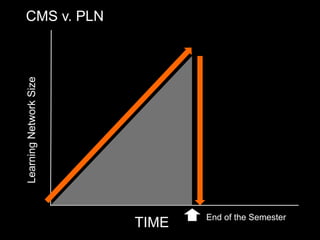
TIME
CMS v. PLN
End of the Semester
LearningNetworkSize
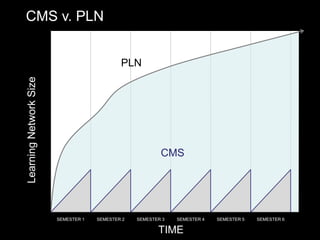
TIME
LearningNetworkSize
SEMESTER 1 SEMESTER 2 SEMESTER 3 SEMESTER 4 SEMESTER 5 SEMESTER 6
CMS
PLN
CMS v. PLN
Data Funnels  Learning Webs
- Steve Wheeler
“Pointing students to data buckets and conduits
we’ve already made for them won’t do.”
- Gardner Campbell
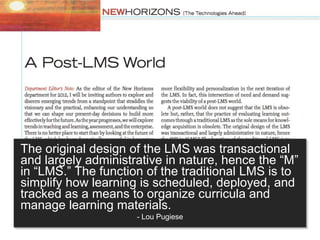
The original design of the LMS was transactional
and largely administrative in nature, hence the “M”
in “LMS.” The function of the traditional LMS is to
simplify how learning is scheduled, deployed, and
tracked as a means to organize curricula and
manage learning materials.
- Lou Pugiese
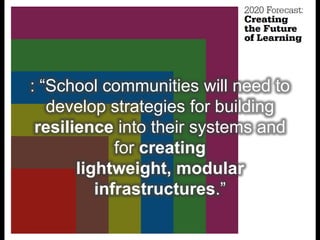
: “School communities will need to
develop strategies for building
resilience into their systems and
for creating
lightweight, modular
infrastructures.”
possible
topics
Open
Participatory
Learning
Ecosystem
Brown & Adler
2009
plns
olns
THE CLOUD
STUDENT
CONTEN
T
UNIVERSITY NETWORK
An Open (Institutional) Learning Network
OPEN
CONTENT
SIS SECURE
ONLINE
ASSESSMENT
GRADE
BOOK LEARNING
OUTCOMES
WIKI
PORTAL
UI
STUDENT
LEARNING
EPORTFOLIO
PERSONAL
PUBLISHING
SPACE
SOCIAL
NETWORKING
APPS
COLLABORATIO
N
TOOLS
UNIVERSITY
CONTEN
T
WEB
APPS
GROUPS
PROGRAMS
COURSES
ID
REPOSITORY
SOCIAL
NETWORKING
REGISTRY
SIS
PORTAL / UI
SERVICES ORIENTED
ARCHITECTURE
CONTENT MANAGEMENT
GRADEBOOK
PROCTORED TESTING
LIBRARY
SYLLABUS BUILDER
LEARNING OUTCOMES
IN-CLASS RESPONSE
ONLINE ASSESSMENT
CALENDAR
EPORTFOLIO
LMS
STUDENT PLANNING
…
NOTIFICATION &
MOBILIZATION
SERVICE
API
sWEB
SERVICE
S
GROUP
MANAGE
R
RSS
WIDGET
S
TAGGING
AUTHOR
PERMISSIO
NS
EMBED
CODES
iCal
LTI
diy
“and”
models
private
secure
reliability
integrated
teachers
efficiency
structured
OR public
OR open
OR flexibility
OR modular
OR learners
OR creativity
OR authentic
moocs
(& oocs)
evolution of
the lms
corporate v.
k-20 learning
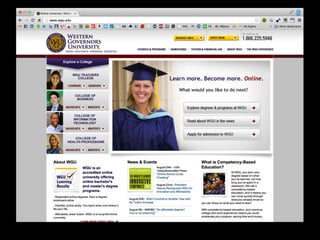
competency-based
education
adaptive
assessment
& learning
big data
& accountabiity
http://www.slideshare.net/jonmott
thejonmott@gmail.com
http://jonmott.com
@jonmott

IP&T 692 R - Day 1

Editor's Notes

  • #4 Figuring out how to do thingsAcquiring new knowledge, skills, abilities
  • #6 Intentional actions aimed at facilitating learning …
  • #8 Just because we *intend* to cause learning doesn’t mean it will happen or that it will happen exactly as we plan.
  • #9 Sometimes we—and our students—learn the hard way.
  • #10 What is it we want our students to become?
  • #15 Not *teacher* goals
  • #17 How should they be different *after* your class/assignment/lecture than they were before it?
  • #18 What are you helping them become? What will they make of themselves?
  • #22 How will student activity & performance be documented?
  • #23 What specific kinds of experiences do they need to have?
  • #24 Specific actions, techniques, or approaches used to implement a strategy
  • #25 How do you measure success?
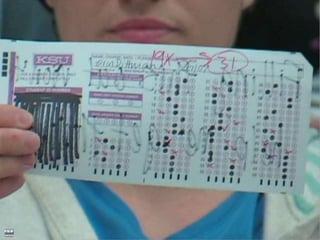
  • #26 What are the naturally occurring artifacts of their learning experiences? Authentic assessment!!!
  • #28 Are we after high test scores?
  • #29 If students don’t think tests are meaningful, they might find a better purpose for answer sheets.
  • #30 Graduation = Success?
  • #31 Is it our job to guarantee employment? (If so, we have competition.)
  • #32 Is employment sufficient?
  • #33 Is employment sufficient?
  • #34 Is employment sufficient?Good citizenshipMake a difference in the world
  • #38 Study of K-20 in Silicon Valley: Teachers use technology to “maintain existing practices.” Technology is general “peripheral to the daily routines.” Teaching & learning activity is largely unchanged.“Lecturing still absorbs half to two-thirds” of teaching time.
  • #41 What are you helping them become? What will they make of themselves?
  • #42 What are you helping them become? What will they make of themselves?
  • #47 At best, “power down” rules breed reluctant compliance. At worst? Subversive disobedience!There’s creativity here to be harnessed!
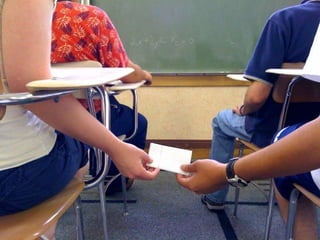
  • #49 Low-tech texting . . .
  • #51 The “Course Management System” – Roots in late 90s. Blackboard’s original name “Course Info” is a good indication of what these tools were originally intended to do.
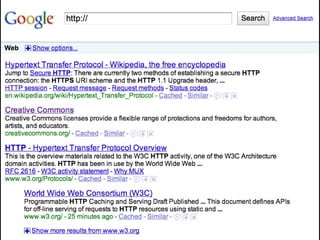
  • #52 Hypertext Transfer ProtocolURIs, URLs, the WebXml + Web Services
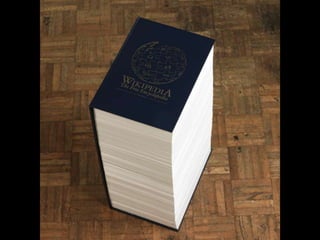
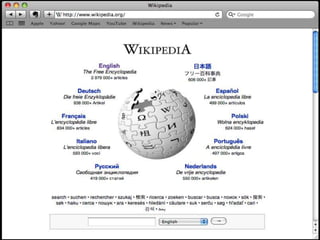
  • #57 http://en.wikipedia.org/wiki/Wikipedia:Size_of_Wikipedia
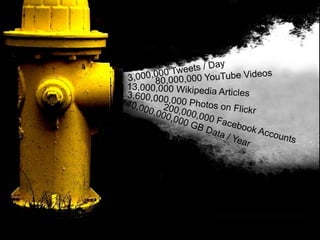
  • #58 60 Billion e-mails a Day75 Million Blogs80 Million YouTube Videos – 412 years to watch! (But 13 new hours / minute)6.4 Billion Google Searches / Month13 Million Wikipedia Articles (280k+ Contributors)
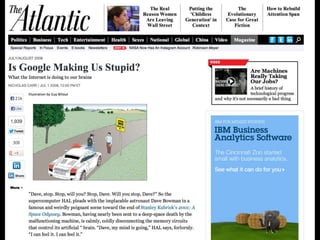
  • #63 SOURCE: http://www.theatlantic.com/magazine/archive/2008/07/is-google-making-us-stupid/306868/
  • #64 “Give me a log hut, with only a simple bench, Mark Hopkins [a well-known educator and lecturer of the day] on one end and I on the other, and you may have all the buildings, apparatus, and libraries without him.” President James Garfield (Source: http://www.britannica.com/EBchecked/topic/271551/Mark-Hopkins)Image Source: President James Garfield http://lcweb2.loc.gov/cgi-bin/query/h?pp/PPALL:@field%28NUMBER+@band%28cwpbh+03743%29%29
  • #70 Peter Drucker: “Thirty years from now the big university campuses will be relics. Universities won't survive. It's as large a change as when we first got the printed book. ... Already we are beginning to deliver more lectures and classes off campus via satellite or two-way video at a fraction of the cost. The college won't survive as a residential institution" (Lenzner and Forbes, Forbes Magazine, 10 March 1997).Image Source: http://www.cgu.edu/images/Drucker/Peter_Drucker/pages/PeterDrucker004_jpg.htm
  • #71 John Seely BrownImage Source: http://www.flickr.com/photos/joi/2253804907/sizes/l
  • #72 Don Tapscott, “The Impending Demise of the University,” http://www.edge.org/3rd_culture/tapscott09/tapscott09_index.html“Universities are finally losing their monopoly on higher learning. … [T]here is a widening gap between the model of learning offered by many big universities and the natural way that young people who have grown up digital best learn.”“The definition of a lecture has become the process in which the notes of the teacher go to the notes of the student without going through the brains of either.”Image Source: http://www.futureofeducation.com/forum/topics/don-tapscott-talks-about (http://api.ning.com/files/TO9lsNfC5fzBZNEAnLhbFgs8j1LBF-KKiXOsG29ErwJ7hFnmP70gXBNsONGF5nvgdVqHtNIQJWnV5KXFPK-zWxIko1isXTxX/1_rgb_300_2400x3000.jpg)
  • #73 The Course Management System is not the academic ERP / PeopleSoft.
  • #74 The Course Management System is not the academic ERP / PeopleSoft.
  • #76 The Course Management System is not the academic ERP / PeopleSoft.
  • #79 The Course Management System is not the academic ERP / PeopleSoft.
  • #80 LannyArvan: “Teaching an learning are not fundamentally transactional.”http://www.educause.edu/EDUCAUSE+Quarterly/EDUCAUSEQuarterlyMagazineVolum/DisIntegratingtheLMS/174588
  • #81 The Web is “a world of pure connection, free of the arbitrary constraints of matter, distance and time.”- Small Pieces Loosely Joined by David WeinbergerImage Source: http://www.flickr.com/photos/ialla/4042996779/sizes/l
  • #82 Gilmor: “The Former Audience” -- Students no longer passive consumers.IMAGE: Obama in Germany http://www.flickr.com/photos/barackobamadotcom/2699346313/sizes/o
  • #83 How is Blackboard actually used?
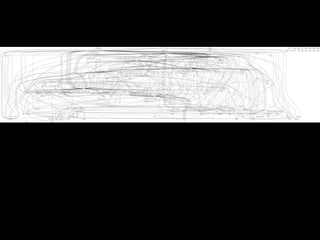
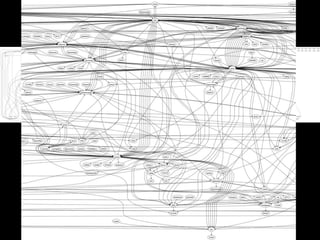
  • #84 Vertically integrated technology stack with uneven integration with other tools in the learning ecosystem.
  • #85 University of Wisconsin System faculty members. In that study, Morgan found that "faculty use the CMS primarily as an administrative tool to facilitate quiz administration and other classroom tasks rather than as a tool anchored in pedagogy or cognitive science models” (2003, 11). As Milligan observes, the CMS is "fundamentally a conservative technology ... [for] managing groups, providing tools, and delivering content" (2006, 1)Evidence of the pervasiveness of such CMS usage tendencies can be found in a recent usage study of the Sakai at the University of North Carolina. Faculty survey data indicates that the top three uses of Sakai in the category "Improving Teaching and Learning" were "Accessing materials any time," "Saving me time," and "Managing my course activities" (UNC 2009, 15).Milligan, C. (2006). The Road to the Personal Learning Environment? CETIS. Retrieved from http://zope.cetis.ac.uk/members/ple/resources/colinmilligan.pdf.Morgan, G. (2003). Faculty Use of Course Management Systems. ECAR. Retrieved from http://net.educause.edu/ir/library/pdf/ers0302/rs/ers0302w.pdf. University of North Carolina. (2009). Sakai Pilot Evaluation Final Report. October 15, 2009. Retrieved from http://www.unc.edu/sakaipilot/evaluation/FinalRept-Oct15-09-sm.pdf.
  • #86 75% of faculty members us a CMS at BYU. 50% use a CMS as their only online teaching & learning technology25% use the CMS plus other online tools.25% don’t use a CMS14% have a course blog, wiki, or custom website11% use no online technology
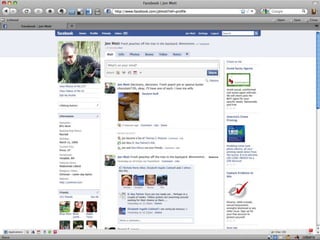
  • #89 This is Facebook
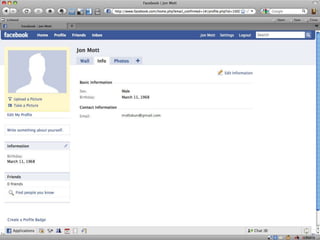
  • #90 This is Facebook every 14 weeks if it was managed like an LMS.
  • #91 The CMS is like a moated castle … IMAGE: “Japan: Osaka-jo outer moat, 1” http://www.flickr.com/photos/53537358@N00/3005861124
  • #92 … or a walled garden.IMAGE: “The Secret Gardens at Tregwainton” http://www.flickr.com/photos/zawtowers/3758680364
  • #93 Steve Wheeler: We need to create learning webs, not pour content through funnels into students heads.http://steve-wheeler.blogspot.com/2009/10/its-personal-learning-spaces-learning.html
  • #94 Gardner Campbell: “Pointing students to data buckets and conduits we’ve already made for them won’t do.”http://www.educause.edu/EDUCAUSE+Review/EDUCAUSEReviewMagazineVolume44/APersonalCyberinfrastructure/178431
  • #96 Platforms for Resilience: “School communities will need to develop strategies for building resilience into their systems and for creating lightweight, modular infrastructures.”KnowledgeWorks Foundation, “2020 Forecast: Creating the Future for Learning” http://www.futureofed.org/driver/platforms-for-resilience.aspxImage Source: “Bracken Growing Through” http://www.flickr.com/photos/spursfan_ace/569104124/sizes/l/
  • #99 See Brown, J. S., and Adler, R. (2009). “Minds on Fire: Open Education, the Long Tail, and Learning 2.0.” Educause Review, January/February (16-32).
  • #101 Martin Weller – PLE http://nogoodreason.typepad.co.uk/.shared/image.html?/photos/uncategorized/2007/12/06/pwe_3.jpg
  • #102 Scott Leslie – PLE http://edtechpost.wikispaces.com/file/view/swl_ple2.gif
  • #103 PLNs connect people in new, dynamic ways that were previously impossible.IMAGE: OpenEd Twitter Conversation – Courtesy Tony Bates http://www.tonybates.ca
  • #104 PLNs connect people in new, dynamic ways that were previously impossible.IMAGE: OpenEd Twitter Conversation – Courtesy Tony Bates http://www.tonybates.ca
  • #106 Mott, J. and Wiley, D. (2009). “Open for Learning: The CMS and the Open Learning Network,” in education, 15:2.
  • #107 Agilix, Moodle, etc.OpenFlexibleScalableLearning-Centered Tools
  • #111 The tyranny of “or”False dichotomy between the institutional network and the PLN.
  • #112 Is there a middle ground???IMAGES: Michael Chasen en Matthew Pittinskyhttp://www.flickr.com/photos/pklaassen/68271156 (left); Edupunk2 http://www.flickr.com/photos/bionicteaching/2533948716 (right)