



1
INTELLECTUAL PROPERTY RIGHTS
Mr. Sagar Kishor savale
Department of Pharmaceutics
avengersagar16@gmail.com
2015-2016
Department of Pharmacy (Pharmaceutics) | Sagar savale
CONTENTS
 INTRODUCTION
 OBJECTIVE
 IMPORTANCE
 TYPES OF IPR
 COPYRIGHT
 TRADEMARK
 REFERANCE
2
Introduction
What is “Intellectual Property”
 Human beings are distinguished from animals due to
INTELECTUALNESS.
 Intellectual property refers to creations of the mind:
inventions, literary and artistic works, and symbols, names,
images, and designs used in commerce.
3
What is meant by intellectual property
rights(IPR)
 The legal rights in the IPR has also become important for the
technological,industrial and economic development of a country.
 As ownership and transactions in other forms of property is
governed by law.
4
Why Protect “Intellectual Property”
1) Because companies & individuals expend a lot of investment
in time, energy, & money into conceptualisation & production of
new & innovative products & processes (services) & they have a
right, at least for a period of time.
2) So authors & inventors have a right to be protected for their
efforts.
3) Protection stimulates creativity and innovation necessary for
productivity, competitiveness, and national economic development.
5
 IPRs give creators exclusive rights to their creations; thereby
providing an incentive for the author or inventor to develop and share
the information rather than keep it secret.
 Carries out Research and Development activities for development
and protection of IPRs.
OBJECTIVES
6
 Prevent duplication of work.
 Help researches to focus on commercially relevant research.
 Prevent exploitation of workers.
 Prevent infringement and help avoid litigation.
 Stimulate creativity.
IMPORTANCE OF IPRs
7
The Concept of Intellectual Property Rights (IPR)
 The underlying aim of IPR is to protect the creator‘s right to be
appropriately acknowledged for his or her intellectual work.
 IPR puts in place a legal mechanism that affords the creator a
means of controlling how his or her protected work is used,
thereby ensuring that the author could be properly rewarded for his
or her creative endeavour.
8
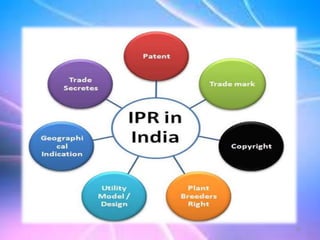
TYPES OF IPR
 Industrial Property
a) Patent
b)Trademarks
c)Industrial Designs
d)trade secrets
 Copyrights
 Geographical Indication
9
10
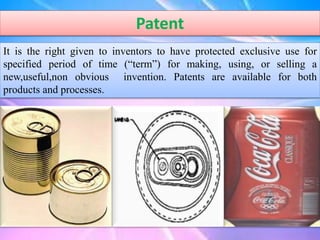
Patent
It is the right given to inventors to have protected exclusive use for
specified period of time (“term”) for making, using, or selling a
new,useful,non obvious invention. Patents are available for both
products and processes.
Trade secrets
Trade Secrets – are information deriving its value from not
being known or available to the public, competitors, or other
parties who might otherwise gain benefit from its disclosure or
use.
12
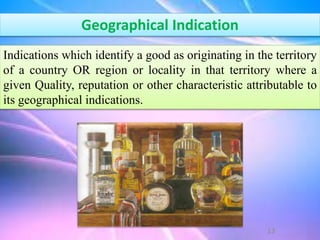
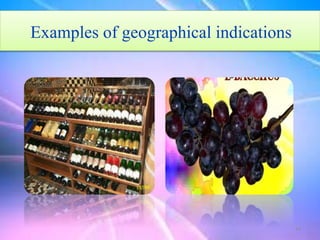
Geographical Indication
Indications which identify a good as originating in the territory
of a country OR region or locality in that territory where a
given Quality, reputation or other characteristic attributable to
its geographical indications.
13
Examples of geographical indications
14
Industrial Designs
 “Industrial designs refer to specific shape, configuration,
surface, pattern or color or combination there of which
produces an aesthetic impression of the article”.
 An “Industrial design right” protects the form of
appearance, style or design of an industrial object (e.g.
spare parts, furniture, or textiles, Shoes, TV).
15
16
EXAMPELS
COPYRIGHTS
 It is a form of originality.
 Among other things, a copyright is the right to make copies.
 Copyright is concerned with protecting the work of the human
intelect
16
17
Copyright
Copyright – is the exclusive right to do certain things
with an original work, including the right to reproduce,
publish, perform the work in public, & to make
adaptations of it. Copyright does not protect ideas as
such, but only the original expression of ideas.
EXAMPLES:
Books, plays, poems, sculptures, dolls, vessel hull designs,
paintings, photographs, computer programs, news papers,
furniture, websites.
18
Indian Copyright Act, 1957
 India has a very strong and comprehensive copyright law based on
Indian Copyright Act. 1957
 It was amended in 1981, 1984, 1992, 1994 and 1999 (w.e.f.January
15, 2000).
 The amendment in 1994 were a response to technological changes in
the means of Communications like broadcasting and telecasting and
the emergence of new technology like computer software.
 The 1999 amendments have made the Copyright Act fully compatible
with TRIPS Agreement.
19
Copyright Act 1957
What does copyright cover?
i. Literary, dramatic and musical work. Computer
programs/software are covered within the definition of
literary work;
ii. Artistic work;
iii. Cinematographic films which include sound track and
video films;
iv. Record-any disc, tape, performed roll or other device
20
Types of rights under copyright
• Economic rights,
Which allow the owner of rights to derive financial reward
from the use of his works by others
● The Right of Reproduction
● The Right of Performance
● The Right of Broadcasting
● The Right of Communication
• Moral rights,
Which allow the author to take certain actions to preserve the
personal link between himself and the work.
– Right of authorship
– Right of Respect
21
Trademark
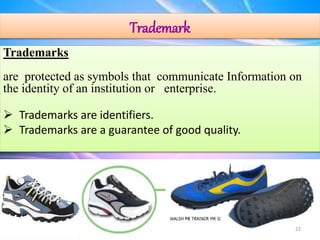
Trademarks
are protected as symbols that communicate Information on
the identity of an institution or enterprise.
 Trademarks are identifiers.
 Trademarks are a guarantee of good quality.
22
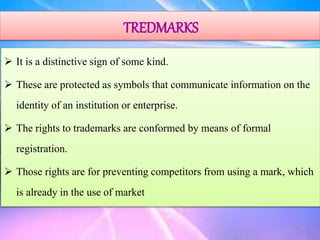
TREDMARKS
 It is a distinctive sign of some kind.
 These are protected as symbols that communicate information on the
identity of an institution or enterprise.
 The rights to trademarks are conformed by means of formal
registration.
 Those rights are for preventing competitors from using a mark, which
is already in the use of market
23
Continued………
 A sign that individualizes goods.
 Trademarks are identifiers.
 Trademarks are a guarantee of good quality.
 Trademarks are identification of company ,and service marks are
which provide service.
 Examples of trademarks -
Words, letters, numerical, devices, colored marks or combination of it.
24
EXAMPLES OF TRADEMARKS
25
Reference
 Parishes Bansal, “IPR Handbook for Pharma students
and Researchers”, second edition 2008, pharmaMed Press,
Hyderabad,1-7,30-34.
 Dr. B. S. Kuchekar‘s “forensic pharmacy”nirali prakashan
7th edition pune 16.1-16.8
 www.uspto.gov
 www.delphion.com
 www.espacenet.com
26

Intelactual property rights [IPR]

  • 1.
    1 INTELLECTUAL PROPERTY RIGHTS Mr.Sagar Kishor savale Department of Pharmaceutics avengersagar16@gmail.com 2015-2016 Department of Pharmacy (Pharmaceutics) | Sagar savale
  • 2.
    CONTENTS  INTRODUCTION  OBJECTIVE IMPORTANCE  TYPES OF IPR  COPYRIGHT  TRADEMARK  REFERANCE 2
  • 3.
    Introduction What is “IntellectualProperty”  Human beings are distinguished from animals due to INTELECTUALNESS.  Intellectual property refers to creations of the mind: inventions, literary and artistic works, and symbols, names, images, and designs used in commerce. 3
  • 4.
    What is meantby intellectual property rights(IPR)  The legal rights in the IPR has also become important for the technological,industrial and economic development of a country.  As ownership and transactions in other forms of property is governed by law. 4
  • 5.
    Why Protect “IntellectualProperty” 1) Because companies & individuals expend a lot of investment in time, energy, & money into conceptualisation & production of new & innovative products & processes (services) & they have a right, at least for a period of time. 2) So authors & inventors have a right to be protected for their efforts. 3) Protection stimulates creativity and innovation necessary for productivity, competitiveness, and national economic development. 5
  • 6.
     IPRs givecreators exclusive rights to their creations; thereby providing an incentive for the author or inventor to develop and share the information rather than keep it secret.  Carries out Research and Development activities for development and protection of IPRs. OBJECTIVES 6
  • 7.
     Prevent duplicationof work.  Help researches to focus on commercially relevant research.  Prevent exploitation of workers.  Prevent infringement and help avoid litigation.  Stimulate creativity. IMPORTANCE OF IPRs 7
  • 8.
    The Concept ofIntellectual Property Rights (IPR)  The underlying aim of IPR is to protect the creator‘s right to be appropriately acknowledged for his or her intellectual work.  IPR puts in place a legal mechanism that affords the creator a means of controlling how his or her protected work is used, thereby ensuring that the author could be properly rewarded for his or her creative endeavour. 8
  • 9.
    TYPES OF IPR Industrial Property a) Patent b)Trademarks c)Industrial Designs d)trade secrets  Copyrights  Geographical Indication 9
  • 10.
  • 11.
    Patent It is theright given to inventors to have protected exclusive use for specified period of time (“term”) for making, using, or selling a new,useful,non obvious invention. Patents are available for both products and processes.
  • 12.
    Trade secrets Trade Secrets– are information deriving its value from not being known or available to the public, competitors, or other parties who might otherwise gain benefit from its disclosure or use. 12
  • 13.
    Geographical Indication Indications whichidentify a good as originating in the territory of a country OR region or locality in that territory where a given Quality, reputation or other characteristic attributable to its geographical indications. 13
  • 14.
  • 15.
    Industrial Designs  “Industrialdesigns refer to specific shape, configuration, surface, pattern or color or combination there of which produces an aesthetic impression of the article”.  An “Industrial design right” protects the form of appearance, style or design of an industrial object (e.g. spare parts, furniture, or textiles, Shoes, TV). 15
  • 16.
  • 17.
    COPYRIGHTS  It isa form of originality.  Among other things, a copyright is the right to make copies.  Copyright is concerned with protecting the work of the human intelect 16 17
  • 18.
    Copyright Copyright – isthe exclusive right to do certain things with an original work, including the right to reproduce, publish, perform the work in public, & to make adaptations of it. Copyright does not protect ideas as such, but only the original expression of ideas. EXAMPLES: Books, plays, poems, sculptures, dolls, vessel hull designs, paintings, photographs, computer programs, news papers, furniture, websites. 18
  • 19.
    Indian Copyright Act,1957  India has a very strong and comprehensive copyright law based on Indian Copyright Act. 1957  It was amended in 1981, 1984, 1992, 1994 and 1999 (w.e.f.January 15, 2000).  The amendment in 1994 were a response to technological changes in the means of Communications like broadcasting and telecasting and the emergence of new technology like computer software.  The 1999 amendments have made the Copyright Act fully compatible with TRIPS Agreement. 19
  • 20.
    Copyright Act 1957 Whatdoes copyright cover? i. Literary, dramatic and musical work. Computer programs/software are covered within the definition of literary work; ii. Artistic work; iii. Cinematographic films which include sound track and video films; iv. Record-any disc, tape, performed roll or other device 20
  • 21.
    Types of rightsunder copyright • Economic rights, Which allow the owner of rights to derive financial reward from the use of his works by others ● The Right of Reproduction ● The Right of Performance ● The Right of Broadcasting ● The Right of Communication • Moral rights, Which allow the author to take certain actions to preserve the personal link between himself and the work. – Right of authorship – Right of Respect 21
  • 22.
    Trademark Trademarks are protected assymbols that communicate Information on the identity of an institution or enterprise.  Trademarks are identifiers.  Trademarks are a guarantee of good quality. 22
  • 23.
    TREDMARKS  It isa distinctive sign of some kind.  These are protected as symbols that communicate information on the identity of an institution or enterprise.  The rights to trademarks are conformed by means of formal registration.  Those rights are for preventing competitors from using a mark, which is already in the use of market 23
  • 24.
    Continued………  A signthat individualizes goods.  Trademarks are identifiers.  Trademarks are a guarantee of good quality.  Trademarks are identification of company ,and service marks are which provide service.  Examples of trademarks - Words, letters, numerical, devices, colored marks or combination of it. 24
  • 25.
  • 26.
    Reference  Parishes Bansal,“IPR Handbook for Pharma students and Researchers”, second edition 2008, pharmaMed Press, Hyderabad,1-7,30-34.  Dr. B. S. Kuchekar‘s “forensic pharmacy”nirali prakashan 7th edition pune 16.1-16.8  www.uspto.gov  www.delphion.com  www.espacenet.com 26