Intellectual property rights . . .


             • The rights given to persons over
               creations of their minds

             • The product should be unique
               and have some value in the
               market.
•   Like Real Property:

    –   It can be bought,
        sold, licensed,
        exchanged, given
        away

    –   The owner can
        prevent unauthorized
        use
Three Principle Types . . .


– Patents
– Copyrights
– Trademarks

– industrial design rights and trade secrets
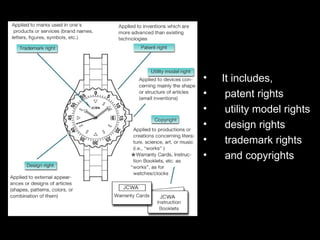
•   It includes,
•    patent rights
•    utility model rights
•    design rights
•    trademark rights
•    and copyrights
Patent . . .
•   The Patent Bill of 1790 enabled the
    government to patent

•    “Any useful art, manufacture, engine, machine,
    or device, or any instrument thereon not before
    known or used."

    –   Not discoveries of nature

    –   Exclusive right to make, use and sell an invention for
        a specific period—20 years
Patent Benefits . . .
• Rewards time, money & effort associated with
  research

• Encourages innovation and research by
  permitting companies to recover R&D costs

• Encourages quick commercialization

• Allow early exchange of information between
  research groups
  – Avoiding duplicate efforts
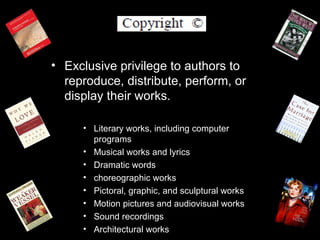
• Exclusive privilege to authors to
  reproduce, distribute, perform, or
  display their works.

     • Literary works, including computer
       programs
     • Musical works and lyrics
     • Dramatic words
     • choreographic works
     • Pictoral, graphic, and sculptural works
     • Motion pictures and audiovisual works
     • Sound recordings
     • Architectural works
• It is usually associated with civil law.

• In the Copyright Act, there are provisions to treat
  all forms of infringement of copyright as
  offences.

• The police also have powers to take action and
  is punishable with a minimum of six months’
  imprisonment, which may extend to three years,
  and a fine of between Rs 50,000 and Rs
  200,000.
Trademark . . .

• Word or symbol used by manufacturers to
  identify goods.

• It is a distinctive sign which is used to
  prevent confusion among products in the
  marketplace.
Legislation . . .
• (WIPO) World Intellectual Property
  Organisation

• (WTO) World Trade Organisation

• (TRIPS) Trade-Related Aspects of
  Intellectual Property Rights
Legislations . . .
• Each country or region has its own set of IPRs laws and
  regulations

• In Jan 1, 1995 the WTO Agreement on Trade-Related
  Aspects of Intellectual Property Rights (“TRIPS
  Agreement”) entered into force

• TRIPS Agreement rules do not directly apply in most
  national legal systems, but instead are implemented by
  legislation

• TRIPS allows for compulsory licensing, price controls
  and a competition policy.
Those are my thoughts.
   What are yours?
Seminar by . . .
•   M.Ravishankar
•   Oxygen024@gmail.com
•   MBA [ Final ] 2008 - 2010
•   Nift-tea college of fashion
•   Tirupur, Tamil nadu.
•   India.

Intellectual property-rights

  • 2.
    Intellectual property rights. . . • The rights given to persons over creations of their minds • The product should be unique and have some value in the market.
  • 3.
    Like Real Property: – It can be bought, sold, licensed, exchanged, given away – The owner can prevent unauthorized use
  • 4.
    Three Principle Types. . . – Patents – Copyrights – Trademarks – industrial design rights and trade secrets
  • 5.
    It includes, • patent rights • utility model rights • design rights • trademark rights • and copyrights
  • 6.
    Patent . .. • The Patent Bill of 1790 enabled the government to patent • “Any useful art, manufacture, engine, machine, or device, or any instrument thereon not before known or used." – Not discoveries of nature – Exclusive right to make, use and sell an invention for a specific period—20 years
  • 7.
    Patent Benefits .. . • Rewards time, money & effort associated with research • Encourages innovation and research by permitting companies to recover R&D costs • Encourages quick commercialization • Allow early exchange of information between research groups – Avoiding duplicate efforts
  • 8.
    • Exclusive privilegeto authors to reproduce, distribute, perform, or display their works. • Literary works, including computer programs • Musical works and lyrics • Dramatic words • choreographic works • Pictoral, graphic, and sculptural works • Motion pictures and audiovisual works • Sound recordings • Architectural works
  • 9.
    • It isusually associated with civil law. • In the Copyright Act, there are provisions to treat all forms of infringement of copyright as offences. • The police also have powers to take action and is punishable with a minimum of six months’ imprisonment, which may extend to three years, and a fine of between Rs 50,000 and Rs 200,000.
  • 10.
    Trademark . .. • Word or symbol used by manufacturers to identify goods. • It is a distinctive sign which is used to prevent confusion among products in the marketplace.
  • 11.
    Legislation . .. • (WIPO) World Intellectual Property Organisation • (WTO) World Trade Organisation • (TRIPS) Trade-Related Aspects of Intellectual Property Rights
  • 12.
    Legislations . .. • Each country or region has its own set of IPRs laws and regulations • In Jan 1, 1995 the WTO Agreement on Trade-Related Aspects of Intellectual Property Rights (“TRIPS Agreement”) entered into force • TRIPS Agreement rules do not directly apply in most national legal systems, but instead are implemented by legislation • TRIPS allows for compulsory licensing, price controls and a competition policy.
  • 13.
    Those are mythoughts. What are yours?
  • 14.
    Seminar by .. . • M.Ravishankar • Oxygen024@gmail.com • MBA [ Final ] 2008 - 2010 • Nift-tea college of fashion • Tirupur, Tamil nadu. • India.