• Objectives of Granting IPR
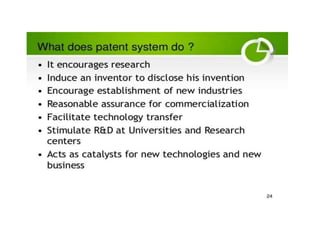
• i. To enhance the performance levels of
institutions.
• ii. To give recognition and financial benefits to the
efforts for the creativity
• iii. To create competition among the researchers
and institutions for quality of research
• iv. To have return on investment in research
• v. To fasten the technology transfer through
licensing and other means
TRIPS
• The Agreement on Trade Related Aspects of Intellectual Property
Rights (TRIPS) is an international
• agreement administered by the World Trade Organization (WTO)
that sets down minimum standards
• for many forms of intellectual property (IP) regulation. Specifically,
TRIPS contains requirements that
• nations' laws must meet for: copyright rights, including the rights of
performers, producers of sound
• recordings and broadcasting organizations; geographical indications,
including appellations of origin;
• industrial designs; integrated circuit layout-designs; patents;
monopolies for the developers of new plant
• varieties; trademarks; trade dress; and undisclosed or confidential
information
Definition
• Copyright is a right given by the law to
creators of literary, dramatic, musical,
performances and artistic works and
producers of cinematograph films and sound
recordings.
• Use of the "©" symbol
• Anyone who claims copyrights in a work can
use copyright notice to alert the public of the
claim
Patent
A Patent is an exclusive right granted by the
government to the owner of the invention for a
• limited period to make, use, manufacture and
market the invention, provided the invention
satisfy the
• following criteria:
• • Novelty: not known as prior art
• • Non- obviousness: Must involve inventiveness
• • Usefulness: Invention must have industrial
application
• TRIPS Agreement : The TRIPS agreement says
that granting protection through patent
should have following provisions:
• Patent protection must be available for
inventions for at least 20 years.
• Patent protection must be available for both
products and processes, in almost all fields of
• Technology.
• Definition: Geographical indications (GI) are
indications that identify a good as originating in the
• territory of a country, or a region or locality in that
territory, where a given quality, reputation or other
• characteristic of the good is essentially attributable to
its geographic origin.
• Geographical indications serve the same functions as
trademarks, because like trademarks they are:
• 1. source-identifiers,
• 2. guarantees of quality, and
• 3. valuable business interests.
• The TRIPS Agreement says countries have to
prevent this misuse of place names.
• For wines and spirits, the agreement provides
higher levels of protection, i.e. even where
there is no danger of the public being misled.
• Definition: A trade mark (popularly known as brand
name) in layman’s language is a visual symbol
• which may be a word signature, name, device, label,
numerals or combination of colours used by one
• undertaking on goods or services or other articles of
commerce to distinguish it from other similar
• goods or services originating from a different
undertaking. In summary-
• It identifies the goods /or services and its origin.
• It guarantees its unchanged quality
• It advertises the goods/services
• It creates an image for the goods/ services.
IPR ppt.pptx
IPR ppt.pptx
IPR ppt.pptx

IPR ppt.pptx

  • 2.
    • Objectives ofGranting IPR • i. To enhance the performance levels of institutions. • ii. To give recognition and financial benefits to the efforts for the creativity • iii. To create competition among the researchers and institutions for quality of research • iv. To have return on investment in research • v. To fasten the technology transfer through licensing and other means
  • 3.
    TRIPS • The Agreementon Trade Related Aspects of Intellectual Property Rights (TRIPS) is an international • agreement administered by the World Trade Organization (WTO) that sets down minimum standards • for many forms of intellectual property (IP) regulation. Specifically, TRIPS contains requirements that • nations' laws must meet for: copyright rights, including the rights of performers, producers of sound • recordings and broadcasting organizations; geographical indications, including appellations of origin; • industrial designs; integrated circuit layout-designs; patents; monopolies for the developers of new plant • varieties; trademarks; trade dress; and undisclosed or confidential information
  • 5.
    Definition • Copyright isa right given by the law to creators of literary, dramatic, musical, performances and artistic works and producers of cinematograph films and sound recordings. • Use of the "©" symbol • Anyone who claims copyrights in a work can use copyright notice to alert the public of the claim
  • 7.
    Patent A Patent isan exclusive right granted by the government to the owner of the invention for a • limited period to make, use, manufacture and market the invention, provided the invention satisfy the • following criteria: • • Novelty: not known as prior art • • Non- obviousness: Must involve inventiveness • • Usefulness: Invention must have industrial application
  • 14.
    • TRIPS Agreement: The TRIPS agreement says that granting protection through patent should have following provisions: • Patent protection must be available for inventions for at least 20 years. • Patent protection must be available for both products and processes, in almost all fields of • Technology.
  • 15.
    • Definition: Geographicalindications (GI) are indications that identify a good as originating in the • territory of a country, or a region or locality in that territory, where a given quality, reputation or other • characteristic of the good is essentially attributable to its geographic origin. • Geographical indications serve the same functions as trademarks, because like trademarks they are: • 1. source-identifiers, • 2. guarantees of quality, and • 3. valuable business interests.
  • 16.
    • The TRIPSAgreement says countries have to prevent this misuse of place names. • For wines and spirits, the agreement provides higher levels of protection, i.e. even where there is no danger of the public being misled.
  • 17.
    • Definition: Atrade mark (popularly known as brand name) in layman’s language is a visual symbol • which may be a word signature, name, device, label, numerals or combination of colours used by one • undertaking on goods or services or other articles of commerce to distinguish it from other similar • goods or services originating from a different undertaking. In summary- • It identifies the goods /or services and its origin. • It guarantees its unchanged quality • It advertises the goods/services • It creates an image for the goods/ services.