INTELLECTUAL
PROPERTY LAW
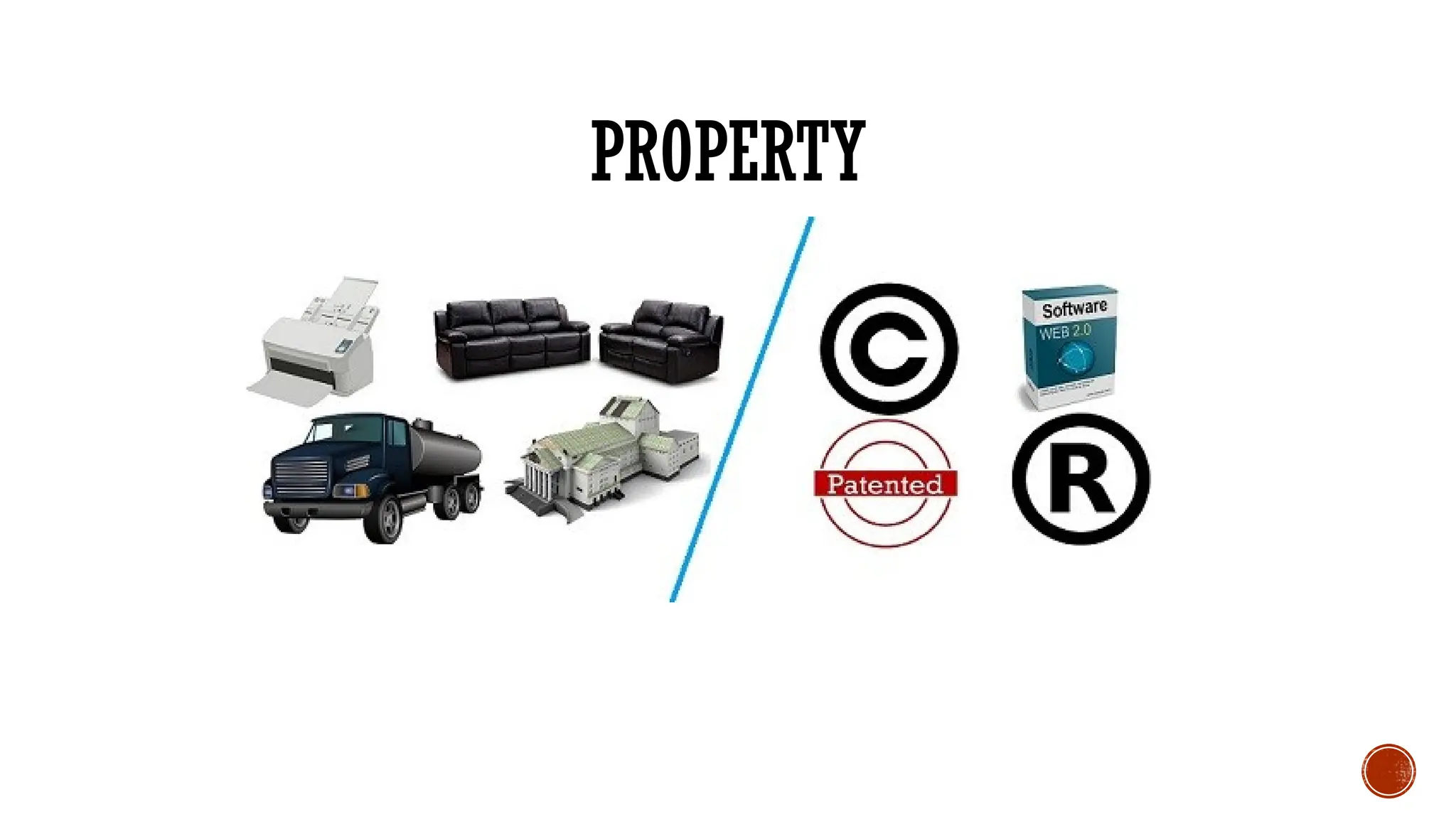
PROPERTY
KNOWLEDGE IS POWER
KNOWLEDGE IS TOOL FOR DEVELOPMENT
KNOWLEDGE IS MONEY
IT HAS TO BE PROTECTED
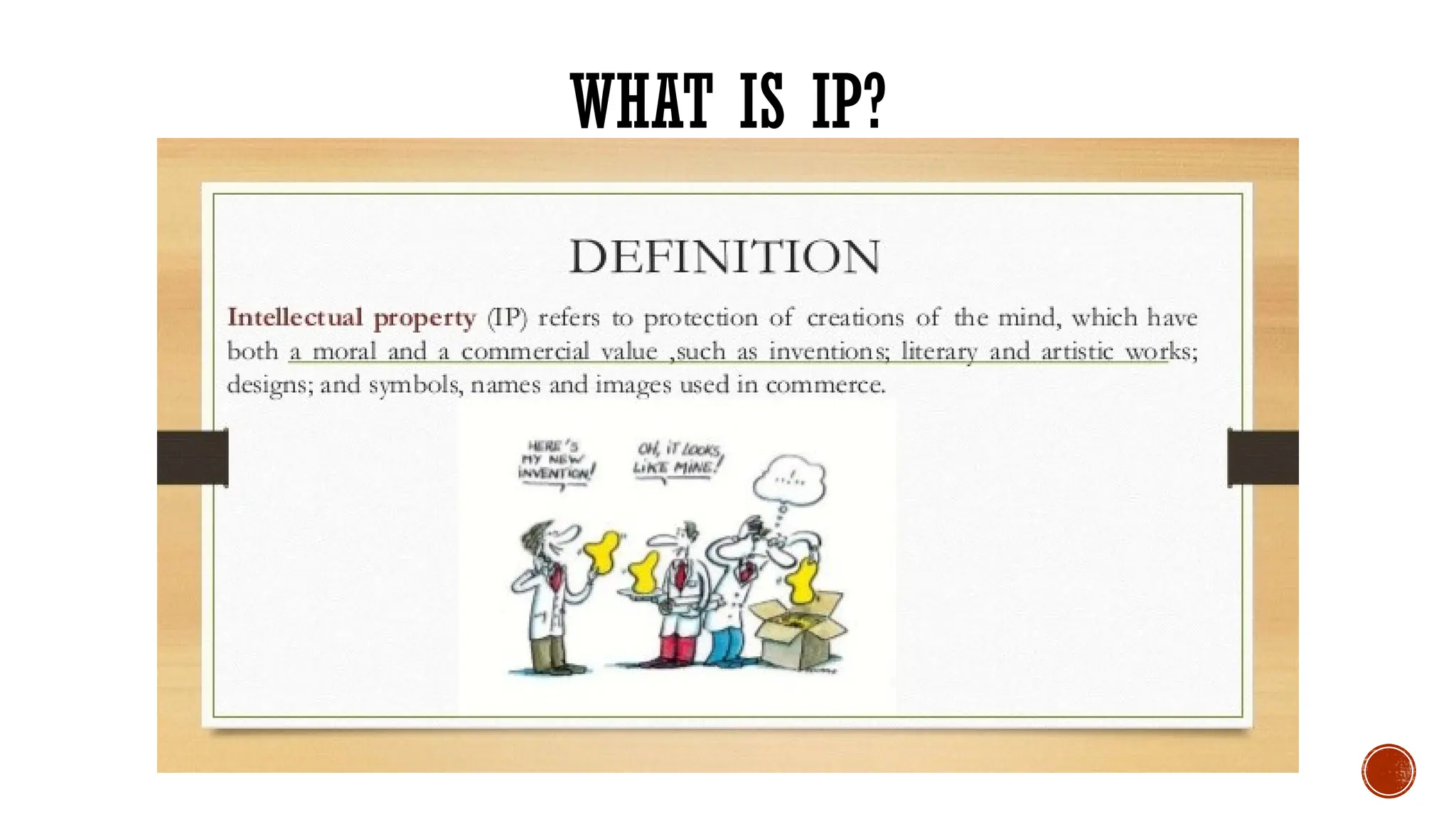
WHAT IS IP?
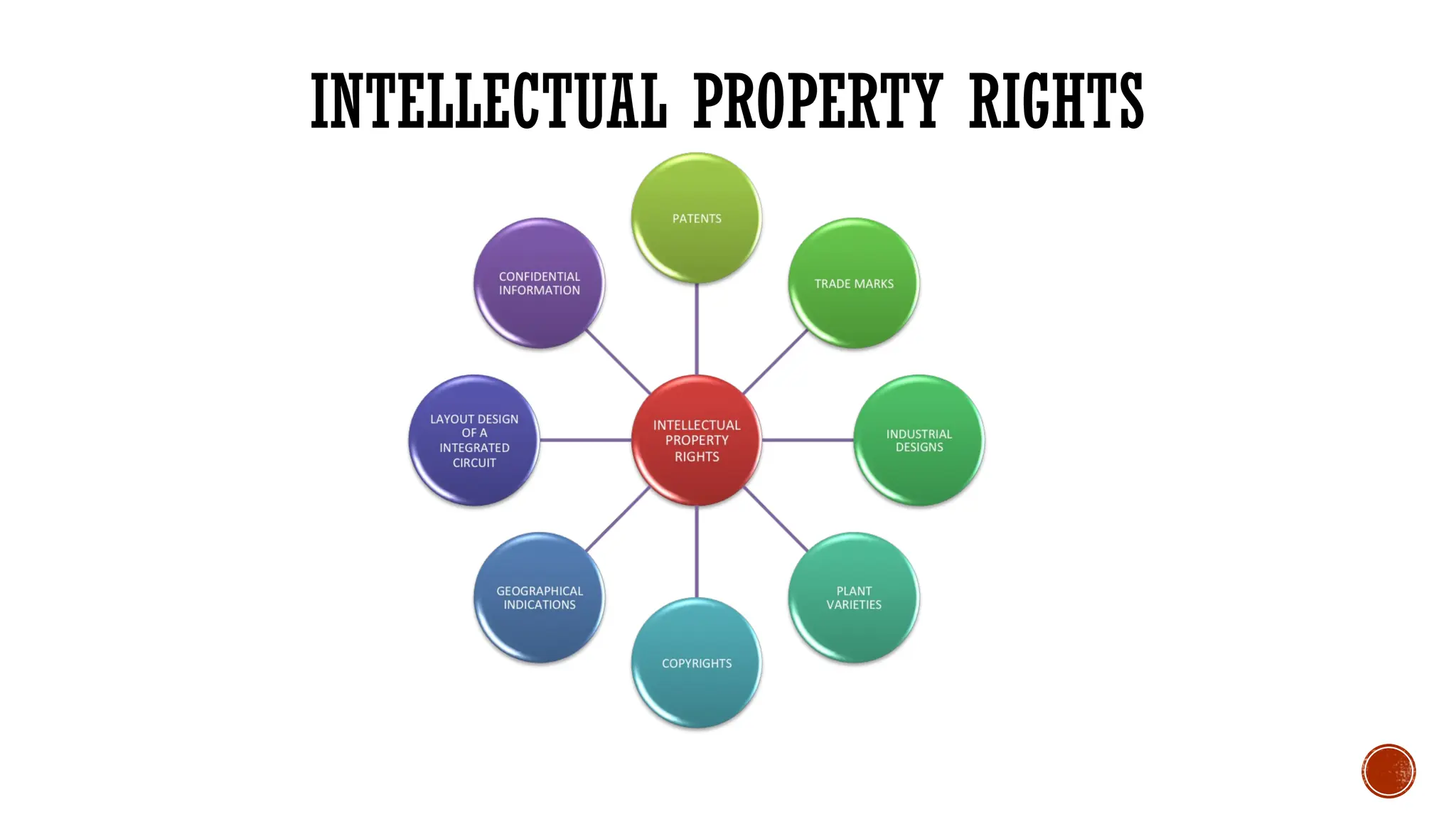
INTELLECTUAL PROPERTY RIGHTS
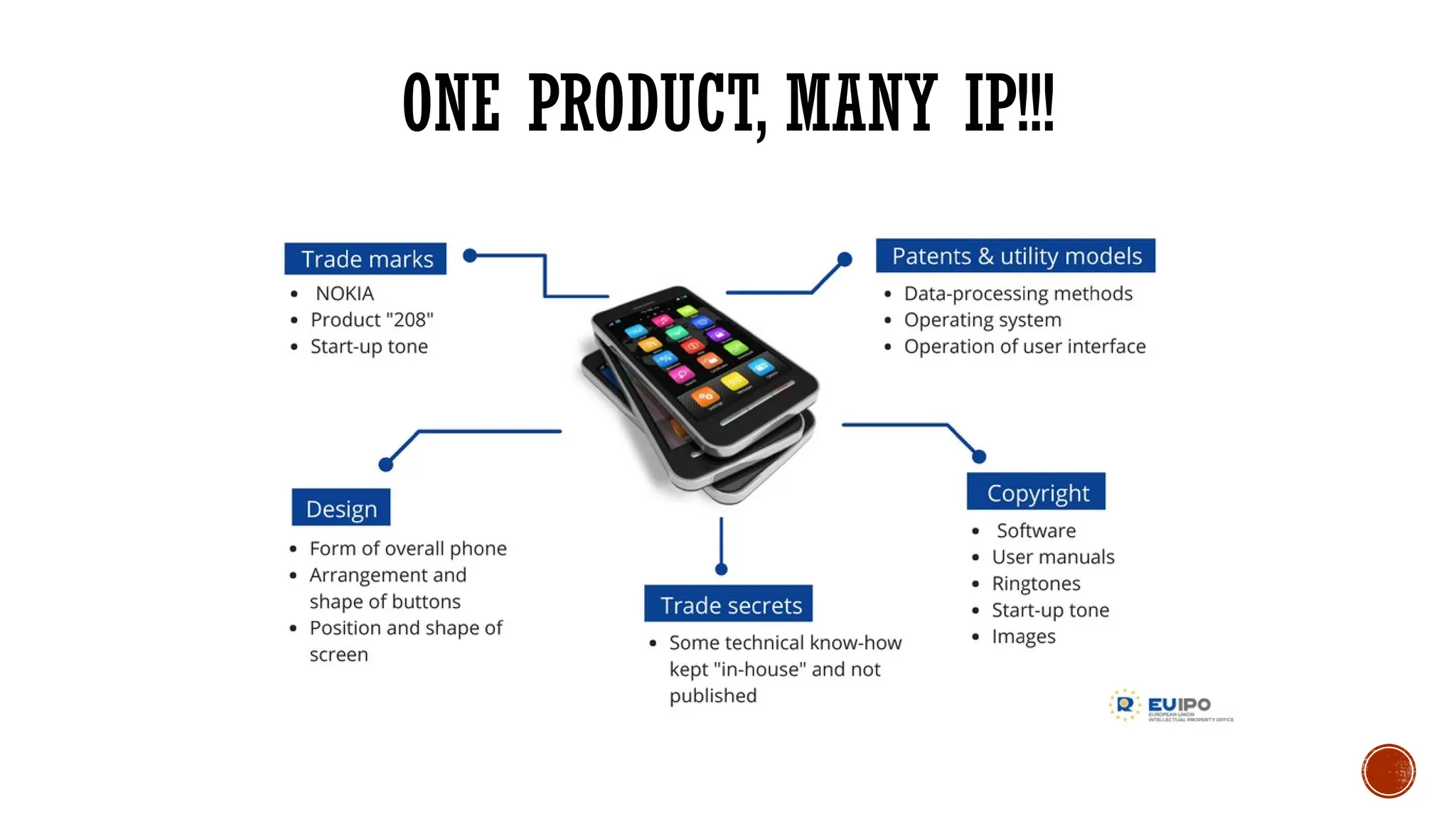
ONE PRODUCT, MANY IP!!!
WHY LEARN IP LAW
IMPORTANCE OF IPR
Intellectual Property Rights plays a significant
role in protecting your creativity and innovation
It is important for enhancing your business
IP is wealth which can be stolen easily, so needs
to be protected!!
 https://www.youtube.com/watch?v=G79yiNANWZU&t=7s
COURSE EDUCATIONAL OBJECTIVES
 To understand the basic concepts of IPR.
 To acquire skills in applying the IPR Law in several practical ways.
 To acquaint the students with the registration of different kinds of IPR applicable across several
skill sectors.
 To analyze the recent amendments dealing with IPR Legislations
 Evaluate as against other the international legal framework related to IP protection and
articulate the problem areas for the deficiency.
 Propose a solution to the existing IP problems in India.
SYLLABUS
 Unit – 1 Introduction - Concept of Intellectual Property-and its characteristics and nature of
intellectual property right justifications for protection of IP and harmonization; International
Conventions of IPRs; Types of IPRs; WTO, TRIPs; Theories of IPR:- i. Natural Theory. (ii) Hegelian
Philosophy (Personality Theory) iii. Lockes' Theory Of Property (Labour Theory) Iv. Social Contract
Theory. Economic Theory, IP- relation with Competition law, Trade law and other multi-disciplinary
areas.
 Unit – 2 Patents - Indian Patents Act, 1970- Meaning Criteria for obtaining patents , Patent Search,
Procedure for registration; Specification; Term of patent, rights of Patentee; Transfer, Revocation and
Surrender of Patents; Infringement of Patents and Remedies for infringement; Basic concept of
Voluntary and Compulsory license, parallel import, process product patents, Govt. use of Patents for
Public purpose, Dispute resolution bodies national and International.
 Unit – 3 Trade Marks - Trade Marks Act, 1999 - Functions of Trademarks; Categories of Trademark:
Certification Mark, Collective Mark and Well known Mark and Non-conventional Marks, Service
marks, Classification of goods and Service; Registration of Trademarks; Doctrine of distinctiveness;
Absolute and relative grounds of refusal Doctrine of honest concurrent user Infringement of
Trademarks;, Remedies; Licensing in trademarks – Deceptive Similarity and passing off, Border
measures and Trademark protection Domain name registration, Domain Name Disputes & WIPO.
Geographical Indication; Difference between GI and Trade Marks, Concept of Authorized user,
Homonymous GI, Geographical Indication of Goods 141 (Registration and Protection) Act, 1999 -
Infringements and Remedies, Adjudication authorities in dispute resolution
SYLLABUS
 Unit – 4 Copyright - Copyright Act 1957 - Characteristics; works protected under-
copyright - Literary works; Dramatic, musical & amp; artistic works; Architecture,
cinematograph film & sound recording; Author and ownership of Copyright; Rights
conferred by Copyright; Term of Copyright; Infringement and Remedies for
Infringement; Performers' Right; Publication Copyright issues in digital era,
Software Piracy, Copy left.
 Unit – 5 Designs - Design Act, 2000 - Registerable designs; Procedure for
Registration; Piracy of a design; The Semiconductor Integrated Circuits Layout
Designs Act, 2000; The Plant Varieties and Farmers' Rights Act, 2001; National
Register of Plant Varieties. Trade secret, Meaning, Criteria of Protection, Traditional
Knowledge, e-Protection of Traditional Knowledge.
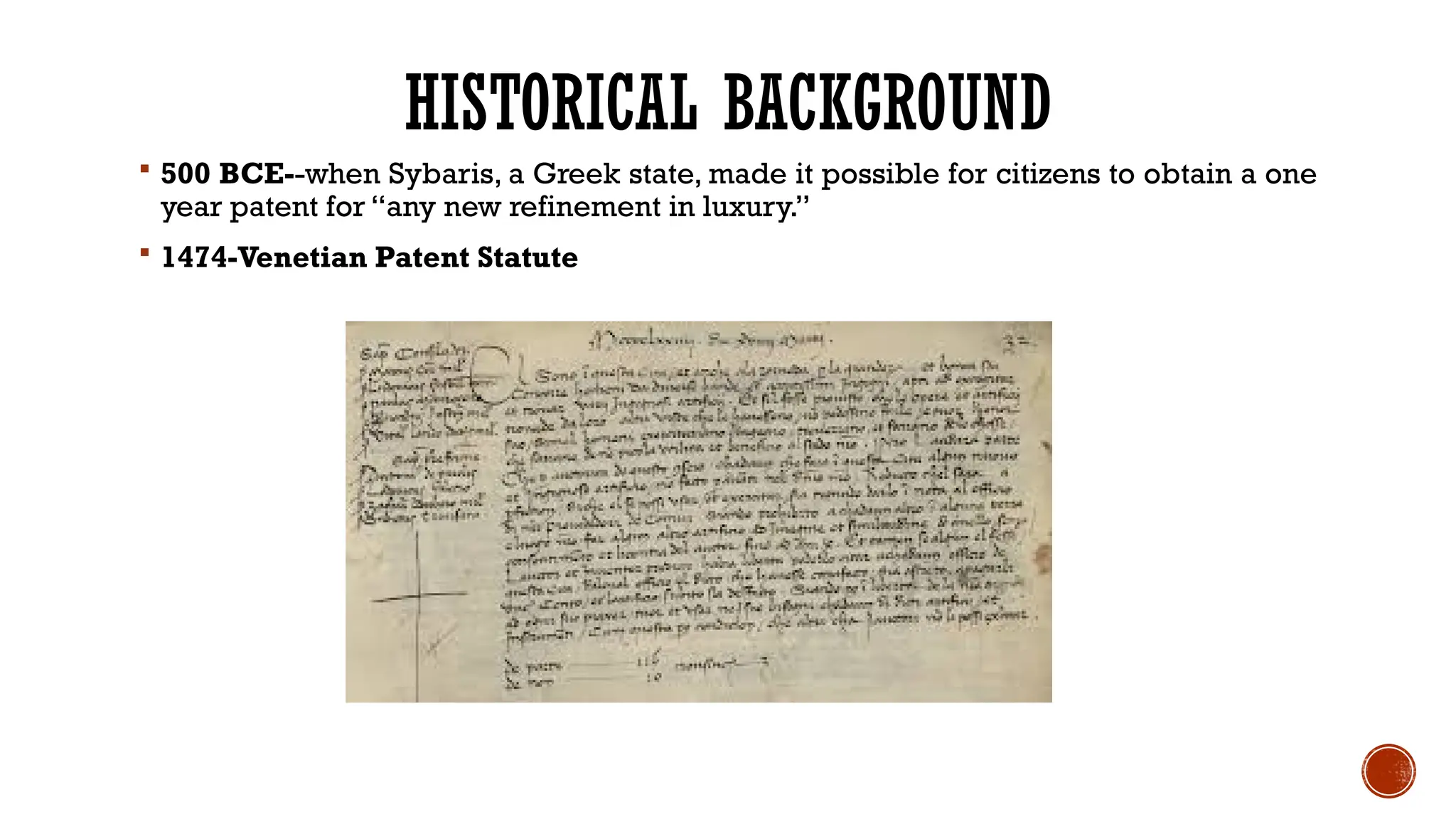
HISTORICAL BACKGROUND
 500 BCE--when Sybaris, a Greek state, made it possible for citizens to obtain a one
year patent for “any new refinement in luxury.”
 1474-Venetian Patent Statute
 1623-- Statute of Monopolies
 Origin from letters patent
 14 years protection
 1710-Statute of Anne
 Provided a 14 year term of protection. It also gave option of seeking a 14 year renewal
term.
 Aimed largely at copyrights, this law granted authors rights in the recreation and
distribution of their work.
 Late 1800’s- Global Intellectual Property Development
GLOBAL INTELLECTUAL PROPERTY
DEVELOPMENT
 1883- The Paris Convention for the Protection of Industrial Property
 1886-The Berne Convention for the Protection of Literary and Artistic Works
 1891- Madrid Agreement Concerning International Registration of Marks
 1893-United International Bureaux for the Protection of Intellectual Property
(Precursor of WIPO)
 Paris Convention and Berne Convention merged
 1994-The Agreement on Trade-Related Aspects of Intellectual Property Rights
(TRIPS)
1883- THE PARIS CONVENTION FOR THE
PROTECTION OF INDUSTRIAL PROPERTY
 Industrial rights; Patents,Trademarks and design rights
 1883
 Last amendment: 1979
 177 members
 Basic principles:
 Principle of national treatment (nondiscrimination)
 Rule of priority
 Common rules
1886-THE BERNE CONVENTION FOR THE
PROTECTION OF LITERARY AND ARTISTIC WORKS
 Intellectual rights; Literary and Artistic Works
 1886
 Last amendment: 1979
 179 members
 Basic principles:
 Principle of national treatment (nondiscrimination)
 Principle of automatic protection
 Principle of Independence of Protection
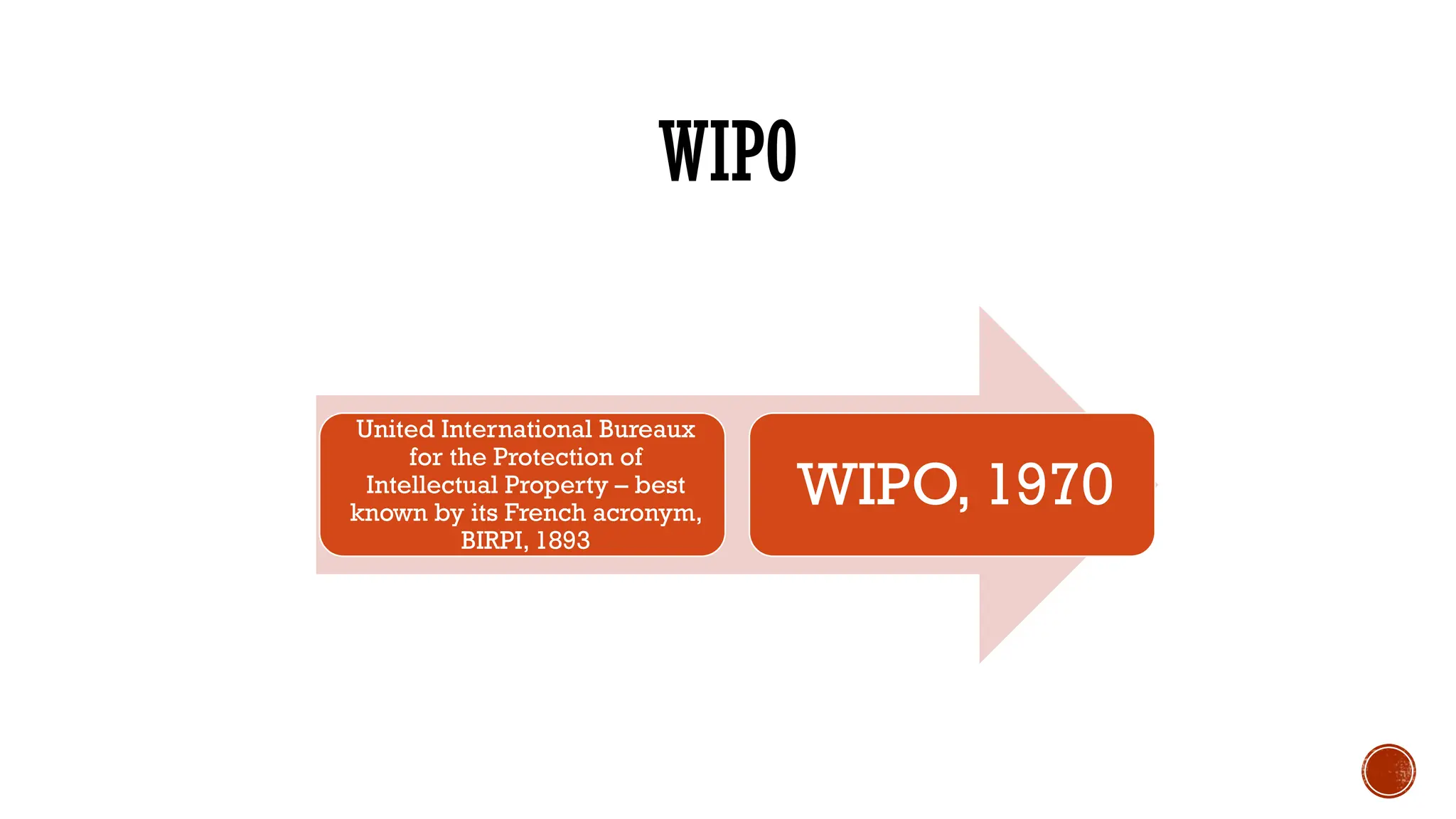
WIPO
United International Bureaux
for the Protection of
Intellectual Property – best
known by its French acronym,
BIRPI, 1893
WIPO, 1970
STRATEGIC GOALS OF WIPO
• Balanced Evolution of the International Normative Framework for IP
• Provision of Premier Global IP Services
• Facilitating the Use of IP for Development
• Coordination and Development of Global IP Infrastructure
• World Reference Source for IP Information and Analysis
• International Cooperation on Building Respect for IP
• Addressing IP in Relation to Global Policy Issues
• A Responsive Communications Interface between WIPO, its Member States and All
Stakeholders
• An Efficient Administrative and Financial Support Structure to Enable WIPO to Deliver its
Programs
1994-THE AGREEMENT ON TRADE-RELATED ASPECTS OF
INTELLECTUAL PROPERTY RIGHTS (TRIPS)
 Agreement on Trade-Related Aspects of Intellectual Property Rights
 1994
 Background; negotiations in GATT
 WTO (164 members) established in 1993 and TRIPs entered into force in1995
 Minimum requirements to national legislation on IPR and enforcement of IPR
 scope is to bring up level of protection in developing countries
TRIPS
 PART I-GENERAL PROVISIONS AND BASIC PRINCIPLES
 PART II STANDARDS CONCERNING THE AVAILABILITY, SCOPE AND USE OF
INTELLECTUAL PROPERTY RIGHTS
1.Copyright and Related Rights (Art. 9-14)
2.Trademarks (Art. 15-21)
3. Geographical Indications (Art. 22-24)
4. Industrial Designs (Art. 25-26)
5. Patents (Art. 27-34)
6. Layout-Designs (Topographies) of Integrated Circuits (Art. 35-38)
7. Protection of Undisclosed Information (Art. 39)
8. Control of Anti-Competitive Practices in Contractual Licences (Art. 40)
 PART III-ENFORCEMENT OF INTELLECTUAL PROPERTY RIGHTS
 PART IV- ACQUISITION AND MAINTENANCE OF INTELLECTUAL PROPERTY
RIGHTS AND RELATED INTER-PARTES PROCEDURES
 PART V -DISPUTE PREVENTION AND SETTLEMENT
 PART VI-TRANSITIONAL ARRANGEMENTS PART VII INSTITUTIONAL
ARRANGEMENTS; FINAL PROVISIONS
COPYRIGHT-INTERNATIONAL CONVENTIONS
 Berne Convention 1886
 Universal Copyright Convention, 1952
 Rome Convention for the Protection of Performers, Producers of Phonograms and
Broadcasting Organizations, 1961
 TRIPS Agreement 1994
 WIPO Copyright Treaty 1996
 WIPO Performances and Phonograms Treaty 1996
 Marrakesh Treaty to Facilitate Access to Published Works by Visually Impaired
Persons and Persons with Print Disabilities, 2013
PATENTS-INTERNATIONAL CONVENTIONS
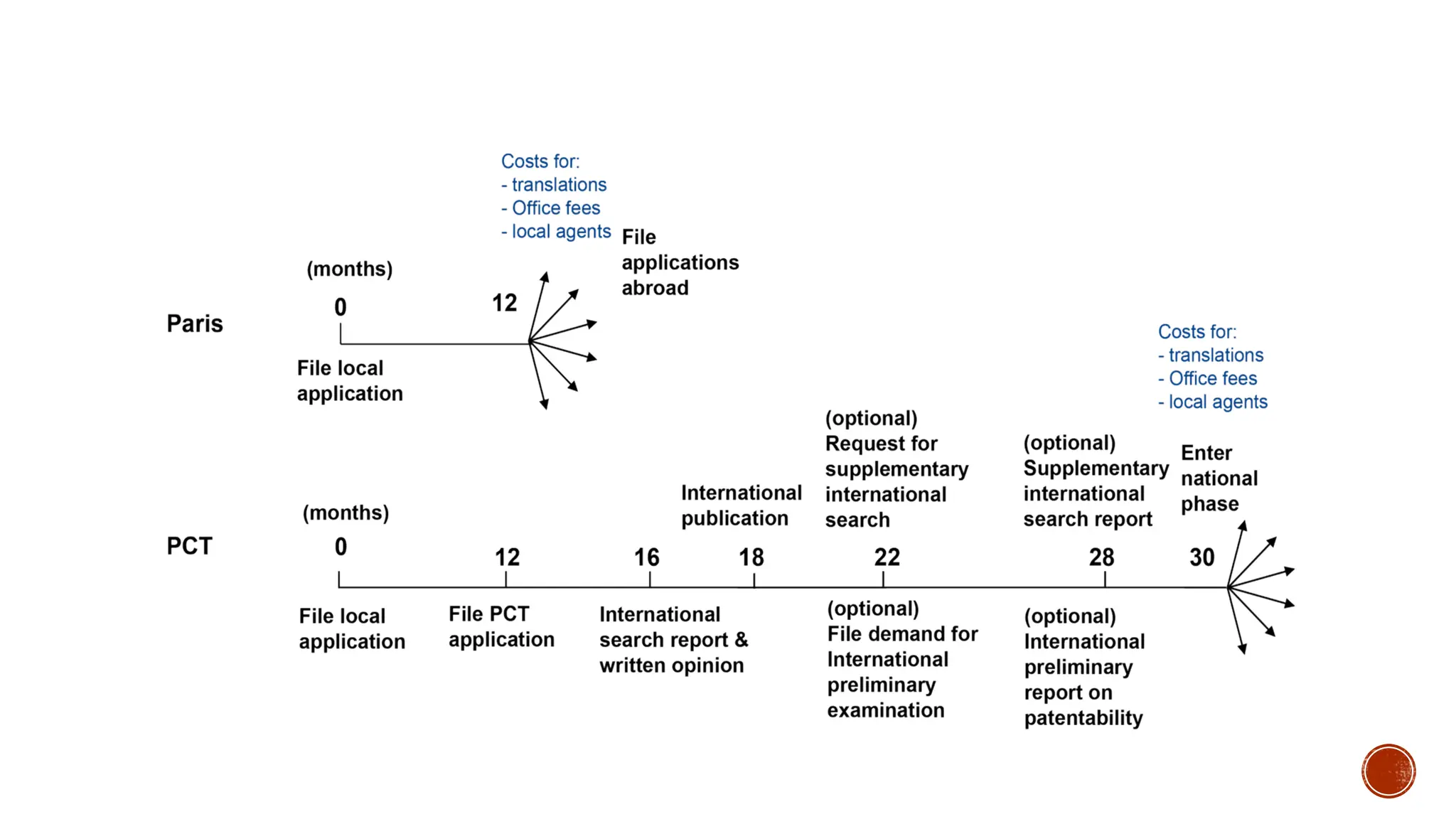
 Paris Convention 1883
 Patent Co-operation Treaty 1970
 Budapest Treaty on the International Recognition of the Deposit of
Microorganisms for the Purposes of Patent Procedure, 1977
 TRIPS
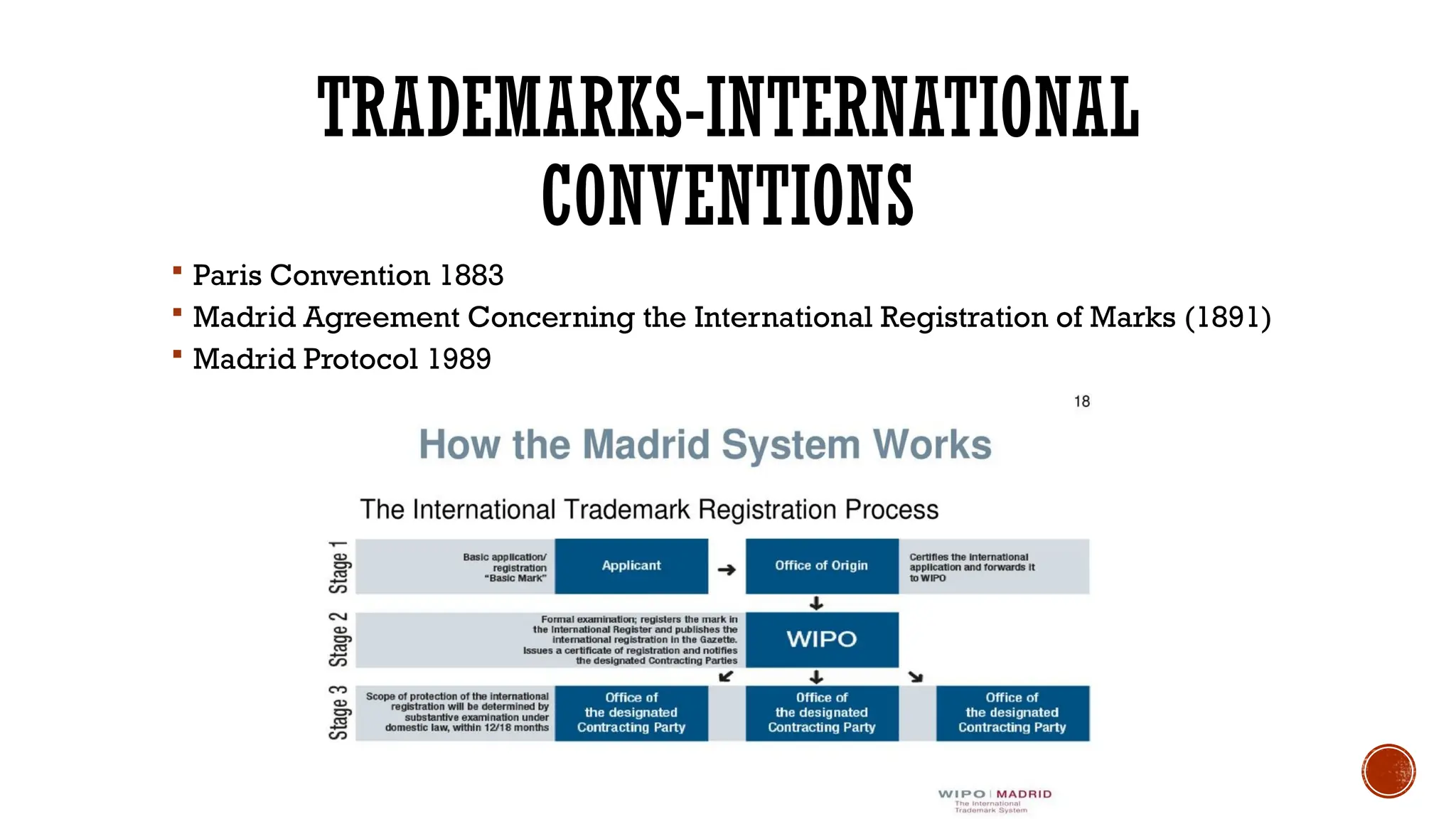
TRADEMARKS-INTERNATIONAL
CONVENTIONS
 Paris Convention 1883
 Madrid Agreement Concerning the International Registration of Marks (1891)
 Madrid Protocol 1989
 Nice Agreement concerning the International Classification of Goods and
Services for the Purposes of the Registration of Marks (1957)
 Vienna Agreement Establishing an International Classification of the Figurative
Elements of Marks (1973)
 TRIPS
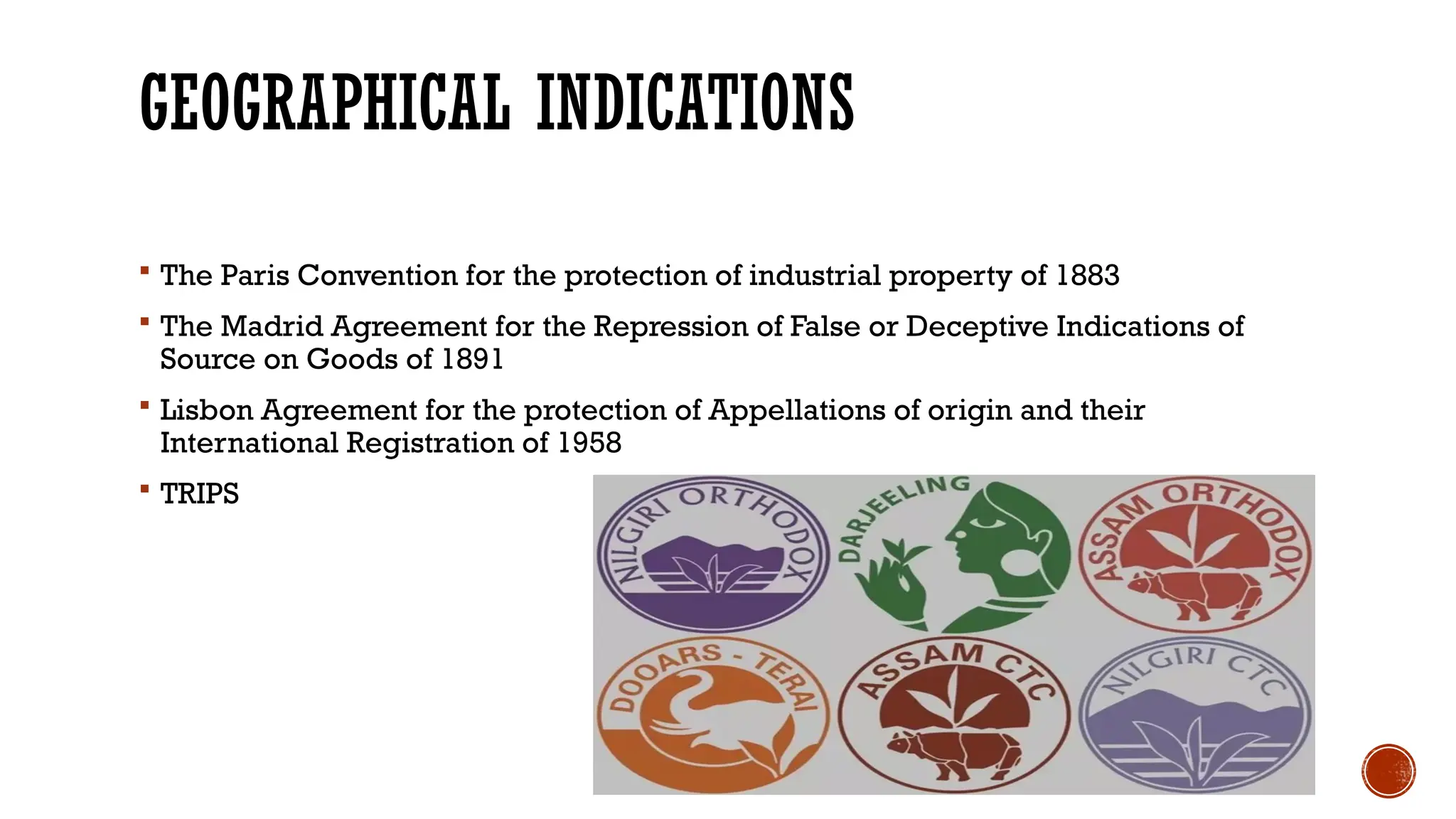
GEOGRAPHICAL INDICATIONS
 The Paris Convention for the protection of industrial property of 1883
 The Madrid Agreement for the Repression of False or Deceptive Indications of
Source on Goods of 1891
 Lisbon Agreement for the protection of Appellations of origin and their
International Registration of 1958
 TRIPS
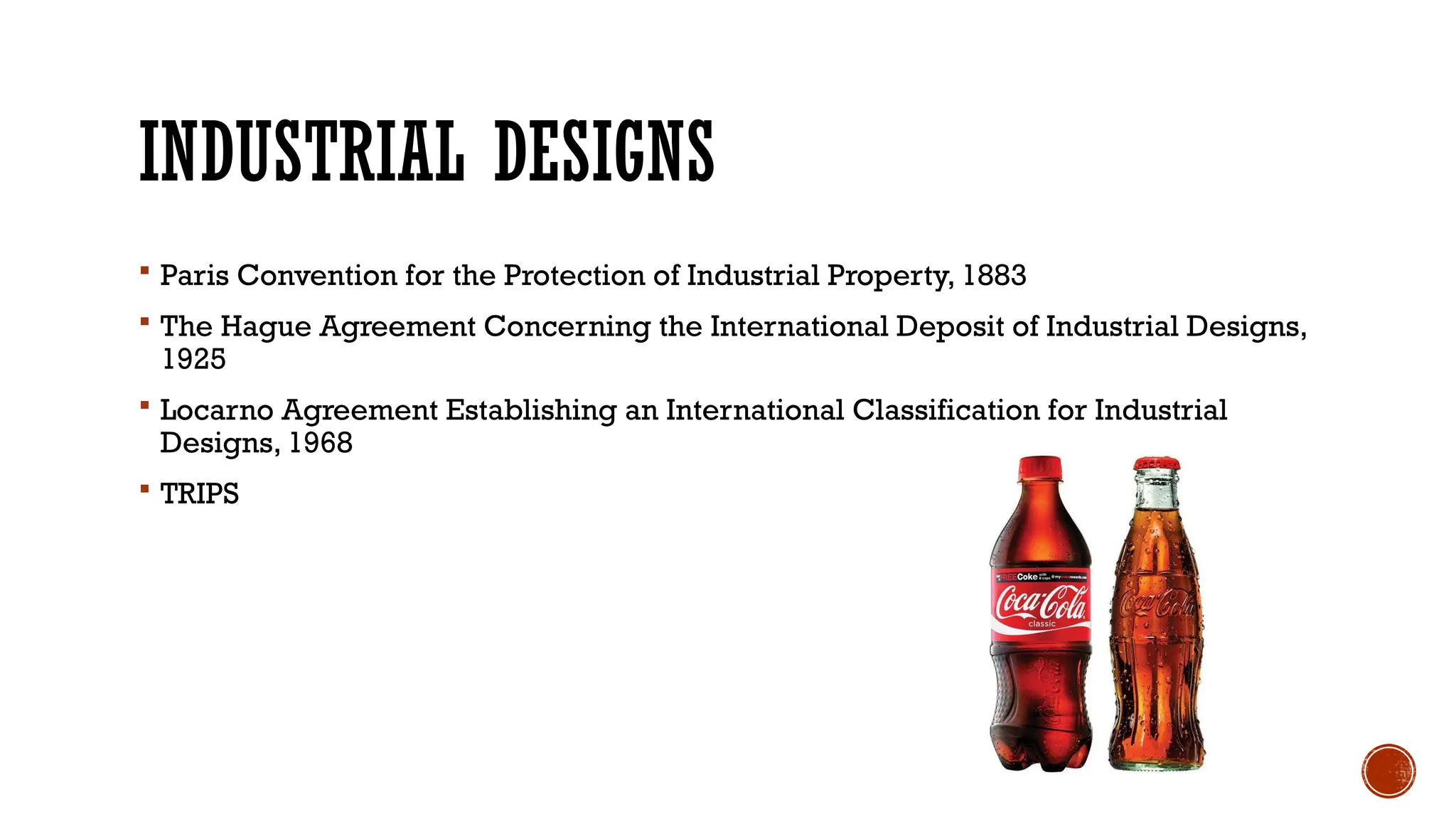
INDUSTRIAL DESIGNS
 Paris Convention for the Protection of Industrial Property, 1883
 The Hague Agreement Concerning the International Deposit of Industrial Designs,
1925
 Locarno Agreement Establishing an International Classification for Industrial
Designs, 1968
 TRIPS
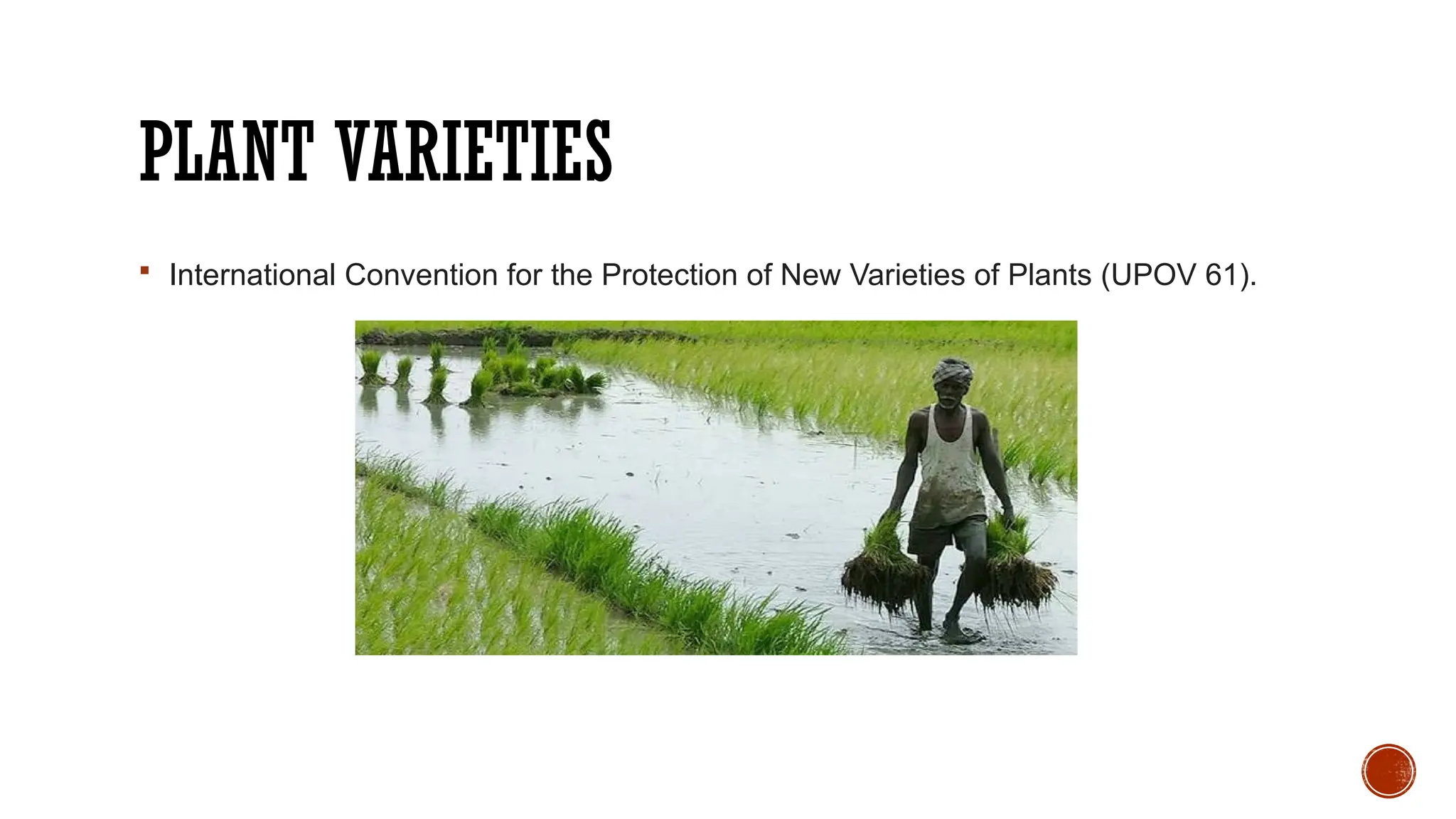
PLANT VARIETIES
 International Convention for the Protection of New Varieties of Plants (UPOV 61).
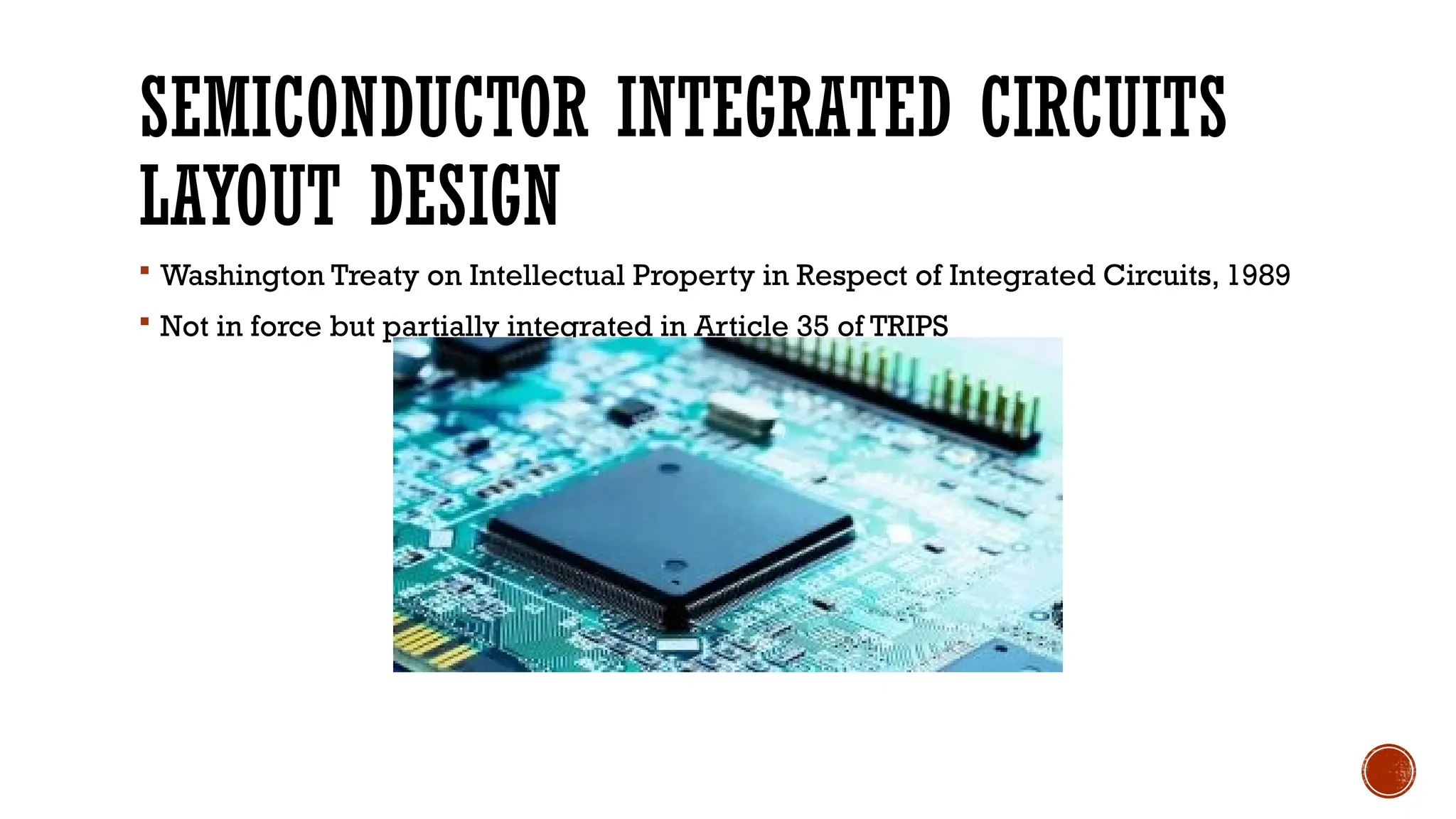
SEMICONDUCTOR INTEGRATED CIRCUITS
LAYOUT DESIGN
 Washington Treaty on Intellectual Property in Respect of Integrated Circuits, 1989
 Not in force but partially integrated in Article 35 of TRIPS
CONFIDENTIAL INFORMATION
 TRIPS
 Paris Convention

An Introduction to Intellectual Property: A Brief Overview

  • 1.
  • 3.
  • 4.
    KNOWLEDGE IS POWER KNOWLEDGEIS TOOL FOR DEVELOPMENT KNOWLEDGE IS MONEY IT HAS TO BE PROTECTED
  • 6.
  • 7.
  • 9.
  • 10.
  • 11.
    IMPORTANCE OF IPR IntellectualProperty Rights plays a significant role in protecting your creativity and innovation It is important for enhancing your business IP is wealth which can be stolen easily, so needs to be protected!!  https://www.youtube.com/watch?v=G79yiNANWZU&t=7s
  • 12.
    COURSE EDUCATIONAL OBJECTIVES To understand the basic concepts of IPR.  To acquire skills in applying the IPR Law in several practical ways.  To acquaint the students with the registration of different kinds of IPR applicable across several skill sectors.  To analyze the recent amendments dealing with IPR Legislations  Evaluate as against other the international legal framework related to IP protection and articulate the problem areas for the deficiency.  Propose a solution to the existing IP problems in India.
  • 13.
    SYLLABUS  Unit –1 Introduction - Concept of Intellectual Property-and its characteristics and nature of intellectual property right justifications for protection of IP and harmonization; International Conventions of IPRs; Types of IPRs; WTO, TRIPs; Theories of IPR:- i. Natural Theory. (ii) Hegelian Philosophy (Personality Theory) iii. Lockes' Theory Of Property (Labour Theory) Iv. Social Contract Theory. Economic Theory, IP- relation with Competition law, Trade law and other multi-disciplinary areas.  Unit – 2 Patents - Indian Patents Act, 1970- Meaning Criteria for obtaining patents , Patent Search, Procedure for registration; Specification; Term of patent, rights of Patentee; Transfer, Revocation and Surrender of Patents; Infringement of Patents and Remedies for infringement; Basic concept of Voluntary and Compulsory license, parallel import, process product patents, Govt. use of Patents for Public purpose, Dispute resolution bodies national and International.  Unit – 3 Trade Marks - Trade Marks Act, 1999 - Functions of Trademarks; Categories of Trademark: Certification Mark, Collective Mark and Well known Mark and Non-conventional Marks, Service marks, Classification of goods and Service; Registration of Trademarks; Doctrine of distinctiveness; Absolute and relative grounds of refusal Doctrine of honest concurrent user Infringement of Trademarks;, Remedies; Licensing in trademarks – Deceptive Similarity and passing off, Border measures and Trademark protection Domain name registration, Domain Name Disputes & WIPO. Geographical Indication; Difference between GI and Trade Marks, Concept of Authorized user, Homonymous GI, Geographical Indication of Goods 141 (Registration and Protection) Act, 1999 - Infringements and Remedies, Adjudication authorities in dispute resolution
  • 14.
    SYLLABUS  Unit –4 Copyright - Copyright Act 1957 - Characteristics; works protected under- copyright - Literary works; Dramatic, musical & amp; artistic works; Architecture, cinematograph film & sound recording; Author and ownership of Copyright; Rights conferred by Copyright; Term of Copyright; Infringement and Remedies for Infringement; Performers' Right; Publication Copyright issues in digital era, Software Piracy, Copy left.  Unit – 5 Designs - Design Act, 2000 - Registerable designs; Procedure for Registration; Piracy of a design; The Semiconductor Integrated Circuits Layout Designs Act, 2000; The Plant Varieties and Farmers' Rights Act, 2001; National Register of Plant Varieties. Trade secret, Meaning, Criteria of Protection, Traditional Knowledge, e-Protection of Traditional Knowledge.
  • 15.
    HISTORICAL BACKGROUND  500BCE--when Sybaris, a Greek state, made it possible for citizens to obtain a one year patent for “any new refinement in luxury.”  1474-Venetian Patent Statute
  • 16.
     1623-- Statuteof Monopolies  Origin from letters patent  14 years protection  1710-Statute of Anne  Provided a 14 year term of protection. It also gave option of seeking a 14 year renewal term.  Aimed largely at copyrights, this law granted authors rights in the recreation and distribution of their work.  Late 1800’s- Global Intellectual Property Development
  • 17.
    GLOBAL INTELLECTUAL PROPERTY DEVELOPMENT 1883- The Paris Convention for the Protection of Industrial Property  1886-The Berne Convention for the Protection of Literary and Artistic Works  1891- Madrid Agreement Concerning International Registration of Marks  1893-United International Bureaux for the Protection of Intellectual Property (Precursor of WIPO)  Paris Convention and Berne Convention merged  1994-The Agreement on Trade-Related Aspects of Intellectual Property Rights (TRIPS)
  • 18.
    1883- THE PARISCONVENTION FOR THE PROTECTION OF INDUSTRIAL PROPERTY  Industrial rights; Patents,Trademarks and design rights  1883  Last amendment: 1979  177 members  Basic principles:  Principle of national treatment (nondiscrimination)  Rule of priority  Common rules
  • 19.
    1886-THE BERNE CONVENTIONFOR THE PROTECTION OF LITERARY AND ARTISTIC WORKS  Intellectual rights; Literary and Artistic Works  1886  Last amendment: 1979  179 members  Basic principles:  Principle of national treatment (nondiscrimination)  Principle of automatic protection  Principle of Independence of Protection
  • 20.
    WIPO United International Bureaux forthe Protection of Intellectual Property – best known by its French acronym, BIRPI, 1893 WIPO, 1970
  • 21.
    STRATEGIC GOALS OFWIPO • Balanced Evolution of the International Normative Framework for IP • Provision of Premier Global IP Services • Facilitating the Use of IP for Development • Coordination and Development of Global IP Infrastructure • World Reference Source for IP Information and Analysis • International Cooperation on Building Respect for IP • Addressing IP in Relation to Global Policy Issues • A Responsive Communications Interface between WIPO, its Member States and All Stakeholders • An Efficient Administrative and Financial Support Structure to Enable WIPO to Deliver its Programs
  • 22.
    1994-THE AGREEMENT ONTRADE-RELATED ASPECTS OF INTELLECTUAL PROPERTY RIGHTS (TRIPS)  Agreement on Trade-Related Aspects of Intellectual Property Rights  1994  Background; negotiations in GATT  WTO (164 members) established in 1993 and TRIPs entered into force in1995  Minimum requirements to national legislation on IPR and enforcement of IPR  scope is to bring up level of protection in developing countries
  • 23.
    TRIPS  PART I-GENERALPROVISIONS AND BASIC PRINCIPLES  PART II STANDARDS CONCERNING THE AVAILABILITY, SCOPE AND USE OF INTELLECTUAL PROPERTY RIGHTS 1.Copyright and Related Rights (Art. 9-14) 2.Trademarks (Art. 15-21) 3. Geographical Indications (Art. 22-24) 4. Industrial Designs (Art. 25-26) 5. Patents (Art. 27-34) 6. Layout-Designs (Topographies) of Integrated Circuits (Art. 35-38) 7. Protection of Undisclosed Information (Art. 39) 8. Control of Anti-Competitive Practices in Contractual Licences (Art. 40)
  • 24.
     PART III-ENFORCEMENTOF INTELLECTUAL PROPERTY RIGHTS  PART IV- ACQUISITION AND MAINTENANCE OF INTELLECTUAL PROPERTY RIGHTS AND RELATED INTER-PARTES PROCEDURES  PART V -DISPUTE PREVENTION AND SETTLEMENT  PART VI-TRANSITIONAL ARRANGEMENTS PART VII INSTITUTIONAL ARRANGEMENTS; FINAL PROVISIONS
  • 25.
    COPYRIGHT-INTERNATIONAL CONVENTIONS  BerneConvention 1886  Universal Copyright Convention, 1952  Rome Convention for the Protection of Performers, Producers of Phonograms and Broadcasting Organizations, 1961  TRIPS Agreement 1994  WIPO Copyright Treaty 1996  WIPO Performances and Phonograms Treaty 1996  Marrakesh Treaty to Facilitate Access to Published Works by Visually Impaired Persons and Persons with Print Disabilities, 2013
  • 26.
    PATENTS-INTERNATIONAL CONVENTIONS  ParisConvention 1883  Patent Co-operation Treaty 1970  Budapest Treaty on the International Recognition of the Deposit of Microorganisms for the Purposes of Patent Procedure, 1977  TRIPS
  • 28.
    TRADEMARKS-INTERNATIONAL CONVENTIONS  Paris Convention1883  Madrid Agreement Concerning the International Registration of Marks (1891)  Madrid Protocol 1989
  • 29.
     Nice Agreementconcerning the International Classification of Goods and Services for the Purposes of the Registration of Marks (1957)  Vienna Agreement Establishing an International Classification of the Figurative Elements of Marks (1973)  TRIPS
  • 30.
    GEOGRAPHICAL INDICATIONS  TheParis Convention for the protection of industrial property of 1883  The Madrid Agreement for the Repression of False or Deceptive Indications of Source on Goods of 1891  Lisbon Agreement for the protection of Appellations of origin and their International Registration of 1958  TRIPS
  • 31.
    INDUSTRIAL DESIGNS  ParisConvention for the Protection of Industrial Property, 1883  The Hague Agreement Concerning the International Deposit of Industrial Designs, 1925  Locarno Agreement Establishing an International Classification for Industrial Designs, 1968  TRIPS
  • 32.
    PLANT VARIETIES  InternationalConvention for the Protection of New Varieties of Plants (UPOV 61).
  • 33.
    SEMICONDUCTOR INTEGRATED CIRCUITS LAYOUTDESIGN  Washington Treaty on Intellectual Property in Respect of Integrated Circuits, 1989  Not in force but partially integrated in Article 35 of TRIPS
  • 34.