1Samsung Open Source Group
IoT meets Security
Habib Virji
habib.virji@samsung.com
Samsung Open Source Group
Samsung Research, UK
LinuxCon Europe 2015
Dublin, Ireland, October 5 – 7, 2015
2Samsung Open Source Group
Agenda

Need for IoT Security

Overview of IoTivity

Device Security
– Onboarding
– Provisioning
– Software Resource Manager
– Hardware Hardening

Connectivity
– Local
– Remote

Privacy
3Samsung Open Source Group
Need for IoT Security

IoT device to be around 26 billion by 2020 [1]

Increase in IoT device require strong security.

Lots of issues still in current IoT devices:[4]
– 80% of devices had privacy issues.
– 70% of devices used unencrypted network.
– 90% of device collected personal information.
– 70% of device along with their cloud enable
attacker to identify valid user account using
account renumeration.

Need for IoT devices to have device, network and
privacy concerns addressed.
4Samsung Open Source Group
IoTivity Overview

IoTivity is Linux Foundation project to implement
the OIC standard.
– OIC is an industry consortium to define a IoT (Internet of
Things) standard and certification.
– IoTivity implementation is happening in parallel.

Discovery of device is done by looking for a RESTful
interface using multicast communication.

Communication is done using:
– CoAP (Constrained Application Protocol) over UDP in local
scenarios.
– XMPP is used in remote scenarios.

Support for multiple OSs platforms – Tizen, Android,
Linux, Arduino, etc.
5
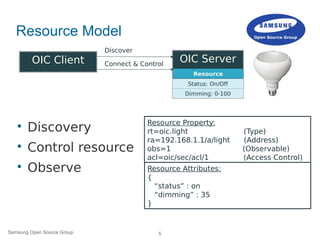
OIC Server
Samsung Open Source Group
Resource Model

Discovery

Control resource

Observe
Status: On/Of
Dimming: 0-100
Resource Property:
rt=oic.light (Type)
ra=192.168.1.1/a/light (Address)
obs=1 (Observable)
acl=oic/sec/acl/1 (Access Control)
Resource Attributes:
{
“status” : on
“dimming” : 35
}
Discover
Connect & ControlOIC Client
Resource
7Samsung Open Source Group
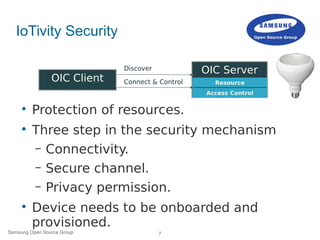
IoTivity Security

Protection of resources.

Three step in the security mechanism
– Connectivity.
– Secure channel.
– Privacy permission.

Device needs to be onboarded and
provisioned.
Discover
Connect & ControlOIC Client
OIC Server
Resource
Access Control
8Samsung Open Source Group
Device Security
9
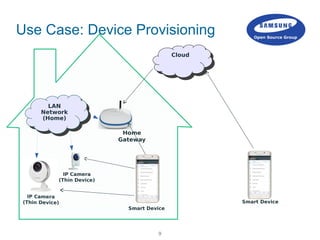
Use Case: Device Provisioning
LAN
Network
(Home)
LAN
Network
(Home)
Home
Gateway
Smart Device
CloudCloud
IP Camera
(Thin Device)
Smart Device
10
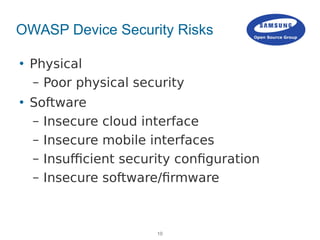
OWASP Device Security Risks
 Physical
– Poor physical security
 Software
– Insecure cloud interface
– Insecure mobile interfaces
– Insufficient security configuration
– Insecure software/firmware
11Samsung Open Source Group
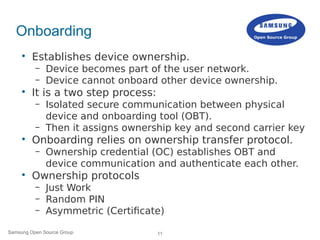
Onboarding

Establishes device ownership.
– Device becomes part of the user network.
– Device cannot onboard other device ownership.

It is a two step process:
– Isolated secure communication between physical
device and onboarding tool (OBT).
– Then it assigns ownership key and second carrier key

Onboarding relies on ownership transfer protocol.
– Ownership credential (OC) establishes OBT and
device communication and authenticate each other.

Ownership protocols
– Just Work
– Random PIN
– Asymmetric (Certificate)
12Samsung Open Source Group © SAMSUNG Electronics Co.
Ownership Transfer – Just Works
Onboarding Tool Enrolling DeviceOnboarding Tool
Ownership Transfer Start
GET /oic/sec/doxm?Owned=”False”
RSP [{“OxmType”: “oic.sec.doxm.jw”,
“DeviceId”: “UUID”}]
Discovery
Preparing for Ownership
transfer using Just Works
Set Ownership
transfer Method
PUT /oic/sec/doxm [{“OxmSel”:
“oic.sec.doxm.jw”}]
RSP 2.04
SRM enables
TLS_ECDH_anon_WITH_AES_12SHA256
cipher suite
DTLS Connection
PUT /oic/sec/doxm [{“Owned”: “T”,
“Owner”: “Admin0””}]
RSP 2.04
Ownership Transfer Stops
13Samsung Open Source Group © SAMSUNG Electronics Co.
Ownership Transfer – Random PIN
Onboarding Tool Enrolling DeviceOnboarding Tool
Ownership Transfer Start
GET /oic/sec/doxm?Owned=”False”
RSP [{“OxmType”: “oic.sec.doxm.rdp”,
“DeviceId”: “UUID”}]
Discovery
Preparing for Ownership
transfer using Random PIN
Set Ownership
transfer Method
PUT /oic/sec/doxm [{“OxmSel”:
“oic.sec.doxm.rdp”}]
RSP 2.04
SRM enables
TLS_ECDHE_PSK_WITH_AES_128_CBC_SH
A256 cipher suite
DTLS Connection
PUT /oic/sec/doxm [{“Owned”: “T”,
“Owner”: “Admin0””}]
RSP 2.04
Ownership Transfer Stops
14Samsung Open Source Group © SAMSUNG Electronics Co.
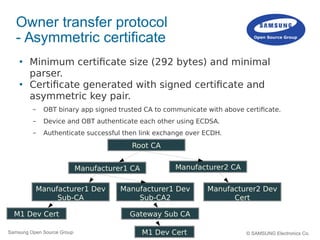
Owner transfer protocol
- Asymmetric certificate
 Minimum certificate size (292 bytes) and minimal
parser.
 Certificate generated with signed certificate and
asymmetric key pair.
– OBT binary app signed trusted CA to communicate with above certificate.
– Device and OBT authenticate each other using ECDSA.
– Authenticate successful then link exchange over ECDH.
Root CA
Manufacturer1 CA Manufacturer2 CA
Gateway Sub CA
Manufacturer1 Dev
Sub-CA
Manufacturer1 Dev
Sub-CA2
M1 Dev Cert
M1 Dev Cert
Manufacturer2 Dev
Cert
15Samsung Open Source Group © SAMSUNG Electronics Co.
8
Onboarding Tool Enrolling DeviceOnboarding Tool
Ownership Transfer Start
GET /oic/sec/doxm?Owned=”False”
RSP [{“OxmType”: “oic.sec.doxm.mfgcert”,
“DeviceId”: “UUID”}]
Discovery
Preparing for Ownership
transfer using Certificate
Set Ownership
transfer Method
PUT /oic/sec/doxm [{“OxmSel”:
“oic.sec.doxm.mfgcert”}]
RSP 2.04
SRM enables
TLS_ECDHE_ECDSA_WITH_AES_128_CCM_
8_SHA256 cipher suite
DTLS Connection
POST /oic/sec/doxm [{“credid”: “..”, “sub”: “..”,
“credType”: “8”, “pdbdata”: “device and CA in
base 64”, “pvdata”: {“x”: “x position of elliptic
curve in base 64”, “y”: “y position of elliptic
curve in base 64”, “ownrs”: “” }}]
RSP 2.04
Ownership Transfer Stops
Owner transfer protocol
- Asymmetric certificate
16Samsung Open Source Group © SAMSUNG Electronics Co.
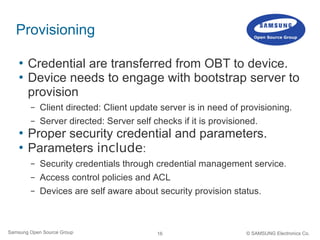
Provisioning
 Credential are transferred from OBT to device.
 Device needs to engage with bootstrap server to
provision
– Client directed: Client update server is in need of provisioning.
– Server directed: Server self checks if it is provisioned.
 Proper security credential and parameters.
 Parameters include:
– Security credentials through credential management service.
– Access control policies and ACL
– Devices are self aware about security provision status.
17Samsung Open Source Group © SAMSUNG Electronics Co.
Provisioning
8
Onboarding Tool Enrolling DeviceOnboarding Tool
ACL Provisioning Start
GET /oic/sec/pstat
RSP [{“IsOp”: “False”, “Sm”: “0x11”}]
Status
Client Mode PUT /oic/sec/pstat [{“Om”: “0x11”}]
RSP 2.04
RSP 2.04
ACL Provisioning Stop
DTLS with Owner PSK
RSP 2.04
RSP 2.04
18Samsung Open Source Group © SAMSUNG Electronics Co.
Secure Resource Manager (SRM)
 Management of the secure virtual resource and ACL [3].
Secure Resource Manager Layer
Resource Manager (RM)
Persistent Storage
interface
Policy Engine (PE)
Connection Abstraction (CA) Layer
DTLS Module
Resource Introspection (RI) Layer
Application
Secure
Virtual
Resource
Database
19Samsung Open Source Group
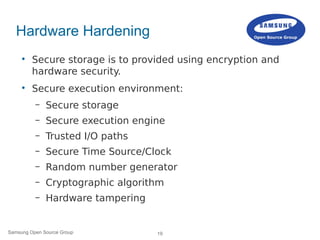
Hardware Hardening

Secure storage is to provided using encryption and
hardware security.

Secure execution environment:
– Secure storage
– Secure execution engine
– Trusted I/O paths
– Secure Time Source/Clock
– Random number generator
– Cryptographic algorithm
– Hardware tampering
20Samsung Open Source Group
Connectivity
21
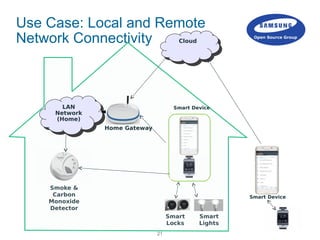
Use Case: Local and Remote
Network Connectivity
Smoke &
Carbon
Monoxide
Detector
Smart
Locks
Smart
Lights
LAN
Network
(Home)
LAN
Network
(Home)
Home Gateway
Smart Device
CloudCloud
Smart Device
22
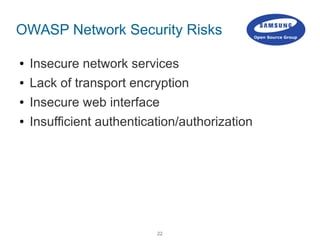
OWASP Network Security Risks
● Insecure network services
● Lack of transport encryption
● Insecure web interface
● Insufficient authentication/authorization
23Samsung Open Source Group
Secure Connectivity

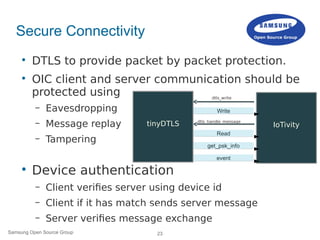
DTLS to provide packet by packet protection.

OIC client and server communication should be
protected using
– Eavesdropping
– Message replay
– Tampering

Device authentication
– Client verifies server using device id
– Client if it has match sends server message
– Server verifies message exchange
dtls_write
dtls_handle_message
tinyDTLS
tinyDTLS IoTivity
24Samsung Open Source Group
Low End Device Secure
Connectivity
●
Low end device uses extension of DTLS
handshake to establish session keys.
●
Based on Diffie-Hellman key agreement.
●
Can be used in owner transfer protocol to
establish keys.
●
Breaks down further DTLS handshake to ease
smaller packet transfer and fragmented PDU.
– 6 way message protocol instead of 3 message.
tinyDTLS
25Samsung Open Source Group
Remote connectivity

OIC device communicate with XMPP server
– Authenticates using XMPP roster credential

Device identified using JID
– Server: me@mydomain.com/oic/1.0/oic.d.light/FFFFDDDD-
YYYY-4567-JADE-123456789A123
– Client: me@mydomain.com/oic/1.0/client/FFFFDDDD-YYYY-
4567-JADE-123456789A123

Remote XMPP server and OIC server have
secure connection.

Inband bytestream is used between XMPP and
OIC server.
26Samsung Open Source Group
Privacy
27
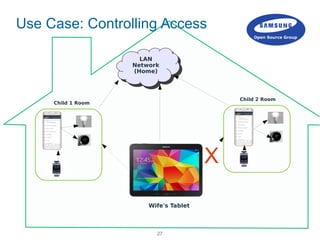
Use Case: Controlling Access
Wife's Tablet
LAN
Network
(Home)
LAN
Network
(Home)
Child 2 Room
Child 1 Room
X
28Samsung Open Source Group
Privacy

Protects resources at the OIC server.

ACL are defined via ACE (access control
entities).

Every resource should have an ACE.

ACE are stored either locally or remotely on
Access manager server (AMS).

ACL needs to be secure stored and partitioned
between logical OIC servers.

Access control levels is per group, device,
resource or properties.
29Samsung Open Source Group
Local Access Control
Is light open?
Request
Accept
Response
Turn Light Off
Request
Reject
Response
acl[0]
acl[0]
30
Remote Access Control
Samsung Open Source Group
Is light open?
Request
Accept
Response
Turn Light Off
Request
Reject
Response
Request
amacl[0]
amacl[0]
Request
AMS1
AMS1
Response
Response
31Samsung Open Source Group © SAMSUNG Electronics Co.
Conclusion
 IoTivity addresses majority of the OWASP issues.

OIC provides following security functionality:
– Onboarding mechanism to get device securely in
user network
– Policies control who can read/write on to the
device.
– Secure connectivity between device.
 Hardening mechanism suggested.

SRM includes security functionality.
32Samsung Open Source Group © SAMSUNG Electronics Co.
References
 [1] http://www.gartner.com/newsroom/id/2636073
 [2] https://www.owasp.org/images/8/8e/Infographic-v1.jpg
 [3] https://wiki.iotivity.org/iotivity_security
 [4] http://www8.hp.com/h20195/V2/GetPDF.aspx/4AA5-4759ENW.pdf

33Samsung Open Source Group
Thank You!

IoT Meets Security

  • 1.
    1Samsung Open SourceGroup IoT meets Security Habib Virji habib.virji@samsung.com Samsung Open Source Group Samsung Research, UK LinuxCon Europe 2015 Dublin, Ireland, October 5 – 7, 2015
  • 2.
    2Samsung Open SourceGroup Agenda  Need for IoT Security  Overview of IoTivity  Device Security – Onboarding – Provisioning – Software Resource Manager – Hardware Hardening  Connectivity – Local – Remote  Privacy
  • 3.
    3Samsung Open SourceGroup Need for IoT Security  IoT device to be around 26 billion by 2020 [1]  Increase in IoT device require strong security.  Lots of issues still in current IoT devices:[4] – 80% of devices had privacy issues. – 70% of devices used unencrypted network. – 90% of device collected personal information. – 70% of device along with their cloud enable attacker to identify valid user account using account renumeration.  Need for IoT devices to have device, network and privacy concerns addressed.
  • 4.
    4Samsung Open SourceGroup IoTivity Overview  IoTivity is Linux Foundation project to implement the OIC standard. – OIC is an industry consortium to define a IoT (Internet of Things) standard and certification. – IoTivity implementation is happening in parallel.  Discovery of device is done by looking for a RESTful interface using multicast communication.  Communication is done using: – CoAP (Constrained Application Protocol) over UDP in local scenarios. – XMPP is used in remote scenarios.  Support for multiple OSs platforms – Tizen, Android, Linux, Arduino, etc.
  • 5.
    5 OIC Server Samsung OpenSource Group Resource Model  Discovery  Control resource  Observe Status: On/Of Dimming: 0-100 Resource Property: rt=oic.light (Type) ra=192.168.1.1/a/light (Address) obs=1 (Observable) acl=oic/sec/acl/1 (Access Control) Resource Attributes: { “status” : on “dimming” : 35 } Discover Connect & ControlOIC Client Resource
  • 6.
    7Samsung Open SourceGroup IoTivity Security  Protection of resources.  Three step in the security mechanism – Connectivity. – Secure channel. – Privacy permission.  Device needs to be onboarded and provisioned. Discover Connect & ControlOIC Client OIC Server Resource Access Control
  • 7.
    8Samsung Open SourceGroup Device Security
  • 8.
    9 Use Case: DeviceProvisioning LAN Network (Home) LAN Network (Home) Home Gateway Smart Device CloudCloud IP Camera (Thin Device) Smart Device
  • 9.
    10 OWASP Device SecurityRisks  Physical – Poor physical security  Software – Insecure cloud interface – Insecure mobile interfaces – Insufficient security configuration – Insecure software/firmware
  • 10.
    11Samsung Open SourceGroup Onboarding  Establishes device ownership. – Device becomes part of the user network. – Device cannot onboard other device ownership.  It is a two step process: – Isolated secure communication between physical device and onboarding tool (OBT). – Then it assigns ownership key and second carrier key  Onboarding relies on ownership transfer protocol. – Ownership credential (OC) establishes OBT and device communication and authenticate each other.  Ownership protocols – Just Work – Random PIN – Asymmetric (Certificate)
  • 11.
    12Samsung Open SourceGroup © SAMSUNG Electronics Co. Ownership Transfer – Just Works Onboarding Tool Enrolling DeviceOnboarding Tool Ownership Transfer Start GET /oic/sec/doxm?Owned=”False” RSP [{“OxmType”: “oic.sec.doxm.jw”, “DeviceId”: “UUID”}] Discovery Preparing for Ownership transfer using Just Works Set Ownership transfer Method PUT /oic/sec/doxm [{“OxmSel”: “oic.sec.doxm.jw”}] RSP 2.04 SRM enables TLS_ECDH_anon_WITH_AES_12SHA256 cipher suite DTLS Connection PUT /oic/sec/doxm [{“Owned”: “T”, “Owner”: “Admin0””}] RSP 2.04 Ownership Transfer Stops
  • 12.
    13Samsung Open SourceGroup © SAMSUNG Electronics Co. Ownership Transfer – Random PIN Onboarding Tool Enrolling DeviceOnboarding Tool Ownership Transfer Start GET /oic/sec/doxm?Owned=”False” RSP [{“OxmType”: “oic.sec.doxm.rdp”, “DeviceId”: “UUID”}] Discovery Preparing for Ownership transfer using Random PIN Set Ownership transfer Method PUT /oic/sec/doxm [{“OxmSel”: “oic.sec.doxm.rdp”}] RSP 2.04 SRM enables TLS_ECDHE_PSK_WITH_AES_128_CBC_SH A256 cipher suite DTLS Connection PUT /oic/sec/doxm [{“Owned”: “T”, “Owner”: “Admin0””}] RSP 2.04 Ownership Transfer Stops
  • 13.
    14Samsung Open SourceGroup © SAMSUNG Electronics Co. Owner transfer protocol - Asymmetric certificate  Minimum certificate size (292 bytes) and minimal parser.  Certificate generated with signed certificate and asymmetric key pair. – OBT binary app signed trusted CA to communicate with above certificate. – Device and OBT authenticate each other using ECDSA. – Authenticate successful then link exchange over ECDH. Root CA Manufacturer1 CA Manufacturer2 CA Gateway Sub CA Manufacturer1 Dev Sub-CA Manufacturer1 Dev Sub-CA2 M1 Dev Cert M1 Dev Cert Manufacturer2 Dev Cert
  • 14.
    15Samsung Open SourceGroup © SAMSUNG Electronics Co. 8 Onboarding Tool Enrolling DeviceOnboarding Tool Ownership Transfer Start GET /oic/sec/doxm?Owned=”False” RSP [{“OxmType”: “oic.sec.doxm.mfgcert”, “DeviceId”: “UUID”}] Discovery Preparing for Ownership transfer using Certificate Set Ownership transfer Method PUT /oic/sec/doxm [{“OxmSel”: “oic.sec.doxm.mfgcert”}] RSP 2.04 SRM enables TLS_ECDHE_ECDSA_WITH_AES_128_CCM_ 8_SHA256 cipher suite DTLS Connection POST /oic/sec/doxm [{“credid”: “..”, “sub”: “..”, “credType”: “8”, “pdbdata”: “device and CA in base 64”, “pvdata”: {“x”: “x position of elliptic curve in base 64”, “y”: “y position of elliptic curve in base 64”, “ownrs”: “” }}] RSP 2.04 Ownership Transfer Stops Owner transfer protocol - Asymmetric certificate
  • 15.
    16Samsung Open SourceGroup © SAMSUNG Electronics Co. Provisioning  Credential are transferred from OBT to device.  Device needs to engage with bootstrap server to provision – Client directed: Client update server is in need of provisioning. – Server directed: Server self checks if it is provisioned.  Proper security credential and parameters.  Parameters include: – Security credentials through credential management service. – Access control policies and ACL – Devices are self aware about security provision status.
  • 16.
    17Samsung Open SourceGroup © SAMSUNG Electronics Co. Provisioning 8 Onboarding Tool Enrolling DeviceOnboarding Tool ACL Provisioning Start GET /oic/sec/pstat RSP [{“IsOp”: “False”, “Sm”: “0x11”}] Status Client Mode PUT /oic/sec/pstat [{“Om”: “0x11”}] RSP 2.04 RSP 2.04 ACL Provisioning Stop DTLS with Owner PSK RSP 2.04 RSP 2.04
  • 17.
    18Samsung Open SourceGroup © SAMSUNG Electronics Co. Secure Resource Manager (SRM)  Management of the secure virtual resource and ACL [3]. Secure Resource Manager Layer Resource Manager (RM) Persistent Storage interface Policy Engine (PE) Connection Abstraction (CA) Layer DTLS Module Resource Introspection (RI) Layer Application Secure Virtual Resource Database
  • 18.
    19Samsung Open SourceGroup Hardware Hardening  Secure storage is to provided using encryption and hardware security.  Secure execution environment: – Secure storage – Secure execution engine – Trusted I/O paths – Secure Time Source/Clock – Random number generator – Cryptographic algorithm – Hardware tampering
  • 19.
    20Samsung Open SourceGroup Connectivity
  • 20.
    21 Use Case: Localand Remote Network Connectivity Smoke & Carbon Monoxide Detector Smart Locks Smart Lights LAN Network (Home) LAN Network (Home) Home Gateway Smart Device CloudCloud Smart Device
  • 21.
    22 OWASP Network SecurityRisks ● Insecure network services ● Lack of transport encryption ● Insecure web interface ● Insufficient authentication/authorization
  • 22.
    23Samsung Open SourceGroup Secure Connectivity  DTLS to provide packet by packet protection.  OIC client and server communication should be protected using – Eavesdropping – Message replay – Tampering  Device authentication – Client verifies server using device id – Client if it has match sends server message – Server verifies message exchange dtls_write dtls_handle_message tinyDTLS tinyDTLS IoTivity
  • 23.
    24Samsung Open SourceGroup Low End Device Secure Connectivity ● Low end device uses extension of DTLS handshake to establish session keys. ● Based on Diffie-Hellman key agreement. ● Can be used in owner transfer protocol to establish keys. ● Breaks down further DTLS handshake to ease smaller packet transfer and fragmented PDU. – 6 way message protocol instead of 3 message. tinyDTLS
  • 24.
    25Samsung Open SourceGroup Remote connectivity  OIC device communicate with XMPP server – Authenticates using XMPP roster credential  Device identified using JID – Server: me@mydomain.com/oic/1.0/oic.d.light/FFFFDDDD- YYYY-4567-JADE-123456789A123 – Client: me@mydomain.com/oic/1.0/client/FFFFDDDD-YYYY- 4567-JADE-123456789A123  Remote XMPP server and OIC server have secure connection.  Inband bytestream is used between XMPP and OIC server.
  • 25.
    26Samsung Open SourceGroup Privacy
  • 26.
    27 Use Case: ControllingAccess Wife's Tablet LAN Network (Home) LAN Network (Home) Child 2 Room Child 1 Room X
  • 27.
    28Samsung Open SourceGroup Privacy  Protects resources at the OIC server.  ACL are defined via ACE (access control entities).  Every resource should have an ACE.  ACE are stored either locally or remotely on Access manager server (AMS).  ACL needs to be secure stored and partitioned between logical OIC servers.  Access control levels is per group, device, resource or properties.
  • 28.
    29Samsung Open SourceGroup Local Access Control Is light open? Request Accept Response Turn Light Off Request Reject Response acl[0] acl[0]
  • 29.
    30 Remote Access Control SamsungOpen Source Group Is light open? Request Accept Response Turn Light Off Request Reject Response Request amacl[0] amacl[0] Request AMS1 AMS1 Response Response
  • 30.
    31Samsung Open SourceGroup © SAMSUNG Electronics Co. Conclusion  IoTivity addresses majority of the OWASP issues.  OIC provides following security functionality: – Onboarding mechanism to get device securely in user network – Policies control who can read/write on to the device. – Secure connectivity between device.  Hardening mechanism suggested.  SRM includes security functionality.
  • 31.
    32Samsung Open SourceGroup © SAMSUNG Electronics Co. References  [1] http://www.gartner.com/newsroom/id/2636073  [2] https://www.owasp.org/images/8/8e/Infographic-v1.jpg  [3] https://wiki.iotivity.org/iotivity_security  [4] http://www8.hp.com/h20195/V2/GetPDF.aspx/4AA5-4759ENW.pdf 
  • 32.
    33Samsung Open SourceGroup Thank You!