Samsung Open Source Group 1 #LFALS
For Automotive
Philippe Coval
Samsung Open Source Group / SRUK
philippe.coval@osg.samsung.com
meta-ocf-automotive tutorial
Automotive Linux Summit
#LFALS, Tokyo, Japan <2017-05-31>
Samsung Open Source Group 2 #LFALS
こんにちは from Philippe Coval
● Software engineer for Samsung Research
– Open Source Group, EU team (@UK + DE + FR + CZ...)
● Commit into IoTivity, Tizen
– Plus automotive related projects: Yocto, GENIVI, AGL
● Interest: Usages, OS/hardware support, build, community
● Ask me online for help:
– https://wiki.tizen.org/wiki/User:Pcoval
Samsung Open Source Group 3 #LFALS
Agenda
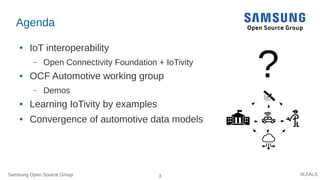
● IoT interoperability
– Open Connectivity Foundation + IoTivity
● OCF Automotive working group
– Demos
● Learning IoTivity by examples
● Convergence of automotive data models
?
Samsung Open Source Group 4
“Without trust there's no cooperation.
And without cooperation
there's no progress.
History stops.”
~ Rick Yancey, The Last Star
Samsung Open Source Group 5 #LFALS
Motivations for Interoperability in IoT
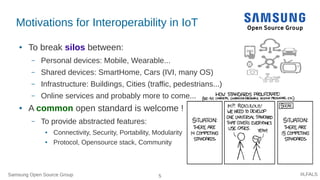
● To break silos between:
– Personal devices: Mobile, Wearable...
– Shared devices: SmartHome, Cars (IVI, many OS)
– Infrastructure: Buildings, Cities (traffic, pedestrians...)
– Online services and probably more to come...
● A common open standard is welcome !
– To provide abstracted features:
● Connectivity, Security, Portability, Modularity
● Protocol, Opensource stack, Community
Samsung Open Source Group 6 #LFALS
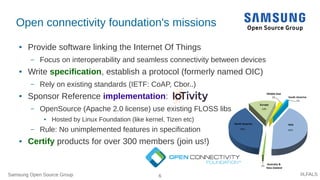
Open connectivity foundation's missions
● Provide software linking the Internet Of Things
– Focus on interoperability and seamless connectivity between devices
● Write specification, establish a protocol (formerly named OIC)
– Rely on existing standards (IETF: CoAP, Cbor..)
● Sponsor Reference implementation:
– OpenSource (Apache 2.0 license) use existing FLOSS libs
● Hosted by Linux Foundation (like kernel, Tizen etc)
– Rule: No unimplemented features in specification
● Certify products for over 300 members (join us!)
Samsung Open Source Group 7 #LFALS
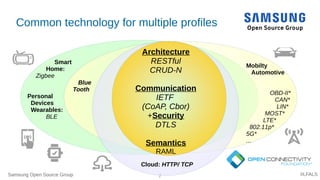
Common technology for multiple profiles
Architecture
RESTful
CRUD-N
Communication
IETF
(CoAP, Cbor)
+Security
DTLS
Semantics
RAML
Smart
Home:
Zigbee
Blue
Tooth
Personal
Devices
Wearables:
BLE
Cloud: HTTP/ TCP
Mobilty
Automotive
OBD-II*
CAN*
LIN*
MOST*
LTE*
802.11p*
5G*
...
Samsung Open Source Group 8 #LFALS
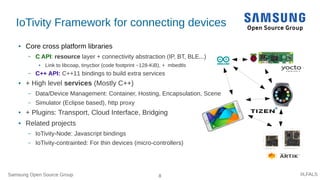
IoTivity Framework for connecting devices
● Core cross platform libraries
– C API: resource layer + connectivity abstraction (IP, BT, BLE...)
● Link to libcoap, tinycbor (code footprint ~128-KiB), + mbedtls
– C++ API: C++11 bindings to build extra services
● + High level services (Mostly C++)
– Data/Device Management: Container, Hosting, Encapsulation, Scene
– Simulator (Eclipse based), http proxy
● + Plugins: Transport, Cloud Interface, Bridging
● Related projects
– IoTivity-Node: Javascript bindings
– IoTivity-contrainted: For thin devices (micro-controllers)
Samsung Open Source Group 9
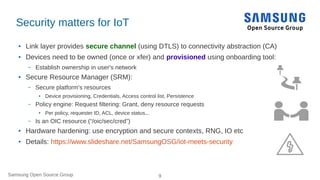
Security matters for IoT
● Link layer provides secure channel (using DTLS) to connectivity abstraction (CA)
● Devices need to be owned (once or xfer) and provisioned using onboarding tool:
– Establish ownership in user's network
● Secure Resource Manager (SRM):
– Secure platform's resources
● Device provisioning, Credentials, Access control list, Persistence
– Policy engine: Request filtering: Grant, deny resource requests
●
Per policy, requester ID, ACL, device status...
– Is an OIC resource (“/oic/sec/cred”)
● Hardware hardening: use encryption and secure contexts, RNG, IO etc
● Details: https://www.slideshare.net/SamsungOSG/iot-meets-security
Samsung Open Source Group 10
“Any sufficiently
advanced technology
is indistinguishable
from magic.”
~ Arthur C. Clarke
Samsung Open Source Group 11Samsung Open Source Group
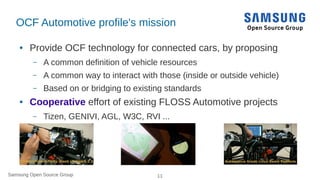
OCF Automotive profile's mission
● Provide OCF technology for connected cars, by proposing
– A common definition of vehicle resources
– A common way to interact with those (inside or outside vehicle)
– Based on or bridging to existing standards
● Cooperative effort of existing FLOSS Automotive projects
– Tizen, GENIVI, AGL, W3C, RVI ...
12 #LFALS
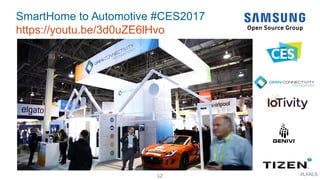
SmartHome to Automotive #CES2017
https://youtu.be/3d0uZE6lHvo
SmartHome to Automotive (#CES2017)
https://youtu.be/3d0uZE6lHvo
Samsung Open Source Group 13
“The secret of getting ahead
is getting started.”
~ Mark Twain
Samsung Open Source Group 14Samsung Open Source Group
Supported Automotive OS
● Download OS image shipping IoTivity: Tizen, GDP, AGL?
– Or install package from repository (RPM)
● Use “meta-oic” layer on OE/Yocto based distributions:
– GENIVI (Specification first): integrated
– AGL/Automotive Grade Linux (Code first): optional
– Tizen Yocto project to build Common + IVI
● Rebuild package from sources for most GNU/Linux systems
– https://wiki.iotivity.org/build
15 #LFALS
Build Yocto's Poky with IoTivity
●
Adding “meta-oic” layer to poky reference distribution
git clone http://git.yoctoproject.org/git/poky
cd poky && source ./oe-init-build-env
git clone http://git.yoctoproject.org/git/meta-oic
●
Append to environment files previously generated:
– “poky/conf/bblayers.conf” (Layer path file)
RELATIVE_DIR := 
"${@os.path.abspath(os.path.dirname(d.getVar('FILE', True))+'/../..')}"
BBLAYERS += "${RELATIVE_DIR}/meta-oic"
– “poky/conf/local.conf” (Project configuration file)
CORE_IMAGE_EXTRA_INSTALL += " packagegroup-iotivity "
●
Rebuild poky image using: bitbake core-image-minimal
Samsung Open Source Group
16 #LFALS
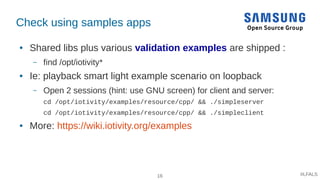
Check using samples apps
● Shared libs plus various validation examples are shipped :
– find /opt/iotivity*
● Ie: playback smart light example scenario on loopback
– Open 2 sessions (hint: use GNU screen) for client and server:
cd /opt/iotivity/examples/resource/cpp/ && ./simpleserver
cd /opt/iotivity/examples/resource/cpp/ && ./simpleclient
● More: https://wiki.iotivity.org/examples
Samsung Open Source Group 17 #LFALS
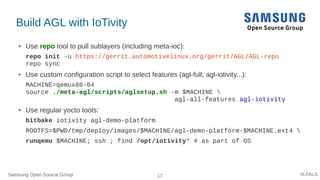
Build AGL with IoTivity
● Use repo tool to pull sublayers (including meta-ioc):
repo init -u https://gerrit.automotivelinux.org/gerrit/AGL/AGL-repo
repo sync
● Use custom configuration script to select features (agl-full, agl-iotivity...):
MACHINE=qemux86-64
source ./meta-agl/scripts/aglsetup.sh -m $MACHINE 
agl-all-features agl-iotivity
● Use regular yocto tools:
bitbake iotivity agl-demo-platform
ROOTFS=$PWD/tmp/deploy/images/$MACHINE/agl-demo-platform-$MACHINE.ext4 
runqemu $MACHINE; ssh ; find /opt/iotivity* # as part of OS
Samsung Open Source Group 18 #LFALS
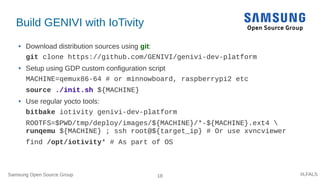
Build GENIVI with IoTivity
● Download distribution sources using git:
git clone https://github.com/GENIVI/genivi-dev-platform
● Setup using GDP custom configuration script
MACHINE=qemux86-64 # or minnowboard, raspberrypi2 etc
source ./init.sh ${MACHINE}
● Use regular yocto tools:
bitbake iotivity genivi-dev-platform
ROOTFS=$PWD/tmp/deploy/images/${MACHINE}/*-${MACHINE}.ext4 
runqemu ${MACHINE} ; ssh root@${target_ip} # Or use xvncviewer
find /opt/iotivity* # As part of OS
Samsung Open Source Group 19
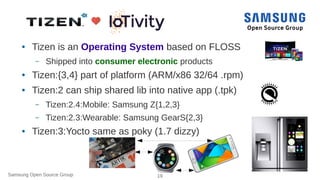
● Tizen is an Operating System based on FLOSS
– Shipped into consumer electronic products
● Tizen:{3,4} part of platform (ARM/x86 32/64 .rpm)
● Tizen:2 can ship shared lib into native app (.tpk)
– Tizen:2.4:Mobile: Samsung Z{1,2,3}
– Tizen:2.3:Wearable: Samsung GearS{2,3}
● Tizen:3:Yocto same as poky (1.7 dizzy)
Samsung Open Source Group 20 #LFALS
Timeline
● 2014-12-31: meta-oic 0.9.1 Initiated by Kishen Maloor (Intel) , (with demo for edison)
● 2016-01-31: FOSDEM: Presented how to use meta-oic on Tizen Yocto (Tizen fan)
● 2016-09-14: meta-oic 1.1.1 Philippe Coval (Samsung) new contribitor
● 2016-04-27: GENIVI AMM : Presented demos (fan+map+wearables on 1.1.1), +RVI
● 2016-05-08: meta-oic 1.1.1 integrated in GENIVI
● 2016-05-27: AGLF2F meeting, meta-ocf-automotive Introduced
● 2016-09-21: meta-oic 1.1.1 integrated in AGL
● 2016-12-20: meta-oic 1.2.0 integrated in GENIVI and AGL
● 2017-01-05: CES, GENIVI+Smarthome+Wearables demos (contact Sanjeev BA)
● 2017-02-04: FOSDEM: Presented “streetlight+cloud” usecase on AGL 3.0
● 2017-02-15: GENIVI announced partnership with Open Connectivity Foundation
● 2017-03-20: meta-oic 1.2.1+ : Phil C keeps maintaining it
Samsung Open Source Group 21
“Talk is cheap.
Show me the code.”
~ Linus Torvalds
22 #LFALS
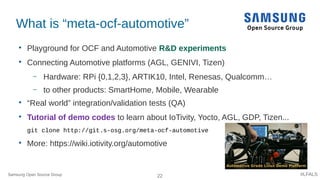
What is “meta-ocf-automotive”

Playground for OCF and Automotive R&D experiments

Connecting Automotive platforms (AGL, GENIVI, Tizen)
– Hardware: RPi {0,1,2,3}, ARTIK10, Intel, Renesas, Qualcomm…
– to other products: SmartHome, Mobile, Wearable

“Real world” integration/validation tests (QA)

Tutorial of demo codes to learn about IoTivity, Yocto, AGL, GDP, Tizen...
git clone http://git.s-osg.org/meta-ocf-automotive

More: https://wiki.iotivity.org/automotive
Samsung Open Source Group
23 #LFALS
Prepare your environment

Build IoTivity from sources for your OS: https://wiki.iotivity.org/os

Hint: build system package to use standard paths (/usr/include)

Or ask me for packages for Debian, Fedora, Arch (unsupported)

Tizen: Install OS on supported hardware and setup GBS tool
git clone https://git.tizen.org/cgit/platform/upstream/iotivity
cd iotivity && gbs build -P tizen_unified_armv7l -A armv7l

Yocto (AGL, GDP): meta-oic + meta-ocf-automotive layers to pull iotivity-example

Note: Security can be disabled at build time (for prototyping on 1.3-rel)

https://wiki.iotivity.org/security
Samsung Open Source Group
24 #LFALS
iotivity-example tutorial

OCF application developers might not develop in upstream source tree
– SCons build system is complex (even for sample apps)

A standalone project is better to get inspiration from or derivate
– minimalist, can be used as base skeleton (fork it at will, SDK?)

Download a collection of standalone subprojects:
– git clone http://git.s-osg.org/iotivity-example/ ; make

Each ”feature” subproject is a git module (pulling a branch based on other)
– Nice history to understand each steps of development
– For many OSes or build system (Currently, GNUmake, Linux, Tizen, More welcome)
Samsung Open Source Group
Samsung Open Source Group 25 #LFALS
“Simplicity
is the ultimate sophistication.”
~ Leonardo da Vinci
26 #LFALS
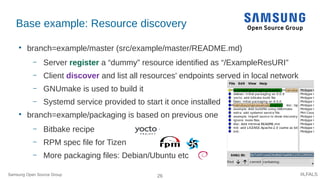
Base example: Resource discovery

branch=example/master (src/example/master/README.md)
– Server register a “dummy” resource identified as “/ExampleResURI”
– Client discover and list all resources' endpoints served in local network
– GNUmake is used to build it
– Systemd service provided to start it once installed

branch=example/packaging is based on previous one
– Bitbake recipe
– RPM spec file for Tizen
– More packaging files: Debian/Ubuntu etc
Samsung Open Source Group
27 #LFALS
main {
IoTServer::init() { ModeType::Server }
IoTServer::createResource()
{ OCPlatform::registerResource(... uri …) }
// loop on OCProcess() is called internally
}
main {
IoTClient::init() { ModeType::Client }
IoTClient::start()
{ OCPlatform::findResource(onFindCallback) }
IoTClient::onFind(resource)
{ print(resource->uri) }
IoTivity
Server
IoTivity
Client(s)
IP Network
Resource discovery example flow
$ ./bin/server -v
(...)
log: { IoTServer::createResource(...)
log: Successfully created
org.example.r.example resource
log: } OCStackResult
(...)
$ ./bin/client -v
(...)
log: { void IoTClient::onFind(...)
log: Resource: uri: /oic/d
(...)
log: Resource: uri: /ExampleResURI
coap://[fe80::baca:3aff:fe9b:b934%25eth0]:47508
28 #LFALS
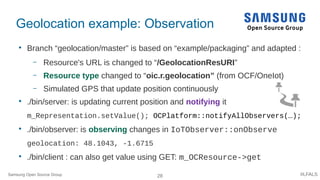
Geolocation example: Observation

Branch “geolocation/master” is based on “example/packaging” and adapted :
– Resource's URL is changed to “/GeolocationResURI”
– Resource type changed to “oic.r.geolocation” (from OCF/OneIot)
– Simulated GPS that update position continuously

./bin/server: is updating current position and notifying it
m_Representation.setValue(); OCPlatform::notifyAllObservers(…);

./bin/observer: is observing changes in IoTObserver::onObserve
geolocation: 48.1043, -1.6715

./bin/client : can also get value using GET: m_OCResource->get
Samsung Open Source Group
29 #LFALS
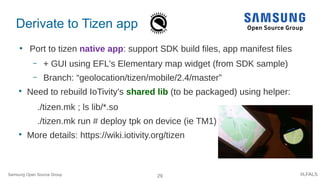
Derivate to Tizen app
●
Port to tizen native app: support SDK build files, app manifest files
– + GUI using EFL's Elementary map widget (from SDK sample)
– Branch: “geolocation/tizen/mobile/2.4/master”

Need to rebuild IoTivity’s shared lib (to be packaged) using helper:
./tizen.mk ; ls lib/*.so
./tizen.mk run # deploy tpk on device (ie TM1)

More details: https://wiki.iotivity.org/tizen
Samsung Open Source Group
Samsung Open Source Group 30 #LFALS
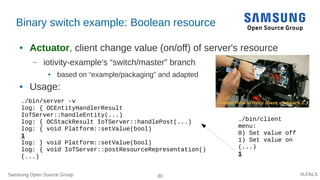
Binary switch example: Boolean resource
● Actuator, client change value (on/off) of server's resource
– iotivity-example's “switch/master” branch
● based on “example/packaging” and adapted
● Usage:
./bin/client
menu:
0) Set value off
1) Set value on
(...)
1
./bin/server -v
log: { OCEntityHandlerResult
IoTServer::handleEntity(...)
log: { OCStackResult IoTServer::handlePost(...)
log: { void Platform::setValue(bool)
1
log: } void Platform::setValue(bool)
log: { void IoTServer::postResourceRepresentation()
(...)
Samsung Open Source Group 31 #LFALS
OCResource::post(rep,
callback);
onPost(...)
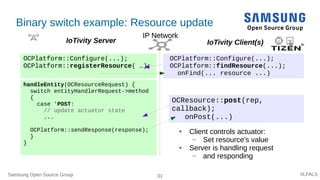
Binary switch example: Resource update
OCPlatform::Configure(...);
OCPlatform::registerResource( …);
handleEntity(OCResourceRequest) {
switch entityHandlerRequest->method
{
case 'POST:
// update actuator state
...
OCPlatform::sendResponse(response);
}
}
OCPlatform::Configure(...);
OCPlatform::findResource(...);
onFind(... resource ...)
IoTivity Server IoTivity Client(s)
IP NetworkIP Network
● Client controls actuator:
– Set resource's value
● Server is handling request
– and responding
32 #LFALS
More examples

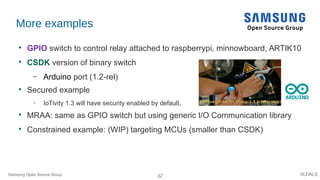
GPIO switch to control relay attached to raspberrypi, minnowboard, ARTIK10

CSDK version of binary switch
– Arduino port (1.2-rel)

Secured example
– IoTivity 1.3 will have security enabled by default,

MRAA: same as GPIO switch but using generic I/O Communication library

Constrained example: (WIP) targeting MCUs (smaller than CSDK)
Samsung Open Source Group
Samsung Open Source Group 33
Constantly talking
isn't necessarily communicating
~ Charlie Kaufman
Samsung Open Source Group 34
OCF Resource Model
/example/BinarySwitchResURI
{
“p” : Discoverable & Observable & Secured,
“if” : ["oic.if.a","oic.if.baseline"],
“rt” : [“oic.r.switch.binary”],
“value” : true
...
}
URI:
+ common
properties:
Policy
Interface...
Resource Type:
+ attribute(s)
● Well knows resources URI (/oic/*):
– “res” discovery, “p” for platform , “d”: device (role: C/S), “sec/*” : security
Samsung Open Source Group 35Samsung Open Source Group
Data models can be:
● Described
– For RESTful operations (CRUD)
– RAML+JSON, Swagger Schemas
● Reviewed and validated
– OCF check consistency and versions
● Shared
– http://OneIotA.org repository & tools
● Note:
– IoTivity works with private models too
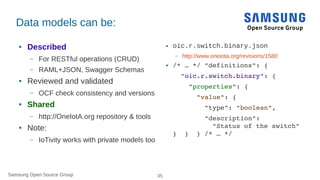
● oic.r.switch.binary.json
– http://www.oneiota.org/revisions/1580
● /* … */ "definitions": {
  "oic.r.switch.binary": {
    "properties": {
      "value": {
        "type": "boolean",
        "description":
          "Status of the switch"
}  }  } /* … */
Samsung Open Source Group 36Samsung Open Source Group
Aligning semantic: W3C, OCF, OMA...
● W3C: Automotive Working Group:
– Vehicle Signal Specification (VSS): YAML & Json
● Many specific signals on ~100 interfaces (Chassis, OBD, Cabin, ADAS, Media...)
– Could be dispatched over generic OCF models:
● Switch, Speed, Distance, Movement, Audio, TimePeriod, Weight
● Example of aligned concepts:
– oic.r.sensor.geolocation : { latitude, longitude, altitude }
● W3C: Signal.Cabin.Infotainment.Navigation.DestinatonSet.Longitude
● Longitude of destination, Integer double [-180..+180]
– oic.r.switch.binary: for lights, door, brake, belt...
● Details: http://tinyurl.com/omaocf2017
Samsung Open Source Group 37Samsung Open Source Group
OCF-VSS Translator
https://youtu.be/jKt_fPnqggo
https://youtu.be/jKt_fPnqggo#
openconnectivity-lfals2017
Samsung Open Source Group 38 #LFALS
Want more ?
39 #LFALS
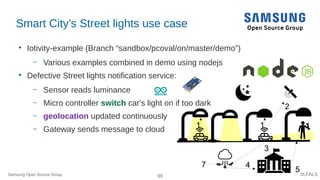
Smart City’s Street lights use case

Iotivity-example (Branch “sandbox/pcoval/on/master/demo”)
– Various examples combined in demo using nodejs

Defective Street lights notification service:
– Sensor reads luminance
– Micro controller switch car's light on if too dark
– geolocation updated continuously
– Gateway sends message to cloud
Samsung Open Source Group
11
2
3
5
47
40 #LFALS
From sensor to ARTIKCloud #FOSDEM2017
https://youtu.be/3L6_DbMLJ1k
From sensor to ARTIKCloud (FOSDEM2017)
https://youtu.be/3L6_DbMLJ1k
Samsung Open Source Group 41Samsung Open Source Group
https://api.artik.cloud/
{
illuminance: 42,
latitude: 52.165,
longitude: -2.21
}
/IlluminanceResURI
{
illuminance: 42
}
/GeoLocationResURI
{
latitude: 52.165,
longitude: -2.21,
}
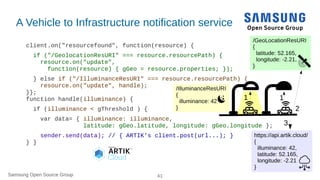
A Vehicle to Infrastructure notification service
client.on("resourcefound", function(resource) {
if ("/GeolocationResURI" === resource.resourcePath) {
resource.on("update",
function(resource) { gGeo = resource.properties; });
} else if ("/IlluminanceResURI" === resource.resourcePath) {
resource.on("update", handle);
}};
function handle(illuminance) {
if (illuminance < gThreshold ) {
var data= { illuminance: illuminance,
latitude: gGeo.latitude, longitude: gGeo.longitude };
sender.send(data); // { ARTIK's client.post(url...); }
} }
1
2
3
1
Samsung Open Source Group 42 #LFALS
Summary
● OCF establishes a standard for interconnecting things
– Several profiles: SmartHome, Automotive, Health...
– Common technology: Resource model & RESTful architecture
– Definitions must be shared to ensure interoperability
● Open Source project IoTivity
– implements it in C, C++, Java and Javascript
– Ready to be used on Automotive Oses and beyond
– Try using examples. Feedback welcome !
Samsung Open Source Group 43 #LFALS
References
● Entry points:
– http://wiki.iotivity.org/automotive
– https://openconnectivity.org/industries/automotive
– https://blogs.s-osg.org/tag/automotive/
– http://git.s-osg.org/iotivity-example
– http://git.s-osg.org/meta-ocf-automotive/
● Going further:
– https://openconnectivity.org/resources/iotivity
– https://openconnectivity.org/resources/oneiota-data-model-tool
– https://news.samsung.com/global/samsung-contributes-to-open-iot-showcase-at-ces-2017
● Keep in touch online:
– https://wiki.iotivity.org/community (Wiki, Mailing list, IRC, Events ...)
– https://wiki.tizen.org/wiki/Meeting
– https://www.meetup.com/OCF-France/ (Local events worldwide, Soon in Tokyo)
– https://blogs.s-osg.org/author/pcoval/
Samsung Open Source Group 44
Q&A or Extras ?
45 #LFALS
IoTivity on GENIVI demo platform:
https://youtu.be/DJKYauaOmsc
tizen-genivi-20160424rzr
https://youtu.be/DJKYauaOmsc
46 #LFALS
IoTivity on Automotive Grade Linux (AGL)
https://youtu.be/w_c0wxJfBsw
iotivity-agl-demo-platform-20160222rzr
https://youtu.be/w_c0wxJfBsw
Samsung Open Source Group 47 #LFALS
Thank you
ありがとう
Merci !
Resources: flaticons CC
Visit OpenConnectivity #LFALS booth !
Contact:
https://wiki.tizen.org/wiki/User:Pcoval

IoTivity for Automotive: meta-ocf-automotive tutorial

  • 1.
    Samsung Open SourceGroup 1 #LFALS For Automotive Philippe Coval Samsung Open Source Group / SRUK philippe.coval@osg.samsung.com meta-ocf-automotive tutorial Automotive Linux Summit #LFALS, Tokyo, Japan <2017-05-31>
  • 2.
    Samsung Open SourceGroup 2 #LFALS こんにちは from Philippe Coval ● Software engineer for Samsung Research – Open Source Group, EU team (@UK + DE + FR + CZ...) ● Commit into IoTivity, Tizen – Plus automotive related projects: Yocto, GENIVI, AGL ● Interest: Usages, OS/hardware support, build, community ● Ask me online for help: – https://wiki.tizen.org/wiki/User:Pcoval
  • 3.
    Samsung Open SourceGroup 3 #LFALS Agenda ● IoT interoperability – Open Connectivity Foundation + IoTivity ● OCF Automotive working group – Demos ● Learning IoTivity by examples ● Convergence of automotive data models ?
  • 4.
    Samsung Open SourceGroup 4 “Without trust there's no cooperation. And without cooperation there's no progress. History stops.” ~ Rick Yancey, The Last Star
  • 5.
    Samsung Open SourceGroup 5 #LFALS Motivations for Interoperability in IoT ● To break silos between: – Personal devices: Mobile, Wearable... – Shared devices: SmartHome, Cars (IVI, many OS) – Infrastructure: Buildings, Cities (traffic, pedestrians...) – Online services and probably more to come... ● A common open standard is welcome ! – To provide abstracted features: ● Connectivity, Security, Portability, Modularity ● Protocol, Opensource stack, Community
  • 6.
    Samsung Open SourceGroup 6 #LFALS Open connectivity foundation's missions ● Provide software linking the Internet Of Things – Focus on interoperability and seamless connectivity between devices ● Write specification, establish a protocol (formerly named OIC) – Rely on existing standards (IETF: CoAP, Cbor..) ● Sponsor Reference implementation: – OpenSource (Apache 2.0 license) use existing FLOSS libs ● Hosted by Linux Foundation (like kernel, Tizen etc) – Rule: No unimplemented features in specification ● Certify products for over 300 members (join us!)
  • 7.
    Samsung Open SourceGroup 7 #LFALS Common technology for multiple profiles Architecture RESTful CRUD-N Communication IETF (CoAP, Cbor) +Security DTLS Semantics RAML Smart Home: Zigbee Blue Tooth Personal Devices Wearables: BLE Cloud: HTTP/ TCP Mobilty Automotive OBD-II* CAN* LIN* MOST* LTE* 802.11p* 5G* ...
  • 8.
    Samsung Open SourceGroup 8 #LFALS IoTivity Framework for connecting devices ● Core cross platform libraries – C API: resource layer + connectivity abstraction (IP, BT, BLE...) ● Link to libcoap, tinycbor (code footprint ~128-KiB), + mbedtls – C++ API: C++11 bindings to build extra services ● + High level services (Mostly C++) – Data/Device Management: Container, Hosting, Encapsulation, Scene – Simulator (Eclipse based), http proxy ● + Plugins: Transport, Cloud Interface, Bridging ● Related projects – IoTivity-Node: Javascript bindings – IoTivity-contrainted: For thin devices (micro-controllers)
  • 9.
    Samsung Open SourceGroup 9 Security matters for IoT ● Link layer provides secure channel (using DTLS) to connectivity abstraction (CA) ● Devices need to be owned (once or xfer) and provisioned using onboarding tool: – Establish ownership in user's network ● Secure Resource Manager (SRM): – Secure platform's resources ● Device provisioning, Credentials, Access control list, Persistence – Policy engine: Request filtering: Grant, deny resource requests ● Per policy, requester ID, ACL, device status... – Is an OIC resource (“/oic/sec/cred”) ● Hardware hardening: use encryption and secure contexts, RNG, IO etc ● Details: https://www.slideshare.net/SamsungOSG/iot-meets-security
  • 10.
    Samsung Open SourceGroup 10 “Any sufficiently advanced technology is indistinguishable from magic.” ~ Arthur C. Clarke
  • 11.
    Samsung Open SourceGroup 11Samsung Open Source Group OCF Automotive profile's mission ● Provide OCF technology for connected cars, by proposing – A common definition of vehicle resources – A common way to interact with those (inside or outside vehicle) – Based on or bridging to existing standards ● Cooperative effort of existing FLOSS Automotive projects – Tizen, GENIVI, AGL, W3C, RVI ...
  • 12.
    12 #LFALS SmartHome toAutomotive #CES2017 https://youtu.be/3d0uZE6lHvo SmartHome to Automotive (#CES2017) https://youtu.be/3d0uZE6lHvo
  • 13.
    Samsung Open SourceGroup 13 “The secret of getting ahead is getting started.” ~ Mark Twain
  • 14.
    Samsung Open SourceGroup 14Samsung Open Source Group Supported Automotive OS ● Download OS image shipping IoTivity: Tizen, GDP, AGL? – Or install package from repository (RPM) ● Use “meta-oic” layer on OE/Yocto based distributions: – GENIVI (Specification first): integrated – AGL/Automotive Grade Linux (Code first): optional – Tizen Yocto project to build Common + IVI ● Rebuild package from sources for most GNU/Linux systems – https://wiki.iotivity.org/build
  • 15.
    15 #LFALS Build Yocto'sPoky with IoTivity ● Adding “meta-oic” layer to poky reference distribution git clone http://git.yoctoproject.org/git/poky cd poky && source ./oe-init-build-env git clone http://git.yoctoproject.org/git/meta-oic ● Append to environment files previously generated: – “poky/conf/bblayers.conf” (Layer path file) RELATIVE_DIR := "${@os.path.abspath(os.path.dirname(d.getVar('FILE', True))+'/../..')}" BBLAYERS += "${RELATIVE_DIR}/meta-oic" – “poky/conf/local.conf” (Project configuration file) CORE_IMAGE_EXTRA_INSTALL += " packagegroup-iotivity " ● Rebuild poky image using: bitbake core-image-minimal Samsung Open Source Group
  • 16.
    16 #LFALS Check usingsamples apps ● Shared libs plus various validation examples are shipped : – find /opt/iotivity* ● Ie: playback smart light example scenario on loopback – Open 2 sessions (hint: use GNU screen) for client and server: cd /opt/iotivity/examples/resource/cpp/ && ./simpleserver cd /opt/iotivity/examples/resource/cpp/ && ./simpleclient ● More: https://wiki.iotivity.org/examples
  • 17.
    Samsung Open SourceGroup 17 #LFALS Build AGL with IoTivity ● Use repo tool to pull sublayers (including meta-ioc): repo init -u https://gerrit.automotivelinux.org/gerrit/AGL/AGL-repo repo sync ● Use custom configuration script to select features (agl-full, agl-iotivity...): MACHINE=qemux86-64 source ./meta-agl/scripts/aglsetup.sh -m $MACHINE agl-all-features agl-iotivity ● Use regular yocto tools: bitbake iotivity agl-demo-platform ROOTFS=$PWD/tmp/deploy/images/$MACHINE/agl-demo-platform-$MACHINE.ext4 runqemu $MACHINE; ssh ; find /opt/iotivity* # as part of OS
  • 18.
    Samsung Open SourceGroup 18 #LFALS Build GENIVI with IoTivity ● Download distribution sources using git: git clone https://github.com/GENIVI/genivi-dev-platform ● Setup using GDP custom configuration script MACHINE=qemux86-64 # or minnowboard, raspberrypi2 etc source ./init.sh ${MACHINE} ● Use regular yocto tools: bitbake iotivity genivi-dev-platform ROOTFS=$PWD/tmp/deploy/images/${MACHINE}/*-${MACHINE}.ext4 runqemu ${MACHINE} ; ssh root@${target_ip} # Or use xvncviewer find /opt/iotivity* # As part of OS
  • 19.
    Samsung Open SourceGroup 19 ● Tizen is an Operating System based on FLOSS – Shipped into consumer electronic products ● Tizen:{3,4} part of platform (ARM/x86 32/64 .rpm) ● Tizen:2 can ship shared lib into native app (.tpk) – Tizen:2.4:Mobile: Samsung Z{1,2,3} – Tizen:2.3:Wearable: Samsung GearS{2,3} ● Tizen:3:Yocto same as poky (1.7 dizzy)
  • 20.
    Samsung Open SourceGroup 20 #LFALS Timeline ● 2014-12-31: meta-oic 0.9.1 Initiated by Kishen Maloor (Intel) , (with demo for edison) ● 2016-01-31: FOSDEM: Presented how to use meta-oic on Tizen Yocto (Tizen fan) ● 2016-09-14: meta-oic 1.1.1 Philippe Coval (Samsung) new contribitor ● 2016-04-27: GENIVI AMM : Presented demos (fan+map+wearables on 1.1.1), +RVI ● 2016-05-08: meta-oic 1.1.1 integrated in GENIVI ● 2016-05-27: AGLF2F meeting, meta-ocf-automotive Introduced ● 2016-09-21: meta-oic 1.1.1 integrated in AGL ● 2016-12-20: meta-oic 1.2.0 integrated in GENIVI and AGL ● 2017-01-05: CES, GENIVI+Smarthome+Wearables demos (contact Sanjeev BA) ● 2017-02-04: FOSDEM: Presented “streetlight+cloud” usecase on AGL 3.0 ● 2017-02-15: GENIVI announced partnership with Open Connectivity Foundation ● 2017-03-20: meta-oic 1.2.1+ : Phil C keeps maintaining it
  • 21.
    Samsung Open SourceGroup 21 “Talk is cheap. Show me the code.” ~ Linus Torvalds
  • 22.
    22 #LFALS What is“meta-ocf-automotive”  Playground for OCF and Automotive R&D experiments  Connecting Automotive platforms (AGL, GENIVI, Tizen) – Hardware: RPi {0,1,2,3}, ARTIK10, Intel, Renesas, Qualcomm… – to other products: SmartHome, Mobile, Wearable  “Real world” integration/validation tests (QA)  Tutorial of demo codes to learn about IoTivity, Yocto, AGL, GDP, Tizen... git clone http://git.s-osg.org/meta-ocf-automotive  More: https://wiki.iotivity.org/automotive Samsung Open Source Group
  • 23.
    23 #LFALS Prepare yourenvironment  Build IoTivity from sources for your OS: https://wiki.iotivity.org/os  Hint: build system package to use standard paths (/usr/include)  Or ask me for packages for Debian, Fedora, Arch (unsupported)  Tizen: Install OS on supported hardware and setup GBS tool git clone https://git.tizen.org/cgit/platform/upstream/iotivity cd iotivity && gbs build -P tizen_unified_armv7l -A armv7l  Yocto (AGL, GDP): meta-oic + meta-ocf-automotive layers to pull iotivity-example  Note: Security can be disabled at build time (for prototyping on 1.3-rel)  https://wiki.iotivity.org/security Samsung Open Source Group
  • 24.
    24 #LFALS iotivity-example tutorial  OCFapplication developers might not develop in upstream source tree – SCons build system is complex (even for sample apps)  A standalone project is better to get inspiration from or derivate – minimalist, can be used as base skeleton (fork it at will, SDK?)  Download a collection of standalone subprojects: – git clone http://git.s-osg.org/iotivity-example/ ; make  Each ”feature” subproject is a git module (pulling a branch based on other) – Nice history to understand each steps of development – For many OSes or build system (Currently, GNUmake, Linux, Tizen, More welcome) Samsung Open Source Group
  • 25.
    Samsung Open SourceGroup 25 #LFALS “Simplicity is the ultimate sophistication.” ~ Leonardo da Vinci
  • 26.
    26 #LFALS Base example:Resource discovery  branch=example/master (src/example/master/README.md) – Server register a “dummy” resource identified as “/ExampleResURI” – Client discover and list all resources' endpoints served in local network – GNUmake is used to build it – Systemd service provided to start it once installed  branch=example/packaging is based on previous one – Bitbake recipe – RPM spec file for Tizen – More packaging files: Debian/Ubuntu etc Samsung Open Source Group
  • 27.
    27 #LFALS main { IoTServer::init(){ ModeType::Server } IoTServer::createResource() { OCPlatform::registerResource(... uri …) } // loop on OCProcess() is called internally } main { IoTClient::init() { ModeType::Client } IoTClient::start() { OCPlatform::findResource(onFindCallback) } IoTClient::onFind(resource) { print(resource->uri) } IoTivity Server IoTivity Client(s) IP Network Resource discovery example flow $ ./bin/server -v (...) log: { IoTServer::createResource(...) log: Successfully created org.example.r.example resource log: } OCStackResult (...) $ ./bin/client -v (...) log: { void IoTClient::onFind(...) log: Resource: uri: /oic/d (...) log: Resource: uri: /ExampleResURI coap://[fe80::baca:3aff:fe9b:b934%25eth0]:47508
  • 28.
    28 #LFALS Geolocation example:Observation  Branch “geolocation/master” is based on “example/packaging” and adapted : – Resource's URL is changed to “/GeolocationResURI” – Resource type changed to “oic.r.geolocation” (from OCF/OneIot) – Simulated GPS that update position continuously  ./bin/server: is updating current position and notifying it m_Representation.setValue(); OCPlatform::notifyAllObservers(…);  ./bin/observer: is observing changes in IoTObserver::onObserve geolocation: 48.1043, -1.6715  ./bin/client : can also get value using GET: m_OCResource->get Samsung Open Source Group
  • 29.
    29 #LFALS Derivate toTizen app ● Port to tizen native app: support SDK build files, app manifest files – + GUI using EFL's Elementary map widget (from SDK sample) – Branch: “geolocation/tizen/mobile/2.4/master”  Need to rebuild IoTivity’s shared lib (to be packaged) using helper: ./tizen.mk ; ls lib/*.so ./tizen.mk run # deploy tpk on device (ie TM1)  More details: https://wiki.iotivity.org/tizen Samsung Open Source Group
  • 30.
    Samsung Open SourceGroup 30 #LFALS Binary switch example: Boolean resource ● Actuator, client change value (on/off) of server's resource – iotivity-example's “switch/master” branch ● based on “example/packaging” and adapted ● Usage: ./bin/client menu: 0) Set value off 1) Set value on (...) 1 ./bin/server -v log: { OCEntityHandlerResult IoTServer::handleEntity(...) log: { OCStackResult IoTServer::handlePost(...) log: { void Platform::setValue(bool) 1 log: } void Platform::setValue(bool) log: { void IoTServer::postResourceRepresentation() (...)
  • 31.
    Samsung Open SourceGroup 31 #LFALS OCResource::post(rep, callback); onPost(...) Binary switch example: Resource update OCPlatform::Configure(...); OCPlatform::registerResource( …); handleEntity(OCResourceRequest) { switch entityHandlerRequest->method { case 'POST: // update actuator state ... OCPlatform::sendResponse(response); } } OCPlatform::Configure(...); OCPlatform::findResource(...); onFind(... resource ...) IoTivity Server IoTivity Client(s) IP NetworkIP Network ● Client controls actuator: – Set resource's value ● Server is handling request – and responding
  • 32.
    32 #LFALS More examples  GPIOswitch to control relay attached to raspberrypi, minnowboard, ARTIK10  CSDK version of binary switch – Arduino port (1.2-rel)  Secured example – IoTivity 1.3 will have security enabled by default,  MRAA: same as GPIO switch but using generic I/O Communication library  Constrained example: (WIP) targeting MCUs (smaller than CSDK) Samsung Open Source Group
  • 33.
    Samsung Open SourceGroup 33 Constantly talking isn't necessarily communicating ~ Charlie Kaufman
  • 34.
    Samsung Open SourceGroup 34 OCF Resource Model /example/BinarySwitchResURI { “p” : Discoverable & Observable & Secured, “if” : ["oic.if.a","oic.if.baseline"], “rt” : [“oic.r.switch.binary”], “value” : true ... } URI: + common properties: Policy Interface... Resource Type: + attribute(s) ● Well knows resources URI (/oic/*): – “res” discovery, “p” for platform , “d”: device (role: C/S), “sec/*” : security
  • 35.
    Samsung Open SourceGroup 35Samsung Open Source Group Data models can be: ● Described – For RESTful operations (CRUD) – RAML+JSON, Swagger Schemas ● Reviewed and validated – OCF check consistency and versions ● Shared – http://OneIotA.org repository & tools ● Note: – IoTivity works with private models too ● oic.r.switch.binary.json – http://www.oneiota.org/revisions/1580 ● /* … */ "definitions": {   "oic.r.switch.binary": {     "properties": {       "value": {         "type": "boolean",         "description":           "Status of the switch" }  }  } /* … */
  • 36.
    Samsung Open SourceGroup 36Samsung Open Source Group Aligning semantic: W3C, OCF, OMA... ● W3C: Automotive Working Group: – Vehicle Signal Specification (VSS): YAML & Json ● Many specific signals on ~100 interfaces (Chassis, OBD, Cabin, ADAS, Media...) – Could be dispatched over generic OCF models: ● Switch, Speed, Distance, Movement, Audio, TimePeriod, Weight ● Example of aligned concepts: – oic.r.sensor.geolocation : { latitude, longitude, altitude } ● W3C: Signal.Cabin.Infotainment.Navigation.DestinatonSet.Longitude ● Longitude of destination, Integer double [-180..+180] – oic.r.switch.binary: for lights, door, brake, belt... ● Details: http://tinyurl.com/omaocf2017
  • 37.
    Samsung Open SourceGroup 37Samsung Open Source Group OCF-VSS Translator https://youtu.be/jKt_fPnqggo https://youtu.be/jKt_fPnqggo# openconnectivity-lfals2017
  • 38.
    Samsung Open SourceGroup 38 #LFALS Want more ?
  • 39.
    39 #LFALS Smart City’sStreet lights use case  Iotivity-example (Branch “sandbox/pcoval/on/master/demo”) – Various examples combined in demo using nodejs  Defective Street lights notification service: – Sensor reads luminance – Micro controller switch car's light on if too dark – geolocation updated continuously – Gateway sends message to cloud Samsung Open Source Group 11 2 3 5 47
  • 40.
    40 #LFALS From sensorto ARTIKCloud #FOSDEM2017 https://youtu.be/3L6_DbMLJ1k From sensor to ARTIKCloud (FOSDEM2017) https://youtu.be/3L6_DbMLJ1k
  • 41.
    Samsung Open SourceGroup 41Samsung Open Source Group https://api.artik.cloud/ { illuminance: 42, latitude: 52.165, longitude: -2.21 } /IlluminanceResURI { illuminance: 42 } /GeoLocationResURI { latitude: 52.165, longitude: -2.21, } A Vehicle to Infrastructure notification service client.on("resourcefound", function(resource) { if ("/GeolocationResURI" === resource.resourcePath) { resource.on("update", function(resource) { gGeo = resource.properties; }); } else if ("/IlluminanceResURI" === resource.resourcePath) { resource.on("update", handle); }}; function handle(illuminance) { if (illuminance < gThreshold ) { var data= { illuminance: illuminance, latitude: gGeo.latitude, longitude: gGeo.longitude }; sender.send(data); // { ARTIK's client.post(url...); } } } 1 2 3 1
  • 42.
    Samsung Open SourceGroup 42 #LFALS Summary ● OCF establishes a standard for interconnecting things – Several profiles: SmartHome, Automotive, Health... – Common technology: Resource model & RESTful architecture – Definitions must be shared to ensure interoperability ● Open Source project IoTivity – implements it in C, C++, Java and Javascript – Ready to be used on Automotive Oses and beyond – Try using examples. Feedback welcome !
  • 43.
    Samsung Open SourceGroup 43 #LFALS References ● Entry points: – http://wiki.iotivity.org/automotive – https://openconnectivity.org/industries/automotive – https://blogs.s-osg.org/tag/automotive/ – http://git.s-osg.org/iotivity-example – http://git.s-osg.org/meta-ocf-automotive/ ● Going further: – https://openconnectivity.org/resources/iotivity – https://openconnectivity.org/resources/oneiota-data-model-tool – https://news.samsung.com/global/samsung-contributes-to-open-iot-showcase-at-ces-2017 ● Keep in touch online: – https://wiki.iotivity.org/community (Wiki, Mailing list, IRC, Events ...) – https://wiki.tizen.org/wiki/Meeting – https://www.meetup.com/OCF-France/ (Local events worldwide, Soon in Tokyo) – https://blogs.s-osg.org/author/pcoval/
  • 44.
    Samsung Open SourceGroup 44 Q&A or Extras ?
  • 45.
    45 #LFALS IoTivity onGENIVI demo platform: https://youtu.be/DJKYauaOmsc tizen-genivi-20160424rzr https://youtu.be/DJKYauaOmsc
  • 46.
    46 #LFALS IoTivity onAutomotive Grade Linux (AGL) https://youtu.be/w_c0wxJfBsw iotivity-agl-demo-platform-20160222rzr https://youtu.be/w_c0wxJfBsw
  • 47.
    Samsung Open SourceGroup 47 #LFALS Thank you ありがとう Merci ! Resources: flaticons CC Visit OpenConnectivity #LFALS booth ! Contact: https://wiki.tizen.org/wiki/User:Pcoval