Enabling System Level Design1
GreenSocs Overview
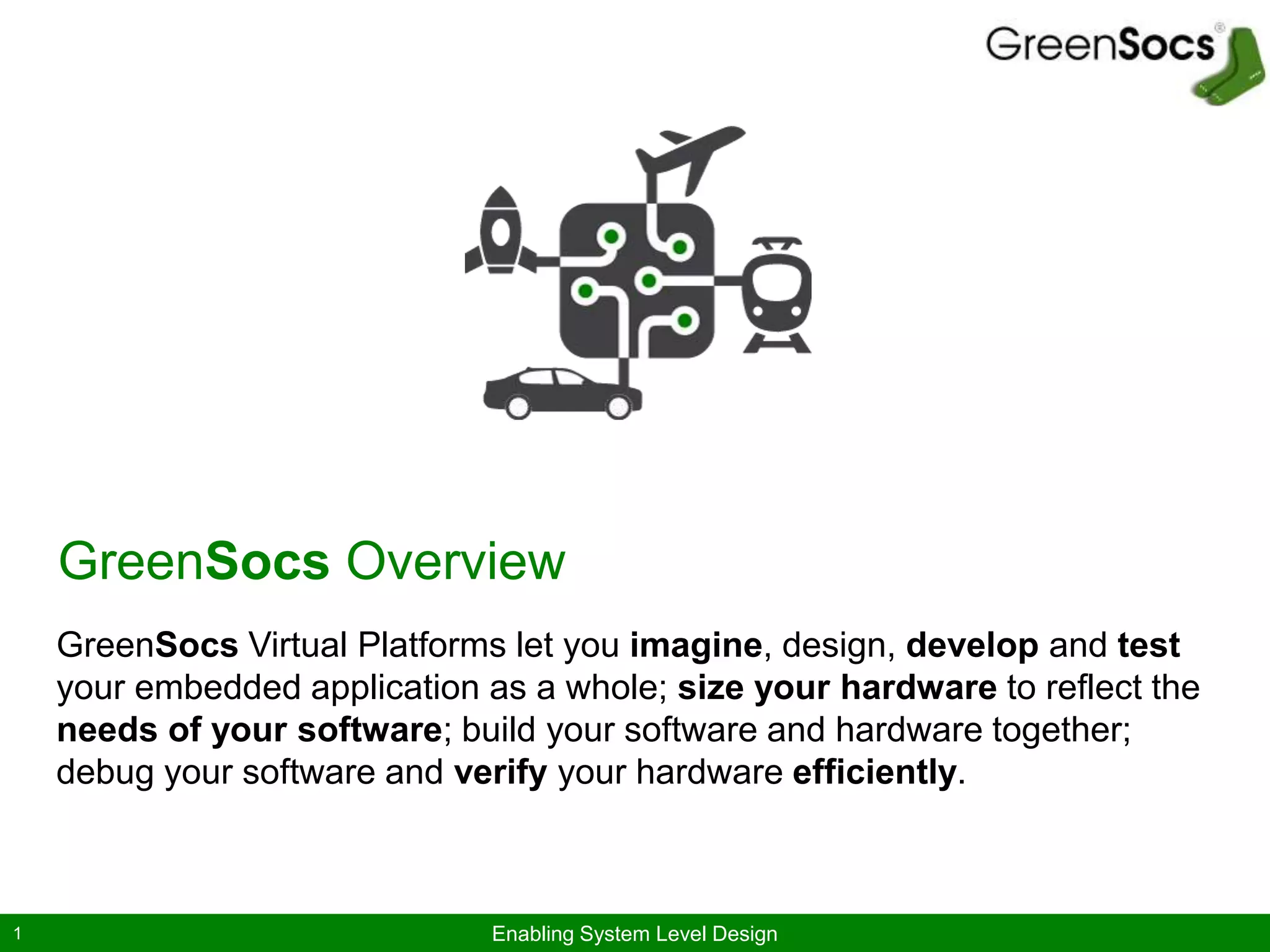
GreenSocs Virtual Platforms let you imagine, design, develop and test
your embedded application as a whole; size your hardware to reflect the
needs of your software; build your software and hardware together;
debug your software and verify your hardware efficiently.
Enabling System Level Design2
GreenSocs: Integrated Virtual Platforms
• GreenSocs® is the industrial leader in integrating different Virtual Platform
solutions
• Dr Mark Burton is the founder of GreenSocs. Mark has worked for ARM
managing their modeling group. He was the chair of the OSCI TLM WG
and the OCP-IP SLD WG.
• GreenSocs provided technology behind the TLM-2.0 standard, and the
CCI standard. We continue to be at the heart of SystemC development.
• GreenSocs is a contributor to QEMU, providing technology to support
multi-thread and reverse execution.
• GreenSocs has been in business (incorporated in UK and France), and
profitable, since 2005, including within its client base large multi-nationals.
Enabling System Level Design3
THE PROBLEM
Entrée
Enabling System Level Design4
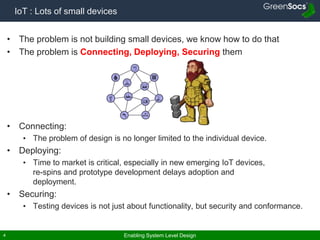
IoT : Lots of small devices
• The problem is not building small devices, we know how to do that
• The problem is Connecting, Deploying, Securing them
• Connecting:
• The problem of design is no longer limited to the individual device.
• Deploying:
• Time to market is critical, especially in new emerging IoT devices,
re-spins and prototype development delays adoption and
deployment.
• Securing:
• Testing devices is not just about functionality, but security and conformance.
Enabling System Level Design5
No longer can we simply test the device, we must test the devices
impact on the network and other devices.
We must consider the complexities of big data.
The Problem of Testing
• Testing IoT is a major issue:
• 26 Billion IoT units by 2020 (Gartner)
• Enormous data throughput
• An individual working device is not
enough!
Enabling System Level Design6
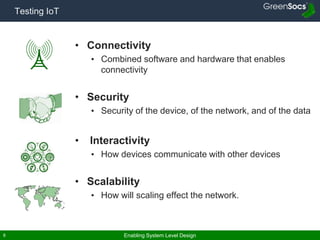
Testing IoT
• Connectivity
• Combined software and hardware that enables
connectivity
• Security
• Security of the device, of the network, and of the data
• Interactivity
• How devices communicate with other devices
• Scalability
• How will scaling effect the network.
Enabling System Level Design7
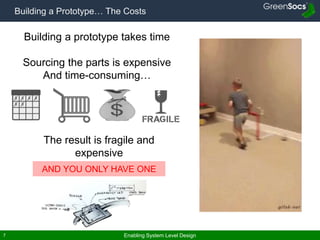
Building a Prototype… The Costs
Building a prototype takes time
Sourcing the parts is expensive
And time-consuming…
The result is fragile and
expensive
AND YOU ONLY HAVE ONE
Enabling System Level Design8
THE SOLUTION
Plat principal
Enabling System Level Design9
Radio
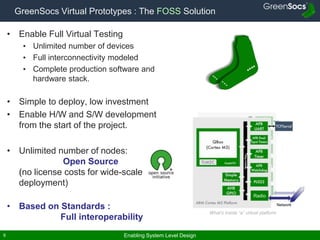
GreenSocs Virtual Prototypes : The FOSS Solution
• Enable Full Virtual Testing
• Unlimited number of devices
• Full interconnectivity modeled
• Complete production software and
hardware stack.
• Simple to deploy, low investment
• Enable H/W and S/W development
from the start of the project.
• Unlimited number of nodes:
Open Source
(no license costs for wide-scale
deployment)
• Based on Standards :
Full interoperability
What’s inside “a” virtual platform
Radio
Network
Enabling System Level Design10
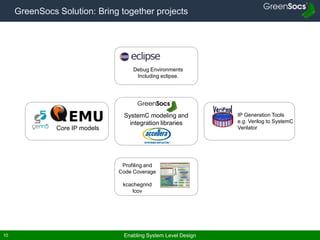
GreenSocs Solution: Bring together projects
IP Generation Tools
e.g. Verilog to SystemC
Verilator
Debug Environments
Including eclipse.
Core IP models
SystemC modeling and
integration libraries
Profiling and
Code Coverage
kcachegrind
lcov
Enabling System Level Design11
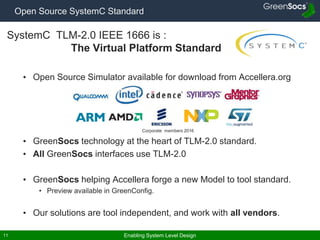
Open Source SystemC Standard
SystemC TLM-2.0 IEEE 1666 is :
The Virtual Platform Standard
• Open Source Simulator available for download from Accellera.org
Corporate members 2016
• GreenSocs technology at the heart of TLM-2.0 standard.
• All GreenSocs interfaces use TLM-2.0
• GreenSocs helping Accellera forge a new Model to tool standard.
• Preview available in GreenConfig.
• Our solutions are tool independent, and work with all vendors.
Enabling System Level Design12
Based on Existing and stable technology
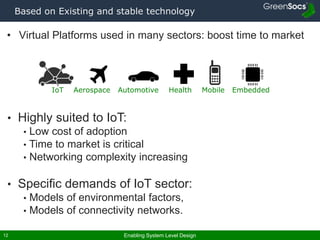
IoT Aerospace Automotive Health Mobile Embedded
• Virtual Platforms used in many sectors: boost time to market
• Highly suited to IoT:
• Low cost of adoption
• Time to market is critical
• Networking complexity increasing
• Specific demands of IoT sector:
• Models of environmental factors,
• Models of connectivity networks.
Enabling System Level Design13
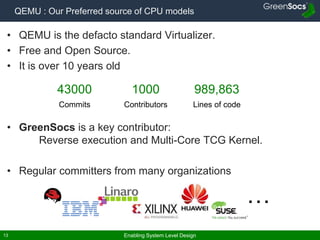
QEMU : Our Preferred source of CPU models
• QEMU is the defacto standard Virtualizer.
• Free and Open Source.
• It is over 10 years old
• GreenSocs is a key contributor:
Reverse execution and Multi-Core TCG Kernel.
• Regular committers from many organizations
43000 1000 989,863
Commits Contributors Lines of code
…
Enabling System Level Design14
THE ADVANTAGES
Dessert
Enabling System Level Design15
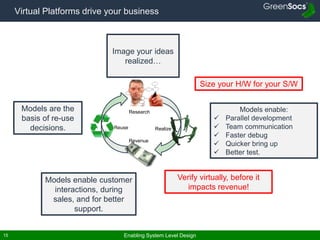
Virtual Platforms drive your business
Research
Realize
Revenue
Reuse
Image your ideas
realized…
Models enable:
 Parallel development
 Team communication
 Faster debug
 Quicker bring up
 Better test.
Models enable customer
interactions, during
sales, and for better
support.
Models are the
basis of re-use
decisions.
Size your H/W for your S/W
Verify virtually, before it
impacts revenue!
Enabling System Level Design16
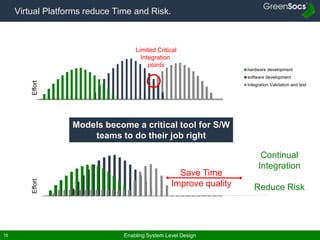
hardware development
software development
Integration Validation and test
Virtual Platforms reduce Time and Risk.
Effort
Limited Critical
Integration
points
Continual
Integration
Reduce Risk
Models become a critical tool for S/W
teams to do their job right
Save Time
Improve quality
Effort
Enabling System Level Design17
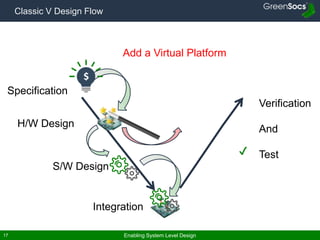
Classic V Design Flow
✔
Verification
And
Test
Specification
H/W Design
S/W Design
Integration
Add a Virtual Platform
Enabling System Level Design18
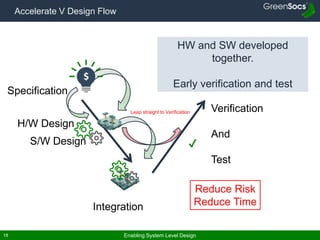
Accelerate V Design Flow
✔
Verification
And
Test
Specification
H/W Design
S/W Design
Integration
HW and SW developed
together.
Early verification and test
Reduce Risk
Reduce Time
Leap straight to Verification
Enabling System Level Design19
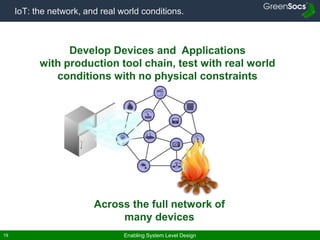
IoT: the network, and real world conditions.
Develop Devices and Applications
with production tool chain, test with real world
conditions with no physical constraints
Across the full network of
many devices
Enabling System Level Design20
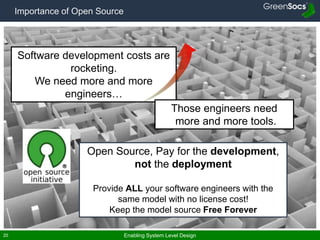
Importance of Open Source
Software development costs are
rocketing.
We need more and more
engineers…
Those engineers need
more and more tools.
Open Source, Pay for the development,
not the deployment
Provide ALL your software engineers with the
same model with no license cost!
Keep the model source Free Forever
Enabling System Level Design21
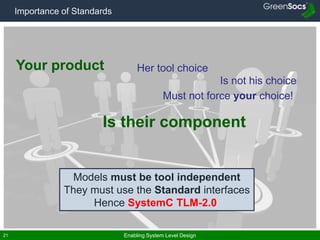
Importance of Standards
Your product
Is their component
Her tool choice
Must not force your choice!
Models must be tool independent
They must use the Standard interfaces
Hence SystemC TLM-2.0
Is not his choice
Enabling System Level Design22
GreenSocs : principle offers
CONSULTANCY AND SERVICES
The Experts in Virtual platforms:
Creation, deployment, integration
Tool independent – vendor neutral.
Allow us to guide you to success
MODEL DEVELOPMENT
Virtual Platforms based integrated development environments, for
CoTs or specialist devices,
ready for your software engineers to be productive.
All models adhere to STANDARDS
All model source provided.
OPEN SOURCE DEVELOPMENT
Adding to the existing open source tools and models.
‘Upstreaming’ and dissemination
Enabling System Level Design23
More information:
www.greensocs.com
Enabling System Level Design24
GreenSocs Technology
Enabling System Level Design25
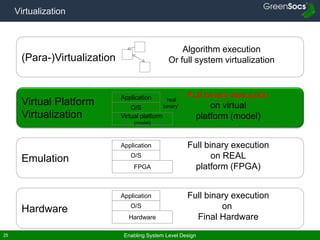
Virtualization
Emulation
Virtual Platform
Virtualization
(Para-)Virtualization
Hardware
Algorithm execution
Or full system virtualization
Application
O/S
Virtual platform
(model)
‘real
binary’
Full binary execution
on virtual
platform (model)
Application
O/S
FPGA
Full binary execution
on REAL
platform (FPGA)
Application
O/S
Hardware
Full binary execution
on
Final Hardware
Enabling System Level Design26
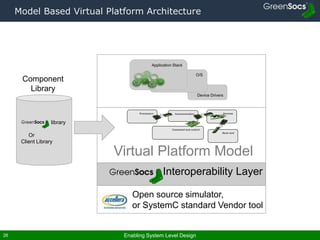
Open source simulator,
or SystemC standard Vendor tool
Processors Communication Devices
Command and control
Back-end
Device Drivers
O/S
Application Stack
Model Based Virtual Platform Architecture
Component
Library
library
Or
Client Library
Virtual Platform Model
Interoperability Layer
Enabling System Level Design27
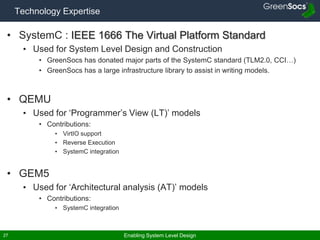
Technology Expertise
• SystemC : IEEE 1666 The Virtual Platform Standard
• Used for System Level Design and Construction
• GreenSocs has donated major parts of the SystemC standard (TLM2.0, CCI…)
• GreenSocs has a large infrastructure library to assist in writing models.
• QEMU
• Used for ‘Programmer’s View (LT)’ models
• Contributions:
• VirtIO support
• Reverse Execution
• SystemC integration
• GEM5
• Used for ‘Architectural analysis (AT)’ models
• Contributions:
• SystemC integration
Enabling System Level Design28
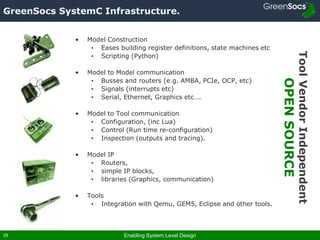
GreenSocs SystemC Infrastructure.
• Model Construction
• Eases building register definitions, state machines etc
• Scripting (Python)
• Model to Model communication
• Busses and routers (e.g. AMBA, PCIe, OCP, etc)
• Signals (interrupts etc)
• Serial, Ethernet, Graphics etc….
• Model to Tool communication
• Configuration, (inc Lua)
• Control (Run time re-configuration)
• Inspection (outputs and tracing).
• Model IP
• Routers,
• simple IP blocks,
• libraries (Graphics, communication)
• Tools
• Integration with Qemu, GEM5, Eclipse and other tools.
ToolVendorIndependent
OPENSOURCE
Enabling System Level Design29
QEMU
• QEMU is a virtualization engine
• It uses Dynamic translation to be very very fast.
• We recommend that QEMU is used for software development,
test and debug.
• QEMU is extremely well known and very solid and reliable.
• QEMU is under extremely active development supported by a
large community
• QEMU covers a vast range of CPU’s and Platforms
Enabling System Level Design30
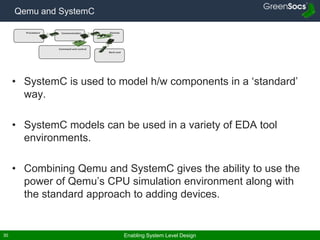
Qemu and SystemC
• SystemC is used to model h/w components in a ‘standard’
way.
• SystemC models can be used in a variety of EDA tool
environments.
• Combining Qemu and SystemC gives the ability to use the
power of Qemu’s CPU simulation environment along with
the standard approach to adding devices.
Processors Communication Devices
Command and control
Back-end
Enabling System Level Design31
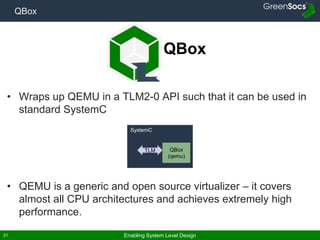
QBox
• Wraps up QEMU in a TLM2-0 API such that it can be used in
standard SystemC
• QEMU is a generic and open source virtualizer – it covers
almost all CPU architectures and achieves extremely high
performance.
SystemC
QBox
(qemu)
TLM
QBox
Enabling System Level Design32
QBox features
• QBox is multi-threaded – the QEMU CPU executes in it’s own
thread.
• SystemC code is always executed in it’s own thread to
preserve the integrity of SystemC code.
• (legacy code can be optimized to prevent too many context switches)
• QEMU and SystemC are synchronized on ‘quantums’ (as
defined by TLM 2.0).
• Interrupts are handled asynchronously by QEMU.
Enabling System Level Design33
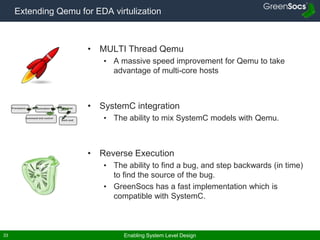
Extending Qemu for EDA virtulization
• MULTI Thread Qemu
• A massive speed improvement for Qemu to take
advantage of multi-core hosts
• SystemC integration
• The ability to mix SystemC models with Qemu.
• Reverse Execution
• The ability to find a bug, and step backwards (in time)
to find the source of the bug.
• GreenSocs has a fast implementation which is
compatible with SystemC.
Processors Communication Devices
Command and control
Back-end
Enabling System Level Design34
Gem5
• Gem5 is a cycle approximate simulator.
• It is at least 10x slower than QEMU
• It can be very accurate.
• Companies such as ARM use Gem5 to
explore CPU architecture.
• Some models are available publically
• Gem5 can be very useful as the CPU model within a
SystemC simulation environment.
Enabling System Level Design35
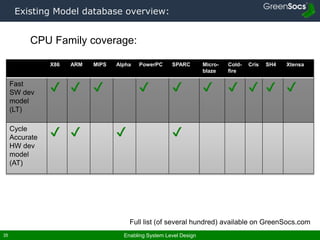
Existing Model database overview:
X86 ARM MIPS Alpha PowerPC SPARC Micro-
blaze
Cold-
fire
Cris SH4 Xtensa
Fast
SW dev
model
(LT)
✔ ✔ ✔ ✔ ✔ ✔ ✔ ✔ ✔ ✔
Cycle
Accurate
HW dev
model
(AT)
✔ ✔ ✔ ✔
CPU Family coverage:
Full list (of several hundred) available on GreenSocs.com
Enabling System Level Design36
GreenSocs Summary
GreenSocs
Modelling
Services
• GreenSocs specialises in
understanding the
problems of modelling,
and providing tailored
appropriate solutions
GreenSocs
Open Source
Infrastructure
• Infrastructure freely provided
• keep your code
Tool Independent.
• Maximise productivity,
interoperability and re-use.
• Cost effective infrastructure
development and maintenance.
Enabling System Level Design37
More information:
www.greensocs.com

Utilisation de la plateforme virtuelle QEMU/SystemC pour l'IoT

  • 1.
    Enabling System LevelDesign1 GreenSocs Overview GreenSocs Virtual Platforms let you imagine, design, develop and test your embedded application as a whole; size your hardware to reflect the needs of your software; build your software and hardware together; debug your software and verify your hardware efficiently.
  • 2.
    Enabling System LevelDesign2 GreenSocs: Integrated Virtual Platforms • GreenSocs® is the industrial leader in integrating different Virtual Platform solutions • Dr Mark Burton is the founder of GreenSocs. Mark has worked for ARM managing their modeling group. He was the chair of the OSCI TLM WG and the OCP-IP SLD WG. • GreenSocs provided technology behind the TLM-2.0 standard, and the CCI standard. We continue to be at the heart of SystemC development. • GreenSocs is a contributor to QEMU, providing technology to support multi-thread and reverse execution. • GreenSocs has been in business (incorporated in UK and France), and profitable, since 2005, including within its client base large multi-nationals.
  • 3.
    Enabling System LevelDesign3 THE PROBLEM Entrée
  • 4.
    Enabling System LevelDesign4 IoT : Lots of small devices • The problem is not building small devices, we know how to do that • The problem is Connecting, Deploying, Securing them • Connecting: • The problem of design is no longer limited to the individual device. • Deploying: • Time to market is critical, especially in new emerging IoT devices, re-spins and prototype development delays adoption and deployment. • Securing: • Testing devices is not just about functionality, but security and conformance.
  • 5.
    Enabling System LevelDesign5 No longer can we simply test the device, we must test the devices impact on the network and other devices. We must consider the complexities of big data. The Problem of Testing • Testing IoT is a major issue: • 26 Billion IoT units by 2020 (Gartner) • Enormous data throughput • An individual working device is not enough!
  • 6.
    Enabling System LevelDesign6 Testing IoT • Connectivity • Combined software and hardware that enables connectivity • Security • Security of the device, of the network, and of the data • Interactivity • How devices communicate with other devices • Scalability • How will scaling effect the network.
  • 7.
    Enabling System LevelDesign7 Building a Prototype… The Costs Building a prototype takes time Sourcing the parts is expensive And time-consuming… The result is fragile and expensive AND YOU ONLY HAVE ONE
  • 8.
    Enabling System LevelDesign8 THE SOLUTION Plat principal
  • 9.
    Enabling System LevelDesign9 Radio GreenSocs Virtual Prototypes : The FOSS Solution • Enable Full Virtual Testing • Unlimited number of devices • Full interconnectivity modeled • Complete production software and hardware stack. • Simple to deploy, low investment • Enable H/W and S/W development from the start of the project. • Unlimited number of nodes: Open Source (no license costs for wide-scale deployment) • Based on Standards : Full interoperability What’s inside “a” virtual platform Radio Network
  • 10.
    Enabling System LevelDesign10 GreenSocs Solution: Bring together projects IP Generation Tools e.g. Verilog to SystemC Verilator Debug Environments Including eclipse. Core IP models SystemC modeling and integration libraries Profiling and Code Coverage kcachegrind lcov
  • 11.
    Enabling System LevelDesign11 Open Source SystemC Standard SystemC TLM-2.0 IEEE 1666 is : The Virtual Platform Standard • Open Source Simulator available for download from Accellera.org Corporate members 2016 • GreenSocs technology at the heart of TLM-2.0 standard. • All GreenSocs interfaces use TLM-2.0 • GreenSocs helping Accellera forge a new Model to tool standard. • Preview available in GreenConfig. • Our solutions are tool independent, and work with all vendors.
  • 12.
    Enabling System LevelDesign12 Based on Existing and stable technology IoT Aerospace Automotive Health Mobile Embedded • Virtual Platforms used in many sectors: boost time to market • Highly suited to IoT: • Low cost of adoption • Time to market is critical • Networking complexity increasing • Specific demands of IoT sector: • Models of environmental factors, • Models of connectivity networks.
  • 13.
    Enabling System LevelDesign13 QEMU : Our Preferred source of CPU models • QEMU is the defacto standard Virtualizer. • Free and Open Source. • It is over 10 years old • GreenSocs is a key contributor: Reverse execution and Multi-Core TCG Kernel. • Regular committers from many organizations 43000 1000 989,863 Commits Contributors Lines of code …
  • 14.
    Enabling System LevelDesign14 THE ADVANTAGES Dessert
  • 15.
    Enabling System LevelDesign15 Virtual Platforms drive your business Research Realize Revenue Reuse Image your ideas realized… Models enable:  Parallel development  Team communication  Faster debug  Quicker bring up  Better test. Models enable customer interactions, during sales, and for better support. Models are the basis of re-use decisions. Size your H/W for your S/W Verify virtually, before it impacts revenue!
  • 16.
    Enabling System LevelDesign16 hardware development software development Integration Validation and test Virtual Platforms reduce Time and Risk. Effort Limited Critical Integration points Continual Integration Reduce Risk Models become a critical tool for S/W teams to do their job right Save Time Improve quality Effort
  • 17.
    Enabling System LevelDesign17 Classic V Design Flow ✔ Verification And Test Specification H/W Design S/W Design Integration Add a Virtual Platform
  • 18.
    Enabling System LevelDesign18 Accelerate V Design Flow ✔ Verification And Test Specification H/W Design S/W Design Integration HW and SW developed together. Early verification and test Reduce Risk Reduce Time Leap straight to Verification
  • 19.
    Enabling System LevelDesign19 IoT: the network, and real world conditions. Develop Devices and Applications with production tool chain, test with real world conditions with no physical constraints Across the full network of many devices
  • 20.
    Enabling System LevelDesign20 Importance of Open Source Software development costs are rocketing. We need more and more engineers… Those engineers need more and more tools. Open Source, Pay for the development, not the deployment Provide ALL your software engineers with the same model with no license cost! Keep the model source Free Forever
  • 21.
    Enabling System LevelDesign21 Importance of Standards Your product Is their component Her tool choice Must not force your choice! Models must be tool independent They must use the Standard interfaces Hence SystemC TLM-2.0 Is not his choice
  • 22.
    Enabling System LevelDesign22 GreenSocs : principle offers CONSULTANCY AND SERVICES The Experts in Virtual platforms: Creation, deployment, integration Tool independent – vendor neutral. Allow us to guide you to success MODEL DEVELOPMENT Virtual Platforms based integrated development environments, for CoTs or specialist devices, ready for your software engineers to be productive. All models adhere to STANDARDS All model source provided. OPEN SOURCE DEVELOPMENT Adding to the existing open source tools and models. ‘Upstreaming’ and dissemination
  • 23.
    Enabling System LevelDesign23 More information: www.greensocs.com
  • 24.
    Enabling System LevelDesign24 GreenSocs Technology
  • 25.
    Enabling System LevelDesign25 Virtualization Emulation Virtual Platform Virtualization (Para-)Virtualization Hardware Algorithm execution Or full system virtualization Application O/S Virtual platform (model) ‘real binary’ Full binary execution on virtual platform (model) Application O/S FPGA Full binary execution on REAL platform (FPGA) Application O/S Hardware Full binary execution on Final Hardware
  • 26.
    Enabling System LevelDesign26 Open source simulator, or SystemC standard Vendor tool Processors Communication Devices Command and control Back-end Device Drivers O/S Application Stack Model Based Virtual Platform Architecture Component Library library Or Client Library Virtual Platform Model Interoperability Layer
  • 27.
    Enabling System LevelDesign27 Technology Expertise • SystemC : IEEE 1666 The Virtual Platform Standard • Used for System Level Design and Construction • GreenSocs has donated major parts of the SystemC standard (TLM2.0, CCI…) • GreenSocs has a large infrastructure library to assist in writing models. • QEMU • Used for ‘Programmer’s View (LT)’ models • Contributions: • VirtIO support • Reverse Execution • SystemC integration • GEM5 • Used for ‘Architectural analysis (AT)’ models • Contributions: • SystemC integration
  • 28.
    Enabling System LevelDesign28 GreenSocs SystemC Infrastructure. • Model Construction • Eases building register definitions, state machines etc • Scripting (Python) • Model to Model communication • Busses and routers (e.g. AMBA, PCIe, OCP, etc) • Signals (interrupts etc) • Serial, Ethernet, Graphics etc…. • Model to Tool communication • Configuration, (inc Lua) • Control (Run time re-configuration) • Inspection (outputs and tracing). • Model IP • Routers, • simple IP blocks, • libraries (Graphics, communication) • Tools • Integration with Qemu, GEM5, Eclipse and other tools. ToolVendorIndependent OPENSOURCE
  • 29.
    Enabling System LevelDesign29 QEMU • QEMU is a virtualization engine • It uses Dynamic translation to be very very fast. • We recommend that QEMU is used for software development, test and debug. • QEMU is extremely well known and very solid and reliable. • QEMU is under extremely active development supported by a large community • QEMU covers a vast range of CPU’s and Platforms
  • 30.
    Enabling System LevelDesign30 Qemu and SystemC • SystemC is used to model h/w components in a ‘standard’ way. • SystemC models can be used in a variety of EDA tool environments. • Combining Qemu and SystemC gives the ability to use the power of Qemu’s CPU simulation environment along with the standard approach to adding devices. Processors Communication Devices Command and control Back-end
  • 31.
    Enabling System LevelDesign31 QBox • Wraps up QEMU in a TLM2-0 API such that it can be used in standard SystemC • QEMU is a generic and open source virtualizer – it covers almost all CPU architectures and achieves extremely high performance. SystemC QBox (qemu) TLM QBox
  • 32.
    Enabling System LevelDesign32 QBox features • QBox is multi-threaded – the QEMU CPU executes in it’s own thread. • SystemC code is always executed in it’s own thread to preserve the integrity of SystemC code. • (legacy code can be optimized to prevent too many context switches) • QEMU and SystemC are synchronized on ‘quantums’ (as defined by TLM 2.0). • Interrupts are handled asynchronously by QEMU.
  • 33.
    Enabling System LevelDesign33 Extending Qemu for EDA virtulization • MULTI Thread Qemu • A massive speed improvement for Qemu to take advantage of multi-core hosts • SystemC integration • The ability to mix SystemC models with Qemu. • Reverse Execution • The ability to find a bug, and step backwards (in time) to find the source of the bug. • GreenSocs has a fast implementation which is compatible with SystemC. Processors Communication Devices Command and control Back-end
  • 34.
    Enabling System LevelDesign34 Gem5 • Gem5 is a cycle approximate simulator. • It is at least 10x slower than QEMU • It can be very accurate. • Companies such as ARM use Gem5 to explore CPU architecture. • Some models are available publically • Gem5 can be very useful as the CPU model within a SystemC simulation environment.
  • 35.
    Enabling System LevelDesign35 Existing Model database overview: X86 ARM MIPS Alpha PowerPC SPARC Micro- blaze Cold- fire Cris SH4 Xtensa Fast SW dev model (LT) ✔ ✔ ✔ ✔ ✔ ✔ ✔ ✔ ✔ ✔ Cycle Accurate HW dev model (AT) ✔ ✔ ✔ ✔ CPU Family coverage: Full list (of several hundred) available on GreenSocs.com
  • 36.
    Enabling System LevelDesign36 GreenSocs Summary GreenSocs Modelling Services • GreenSocs specialises in understanding the problems of modelling, and providing tailored appropriate solutions GreenSocs Open Source Infrastructure • Infrastructure freely provided • keep your code Tool Independent. • Maximise productivity, interoperability and re-use. • Cost effective infrastructure development and maintenance.
  • 37.
    Enabling System LevelDesign37 More information: www.greensocs.com