02
18
Brief Definition in General Use
04
18
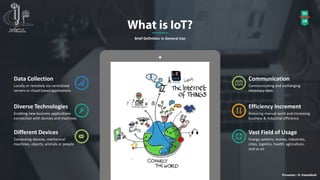
The internet of things, or IoT, is a system of interrelated computing devices, mechanical and digital
machines, objects, animals or people that are provided with unique identifiers (UIDs) and the ability to
transfer data over a network without requiring human-to-human or human-to-computer interaction.
“
”Margaret Rouse – WhatIs.com
Brief Definition in General Use
Communication
Communicating and exchanging
necessary data
Efficiency Increment
Reducing manual work and increasing
business & Industrial efficiency
Vast Field of Usage
Energy systems, homes, industries,
cities, logistics, health, agriculture,
and so on
Data Collection
Locally or remotely via centralized
servers or cloud based applications
Diverse Technologies
Enabling new business applications
connection with devices and machines
Different Devices
Computing devices, mechanical
machines, objects, animals or people
05
18
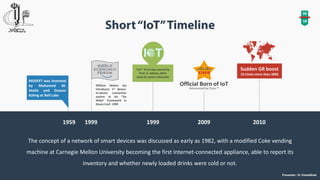
MOSFET was invented
by Mohamed M.
Atalla and Dawon
Kahng at Bell Labs
William Nelson Joy
Introduces 1st device-
to-device connection
system as his “Six
Webs” framework in
Davos Conf. 1999
“IoT” Term was named by
Prof. K. Ashton, MITs
Auto-ID centre cofounder
Official Born of IoT
Announced by Cisco ™
Sudden GR boost
23 times more than 2003
The concept of a network of smart devices was discussed as early as 1982, with a modified Coke vending
machine at Carnegie Mellon University becoming the first Internet-connected appliance, able to report its
inventory and whether newly loaded drinks were cold or not.
1959 1999 2009 20101999
06
18
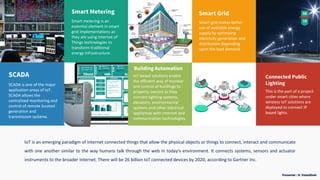
SCADA is one of the major
application areas of IoT.
SCADA allows the
centralized monitoring and
control of remote located
generation and
transmission systems.
SCADA IoT based solutions enable
the efficient way of monitor
and control of buildings to
property owners as they
connect lighting systems,
elevators, environmental
systems and other electrical
appliances with internet and
communication technologies.
Building Automation
Smart grid makes better
use of available energy
supply by optimizing
electricity generation and
distribution depending
upon the load demand.
Smart Grid
This is the part of a project
under smart cities where
wireless IoT solutions are
deployed to connect IP
based lights.
Connected Public
Lighting
Smart metering is an
essential element in smart
grid implementations as
they are using Internet of
Things technologies to
transform traditional
energy infrastructure.
Smart Metering
IoT is an emerging paradigm of Internet connected things that allow the physical objects or things to connect, interact and communicate
with one another similar to the way humans talk through the web in today’s environment. It connects systems, sensors and actuator
instruments to the broader Internet. There will be 26 billion IoT connected devices by 2020, according to Gartner Inc.
08
18
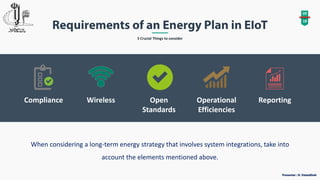
When considering a long-term energy strategy that involves system integrations, take into
account the elements mentioned above.
5 Crucial Things to consider
09
18
Compliance Wireless Open
Standards
Operational
Efficiencies
Reporting
10
18
Phase 1
As environmental concerns intensify, building owners and corporations must carefully scrutinize their energy
management and monitoring solution to ensure it fully complies with all mandates and regulations. These
include automated demand response, plug load circuit control, daylighting, and multi-level lighting controls.
As standards look to become ever more stringent in coming years, energy efficiency needs to be viewed
as a facilities management and IT investment that helps optimize building operations. Companies may
do well to avoid disparate systems that cannot interoperate and therefore cannot be leveraged for
adjacent energy cost saving opportunities.
11
18
Phase 2
Wireless control solutions have the capability to transform a building into a connected, intelligent
facility that responds automatically to various needs. The end result is unprecedented visibility,
automated fault detection, and centralized monitoring and control that empower the facility
manager.
Making use of Enterprise IoT requires wireless systems, as the sheer number of wired devices
would make their integration impossible.
12
18
Phase 3
By choosing open standard-based lighting control systems, organizations provide
themselves with the ability to easily upgrade to other related devices, such as thermostats,
plug-loads, fans, CO2 sensors, and more.
The flexibility of open standards provides the ability to add new devices into the existing
control system. There’s no need to buy a separate system to manage each additional
device.
13
18
Phase 4
Using the actionable data provided by Enterprise IoT can result in an endless variety of
operational efficiencies. Think about peak time usage: most utilities are now using a
demand response fee structure, charging higher rates during peak times.
For utility customers who aren’t looking closely at their data and not shedding loads, they
may be wasting a significant amount of money on energy.
14
18
Phase 5
More and more facility managers in commercial and industrial buildings have been rolling
out building energy management systems (BEMS), which are able to take advantage of
Enterprise IoT, and as they do so they are searching for better and easier ways to analyze
and make use of the information that they are now able to gather.
When investigating BEMS, look beyond dashboards and graphs to see whether enhanced
analytics are easy to access and read. In addition, consider consultants who can provide
audits and turn data into actionable recommendations and solutions.
Vs.
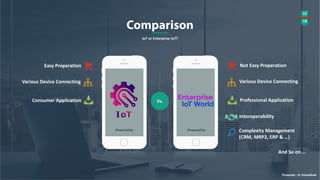
IoT or Enterprise IoT?
Complexity Management
(CRM, MRP2, ERP & …)
Professional Application
Interoperability
Not Easy Preperation
Various Device Connecting
Consumer Application
Easy Preperation
Various Device Connecting
Powered by
15
18
And So on …
Powered by
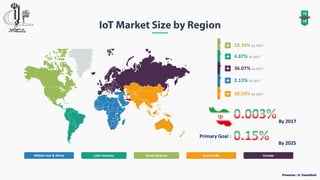
Middle East & Africa North AmericaLatin America Asia Pacific Europe
4.87% by 2017
18.34% by 2017
36.07% by 2017
2.13% by 2017
38.59% by 2017
By 2017
By 2025
Primary Goal :
16
18
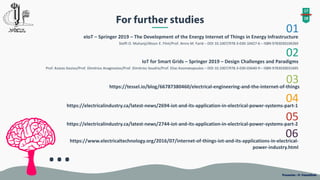
eIoT – Springer 2019 – The Development of the Energy Internet of Things in Energy Infrastructure
01
Steffi O. Muhanji/Alison E. Flint/Prof. Amro M. Farid – DOI 10.1007/978-3-030-10427-6 – ISBN 9783030104269
IoT for Smart Grids – Springer 2019 – Design Challenges and Paradigms
02
Prof. Kostas Siozios/Prof. Dimitrios Anagnostos/Prof. Dimitrios Soudris/Prof. Elias Kosmatopoulos – DOI 10.1007/978-3-030-03640-9 – ISBN 9783030031695
https://tessel.io/blog/66787380460/electrical-engineering-and-the-internet-of-things
03
https://electricalindustry.ca/latest-news/2694-iot-and-its-application-in-electrical-power-systems-part-1
04
https://electricalindustry.ca/latest-news/2744-iot-and-its-application-in-electrical-power-systems-part-2
05
https://www.electricaltechnology.org/2016/07/internet-of-things-iot-and-its-applications-in-electrical-
power-industry.html
06
…
17
18
IoT in Electrical Engineering, Energy Management

IoT in Electrical Engineering, Energy Management

  • 2.
  • 4.
    Brief Definition inGeneral Use 04 18 The internet of things, or IoT, is a system of interrelated computing devices, mechanical and digital machines, objects, animals or people that are provided with unique identifiers (UIDs) and the ability to transfer data over a network without requiring human-to-human or human-to-computer interaction. “ ”Margaret Rouse – WhatIs.com
  • 5.
    Brief Definition inGeneral Use Communication Communicating and exchanging necessary data Efficiency Increment Reducing manual work and increasing business & Industrial efficiency Vast Field of Usage Energy systems, homes, industries, cities, logistics, health, agriculture, and so on Data Collection Locally or remotely via centralized servers or cloud based applications Diverse Technologies Enabling new business applications connection with devices and machines Different Devices Computing devices, mechanical machines, objects, animals or people 05 18
  • 6.
    MOSFET was invented byMohamed M. Atalla and Dawon Kahng at Bell Labs William Nelson Joy Introduces 1st device- to-device connection system as his “Six Webs” framework in Davos Conf. 1999 “IoT” Term was named by Prof. K. Ashton, MITs Auto-ID centre cofounder Official Born of IoT Announced by Cisco ™ Sudden GR boost 23 times more than 2003 The concept of a network of smart devices was discussed as early as 1982, with a modified Coke vending machine at Carnegie Mellon University becoming the first Internet-connected appliance, able to report its inventory and whether newly loaded drinks were cold or not. 1959 1999 2009 20101999 06 18
  • 8.
    SCADA is oneof the major application areas of IoT. SCADA allows the centralized monitoring and control of remote located generation and transmission systems. SCADA IoT based solutions enable the efficient way of monitor and control of buildings to property owners as they connect lighting systems, elevators, environmental systems and other electrical appliances with internet and communication technologies. Building Automation Smart grid makes better use of available energy supply by optimizing electricity generation and distribution depending upon the load demand. Smart Grid This is the part of a project under smart cities where wireless IoT solutions are deployed to connect IP based lights. Connected Public Lighting Smart metering is an essential element in smart grid implementations as they are using Internet of Things technologies to transform traditional energy infrastructure. Smart Metering IoT is an emerging paradigm of Internet connected things that allow the physical objects or things to connect, interact and communicate with one another similar to the way humans talk through the web in today’s environment. It connects systems, sensors and actuator instruments to the broader Internet. There will be 26 billion IoT connected devices by 2020, according to Gartner Inc. 08 18
  • 9.
    When considering along-term energy strategy that involves system integrations, take into account the elements mentioned above. 5 Crucial Things to consider 09 18 Compliance Wireless Open Standards Operational Efficiencies Reporting
  • 10.
    10 18 Phase 1 As environmentalconcerns intensify, building owners and corporations must carefully scrutinize their energy management and monitoring solution to ensure it fully complies with all mandates and regulations. These include automated demand response, plug load circuit control, daylighting, and multi-level lighting controls. As standards look to become ever more stringent in coming years, energy efficiency needs to be viewed as a facilities management and IT investment that helps optimize building operations. Companies may do well to avoid disparate systems that cannot interoperate and therefore cannot be leveraged for adjacent energy cost saving opportunities.
  • 11.
    11 18 Phase 2 Wireless controlsolutions have the capability to transform a building into a connected, intelligent facility that responds automatically to various needs. The end result is unprecedented visibility, automated fault detection, and centralized monitoring and control that empower the facility manager. Making use of Enterprise IoT requires wireless systems, as the sheer number of wired devices would make their integration impossible.
  • 12.
    12 18 Phase 3 By choosingopen standard-based lighting control systems, organizations provide themselves with the ability to easily upgrade to other related devices, such as thermostats, plug-loads, fans, CO2 sensors, and more. The flexibility of open standards provides the ability to add new devices into the existing control system. There’s no need to buy a separate system to manage each additional device.
  • 13.
    13 18 Phase 4 Using theactionable data provided by Enterprise IoT can result in an endless variety of operational efficiencies. Think about peak time usage: most utilities are now using a demand response fee structure, charging higher rates during peak times. For utility customers who aren’t looking closely at their data and not shedding loads, they may be wasting a significant amount of money on energy.
  • 14.
    14 18 Phase 5 More andmore facility managers in commercial and industrial buildings have been rolling out building energy management systems (BEMS), which are able to take advantage of Enterprise IoT, and as they do so they are searching for better and easier ways to analyze and make use of the information that they are now able to gather. When investigating BEMS, look beyond dashboards and graphs to see whether enhanced analytics are easy to access and read. In addition, consider consultants who can provide audits and turn data into actionable recommendations and solutions.
  • 15.
    Vs. IoT or EnterpriseIoT? Complexity Management (CRM, MRP2, ERP & …) Professional Application Interoperability Not Easy Preperation Various Device Connecting Consumer Application Easy Preperation Various Device Connecting Powered by 15 18 And So on … Powered by
  • 16.
    Middle East &Africa North AmericaLatin America Asia Pacific Europe 4.87% by 2017 18.34% by 2017 36.07% by 2017 2.13% by 2017 38.59% by 2017 By 2017 By 2025 Primary Goal : 16 18
  • 17.
    eIoT – Springer2019 – The Development of the Energy Internet of Things in Energy Infrastructure 01 Steffi O. Muhanji/Alison E. Flint/Prof. Amro M. Farid – DOI 10.1007/978-3-030-10427-6 – ISBN 9783030104269 IoT for Smart Grids – Springer 2019 – Design Challenges and Paradigms 02 Prof. Kostas Siozios/Prof. Dimitrios Anagnostos/Prof. Dimitrios Soudris/Prof. Elias Kosmatopoulos – DOI 10.1007/978-3-030-03640-9 – ISBN 9783030031695 https://tessel.io/blog/66787380460/electrical-engineering-and-the-internet-of-things 03 https://electricalindustry.ca/latest-news/2694-iot-and-its-application-in-electrical-power-systems-part-1 04 https://electricalindustry.ca/latest-news/2744-iot-and-its-application-in-electrical-power-systems-part-2 05 https://www.electricaltechnology.org/2016/07/internet-of-things-iot-and-its-applications-in-electrical- power-industry.html 06 … 17 18