1
<AddIoT in the Energy sector, Sep 2016 www.theiet.in/IoTPanel
IoT possibilities for India in the
Energy sector – Integrating
Demand & Supply side
By Prakash Chandraker and Mohan Raju
In collaboration with Dr. Rishi Bhatnagar
2
<AddIoT in the Energy sector, Sep 2016 www.theiet.in/IoTPanel
Executive summary
New World of Energy is where electricity is increasingly distributed and connected, and the flow is
bi-directional between smart supply and smart demand. The new ecosystem starts from the supply
side of Smart Generation and converges all the way till the Smart Grids from the supply side to the
demand side of diverse consumer-ends.
In the area of Smart Generation, there is deep innovation and transformation in areas such as
Renewable and Distributed Energy. In Smart Grids, there are huge opportunities for Automation,
Demand Response and Distributed Management Systems, including Micro grids. On the demand
side, we have Smart Buildings and Homes, Smart Industry and Efficient Data Centres.
3
<AddIoT in the Energy sector, Sep 2016 www.theiet.in/IoTPanel
Introduction – What is IoT?
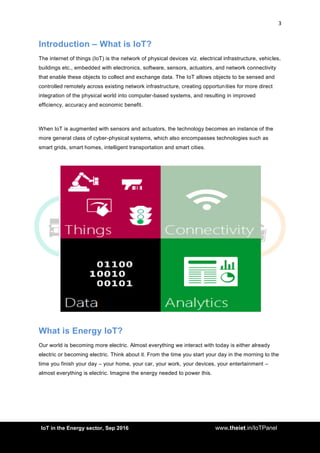
The internet of things (IoT) is the network of physical devices viz. electrical infrastructure, vehicles,
buildings etc., embedded with electronics, software, sensors, actuators, and network connectivity
that enable these objects to collect and exchange data. The IoT allows objects to be sensed and
controlled remotely across existing network infrastructure, creating opportunities for more direct
integration of the physical world into computer-based systems, and resulting in improved
efficiency, accuracy and economic benefit.
When IoT is augmented with sensors and actuators, the technology becomes an instance of the
more general class of cyber-physical systems, which also encompasses technologies such as
smart grids, smart homes, intelligent transportation and smart cities.
What is Energy IoT?
Our world is becoming more electric. Almost everything we interact with today is either already
electric or becoming electric. Think about it. From the time you start your day in the morning to the
time you finish your day – your home, your car, your work, your devices, your entertainment –
almost everything is electric. Imagine the energy needed to power this.
4
<AddIoT in the Energy sector, Sep 2016 www.theiet.in/IoTPanel
Energy will be More Distributed than ever
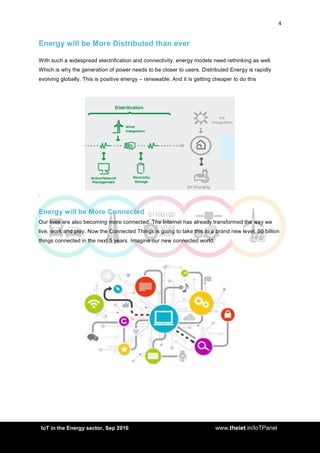
With such a widespread electrification and connectivity, energy models need rethinking as well.
Which is why the generation of power needs to be closer to users. Distributed Energy is rapidly
evolving globally. This is positive energy – renewable. And it is getting cheaper to do this
.
Energy will be More Connected
Our lives are also becoming more connected. The Internet has already transformed the way we
live, work and play. Now the Connected Things is going to take this to a brand new level. 50 billion
things connected in the next 5 years. Imagine our new connected world.
5
<AddIoT in the Energy sector, Sep 2016 www.theiet.in/IoTPanel
Energy will have to be More Efficient
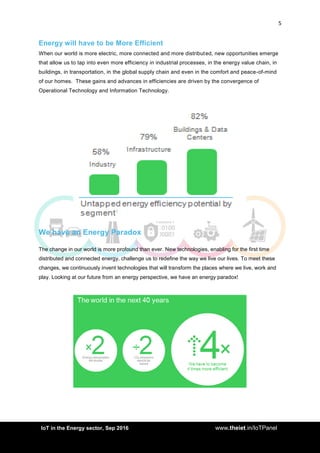
When our world is more electric, more connected and more distributed, new opportunities emerge
that allow us to tap into even more efficiency in industrial processes, in the energy value chain, in
buildings, in transportation, in the global supply chain and even in the comfort and peace-of-mind
of our homes. These gains and advances in efficiencies are driven by the convergence of
Operational Technology and Information Technology.
We have an Energy Paradox
The change in our world is more profound than ever. New technologies, enabling for the first time
distributed and connected energy, challenge us to redefine the way we live our lives. To meet these
changes, we continuously invent technologies that will transform the places where we live, work and
play. Looking at our future from an energy perspective, we have an energy paradox!
6
<AddIoT in the Energy sector, Sep 2016 www.theiet.in/IoTPanel
Energy demand will double in the next 40 years, stemming from the twin challenges of access-to-
energy and the mega trends of Urbanisation, Digitisation and Industrialisation worldwide. This is
no different for India. However, at the same time, we have to reduce CO2 emission by half to
avoid significant irreversible damage to our planet. Therefore the only way is to become 4 tim es
more efficient.
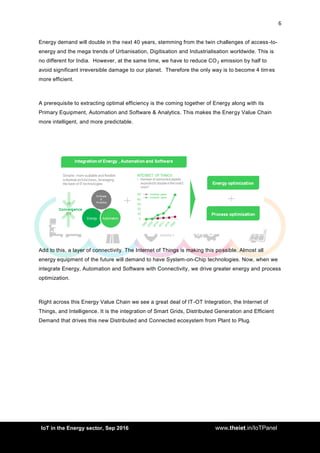
A prerequisite to extracting optimal efficiency is the coming together of Energy along with its
Primary Equipment, Automation and Software & Analytics. This makes the Energy Value Chain
more intelligent, and more predictable.
Add to this, a layer of connectivity. The Internet of Things is making this possible. Almost all
energy equipment of the future will demand to have System-on-Chip technologies. Now, when we
integrate Energy, Automation and Software with Connectivity, we drive greater energy and process
optimization.
Right across this Energy Value Chain we see a great deal of IT-OT Integration, the Internet of
Things, and Intelligence. It is the integration of Smart Grids, Distributed Generation and Efficient
Demand that drives this new Distributed and Connected ecosystem from Plant to Plug.
7
<AddIoT in the Energy sector, Sep 2016 www.theiet.in/IoTPanel
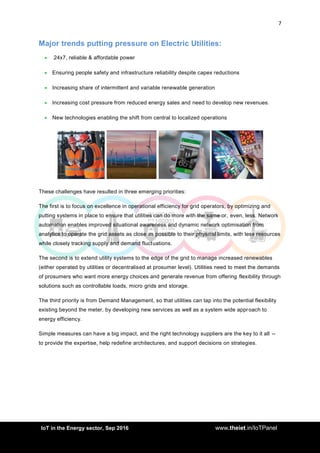
Major trends putting pressure on Electric Utilities:
 24x7, reliable & affordable power
 Ensuring people safety and infrastructure reliability despite capex reductions
 Increasing share of intermittent and variable renewable generation
 Increasing cost pressure from reduced energy sales and need to develop new revenues.
 New technologies enabling the shift from central to localized operations
These challenges have resulted in three emerging priorities:
The first is to focus on excellence in operational efficiency for grid operators, by optimizing and
putting systems in place to ensure that utilities can do more with the same or, even, less. Network
automation enables improved situational awareness and dynamic network optimisation from
analytics to operate the grid assets as close as possible to their physical limits, with less resources
while closely tracking supply and demand fluctuations.
The second is to extend utility systems to the edge of the grid to manage increased renewables
(either operated by utilities or decentralised at prosumer level). Utilities need to meet the demands
of prosumers who want more energy choices and generate revenue from offering flexibility through
solutions such as controllable loads, micro grids and storage.
The third priority is from Demand Management, so that utilities can tap into the potential flexibility
existing beyond the meter, by developing new services as well as a system wide approach to
energy efficiency.
Simple measures can have a big impact, and the right technology suppliers are the key to it all --
to provide the expertise, help redefine architectures, and support decisions on strategies.
8
<AddIoT in the Energy sector, Sep 2016 www.theiet.in/IoTPanel
What solutions can emerge out of Energy IoT?
Constant efforts to improve reliability, safety & efficiency by the Utilities who continue to steadily
invest in traditional grid infrastructures but look to control costs with smarter equipment and
flexible solutions to make the most of existing grid assets with 30% increased reliability from
integrated electro-mechanical asset management solutions and services.
• Real-time problem resolution
• Extended network automation limits (LV)
• Predictive maintenance
Efficient day-to-day grid operations
• Streamlined distribution management processes to dynamically optimise the network
and operate as close to its physical limits as possible, closely tracking fluctuation in
supply and demand
• 30% increased operational efficiency from fully digitised asset portfolio
• Integrated meter data
• Self-healing schemes
• Workforce efficiency
IT/OT connectivity for a smarter grid
• OT systems connect to IT resources through standardized IP communication
architectures
• Single platform & user experience, managing integrated information flows enabling
simplified grid operations and analysis for quicker and more accurate decision-making.
• Utilities will achieve unprecedented situational awareness to optimize supply and
demand
• Advanced Distribution Management System applications (OMS, etc.)
• Weather & power forecasting
• Geographical Information systems
Thriving on the renewable boom
• Increased intermittent and distributed generation requires more grid edge intelligence
to connect wind, solar and other distributed energy sources
9
<AddIoT in the Energy sector, Sep 2016 www.theiet.in/IoTPanel
• Decentralised generation systems need flexible management solutions allowing
utilities and prosumers to take control & leverage energy choices
• Microgrid Control
• Distributed Energy Resources Management Systems
• Demand-Side Management Systems
At the core of Energy IoT is equipment intelligence
In addition to the smart Discom, the other key factor for smart electricity would be the smart
electrical equipment and systems that combine together to deliver electricity at customer’s
doorstep. The smart electrical equipment and systems, when integrated through suitable ICT
based applications, result in an intelligent distribution network that can be controlled remotely and
also possess self-healing capabilities.
In the context of a smart city or even from a smart grid viewpoint, smart electrical equipment
should possess a number of general characteristics such as:
 Data recording: capability of logging predefined critical parameters and events within a
specific time period that would assist in analytics based decision making;
 Communication: ability to communicate the recorded parameters/events, in real time or as
per a predefined time interval, with other equipment or with any remotely located data
aggregating center. This communication can either be one-way or two-way depending on the
system requirements;
 Ease of operation: designed to ensure easy operability and maintenance with the possibility
of remote monitoring and control;
 Efficiency: producing maximum possible output, for a specific input, without compromising
on the equipment life and cost of operation;
 Safety: focuses on operator and societal safety during installation and operation;
 Zero defect: best in class quality, meeting global standards;
 Zero effect: negligible environmental impact during the product life cycle including
manufacturing and disposal stages.
10
<AddIoT in the Energy sector, Sep 2016 www.theiet.in/IoTPanel
Some serious general challenges addressing IoT
Scalability Protocols: IEC61850 is an Ethernet / IP based protocol for Primary Substation
Monitoring and Control and IEC 60870-5-104 is an Ethernet / IP based protocol for Telemetry of
Secondary Substation Monitoring and Control etc.,. Efficient protocol standards have to evolve for
demand side and DER (Distributed Energy Resources) integration. Existing standards OPC,
HTTP is too verbose, CoAP is less so, is RESTful, supports UDP and SMS, supports resource
discovery, and is designed to support constrained devices.
With tens of billions of connected Energy IoT devices, with enormous variety across them, the
scale required for data ingestion and processing is very considerable. One may need to support
millions of concurrent devices with significant variety, producing millions of events per second,
which all needs to support hundreds of TB of event processing.
Energy equipment send telemetry data every minute, thermostats report data every 15 minutes,
mobile app telemetry is captured for every action in an app, many game engines produce 1000000
messages per second etc.
Security: Authentication, registration, data confidentiality, privacy, etc.
Constrained Devices: Low power, smaller, cost effective devices are required. The specific
needs of such constrained devices need to be addressed. Devices need management, such as
provisioning & configuration, firmware upgrades, identity management, security management, etc.
Mobile: Mobile and its very large variety of device profiles, needs to be supported cost effectively.
Mobile devices are also data sources – as gateways or natively.
“Real Time” Data: Processing events at low latency to help support making decisions or taking
actions faster.
11
<AddIoT in the Energy sector, Sep 2016 www.theiet.in/IoTPanel
Conclusion
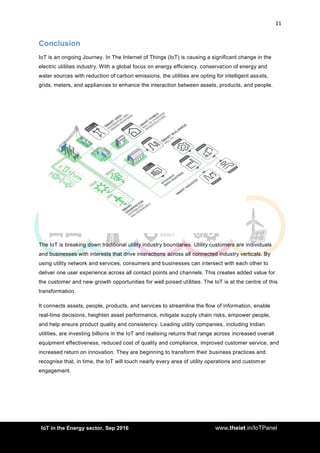
IoT is an ongoing Journey. In The Internet of Things (IoT) is causing a significant change in the
electric utilities industry. With a global focus on energy efficiency, conservation of energy and
water sources with reduction of carbon emissions, the utilities are opting for intelligent assets,
grids, meters, and appliances to enhance the interaction between assets, products, and people.
The IoT is breaking down traditional utility industry boundaries. Utility customers are individuals
and businesses with interests that drive interactions across all connected industry verticals. By
using utility network and services, consumers and businesses can intersect with each other to
deliver one user experience across all contact points and channels. This creates added value for
the customer and new growth opportunities for well poised utilities. The IoT is at the centre of this
transformation.
It connects assets, people, products, and services to streamline the flow of information, enable
real-time decisions, heighten asset performance, mitigate supply chain risks, empower people,
and help ensure product quality and consistency. Leading utility companies, including Indian
utilities, are investing billions in the IoT and realising returns that range across increased overall
equipment effectiveness, reduced cost of quality and compliance, improved customer service, and
increased return on innovation. They are beginning to transform their business practices and
recognise that, in time, the IoT will touch nearly every area of utility operations and customer
engagement.
12
<AddIoT in the Energy sector, Sep 2016 www.theiet.in/IoTPanel
About the authors
Mr. Prakash Kumar Chandraker is presently Managing Director, Schneider Electric
Infrastructure Ltd. In a career spanning more than 27 years in the power sector, he has held various senior positions in
companies such as Voltas, Cegelec, Alstom, and Areva T&D. Mr Chandraker was the Regional Managing Director, Energy
Automation at Areva T&D India, when he was awarded for Excellence in Operations. During this period, his expertise was
crucial in implementing the Unified Load Despatch Centre Scheme for the Northern Region, the North-Eastern Region and the
Eastern Region for Power Grid Corporation of India and various Electricity Boards in the country.
Mr. Mohan Raju is a distinguished Member of the IET-IOT India panel, a platform for stakeholders to participate in becoming
an authoritative, but neutral voice for the evolving movement of IoT in India, where he actively advises & collaborates with
industry & government stakeholders to shape health, education and energy initiatives in India by leveraging IoT & Big Data
technologies. He is presently working with Bharti Airtel as Business Head based out of Mumbai and has rich experience in
working for fortune 500, BFSI, Manufacturing Services and public sector customers in India. Mr. Raju completed his MBA in
Marketing education from Narsee Monjee Institue of Management Studies, Mumbai and Bachelor in Engineering (Electronics &
Telecommunications) from Utkal University India.
In Collaboration with
Dr Rishi Bhatnagar, Doctorate in IT Computer Science, is currently President of Aeris Communications India, Middle East &
Africa. Rishi’s career has taken him through more than 15 years of Sales, Delivery, Research, Merger & Acquisitions and
Administrative responsibilities. During his PhD, he had developed for the first time “Relationship Maturity Model for IT services
Industry” which helps corporates to identify effective relationship management processes & best practices for managing
customer supplier relationship. He has co-authored the first book on IoT – Titled “Enterprise IoT”. Dr. Rishi is the Chairperson of
Institution of Engineering and Technology IoT panel for India.

IoT for the energy sector

  • 1.
    1 <AddIoT in theEnergy sector, Sep 2016 www.theiet.in/IoTPanel IoT possibilities for India in the Energy sector – Integrating Demand & Supply side By Prakash Chandraker and Mohan Raju In collaboration with Dr. Rishi Bhatnagar
  • 2.
    2 <AddIoT in theEnergy sector, Sep 2016 www.theiet.in/IoTPanel Executive summary New World of Energy is where electricity is increasingly distributed and connected, and the flow is bi-directional between smart supply and smart demand. The new ecosystem starts from the supply side of Smart Generation and converges all the way till the Smart Grids from the supply side to the demand side of diverse consumer-ends. In the area of Smart Generation, there is deep innovation and transformation in areas such as Renewable and Distributed Energy. In Smart Grids, there are huge opportunities for Automation, Demand Response and Distributed Management Systems, including Micro grids. On the demand side, we have Smart Buildings and Homes, Smart Industry and Efficient Data Centres.
  • 3.
    3 <AddIoT in theEnergy sector, Sep 2016 www.theiet.in/IoTPanel Introduction – What is IoT? The internet of things (IoT) is the network of physical devices viz. electrical infrastructure, vehicles, buildings etc., embedded with electronics, software, sensors, actuators, and network connectivity that enable these objects to collect and exchange data. The IoT allows objects to be sensed and controlled remotely across existing network infrastructure, creating opportunities for more direct integration of the physical world into computer-based systems, and resulting in improved efficiency, accuracy and economic benefit. When IoT is augmented with sensors and actuators, the technology becomes an instance of the more general class of cyber-physical systems, which also encompasses technologies such as smart grids, smart homes, intelligent transportation and smart cities. What is Energy IoT? Our world is becoming more electric. Almost everything we interact with today is either already electric or becoming electric. Think about it. From the time you start your day in the morning to the time you finish your day – your home, your car, your work, your devices, your entertainment – almost everything is electric. Imagine the energy needed to power this.
  • 4.
    4 <AddIoT in theEnergy sector, Sep 2016 www.theiet.in/IoTPanel Energy will be More Distributed than ever With such a widespread electrification and connectivity, energy models need rethinking as well. Which is why the generation of power needs to be closer to users. Distributed Energy is rapidly evolving globally. This is positive energy – renewable. And it is getting cheaper to do this . Energy will be More Connected Our lives are also becoming more connected. The Internet has already transformed the way we live, work and play. Now the Connected Things is going to take this to a brand new level. 50 billion things connected in the next 5 years. Imagine our new connected world.
  • 5.
    5 <AddIoT in theEnergy sector, Sep 2016 www.theiet.in/IoTPanel Energy will have to be More Efficient When our world is more electric, more connected and more distributed, new opportunities emerge that allow us to tap into even more efficiency in industrial processes, in the energy value chain, in buildings, in transportation, in the global supply chain and even in the comfort and peace-of-mind of our homes. These gains and advances in efficiencies are driven by the convergence of Operational Technology and Information Technology. We have an Energy Paradox The change in our world is more profound than ever. New technologies, enabling for the first time distributed and connected energy, challenge us to redefine the way we live our lives. To meet these changes, we continuously invent technologies that will transform the places where we live, work and play. Looking at our future from an energy perspective, we have an energy paradox!
  • 6.
    6 <AddIoT in theEnergy sector, Sep 2016 www.theiet.in/IoTPanel Energy demand will double in the next 40 years, stemming from the twin challenges of access-to- energy and the mega trends of Urbanisation, Digitisation and Industrialisation worldwide. This is no different for India. However, at the same time, we have to reduce CO2 emission by half to avoid significant irreversible damage to our planet. Therefore the only way is to become 4 tim es more efficient. A prerequisite to extracting optimal efficiency is the coming together of Energy along with its Primary Equipment, Automation and Software & Analytics. This makes the Energy Value Chain more intelligent, and more predictable. Add to this, a layer of connectivity. The Internet of Things is making this possible. Almost all energy equipment of the future will demand to have System-on-Chip technologies. Now, when we integrate Energy, Automation and Software with Connectivity, we drive greater energy and process optimization. Right across this Energy Value Chain we see a great deal of IT-OT Integration, the Internet of Things, and Intelligence. It is the integration of Smart Grids, Distributed Generation and Efficient Demand that drives this new Distributed and Connected ecosystem from Plant to Plug.
  • 7.
    7 <AddIoT in theEnergy sector, Sep 2016 www.theiet.in/IoTPanel Major trends putting pressure on Electric Utilities:  24x7, reliable & affordable power  Ensuring people safety and infrastructure reliability despite capex reductions  Increasing share of intermittent and variable renewable generation  Increasing cost pressure from reduced energy sales and need to develop new revenues.  New technologies enabling the shift from central to localized operations These challenges have resulted in three emerging priorities: The first is to focus on excellence in operational efficiency for grid operators, by optimizing and putting systems in place to ensure that utilities can do more with the same or, even, less. Network automation enables improved situational awareness and dynamic network optimisation from analytics to operate the grid assets as close as possible to their physical limits, with less resources while closely tracking supply and demand fluctuations. The second is to extend utility systems to the edge of the grid to manage increased renewables (either operated by utilities or decentralised at prosumer level). Utilities need to meet the demands of prosumers who want more energy choices and generate revenue from offering flexibility through solutions such as controllable loads, micro grids and storage. The third priority is from Demand Management, so that utilities can tap into the potential flexibility existing beyond the meter, by developing new services as well as a system wide approach to energy efficiency. Simple measures can have a big impact, and the right technology suppliers are the key to it all -- to provide the expertise, help redefine architectures, and support decisions on strategies.
  • 8.
    8 <AddIoT in theEnergy sector, Sep 2016 www.theiet.in/IoTPanel What solutions can emerge out of Energy IoT? Constant efforts to improve reliability, safety & efficiency by the Utilities who continue to steadily invest in traditional grid infrastructures but look to control costs with smarter equipment and flexible solutions to make the most of existing grid assets with 30% increased reliability from integrated electro-mechanical asset management solutions and services. • Real-time problem resolution • Extended network automation limits (LV) • Predictive maintenance Efficient day-to-day grid operations • Streamlined distribution management processes to dynamically optimise the network and operate as close to its physical limits as possible, closely tracking fluctuation in supply and demand • 30% increased operational efficiency from fully digitised asset portfolio • Integrated meter data • Self-healing schemes • Workforce efficiency IT/OT connectivity for a smarter grid • OT systems connect to IT resources through standardized IP communication architectures • Single platform & user experience, managing integrated information flows enabling simplified grid operations and analysis for quicker and more accurate decision-making. • Utilities will achieve unprecedented situational awareness to optimize supply and demand • Advanced Distribution Management System applications (OMS, etc.) • Weather & power forecasting • Geographical Information systems Thriving on the renewable boom • Increased intermittent and distributed generation requires more grid edge intelligence to connect wind, solar and other distributed energy sources
  • 9.
    9 <AddIoT in theEnergy sector, Sep 2016 www.theiet.in/IoTPanel • Decentralised generation systems need flexible management solutions allowing utilities and prosumers to take control & leverage energy choices • Microgrid Control • Distributed Energy Resources Management Systems • Demand-Side Management Systems At the core of Energy IoT is equipment intelligence In addition to the smart Discom, the other key factor for smart electricity would be the smart electrical equipment and systems that combine together to deliver electricity at customer’s doorstep. The smart electrical equipment and systems, when integrated through suitable ICT based applications, result in an intelligent distribution network that can be controlled remotely and also possess self-healing capabilities. In the context of a smart city or even from a smart grid viewpoint, smart electrical equipment should possess a number of general characteristics such as:  Data recording: capability of logging predefined critical parameters and events within a specific time period that would assist in analytics based decision making;  Communication: ability to communicate the recorded parameters/events, in real time or as per a predefined time interval, with other equipment or with any remotely located data aggregating center. This communication can either be one-way or two-way depending on the system requirements;  Ease of operation: designed to ensure easy operability and maintenance with the possibility of remote monitoring and control;  Efficiency: producing maximum possible output, for a specific input, without compromising on the equipment life and cost of operation;  Safety: focuses on operator and societal safety during installation and operation;  Zero defect: best in class quality, meeting global standards;  Zero effect: negligible environmental impact during the product life cycle including manufacturing and disposal stages.
  • 10.
    10 <AddIoT in theEnergy sector, Sep 2016 www.theiet.in/IoTPanel Some serious general challenges addressing IoT Scalability Protocols: IEC61850 is an Ethernet / IP based protocol for Primary Substation Monitoring and Control and IEC 60870-5-104 is an Ethernet / IP based protocol for Telemetry of Secondary Substation Monitoring and Control etc.,. Efficient protocol standards have to evolve for demand side and DER (Distributed Energy Resources) integration. Existing standards OPC, HTTP is too verbose, CoAP is less so, is RESTful, supports UDP and SMS, supports resource discovery, and is designed to support constrained devices. With tens of billions of connected Energy IoT devices, with enormous variety across them, the scale required for data ingestion and processing is very considerable. One may need to support millions of concurrent devices with significant variety, producing millions of events per second, which all needs to support hundreds of TB of event processing. Energy equipment send telemetry data every minute, thermostats report data every 15 minutes, mobile app telemetry is captured for every action in an app, many game engines produce 1000000 messages per second etc. Security: Authentication, registration, data confidentiality, privacy, etc. Constrained Devices: Low power, smaller, cost effective devices are required. The specific needs of such constrained devices need to be addressed. Devices need management, such as provisioning & configuration, firmware upgrades, identity management, security management, etc. Mobile: Mobile and its very large variety of device profiles, needs to be supported cost effectively. Mobile devices are also data sources – as gateways or natively. “Real Time” Data: Processing events at low latency to help support making decisions or taking actions faster.
  • 11.
    11 <AddIoT in theEnergy sector, Sep 2016 www.theiet.in/IoTPanel Conclusion IoT is an ongoing Journey. In The Internet of Things (IoT) is causing a significant change in the electric utilities industry. With a global focus on energy efficiency, conservation of energy and water sources with reduction of carbon emissions, the utilities are opting for intelligent assets, grids, meters, and appliances to enhance the interaction between assets, products, and people. The IoT is breaking down traditional utility industry boundaries. Utility customers are individuals and businesses with interests that drive interactions across all connected industry verticals. By using utility network and services, consumers and businesses can intersect with each other to deliver one user experience across all contact points and channels. This creates added value for the customer and new growth opportunities for well poised utilities. The IoT is at the centre of this transformation. It connects assets, people, products, and services to streamline the flow of information, enable real-time decisions, heighten asset performance, mitigate supply chain risks, empower people, and help ensure product quality and consistency. Leading utility companies, including Indian utilities, are investing billions in the IoT and realising returns that range across increased overall equipment effectiveness, reduced cost of quality and compliance, improved customer service, and increased return on innovation. They are beginning to transform their business practices and recognise that, in time, the IoT will touch nearly every area of utility operations and customer engagement.
  • 12.
    12 <AddIoT in theEnergy sector, Sep 2016 www.theiet.in/IoTPanel About the authors Mr. Prakash Kumar Chandraker is presently Managing Director, Schneider Electric Infrastructure Ltd. In a career spanning more than 27 years in the power sector, he has held various senior positions in companies such as Voltas, Cegelec, Alstom, and Areva T&D. Mr Chandraker was the Regional Managing Director, Energy Automation at Areva T&D India, when he was awarded for Excellence in Operations. During this period, his expertise was crucial in implementing the Unified Load Despatch Centre Scheme for the Northern Region, the North-Eastern Region and the Eastern Region for Power Grid Corporation of India and various Electricity Boards in the country. Mr. Mohan Raju is a distinguished Member of the IET-IOT India panel, a platform for stakeholders to participate in becoming an authoritative, but neutral voice for the evolving movement of IoT in India, where he actively advises & collaborates with industry & government stakeholders to shape health, education and energy initiatives in India by leveraging IoT & Big Data technologies. He is presently working with Bharti Airtel as Business Head based out of Mumbai and has rich experience in working for fortune 500, BFSI, Manufacturing Services and public sector customers in India. Mr. Raju completed his MBA in Marketing education from Narsee Monjee Institue of Management Studies, Mumbai and Bachelor in Engineering (Electronics & Telecommunications) from Utkal University India. In Collaboration with Dr Rishi Bhatnagar, Doctorate in IT Computer Science, is currently President of Aeris Communications India, Middle East & Africa. Rishi’s career has taken him through more than 15 years of Sales, Delivery, Research, Merger & Acquisitions and Administrative responsibilities. During his PhD, he had developed for the first time “Relationship Maturity Model for IT services Industry” which helps corporates to identify effective relationship management processes & best practices for managing customer supplier relationship. He has co-authored the first book on IoT – Titled “Enterprise IoT”. Dr. Rishi is the Chairperson of Institution of Engineering and Technology IoT panel for India.