
A N e x t B I G T h i n g
2015 © PIVIT, LLC.
Today’s agenda
What is IoT
Expected Impacts
Examples
What you can do
2015 © PIVIT, LLC.
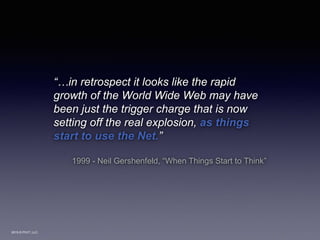
“…in retrospect it looks like the rapid
growth of the World Wide Web may have
been just the trigger charge that is now
setting off the real explosion, as things
start to use the Net.”
1999 - Neil Gershenfeld, “When Things Start to Think”
2015 © PIVIT, LLC.
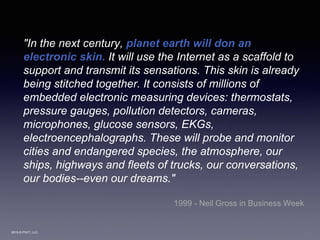
"In the next century, planet earth will don an
electronic skin. It will use the Internet as a scaffold to
support and transmit its sensations. This skin is already
being stitched together. It consists of millions of
embedded electronic measuring devices: thermostats,
pressure gauges, pollution detectors, cameras,
microphones, glucose sensors, EKGs,
electroencephalographs. These will probe and monitor
cities and endangered species, the atmosphere, our
ships, highways and fleets of trucks, our conversations,
our bodies--even our dreams."
1999 - Neil Gross in Business Week
2015 © PIVIT, LLC.
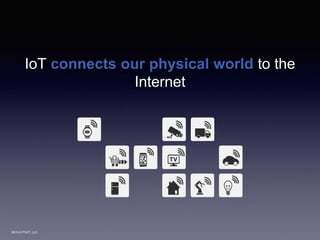
IoT connects our physical world to the
Internet
2015 © PIVIT, LLC.
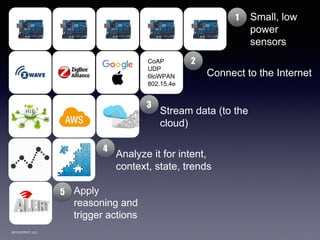
Small, low
power
sensors
1
Connect to the Internet
2CoAP
UDP
6loWPAN
802.15.4e
Stream data (to the
cloud)
3
4
Analyze it for intent,
context, state, trends
5 Apply
reasoning and
trigger actions
2015 © PIVIT, LLC.
heat
location
accelleration
direction
proximity
pressure
temperature
audio
video
light
signal type
signal strength
signal direction
moisture
pH
magnetic field
position
time
chemistry
power levels
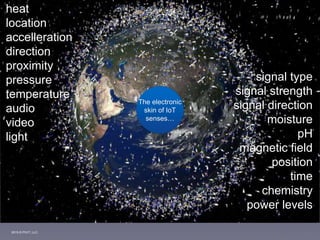
The electronic
skin of IoT
senses…
2015 © PIVIT, LLC.
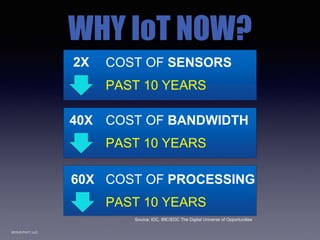
2X COST OF SENSORS
PAST 10 YEARS
Source: IDC, IMC/EDC The Digital Universe of Opportunities
40X COST OF BANDWIDTH
PAST 10 YEARS
60X COST OF PROCESSING
PAST 10 YEARS
WHY IoT NOW?
2015 © PIVIT, LLC.
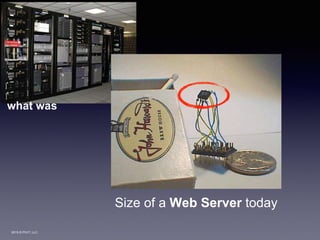
Size of a Web Server today
what was
2015 © PIVIT, LLC.
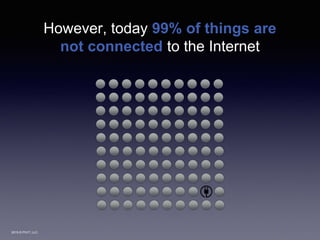
However, today 99% of things are
not connected to the Internet
2015 © PIVIT, LLC.
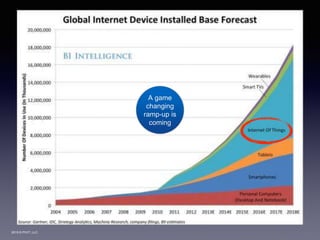
A game
changing
ramp-up is
coming
2015 © PIVIT, LLC.
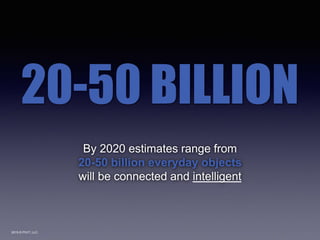
By 2020 estimates range from
20-50 billion everyday objects
will be connected and intelligent
20-50 BILLION
2015 © PIVIT, LLC.
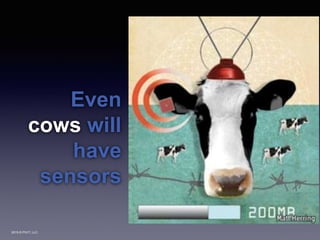
Even
cows will
have
sensors
2015 © PIVIT, LLC.
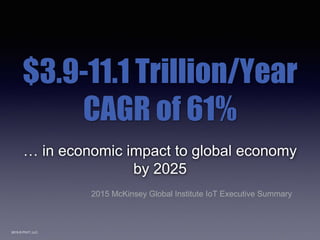
… in economic impact to global economy
by 2025
$3.9-11.1 Trillion/Year
CAGR of 61%
2015 McKinsey Global Institute IoT Executive Summary
2015 © PIVIT, LLC.
HOME
Security, efficiency,
comfort,
entertainment
$200B-350B/y
OFFICE
Security, energy,
efficiency
$70B-150B/y
FACTORY
Operations
optimization
$1.2T-3.7T/y
RETAIL
Automated
checkout, proximity
$410B-1.2T/y
PEOPLE
Health & fitness
$170B-1.6T/y
CITIES
Public health and
transport
$930B-1.7T/y
2015
McKinsey Global
Institute IoT
Executive
Summary
VEHICLES
Driverless,
maintenance
$210B-740B/y
WORKSITES
Operations, health
& safety
$160B-930B/y
OUTSIDE
Logistics and
navigation
$560B-850B/y
2015 © PIVIT, LLC.
WEARABLES
+ Virtual wearables:
Check out MSFT
Hololens on W10
launch
2015 © PIVIT, LLC.
WEARABLES
2015 © PIVIT, LLC.
WEARABLES
2015 © PIVIT, LLC.
PLAYABLES
2015 © PIVIT, LLC.
SMARTHOME
2015 © PIVIT, LLC.
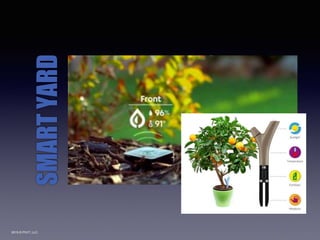
SMARTYARD
2015 © PIVIT, LLC.
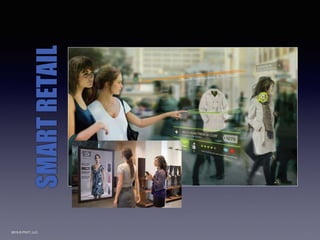
SMARTRETAIL
2015 © PIVIT, LLC.
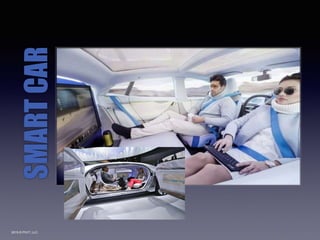
SMARTCAR
2015 © PIVIT, LLC.
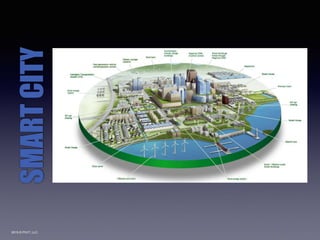
SMARTCITY
2015 © PIVIT, LLC.
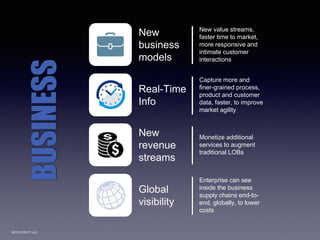
New
business
models
New value streams,
faster time to market,
more responsive and
intimate customer
interactions
Capture more and
finer-grained process,
product and customer
data, faster, to improve
market agility
Monetize additional
services to augment
traditional LOBs
Enterprise can see
inside the business
supply chains end-to-
end, globally, to lower
costs
Real-Time
Info
New
revenue
streams
Global
visibility
BUSINESS
2015 © PIVIT, LLC.
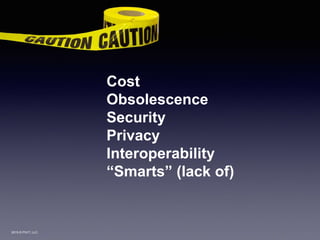
Cost
Obsolescence
Security
Privacy
Interoperability
“Smarts” (lack of)
2015 © PIVIT, LLC.
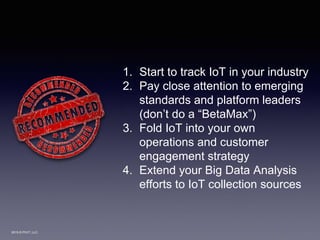
1. Start to track IoT in your industry
2. Pay close attention to emerging
standards and platform leaders
(don’t do a “BetaMax”)
3. Fold IoT into your own
operations and customer
engagement strategy
4. Extend your Big Data Analysis
efforts to IoT collection sources
2015 (c) PIVIT, LLC.
Karl Seiler
President & Founder
PIVIT, LLC.
109 Wimico Drive, Suite 200
Indian Harbour Beach, FL
e: Karl@Piviting.com
t: @pivitguru
l: KarlSeiler
m: 321-750-5165
THANKS

IoT - A Next Big Thing

  • 1.
    A N ex t B I G T h i n g
  • 2.
    2015 © PIVIT,LLC. Today’s agenda What is IoT Expected Impacts Examples What you can do
  • 3.
    2015 © PIVIT,LLC. “…in retrospect it looks like the rapid growth of the World Wide Web may have been just the trigger charge that is now setting off the real explosion, as things start to use the Net.” 1999 - Neil Gershenfeld, “When Things Start to Think”
  • 4.
    2015 © PIVIT,LLC. "In the next century, planet earth will don an electronic skin. It will use the Internet as a scaffold to support and transmit its sensations. This skin is already being stitched together. It consists of millions of embedded electronic measuring devices: thermostats, pressure gauges, pollution detectors, cameras, microphones, glucose sensors, EKGs, electroencephalographs. These will probe and monitor cities and endangered species, the atmosphere, our ships, highways and fleets of trucks, our conversations, our bodies--even our dreams." 1999 - Neil Gross in Business Week
  • 5.
    2015 © PIVIT,LLC. IoT connects our physical world to the Internet
  • 6.
    2015 © PIVIT,LLC. Small, low power sensors 1 Connect to the Internet 2CoAP UDP 6loWPAN 802.15.4e Stream data (to the cloud) 3 4 Analyze it for intent, context, state, trends 5 Apply reasoning and trigger actions
  • 7.
    2015 © PIVIT,LLC. heat location accelleration direction proximity pressure temperature audio video light signal type signal strength signal direction moisture pH magnetic field position time chemistry power levels The electronic skin of IoT senses…
  • 8.
    2015 © PIVIT,LLC. 2X COST OF SENSORS PAST 10 YEARS Source: IDC, IMC/EDC The Digital Universe of Opportunities 40X COST OF BANDWIDTH PAST 10 YEARS 60X COST OF PROCESSING PAST 10 YEARS WHY IoT NOW?
  • 9.
    2015 © PIVIT,LLC. Size of a Web Server today what was
  • 10.
    2015 © PIVIT,LLC. However, today 99% of things are not connected to the Internet
  • 11.
    2015 © PIVIT,LLC. A game changing ramp-up is coming
  • 12.
    2015 © PIVIT,LLC. By 2020 estimates range from 20-50 billion everyday objects will be connected and intelligent 20-50 BILLION
  • 13.
    2015 © PIVIT,LLC. Even cows will have sensors
  • 14.
    2015 © PIVIT,LLC. … in economic impact to global economy by 2025 $3.9-11.1 Trillion/Year CAGR of 61% 2015 McKinsey Global Institute IoT Executive Summary
  • 15.
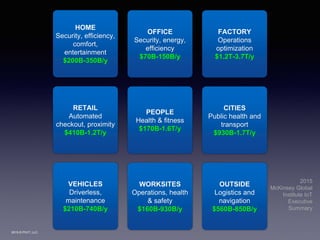
    2015 © PIVIT,LLC. HOME Security, efficiency, comfort, entertainment $200B-350B/y OFFICE Security, energy, efficiency $70B-150B/y FACTORY Operations optimization $1.2T-3.7T/y RETAIL Automated checkout, proximity $410B-1.2T/y PEOPLE Health & fitness $170B-1.6T/y CITIES Public health and transport $930B-1.7T/y 2015 McKinsey Global Institute IoT Executive Summary VEHICLES Driverless, maintenance $210B-740B/y WORKSITES Operations, health & safety $160B-930B/y OUTSIDE Logistics and navigation $560B-850B/y
  • 16.
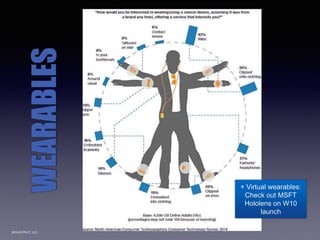
    2015 © PIVIT,LLC. WEARABLES + Virtual wearables: Check out MSFT Hololens on W10 launch
  • 17.
    2015 © PIVIT,LLC. WEARABLES
  • 18.
    2015 © PIVIT,LLC. WEARABLES
  • 19.
    2015 © PIVIT,LLC. PLAYABLES
  • 20.
    2015 © PIVIT,LLC. SMARTHOME
  • 21.
    2015 © PIVIT,LLC. SMARTYARD
  • 22.
    2015 © PIVIT,LLC. SMARTRETAIL
  • 23.
    2015 © PIVIT,LLC. SMARTCAR
  • 24.
    2015 © PIVIT,LLC. SMARTCITY
  • 25.
    2015 © PIVIT,LLC. New business models New value streams, faster time to market, more responsive and intimate customer interactions Capture more and finer-grained process, product and customer data, faster, to improve market agility Monetize additional services to augment traditional LOBs Enterprise can see inside the business supply chains end-to- end, globally, to lower costs Real-Time Info New revenue streams Global visibility BUSINESS
  • 26.
    2015 © PIVIT,LLC. Cost Obsolescence Security Privacy Interoperability “Smarts” (lack of)
  • 27.
    2015 © PIVIT,LLC. 1. Start to track IoT in your industry 2. Pay close attention to emerging standards and platform leaders (don’t do a “BetaMax”) 3. Fold IoT into your own operations and customer engagement strategy 4. Extend your Big Data Analysis efforts to IoT collection sources
  • 28.
    2015 (c) PIVIT,LLC. Karl Seiler President & Founder PIVIT, LLC. 109 Wimico Drive, Suite 200 Indian Harbour Beach, FL e: Karl@Piviting.com t: @pivitguru l: KarlSeiler m: 321-750-5165 THANKS

Editor's Notes

  • #2 Hello, and welcome to the IOT breakout. I am Karl Seiler, President of Pivit, a new company focused on the intelligent open-software layer in the cloud needed for automating decisions. Prior to that I worked for Modus Operandi on product design. Before that I spent 12 years in Chicago working on navigation systems and physical world data collection with sensor fleets for NAVTEQ which was acquired by NOKIA. Prior to that I ran a series of software companies that all centered around artificial intelligence tech. My roots in the area go back to trouble shooting launch systems in firing room #1 for the first space shuttle launch.
  • #3 Today we have 30 minutes to cover what is the Internet of Things. Why now. Why the Internet of Things is widely projected to be the “next big thing”. We will quickly explore a range of market disruption examples. Ending with some recommendations. Ready? Set and go.
  • #4 The key in Neil’s quote is that the relative pervasiveness of today’s Internet, has primed the pump for a new “next big thing” explosion. The World Wide Web era was typified by people using the web to share inform as pages and sites. In tis next phase we will see everyday things streaming information over the net to canvas reality itself.
  • #5 This canvasing was called, by another Neil, an “electronic skin” that transmits its sensations from a myriad of measuring devices stitched together by the Internet, to monitor our cities, landscapes, bodies, homes, workplaces, etc. IoT is that electronic skin.
  • #6 The simplest way to think about the Internet of Things or IoT is as an intelligent compute fabric that connects the physical world to the Internet. Revolutionizing what you wear, your heath, your security, your home, your vehicles, how we shop retail, our factories, our business operations, how we make and grow things, and so on.
  • #7 A bottom-up view of the how of IoT works is as follows. From a diverse and enormous number of real-world small-footprint, low-power sensors That are wirelessly connected to the internet via mostly short hops meshes Stream their perception data to private, secure cloud-based services Where applications analyze it for intent, context, state/situation, and trends over time And where at the top, applications use that analysis to detect patterns, automate decisions, and issue commands, alerts, and recommendations. If it is going to rain, and we detect open windows, and we know no adult is home, then text a string of responsible parties, Also, lower the thermostat, decrease the indoor humidity, and delay any pending yard watering system.
  • #8 The IoT electronic skin of diverse sensors can sense and gather a wide range of fine-grained info. Such as: heat, location, acceleration, direction of travel, proximity to other stuff, pressure, temp, sound, light, signals, moisture, pH, mag fields, body angles, time, chemicals, power, etc.
  • #9 Why is this about to happen, now? Over the last 10 years we have seen - 2x drop in the cost of sensors 40x drop in the cost of connectivity 60x drop in the cost of compute and storage capacity …and this is just the beginning. The net is that we have passed a cost-effectiveness tipping point enabling a projected massive scale out.
  • #10 I recently went to a IoT meet-up in Orlando, where they showed me a web server 1/4” x 1/4” running a lego remote control car from an iPhone via web pages hosted by the web server on the car. This toy has its own web address, app logic and was controlled via HTML5 web pages. You talked to it like any backend service or site.
  • #11 OK, so a big change is coming, but it is not yet really here. Only 1 in 100 devices are connected to the Internet today. Where each home is expected to have hundreds of Internet connected end-points in the future. Today, might be only a few phones, TV boxes, and PCs.
  • #12 But the projections for the ramp up are really really big. The scale of IoT ramp up dwarfs other connected-things such as smartphones, computers, wearables, etc.
  • #13 Projections from the analyst community vary. New refined estimates are coming out all the time. But the range now is between 20 to 50 billion everyday devices will be connected and intelligent by 2020. Thats’ a mere 5 years from now.
  • #14 Even cows will have sensors. For their ID, location, intake, methane production, health,…
  • #15 By 2025 McKinsey projects a global economic impact of between $4 an $11 trillion dollars per year. With a cumulative average growth rate of +60% per year. That’s an explosion that dwarfs the smartphone ramp-up. Growth in business-2-business sectors will lead. Home and office sectors to follow.
  • #16 In the McKinsey analysis their projections were driven by 9 key sectors. Dollar impacts for each are provided in green. The sectors considered include: Smart Home, Smart Office, Smart Factory, Smart Retail, wearables for health and fitness, Smart Cities, Smart cars and trucks, smart worksites, smart landscape and logistics.
  • #17 Lets do a quick dive into some of these sectors to give you a better feel for this transformation. Quantified-self monitoring with be imbedded in watches, shoes, tattoos, clothes, teeth caps, bands and surgically imbedded. So devices all over your body.
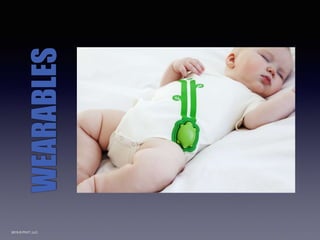
  • #18 In wearables we tend to think of the Apple watch and Fitbits. But baby monitoring is being transformed as well. I met these kids from MIT who invented this Turtle singlet. It watches temp, heart rate, breathing patterns, body movement. The counter-intuitive lesson from the parents was they did not want a dumbed down report of red, yellow, green on their smartphone, rather they wanted the fine grained stream of each sensor trend pushed as a channel to their TV. Channel “My-Baby”.
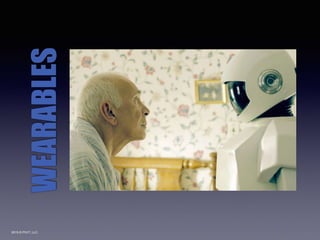
  • #19 I was talking to the FPL lead on IoT about their smart grids. Did you know they have already have 4.5 million 2-way digital meters installed and that Florida’s grid is consider to be the state-of-the-art in the nation? This enables at a minimum predictive equipment failure and faster outage detection. Serendipitously what my FPL contact wanted to talk about was the benefits to the aging-in-place initiative as enabled by IoT. Monitoring activity, eating, prescriptions, supplies, sleeping, security, chronic disease remote monitoring and providing a less isolated life experience. IoT is set to have a very positive impact on our aging population. What is desired is timely and appropriate help from a wellness coach, via hidden sensors, needing zero-effort technology.
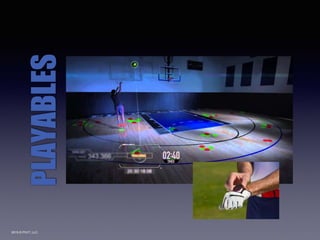
  • #20 I also met the VCs who first funded imbedding 6 axis inertial measuring devices in basket balls. They can track the shot location, arc, power, lift, and compute what you did right or wrong with your body that made that happen. This streams to and from a smartphone in the pocket, and to an ear bud for instant feedback. The app provides coaching tips in real time. You take a shot and a virtual coach whispers in your ear. Same for golf. Clip the IoT device on your glove. Take a swing, and they can tell you all kinds of things relative to how close or far you are from the favorite pro you want to swing like. I recently met the CEO from VERT in Miami who’s tiny IMU clip-on device went to the Olympics in support of women’s volleyball. Now that detailed jump and spike data is deemed essential by college volleyball coaches for both performance optimization and to prevent overwork and injury. Think about it. No more keeling-over at football practice.
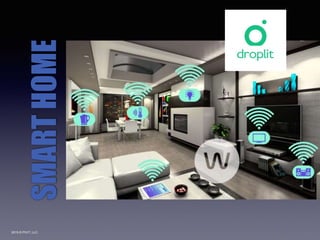
  • #21 We are in the age of DIY on the smart home front. Devices and hubs are selling on Amazon,at Home Depot and Loews. I have bought most, and spun them up. It is messy and I am technical. It is sketchy stuff at this point and I see little common info sharing across silos. We need Google, Apple, Verizon, or someone big to settle the landscape. A local company Droplet is working on exciting bridge-across solutions in this space. I encourage you to check them out. I talked to Joyal construction here in town to see if their high-end customers were asking them to build smart homes, yet. Answer was “not really.” So they are focused on smart energy systems, no-deadspot connectivity and home security. Their primary concerns are for reliability and privacy are not yet addressed adequately by IoT smart home device vendors. The big players with deep-pockets want to rule your home computing environment. It will be a battleground.
  • #22 Yep, plant monitors for weather, temp, light, nutrients, are out there. They bridge to your WiFi. Their apps watch the weather, they control your sprinklers. The real innovation in this area is in mainstream agriculture and use of drone-based sensors. Watch for that. This tip from my client in LA at AirMap creating the 3D map for drone airspace management and compliance. Automation is coming that will not let you fly drones where you should not fly them.
  • #23 Retail will become a guided experience, with smart helpers who know your preferences. Proximity sensors know where you are, where stuff is, and real time inventory cross-matching. Special offers, tailored for you in real-time based on proximity will optimize your experience. The purchase transaction itself continues to move toward more self-serve. You put it in your cart, you bought it.
  • #24 Driverless fleets are coming. Audi, Daimler Chrysler, and BMW recently bought the navigation and digital map company I used to work for. Why? Driverless fleets need special and different maps to do what they do safely and they did not want to be beholding to Google for maps. Notice in the picture above, that the steering wheel is behind and between the couple. Safer cars. More efficient cars. Faster commutes. Always connected cars. Like the home the car’s compute environment is a battlefield for control by the big tech giants, who are now bigger and more well funded than the car manufacturers themselves. Your cars are quintessential IoT. Car ownership may also shift to a car-as-a-subscription service.
  • #25 The smart city. The connected city. Resources tightly monitored and controlled. Integrated transportation management. Integrated utility management. Integrated security systems. Locally generated energy. Integrated in cooperation with smart buildings and smart homes. Counter intuitively cities are one of mankind’s greatest efficiency inventions, that are getting smarter.
  • #26 So we see impacts across multiple sectors. From a business perspective what can we expect and what should we be doing to take advantage of this technology-driven change? Digitization tends to blur the lines between technology companies and other types of companies. IoT opens new business models. New value streams, faster product time-to-market, and increased intimacy with your customers. Business speeds up. With real-time data flows, analyzed as it is perceived, you have an enormous opportunity to be agile and opportunistic. New revenues. IoT enables add-on services that can generate new subscription based revenue streams. Improved visibility. Globally. Your end-to-end supply chain becomes visible, allowing elasticity for cost optimization.
  • #27 But… there are hurdles for IoT that include: High costs - for example to IoT smarten-up a normal house room is ~$350. Obsolescence - new smarter connected stuff has to replace old stuff that still works fine. Security - In 2014, Hewlett-Packard Co. released a research report that concluded 70 per cent of “Internet of Things” connected devices were vulnerable to hacks, either through weak passwords or unencrypted connections. It is not about a hacked light bulb, rather it is an unsecured access points to home network’s assets at large. People are very couscous of privacy and security. Smart stuff knows so much about you it is hard to get comfortable with. Baddies will hack your car and your house and your factory and your office. This is a must solve problem. Providers of IoT enabled products and services will have to create compelling value propositions for data to be collected and used, provide transparency into what data are used and how they are being used, and ensure that the data are appropriately protected. Interoperability - data silos are a real problem. Secure info exchange standards need to settle. Common compute platforms and hubs need to emerge. We will make mistakes and we will create IoT data islands. Aka, remember the BetaMax. There are currently few standards (or regulations) for what is needed to run an IoT device. Consortia that group together global industrial, tech, and electronics companies are involved in an effort to standardize the IoT and solve the most pressing security concerns. Lack of Smarts - my special area of interest. Getting all the IoT stuff to generate a detectable pattern “it is a workday evening and the family is home” to which logical automated decision making can be applied to create the benefits of personalization, security, comfort, efficiency. Smart services are needed and missing except for brittle hand-coded apps. Not smart enough or dependable enough, or flexible enough. These systems will need to learn about you as they go. No one will have the time or interest in programming each IoT device and its contextual neighborhood relationships by-hand.
  • #28 What can you do about this coming tsunami? Pay attention to IoT inroads into your industry. Start to opt in and track those info feeds. Watch carefully for emerging dominate platforms and standards. Stay on the main path so your solutions do not become islands. Start the strategy discussions on how to best take advantage of IoT in your operations and customer interaction business models Lastly, if you are active in Big Data Analysis - start the process of bridging out to IoT as new physical-world perception data resources for your analysis.
  • #29 Thanks for your time and attention today. I hope I was able to give you a feel for the next big thing headed your way. For more info, advice or strategic help please contact me @ PIVIT. Let me ask you a starting question. How many of you knew about IoT before coming here today? Who knew it was this big and broad? How many have active IoT projects in your concerns? Q&A…