© 2015 Nuance Communications, Inc. All rights reserved.
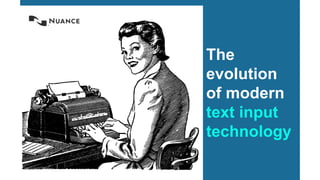
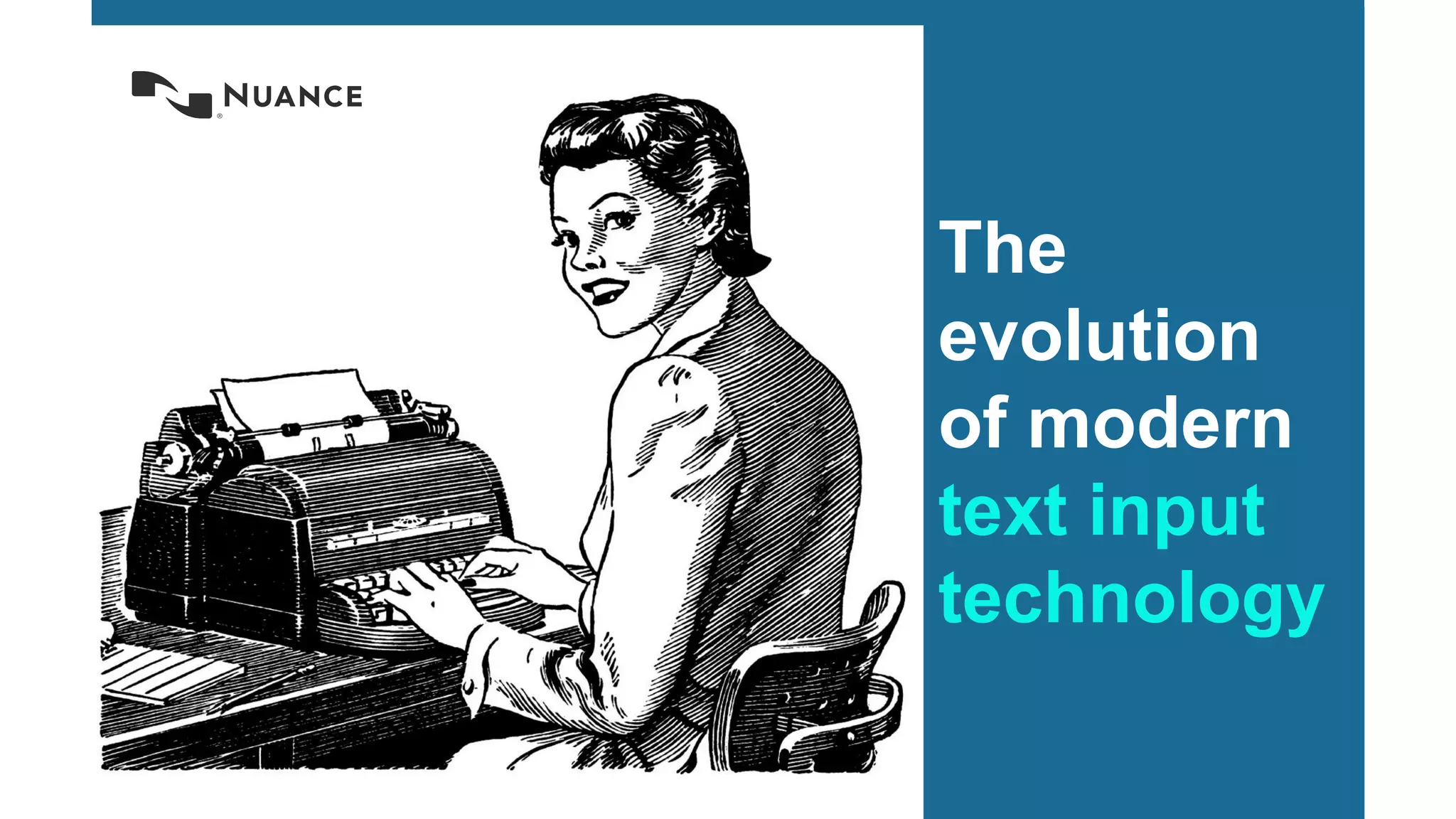
The
evolution
of modern
text input
technology
© 2015 Nuance Communications, Inc. All rights reserved. 2
The evolution of modern typing
technology has radically shifted
the way we collect and store
information. Innovations have led
to quicker, easier, less costly, and
more consistent ways to input and
manage this data that all of society
so readily depends on.
© 2015 Nuance Communications, Inc. All rights reserved. 3
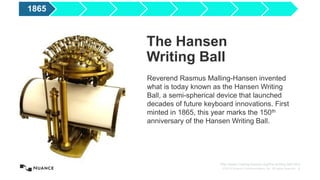
Reverend Rasmus Malling-Hansen invented
what is today known as the Hansen Writing
Ball, a semi-spherical device that launched
decades of future keyboard innovations. First
minted in 1865, this year marks the 150th
anniversary of the Hansen Writing Ball.
The Hansen
Writing Ball
1865
http://www.malling-hansen.org/the-writing-ball.html
© 2015 Nuance Communications, Inc. All rights reserved. 4
The introduction of the Hansen
Writing Ball spurred a series of
innovations – some prototypes
that didn’t make it to market,
others that were quick to be
commercialized, ultimately
permeating the office and home
environments.
© 2015 Nuance Communications, Inc. All rights reserved. 5
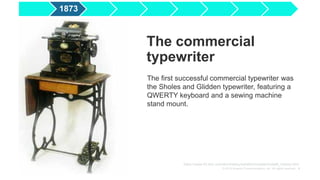
1873
The first successful commercial typewriter was
the Sholes and Glidden typewriter, featuring a
QWERTY keyboard and a sewing machine
stand mount.
The commercial
typewriter
https://www-03.ibm.com/ibm/history/exhibits/modelb/modelb_history.html
© 2015 Nuance Communications, Inc. All rights reserved. 6
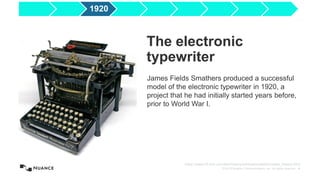
James Fields Smathers produced a successful
model of the electronic typewriter in 1920, a
project that he had initially started years before,
prior to World War I.
The electronic
typewriter
1920
https://www-03.ibm.com/ibm/history/exhibits/modelb/modelb_history.html
© 2015 Nuance Communications, Inc. All rights reserved. 7
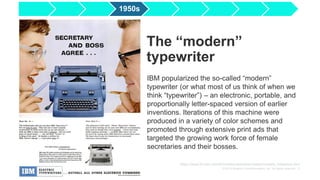
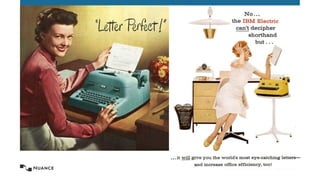
IBM popularized the so-called “modern”
typewriter (or what most of us think of when we
think “typewriter”) – an electronic, portable, and
proportionally letter-spaced version of earlier
inventions. Iterations of this machine were
produced in a variety of color schemes and
promoted through extensive print ads that
targeted the growing work force of female
secretaries and their bosses.
The “modern”
typewriter
1950s
https://www-03.ibm.com/ibm/history/exhibits/modelb/modelb_milestone.html
© 2015 Nuance Communications, Inc. All rights reserved. 8
© 2015 Nuance Communications, Inc. All rights reserved. 9
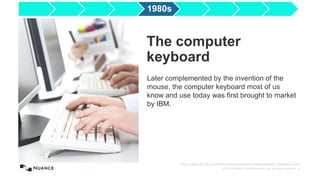
Later complemented by the invention of the
mouse, the computer keyboard most of us
know and use today was first brought to market
by IBM.
The computer
keyboard
1980s
https://www-03.ibm.com/ibm/history/exhibits/modelb/modelb_milestone.html
© 2015 Nuance Communications, Inc. All rights reserved. 10
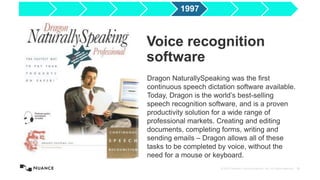
Dragon NaturallySpeaking was the first
continuous speech dictation software available.
Today, Dragon is the world’s best-selling
speech recognition software, and is a proven
productivity solution for a wide range of
professional markets. Creating and editing
documents, completing forms, writing and
sending emails – Dragon allows all of these
tasks to be completed by voice, without the
need for a mouse or keyboard.
Voice recognition
software
1997
© 2015 Nuance Communications, Inc. All rights reserved. 11
Following the introduction of SMS (short
message service) texting, Martin King and
Cliff Kushler invented T-9, a text input method
boasting predictive input technology. The
duo’s innovation was a result of them
developing products for people with
disabilities, including the creation of eye-
tracking devices that allowed for text input via
eye movements.
T9 texting on mobile
devices
http://mashable.com/2012/09/21/text-messaging-history/
1998
http://www.wired.com/2010/09/martin-king-t9-dies
© 2015 Nuance Communications, Inc. All rights reserved. 12
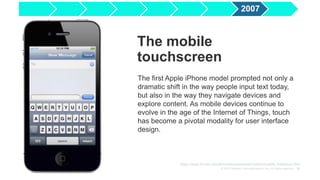
The first Apple iPhone model prompted not only a
dramatic shift in the way people input text today,
but also in the way they navigate devices and
explore content. As mobile devices continue to
evolve in the age of the Internet of Things, touch
has become a pivotal modality for user interface
design.
The mobile
touchscreen
https://www-03.ibm.com/ibm/history/exhibits/modelb/modelb_milestone.html
2007
© 2015 Nuance Communications, Inc. All rights reserved. 13
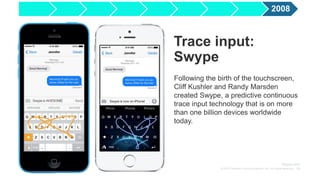
Following the birth of the touchscreen,
Cliff Kushler and Randy Marsden
created Swype, a predictive continuous
trace input technology that is on more
than one billion devices worldwide
today.
Trace input:
Swype
Swype.com
2008
© 2015 Nuance Communications, Inc. All rights reserved. 14
Today, there is a blurring of the
lines between these devices we
once considered additive and our
interactions with them in our daily
lives.
© 2015 Nuance Communications, Inc. All rights reserved. 15
Technology is increasingly more natural,
more human. Over time, the interface will
become almost invisible.
© 2015 Nuance Communications, Inc. All rights reserved. 16
“With the evolution throughout history
of communication technologies that
affect our creation, transmission,
and storage of knowledge, there will
continue to be changes in our
conceptualization of knowledge.”
Communication Technology and the Evolution of Knowledge,
The Journal of Electronic Publishing
© 2015 Nuance Communications, Inc. All rights reserved.
Here’s to many more
years of innovations.

Rasmus Malling-Hansen, a writing ball, and the evolution of modern typing

  • 1.
    © 2015 NuanceCommunications, Inc. All rights reserved. The evolution of modern text input technology
  • 2.
    © 2015 NuanceCommunications, Inc. All rights reserved. 2 The evolution of modern typing technology has radically shifted the way we collect and store information. Innovations have led to quicker, easier, less costly, and more consistent ways to input and manage this data that all of society so readily depends on.
  • 3.
    © 2015 NuanceCommunications, Inc. All rights reserved. 3 Reverend Rasmus Malling-Hansen invented what is today known as the Hansen Writing Ball, a semi-spherical device that launched decades of future keyboard innovations. First minted in 1865, this year marks the 150th anniversary of the Hansen Writing Ball. The Hansen Writing Ball 1865 http://www.malling-hansen.org/the-writing-ball.html
  • 4.
    © 2015 NuanceCommunications, Inc. All rights reserved. 4 The introduction of the Hansen Writing Ball spurred a series of innovations – some prototypes that didn’t make it to market, others that were quick to be commercialized, ultimately permeating the office and home environments.
  • 5.
    © 2015 NuanceCommunications, Inc. All rights reserved. 5 1873 The first successful commercial typewriter was the Sholes and Glidden typewriter, featuring a QWERTY keyboard and a sewing machine stand mount. The commercial typewriter https://www-03.ibm.com/ibm/history/exhibits/modelb/modelb_history.html
  • 6.
    © 2015 NuanceCommunications, Inc. All rights reserved. 6 James Fields Smathers produced a successful model of the electronic typewriter in 1920, a project that he had initially started years before, prior to World War I. The electronic typewriter 1920 https://www-03.ibm.com/ibm/history/exhibits/modelb/modelb_history.html
  • 7.
    © 2015 NuanceCommunications, Inc. All rights reserved. 7 IBM popularized the so-called “modern” typewriter (or what most of us think of when we think “typewriter”) – an electronic, portable, and proportionally letter-spaced version of earlier inventions. Iterations of this machine were produced in a variety of color schemes and promoted through extensive print ads that targeted the growing work force of female secretaries and their bosses. The “modern” typewriter 1950s https://www-03.ibm.com/ibm/history/exhibits/modelb/modelb_milestone.html
  • 8.
    © 2015 NuanceCommunications, Inc. All rights reserved. 8
  • 9.
    © 2015 NuanceCommunications, Inc. All rights reserved. 9 Later complemented by the invention of the mouse, the computer keyboard most of us know and use today was first brought to market by IBM. The computer keyboard 1980s https://www-03.ibm.com/ibm/history/exhibits/modelb/modelb_milestone.html
  • 10.
    © 2015 NuanceCommunications, Inc. All rights reserved. 10 Dragon NaturallySpeaking was the first continuous speech dictation software available. Today, Dragon is the world’s best-selling speech recognition software, and is a proven productivity solution for a wide range of professional markets. Creating and editing documents, completing forms, writing and sending emails – Dragon allows all of these tasks to be completed by voice, without the need for a mouse or keyboard. Voice recognition software 1997
  • 11.
    © 2015 NuanceCommunications, Inc. All rights reserved. 11 Following the introduction of SMS (short message service) texting, Martin King and Cliff Kushler invented T-9, a text input method boasting predictive input technology. The duo’s innovation was a result of them developing products for people with disabilities, including the creation of eye- tracking devices that allowed for text input via eye movements. T9 texting on mobile devices http://mashable.com/2012/09/21/text-messaging-history/ 1998 http://www.wired.com/2010/09/martin-king-t9-dies
  • 12.
    © 2015 NuanceCommunications, Inc. All rights reserved. 12 The first Apple iPhone model prompted not only a dramatic shift in the way people input text today, but also in the way they navigate devices and explore content. As mobile devices continue to evolve in the age of the Internet of Things, touch has become a pivotal modality for user interface design. The mobile touchscreen https://www-03.ibm.com/ibm/history/exhibits/modelb/modelb_milestone.html 2007
  • 13.
    © 2015 NuanceCommunications, Inc. All rights reserved. 13 Following the birth of the touchscreen, Cliff Kushler and Randy Marsden created Swype, a predictive continuous trace input technology that is on more than one billion devices worldwide today. Trace input: Swype Swype.com 2008
  • 14.
    © 2015 NuanceCommunications, Inc. All rights reserved. 14 Today, there is a blurring of the lines between these devices we once considered additive and our interactions with them in our daily lives.
  • 15.
    © 2015 NuanceCommunications, Inc. All rights reserved. 15 Technology is increasingly more natural, more human. Over time, the interface will become almost invisible.
  • 16.
    © 2015 NuanceCommunications, Inc. All rights reserved. 16 “With the evolution throughout history of communication technologies that affect our creation, transmission, and storage of knowledge, there will continue to be changes in our conceptualization of knowledge.” Communication Technology and the Evolution of Knowledge, The Journal of Electronic Publishing
  • 17.
    © 2015 NuanceCommunications, Inc. All rights reserved. Here’s to many more years of innovations.