Effect of the iontophoresis of a chitosan gel on    doxorubicin skin penetration and cytotoxicitySaketAsatiDept. of PharmaceuticsNIPERA1012PE12
Flow of seminarIntroductionResearch ArticleAimMaterials & MethodResult & DiscusionConclusionReferences
Human skin	Most extensive and readily accessible organs of the human body.
 It receives about 1/3 of the blood circulation through the 	body.
 Adult body covers a surface area approximately 2m2
 Average thickness of human skin: 0.5 mm.
 The stratum corneum is effectively a 10-15ฮผm thick.
 The epidermis, is approximately 100 to150 ยตm thick.
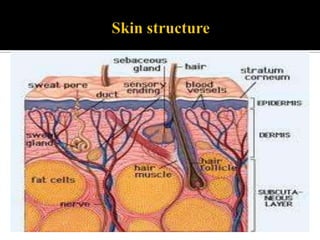
 Skin is a net negatively charged membrane under normal physiological condition.Skin structure
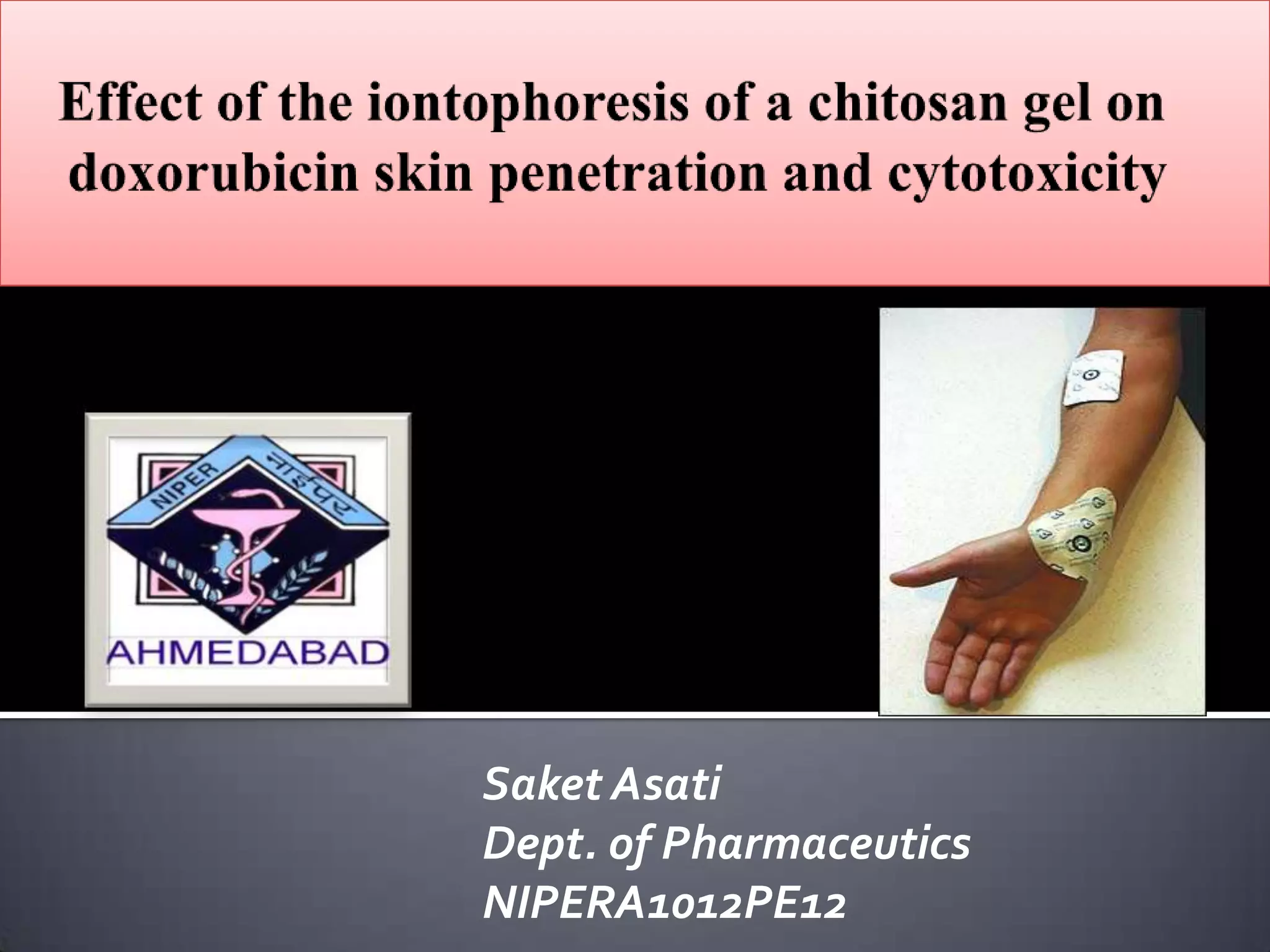
IontophoresisIontophoresis involves the application of a weak (low) electric current to the skin and allowing the drugs into the body, through the skin, by a potential gradient.Four components needed for effective Iontophoresis delivery:โ€ข	Power source in order to generate controlled direct current.โ€ข	Electrodes that contain the drug and disperse the drug.โ€ข	Negatively or positively charged aqueous medication of small molecule size (nearly <8000 Daltons).โ€ข	Treatment site (localized).
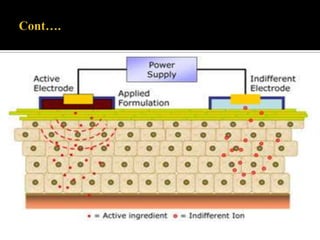
Mechanism involvedย In Iontophoresis, electrodes are present both anode and cathode. Anode represents a positively charged chamber whereas cathode represents a negatively charged chamber. Now the cationic drugs are kept under the anode or the anionic drugs are placed under the cathode.When a low voltage density current is applied, due to โ€˜Electro     repulsionโ€™, the ions will be repelled into the skin from the active electrode that is having the drug ions.
Contโ€ฆ.The amount of drug delivered is directly proportional to the quantity of electrical charge passed. Electromigration and electroosmosis are two different mechanisms contributing to  the iontophoretic flux.In electromigration, the applied electrical potential gradient causes electrorepulsion between the positive electrode and a cationic drug.Electroosmosis causes a convective solvent flow in the anode-to cathode direction, which enhances the transport of cations and of neutral polar compounds, while diminishing the overall electrotransport of anions.
Contโ€ฆ.
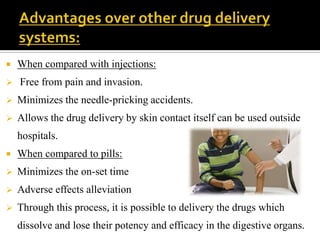
Advantages over other drug delivery systems:When compared with injections: Free from pain and invasion.
Minimizes the needle-pricking accidents.
Allows the drug delivery by skin contact itself can be used outside hospitals.When compared to pills:Minimizes the on-set time
Adverse effects alleviation
Through this process, it is possible to delivery the drugs which dissolve and lose their potency and efficacy in the digestive organs.Contโ€ฆ.When compared to patches (adhesives):Shortens the on-set time
Drugs can de delivered quantitatively
Reduces the residual drug amount.ย 
Chitosan gelChitosan is a linearย polysaccharideย composed of randomly distributed ฮฒ-(1-4)-linkedย D-glucosamine andย N-acetyl-D-glucosamine. Theย aminoย group in chitosan makes chitosan water soluble and  cationic which readily binds to negatively charged surfaces such as mucosal membranes.Chitosan enhances the transport of polarย drugsย across epithelial surfaces, and isย biocompatibleย andย biodegradable.
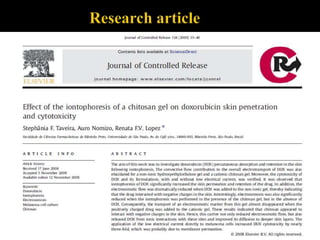
Research article
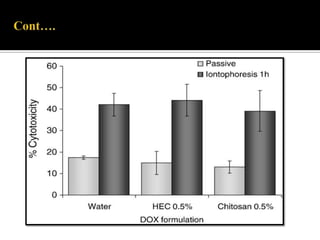
AimTo determine the effect of iontophoresis on skin permeation & retension of doxorubicin (DOX).To determine the effect of chitosan gel on the electroosmotic flow.To determine the effect of low electric current on the melanoma cells.
MaterialsDoxorubicin hydrochloride (DOX)
Methanol
Tetrahydrofuran
 Propylene glycol and ZnSO4
Natrosol 250 HHR hydroxyethylcellulose(HEC)
 High molecular weight Chitosan (Hydagenยฎ CMFP)
Deionized water
 Pig ear skin
 B16F10 Melanoma cellsPreparation of DOX formulationDOX 0.5% was dispersed in water, hydroxyethylcellulose (HEC) gel and chitosan gel.

iontophoresis

  • 1.
    Effect of theiontophoresis of a chitosan gel on doxorubicin skin penetration and cytotoxicitySaketAsatiDept. of PharmaceuticsNIPERA1012PE12
  • 2.
    Flow of seminarIntroductionResearchArticleAimMaterials & MethodResult & DiscusionConclusionReferences
  • 3.
    Human skin Most extensiveand readily accessible organs of the human body.
  • 4.
    It receivesabout 1/3 of the blood circulation through the body.
  • 5.
    Adult bodycovers a surface area approximately 2m2
  • 6.
    Average thicknessof human skin: 0.5 mm.
  • 7.
    The stratumcorneum is effectively a 10-15ฮผm thick.
  • 8.
    The epidermis,is approximately 100 to150 ยตm thick.
  • 9.
    Skin isa net negatively charged membrane under normal physiological condition.Skin structure
  • 10.
    IontophoresisIontophoresis involves theapplication of a weak (low) electric current to the skin and allowing the drugs into the body, through the skin, by a potential gradient.Four components needed for effective Iontophoresis delivery:โ€ข Power source in order to generate controlled direct current.โ€ข Electrodes that contain the drug and disperse the drug.โ€ข Negatively or positively charged aqueous medication of small molecule size (nearly <8000 Daltons).โ€ข Treatment site (localized).
  • 11.
    Mechanism involvedย In Iontophoresis,electrodes are present both anode and cathode. Anode represents a positively charged chamber whereas cathode represents a negatively charged chamber. Now the cationic drugs are kept under the anode or the anionic drugs are placed under the cathode.When a low voltage density current is applied, due to โ€˜Electro repulsionโ€™, the ions will be repelled into the skin from the active electrode that is having the drug ions.
  • 12.
    Contโ€ฆ.The amount ofdrug delivered is directly proportional to the quantity of electrical charge passed. Electromigration and electroosmosis are two different mechanisms contributing to the iontophoretic flux.In electromigration, the applied electrical potential gradient causes electrorepulsion between the positive electrode and a cationic drug.Electroosmosis causes a convective solvent flow in the anode-to cathode direction, which enhances the transport of cations and of neutral polar compounds, while diminishing the overall electrotransport of anions.
  • 13.
  • 14.
    Advantages over otherdrug delivery systems:When compared with injections: Free from pain and invasion.
  • 15.
  • 16.
    Allows the drugdelivery by skin contact itself can be used outside hospitals.When compared to pills:Minimizes the on-set time
  • 17.
  • 18.
    Through this process,it is possible to delivery the drugs which dissolve and lose their potency and efficacy in the digestive organs.Contโ€ฆ.When compared to patches (adhesives):Shortens the on-set time
  • 19.
    Drugs can dedelivered quantitatively
  • 20.
    Reduces the residualdrug amount.ย 
  • 21.
    Chitosan gelChitosan isa linearย polysaccharideย composed of randomly distributed ฮฒ-(1-4)-linkedย D-glucosamine andย N-acetyl-D-glucosamine. Theย aminoย group in chitosan makes chitosan water soluble and cationic which readily binds to negatively charged surfaces such as mucosal membranes.Chitosan enhances the transport of polarย drugsย across epithelial surfaces, and isย biocompatibleย andย biodegradable.
  • 22.
  • 23.
    AimTo determine theeffect of iontophoresis on skin permeation & retension of doxorubicin (DOX).To determine the effect of chitosan gel on the electroosmotic flow.To determine the effect of low electric current on the melanoma cells.
  • 24.
  • 25.
  • 26.
  • 27.
  • 28.
    Natrosol 250 HHRhydroxyethylcellulose(HEC)
  • 29.
    High molecularweight Chitosan (Hydagenยฎ CMFP)
  • 30.
  • 31.
  • 32.
    B16F10 MelanomacellsPreparation of DOX formulationDOX 0.5% was dispersed in water, hydroxyethylcellulose (HEC) gel and chitosan gel.

Editor's Notes

  • #28ย 3-(4,5-dimethylthizol-2-yl)-2,5-diphenyl tetrazolium bromide (MTT)