Inventory
Inventory refers to the goods, raw
materials, work-in-progress, or
finished products that a business
holds for the purpose of resale,
production, or service delivery. It
represents an essential part of the
supply chain and includes all items
a company maintains to meet
current or future demand, manage
uncertainties, and support
operations. Tracking and
managing inventory levels are
crucial for optimizing costs,
meeting customer needs, and
ensuring smooth operations.
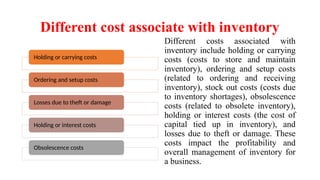
Different cost associate with inventory
Holding or carrying costs
Ordering and setup costs
Losses due to theft or damage
Holding or interest costs
Obsolescence costs
Different costs associated with
inventory include holding or carrying
costs (costs to store and maintain
inventory), ordering and setup costs
(related to ordering and receiving
inventory), stock out costs (costs due
to inventory shortages), obsolescence
costs (related to obsolete inventory),
holding or interest costs (the cost of
capital tied up in inventory), and
losses due to theft or damage. These
costs impact the profitability and
overall management of inventory for
a business.
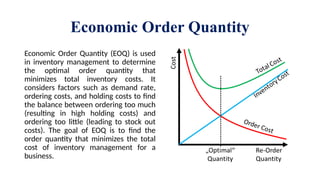
Economic Order Quantity
Economic Order Quantity (EOQ) is used
in inventory management to determine
the optimal order quantity that
minimizes total inventory costs. It
considers factors such as demand rate,
ordering costs, and holding costs to find
the balance between ordering too much
(resulting in high holding costs) and
ordering too little (leading to stock out
costs). The goal of EOQ is to find the
order quantity that minimizes the total
cost of inventory management for a
business.
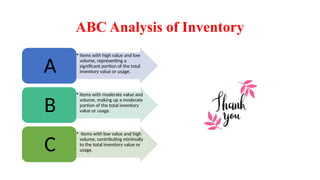
ABC Analysis of Inventory
• Items with high value and low
volume, representing a
significant portion of the total
inventory value or usage.
A
• Items with moderate value and
volume, making up a moderate
portion of the total inventory
value or usage.
B
• Items with low value and high
volume, contributing minimally
to the total inventory value or
usage.
C

Inventory Control or inventory management system.pptx

  • 1.
    Inventory Inventory refers tothe goods, raw materials, work-in-progress, or finished products that a business holds for the purpose of resale, production, or service delivery. It represents an essential part of the supply chain and includes all items a company maintains to meet current or future demand, manage uncertainties, and support operations. Tracking and managing inventory levels are crucial for optimizing costs, meeting customer needs, and ensuring smooth operations.
  • 2.
    Different cost associatewith inventory Holding or carrying costs Ordering and setup costs Losses due to theft or damage Holding or interest costs Obsolescence costs Different costs associated with inventory include holding or carrying costs (costs to store and maintain inventory), ordering and setup costs (related to ordering and receiving inventory), stock out costs (costs due to inventory shortages), obsolescence costs (related to obsolete inventory), holding or interest costs (the cost of capital tied up in inventory), and losses due to theft or damage. These costs impact the profitability and overall management of inventory for a business.
  • 3.
    Economic Order Quantity EconomicOrder Quantity (EOQ) is used in inventory management to determine the optimal order quantity that minimizes total inventory costs. It considers factors such as demand rate, ordering costs, and holding costs to find the balance between ordering too much (resulting in high holding costs) and ordering too little (leading to stock out costs). The goal of EOQ is to find the order quantity that minimizes the total cost of inventory management for a business.
  • 4.
    ABC Analysis ofInventory • Items with high value and low volume, representing a significant portion of the total inventory value or usage. A • Items with moderate value and volume, making up a moderate portion of the total inventory value or usage. B • Items with low value and high volume, contributing minimally to the total inventory value or usage. C