Inventory Audit
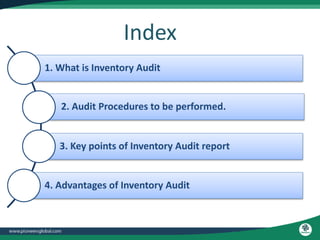
Index
Information requirements and Next Steps
Indicative High Level Plan
1. What is Inventory Audit
2. Audit Procedures to be performed.
3. Key points of Inventory Audit report
4. Advantages of Inventory Audit
2
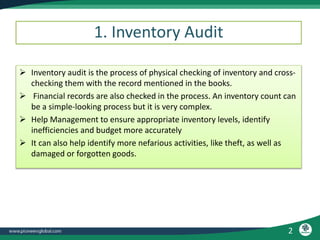
 Inventory audit is the process of physical checking of inventory and cross-
checking them with the record mentioned in the books.
 Financial records are also checked in the process. An inventory count can
be a simple-looking process but it is very complex.
 Help Management to ensure appropriate inventory levels, identify
inefficiencies and budget more accurately
 It can also help identify more nefarious activities, like theft, as well as
damaged or forgotten goods.
1. Inventory Audit
4
Inventory
Audit
Physical
Inventory
Counting
ABC
Inventory
Analysis
Cut-off
Analysis
Analytical
Procedures
Product
Reconciliati
on
Inventory
Audit
Report
2. Audit Procedure
5
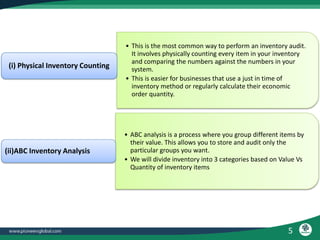
• This is the most common way to perform an inventory audit.
It involves physically counting every item in your inventory
and comparing the numbers against the numbers in your
system.
• This is easier for businesses that use a just in time of
inventory method or regularly calculate their economic
order quantity.
(i) Physical Inventory Counting
• ABC analysis is a process where you group different items by
their value. This allows you to store and audit only the
particular groups you want.
• We will divide inventory into 3 categories based on Value Vs
Quantity of inventory items
(ii)ABC Inventory Analysis
5
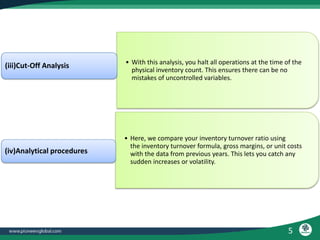
• With this analysis, you halt all operations at the time of the
physical inventory count. This ensures there can be no
mistakes of uncontrolled variables.
(iii)Cut-Off Analysis
• Here, we compare your inventory turnover ratio using
the inventory turnover formula, gross margins, or unit costs
with the data from previous years. This lets you catch any
sudden increases or volatility.
(iv)Analytical procedures
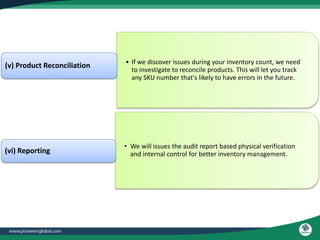
• If we discover issues during your inventory count, we need
to investigate to reconcile products. This will let you track
any SKU number that's likely to have errors in the future.
(v) Product Reconciliation
• We will issues the audit report based physical verification
and internal control for better inventory management.
(vi) Reporting
9
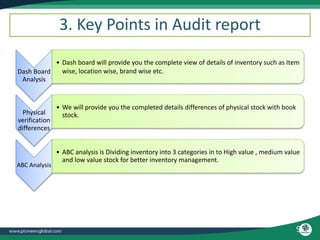
Dash Board
Analysis
• Dash board will provide you the complete view of details of inventory such as Item
wise, location wise, brand wise etc.
Physical
verification
differences
• We will provide you the completed details differences of physical stock with book
stock.
ABC Analysis
• ABC analysis is Dividing inventory into 3 categories in to High value , medium value
and low value stock for better inventory management.
3. Key Points in Audit report
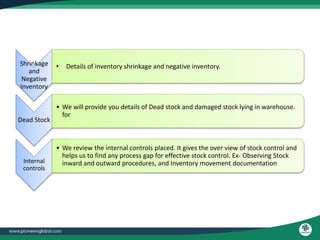
Shrinkage
and
Negative
Inventory
• Details of inventory shrinkage and negative inventory.
Dead Stock
• We will provide you details of Dead stock and damaged stock lying in warehouse.
for
Internal
controls
• We review the internal controls placed. It gives the over view of stock control and
helps us to find any process gap for effective stock control. Ex- Observing Stock
inward and outward procedures, and Inventory movement documentation
9
3. Advantages of Inventory Audit
 Know what’s missing – As you compare physical counts with your records,
you can identify which items are missing. If you find consistent inventory
shrinkage with supplies or products, further investigation can help determine
if they were lost, stolen, damaged, or discarded. And you can take action to
stop shrinkage.
 Assess overall inventory status – Regular inventory audits will reveal if
specific items are consistently understocked. You can also identify which
supplies aren’t being used and are taking up storage space It can also help
identify more nefarious activities, like theft, as well as damaged or forgotten
goods.
• Budget better – When you understand which items you need the most, it’s
easy to budget more efficiently. Regular inventory audits prevent wasting
money on buying and storing products that are always in surplus. Audits help
you determine if you need to discontinue surplus items and redirect funds to
goods that are frequent stockouts.
Inventory Audit.pptx

Inventory Audit.pptx

  • 1.
  • 2.
    Index Information requirements andNext Steps Indicative High Level Plan 1. What is Inventory Audit 2. Audit Procedures to be performed. 3. Key points of Inventory Audit report 4. Advantages of Inventory Audit
  • 3.
    2  Inventory auditis the process of physical checking of inventory and cross- checking them with the record mentioned in the books.  Financial records are also checked in the process. An inventory count can be a simple-looking process but it is very complex.  Help Management to ensure appropriate inventory levels, identify inefficiencies and budget more accurately  It can also help identify more nefarious activities, like theft, as well as damaged or forgotten goods. 1. Inventory Audit
  • 4.
  • 5.
    5 • This isthe most common way to perform an inventory audit. It involves physically counting every item in your inventory and comparing the numbers against the numbers in your system. • This is easier for businesses that use a just in time of inventory method or regularly calculate their economic order quantity. (i) Physical Inventory Counting • ABC analysis is a process where you group different items by their value. This allows you to store and audit only the particular groups you want. • We will divide inventory into 3 categories based on Value Vs Quantity of inventory items (ii)ABC Inventory Analysis
  • 6.
    5 • With thisanalysis, you halt all operations at the time of the physical inventory count. This ensures there can be no mistakes of uncontrolled variables. (iii)Cut-Off Analysis • Here, we compare your inventory turnover ratio using the inventory turnover formula, gross margins, or unit costs with the data from previous years. This lets you catch any sudden increases or volatility. (iv)Analytical procedures
  • 7.
    • If wediscover issues during your inventory count, we need to investigate to reconcile products. This will let you track any SKU number that's likely to have errors in the future. (v) Product Reconciliation • We will issues the audit report based physical verification and internal control for better inventory management. (vi) Reporting
  • 8.
    9 Dash Board Analysis • Dashboard will provide you the complete view of details of inventory such as Item wise, location wise, brand wise etc. Physical verification differences • We will provide you the completed details differences of physical stock with book stock. ABC Analysis • ABC analysis is Dividing inventory into 3 categories in to High value , medium value and low value stock for better inventory management. 3. Key Points in Audit report
  • 9.
    Shrinkage and Negative Inventory • Details ofinventory shrinkage and negative inventory. Dead Stock • We will provide you details of Dead stock and damaged stock lying in warehouse. for Internal controls • We review the internal controls placed. It gives the over view of stock control and helps us to find any process gap for effective stock control. Ex- Observing Stock inward and outward procedures, and Inventory movement documentation
  • 10.
    9 3. Advantages ofInventory Audit  Know what’s missing – As you compare physical counts with your records, you can identify which items are missing. If you find consistent inventory shrinkage with supplies or products, further investigation can help determine if they were lost, stolen, damaged, or discarded. And you can take action to stop shrinkage.  Assess overall inventory status – Regular inventory audits will reveal if specific items are consistently understocked. You can also identify which supplies aren’t being used and are taking up storage space It can also help identify more nefarious activities, like theft, as well as damaged or forgotten goods. • Budget better – When you understand which items you need the most, it’s easy to budget more efficiently. Regular inventory audits prevent wasting money on buying and storing products that are always in surplus. Audits help you determine if you need to discontinue surplus items and redirect funds to goods that are frequent stockouts.