STARTUP
BUSINESS
Presentation by
ANNA ROSE C. GARCIA
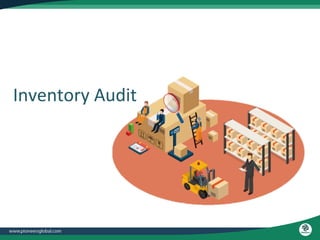
Inventory Audit
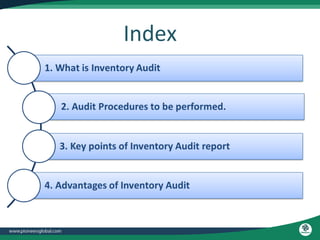
Index
Information requirements and Next Steps
Indicative High Level Plan
2
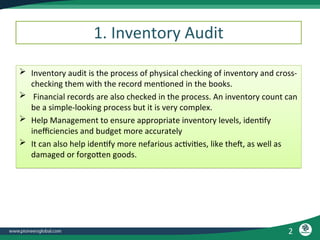
 Inventory audit is the process of physical checking of inventory and cross-
checking them with the record mentioned in the books.
 Financial records are also checked in the process. An inventory count can
be a simple-looking process but it is very complex.
 Help Management to ensure appropriate inventory levels, identify
inefficiencies and budget more accurately
 It can also help identify more nefarious activities, like theft, as well as
damaged or forgotten goods.
1. Inventory Audit
4
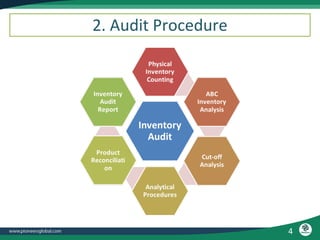
2. Audit Procedure
5
5
9
3. Key Points in Audit report
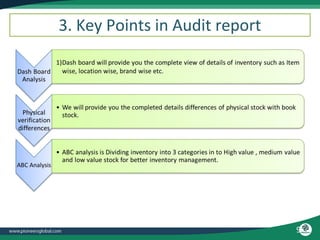
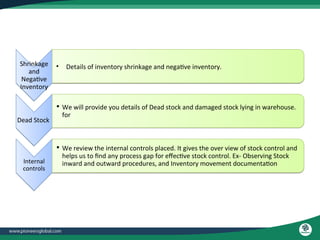
Shrinkage
and
Negative
Inventory
• Details of inventory shrinkage and negative inventory.
Dead Stock
• We will provide you details of Dead stock and damaged stock lying in warehouse.
for
Internal
controls
• We review the internal controls placed. It gives the over view of stock control and
helps us to find any process gap for effective stock control. Ex- Observing Stock
inward and outward procedures, and Inventory movement documentation
9
3. Advantages of Inventory Audit
 Know what’s missing – As you compare physical counts with your records, you
can identify which items are missing. If you find consistent inventory
shrinkage with supplies or products, further investigation can help determine
if they were lost, stolen, damaged, or discarded. And you can take action to
stop shrinkage.
 Assess overall inventory status – Regular inventory audits will reveal if specific
items are consistently understocked. You can also identify which supplies
aren’t being used and are taking up storage space It can also help identify
more nefarious activities, like theft, as well as damaged or forgotten goods.
• Budget better – When you understand which items you need the most, it’s
easy to budget more efficiently. Regular inventory audits prevent wasting
money on buying and storing products that are always in surplus. Audits help
you determine if you need to discontinue surplus items and redirect funds to
goods that are frequent stockouts.
9
9
9
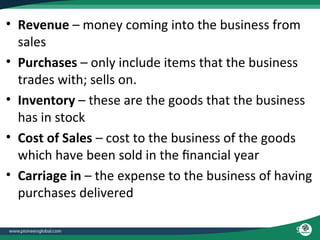
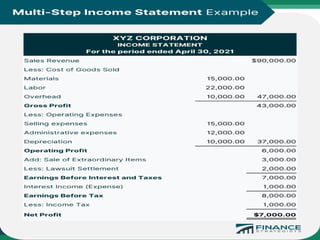
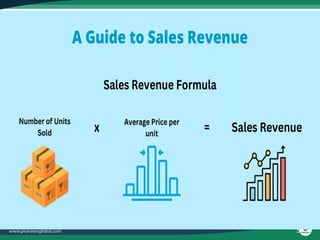
• Revenue – money coming into the business from
sales
• Purchases – only include items that the business
trades with; sells on.
• Inventory – these are the goods that the business
has in stock
• Cost of Sales – cost to the business of the goods
which have been sold in the financial year
• Carriage in – the expense to the business of having
purchases delivered
9
9
INTRODUCTION
1
What is an audit?
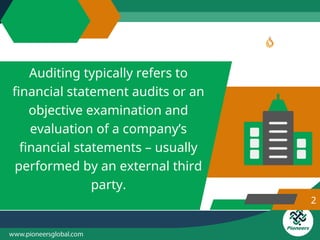
Auditing typically refers to
financial statement audits or an
objective examination and
evaluation of a company’s
financial statements – usually
performed by an external third
party.
2
Purpose of Auditing:
Ensuring accuracy,
reliability, and compliance
in financial and
operational processes.
• Financial Audits
• Operational Audits
• Compliance Audits
• Information Systems Audits:
Types of Audits
FINANCIAL AUDITS
5
• Examination of financial
statements to ensure
accuracy and compliance
with accounting standards.
OPERATIONAL AUDITS
5
• Evaluation of an
organization's operations,
including efficiency and
effectiveness.
INVENTORY AUDIT
7
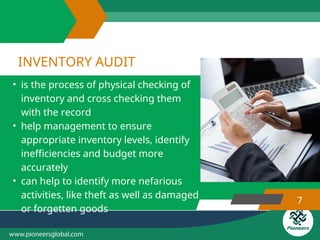
• is the process of physical checking of
inventory and cross checking them
with the record
• help management to ensure
appropriate inventory levels, identify
inefficiencies and budget more
accurately
• can help to identify more nefarious
activities, like theft as well as damaged
or forgetten goods
PHYSICAL INVENTORY
COUNTING
7
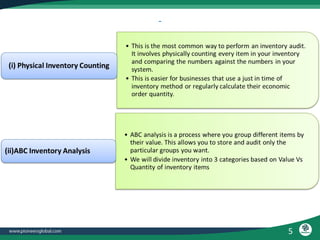
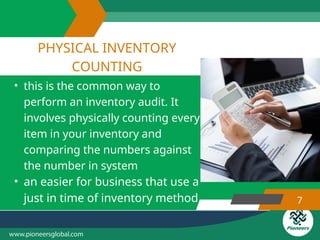
• this is the common way to
perform an inventory audit. It
involves physically counting every
item in your inventory and
comparing the numbers against
the number in system
• an easier for business that use a
just in time of inventory method

PPT INVENTORY.pp........................

  • 1.
  • 2.
  • 3.
    Index Information requirements andNext Steps Indicative High Level Plan
  • 4.
    2  Inventory auditis the process of physical checking of inventory and cross- checking them with the record mentioned in the books.  Financial records are also checked in the process. An inventory count can be a simple-looking process but it is very complex.  Help Management to ensure appropriate inventory levels, identify inefficiencies and budget more accurately  It can also help identify more nefarious activities, like theft, as well as damaged or forgotten goods. 1. Inventory Audit
  • 5.
  • 6.
  • 7.
  • 9.
    9 3. Key Pointsin Audit report
  • 10.
    Shrinkage and Negative Inventory • Details ofinventory shrinkage and negative inventory. Dead Stock • We will provide you details of Dead stock and damaged stock lying in warehouse. for Internal controls • We review the internal controls placed. It gives the over view of stock control and helps us to find any process gap for effective stock control. Ex- Observing Stock inward and outward procedures, and Inventory movement documentation
  • 11.
    9 3. Advantages ofInventory Audit  Know what’s missing – As you compare physical counts with your records, you can identify which items are missing. If you find consistent inventory shrinkage with supplies or products, further investigation can help determine if they were lost, stolen, damaged, or discarded. And you can take action to stop shrinkage.  Assess overall inventory status – Regular inventory audits will reveal if specific items are consistently understocked. You can also identify which supplies aren’t being used and are taking up storage space It can also help identify more nefarious activities, like theft, as well as damaged or forgotten goods. • Budget better – When you understand which items you need the most, it’s easy to budget more efficiently. Regular inventory audits prevent wasting money on buying and storing products that are always in surplus. Audits help you determine if you need to discontinue surplus items and redirect funds to goods that are frequent stockouts.
  • 12.
  • 13.
  • 14.
    9 • Revenue –money coming into the business from sales • Purchases – only include items that the business trades with; sells on. • Inventory – these are the goods that the business has in stock • Cost of Sales – cost to the business of the goods which have been sold in the financial year • Carriage in – the expense to the business of having purchases delivered
  • 15.
  • 16.
  • 17.
  • 18.
    Auditing typically refersto financial statement audits or an objective examination and evaluation of a company’s financial statements – usually performed by an external third party. 2
  • 19.
    Purpose of Auditing: Ensuringaccuracy, reliability, and compliance in financial and operational processes.

  • 20.
    • Financial Audits •Operational Audits • Compliance Audits • Information Systems Audits: Types of Audits
  • 21.
    FINANCIAL AUDITS 5 • Examinationof financial statements to ensure accuracy and compliance with accounting standards.
  • 22.
    OPERATIONAL AUDITS 5 • Evaluationof an organization's operations, including efficiency and effectiveness.
  • 23.
    INVENTORY AUDIT 7 • isthe process of physical checking of inventory and cross checking them with the record • help management to ensure appropriate inventory levels, identify inefficiencies and budget more accurately • can help to identify more nefarious activities, like theft as well as damaged or forgetten goods
  • 24.
    PHYSICAL INVENTORY COUNTING 7 • thisis the common way to perform an inventory audit. It involves physically counting every item in your inventory and comparing the numbers against the number in system • an easier for business that use a just in time of inventory method