Inventory Management &
Quality Methodologies
Module 4
What Is Inventory?
• Inventory is the accounting of items, component parts and raw materials
that a company either uses in production or sells. As a business leader, you
practice inventory management in order to ensure that you have enough
stock on hand and to identify when there’s a shortage.
• The verb “inventory” refers to the act of counting or listing items. As an
accounting term, inventory is a current asset and refers to all stock in the
various production stages. By keeping stock, both retailers and
manufacturers can continue to sell or build items. Inventory is a major
asset on the balance sheet for most companies, however, too much
inventory can become a practical liability.
Inventory Explained
• An organization’s inventory, which is often described as the step between
manufacturing and order fulfillment, is central to all its business operations as it
often serves as a primary source of revenue generation. Although inventory can
be described and classified in numerous ways, it’s ultimately its management that
directly affects an organization’s order fulfillment capabilities.
• For example, in keeping track of raw materials, safety stock, finished goods or
even packing materials, businesses are collecting crucial data that influences their
future purchasing and fulfillment operations. Understanding purchasing trends
and the rates at which items sell determines how often companies need to
restock inventory and which items are prioritized for re-purchase. Having this
information on hand can improve customer relations, cash flow and profitability
while also decreasing the amount of money lost to wasted inventory, stockouts
and re-stocking delays.
Inventory vs. Stock
• Inventory is often called stock in retail businesses: Managers
frequently use the term “stock on hand” to refer to products like
apparel and housewares. Across industries, “inventory” more
broadly refers to stored sales goods and raw materials and
parts used in production.
• Some people also say that the word “stock” is used more
commonly in the U.K. to refer to inventory. While there is a
difference between the two, the terms inventory and stock are
often interchangeable.
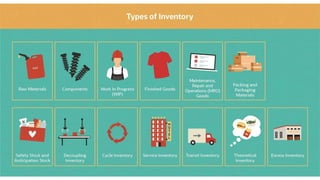
13 Types of Inventory
There are four different top-level inventory types:
1. raw materials,
2. work-in-progress (WIP),
3. merchandise and supplies, and
4. finished goods.
These four main categories help businesses classify and track
items that are in stock or that they might need in the future.
However, the main categories can be broken down even further
to help companies manage their inventory more accurately and
efficiently.
13 Types of Inventory
1. Raw Materials: Raw materials are the materials a company uses to create and finish products. When
the product is completed, the raw materials are typically unrecognizable from their original form, such as
oil used to create shampoo.
2. Components: Components are like raw materials in that they are the materials a company uses to
create and finish products, except that they remain recognizable when the product is completed, such as
a screw.
3. Work In Progress (WIP): WIP inventory refers to items in production and includes raw materials or
components, labor, overhead and even packing materials.
4. Finished Goods: Finished goods are items that are ready to sell.
5. Maintenance, Repair and Operations (MRO) Goods: MRO is inventory — often in the form of supplies
— that supports making a product or the maintenance of a business.
6. Packing and Packaging Materials: There are three types of packing materials. Primary packing
protects the product and makes it usable. Secondary packing is the packaging of the finished good and
can include labels or SKU information. Tertiary packing is bulk packaging for transport.
7. Safety Stock and Anticipation Stock: Safety stock is the extra inventory a company buys and stores to
cover unexpected events. Safety stock has carrying costs, but it supports customer satisfaction.
Similarly, anticipation stock comprises of raw materials or finished items that a business purchases
based on sales and production trends. If a raw material’s price is rising or peak sales time is
13 Types of Inventory
8. Decoupling Inventory: Decoupling inventory is the term used for extra items or WIP kept at each
production line station to prevent work stoppages. Whereas all companies may have safety stock,
decoupling inventory is useful if parts of the line work at different speeds and only applies to companies
that manufacture goods.
9. Cycle Inventory: Companies order cycle inventory in lots to get the right amount of stock for the lowest
storage cost.
10.Service Inventory: Service inventory is a management accounting concept that refers to how much
service a business can provide in a given period. A hotel with 10 rooms, for example, has a service
inventory of 70 one-night stays in each week.
11.Transit Inventory: Also known as pipeline inventory, transit inventory is stock that’s moving between the
manufacturer, warehouses and distribution centers. Transit inventory may take weeks to move between
facilities.
12.Theoretical Inventory: Also called book inventory, theoretical inventory is the least amount of stock a
company needs to complete a process without waiting. Theoretical inventory is used mostly in production
and the food industry. It’s measured using the actual versus theoretical formula.
13.Excess Inventory: Also known as obsolete inventory, excess inventory is unsold or unused goods or
raw materials that a company doesn’t expect to use or sell but must still pay to store.
Inventory Management
Inventory management refers to the process of ordering, storing, using,
and selling a company's inventory. This includes the management of
raw materials, components, and finished products, as well as
warehousing and processing of such items. There are different types of
inventory management, each with its pros and cons, depending on a
company’s needs.
Inventory Management
Inventory management is an approach for keeping track of the flow of
inventory. It starts right from the procurement of goods and its
warehousing and continues to the outflow of the raw material or stock
to reach the manufacturing units or to the market, respectively. The
process can be carried out manually or by using an automated system.
• When the goods arrive at the premises, inventory management
ensures receiving, counting, sorting, arrangement, storage and
maintenance of these items, i.e. stock, raw material, components,
tools, etc., efficiently.
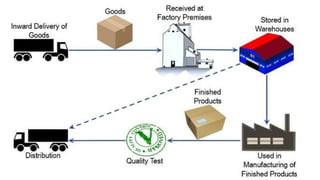
• To see how this whole system functions, we should first understand
the flow of inventory in an organization. The same has been
represented in the following diagram:
• Here, the goods which are stored in the warehouse can be utilized in the
following two ways:
• Direct distribution in the market i.e., to the wholesalers, dealers, retailers or
customer; or
• Sent to the production units for manufacturing of finished goods.
• There are many inventory management techniques available for
organizations to choose from. Some of the most common ones are
• EOQ (economic order quantity),
• ABC analysis,
• just-in-time management,
• EQR model,
• VED analysis,
• LIFO (last in last out) and
• FIFO (first in first out).
Inventory Management
• Inventory management helps companies identify which and how
much stock to order at what time. It tracks inventory from purchase
to the sale of goods. The practice identifies and responds to trends
to ensure there’s always enough stock to fulfill customer orders and
proper warning of a shortage.
• Once sold, inventory becomes revenue. Before it sells, inventory
(although reported as an asset on the balance sheet) ties up cash.
Therefore, too much stock costs money and reduces cash flow.
• One measurement of good inventory management is inventory
turnover. An accounting measurement, inventory turnover reflects
how often stock is sold in a period. A business does not want more
stock than sales. Poor inventory turnover can lead to deadstock, or
unsold stock.
Inventory Management-Objectives
• Preventing Dead Stock or Perishability: With an optimal
inventory level, the chances of wastage in the form of goods
spoilage or dead stock.
• Optimizing Storage Cost: It reduces the chances of
maintaining excessive stock, even the requirements are pre-
determined, which ultimately cuts done the unnecessary
warehousing costs.
• Maintaining Sufficient Stock: Now, the production
department need not worry about the shortage of raw material
or goods because of its constant supply.
Inventory Management-Objectives
• Enhancing Cash Flow: Inventory has a significant impact on the
cash flow of the company. With effective inventory
management, the organization can ensure sufficient liquid cash
to enhance its operational efficiency.
• Reducing the Inventories’ Cost Value: When there is a
constant purchase of goods or stock, the organization can ask
for discounts and other benefits to decrease the purchase price.
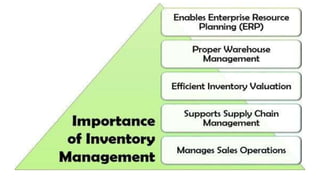
Importance of Inventory Management
• Enables Enterprise Resource Planning (ERP)
• The ERP software accommodates and links the different
business operations. These are inventory procurement,
warehousing, production, human resource, finance, marketing
and sales to one another. In this process, inventory
management contributes its part of providing the necessary
data.
• Proper Warehouse Management
• The barcode system, LIFO and FIFO techniques provide a clear
picture of the past and present inventory available with the
company to optimize the warehousing functions.
Importance of Inventory Management
• Efficient Inventory Valuation
• It provides for proper evaluation of the different types of inventory, i.e.,
stock in hand, opening and closing stocks, raw material, finished goods,
etc. This data is also used to prepare the cost sheet.
• Supports Supply Chain Management
• Being a segment of supply chain management, it is responsible for
streamlining all the warehousing operations and flow of raw material or
stock.
• Manages Sales Operations
• Sales, as we know, is a continuous process which depends upon the
production of goods or services. If there is inefficient inventory
management in the organization, the chances of unavailability of raw
material for manufacturing may arise.
Inventory Management-Benefits
• Saves Money:
Understanding stock trends means you see how much of and where
you have something in stock so you’re better able to use the stock
you have. This also allows you to keep less stock at each location
(store, warehouse), as you’re able to pull from anywhere to fulfill
orders — all of this decreases costs tied up in inventory and
decreases the amount of stock that goes unsold before it’s obsolete.
• Improves Cash Flow:
With proper inventory management, you spend money on inventory
that sells, so cash is always moving through the business.
• Satisfies Customers:
One element of developing loyal customers is ensuring they receive
the items they want without waiting.
Inventory Management Challenges
• The primary challenges of inventory management are having too much inventory
and not being able to sell it, not having enough inventory to fulfill orders, and not
understanding what items you have in inventory and where they’re located. Other
obstacles include:
• Getting Accurate Stock Details:
If you don’t have accurate stock details,there’s no way to know when to refill
stock or which stock moves well.
• Poor Processes:
Outdated or manual processes can make work error-prone and slow down
operations.
• Changing Customer Demand:
Customer tastes and needs change constantly. If your system can’t track trends,
how will you know when their preferences change and why?
• Using Warehouse Space Well:
Staff wastes time if like products are hard to locate. Mastering inventory
management can help eliminate this challenge.

Module 4 Session 1 operations management

  • 1.
    Inventory Management & QualityMethodologies Module 4
  • 2.
    What Is Inventory? •Inventory is the accounting of items, component parts and raw materials that a company either uses in production or sells. As a business leader, you practice inventory management in order to ensure that you have enough stock on hand and to identify when there’s a shortage. • The verb “inventory” refers to the act of counting or listing items. As an accounting term, inventory is a current asset and refers to all stock in the various production stages. By keeping stock, both retailers and manufacturers can continue to sell or build items. Inventory is a major asset on the balance sheet for most companies, however, too much inventory can become a practical liability.
  • 3.
    Inventory Explained • Anorganization’s inventory, which is often described as the step between manufacturing and order fulfillment, is central to all its business operations as it often serves as a primary source of revenue generation. Although inventory can be described and classified in numerous ways, it’s ultimately its management that directly affects an organization’s order fulfillment capabilities. • For example, in keeping track of raw materials, safety stock, finished goods or even packing materials, businesses are collecting crucial data that influences their future purchasing and fulfillment operations. Understanding purchasing trends and the rates at which items sell determines how often companies need to restock inventory and which items are prioritized for re-purchase. Having this information on hand can improve customer relations, cash flow and profitability while also decreasing the amount of money lost to wasted inventory, stockouts and re-stocking delays.
  • 4.
    Inventory vs. Stock •Inventory is often called stock in retail businesses: Managers frequently use the term “stock on hand” to refer to products like apparel and housewares. Across industries, “inventory” more broadly refers to stored sales goods and raw materials and parts used in production. • Some people also say that the word “stock” is used more commonly in the U.K. to refer to inventory. While there is a difference between the two, the terms inventory and stock are often interchangeable.
  • 6.
    13 Types ofInventory There are four different top-level inventory types: 1. raw materials, 2. work-in-progress (WIP), 3. merchandise and supplies, and 4. finished goods. These four main categories help businesses classify and track items that are in stock or that they might need in the future. However, the main categories can be broken down even further to help companies manage their inventory more accurately and efficiently.
  • 7.
    13 Types ofInventory 1. Raw Materials: Raw materials are the materials a company uses to create and finish products. When the product is completed, the raw materials are typically unrecognizable from their original form, such as oil used to create shampoo. 2. Components: Components are like raw materials in that they are the materials a company uses to create and finish products, except that they remain recognizable when the product is completed, such as a screw. 3. Work In Progress (WIP): WIP inventory refers to items in production and includes raw materials or components, labor, overhead and even packing materials. 4. Finished Goods: Finished goods are items that are ready to sell. 5. Maintenance, Repair and Operations (MRO) Goods: MRO is inventory — often in the form of supplies — that supports making a product or the maintenance of a business. 6. Packing and Packaging Materials: There are three types of packing materials. Primary packing protects the product and makes it usable. Secondary packing is the packaging of the finished good and can include labels or SKU information. Tertiary packing is bulk packaging for transport. 7. Safety Stock and Anticipation Stock: Safety stock is the extra inventory a company buys and stores to cover unexpected events. Safety stock has carrying costs, but it supports customer satisfaction. Similarly, anticipation stock comprises of raw materials or finished items that a business purchases based on sales and production trends. If a raw material’s price is rising or peak sales time is
  • 8.
    13 Types ofInventory 8. Decoupling Inventory: Decoupling inventory is the term used for extra items or WIP kept at each production line station to prevent work stoppages. Whereas all companies may have safety stock, decoupling inventory is useful if parts of the line work at different speeds and only applies to companies that manufacture goods. 9. Cycle Inventory: Companies order cycle inventory in lots to get the right amount of stock for the lowest storage cost. 10.Service Inventory: Service inventory is a management accounting concept that refers to how much service a business can provide in a given period. A hotel with 10 rooms, for example, has a service inventory of 70 one-night stays in each week. 11.Transit Inventory: Also known as pipeline inventory, transit inventory is stock that’s moving between the manufacturer, warehouses and distribution centers. Transit inventory may take weeks to move between facilities. 12.Theoretical Inventory: Also called book inventory, theoretical inventory is the least amount of stock a company needs to complete a process without waiting. Theoretical inventory is used mostly in production and the food industry. It’s measured using the actual versus theoretical formula. 13.Excess Inventory: Also known as obsolete inventory, excess inventory is unsold or unused goods or raw materials that a company doesn’t expect to use or sell but must still pay to store.
  • 9.
    Inventory Management Inventory managementrefers to the process of ordering, storing, using, and selling a company's inventory. This includes the management of raw materials, components, and finished products, as well as warehousing and processing of such items. There are different types of inventory management, each with its pros and cons, depending on a company’s needs.
  • 10.
    Inventory Management Inventory managementis an approach for keeping track of the flow of inventory. It starts right from the procurement of goods and its warehousing and continues to the outflow of the raw material or stock to reach the manufacturing units or to the market, respectively. The process can be carried out manually or by using an automated system. • When the goods arrive at the premises, inventory management ensures receiving, counting, sorting, arrangement, storage and maintenance of these items, i.e. stock, raw material, components, tools, etc., efficiently. • To see how this whole system functions, we should first understand the flow of inventory in an organization. The same has been represented in the following diagram:
  • 12.
    • Here, thegoods which are stored in the warehouse can be utilized in the following two ways: • Direct distribution in the market i.e., to the wholesalers, dealers, retailers or customer; or • Sent to the production units for manufacturing of finished goods. • There are many inventory management techniques available for organizations to choose from. Some of the most common ones are • EOQ (economic order quantity), • ABC analysis, • just-in-time management, • EQR model, • VED analysis, • LIFO (last in last out) and • FIFO (first in first out).
  • 13.
    Inventory Management • Inventorymanagement helps companies identify which and how much stock to order at what time. It tracks inventory from purchase to the sale of goods. The practice identifies and responds to trends to ensure there’s always enough stock to fulfill customer orders and proper warning of a shortage. • Once sold, inventory becomes revenue. Before it sells, inventory (although reported as an asset on the balance sheet) ties up cash. Therefore, too much stock costs money and reduces cash flow. • One measurement of good inventory management is inventory turnover. An accounting measurement, inventory turnover reflects how often stock is sold in a period. A business does not want more stock than sales. Poor inventory turnover can lead to deadstock, or unsold stock.
  • 14.
    Inventory Management-Objectives • PreventingDead Stock or Perishability: With an optimal inventory level, the chances of wastage in the form of goods spoilage or dead stock. • Optimizing Storage Cost: It reduces the chances of maintaining excessive stock, even the requirements are pre- determined, which ultimately cuts done the unnecessary warehousing costs. • Maintaining Sufficient Stock: Now, the production department need not worry about the shortage of raw material or goods because of its constant supply.
  • 15.
    Inventory Management-Objectives • EnhancingCash Flow: Inventory has a significant impact on the cash flow of the company. With effective inventory management, the organization can ensure sufficient liquid cash to enhance its operational efficiency. • Reducing the Inventories’ Cost Value: When there is a constant purchase of goods or stock, the organization can ask for discounts and other benefits to decrease the purchase price.
  • 17.
    Importance of InventoryManagement • Enables Enterprise Resource Planning (ERP) • The ERP software accommodates and links the different business operations. These are inventory procurement, warehousing, production, human resource, finance, marketing and sales to one another. In this process, inventory management contributes its part of providing the necessary data. • Proper Warehouse Management • The barcode system, LIFO and FIFO techniques provide a clear picture of the past and present inventory available with the company to optimize the warehousing functions.
  • 18.
    Importance of InventoryManagement • Efficient Inventory Valuation • It provides for proper evaluation of the different types of inventory, i.e., stock in hand, opening and closing stocks, raw material, finished goods, etc. This data is also used to prepare the cost sheet. • Supports Supply Chain Management • Being a segment of supply chain management, it is responsible for streamlining all the warehousing operations and flow of raw material or stock. • Manages Sales Operations • Sales, as we know, is a continuous process which depends upon the production of goods or services. If there is inefficient inventory management in the organization, the chances of unavailability of raw material for manufacturing may arise.
  • 19.
    Inventory Management-Benefits • SavesMoney: Understanding stock trends means you see how much of and where you have something in stock so you’re better able to use the stock you have. This also allows you to keep less stock at each location (store, warehouse), as you’re able to pull from anywhere to fulfill orders — all of this decreases costs tied up in inventory and decreases the amount of stock that goes unsold before it’s obsolete. • Improves Cash Flow: With proper inventory management, you spend money on inventory that sells, so cash is always moving through the business. • Satisfies Customers: One element of developing loyal customers is ensuring they receive the items they want without waiting.
  • 20.
    Inventory Management Challenges •The primary challenges of inventory management are having too much inventory and not being able to sell it, not having enough inventory to fulfill orders, and not understanding what items you have in inventory and where they’re located. Other obstacles include: • Getting Accurate Stock Details: If you don’t have accurate stock details,there’s no way to know when to refill stock or which stock moves well. • Poor Processes: Outdated or manual processes can make work error-prone and slow down operations. • Changing Customer Demand: Customer tastes and needs change constantly. If your system can’t track trends, how will you know when their preferences change and why? • Using Warehouse Space Well: Staff wastes time if like products are hard to locate. Mastering inventory management can help eliminate this challenge.