Chapter 4: Inventory Auditing
Inventory
The most significant figure in the SFP
The most problematic item in the SFP
Closing stock affect profit and assets
Diverse items with diverse measurements
WIP is subjective
Verification of existence needs
attendance
Provision for obsolence is subjective
Different locations and inventories
held by third part makes things worse
Different valuation methods are
allowed under IAS 2
The four elements of inventory Auditing
1. Existence
 Physical count and test of cut off
2. Completeness
 Observing physical count, correct processing of AP
3. Valuation
 Comparing costs with NRV and testing whether lower
of the two is used
4. Rights and obligations (Ownership)
 Checking invoice prices, legal documents and duties
and taxes can prove ownership
Regulatory aspects of inventory
IAS 2 Inventories
ISA 501 Audit evidence- Specific
considerations for selected items which
relates to attendance at the inventory
count
IAS 2 inventories
Cost : compromising all costs of purchase
and other costs incurred in bringing
inventories to their present location and
condition
NRV: Estimated selling price in the ordinary
course of a business, less the estimated
costs of completion and the estimated costs
necessary to make the sale
The physical inventory count
Management
Ensure inventory figure in the
accounts
 represents inventory that exists
Includes all inventory owned
Ensure accounting records include
statement of physical inventory count
The physical inventory count
Auditors
Obtain sufficient audit evidence about
inventory figure from
Inventory records
Inventory control systems
Results of physical inventory counts
Test counts by auditors
Attend physical inventory count
Methods of inventory count
1. Physical inventory count at the end of the
financial year
Auditors most preferred method
2. Physical inventory count before or after the end of
the financial year
3. Perpetual inventory records exist
Inventory counted at least once a year
Maintain adequate inventory records
Satisfactory procedures
Investigate and correct material differences
Work-in-progress
Existence
Attending physical inventory
count
Reviewing management controls
Planning inventory count
Gain understanding
Review previous arrangement
Perform analytical procedures
Discuss with management
Planning inventory count
 Assess key factors
Nature and volume of inventory
Risk
Method of accounting
Locations
Internal control and accounting systems
Internal audit involvement
Planning inventory count
Plan procedures
Ensure representative selection of
locations, inventory and procedures
Attention to high value items
Obtain third parties confirmation
REVIEW OF COUNT INSTRUCTIONS
Organization of count
Supervision
Tidying and marking
Restriction and control of
movement
Identifying damaged, obsolete,
slow-moving, third part and
REVIEW OF COUNT INSTRUCTIONS
Counting
Systematic counting
Team of two counters
REVIEW OF COUNT INSTRUCTIONS
 Recording
 Serial numbering, control and return of
inventory sheet
 Location, identity, count units, quantity
counted and conditions tested
 Reconciliation with inventory records and
correcting and explaining differences
During the count
 Observe client staff obedience
 Make test counts
 Ensure the procedures for dealing with unusual
inventory
 Ensure inventory held on behalf of third parts
 Conclude whether the count has been properly
done
 Consider whether amendment is required
After the count
 Trace items to final sheets
 Check all count records have been included in final
inventory sheets
 Check that final inventory sheets are supported by
inventory counts
 Confirm cut-off
 Check third part replies about inventory held for
them
 Confirm correct valuation
 Follow up queries and notify problems
cut-off
Auditors should check cut-off by
noting the serial numbers of GRNs
and GDNs received and dispatched
just before and after the end of
financial year and subsequently
checking that they have been
included in the correct period
The importance of cut-off
 Cut-off is most critical to the accurate
recording of transactions
 The point of purchase and receipt of goods
and services
 The requisition of raw materials
 the transfer of completed WIP to finished
goods
 The sales and dispatch of finished goods
Purchase cut-off
Should be recorded as
liability if goods were
received prior to the
inventory count
Sales cut-off
Generally more straightforward to
achieve correctly than purchase
cut-off
Invoices for goods dispatched after
the count should not be recognized
as revenue of current year.
Audit procedures on cut-off
 Record all movement notes relating to the period
 Observe whether correct cut-off procedures are
being followed in the dispatch and receiving areas
 Discuss procedures with company staff performing
the count to ensure understanding
 Ensure that no goods finished on the day of the
count are transferred to the warehouse
Use of the cut-off info
Match up GRNs with PI and ensure liability
has been created in the correct period
Match up GDNs to SI to insure the income
has been recorded in the correct period
Match up RN to WIP figures for the
receiving department to ensure correct
recording
Inventory valuation procedures
Confirming that all overheads have
absorbed (adjusted)
Confirm that inventory is stated at
Lower of cost and NRV
Valuation of raw materials and brought
in components
Check that correct prices have been used to
value raw materials referring supplier invoices
Reference to invoice also ensures ownership
If standard costs are used, auditors should
check basis of standards, compare standard
costs with actual costs and confirm the
treatment of variances
Valuation of WIP and FG
 Cost comprises the cost of purchase and the costs of
conversion
 Cost of conversion comprises
 Costs specifically attributable to unites of production
 Production overheads
 Other overheads attributable to bringing the product to its
present location and condition
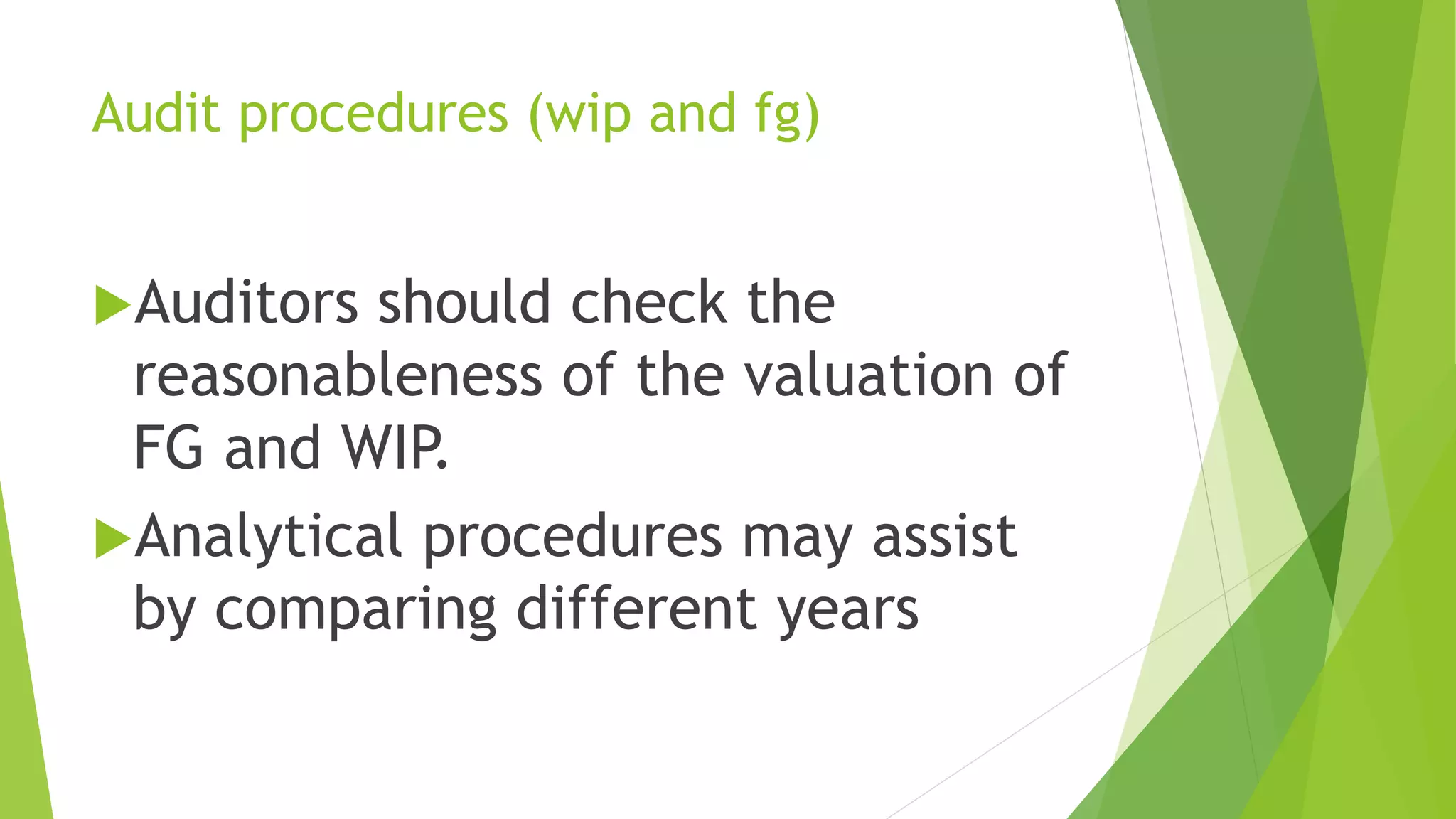
Audit procedures (wip and fg)
Auditors should check the
reasonableness of the valuation of
FG and WIP.
Analytical procedures may assist
by comparing different years
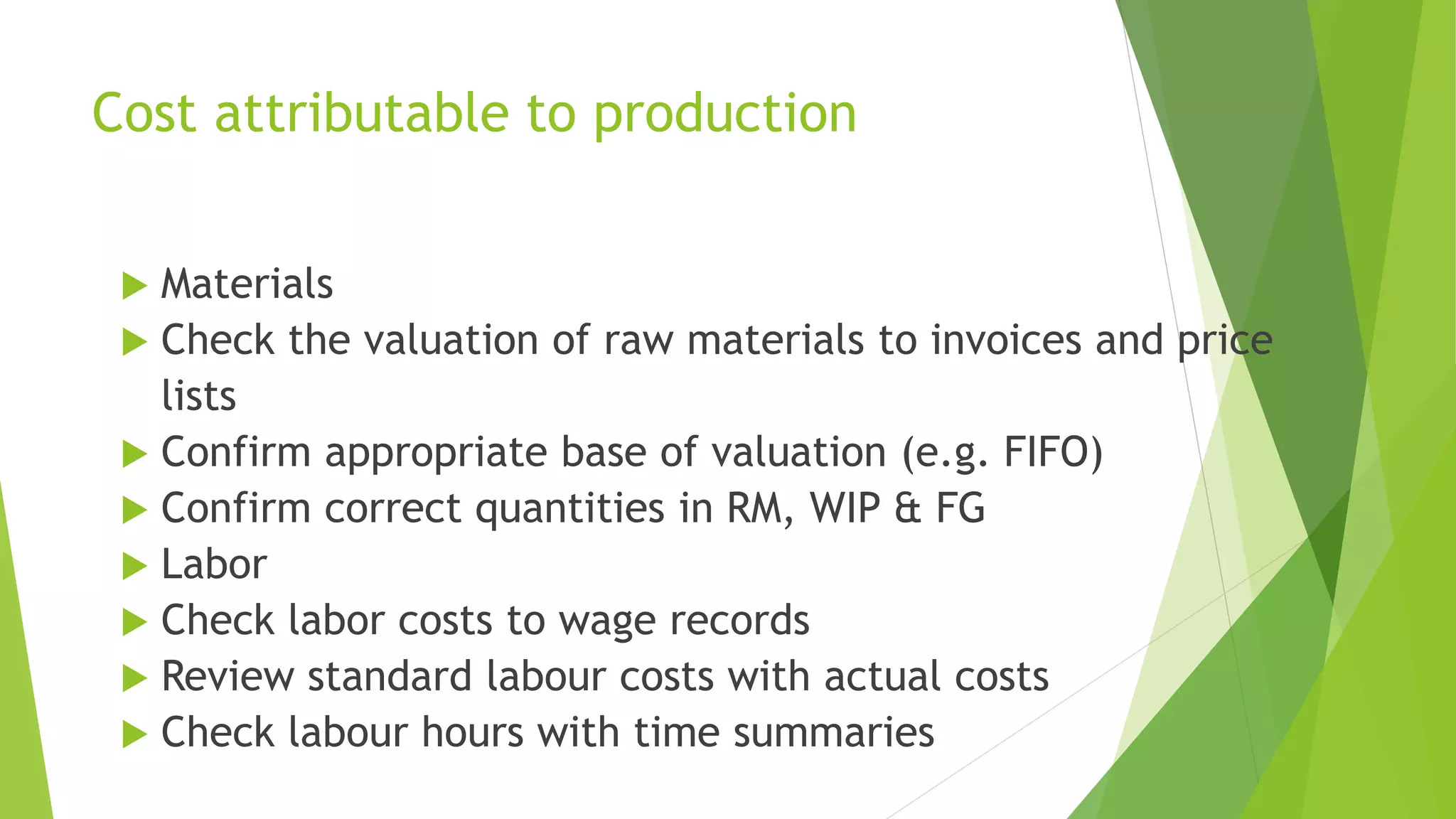
Cost attributable to production
 Materials
 Check the valuation of raw materials to invoices and price
lists
 Confirm appropriate base of valuation (e.g. FIFO)
 Confirm correct quantities in RM, WIP & FG
 Labor
 Check labor costs to wage records
 Review standard labour costs with actual costs
 Check labour hours with time summaries
Cost vs nrv
 Auditors should compare cost and NRV for each
item of inventory
 NRV is likely to be less than cost when there has
been
An increase in costs or fall in selling prices
Physical deterioration
Obsolescence of products
A marketing decision to sell products at loss
Errors in production and purchasing
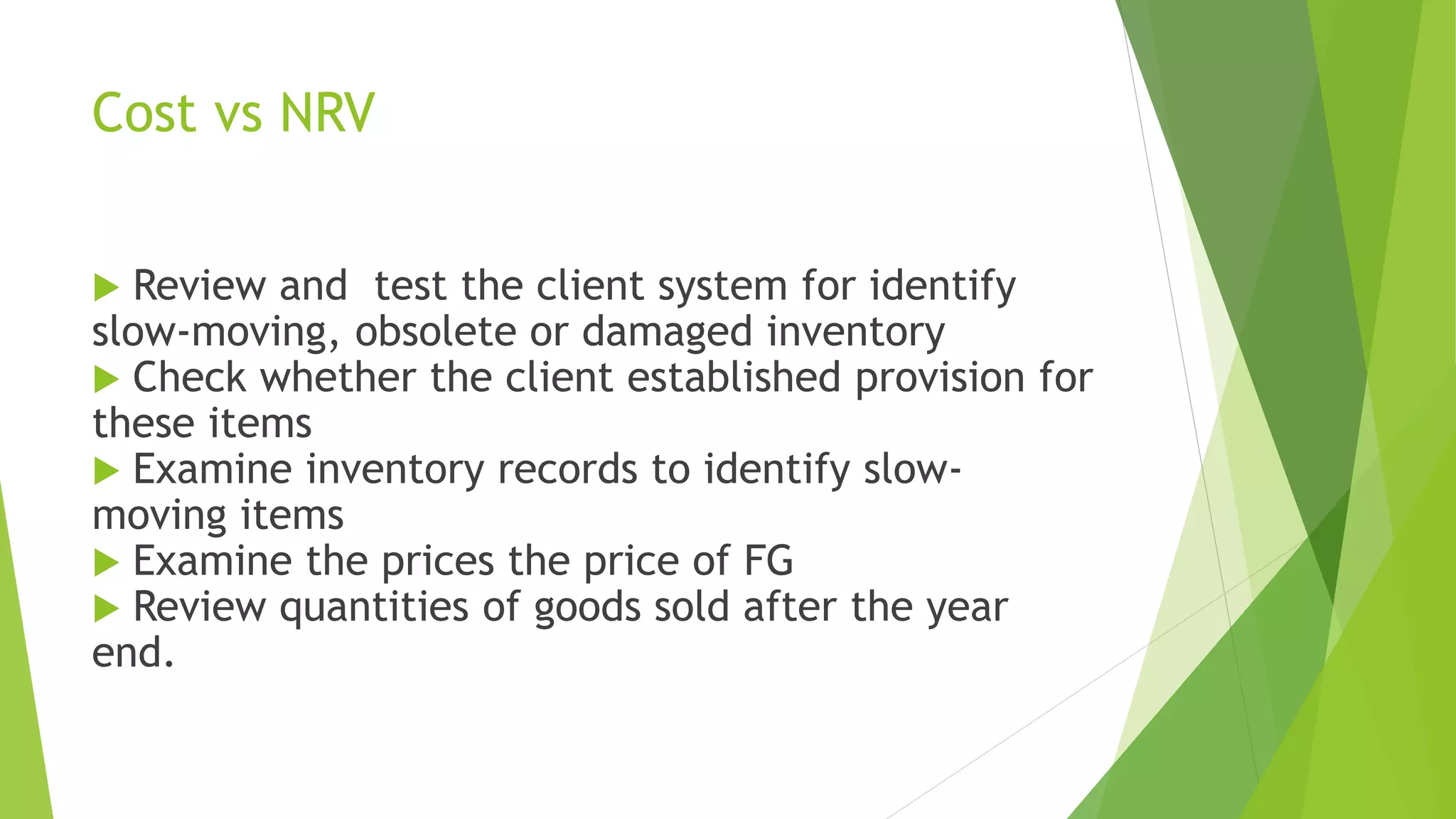
Cost vs NRV
 Review and test the client system for identify
slow-moving, obsolete or damaged inventory
 Check whether the client established provision for
these items
 Examine inventory records to identify slow-
moving items
 Examine the prices the price of FG
 Review quantities of goods sold after the year
end.

Chapter 4

  • 1.
  • 2.
    Inventory The most significantfigure in the SFP The most problematic item in the SFP Closing stock affect profit and assets Diverse items with diverse measurements WIP is subjective Verification of existence needs attendance
  • 3.
    Provision for obsolenceis subjective Different locations and inventories held by third part makes things worse Different valuation methods are allowed under IAS 2
  • 4.
    The four elementsof inventory Auditing 1. Existence  Physical count and test of cut off 2. Completeness  Observing physical count, correct processing of AP 3. Valuation  Comparing costs with NRV and testing whether lower of the two is used 4. Rights and obligations (Ownership)  Checking invoice prices, legal documents and duties and taxes can prove ownership
  • 5.
    Regulatory aspects ofinventory IAS 2 Inventories ISA 501 Audit evidence- Specific considerations for selected items which relates to attendance at the inventory count
  • 6.
    IAS 2 inventories Cost: compromising all costs of purchase and other costs incurred in bringing inventories to their present location and condition NRV: Estimated selling price in the ordinary course of a business, less the estimated costs of completion and the estimated costs necessary to make the sale
  • 7.
    The physical inventorycount Management Ensure inventory figure in the accounts  represents inventory that exists Includes all inventory owned Ensure accounting records include statement of physical inventory count
  • 8.
    The physical inventorycount Auditors Obtain sufficient audit evidence about inventory figure from Inventory records Inventory control systems Results of physical inventory counts Test counts by auditors Attend physical inventory count
  • 9.
    Methods of inventorycount 1. Physical inventory count at the end of the financial year Auditors most preferred method 2. Physical inventory count before or after the end of the financial year 3. Perpetual inventory records exist Inventory counted at least once a year Maintain adequate inventory records Satisfactory procedures Investigate and correct material differences
  • 10.
  • 11.
    Planning inventory count Gainunderstanding Review previous arrangement Perform analytical procedures Discuss with management
  • 12.
    Planning inventory count Assess key factors Nature and volume of inventory Risk Method of accounting Locations Internal control and accounting systems Internal audit involvement
  • 13.
    Planning inventory count Planprocedures Ensure representative selection of locations, inventory and procedures Attention to high value items Obtain third parties confirmation
  • 14.
    REVIEW OF COUNTINSTRUCTIONS Organization of count Supervision Tidying and marking Restriction and control of movement Identifying damaged, obsolete, slow-moving, third part and
  • 15.
    REVIEW OF COUNTINSTRUCTIONS Counting Systematic counting Team of two counters
  • 16.
    REVIEW OF COUNTINSTRUCTIONS  Recording  Serial numbering, control and return of inventory sheet  Location, identity, count units, quantity counted and conditions tested  Reconciliation with inventory records and correcting and explaining differences
  • 17.
    During the count Observe client staff obedience  Make test counts  Ensure the procedures for dealing with unusual inventory  Ensure inventory held on behalf of third parts  Conclude whether the count has been properly done  Consider whether amendment is required
  • 18.
    After the count Trace items to final sheets  Check all count records have been included in final inventory sheets  Check that final inventory sheets are supported by inventory counts  Confirm cut-off  Check third part replies about inventory held for them  Confirm correct valuation  Follow up queries and notify problems
  • 19.
    cut-off Auditors should checkcut-off by noting the serial numbers of GRNs and GDNs received and dispatched just before and after the end of financial year and subsequently checking that they have been included in the correct period
  • 20.
    The importance ofcut-off  Cut-off is most critical to the accurate recording of transactions  The point of purchase and receipt of goods and services  The requisition of raw materials  the transfer of completed WIP to finished goods  The sales and dispatch of finished goods
  • 21.
    Purchase cut-off Should berecorded as liability if goods were received prior to the inventory count
  • 22.
    Sales cut-off Generally morestraightforward to achieve correctly than purchase cut-off Invoices for goods dispatched after the count should not be recognized as revenue of current year.
  • 23.
    Audit procedures oncut-off  Record all movement notes relating to the period  Observe whether correct cut-off procedures are being followed in the dispatch and receiving areas  Discuss procedures with company staff performing the count to ensure understanding  Ensure that no goods finished on the day of the count are transferred to the warehouse
  • 24.
    Use of thecut-off info Match up GRNs with PI and ensure liability has been created in the correct period Match up GDNs to SI to insure the income has been recorded in the correct period Match up RN to WIP figures for the receiving department to ensure correct recording
  • 25.
    Inventory valuation procedures Confirmingthat all overheads have absorbed (adjusted) Confirm that inventory is stated at Lower of cost and NRV
  • 26.
    Valuation of rawmaterials and brought in components Check that correct prices have been used to value raw materials referring supplier invoices Reference to invoice also ensures ownership If standard costs are used, auditors should check basis of standards, compare standard costs with actual costs and confirm the treatment of variances
  • 27.
    Valuation of WIPand FG  Cost comprises the cost of purchase and the costs of conversion  Cost of conversion comprises  Costs specifically attributable to unites of production  Production overheads  Other overheads attributable to bringing the product to its present location and condition
  • 28.
    Audit procedures (wipand fg) Auditors should check the reasonableness of the valuation of FG and WIP. Analytical procedures may assist by comparing different years
  • 29.
    Cost attributable toproduction  Materials  Check the valuation of raw materials to invoices and price lists  Confirm appropriate base of valuation (e.g. FIFO)  Confirm correct quantities in RM, WIP & FG  Labor  Check labor costs to wage records  Review standard labour costs with actual costs  Check labour hours with time summaries
  • 30.
    Cost vs nrv Auditors should compare cost and NRV for each item of inventory  NRV is likely to be less than cost when there has been An increase in costs or fall in selling prices Physical deterioration Obsolescence of products A marketing decision to sell products at loss Errors in production and purchasing
  • 31.
    Cost vs NRV Review and test the client system for identify slow-moving, obsolete or damaged inventory  Check whether the client established provision for these items  Examine inventory records to identify slow- moving items  Examine the prices the price of FG  Review quantities of goods sold after the year end.