INVASIVE MOLEDr. Margarita Isabel Amoroso-ArtesDepartment of OB/GYN
DefinitionMolar pregnancy ChorioadenomaDestruensMolar villi grow into the myometrium or its blood vesselsMay extend into the broad ligament and metastasize to the lungs, the vagina or the vulva.
All cases of invasive mole are sequelae of hydatidiform molesApproximately 15% of complete moles are associated with or precede invasive molesThe pathologic diagnosis of invasive mole is rarely made because most cases are treated medically, without hysterectomy
CLINICAL FEATURESPERSISTENT HEMORRHAGEUTERINE PERFORATION
Vascular invasion may result in trophoblastic nodules in sites outside the uterus, such as: vaginalungs
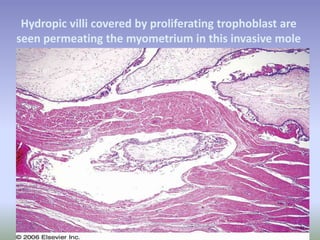
Hydropicvilli covered by proliferating trophoblast are seen permeating the myometrium in this invasive mole
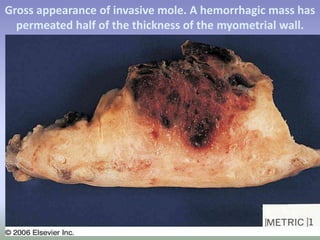
Gross appearance of invasive mole. A hemorrhagic mass has permeated half of the thickness of the myometrial wall.
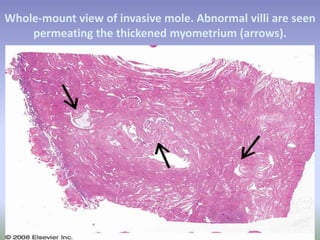
Whole-mount view of invasive mole. Abnormal villi are seen permeating the thickened myometrium (arrows).
Invasive mole vs complete moleDIFFERENTIALS
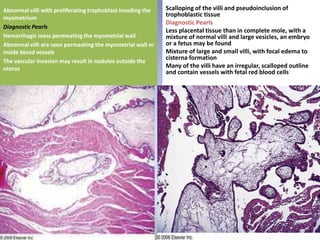
Large villi with stromaledema and marked trophoblastic proliferationDiagnostic PearlsNearly all of the villi show hydropic degeneration appearing as a 'bunch of grapes', vesicles measure 1 to 30 mm, and no embryo, fetus , membranes or cord is seen There is vesicular swelling of the villi and hyperplasia of the trophoblastTrophoblastic hyperplasia has a circumferential arrangement around each villiAbnormal villi with proliferating trophoblast invading the myometriumDiagnostic PearlsHemorrhagic mass permeating the myometrial wall Abnormal villi are seen permeating the myometrial wall or inside blood vessels The vascular invasion may result in nodules outside the uterus
INVASIVE MOLE VS PARTIAL MOLEDIFFERENTIALS
Scalloping of the villi and pseudoinclusion of trophoblastic tissueDiagnostic PearlsLess placental tissue than in complete mole, with a mixture of normal villi and large vesicles, an embryo or a fetus may be found Mixture of large and small villi, with focal edema to cisterna formation Many of the villi have an irregular, scalloped outline and contain vessels with fetal red blood cells Abnormal villi with proliferating trophoblast invading the myometriumDiagnostic PearlsHemorrhagic mass permeating the myometrial wall Abnormal villi are seen permeating the myometrial wall or inside blood vessels The vascular invasion may result in nodules outside the uterus
INVASIVE MOLE VS CHORIOCARCINOMADIFFERENTIALS
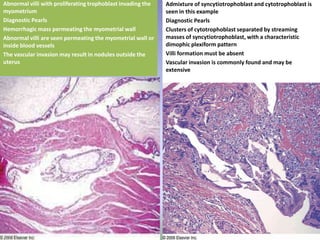
Admixture of syncytiotrophoblast and cytotrophoblast is seen in this exampleDiagnostic PearlsClusters of cytotrophoblast separated by streaming masses of syncytiotrophoblast, with a characteristic dimophicplexiform pattern Villi formation must be absent Vascular invasion is commonly found and may be extensiveAbnormal villi with proliferating trophoblast invading the myometriumDiagnostic PearlsHemorrhagic mass permeating the myometrial wall Abnormal villi are seen permeating the myometrial wall or inside blood vessels The vascular invasion may result in nodules outside the uterus
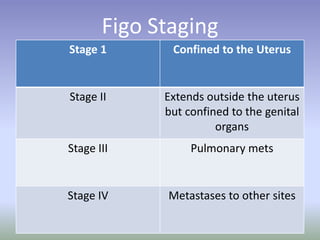
Figo Staging
MANAGEMENTCHEMOTHERAPY  PRIMARILY
Stage I, Stage II-III low risks patientsSingle Agent every 7- 10 days2 clean-up courses after the first normal titerDiscontinue Chemotherapy/shifted to another regimen: (actinomycin D)(+) toxicityDrug resistance
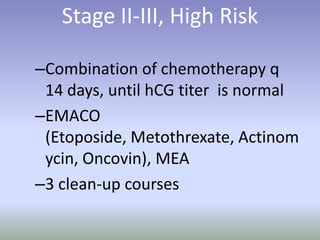
Stage II-III, High RiskCombination of chemotherapy q 14 days, until hCG titer  is normalEMACO (Etoposide, Metothrexate, Actinomycin, Oncovin), MEA3 clean-up courses
Stage IV patientsInitial combination chemotherapy q 14 days3 clean up courses after the 1st normal titerIF with Brain metsIntrathecalmetothrexate12.5 mg Steroids or MannitolFor brain decompression

Invasive Mole

  • 1.
    INVASIVE MOLEDr. MargaritaIsabel Amoroso-ArtesDepartment of OB/GYN
  • 2.
    DefinitionMolar pregnancy ChorioadenomaDestruensMolarvilli grow into the myometrium or its blood vesselsMay extend into the broad ligament and metastasize to the lungs, the vagina or the vulva.
  • 3.
    All cases ofinvasive mole are sequelae of hydatidiform molesApproximately 15% of complete moles are associated with or precede invasive molesThe pathologic diagnosis of invasive mole is rarely made because most cases are treated medically, without hysterectomy
  • 4.
  • 5.
    Vascular invasion mayresult in trophoblastic nodules in sites outside the uterus, such as: vaginalungs
  • 6.
    Hydropicvilli covered byproliferating trophoblast are seen permeating the myometrium in this invasive mole
  • 7.
    Gross appearance ofinvasive mole. A hemorrhagic mass has permeated half of the thickness of the myometrial wall.
  • 8.
    Whole-mount view ofinvasive mole. Abnormal villi are seen permeating the thickened myometrium (arrows).
  • 9.
    Invasive mole vscomplete moleDIFFERENTIALS
  • 10.
    Large villi withstromaledema and marked trophoblastic proliferationDiagnostic PearlsNearly all of the villi show hydropic degeneration appearing as a 'bunch of grapes', vesicles measure 1 to 30 mm, and no embryo, fetus , membranes or cord is seen There is vesicular swelling of the villi and hyperplasia of the trophoblastTrophoblastic hyperplasia has a circumferential arrangement around each villiAbnormal villi with proliferating trophoblast invading the myometriumDiagnostic PearlsHemorrhagic mass permeating the myometrial wall Abnormal villi are seen permeating the myometrial wall or inside blood vessels The vascular invasion may result in nodules outside the uterus
  • 11.
    INVASIVE MOLE VSPARTIAL MOLEDIFFERENTIALS
  • 12.
    Scalloping of thevilli and pseudoinclusion of trophoblastic tissueDiagnostic PearlsLess placental tissue than in complete mole, with a mixture of normal villi and large vesicles, an embryo or a fetus may be found Mixture of large and small villi, with focal edema to cisterna formation Many of the villi have an irregular, scalloped outline and contain vessels with fetal red blood cells Abnormal villi with proliferating trophoblast invading the myometriumDiagnostic PearlsHemorrhagic mass permeating the myometrial wall Abnormal villi are seen permeating the myometrial wall or inside blood vessels The vascular invasion may result in nodules outside the uterus
  • 13.
    INVASIVE MOLE VSCHORIOCARCINOMADIFFERENTIALS
  • 14.
    Admixture of syncytiotrophoblastand cytotrophoblast is seen in this exampleDiagnostic PearlsClusters of cytotrophoblast separated by streaming masses of syncytiotrophoblast, with a characteristic dimophicplexiform pattern Villi formation must be absent Vascular invasion is commonly found and may be extensiveAbnormal villi with proliferating trophoblast invading the myometriumDiagnostic PearlsHemorrhagic mass permeating the myometrial wall Abnormal villi are seen permeating the myometrial wall or inside blood vessels The vascular invasion may result in nodules outside the uterus
  • 15.
  • 16.
  • 17.
    Stage I, StageII-III low risks patientsSingle Agent every 7- 10 days2 clean-up courses after the first normal titerDiscontinue Chemotherapy/shifted to another regimen: (actinomycin D)(+) toxicityDrug resistance
  • 18.
    Stage II-III, HighRiskCombination of chemotherapy q 14 days, until hCG titer is normalEMACO (Etoposide, Metothrexate, Actinomycin, Oncovin), MEA3 clean-up courses
  • 19.
    Stage IV patientsInitialcombination chemotherapy q 14 days3 clean up courses after the 1st normal titerIF with Brain metsIntrathecalmetothrexate12.5 mg Steroids or MannitolFor brain decompression