INUNDATION By Venku In INDIA
INUNDATION - Definition  A sudden inrush of water either from a surface source or from an underground source into the active workings of the mine is called inundation.
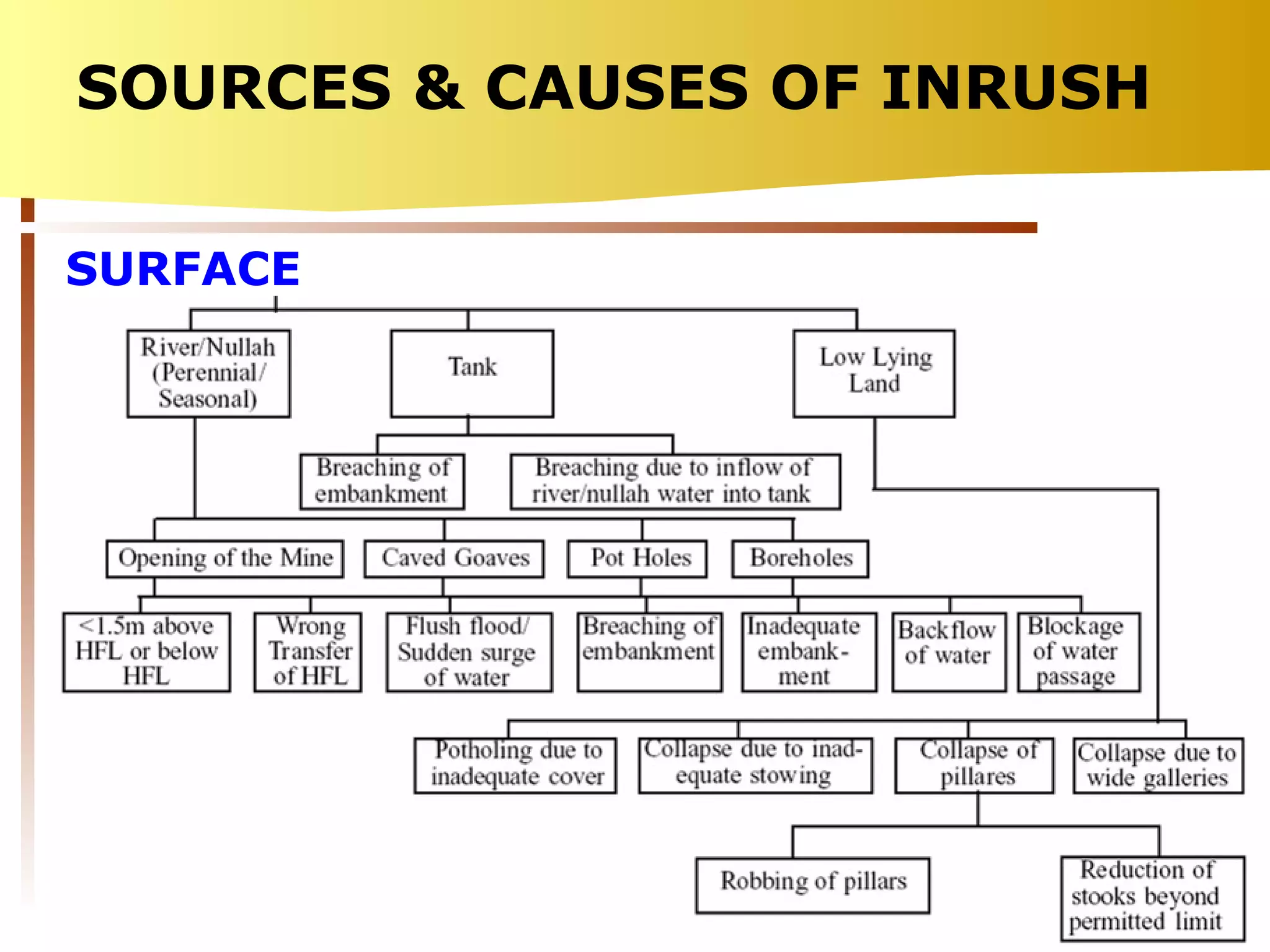
SOURCES & CAUSES OF INRUSH SURFACE
Danger from Surface Water  Adequate protection against sudden inrush of water from a surface source is to be provided and maintained. Every entrance of the mine shall be not less than 1.5m above the HFL. - Should not be worked vertically below any river, canal, lake, tank or reservoir. Reg. 126 of CMR, 1957
Danger from Surface Water  Reg. 126 of CMR, 1957 All mine workings should be at more than 15m horizontal distance from the surface source of water like river … etc. Workings in U/g shall be clearly demarcated. Inspection by Competent person, once in 14 days during rainy season and once in 30 days during other period. Once in quarter atleast by manager.
SOURCES & CAUSES OF INRUSH UNDERGROUND
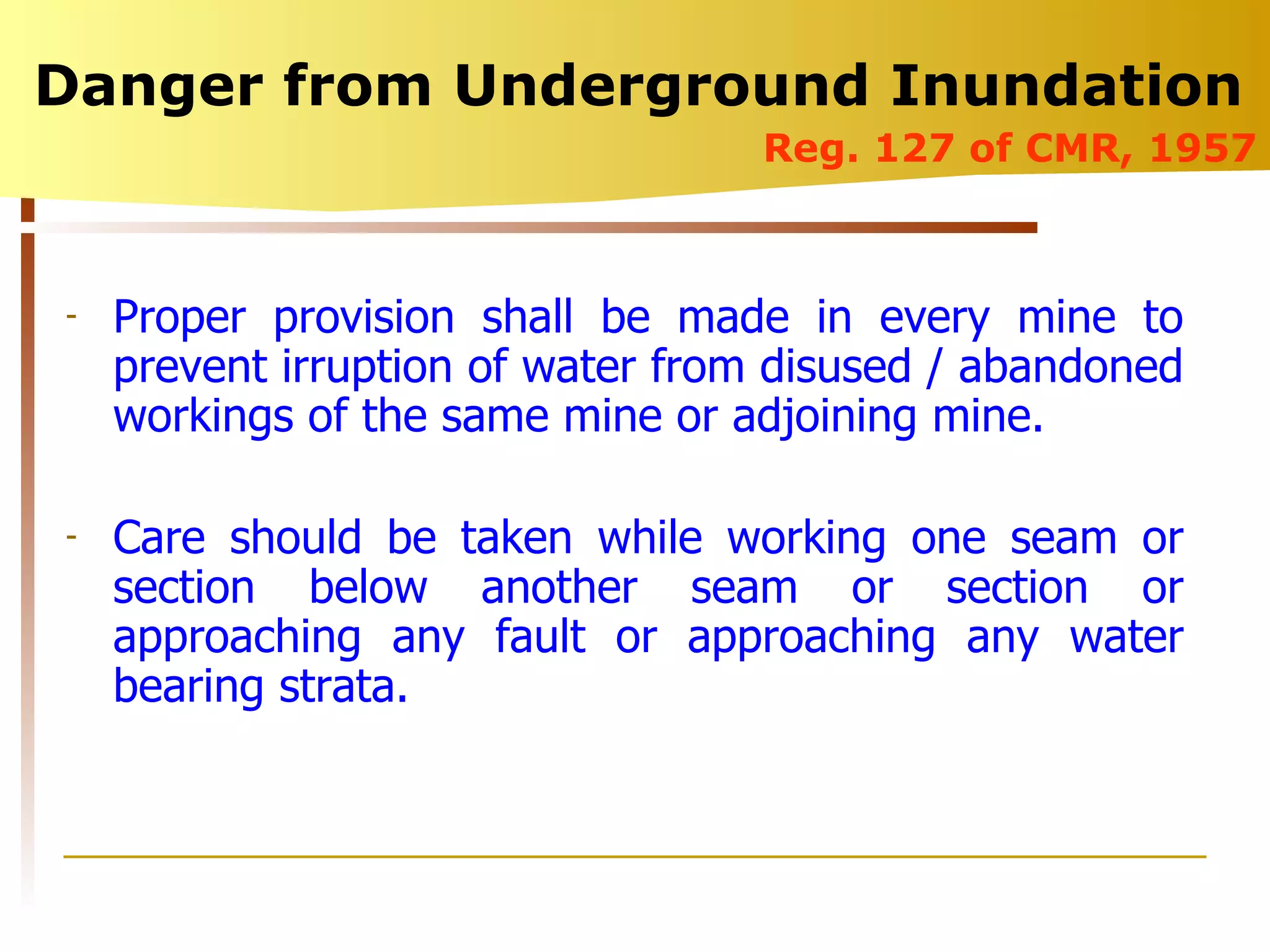
Danger from Underground Inundation  Proper provision shall be made in every mine to prevent irruption of water from disused / abandoned workings of the same mine or adjoining mine. Care should be taken while working one seam or section below another seam or section or approaching any fault or approaching any water bearing strata. Reg. 127 of CMR, 1957
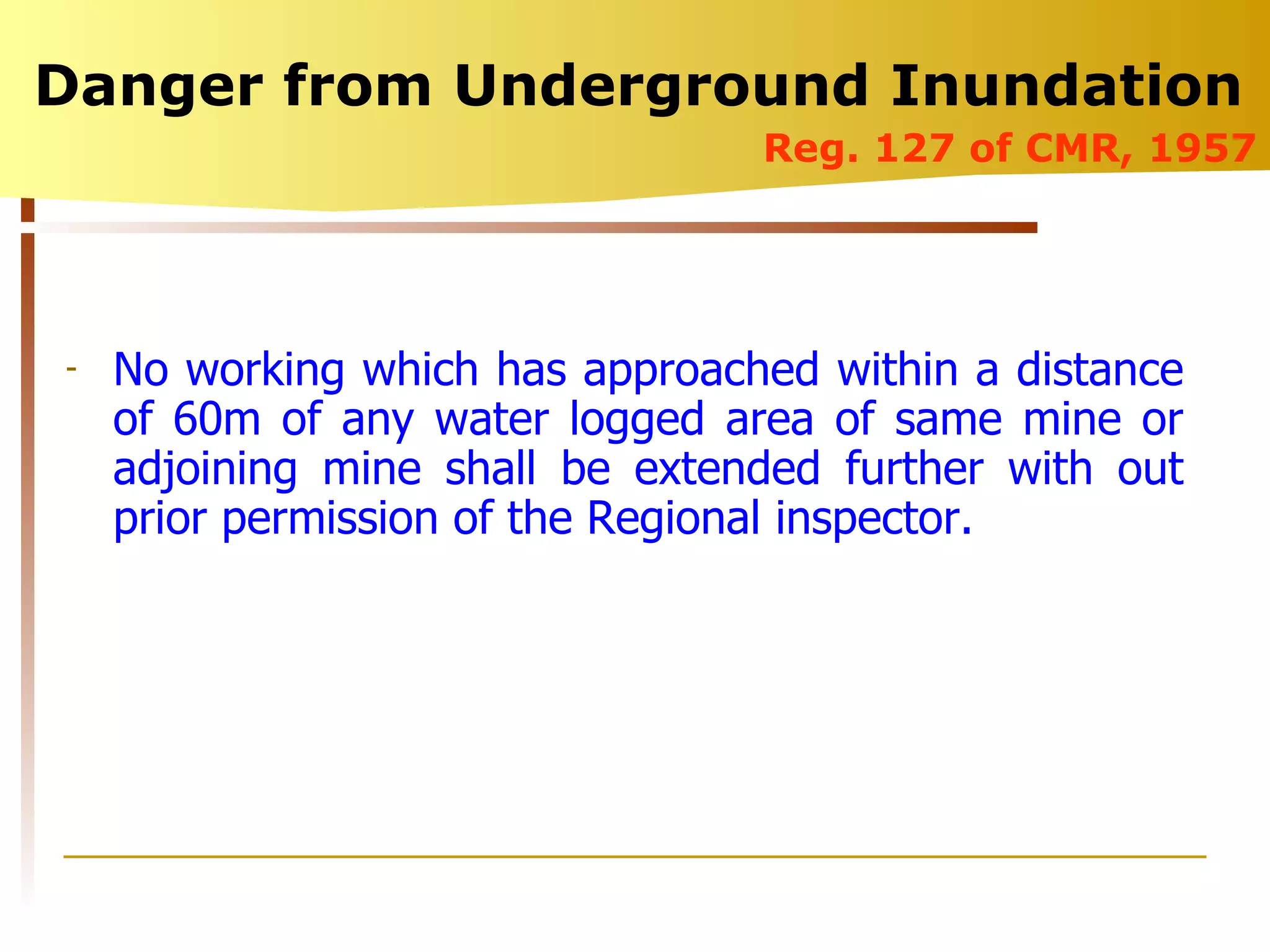
Danger from Underground Inundation  Reg. 127 of CMR, 1957 No working which has approached within a distance of 60m of any water logged area of same mine or adjoining mine shall be extended further with out prior permission of the Regional inspector.
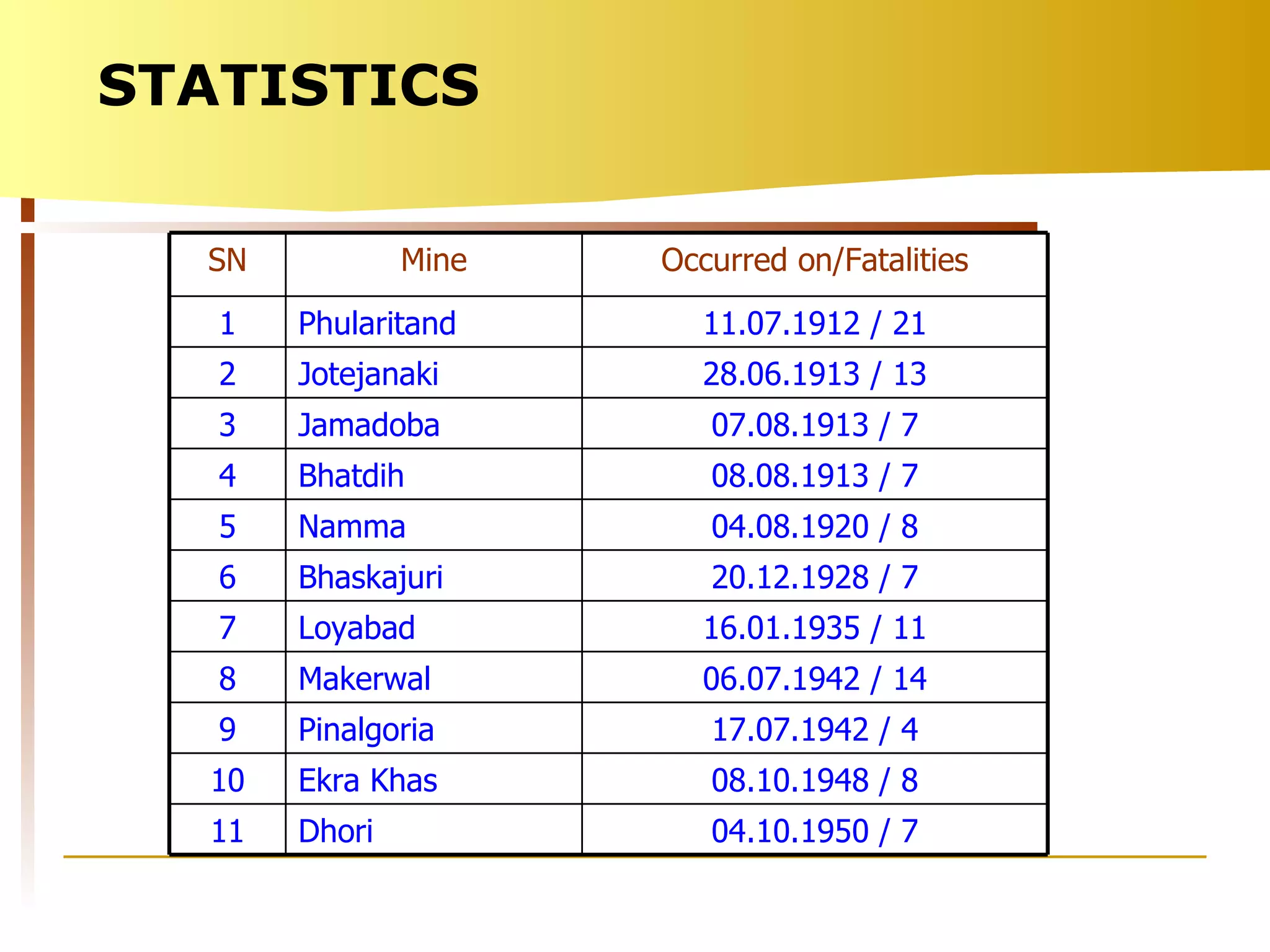
STATISTICS SN Mine Occurred on/Fatalities 1 Phularitand  11.07.1912 / 21 2 Jotejanaki 28.06.1913 / 13 3 Jamadoba 07.08.1913 / 7 4 Bhatdih 08.08.1913 / 7 5 Namma 04.08.1920 / 8 6 Bhaskajuri 20.12.1928 / 7 7 Loyabad 16.01.1935 / 11 8 Makerwal 06.07.1942 / 14 9 Pinalgoria 17.07.1942 / 4 10 Ekra Khas 08.10.1948 / 8 11 Dhori 04.10.1950 / 7
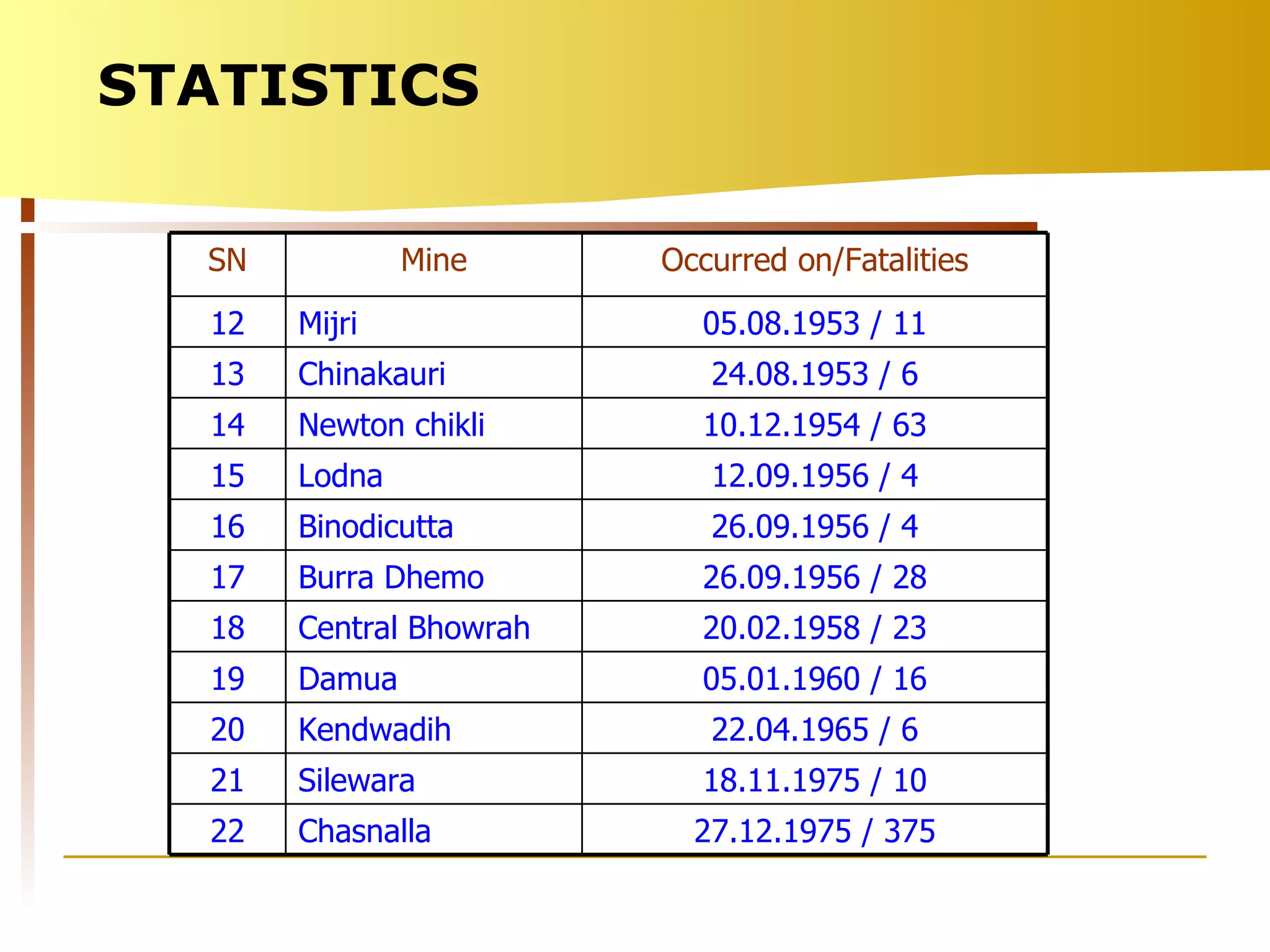
STATISTICS SN Mine Occurred on/Fatalities 12 Mijri 05.08.1953 / 11 13 Chinakauri 24.08.1953 / 6 14 Newton chikli 10.12.1954 / 63 15 Lodna 12.09.1956 / 4 16 Binodicutta 26.09.1956 / 4 17 Burra Dhemo 26.09.1956 / 28 18 Central Bhowrah 20.02.1958 / 23 19 Damua 05.01.1960 / 16 20 Kendwadih 22.04.1965 / 6 21 Silewara 18.11.1975 / 10 22 Chasnalla 27.12.1975 / 375
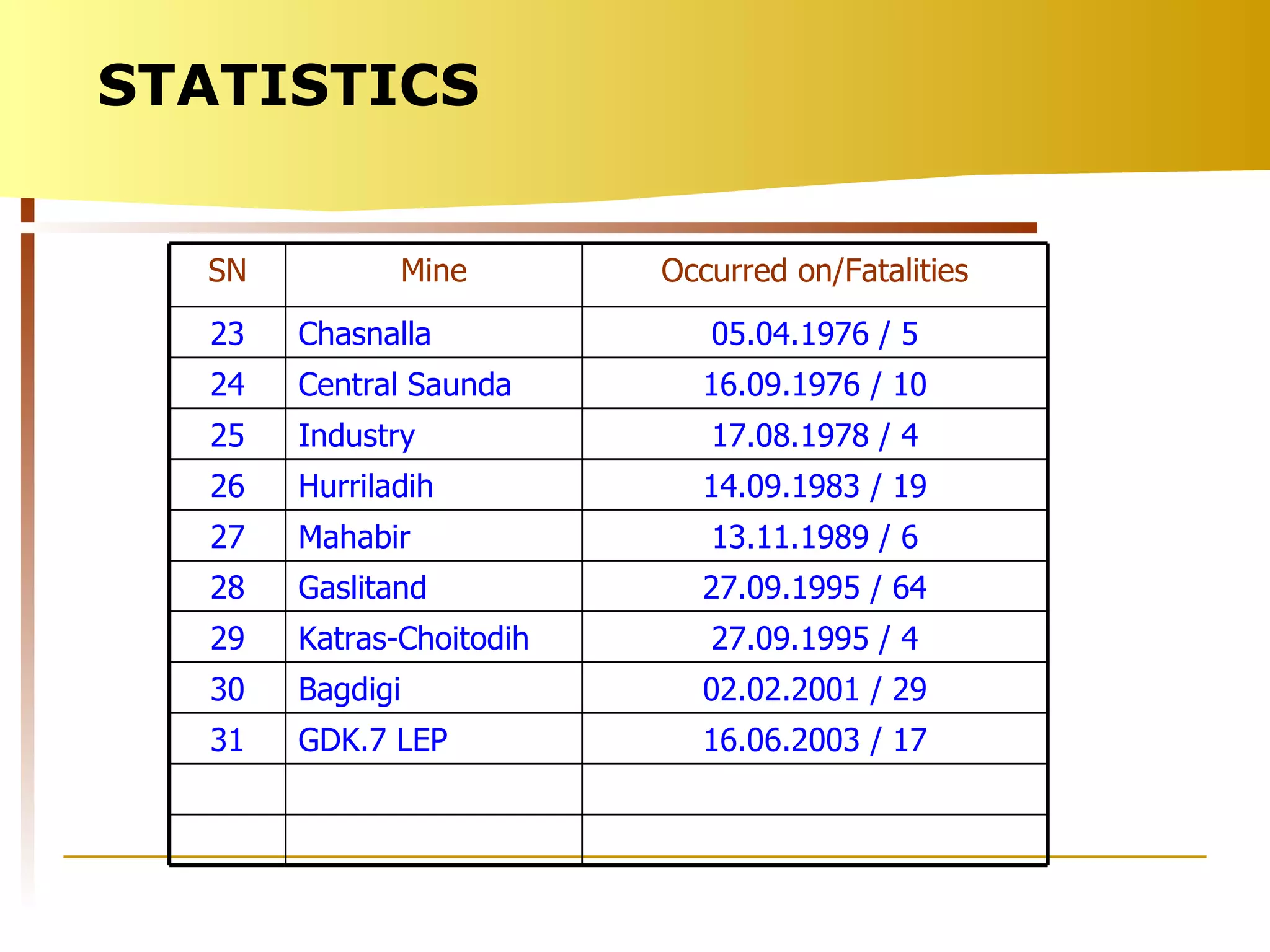
STATISTICS SN Mine Occurred on/Fatalities 23 Chasnalla 05.04.1976 / 5 24 Central Saunda 16.09.1976 / 10 25 Industry 17.08.1978 / 4 26 Hurriladih 14.09.1983 / 19 27 Mahabir 13.11.1989 / 6 28 Gaslitand 27.09.1995 / 64 29 Katras-Choitodih 27.09.1995 / 4 30 Bagdigi 02.02.2001 / 29 31 GDK.7 LEP 16.06.2003 / 17
CASE STUDIES
Jotejanaki Colliery – 1913 Inundation on 28.06.1913. Incline was much above the HFL of jore. A bridge constructed 4 years ago was narrow. Water during highflood could not pass through the bride and thereby inundated the mine.
Newton Chikli Colliery – 1954 Inundation on 10.12.1954. Rising drift without dewatering old workings.
Central Bhowrah Colliery – 1958 Inundation on 20.12.1958.
Damua Colliery – 1960 Inundation on 05.01.1960. Rising drift without dewatering old workings. N
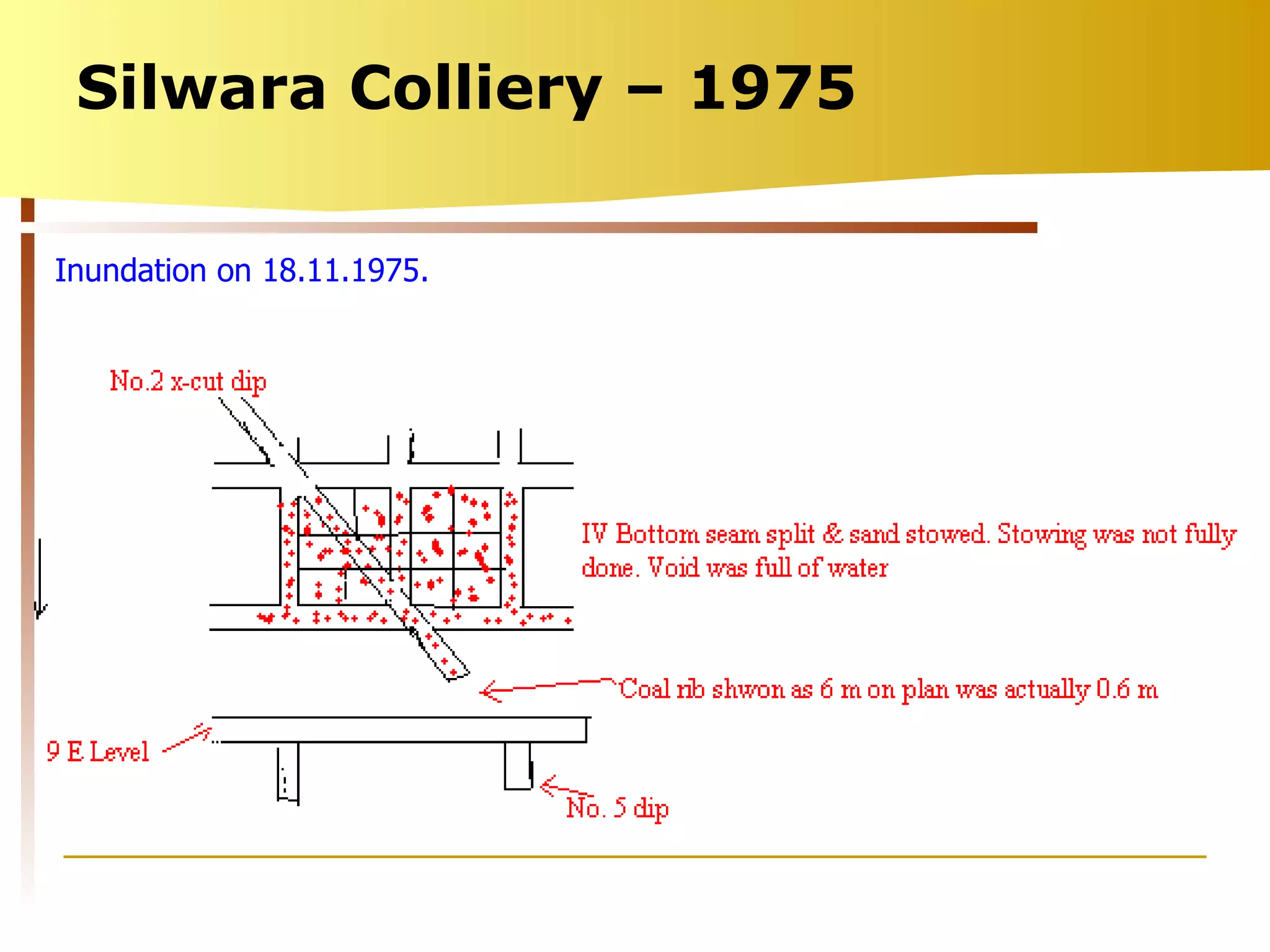
Silwara Colliery – 1975 Inundation on 18.11.1975.
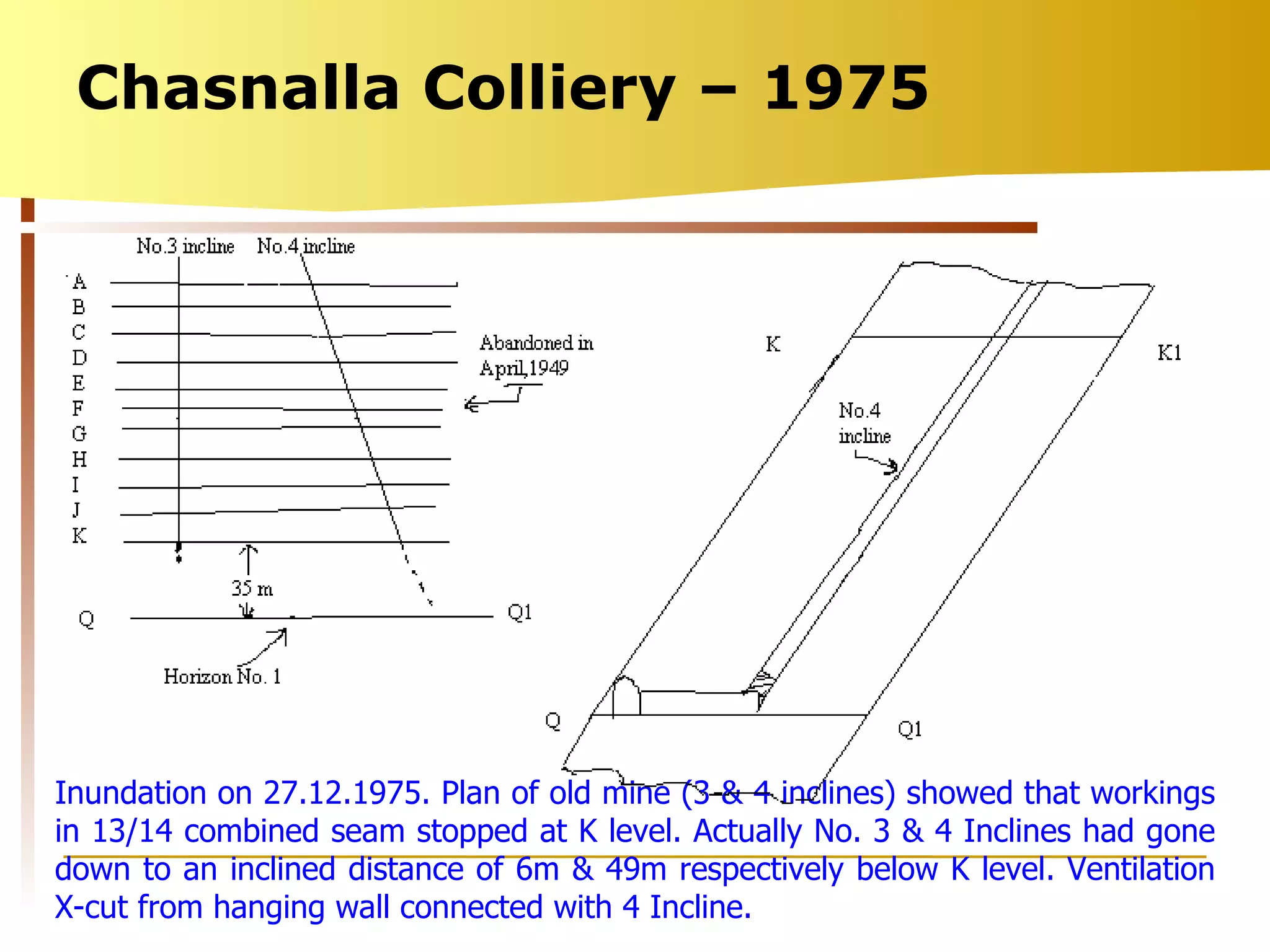
Chasnalla Colliery – 1975 Inundation on 27.12.1975. Plan of old mine (3 & 4 inclines) showed that workings in 13/14 combined seam stopped at K level. Actually No. 3 & 4 Inclines had gone down to an inclined distance of 6m & 49m respectively below K level. Ventilation X-cut from hanging wall connected with 4 Incline.
Central Saunda Colliery – 1976 Inundation on 16.9.1976. Nallah was not shown on mine plan. Development below nallah done without permission. Nallah not shown on plan submitted for depillaring permission. During highflood in Damodar, Nakari could not discharge its water and it back-flew into the nallah and inundated the mine.
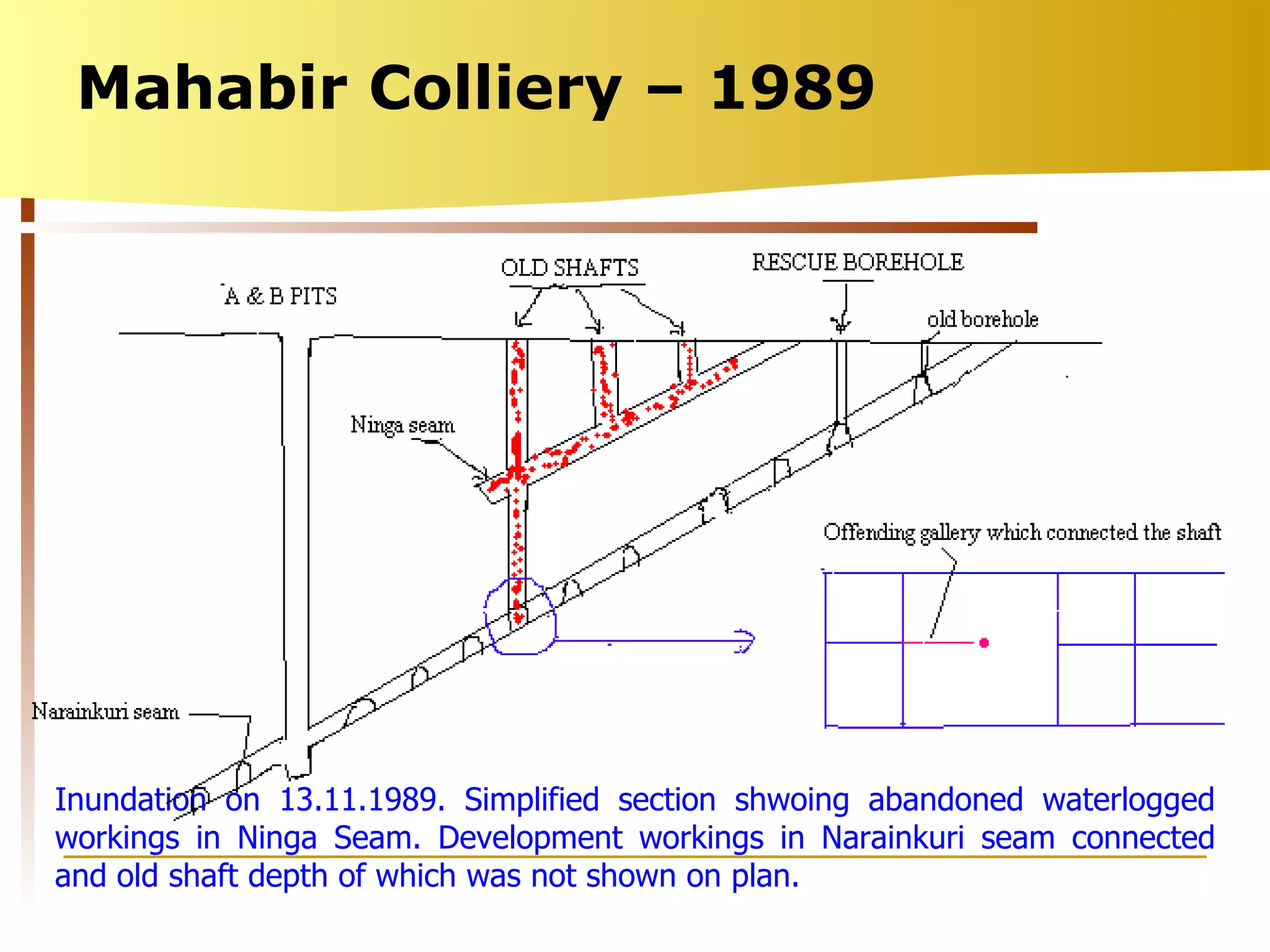
Mahabir Colliery – 1989 Inundation on 13.11.1989. Simplified section shwoing abandoned waterlogged workings in Ninga Seam. Development workings in Narainkuri seam connected and old shaft depth of which was not shown on plan.
Gaslitand Colliery – 1995 Inundation on 26/27.09.1995. Embankment against Katri river gave away. Water entered old quarry. Brickwall collapsed. Water then entered XIII & XIV seam old quarry and inundated belowground workings through the galleries leading from quarry.
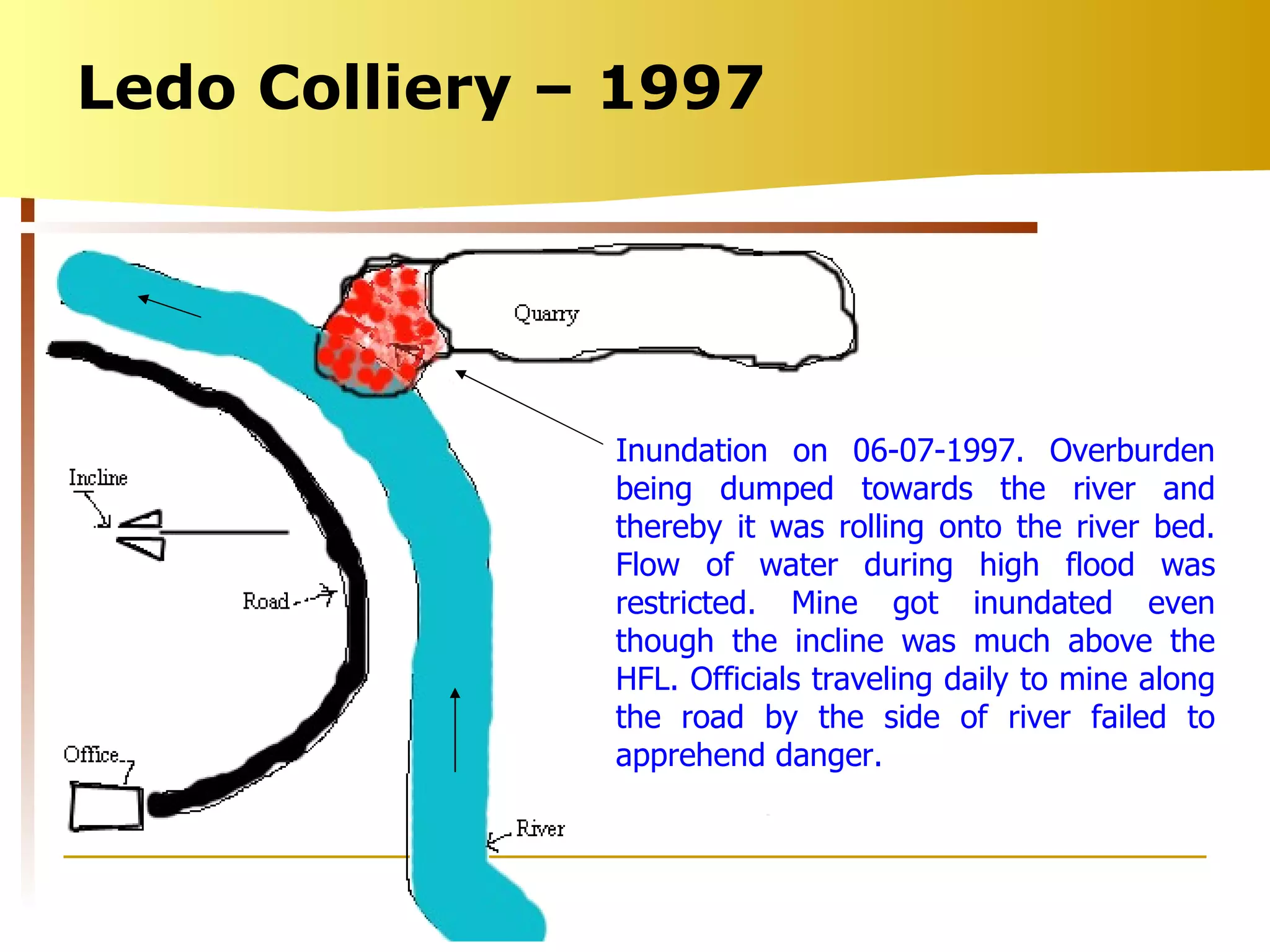
Ledo Colliery – 1997 Inundation on 06-07-1997. Overburden being dumped towards the river and thereby it was rolling onto the river bed. Flow of water during high flood was restricted. Mine got inundated even though the incline was much above the HFL. Officials traveling daily to mine along the road by the side of river failed to apprehend danger.
CASE STUDY AT SCCL
STATISTICS TABLE  –  INUNDATION OCCURANCES/ INCIDENTS IN SCCL SN Mine Occurred on/Fatalities 1 Chennur 2 KTK 3 GDK.11A 4 GDK.7 LEP 16.06.2003 / 17
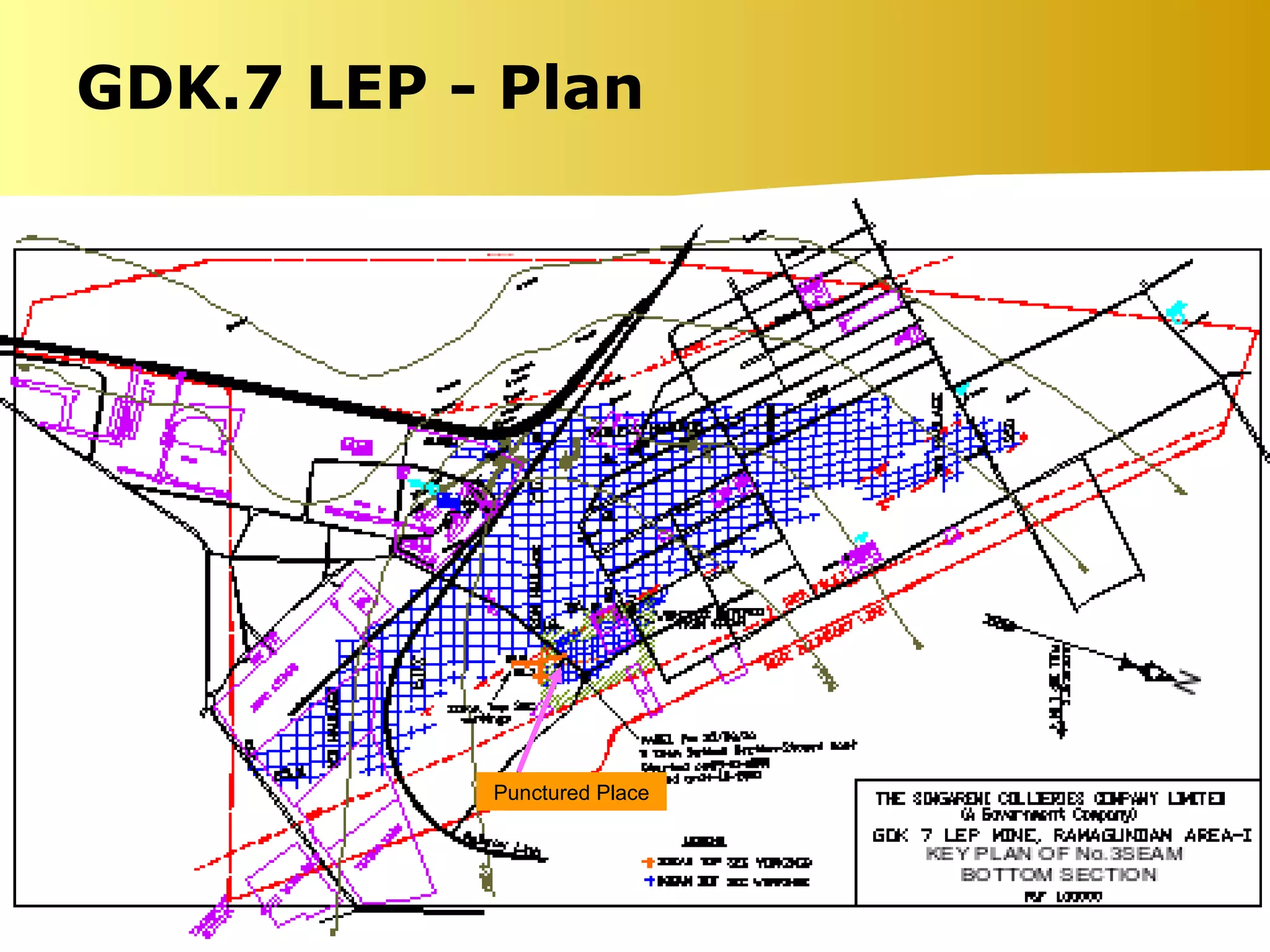
GDK.7 LEP, Ramagundam-I  Inundation taken place on 16-06-2003. Fault:  As regards the locations of the up throw fault with reference to top section workings, (where the accident has taken place) this is to state that this could not be marked on the plan of 3 seam bottom section while working in the bottom section as 18LS off 6D happens to be in coal to coal portion and such location looks like a joint or a slip without any indication of displacement.
GDK.7 LEP - Plan Punctured Place
Part Plan-GDK.7LEP
Litholog of Borehole No.786
The following steps have been taken after GDK.7 LEP inundation disaster to avoid such type of accidents. 1. Audit teams have inspected the mines and submitted the deviations in respect of inundation and fires. Regular feed back is being obtained for rectification's of the deviations. 2. Chief Surveyor thoroughly scrutinised the plans. 3. Technical guidelines were issued regarding stowing districts vis- à -vis inundation. 4. CGM(Safety) had taken up safety awareness programmes at all the areas on GDK.7 LEP disaster. Steps taken after 7LEP Accident
More attention is required for the following mines. As they are located nearer to the Godavari river. Attention required for… SN Mine Area 1 PK-2 Inc Manuguru 2 GDK-1 Inc RG-I 3 GDK-3 Inc RG-I 4 Medapalli OCP RG-III 5 IK-1 Srirampur 6 IK-1A Srirampur 7 SMG-1 Inc Mandamarri
DGMS initiatives... Mentioned in Regulations (CMR, 1957). Issued Circulars from time to time. Regular monitoring by Periodical visits / Inspections. Issue of letters for taking preventive actions. Sending the reminders on the subject. Pre-monsoon inspections. Following are the initiatives taken by DGMS to prevent the occurrence of Inundation accidents.
The  ‘ Water Management Plan ’  of the mine is to be brought upto date. The water seals provided in stoppings should be cleared and it should be ensured that there is no accumulation of water against any stopping. It should be ensured that no water accumulates against ventilation stopping as well. Pre-Monsoon Inspection Following are some of the measures suggested by DGMS before the on set of monsoon. Reference:Ltr.no.H1/DOI/2006/808, Dt.2.5.06
Garland drains should be provided on the surface around subsided areas or broken grounds to reduce or prevent water from going underground. Float alarm signalling arrangement, if stipulated in the precautions against danger of inundation from the surface nallah, jores, river etc., should be checked and it should be ensured that this device is kept operative at all times by providing alternative source of power. It should be ensured that proper guard room is provided in the vicinity of the float alarm signalling arrangement/ withdrawal point. Pre-Monsoon Inspection Reference:Ltr.no.H1/DOI/2006/808, Dt.2.5.06
Embankment provided against any surface nallah, jore, river etc., filling of old course of diverted nallah/ jore etc., if stipulated as precautions against danger of inundation; from the surface nallah, jore, river etc., should be checked and it should be ensured that these are maintained as directed, at all times. During heavy rains, the manager or the senior most official present in the mine, should go around the surface area of the mine to check vulnerable points and effectiveness of the safety measures. In case of any doubt, he should withdraw persons to safety from threatened workings. Pre-Monsoon Inspection Reference:Ltr.no.H1/DOI/2006/808, Dt.2.5.06
Standing orders for withdrawal of persons from the mine in case of apprehended danger should be framed and enforced. All concerned should be made familiar with the standing orders. Mock rehearsals should be held for this purpose once atleast in every month during the rainy season. Specific precautions to be observed in the mine should be prominently displayed in the office of the Manager and also at such other conspicuous places as may be deemed necessary. Pre-Monsoon Inspection Reference:Ltr.no.H1/DOI/2006/808, Dt.2.5.06
All the sources of water from surface and underground are to be thoroughly checked. All the surface subsidence areas are to be filled up with OB / Mulma. Construction/Strengthening of bunds around the low lying areas. Continuous inspection of water level in near by rivers, canals, etc. Provision of good and fast communication system to the inspecting persons. Emergency teams should be kept alert. Pre-Monsoon Inspection -  GIST
Before the on set of monsoon all the mines have to send a check list containing the dangers identified and precautions taken along with Water management plan. During monsoon a status report for every 15 days is to be sent to DGMS. The identified mines, which requires more attention are to be monitored shift-wise from Corporate Office and an online report is to be sent to DGMS daily. What more…
THANK YOU

Inundation

  • 1.
  • 2.
    INUNDATION - Definition A sudden inrush of water either from a surface source or from an underground source into the active workings of the mine is called inundation.
  • 3.
    SOURCES & CAUSESOF INRUSH SURFACE
  • 4.
    Danger from SurfaceWater Adequate protection against sudden inrush of water from a surface source is to be provided and maintained. Every entrance of the mine shall be not less than 1.5m above the HFL. - Should not be worked vertically below any river, canal, lake, tank or reservoir. Reg. 126 of CMR, 1957
  • 5.
    Danger from SurfaceWater Reg. 126 of CMR, 1957 All mine workings should be at more than 15m horizontal distance from the surface source of water like river … etc. Workings in U/g shall be clearly demarcated. Inspection by Competent person, once in 14 days during rainy season and once in 30 days during other period. Once in quarter atleast by manager.
  • 6.
    SOURCES & CAUSESOF INRUSH UNDERGROUND
  • 7.
    Danger from UndergroundInundation Proper provision shall be made in every mine to prevent irruption of water from disused / abandoned workings of the same mine or adjoining mine. Care should be taken while working one seam or section below another seam or section or approaching any fault or approaching any water bearing strata. Reg. 127 of CMR, 1957
  • 8.
    Danger from UndergroundInundation Reg. 127 of CMR, 1957 No working which has approached within a distance of 60m of any water logged area of same mine or adjoining mine shall be extended further with out prior permission of the Regional inspector.
  • 9.
    STATISTICS SN MineOccurred on/Fatalities 1 Phularitand 11.07.1912 / 21 2 Jotejanaki 28.06.1913 / 13 3 Jamadoba 07.08.1913 / 7 4 Bhatdih 08.08.1913 / 7 5 Namma 04.08.1920 / 8 6 Bhaskajuri 20.12.1928 / 7 7 Loyabad 16.01.1935 / 11 8 Makerwal 06.07.1942 / 14 9 Pinalgoria 17.07.1942 / 4 10 Ekra Khas 08.10.1948 / 8 11 Dhori 04.10.1950 / 7
  • 10.
    STATISTICS SN MineOccurred on/Fatalities 12 Mijri 05.08.1953 / 11 13 Chinakauri 24.08.1953 / 6 14 Newton chikli 10.12.1954 / 63 15 Lodna 12.09.1956 / 4 16 Binodicutta 26.09.1956 / 4 17 Burra Dhemo 26.09.1956 / 28 18 Central Bhowrah 20.02.1958 / 23 19 Damua 05.01.1960 / 16 20 Kendwadih 22.04.1965 / 6 21 Silewara 18.11.1975 / 10 22 Chasnalla 27.12.1975 / 375
  • 11.
    STATISTICS SN MineOccurred on/Fatalities 23 Chasnalla 05.04.1976 / 5 24 Central Saunda 16.09.1976 / 10 25 Industry 17.08.1978 / 4 26 Hurriladih 14.09.1983 / 19 27 Mahabir 13.11.1989 / 6 28 Gaslitand 27.09.1995 / 64 29 Katras-Choitodih 27.09.1995 / 4 30 Bagdigi 02.02.2001 / 29 31 GDK.7 LEP 16.06.2003 / 17
  • 12.
  • 13.
    Jotejanaki Colliery –1913 Inundation on 28.06.1913. Incline was much above the HFL of jore. A bridge constructed 4 years ago was narrow. Water during highflood could not pass through the bride and thereby inundated the mine.
  • 14.
    Newton Chikli Colliery– 1954 Inundation on 10.12.1954. Rising drift without dewatering old workings.
  • 15.
    Central Bhowrah Colliery– 1958 Inundation on 20.12.1958.
  • 16.
    Damua Colliery –1960 Inundation on 05.01.1960. Rising drift without dewatering old workings. N
  • 17.
    Silwara Colliery –1975 Inundation on 18.11.1975.
  • 18.
    Chasnalla Colliery –1975 Inundation on 27.12.1975. Plan of old mine (3 & 4 inclines) showed that workings in 13/14 combined seam stopped at K level. Actually No. 3 & 4 Inclines had gone down to an inclined distance of 6m & 49m respectively below K level. Ventilation X-cut from hanging wall connected with 4 Incline.
  • 19.
    Central Saunda Colliery– 1976 Inundation on 16.9.1976. Nallah was not shown on mine plan. Development below nallah done without permission. Nallah not shown on plan submitted for depillaring permission. During highflood in Damodar, Nakari could not discharge its water and it back-flew into the nallah and inundated the mine.
  • 20.
    Mahabir Colliery –1989 Inundation on 13.11.1989. Simplified section shwoing abandoned waterlogged workings in Ninga Seam. Development workings in Narainkuri seam connected and old shaft depth of which was not shown on plan.
  • 21.
    Gaslitand Colliery –1995 Inundation on 26/27.09.1995. Embankment against Katri river gave away. Water entered old quarry. Brickwall collapsed. Water then entered XIII & XIV seam old quarry and inundated belowground workings through the galleries leading from quarry.
  • 22.
    Ledo Colliery –1997 Inundation on 06-07-1997. Overburden being dumped towards the river and thereby it was rolling onto the river bed. Flow of water during high flood was restricted. Mine got inundated even though the incline was much above the HFL. Officials traveling daily to mine along the road by the side of river failed to apprehend danger.
  • 23.
  • 24.
    STATISTICS TABLE – INUNDATION OCCURANCES/ INCIDENTS IN SCCL SN Mine Occurred on/Fatalities 1 Chennur 2 KTK 3 GDK.11A 4 GDK.7 LEP 16.06.2003 / 17
  • 25.
    GDK.7 LEP, Ramagundam-I Inundation taken place on 16-06-2003. Fault: As regards the locations of the up throw fault with reference to top section workings, (where the accident has taken place) this is to state that this could not be marked on the plan of 3 seam bottom section while working in the bottom section as 18LS off 6D happens to be in coal to coal portion and such location looks like a joint or a slip without any indication of displacement.
  • 26.
    GDK.7 LEP -Plan Punctured Place
  • 27.
  • 28.
  • 29.
    The following stepshave been taken after GDK.7 LEP inundation disaster to avoid such type of accidents. 1. Audit teams have inspected the mines and submitted the deviations in respect of inundation and fires. Regular feed back is being obtained for rectification's of the deviations. 2. Chief Surveyor thoroughly scrutinised the plans. 3. Technical guidelines were issued regarding stowing districts vis- à -vis inundation. 4. CGM(Safety) had taken up safety awareness programmes at all the areas on GDK.7 LEP disaster. Steps taken after 7LEP Accident
  • 30.
    More attention isrequired for the following mines. As they are located nearer to the Godavari river. Attention required for… SN Mine Area 1 PK-2 Inc Manuguru 2 GDK-1 Inc RG-I 3 GDK-3 Inc RG-I 4 Medapalli OCP RG-III 5 IK-1 Srirampur 6 IK-1A Srirampur 7 SMG-1 Inc Mandamarri
  • 31.
    DGMS initiatives... Mentionedin Regulations (CMR, 1957). Issued Circulars from time to time. Regular monitoring by Periodical visits / Inspections. Issue of letters for taking preventive actions. Sending the reminders on the subject. Pre-monsoon inspections. Following are the initiatives taken by DGMS to prevent the occurrence of Inundation accidents.
  • 32.
    The ‘Water Management Plan ’ of the mine is to be brought upto date. The water seals provided in stoppings should be cleared and it should be ensured that there is no accumulation of water against any stopping. It should be ensured that no water accumulates against ventilation stopping as well. Pre-Monsoon Inspection Following are some of the measures suggested by DGMS before the on set of monsoon. Reference:Ltr.no.H1/DOI/2006/808, Dt.2.5.06
  • 33.
    Garland drains shouldbe provided on the surface around subsided areas or broken grounds to reduce or prevent water from going underground. Float alarm signalling arrangement, if stipulated in the precautions against danger of inundation from the surface nallah, jores, river etc., should be checked and it should be ensured that this device is kept operative at all times by providing alternative source of power. It should be ensured that proper guard room is provided in the vicinity of the float alarm signalling arrangement/ withdrawal point. Pre-Monsoon Inspection Reference:Ltr.no.H1/DOI/2006/808, Dt.2.5.06
  • 34.
    Embankment provided againstany surface nallah, jore, river etc., filling of old course of diverted nallah/ jore etc., if stipulated as precautions against danger of inundation; from the surface nallah, jore, river etc., should be checked and it should be ensured that these are maintained as directed, at all times. During heavy rains, the manager or the senior most official present in the mine, should go around the surface area of the mine to check vulnerable points and effectiveness of the safety measures. In case of any doubt, he should withdraw persons to safety from threatened workings. Pre-Monsoon Inspection Reference:Ltr.no.H1/DOI/2006/808, Dt.2.5.06
  • 35.
    Standing orders forwithdrawal of persons from the mine in case of apprehended danger should be framed and enforced. All concerned should be made familiar with the standing orders. Mock rehearsals should be held for this purpose once atleast in every month during the rainy season. Specific precautions to be observed in the mine should be prominently displayed in the office of the Manager and also at such other conspicuous places as may be deemed necessary. Pre-Monsoon Inspection Reference:Ltr.no.H1/DOI/2006/808, Dt.2.5.06
  • 36.
    All the sourcesof water from surface and underground are to be thoroughly checked. All the surface subsidence areas are to be filled up with OB / Mulma. Construction/Strengthening of bunds around the low lying areas. Continuous inspection of water level in near by rivers, canals, etc. Provision of good and fast communication system to the inspecting persons. Emergency teams should be kept alert. Pre-Monsoon Inspection - GIST
  • 37.
    Before the onset of monsoon all the mines have to send a check list containing the dangers identified and precautions taken along with Water management plan. During monsoon a status report for every 15 days is to be sent to DGMS. The identified mines, which requires more attention are to be monitored shift-wise from Corporate Office and an online report is to be sent to DGMS daily. What more…
  • 38.