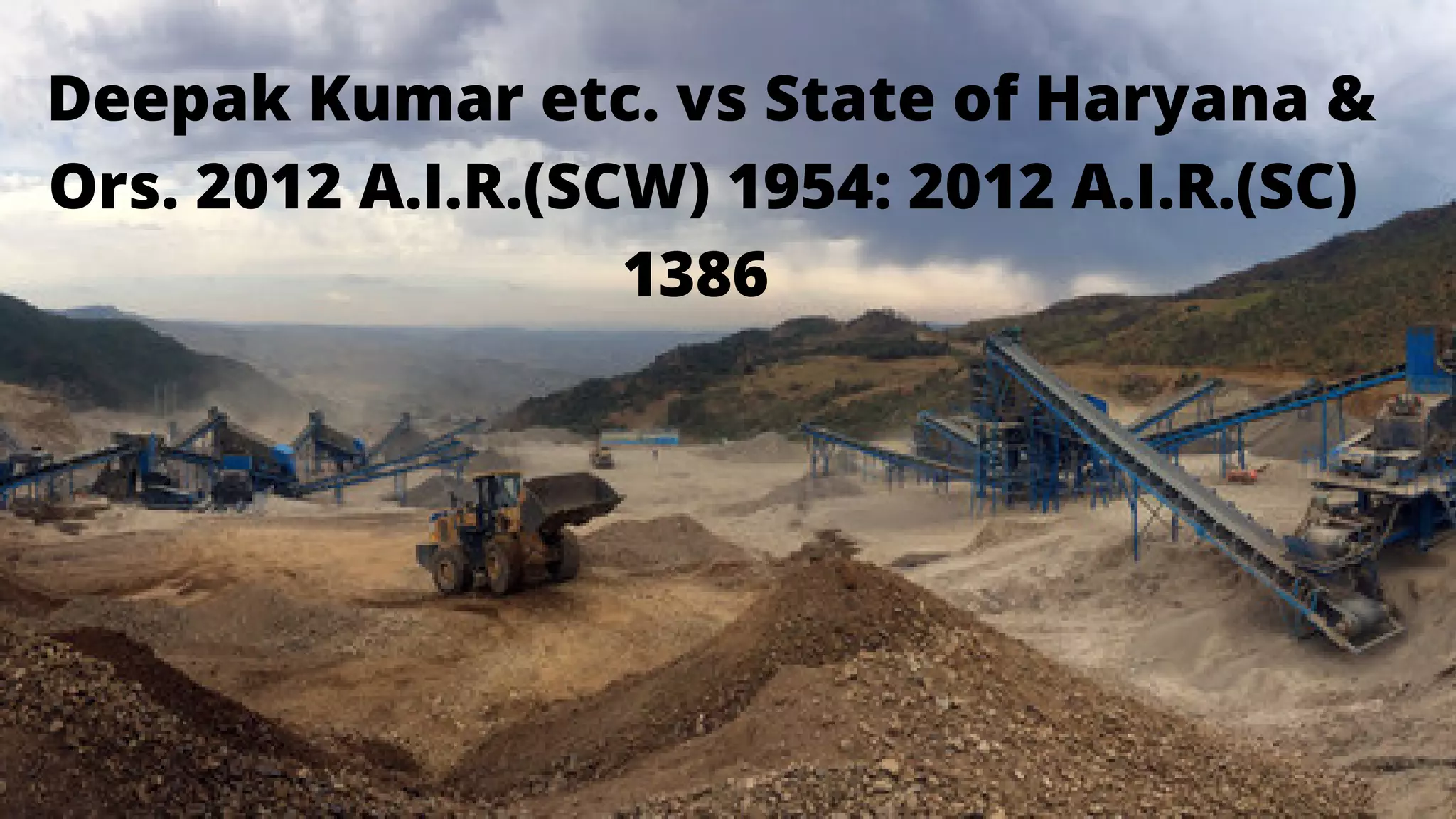
Deepak Kumar etc. vs State of Haryana &
Ors. 2012 A.I.R.(SCW) 1954: 2012 A.I.R.(SC)
1386
illegal mining going on in the State of
Rajasthan and Uttar Pradesh.
no environmental clearance was needed for
land with less than 5 hectares.
no regulation for such mining which resulted
in environmental degradation.
bigger cluster were splited up in less than 5
hectares of land to avoid legal action.
Issues
issues
Facts
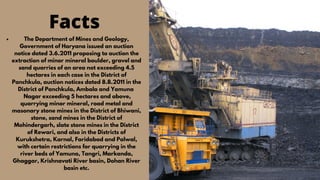
The Department of Mines and Geology,
Government of Haryana issued an auction
notice dated 3.6.2011 proposing to auction the
extraction of minor mineral boulder, gravel and
sand quarries of an area not exceeding 4.5
hectares in each case in the District of
Panchkula, auction notices dated 8.8.2011 in the
District of Panchkula, Ambala and Yamuna
Nagar exceeding 5 hectares and above,
quarrying minor mineral, road metal and
masonary stone mines in the District of Bhiwani,
stone, sand mines in the District of
Mohindergarh, slate stone mines in the District
of Rewari, and also in the Districts of
Kurukshetra, Karnal, Faridabad and Palwal,
with certain restrictions for quarrying in the
river beds of Yamuna, Tangri, Markanda,
Ghaggar, Krishnavati River basin, Dohan River
basin etc.
the CEC was asked to make a local inspection with intimation to MoEF, State of U.P.,
Rajasthan and Haryana with regard to the alleged illegal mining going on in the States of Uttar
Pradesh, Rajasthan and the areas identified for mining in the State of Haryana and to submit a
report.
the report submitted by CEC was silent with regard to the disturbing trend of serious illegal
and unrestricted upstream, in-stream and flood plain sand mining activities and the prevailing
degree of degradation of the sites and the environment, especially on the river beds.
Report of CEC however states that the auction notice also refer to mining leases of less than
5 hectares and hence no environmental clearance need be obtained as per the MoEF
notification dated 14.9.2006. No light is also thrown on the question whether there has been
an attempt to flout the notification dated 14.9.2006 by breaking the homogeneous area into
pieces of less than 5 hectares and the possible environmental or ecological impact on
quarrying of minor minerals.
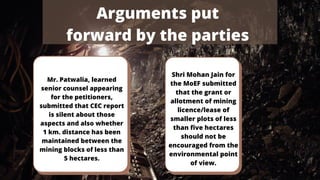
Mr. Patwalia, learned
senior counsel appearing
for the petitioners,
submitted that CEC report
is silent about those
aspects and also whether
1 km. distance has been
maintained between the
mining blocks of less than
5 hectares.
Shri Mohan Jain for
the MoEF submitted
that the grant or
allotment of mining
licence/lease of
smaller plots of less
than five hectares
should not be
encouraged from the
environmental point
of view.
Arguments put
forward by the parties
Relevant law/rules
The Mines and Minerals (Development & Regulation) Act 1957 empowers the
State Governments to make rules in respect of minor minerals.
Environmental Impact Assessment Notification of 1994
Mineral Concession Rules framed by the State Governments under Section 15
of the Mines and Minerals (Development and Regulation) Act 1957.
MoEF constituted a Core Group under the Chairmanship of the Secretary (E&F) to look into the
environmental aspcts associated with mining of minor minerals, vide its order dated
24.03.2009. The terms of reference to the Group were as under:
(i) To consider the environmental aspects of mining of minor minerals (quarrying as well as
river beds mining) for their integration into the mining process.
(ii) Specific safeguard measures required to minimize the likely adverse impacts of mining
on environment with specific reference to impact on water bodies as well as groundwater
so as to ensure sustainable mining.
(iii) To evolve model guidelines so as to address mining as well as environmental concerns
in a balanced manner for their adoption and implementation by all the mineral producing
States.
Actions taken
Furthermore, in terms of economic cost and revenue, it is estimated that the overall value of
minor minerals accounts for roughly 10% of the total value of mineral production, while the
value of nonmetallic minerals accounts for just 3%. As a result, it is clear that the operation of
minor mineral mines must adhere to the same regulatory standards as major mineral mines.
Furthermore, some countries, unlike India, do not have a system for dividing minerals into major
and minor groups based on ultimate use. As a result, the definition of "minor" must be
reconsidered.
As a result, it is proposed that the Ministry of Mines, in collaboration with the Indian Bureau of
Mines, The classification of minerals into major and minor categories may be re-examined in
conjunction with state governments so that regulatory issues and environmental mitigation
measures are properly integrated to ensure sustainable and scientific mining with minimal
environmental impacts.
Judgement
(E&F) wrote to all Chief Ministers of States on June 1, 2010
asking them to examine the report and issue necessary
instructions for incorporation of its recommendations in the
Mineral Concession Rules for mining of minor minerals under
Section 15 of the Mines and Mineral (Development and
Regulation) Act, 1957. The letter makes the following main
recommendations:
Articles 48A, 51A(g) and 21 of the
Constitution must be implemented by
the Ministry of Mines.
it is highly necessary to have an
effective framework of mining plan
which will take care of all
environmental issues and also evolve
a long term rational and sustainable
use of natural resource base and also
the bio-assessment protocol.
conclusion
At present, most of the State Governments have not made it mandatory for preparation of
mining plan in respect of minor minerals. In some States like Rajasthan, eco friendly mining
plans are prepared, which are approved by the State Mining Department.
The eco friendly mining plans so prepared, though conceptually welcome, are observed to be
deficient and need to be made comprehensive in a manner as is being done for major
minerals. Besides, the aspects of reclamation and rehabilitation of mined out areas,
progressive mine closure plan, as in vogue for major minerals could be introduced for minor
minerals as well.
it is recommended that provision for preparation and approval of mine plan, as in the case of major
minerals may appropriately be provided in the Rules governing the mining of minor minerals by the
respective State Governments. These should specifically include the provision for reclamation and
rehabilitation of mined out area, progressive mine closure plan and post mine land use
Environment damage being caused by unregulated river bed mining of sand, bazari and boulders is
attracting considerable attention including in the courts.
RECOMMENDATIONS
The following recommendations are therefore made for the river bed mining.
(a)In the case of mining leases for riverbed sand mining, specific river stretches
should be identified and mining permits/lease should be granted stretch wise, so
that the requisite safeguard measures are duly implemented and are effectively
monitored by the respective Regulatory Authorities.
(b)The depth of mining may be restricted to 3m/water level, whichever is less.
(c) For carrying out mining in proximity to any bridge and/or embankment,
appropriate safety zone should be worked out on case to case basis, taking into
account the structural parameters, locational aspects, flow rate etc. and no mining
should be carried out in the safety zone so worked out.
AP Pollution Control
Board v. M V Nayadu
(1999) 2 SCC 718
introduction
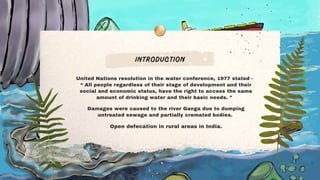
United Nations resolution in the water conference, 1977 stated -
“ All people regardless of their stage of development and their
social and economic status, have the right to access the same
amount of drinking water and their basic needs. ”
Damages were caused to the river Ganga due to dumping
untreated sewage and partially cremated bodies.
Open defecation in rural areas in India.
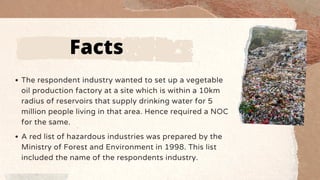
The respondent industry wanted to set up a vegetable
oil production factory at a site which is within a 10km
radius of reservoirs that supply drinking water for 5
million people living in that area. Hence required a NOC
for the same.
A red list of hazardous industries was prepared by the
Ministry of Forest and Environment in 1998. This list
included the name of the respondents industry.
Facts
In 1994 it was banned to establish an industry within 10kms of reservoirs by the State Government under
the Directive Principles of Central Government.
The government India stated that the industry should get a NOC from the Environmental Authorities of the
State’s government.
Considering the 10km rule the application was rejected. However the respondents had permission from
gram panchayat. Moreover after the suggestion of choosing another site, the industry decided to change
the nature of land use.
Under Section 25 of the Water Act, the industry applied for a NOC again and got rejected due to the
presence of water pollutants.
The industry once again approached the government by stating that they have invested a a lot of capital.
They were exempted from the 10km restriction. But, the NOC was quashed because the exemption was
challenged by society of prevention of environment and quality life.
Under Section 28 of the Water Act the industry again applied with an affidavit. It was evaluated that the
redlist made, was for industries in Doon Valley.
Arguments
Section 25(1) of the water act.
Promissory estoppel
Violation of the policy of the government
Judgment
No NOCs to be granted to industries within 10km of the
reservoirs
Principle of promissory estoppels did not apply in this case.
Reviewing the environmental laws in India.
Recommendation of establishing environmental courts.
Analysis
Right to sustainable development
The 1992 rio conference declared, “
Human beings are the center of
concerns for sustainable
development.”
Duty of every state to provide clean
water under article 21.
Right to healthy environment should
be balanced with the right to
development.
Reduce environmental degradation.
Environment ppt.pdf

Environment ppt.pdf

  • 1.
    Deepak Kumar etc.vs State of Haryana & Ors. 2012 A.I.R.(SCW) 1954: 2012 A.I.R.(SC) 1386
  • 2.
    illegal mining goingon in the State of Rajasthan and Uttar Pradesh. no environmental clearance was needed for land with less than 5 hectares. no regulation for such mining which resulted in environmental degradation. bigger cluster were splited up in less than 5 hectares of land to avoid legal action. Issues
  • 3.
    issues Facts The Department ofMines and Geology, Government of Haryana issued an auction notice dated 3.6.2011 proposing to auction the extraction of minor mineral boulder, gravel and sand quarries of an area not exceeding 4.5 hectares in each case in the District of Panchkula, auction notices dated 8.8.2011 in the District of Panchkula, Ambala and Yamuna Nagar exceeding 5 hectares and above, quarrying minor mineral, road metal and masonary stone mines in the District of Bhiwani, stone, sand mines in the District of Mohindergarh, slate stone mines in the District of Rewari, and also in the Districts of Kurukshetra, Karnal, Faridabad and Palwal, with certain restrictions for quarrying in the river beds of Yamuna, Tangri, Markanda, Ghaggar, Krishnavati River basin, Dohan River basin etc.
  • 4.
    the CEC wasasked to make a local inspection with intimation to MoEF, State of U.P., Rajasthan and Haryana with regard to the alleged illegal mining going on in the States of Uttar Pradesh, Rajasthan and the areas identified for mining in the State of Haryana and to submit a report. the report submitted by CEC was silent with regard to the disturbing trend of serious illegal and unrestricted upstream, in-stream and flood plain sand mining activities and the prevailing degree of degradation of the sites and the environment, especially on the river beds. Report of CEC however states that the auction notice also refer to mining leases of less than 5 hectares and hence no environmental clearance need be obtained as per the MoEF notification dated 14.9.2006. No light is also thrown on the question whether there has been an attempt to flout the notification dated 14.9.2006 by breaking the homogeneous area into pieces of less than 5 hectares and the possible environmental or ecological impact on quarrying of minor minerals.
  • 5.
    Mr. Patwalia, learned seniorcounsel appearing for the petitioners, submitted that CEC report is silent about those aspects and also whether 1 km. distance has been maintained between the mining blocks of less than 5 hectares. Shri Mohan Jain for the MoEF submitted that the grant or allotment of mining licence/lease of smaller plots of less than five hectares should not be encouraged from the environmental point of view. Arguments put forward by the parties
  • 6.
    Relevant law/rules The Minesand Minerals (Development & Regulation) Act 1957 empowers the State Governments to make rules in respect of minor minerals. Environmental Impact Assessment Notification of 1994 Mineral Concession Rules framed by the State Governments under Section 15 of the Mines and Minerals (Development and Regulation) Act 1957.
  • 7.
    MoEF constituted aCore Group under the Chairmanship of the Secretary (E&F) to look into the environmental aspcts associated with mining of minor minerals, vide its order dated 24.03.2009. The terms of reference to the Group were as under: (i) To consider the environmental aspects of mining of minor minerals (quarrying as well as river beds mining) for their integration into the mining process. (ii) Specific safeguard measures required to minimize the likely adverse impacts of mining on environment with specific reference to impact on water bodies as well as groundwater so as to ensure sustainable mining. (iii) To evolve model guidelines so as to address mining as well as environmental concerns in a balanced manner for their adoption and implementation by all the mineral producing States. Actions taken
  • 8.
    Furthermore, in termsof economic cost and revenue, it is estimated that the overall value of minor minerals accounts for roughly 10% of the total value of mineral production, while the value of nonmetallic minerals accounts for just 3%. As a result, it is clear that the operation of minor mineral mines must adhere to the same regulatory standards as major mineral mines. Furthermore, some countries, unlike India, do not have a system for dividing minerals into major and minor groups based on ultimate use. As a result, the definition of "minor" must be reconsidered. As a result, it is proposed that the Ministry of Mines, in collaboration with the Indian Bureau of Mines, The classification of minerals into major and minor categories may be re-examined in conjunction with state governments so that regulatory issues and environmental mitigation measures are properly integrated to ensure sustainable and scientific mining with minimal environmental impacts.
  • 9.
    Judgement (E&F) wrote toall Chief Ministers of States on June 1, 2010 asking them to examine the report and issue necessary instructions for incorporation of its recommendations in the Mineral Concession Rules for mining of minor minerals under Section 15 of the Mines and Mineral (Development and Regulation) Act, 1957. The letter makes the following main recommendations: Articles 48A, 51A(g) and 21 of the Constitution must be implemented by the Ministry of Mines. it is highly necessary to have an effective framework of mining plan which will take care of all environmental issues and also evolve a long term rational and sustainable use of natural resource base and also the bio-assessment protocol.
  • 10.
    conclusion At present, mostof the State Governments have not made it mandatory for preparation of mining plan in respect of minor minerals. In some States like Rajasthan, eco friendly mining plans are prepared, which are approved by the State Mining Department. The eco friendly mining plans so prepared, though conceptually welcome, are observed to be deficient and need to be made comprehensive in a manner as is being done for major minerals. Besides, the aspects of reclamation and rehabilitation of mined out areas, progressive mine closure plan, as in vogue for major minerals could be introduced for minor minerals as well. it is recommended that provision for preparation and approval of mine plan, as in the case of major minerals may appropriately be provided in the Rules governing the mining of minor minerals by the respective State Governments. These should specifically include the provision for reclamation and rehabilitation of mined out area, progressive mine closure plan and post mine land use Environment damage being caused by unregulated river bed mining of sand, bazari and boulders is attracting considerable attention including in the courts.
  • 11.
    RECOMMENDATIONS The following recommendationsare therefore made for the river bed mining. (a)In the case of mining leases for riverbed sand mining, specific river stretches should be identified and mining permits/lease should be granted stretch wise, so that the requisite safeguard measures are duly implemented and are effectively monitored by the respective Regulatory Authorities. (b)The depth of mining may be restricted to 3m/water level, whichever is less. (c) For carrying out mining in proximity to any bridge and/or embankment, appropriate safety zone should be worked out on case to case basis, taking into account the structural parameters, locational aspects, flow rate etc. and no mining should be carried out in the safety zone so worked out.
  • 12.
    AP Pollution Control Boardv. M V Nayadu (1999) 2 SCC 718
  • 13.
    introduction United Nations resolutionin the water conference, 1977 stated - “ All people regardless of their stage of development and their social and economic status, have the right to access the same amount of drinking water and their basic needs. ” Damages were caused to the river Ganga due to dumping untreated sewage and partially cremated bodies. Open defecation in rural areas in India.
  • 14.
    The respondent industrywanted to set up a vegetable oil production factory at a site which is within a 10km radius of reservoirs that supply drinking water for 5 million people living in that area. Hence required a NOC for the same. A red list of hazardous industries was prepared by the Ministry of Forest and Environment in 1998. This list included the name of the respondents industry. Facts
  • 15.
    In 1994 itwas banned to establish an industry within 10kms of reservoirs by the State Government under the Directive Principles of Central Government. The government India stated that the industry should get a NOC from the Environmental Authorities of the State’s government. Considering the 10km rule the application was rejected. However the respondents had permission from gram panchayat. Moreover after the suggestion of choosing another site, the industry decided to change the nature of land use. Under Section 25 of the Water Act, the industry applied for a NOC again and got rejected due to the presence of water pollutants. The industry once again approached the government by stating that they have invested a a lot of capital. They were exempted from the 10km restriction. But, the NOC was quashed because the exemption was challenged by society of prevention of environment and quality life. Under Section 28 of the Water Act the industry again applied with an affidavit. It was evaluated that the redlist made, was for industries in Doon Valley.
  • 16.
    Arguments Section 25(1) ofthe water act. Promissory estoppel Violation of the policy of the government
  • 17.
    Judgment No NOCs tobe granted to industries within 10km of the reservoirs Principle of promissory estoppels did not apply in this case. Reviewing the environmental laws in India. Recommendation of establishing environmental courts.
  • 18.
    Analysis Right to sustainabledevelopment The 1992 rio conference declared, “ Human beings are the center of concerns for sustainable development.” Duty of every state to provide clean water under article 21. Right to healthy environment should be balanced with the right to development. Reduce environmental degradation.